seats CITROEN RELAY 2019 Handbook (in English)
[x] Cancel search | Manufacturer: CITROEN, Model Year: 2019, Model line: RELAY, Model: CITROEN RELAY 2019Pages: 232, PDF Size: 8.21 MB
Page 4 of 232
2
.
.
Instrument panels 7
W arning and indicator lamps 8
I
ndic ators
18
Vehicle configuration
2
2
Setting the date and time
2
8
Trip computer
2
8
Tachograph
2
9
Instruments and controls
4
C
entre console
4
K
ey
30
Remote control
3
0
Anti-intrusion security
3
3
Front doors
3
3
Sliding side door
3
3
Rear doors
3
4
Alarm
35
Electric windows
3
6
Driver's seat 3 7
2-seat front bench seat 3 9
Rear seats
4
0
Rear bench seats
4
0
Steering wheel adjustment
4
1
Mirrors
42
H
eating/Manual air conditioning
4
3
Automatic air conditioning
4
4
Additional heating systems
4
6
Rear heating and/or air conditioning
4
6
Programmable additional heating
4
7
Recommendations for ventilation and air
conditioning
5
0
Front demist – defrost
5
1
Defrosting the rear screen and
door mirrors
5
1
Cab layout
5
2
Rear fittings
5
7
Exterior fittings
6
0Lighting controls
6
1
LED daytime running lamps
6
2
Automatic illumination of headlamps
6
2
Guide-me-home lighting
6
2
Automatic headlamps
6
3
Parking lamps
6
4
Headlamp beam height adjustment
6
5
Wiper control stalk
6
5
General safety recommendations
6
7
Hazard warning lamps
6
8
Horn 68
Electronic stability control (ESC) 6 8
Seat belts
7
2
Airbags
75
Child seats
7
7
Deactivating the passenger's front airbag
7
8
ISOFIX mountings and child seats
8
3
Child lock
8
6
Over view
Dashboard instruments Access
Ease of use and comfort Safety
Lighting and visibility
Eco-driving
Contents
Page 8 of 232
6
Limit the causes of excess
consumption
Spread loads throughout the vehicle; place
the heaviest items in the bottom of the boot,
as close as possible to the rear seats.
Limit the loads carried in the vehicle and
reduce wind resistance (roof bars, roof rack,
bicycle carrier, trailer, etc.). Preferably, use a
roof box.
Remove roof bars and roof racks after use.
At the end of winter, remove snow tyres and
refit your summer tyres.
Observe the recommendations
on maintenance
Check the tyre pressures regularly, when cold,
referring to the label in the door aperture,
driver's side.
Carry out this check in particular:
-
b
efore a long journey,
-
a
t each change of season,
-
a
fter a long period out of use.
Do not forget the spare wheel and the tyres on
any trailer or caravan. Have your vehicle ser viced regularly (engine
oil, oil filter, air filter, cabin filter, etc.) and
obser ve the schedule of operations in the
manufacturer's service schedule.
When filling the tank, do not continue after the
3
rd cut-off of the nozzle to avoid over flow.
At the wheel of your new vehicle, it is only
after the first 1,900
miles (3,000 kilometres)
that you will see the fuel consumption settle
down to a
consistent average.
With a
BlueHDi Diesel engine, if the SCR
system is faulty, your vehicle becomes
polluting. As soon as possible, visit
a CITROËN dealer or a qualified workshop to
make your vehicle's level of nitrogen oxides
emissions compliant to the standard.
Eco-driving
Page 39 of 232

37
Driver's seat
Forwards-backwards
F Raise the control and slide the seat forwards or backwards.
Before moving the seat backwards,
ensure that there is no object or person in
the way, preventing full travel of the seat.
There is a
risk of trapping or pinching
passengers if present in the rear seats
or jamming the seat if large objects are
placed on the floor behind the seat.
Seat height
Seat backrest angle
F Turn the knob to adjust the backrest.
Lumbar support
Head restraints
F Lift the handle 1 to raise or lower the front of
the seat.
F
L
ift the handle 2 to raise or lower the rear of
the seat. F
T
urn the knob to obtain the desired level of
lumbar support.
As a
safety measure, seats should only be
adjusted when stationary.
F
P
ress the tab to adjust the height of the
head restraint.
3
Ease of use and comfort
Page 40 of 232

38
Adjustable armrestHeated seat
When the seat and passenger
compartment have reached an adequate
temperature, you can switch off the
function; reducing the consumption
of electrical current reduces fuel
consumption.
F
T
o remove the head restraint, press the tabs
and raise the head restraint.
F
Ra
ise or lower the armrest.
F
T
urn the wheel located under the end of the
armrest to lock it in the desired position. Use this control to switch the heating of the
seat on or off.
Do not use the function when the seat is
e m pt y.
Prolonged use is not recommended for
those with sensitive skin.
There is a
risk of burns for people whose
perception of heat is impaired (illness,
taking medication, etc.).
There is a risk of overheating the system if
material with insulating properties is used,
such as cushions or seat covers.
Do not use the system:
-
i
f wearing damp clothing,
-
i
f child seats are fitted.
To avoid breaking the heating element in
the seat:
- d o not place heavy objects on the seat,
-
d
o not kneel or stand on the seat,
-
d
o not place sharp objects on the seat,
-
d
o not spill liquids onto the seat.
To avoid the risk of short-circuit:
-
d
o not use liquid products for cleaning
the seat,
-
n
ever use the heating function when
the seat is damp.
Ease of use and comfort
Page 41 of 232
39
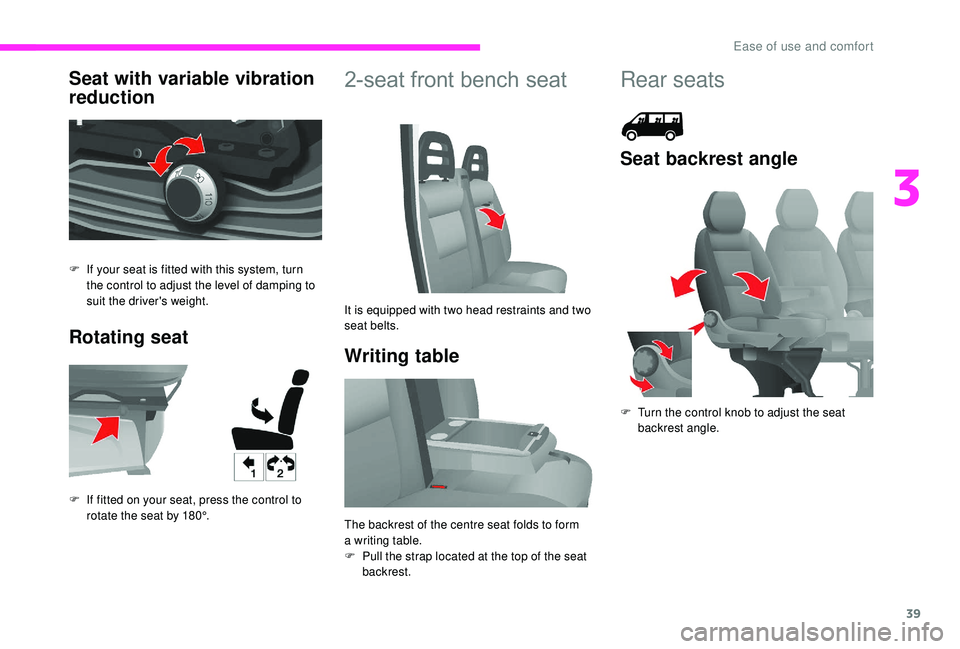
Seat with variable vibration
reduction
Rotating seat2-seat front bench seat
Writing table
F If your seat is fitted with this system, turn the control to adjust the level of damping to
suit the driver's weight.
F
I
f fitted on your seat, press the control to
rotate the seat by 180°. It is equipped with two head restraints and two
seat belts.
The backrest of the centre seat folds to form
a
writing table.
F
P
ull the strap located at the top of the seat
backrest.
Rear seats
Seat backrest angle
F Turn the control knob to adjust the seat backrest angle.
3
Ease of use and comfort
Page 42 of 232
40
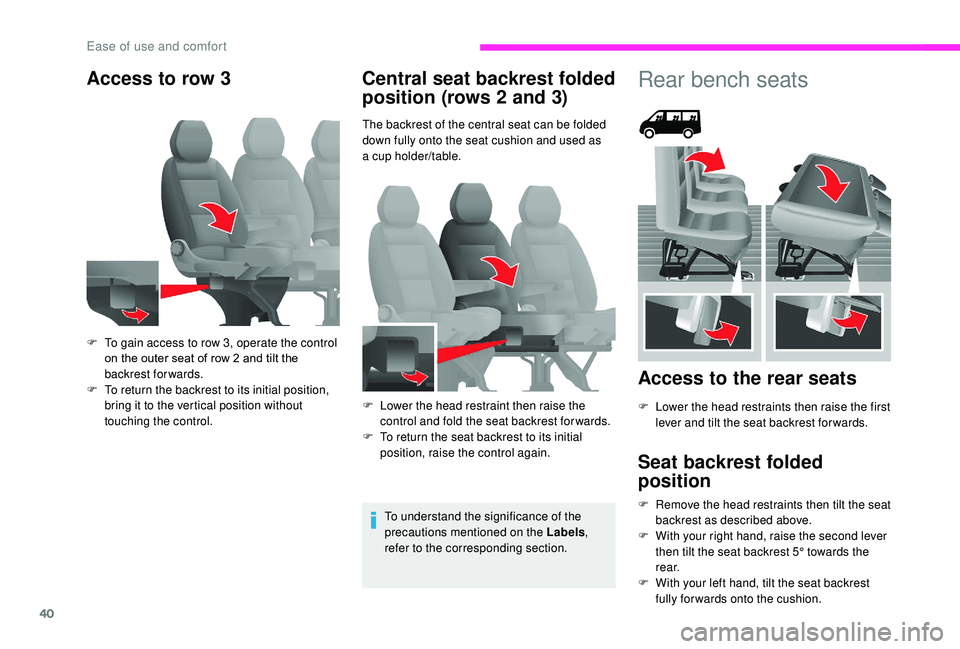
Access to row 3Central seat backrest folded
position (rows 2
and 3)
The backrest of the central seat can be folded
down fully onto the seat cushion and used as
a
cup holder/table.
To understand the significance of the
precautions mentioned on the Labels ,
refer to the corresponding section.
F
T
o gain access to row 3, operate the control
on the outer seat of row 2
and tilt the
backrest forwards.
F
T
o return the backrest to its initial position,
bring it to the vertical position without
touching the control. F
L
ower the head restraint then raise the
control and fold the seat backrest for wards.
F
T
o return the seat backrest to its initial
position, raise the control again.
Rear bench seats
Access to the rear seats
F Lower the head restraints then raise the first lever and tilt the seat backrest for wards.
Seat backrest folded
position
F Remove the head restraints then tilt the seat backrest as described above.
F
W
ith your right hand, raise the second lever
then tilt the seat backrest 5° towards the
r e a r.
F
W
ith your left hand, tilt the seat backrest
fully forwards onto the cushion.
Ease of use and comfort
Page 48 of 232
46
Air outlet
Press this control to activate
extraction of air to the outside; the
LED comes on. Press again to
switch off.
Air intake
Pressing this control activates the
exterior air intake into the passenger
compartment; the LED comes on.
Press again to switch off.
Additional heating
systems
Additional heating
This is passenger compartment heating,
additional to the standard equipment.
It can operate independently of the engine.
Additional heater or
programmable additional
heating
This is an additional, programmable and
separate system which heats the Diesel engine
hot coolant loop to make starting easier.
It improves the demisting and defrosting
per formance and that of the heated seats, if
fitted to the vehicle.
Automatic additional
heating
This is an additional system which starts
automatically when the ignition is switched
on. Its activation depends on the exterior
temperature and the temperature inside the
vehicle.
It switches off automatically once the heating
system is started manually. The passenger compartment heating is brought
up to temperature more rapidly.
This system must be programmed to start up
before you enter the vehicle.
Supplementary heating
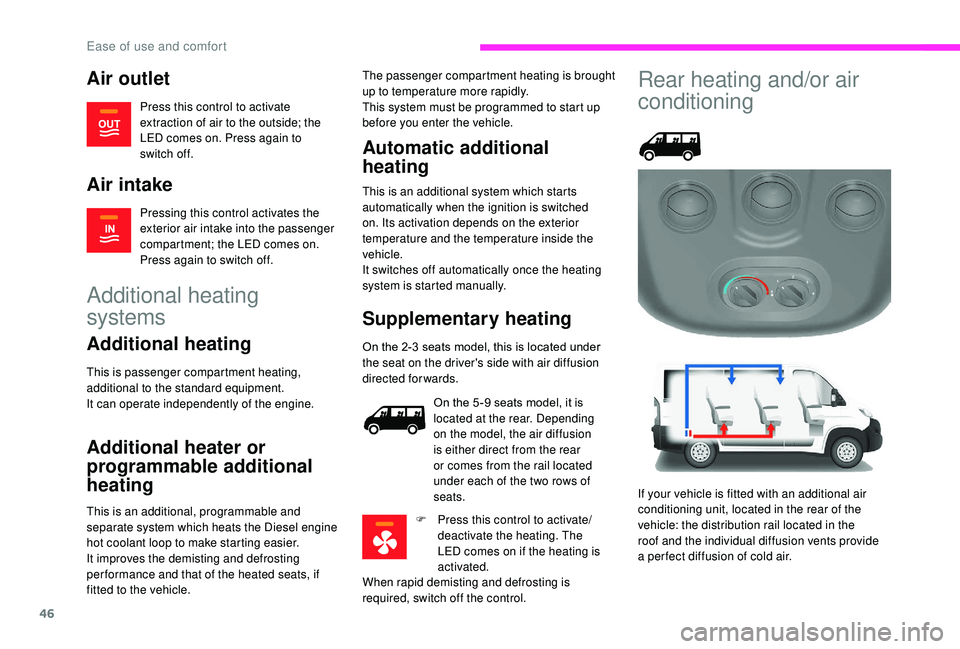
On the 2-3 seats model, this is located under
t he seat on the driver's side with air diffusion
directed forwards.
On the 5 -9
seats model, it is
located at the rear. Depending
on the model, the air diffusion
is either direct from the rear
or comes from the rail located
under each of the two rows of
seats.
F
P
ress this control to activate/
deactivate the heating. The
LED comes on if the heating is
activated.
When rapid demisting and defrosting is
required, switch off the control.
Rear heating and/or air
conditioning
If your vehicle is fitted with an additional air
conditioning unit, located in the rear of the
vehicle: the distribution rail located in the
roof and the individual diffusion vents provide
a
per fect diffusion of cold air.
Ease of use and comfort
Page 60 of 232

58
Cigarette lighter
F Press and wait a few moments until the
lighter pops out automatically.
Courtesy lamps Reading lamps
They are located above each row
of seats.
Interior roof rack
This is a storage compartment located in the
l oad space, above the cab. Its capacity varies
depending on the height of the van (type H2
or
H3).
As a
safety measure, do not place heavy
objects in the roof storage space.
Load retainerIf fitted on your vehicle, one or two courtesy
lamps are located above the rear and side
doors.
They can be activated by:
-
t
ilting the courtesy lamp (to the left or to the
right),
-
o
pening or closing the rear or side doors.
This lighting switches off automatically, after
a
few minutes, if the doors are left open. On the floor, behind the front seats, a
horizontal partition protects the driver and front
passengers against the risk of load movement.
Ladder type vertical
partition
Depending on the country of sale, behind the
driver's seat, a ladder type vertical partition
protects the driver against the risk of load
movement.
Ease of use and comfort
Page 75 of 232

73
Fastening
Unfastening
F Press the red button on the buckle, the seat belt rolls up automatically but you are
advised to guide it.
For safety reasons, these operations must
not be carried out while driving.
Height adjustment
Seat belts not fastened warning
lamp
F Pull the strap in front of you, with an even movement, ensuring that it does not twist.
F
S
ecure the tongue in its buckle.
F
C
heck that the seat belt is fastened securely
and that the automatic locking system is
operating correctly by pulling the strap
rapidly. F
F or the driver or outer passenger seat,
squeeze the control at the adjustable top
mounting, slide the assembly, then release
at the desired position to lock it.
The height of the seat belt for the centre seat
cannot be adjusted.
When the vehicle is started,
this warning lamp comes on,
accompanied by an increasing
audible signal, if the driver and/or
the front passenger has not fastened
their seat belt. This alert works both for models with an
individual passenger front seat as for models
with a
two-seat front bench seat.
If the driver's seat belt is unfastened,
START mode of Stop & Start will not be
triggered. The engine can then only be
restarted using the key.
Rear seat belts
The rear seats/bench seats are fitted with
three-point seat belts and inertia reels.
The centre seat has a seat belt guide and
inertia reel connected to the seat backrest.
A bracket is provided at each outer seat to
allow the seat belt buckle to be secured when
not in use.
5
5
Safety
Page 76 of 232
74
The driver must ensure that passengers use
the seat belts correctly and that they are all
fastened before setting off.
Wherever you are seated in the vehicle,
always fasten your seat belt, even for short
journeys.
Do not interchange the seat belt buckles as
they will not fulfil their role fully.
The seat belts are fitted with an inertia reel
permitting automatic adjustment of the length
of the strap to your size. The seat belt is
stowed automatically when not in use.
Before and after use, ensure that the seat belt
is reeled in correctly.
The lower part of the strap must be positioned
as low as possible on the pelvis.
The upper part must be positioned in the
hollow of the shoulder.
The inertia reels have an automatic locking
device at the time of a collision, during
sudden braking or if the vehicle turns over.
You can release the device by pulling the
strap firmly and then releasing it so that it
reels in slightly.
Advice
In order to be effective, a seat belt must:
- b e tightened as close to the body as
possible,
-
b
e pulled in front of you with a smooth
movement, checking that it does not
twist,
-
b
e used to restrain only one person,
-
n
ot show any signs of cuts or fraying,
-
n
ot be converted or modified to avoid
affecting its performance.
In accordance with current safety
regulations, for all repairs on your vehicle's
seat belts, go to a
qualified workshop with
the skills and equipment needed, which
a
CITROËN dealer is able to provide.
Have your seat belts checked regularly by
a
CITROËN dealer or a qualified workshop,
particularly if the straps show signs of
damage.
Clean the seat belt straps with soapy
water or a
textile cleaning product, sold by
CITROËN dealers.
After folding or moving a
seat or rear bench
seat, ensure that the seat belt is positioned
and reeled in correctly. Recommendations for children
Use a
suitable child seat if the passenger is
less than 12
years old or shorter than one and
a
half metres.
Never use the same seat belt to secure more
than one person.
Never allow a
child to travel on your lap.
For more information on Child seats , refer to
the corresponding section.
In the event of an impact
Depending on the nature and seriousness
of the impact , the pyrotechnic device may
be deployed before and independently of the
airbags. Deployment of the pretensioners
is accompanied by a
slight discharge of
harmless smoke and a
noise, due to the
activation of the pyrotechnic cartridge
incorporated in the system.
In all cases, the airbag warning lamp comes
on.
Following an impact, have the seat belts
system checked and, if necessary, replaced,
by a
CITROËN dealer or a qualified
workshop.
Safety