wheel CITROEN RELAY 2019 Handbook (in English)
[x] Cancel search | Manufacturer: CITROEN, Model Year: 2019, Model line: RELAY, Model: CITROEN RELAY 2019Pages: 232, PDF Size: 8.21 MB
Page 125 of 232
123
Maintenance
Correct operation is only possible if the towball
and its carrier are kept clean.
Before cleaning the vehicle with a high-
pressure jet wash, the towball must be removed
and the protective plug fitted to the carrier.
Apply the label provided to a
clearly visible
area, close to the carrier or in the boot.
Go to a
CITROËN dealer or a qualified
workshop for any work on the towbar
system.
Roof carrying systems
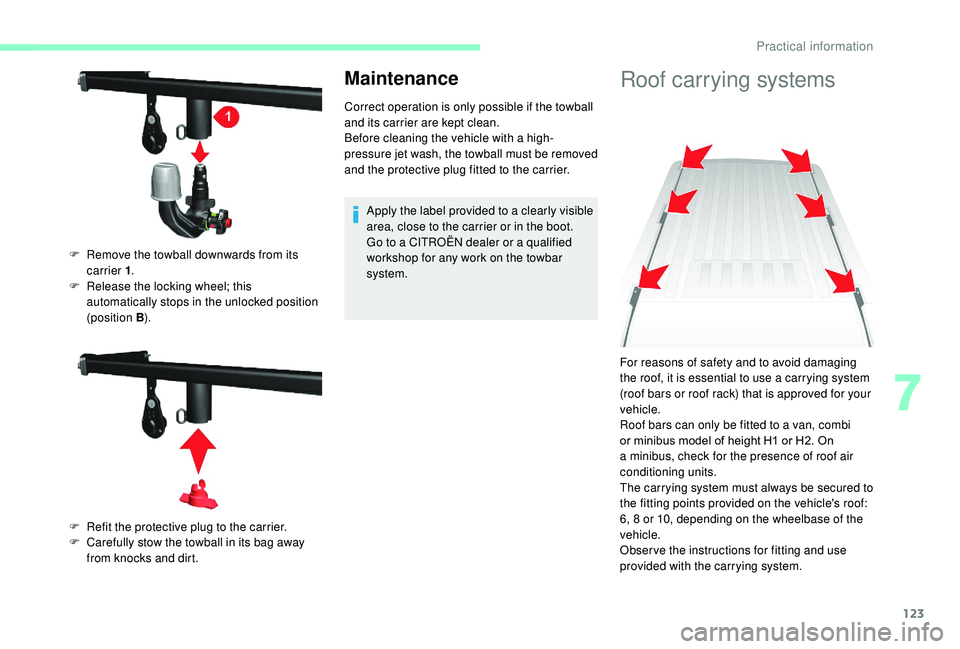
F Remove the towball downwards from its carrier 1 .
F
R
elease the locking wheel; this
automatically stops in the unlocked position
(position B ).
F
R
efit the protective plug to the carrier.
F
C
arefully stow the towball in its bag away
from knocks and dirt. For reasons of safety and to avoid damaging
the roof, it is essential to use a
carrying system
(roof bars or roof rack) that is approved for your
vehicle.
Roof bars can only be fitted to a
van, combi
or minibus model of height H1
or H2. On
a
minibus, check for the presence of roof air
conditioning units.
The carrying system must always be secured to
the fitting points provided on the vehicle's roof:
6, 8
or 10, depending on the wheelbase of the
vehicle.
Obser ve the instructions for fitting and use
provided with the carrying system.
7
Practical information
Page 139 of 232

137
Special feature with pneumatic
suspension
If the vehicle is fitted with this system, you must
activate vehicle lifting mode before lifting the
vehicle with a jack. For vehicles with the steering wheel on the
right, the buttons are located on the right of the
steering wheel.
F
W
ith the ignition on, simultaneously press
buttons 1 and 2 for at least 5 seconds.
Their indicator lamps come on fixed.
F
T
o leave this mode, simultaneously press
buttons 1 and 2 for another 5
seconds.
Their indicator lamps go off and the system
becomes fully operational again.
This mode deactivates itself automatically if the
speed of about 3 mph (5 km/h) is exceeded.
Spare wheel
Parking
F Park the vehicle where it does not block
traffic: the ground must be level, stable and
non-slippery.
F
I
f the road is sloping or damaged, place an
object under the wheels to act as a
chock.
F
W
ith a
manual gearbox, engage first gear
then switch off the ignition to block the
wheels.
F
A
pply the parking brake and check that the
warning lamp is on in the instrument panel.
F
T
he passengers must get out of the vehicle
and wait where they are safe.
F
P
ut on the high visibility vest and signal that
the vehicle is immobile by using the devices
envisaged by the legislation in force in the
country where you are driving (warning
triangle, hazard warning lamps, etc.).
F
E
quip yourself with the tools. Once your vehicle is properly secured, you
should proceed in this order:
1-Take the tools.
2- Remove the spare wheel from its
compartment.
3- Position the jack.
4- Change the wheel to be repaired.
5- Put away the wheel to be repaired.
1 - Take the tools
These are stowed in a box located under the
f ront passenger seat.
F
T
urn the button a quarter of a turn then pull
the box.
F
A
fter use, press the button then turn it
a
quarter of a turn to secure the box.
8
In the event of a breakdown
Page 140 of 232

138
A.Long socket.
B. B a r.
C. Jack.
D. Wheelbrace.
E. Screwdriver (handle and bits).
F. Removable towing eye.
2 - Remove the spare wheel
f
rom its compartment
To make the procedure easier, raise the
rear of the vehicle. The spare wheel is specific to your
vehicle, do not use it on other vehicles of
a
different model.
Likewise, do not use spare wheels that are
from a model different to your vehicle.
These instructions also apply to the bolts.
With steel wheels :
H. Handle.
I. Carrier. With alloy wheels
:
H. Handle.
I. Carrier.
J. Support.
K. Bolt.
In the event of a breakdown
Page 141 of 232

139
The spare wheel retaining bolt is located below
the rear bumper on the right.With steel wheels
:
With alloy wheels :
F
I
nstall the long socket A , the wheelbrace D
and the bar B on the retaining bolt.
F
T
urn the assembly anti-clockwise to lower
the wheel.
F
T
urn to the full extent, indicated by an
increase in the force required.
F
H
aving fully unwound the cable, take out the
spare wheel. F
U
nscrew the handle H.
F
R
emove the carrier I from the outer part of
the steel wheel. F
R
elease the spare wheel and place it near
the wheel to be changed.
F
I
f possible, place a chock under the
wheel diagonally opposite the wheel to be
changed.
3 - Position the jack
Ensure that the jack is stable.
If the ground is slippery or loose, the jack
may collapse – Risk of injury!
F
U
nscrew the three securing bolts K
.
F
U
nscrew the handle H
.
F
R
emove the support J from the carrier I
.
8
In the event of a breakdown
Page 142 of 232
140
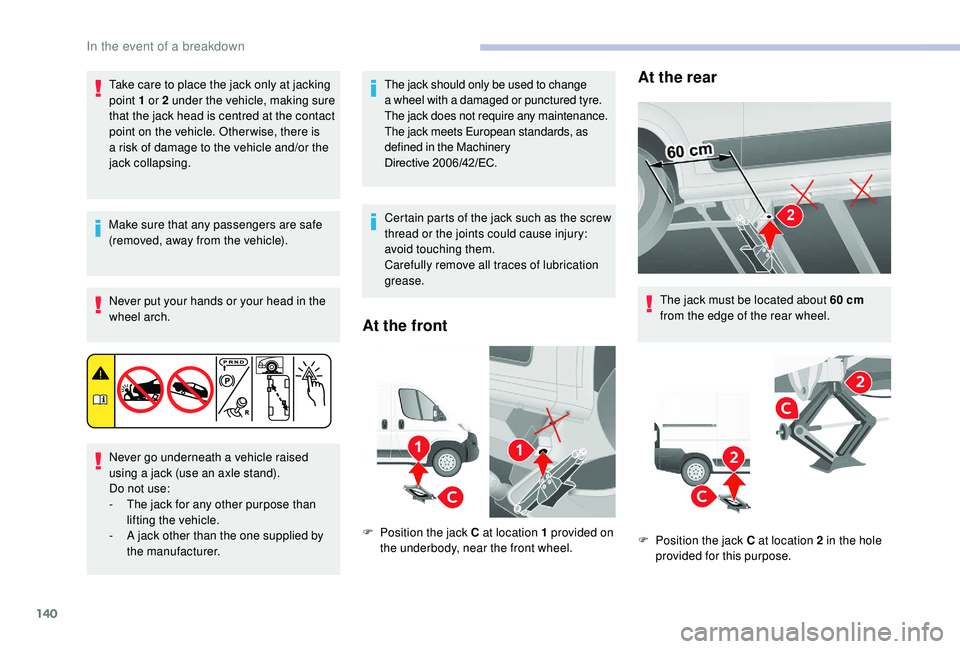
Take care to place the jack only at jacking
point 1 or 2 under the vehicle, making sure
that the jack head is centred at the contact
point on the vehicle. Other wise, there is
a
risk of damage to the vehicle and/or the
jack collapsing.
Make sure that any passengers are safe
(removed, away from the vehicle). Never put your hands or your head in the
wheel arch.
Never go underneath a
vehicle raised
using a
jack (use an axle stand).
Do not use:
-
T
he jack for any other purpose than
lifting the vehicle.
-
A j
ack other than the one supplied by
the manufacturer. The jack should only be used to change
a
wheel with a damaged or punctured tyre.
The jack does not require any maintenance.
The jack meets European standards, as
defined in the Machinery
Directive 2006/42/EC.
Certain parts of the jack such as the screw
thread or the joints could cause injury:
avoid touching them.
Carefully remove all traces of lubrication
grease.
At the front
F Position the jack C at location 1 provided on
the underbody, near the front wheel.
At the rear
The jack must be located about 60 cm
f rom the edge of the rear wheel.
F
P
osition the jack C at location 2 in the hole
provided for this purpose.
In the event of a breakdown
Page 143 of 232
141
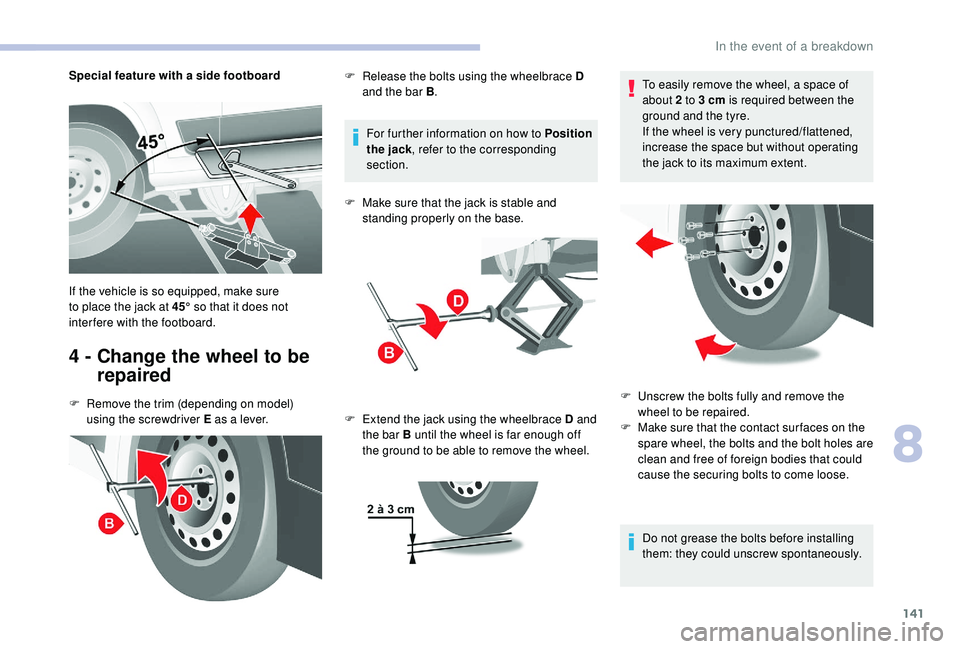
Special feature with a side footboard
4 - Change the wheel to be repaired
F Remove the trim (depending on model)
using the screwdriver E as a lever.For further information on how to Position
the jack , refer to the corresponding
section.
F
M
ake sure that the jack is stable and
standing properly on the base.
If the vehicle is so equipped, make sure
to place the jack at 45° so that it does not
interfere with the footboard. F
R
elease the bolts using the wheelbrace D
and the bar B .
F E xtend the jack using the wheelbrace D and
the bar B until the wheel is far enough off
the ground to be able to remove the wheel. To easily remove the wheel, a space of
about 2
to 3 cm is required between the
ground and the tyre.
If the wheel is very punctured/flattened,
increase the space but without operating
the jack to its maximum extent.
Do not grease the bolts before installing
them: they could unscrew spontaneously.
F
U nscrew the bolts fully and remove the
wheel to be repaired.
F
M
ake sure that the contact sur faces on the
spare wheel, the bolts and the bolt holes are
clean and free of foreign bodies that could
cause the securing bolts to come loose.
8
In the event of a breakdown
Page 144 of 232

142
Screw in the bolts in this order.
F
P
ut the spare wheel in place, making
the 2 openings M coincide with the
2 corresponding pins N
.
F
S
tart screwing in the bolts by hand.
F
P
retighten the bolts using the wheelbrace D
and the bar B .
F
L
ower the vehicle using the wheelbrace D
and the bar B , then remove the jack.
F
T
ighten the bolts again using the
wheelbrace D and the bar B .If your vehicle has tyre under-inflation
detection, check the tyre pressures and
reinitialise the system.
5 - Put away the wheel to be
repaired
You must always place the wheel to be repaired
or the spare wheel under the vehicle to secure
the carrier system.
Check that it is properly secured in its
compartment below the floor.
If the wheel is not correctly in position, it
could be dangerous.
F
R
eplace the wheel at the rear of the vehicle.
Have the tightness of the bolts and the
pressure of the spare wheel checked by
a
member of the dealer network or a qualified
workshop without delay.
Have the punctured wheel repaired and
replace it on the vehicle as soon as possible.
In the event of a breakdown
Page 145 of 232
143
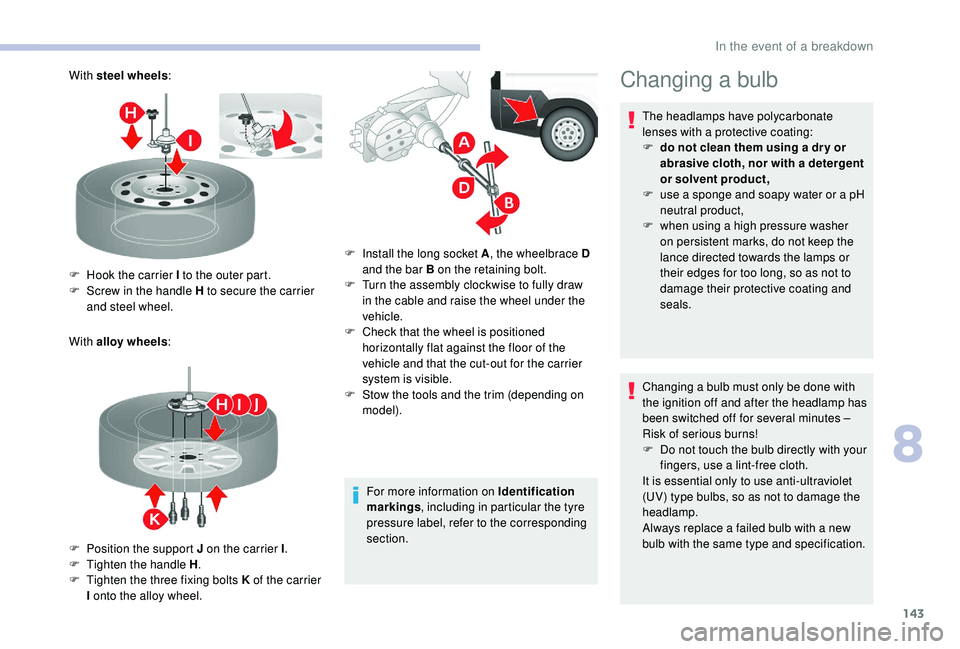
With steel wheels:
With alloy wheels :
For more information on Identification
markings, including in particular the tyre
pressure label, refer to the corresponding
section.
F
H
ook the carrier I to the outer part.
F
S
crew in the handle H to secure the carrier
and steel wheel.
F
P
osition the support J on the carrier I .
F
T
ighten the handle H .
F
T
ighten the three fixing bolts K of the carrier
I onto the alloy wheel. F
I
nstall the long socket A, the wheelbrace D
and the bar B on the retaining bolt.
F
T
urn the assembly clockwise to fully draw
in the cable and raise the wheel under the
vehicle.
F
C
heck that the wheel is positioned
horizontally flat against the floor of the
vehicle and that the cut-out for the carrier
system is visible.
F
S
tow the tools and the trim (depending on
model).Changing a bulb
The headlamps have polycarbonate
lenses with a
protective coating:
F
d
o not clean them using a dr y or
abrasive cloth, nor with a
detergent
or solvent product,
F
u
se a sponge and soapy water or a pH
neutral product,
F
w
hen using a high pressure washer
on persistent marks, do not keep the
lance directed towards the lamps or
their edges for too long, so as not to
damage their protective coating and
seals.
Changing a
bulb must only be done with
the ignition off and after the headlamp has
been switched off for several minutes –
Risk of serious burns!
F
D
o not touch the bulb directly with your
fingers, use a
lint-free cloth.
It is essential only to use anti-ultraviolet
(UV) type bulbs, so as not to damage the
headlamp.
Always replace a
failed bulb with a new
bulb with the same type and specification.
8
In the event of a breakdown
Page 148 of 232
146
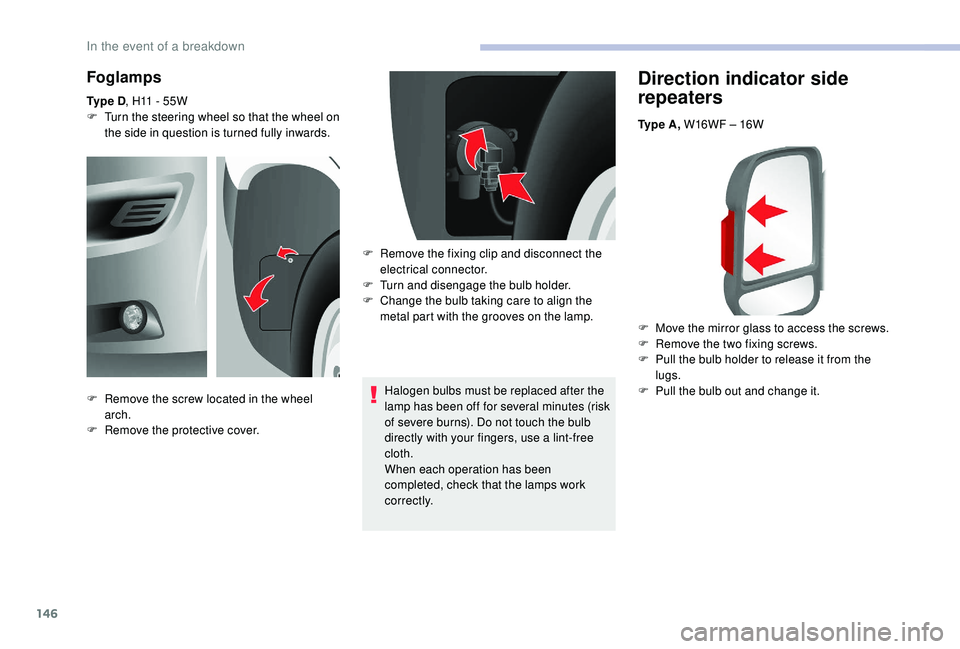
Direction indicator side
repeaters
Ty p e A , W16WF – 16W
F
M
ove the mirror glass to access the screws.
F
R
emove the two fixing screws.
F
P
ull the bulb holder to release it from the
lugs.
F
P
ull the bulb out and change it.
Foglamps
Ty p e D , H11 - 55W
F T urn the steering wheel so that the wheel on
the side in question is turned fully inwards.
Halogen bulbs must be replaced after the
lamp has been off for several minutes (risk
of severe burns). Do not touch the bulb
directly with your fingers, use a
lint-free
cloth.
When each operation has been
completed, check that the lamps work
c o r r e c t l y.
F
R
emove the screw located in the wheel
arch.
F
R
emove the protective cover. F
R
emove the fixing clip and disconnect the
electrical connector.
F
T
urn and disengage the bulb holder.
F
C
hange the bulb taking care to align the
metal part with the grooves on the lamp.
In the event of a breakdown
Page 152 of 232
150
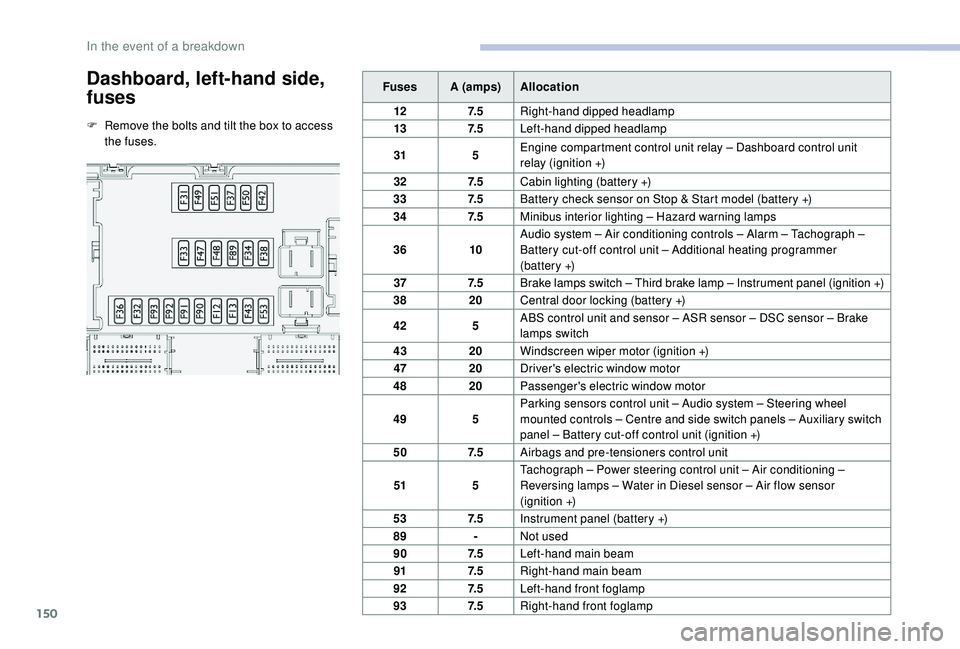
Dashboard, left-hand side,
fuses
F Remove the bolts and tilt the box to access the fuses. Fuses A (amps)
Allocation
12 7. 5Right-hand dipped headlamp
13 7. 5Left-hand dipped headlamp
31 5Engine compartment control unit relay – Dashboard control unit
relay (ignition +)
32 7. 5Cabin lighting (battery +)
33 7. 5Battery check sensor on Stop & Start model (battery +)
34 7. 5Minibus interior lighting – Hazard warning lamps
36 10Audio system – Air conditioning controls – Alarm – Tachograph
–
Battery cut-off control unit – Additional heating programmer
(battery
+)
37 7. 5Brake lamps switch – Third brake lamp – Instrument panel (ignition +)
38 20Central door locking (battery +)
42 5ABS control unit and sensor – ASR sensor – DSC sensor – Brake
lamps switch
43 20Windscreen wiper motor (ignition +)
47 20Driver's electric window motor
48 20Passenger's electric window motor
49 5Parking sensors control unit – Audio system – Steering wheel
mounted controls – Centre and side switch panels – Auxiliary switch
panel – Battery cut-off control unit (ignition +)
50 7. 5Airbags and pre-tensioners control unit
51 5Tachograph – Power steering control unit – Air conditioning –
Reversing lamps – Water in Diesel sensor – Air flow sensor
(ignition +)
53 7. 5Instrument panel (battery +)
89 -Not used
90 7. 5Left-hand main beam
91 7. 5Right-hand main beam
92 7. 5Left-hand front foglamp
93 7. 5Right-hand front foglamp
In the event of a breakdown