heating DACIA DUSTER 2010 1.G User Guide
[x] Cancel search | Manufacturer: DACIA, Model Year: 2010, Model line: DUSTER, Model: DACIA DUSTER 2010 1.GPages: 200, PDF Size: 7.12 MB
Page 92 of 200
ventilationair conditioning ................................ (up to the end of the DU)
air vents ................................................ (up to the end of the DU)
air conditioning ..................................... (up to the end of the DU)
heating system ..................................... (up to the end of the DU)
heating and air conditioning system ..... (up to the end of the DU)
3.2
ENG_UD20572_3
Aérateurs, sorties d’air (H79 - Dacia)
ENG_NU_898-5_H79_Dacia_3
Jaune NoirNoir texte
Air vents, air outlets
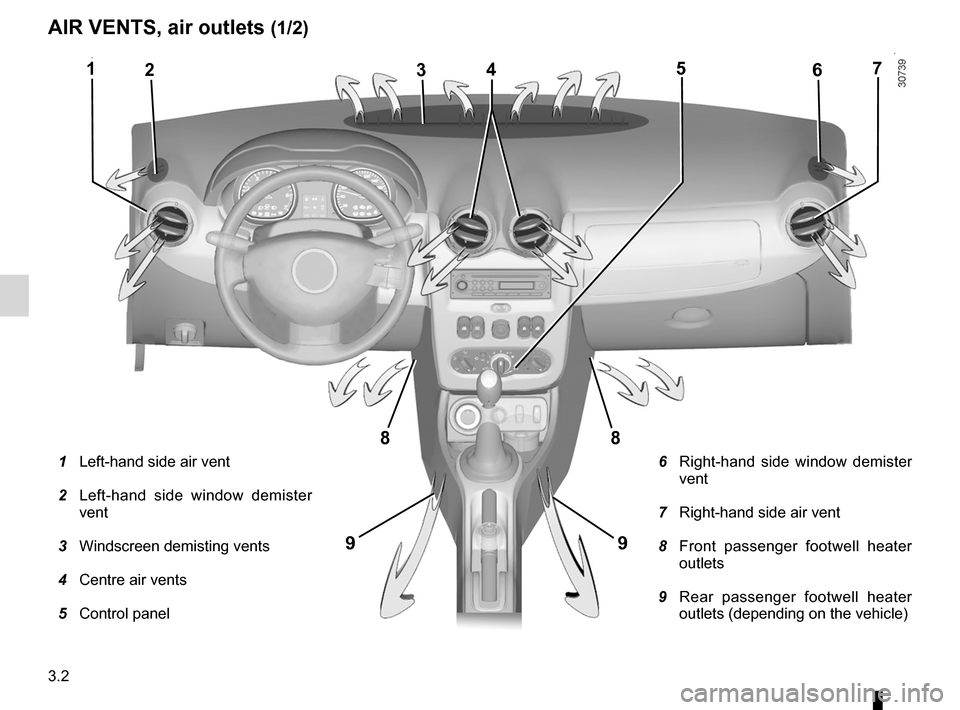
1 Left-hand side air vent
2 Left-hand side window demister
vent
3 Windscreen demisting vents
4 Centre air vents
5 Control panel
6 Right-hand side window demister
vent
7 Right-hand side air vent
8 Front passenger footwell heater
outlets
9 Rear passenger footwell heater
outlets (depending on the vehicle)
AIR VENTS, air outlets (1/2)
1234567
8
99
8
Page 94 of 200
air conditioning ..................................... (up to the end of the DU)
heating and air conditioning system ..... (up to the end of the DU)
heating system ..................................... (up to the end of the DU)
air conditioning ..................................... (up to the end of the DU)
rear screen de-icing/demisting ............. (up to the end of the DU)
ventilation heating and air conditioning system (up to the end of the DU)
3.4
ENG_UD25124_1
Chauffage - Ventilation - Air conditionné (H79 - Dacia)
ENG_NU_898-5_H79_Dacia_3
Jaune NoirNoir texte
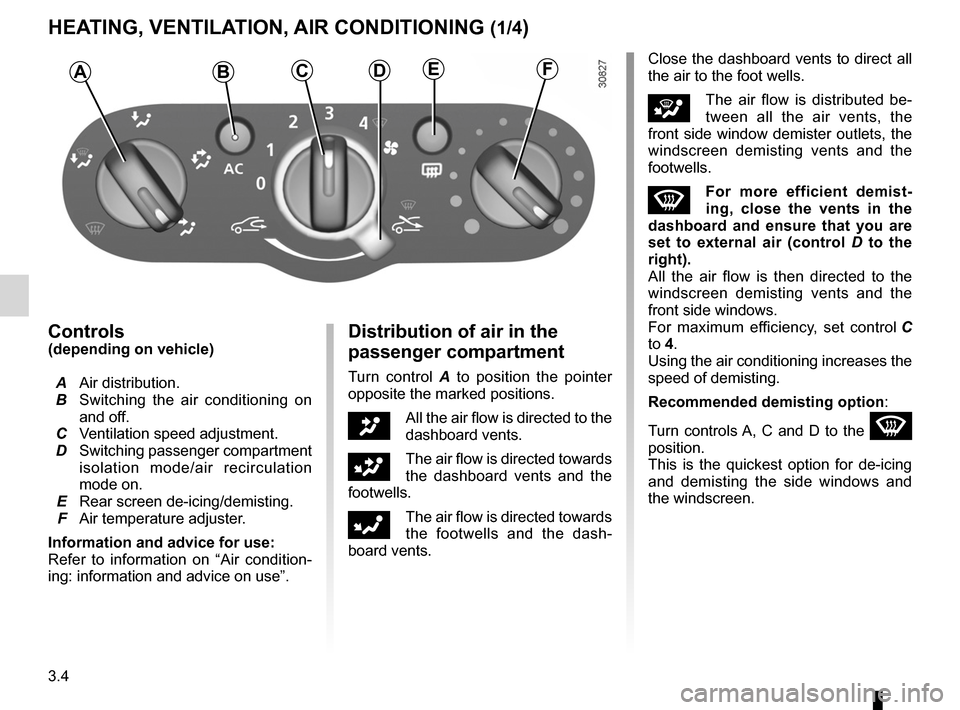
Controls(depending on vehicle)
A Air distribution.
B Switching the air conditioning on
and off.
C Ventilation speed adjustment.
D Switching passenger compartment
isolation mode/air recirculation
mode on.
E Rear screen de-icing/demisting.
F Air temperature adjuster.
Information and advice for use:
Refer to information on “Air condition -
ing: information and advice on use”.Distribution of air in the
passenger compartment
Turn control A to position the pointer
opposite the marked positions.
JAll the air flow is directed to the
dashboard vents.
GThe air flow is directed towards
the dashboard vents and the
footwells.
FThe air flow is directed towards
the footwells and the dash -
board vents. Close the dashboard vents to direct all
the air to the foot wells.
iThe air flow is distributed be
-
tween all the air vents, the
front side window demister outlets, the
windscreen demisting vents and the
footwells.
WFor more efficient demist -
ing, close the vents in the
dashboard and ensure that you are
set to external air (control D to the
right).
All the air flow is then directed to the
windscreen demisting vents and the
front side windows.
For maximum efficiency, set control C
to 4.
Using the air conditioning increases the
speed of demisting.
Recommended demisting option :
Turn controls A, C and D to the
W
position.
This is the quickest option for de-icing
and demisting the side windows and
the windscreen.
HEATING, VENTILATION, AIR CONDITIONING (1/4)
ABCDEF
Page 95 of 200
JauneNoirNoir texte
3.5
ENG_UD25124_1
Chauffage - Ventilation - Air conditionné (H79 - Dacia)
ENG_NU_898-5_H79_Dacia_3
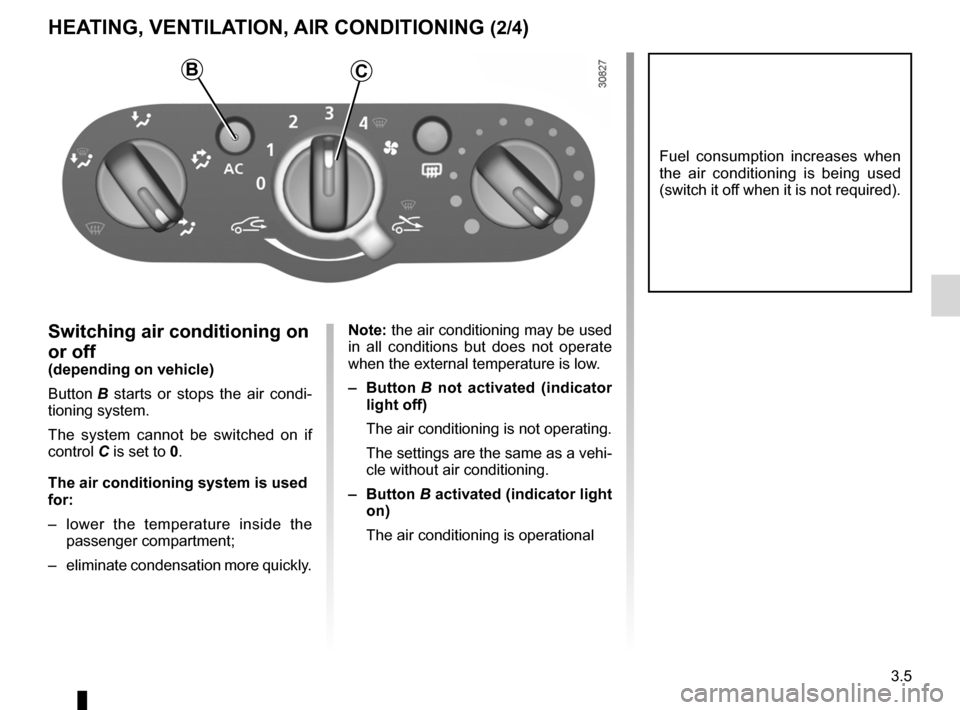
HEATING, VENTILATION, AIR CONDITIONING (2/4)
Switching air conditioning on
or off
(depending on vehicle)
Button B starts or stops the air condi -
tioning system.
The system cannot be switched on if
control C is set to 0.
The air conditioning system is used
for:
– lower the temperature inside the
passenger compartment;
– eliminate condensation more quickly. Note: the air conditioning may be used
in all conditions but does not operate
when the external temperature is low.
–
Button B not activated (indicator
light off)
The air conditioning is not operating.
The settings are the same as a vehi-
cle without air conditioning.
– Button B activated (indicator light
on)
The air conditioning is operational
Fuel consumption increases when
the air conditioning is being used
(switch it off when it is not required).
BC
Page 96 of 200
3.6
ENG_UD25124_1
Chauffage - Ventilation - Air conditionné (H79 - Dacia)
ENG_NU_898-5_H79_Dacia_3
Jaune NoirNoir texte
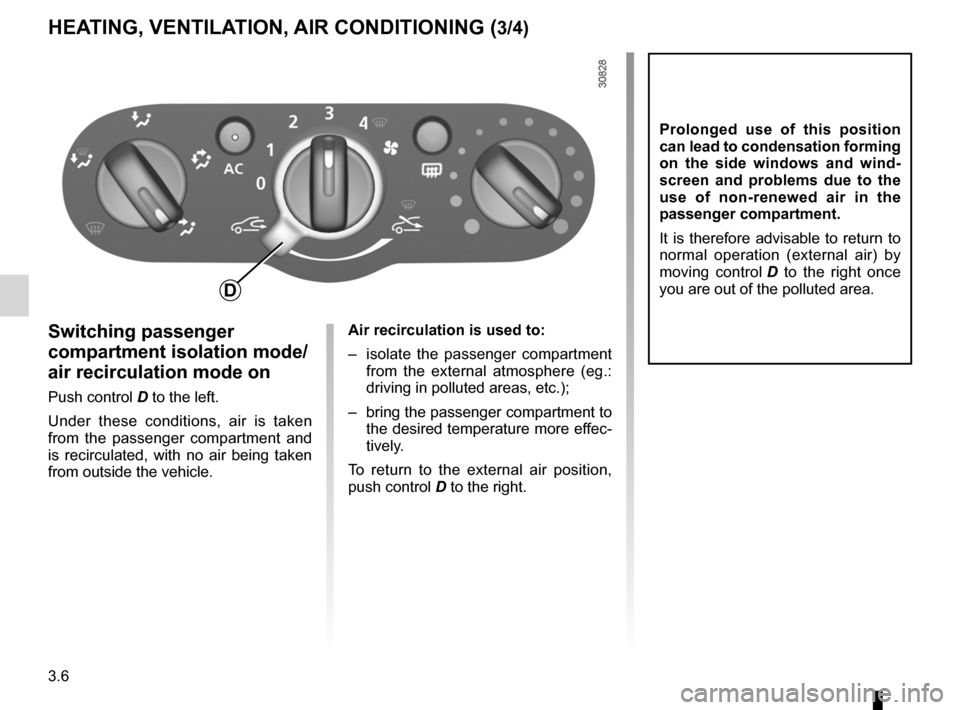
HEATING, VENTILATION, AIR CONDITIONING (3/4)
Switching passenger
compartment isolation mode/
air recirculation mode on
Push control D to the left.
Under these conditions, air is taken
from the passenger compartment and
is recirculated, with no air being taken
from outside the vehicle. Air recirculation is used to:
–
isolate the passenger compartment
from the external atmosphere (eg.:
driving in polluted areas, etc.);
– bring the passenger compartment to
the desired temperature more effec-
tively.
To return to the external air position,
push control D to the right.
Prolonged use of this position
can lead to condensation forming
on the side windows and wind -
screen and problems due to the
use of non-renewed air in the
passenger compartment.
It is therefore advisable to return to
normal operation (external air) by
moving control D to the right once
you are out of the polluted area.
D
Page 97 of 200
JauneNoirNoir texte
3.7
ENG_UD25124_1
Chauffage - Ventilation - Air conditionné (H79 - Dacia)
ENG_NU_898-5_H79_Dacia_3
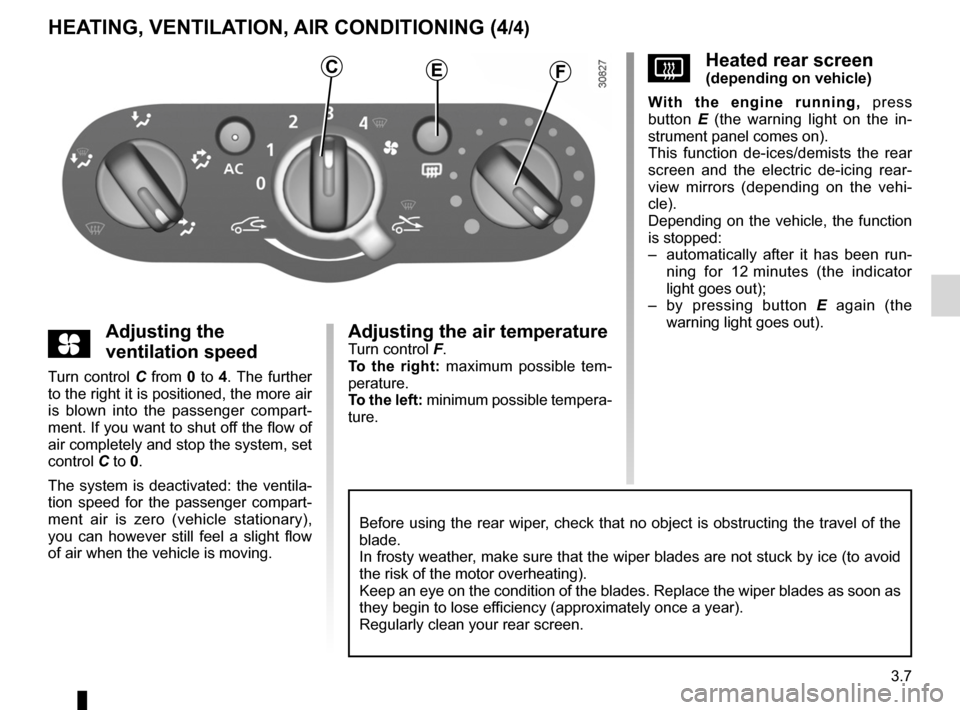
HEATING, VENTILATION, AIR CONDITIONING (4/4)
yAdjusting the
ventilation speed
Turn control C from 0 to 4. The further
to the right it is positioned, the more air
is blown into the passenger compart -
ment. If you want to shut off the flow of
air completely and stop the system, set
control C to 0.
The system is deactivated: the ventila -
tion speed for the passenger compart-
ment air is zero (vehicle stationary),
you can however still feel a slight flow
of air when the vehicle is moving.
Adjusting the air temperatureTurn control F.
To the right: maximum possible tem -
perature.
To the left: minimum possible tempera-
ture.
VHeated rear screen(depending on vehicle)
With the engine running, press
button E (the warning light on the in -
strument panel comes on).
This function de-ices/demists the rear
screen and the electric de-icing rear -
view mirrors (depending on the vehi -
cle).
Depending on the vehicle, the function
is stopped:
– automatically after it has been run -
ning for 12 minutes (the indicator
light goes out);
– by pressing button E again (the
warning light goes out).CEF
Before using the rear wiper, check that no object is obstructing the travel of the
blade.
In frosty weather, make sure that the wiper blades are not stuck by ice (to avoid
the risk of the motor overheating).
Keep an eye on the condition of the blades. Replace the wiper blades as soon as
they begin to lose efficiency (approximately once a year).
Regularly clean your rear screen.
Page 98 of 200
air conditioning ..................................... (up to the end of the DU)
heating system ..................................... (up to the end of the DU)
heating and air conditioning system ..... (up to the end of the DU)
ventilation heating and air conditioning system (up to the end of the DU)
air conditioning ...................................................... (current page)
3.8
ENG_UD18246_14
Air conditionné : informations et conseils utilisation (B90 - U90 - \
L90 Ph2 - F90 Ph2 - R90 Ph2 - H79 - Dacia)
ENG_NU_898-5_H79_Dacia_3
Air conditioning: information and advice on use
AIR CONDITIONING: information and advice on use
Fuel consumption
You will normally notice an increase
in fuel consumption (especially
when driving in town) when the air
conditioning is operating.
For vehicles fitted with air condition -
ing with no automatic mode, switch
off the system when it is not re -
quired.
Advice for reducing consumption
and helping to preserve the envi-
ronment
Drive with the air vents open and
the windows closed.
If the vehicle has been parked in
the sun, open the doors for a few
moments to let the hot air escape
before starting the engine. Operating faults
As a general rule, contact your ap-
proved dealer in the event of an op-
erating fault.
– Reduction in de-icing, demist -
ing or air conditioning per -
formance.
This may be caused by the pas-
senger compartment filter car -
tridge becoming clogged.
– No cold air is being produced .
Check that the controls are set
correctly and that the fuses are
sound. Otherwise, switch off the
system.
Do not open the refriger -
ant fluid circuit. The fluid
may damage eyes or skin.Presence of water under the ve -
hicle. After prolonged use of the air
conditioning system, it is normal for
water to be present under the vehi-
cle. This is caused by condensation.Maintenance
Refer to the Maintenance Service
Booklet for your vehicle for the in -
spection frequency.
Page 128 of 200
4.14
ENG_UD20966_2
Entretien de la carrosserie / compartiment moteur (H79 - Dacia)
ENG_NU_898-5_H79_Dacia_4
Jaune NoirNoir texte
BODyWORK MAINTENANCE, ENGINE COMPARTMENT (2/3)
y ou should
–
Respect local regulations about
washing vehicles (e.g. do not wash
your vehicle on a public highway).
– Always follow the recommenda -
tions supplied with the high-pressure
cleaning equipment (jet distance and
pressure).
– Before going through a roller type
car wash, return the windscreen
wiper stalk to park position (refer
to the information on “Windscreen
wash/wipe” in Section 1), check the
mounting of external accessories,
additional lights and door mirrors
and be sure to hold the wiper blades
and radio aerial in place with adhe -
sive tape. Remove the radio aerial
mast if your vehicle is fitted with this
equipment.
Remember to remove the tape and
refit the antenna after washing. –
After driving off-road (eg. on muddy,
dusty or sandy terrain) quickly clean
the radiator from the outside of the
vehicle through the openings in the
bumper, to prevent it from becoming
blocked or clogged (risk of engine
overheating).
– Wash your vehicle frequently with
the engine off , using shampoo ap -
proved by our Technical Department
(never use abrasive products) and
rinse thoroughly using a warm or
cold water jet (never hot):
– spots of tree resin and industrial
grime;
– the layer of dust or mud and any
insects;
– bird droppings , which contain
chemicals that rapidly discolour
paintwork and may even cause
the paint to peel off ;
Wash the vehicle immediately to
remove these marks since it is im-
possible to remove them by pol -
ishing; –
salt deposited in the wheel arches
and underneath the body after
driving in areas where the roads
are chemically treated;
– mud in the wheel arches and un-
derneath the body which form
damp patches.
– Clean mud and sand from the
wheels, in particular the inside of the
wheels and the brakes, as this can:
– reduce the braking efficiency and
damage the components of the
braking system;
– cause vibrations in the bodywork
and steering column.
We have selected special products
to care for your vehicle and you can
obtain these from the manufactur -
er’s accessory outlets.
Page 158 of 200
5.26
ENG_UD22381_3
Fusibles (H79 - Dacia)
ENG_NU_898-5_H79_Dacia_5
Jaune NoirNoir texte
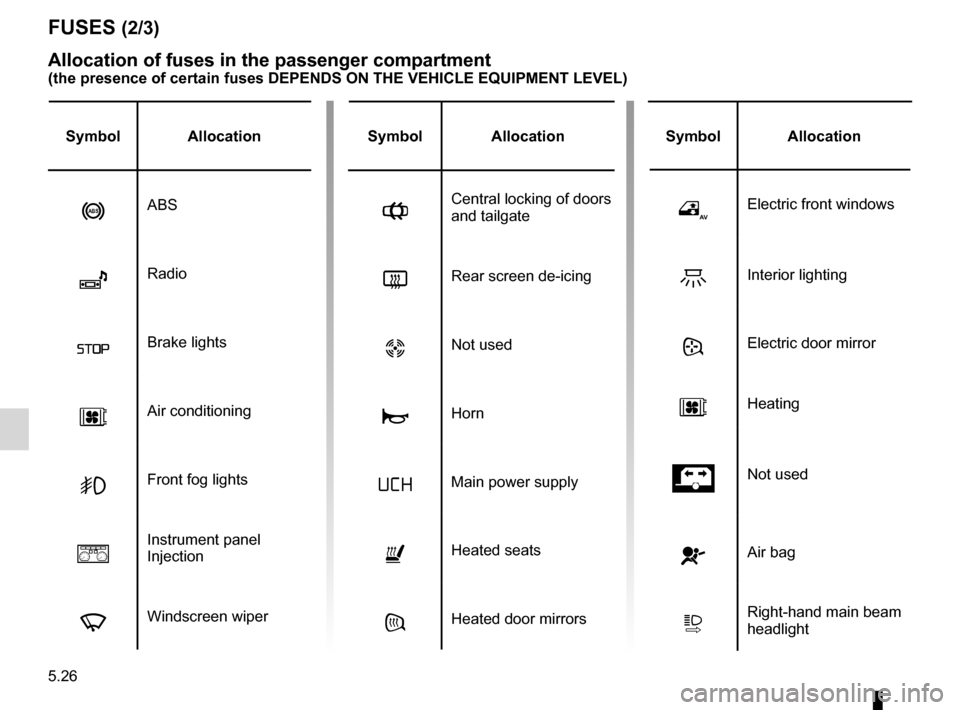
FUSES (2/3)
Symbol Allocation
ḽElectric front windows
ZInterior lighting
eElectric door mirror
àHeating
àNot used
ÅAir bag
PRight-hand main beam
headlight
Allocation of fuses in the passenger compartment(the presence of certain fuses DEPENDS ON THE VEHICLE EQUIPMENT LEVEL)\
SymbolAllocation
nABS
îRadio
ßBrake lights
àAir conditioning
GFront fog lights
aInstrument panel
Injection
fWindscreen wiper
Symbol Allocation
]Central locking of doors
and tailgate
CRear screen de-icing
ÙNot used
ÌHorn
ôMain power supply
ñHeated seats
sHeated door mirrors
Page 163 of 200
wiper blades ......................................... (up to the end of the DU)
practical advice ..................................... (up to the end of the DU)
wipers blades ............................................. (up to the end of the DU)
5.31
ENG_UD20625_2
Balais d’essuie-vitre (H79 - Dacia)
ENG_NU_898-5_H79_Dacia_5
Wiper blades
WIPER BLADES
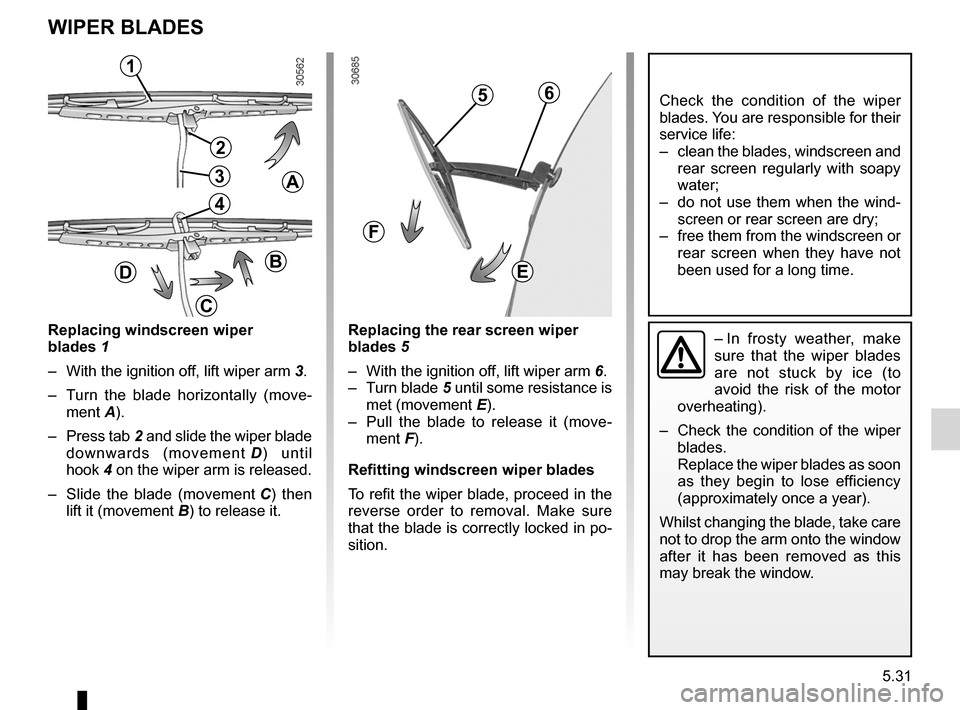
Replacing windscreen wiper
blades 1
– With the ignition off, lift wiper arm 3.
– Turn the blade horizontally (move -
ment A).
– Press tab 2 and slide the wiper blade
downwards (movement D ) until
hook 4 on the wiper arm is released.
– Slide the blade (movement C ) then
lift it (movement B) to release it.Replacing the rear screen wiper
blades 5
– With the ignition off, lift wiper arm 6.
– Turn blade 5 until some resistance is
met (movement E).
– Pull the blade to release it (move -
ment F).
Refitting windscreen wiper blades
To refit the wiper blade, proceed in the
reverse order to removal. Make sure
that the blade is correctly locked in po-
sition.
Check the condition of the wiper
blades. You are responsible for their
service life:
– clean the blades, windscreen and
rear screen regularly with soapy
water;
– do not use them when the wind-
screen or rear screen are dry;
– free them from the windscreen or
rear screen when they have not
been used for a long time.
– In frosty weather, make
sure that the wiper blades
are not stuck by ice (to
avoid the risk of the motor
overheating).
– Check the condition of the wiper
blades.
Replace the wiper blades as soon
as they begin to lose efficiency
(approximately once a year).
Whilst changing the blade, take care
not to drop the arm onto the window
after it has been removed as this
may break the window.
2
3
4
A
C
1
BD
56
F
E
Page 196 of 200
7.2
FRA_UD25066_7
Index (H79 - Dacia)
ENG_NU_898-5_H79_Dacia_7
Jaune NoirNoir texte
AlphAbeticAl index (2/4)
F
4 wheel drive (4WD) .............................................. 2.11 → 2.14
faults operating faults ................................................ 5.39 → 5.43
filter ........................................................................\
............ 4.10
air filter ......................................................................... 4.10
diesel filter .................................................................... 4.10
passenger compartment filter ...................................... 4.10
fitting a radio ........................................................... 5.36 – 5.37
fittings .................................................................... 3.15 → 3.18
fog lights ........................................................................\
.... 1.55
front passenger air bag deactivation ................................. 1.32
front seat adjustment ......................................................... 1.11
front seats adjustment ................................................................... 1.11
fuel advice on fuel economy ....................................... 2.6 → 2.8
filling ............................................................................. 1.61
grade ..................................................................... 1.60, 6.5
fuel economy ............................................................. 2.6 → 2.8
fuel filler cap ...................................................................... 1.60
fuel grade ........................................................................\
... 1.60
fuel level ........................................................................\
.... 1.45
fuel tank ................................................................. 1.60 → 1.62
fuel tank capacity ............................................................... 1.60
fuses ...................................................................... 5.25 → 5.27
G
gear lever ........................................................................\
... 2.10
glove box ........................................................................\
... 3.15
grab handle ........................................................................\
3.13
h
handbrake ........................................................................\
.. 2.10
hazard warning lights signal ................................... 1.52 – 1.53
headlight beam adjustment ............................................... 1.56headlight flashers
................................................... 1.52 – 1.53
headrest .................................................................... 1.9 – 1.10
heating and air conditioning system .......................... 3.2 → 3.8
heating system .......................................................... 3.2 → 3.8
horn ........................................................................\
1.52 – 1.53
hubcap tool ........................................................................\
.. 5.2
i
ignition switch ...................................................................... 2.2
indicator lights .................................................................... 5.21
indicators ....................................................... 1.52 – 1.53, 5.14
indicators: direction indicators ............................................ 1.52 – 1.53
instrument panel .................................................... 1.40 → 1.45
interior trim maintenance ..................................................... 4.16 – 4.17
J
jack .................................................................... 5.2, 5.9 – 5.10
K
keys ........................................................................\
.... 1.2 – 1.3
replacing the battery .................................................... 5.30
l
levels .................................................................. 4.4, 4.7 → 4.9
levels: coolant ........................................................................... 4.8
windscreen washer reservoir ......................................... 4.9
lifting the vehicle changing a wheel ............................... 5.2 – 5.4, 5.8 → 5.10
lighting: exterior ......................................... 1.54 – 1.55, 5.14 → 5.21
interior ..................................................... 3.12, 5.22 → 5.24
lights ...................................................................... 1.54 → 1.56
additional ..................................................................... 5.17