red light DACIA DUSTER 2012 1.G User Guide
[x] Cancel search | Manufacturer: DACIA, Model Year: 2012, Model line: DUSTER, Model: DACIA DUSTER 2012 1.GPages: 200, PDF Size: 2.4 MB
Page 81 of 200
JauneNoirNoir texte
2.13
ENG_UD20643_3
Transmission : 4 roues motrices (4WD) (H79 - Dacia)
ENG_NU_898-5_H79_Dacia_2
TRANSMISSION: 4-wheel drive (4WD) (3/4)
Electronic stability program and
traction control when driving off-
road
(vehicles equipped with ESP)
When driving on soft ground (sand,
mud, deep snow), we recommend that
you deactivate the ESP function by
pressing the “ESP” switch.
In this case, only individual wheel brak-
ing remains active. This function ap-
plies the brake to any wheel that is slip-
ping, allowing the engine torque to be
transferred to the wheels with the most
grip. This is particularly useful when
crossing a bridge.
All the ESP functions will be reactivated
when the vehicle speed reaches ap-
proximately 30 mph (50 km/h), (36 mph
(60 km/h) in “4WD Lock” mode), or
when the engine is restarted, or when
the “ESP” button is pressed again.Operating faults
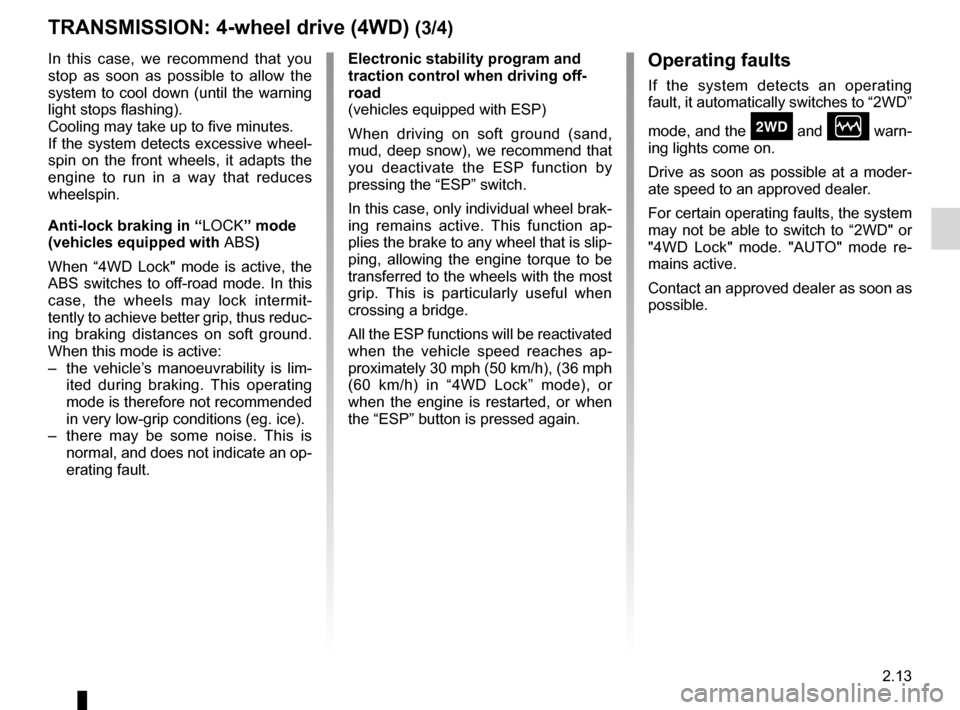
If the system detects an operating
fault, it automatically switches to “2WD”
mode, and the
‘ and Ò warn-
ing lights come on.
Drive as soon as possible at a moder-
ate speed to an approved dealer.
For certain operating faults, the system
may not be able to switch to “2WD" or
"4WD Lock" mode. "AUTO" mode re-
mains active.
Contact an approved dealer as soon as
possible.
In this case, we recommend that you
stop as soon as possible to allow the
system to cool down (until the warning
light stops flashing).
Cooling may take up to five minutes.
If the system detects excessive wheel-
spin on the front wheels, it adapts the
engine to run in a way that reduces
wheelspin.
Anti-lock braking in “
LOCK” mode
(vehicles equipped with ABS)
When “4WD Lock" mode is active, the
ABS switches to off-road mode. In this
case, the wheels may lock intermit-
tently to achieve better grip, thus reduc-
ing braking distances on soft ground.
When this mode is active:
–
t
he vehicle’s manoeuvrability is lim-
ited during braking. This operating
mode is therefore not recommended
in very low-grip conditions (eg. ice).
–
t
here may be some noise. This is
normal, and does not indicate an op-
erating fault.
Page 84 of 200

2.16
ENG_UD22494_3
Dispositifs de correction et d’assistance à la conduite (H79 - Da\
cia)
ENG_NU_898-5_H79_Dacia_2
Jaune No")
emergency brake assist........................ (up to the end of the DU)
2.16
ENG_UD22494_3
Dispositifs de correction et d’assistance à la conduite (H79 - Da\
cia)
ENG_NU_898-5_H79_Dacia_2
Jaune NoirNoir texte
DRIVER CORRECTION DEVICES/AIDS (2/4)
Emergency brake assist with
electronic brake distribution
(depending on the vehicle)
This system supplements the ABS
and helps reduce vehicle stopping dis-
tances.
Operating principle
The system is for detecting an emer-
gency braking situation. In this case,
the braking assistance immediately de-
velops maximum power and may trig-
ger ABS regulation.
ABS braking is maintained as long as
the brake pedal is applied.
Operating faults –
If
the x warning light on the in-
strument panel comes on while you
are driving, the brakes will still
work normally without ABS;
–
I
f the
x and D warning
lights on the instrument panel come
on while you are driving, there is a
fault in the braking system.
In both cases, consult an approved
Dealer.
Yo u r b r a k i n g s y s t e m s
are partially operational.
However, it is dangerous
to brake suddenly and
it is essential to stop immediately,
as soon as traffic conditions allow.
Contact an approved dealer.
Page 85 of 200

ENG_NU_898-5_H79_Dacia_2
DRIVER CORRECTION DEVICES/AIDS (3/4)
Electronic stability pro")
JauneNoirNoir texte
2.17
ENG_UD22494_3
Dispositifs de correction et d’assistance à la conduite (H79 - Da\
cia)
ENG_NU_898-5_H79_Dacia_2
DRIVER CORRECTION DEVICES/AIDS (3/4)
Electronic stability program
ESP with understeer control
and traction control ASR
Electronic Stability Program ESP
(depending on the vehicle)
This system helps you to keep control
of the vehicle in critical driving condi-
tions (avoiding an obstacle, loss of grip
on a bend, etc.). Understeer control
This system optimises the action of the
ESP in the case of pronounced unders-
teering (loss of front axle road holding).
Traction control ASR
This system helps to limit wheelspin of
the drive wheels and to control the ve-
hicle when pulling away accelerating or
decelerating.
Deactivating the function
Deactivating the ASR traction control
function also deactivates the ESP func-
tion (refer to the following page).
1
Special feature of 4-wheel
drive and 2-wheel drive
vehicles (depending on the
vehicle)
Disabling the ESP function
In some situations (driving on very wet
ground: snow, mud, etc. or driving with
snow chains fitted), the system may
reduce the engine output to limit wheel-
spin. If this is not required, it is possible
to deactivate the function by pressing
switch
1.
The
ù warning light on the instru-
ment panel comes on to warn you of
this.
If you deactivate this function, the ASR
traction control function will also be de-
activated.
As the ’ESP and ASR provide en-
hanced safety, it is not advisable to
drive with the function switched off.
Correct this as soon as possible by
pressing switch
1
again.
Page 95 of 200
JauneNoirNoir texte
3.5
ENG_UD25124_1
Chauffage - Ventilation - Air conditionné (H79 - Dacia)
ENG_NU_898-5_H79_Dacia_3
HEATING, VENTILATION, AIR CONDITIONING (2/4)
Switching air conditioning on
or off
(depending on vehicle)
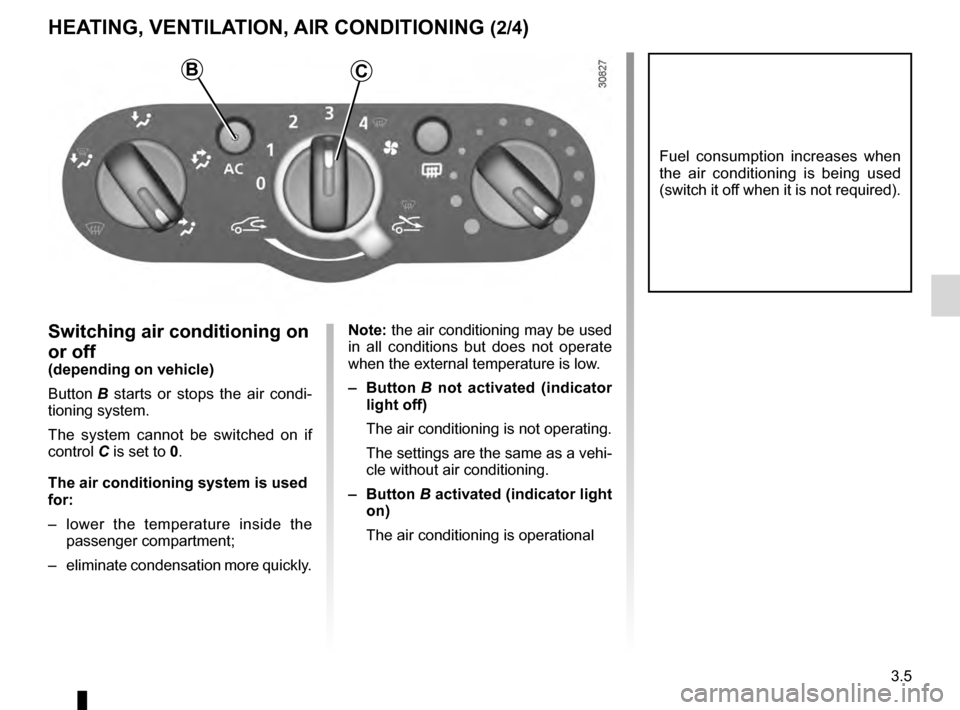
Button
B
starts or stops the air condi-
tioning system.
The system cannot be switched on if
control
C is set to 0.
The air conditioning system is used
for:
–
l
ower the temperature inside the
passenger compartment;
–
eliminate
condensation more quickly. Note: the air conditioning may be used
in all conditions but does not operate
when the external temperature is low.
–
B
utton
B n
ot activated (indicator
light off)
The air conditioning is not operating.
The settings are the same as a vehi-
cle without air conditioning.
–
Button
B activated (indicator light
on)
The air conditioning is operational
Fuel consumption increases when
the air conditioning is being used
(switch it off when it is not required).
BC
Page 127 of 200
bodywork (maintenance) ...................... (up to the end of the DU)
maintenance: bodywork ........................................ (up to the end of the DU)
washing ................................................ (up to the end of the DU)
paintwork maintenance .................................................... (current page)
4.13
ENG_UD20966_2
Entretien de la carrosserie / compartiment moteur (H79 - Dacia)
ENG_NU_898-5_H79_Dacia_4
Bodywork maintenance, engine compartment
BODyWORK MAINTENANCE, ENGINE COMPARTMENT (1/3)
A well-maintained vehicle has a longer
service life. It is therefore recom-
mended that attention is paid to the out-
side of the vehicle on a regular basis.
Protection against the effects
of corrosive agents
Although your vehicle has been treated
with very effective anti-corrosion prod-
ucts, it nevertheless remains subject to
the effects of:
–
corrosives in the atmosphere
–
atmospheric
pollution (urban and in-
dustrial areas);
–
s
aline atmosphere (near the sea,
particularly in hot weather);
–
s
easonal and damp climatic condi-
tions, (e.g.: road salt in winter, water
from road cleaners, etc.).
–
abrasives
W
ind-borne dust and sand, mud, road grit thrown up by other vehicles, etc.
–
mino
r impacts
You should take a minimum number of
precautions in order to safeguard your
vehicle against such risks and not to
lose the benefit of your vehicle’s anti-
corrosion protection.
you should not:
– Degrease or clean mechanical com-
ponents, underneath the body, parts
with hinges (eg. fuel filler cap, inside
the fuel flap) and painted plastic ex-
ternal fittings (eg. bumpers) using
high-pressure cleaning equipment
or by spraying on products not ap-
proved by our Technical Department.
If adequate precautions are not
taken, this could cause corrosion or
lead to operational faults.
–
Aim
a high pressure water jet directly
onto damaged parts of the vehicle
(eg. painted bumpers, lights, etc.).
Wash these parts carefully by hand.
–
W
ash the vehicle in bright sunlight or
freezing temperatures. –
U
se hard brushes to clean alloy
wheels. These can scratch or
damage the wheel’s protective coat-
ing.
–
S
crape off mud or dirt without
prewetting.
–
Allow
dirt to accumulate.
–
Allow
rust to form following minor im-
pacts.
–
U
se solvents not approved by the
Technical Department to remove
stains as this could damage the
paintwork.
–
D
rive when the vehicle is muddy or
covered in snow (the wheel arches,
underneath the body, radiator, etc.
must always be free from mud or
snow).
It is forbidden to wash the engine compartment using a high-pressure
water jet: this risks damaging the electrical/electronic components in the
engine compartment.
A label affixed in the engine compartment reminds you of this.
Page 128 of 200
4.14
ENG_UD20966_2
Entretien de la carrosserie / compartiment moteur (H79 - Dacia)
ENG_NU_898-5_H79_Dacia_4
Jaune NoirNoir texte
BODyWORK MAINTENANCE, ENGINE COMPARTMENT (2/3)
you should
– Respect local regulations about
washing vehicles (e.g. do not wash
your vehicle on a public highway).
–
A
lways follow the recommenda-
tions supplied with the high-pressure
cleaning equipment (jet distance and
pressure).
–
B
efore going through a roller type
car wash, return the windscreen
wiper stalk to park position (refer
to the information on “Windscreen
wash/wipe” in Section 1), check the
mounting of external accessories,
additional lights and door mirrors
and be sure to hold the wiper blades
and radio aerial in place with adhe-
sive tape. Remove the radio aerial
mast if your vehicle is fitted with this
equipment.
Remember to remove the tape and
refit the antenna after washing. –
After
driving off-road (eg. on muddy,
dusty or sandy terrain) quickly clean
the radiator from the outside of the
vehicle through the openings in the
bumper, to prevent it from becoming
blocked or clogged (risk of engine
overheating).
–
W
ash your vehicle frequently with
the engine off , using shampoo ap-
proved by our Technical Department
(never use abrasive products) and
rinse thoroughly using a warm or
cold water jet (never hot):
–
s
pots of tree resin and industrial
grime;
–
the
layer of dust or mud and any
insects;
–
b
ird droppings, which contain
chemicals that rapidly discolour
paintwork and may even cause
the paint to peel off ;
W
ash the vehicle immediately to
remove these marks since it is im-
possible to remove them by pol-
ishing; –
salt
deposited in the wheel arches
and underneath the body after
driving in areas where the roads
are chemically treated;
–
mud
in the wheel arches and un-
derneath the body which form
damp patches.
–
C
lean mud and sand from the
wheels, in particular the inside of the
wheels and the brakes, as this can:
–
reduce
the braking efficiency and
damage the components of the
braking system;
–
cause
vibrations in the bodywork
and steering column.
We have selected special products
to care for your vehicle and you can
obtain these from the manufactur-
er’s accessory outlets.
Page 130 of 200
maintenance:interior trim ...................................... (up to the end of the DU)
interior trim maintenance ................................... (up to the end of the DU)
4.16
ENG_UD22288_6
Entretien des garnitures intérieures (B90 - U90 - L90 Ph2 - F90 Ph2 \
- R90 Ph2 - H79 - Dacia)
ENG_NU_898-5_H79_Dacia_4
Jaune NoirNoir texte
Glass instrument panel(e.g.: instrument panel, clock, exterior
temperature display, radio display).
Use a soft or cotton cloth. If this does
not clean them properly, use a soft cloth
(or cotton wool) slightly moistened with
soapy water and then wipe clean with
another damp soft or cotton cloth.
Finally, dry off carefully with a soft dry
cloth.
Cleaning products containing alco-
hol must not be used under any cir-
cumstances.
Seat belts
These must be kept clean. Use products
selected by our Technical Department
or warm, soapy water and a sponge
and wipe with a dry cloth.
Detergents or dyes must not be used
under any circumstances.
Interior trim maintenance
INTERIOR TRIM MAINTENANCE (1/2)
A well-maintained vehicle will have a
longer service life. It is therefore ad-
visable to maintain the vehicle interior
regularly.
Stains should always be dealt with
quickly. Whatever type of stain is on
the trim, use soapy water (if possible,
warm water) containing:
Do not use detergents (washing up
liquid, powdered products, alcohol-
based products, etc.).
Use a soft cloth.
Rinse and soak up the excess.Fabrics (seats, door trim,
etc.)
Dust fabrics regularly.
Liquid stains
Use soapy water.
Dab lightly (never rub) with a soft cloth,
rinse and remove the excess.
Solid or thick stains
Remove any excess solid or thick ma-
terial immediately and carefully using
a spatula (from the edge inwards to
avoid spreading the stain).
Clean using the procedure for a liquid
stain.
Special instructions for sweets or
chewing gum
Put an ice cube on the stain to solidify
it, then proceed as for a solid stain.
For advice on interior maintenance
and/or on unsatisfactory results,
contact an approved dealer.
Page 138 of 200
5.6
ENG_UD22629_3
Kit de gonflage des pneumatiques (H79 - Dacia)
ENG_NU_898-5_H79_Dacia_5
Jaune NoirNoir texte
TYRE INFLATION KIT (2/3)
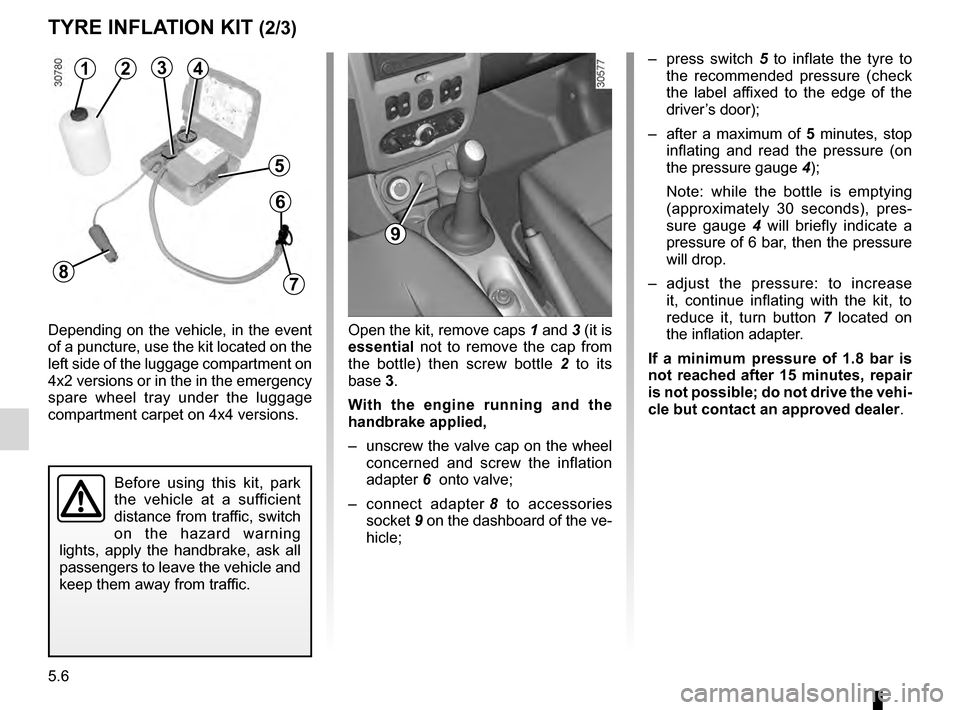
Depending on the vehicle, in the event
of a puncture, use the kit located on the
left side of the luggage compartment on
4x2 versions or in the in the emergency
spare wheel tray under the luggage
compartment carpet on 4x4 versions. –
p
ress switch
5
to inflate the tyre to
the recommended pressure (check
the label affixed to the edge of the
driver’s door);
–
after
a maximum of
5 minutes, stop
inflating and read the pressure (on
the pressure gauge
4
);
Note: while the bottle is emptying
(approximately 30 seconds), pres-
sure gauge
4
will briefly indicate a
pressure of 6 bar, then the pressure
will drop.
–
a
djust the pressure: to increase
it, continue inflating with the kit, to
reduce it, turn button 7 located on
the inflation adapter.
If a minimum pressure of 1.8 bar is
not reached after 15 minutes, repair
is not possible; do not drive the vehi-
cle but contact an approved dealer .
Before using this kit, park
the vehicle at a sufficient
distance from traffic, switch
on the hazard warning
lights, apply the handbrake, ask all
passengers to leave the vehicle and
keep them away from traffic.
Open the kit, remove caps 1 and 3 (it is
essential not to remove the cap from
the bottle) then screw bottle
2
to its
base 3.
With the engine running and the
handbrake applied,
–
unscrew
the valve cap on the wheel
concerned and screw the inflation
adapter
6 onto valve;
–
c
onnect adapter
8
to accessories
socket
9
on the dashboard of the ve-
hicle;
9
1234
5
6
78
Page 141 of 200
changing a wheel.................................. (up to the end of the DU)
practical advice ..................................... (up to the end of the DU)
jack ....................................................... (up to the end of the DU)
puncture................................................ (up to the end of the DU)
lifting the vehicle changing a wheel ............................ (up to the end of the DU)
5.9
ENG_UD20699_3
Changement de roue (H79 - Dacia)
ENG_NU_898-5_H79_Dacia_5
Changing a wheel
CHANGING A WHEEL (1/2)
Switch on the hazard warn-
ing lights.
Park the vehicle away from
traffic on firm, flat, non-slip-
pery ground (if necessary, place a
solid support under the jack base).
Apply the handbrake and engage a
gear (first or reverse gear).
Ask the passengers to leave the ve-
hicle and to keep away from traffic.
If you have a puncture, re-
place the wheel as soon as
possible.
A tyre which has been punc-
tured should always be inspected
(and repaired, where possible) by a
specialist.
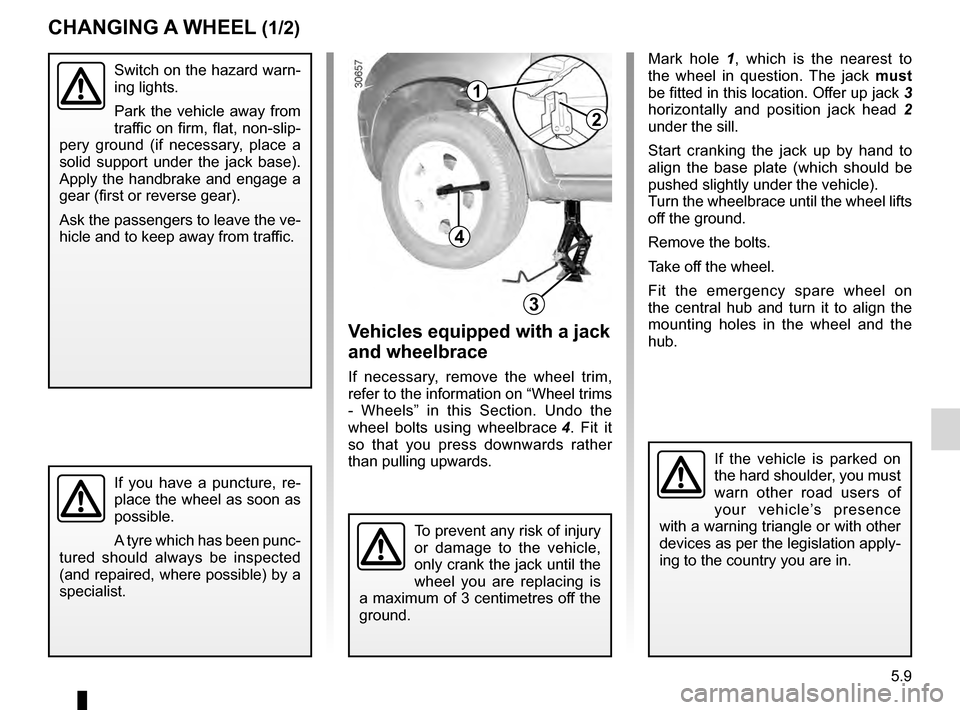
Vehicles equipped with a jack
and wheelbrace
If necessary, remove the wheel trim,
refer to the information on “Wheel trims
- Wheels” in this Section. Undo the
wheel bolts using wheelbrace
4 .
Fit it
so that you press downwards rather
than pulling upwards. Mark hole
1
,
which is the nearest to
the wheel in question. The jack must
be fitted in this location. Offer up jack
3
horizontally and position jack head
2
under the sill.
Start cranking the jack up by hand to
align the base plate (which should be
pushed slightly under the vehicle).
Turn the wheelbrace until the wheel lifts
off the ground.
Remove the bolts.
Take off the wheel.
Fit the emergency spare wheel on
the central hub and turn it to align the
mounting holes in the wheel and the
hub.
To prevent any risk of injury
or damage to the vehicle,
only crank the jack until the
wheel you are replacing is
a maximum of 3 centimetres off the
ground.
If the vehicle is parked on
the hard shoulder, you must
warn other road users of
your vehicle’s presence
with a warning triangle or with other
devices as per the legislation apply-
ing to the country you are in.
1
2
3
4
Page 149 of 200
bulbschanging ......................................... (up to the end of the DU)
changing a bulb .................................... (up to the end of the DU)
practical advice ..................................... (up to the end of the DU)
lighting: exterior ............................................ (up to the end of the DU)
lights: fog lights ......................................... (up to the end of the DU)
bulbs changing ......................................... (up to the end of the DU)
lights additional ........................................ (up to the end of the DU)
5.17
ENG_UD20701_2
Projecteurs antibrouillard : remplacement des lampes (H79 - Dacia)
ENG_NU_898-5_H79_Dacia_5
Additional lights
If you wish to fit fog lights or long range
headlights to your vehicle, consult an
approved dealer.
Fog lights
FOG LIGHTS: changing bulbs
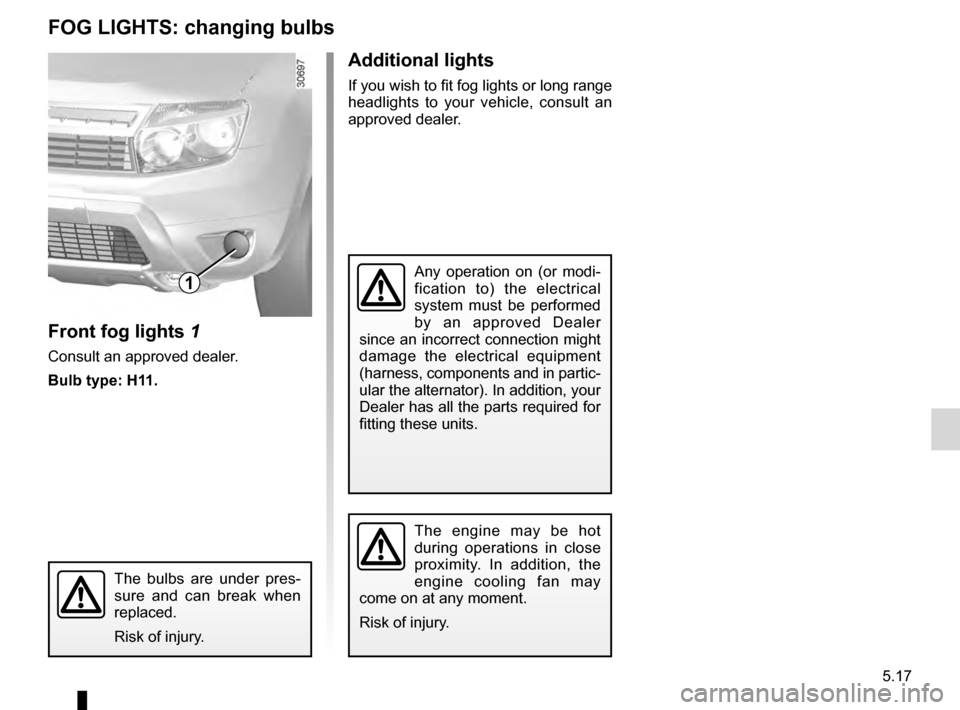
Front fog lights 1
Consult an approved dealer.
Bulb type: H11.
Any operation on (or modi-
fication to) the electrical
system must be performed
by an approved Dealer
since an incorrect connection might
damage the electrical equipment
(harness, components and in partic-
ular the alternator). In addition, your
Dealer has all the parts required for
fitting these units.
The engine may be hot
during operations in close
proximity. In addition, the
engine cooling fan may
come on at any moment.
Risk of injury.
The bulbs are under pres-
sure and can break when
replaced.
Risk of injury.
1