Lights DACIA DUSTER 2012 1.G Owner's Manual
[x] Cancel search | Manufacturer: DACIA, Model Year: 2012, Model line: DUSTER, Model: DACIA DUSTER 2012 1.GPages: 200, PDF Size: 2.4 MB
Page 68 of 200
1.62
ENG_UD22445_3
Réservoir carburant (H79 - Dacia)
ENG_NU_898-5_H79_Dacia_1
Persistent smell of fuel
If you notice a persistent
smell of fuel you should:
–
s
top the vehicle as soon
as traffic conditions allow and
switch off the ignition;
–
s
witch on the hazard warning
lights and ask your passengers to
leave the vehicle and stay clear
of the traffic;
–
contact an approved Dealer
.
No modifications what -
soever are permitted on
any part of the fuel supply
system (computers, wiring,
fuel circuit, injector, protection
covers, etc.) as this may be danger-
ous (such work must be undertaken
by qualified Network personnel).
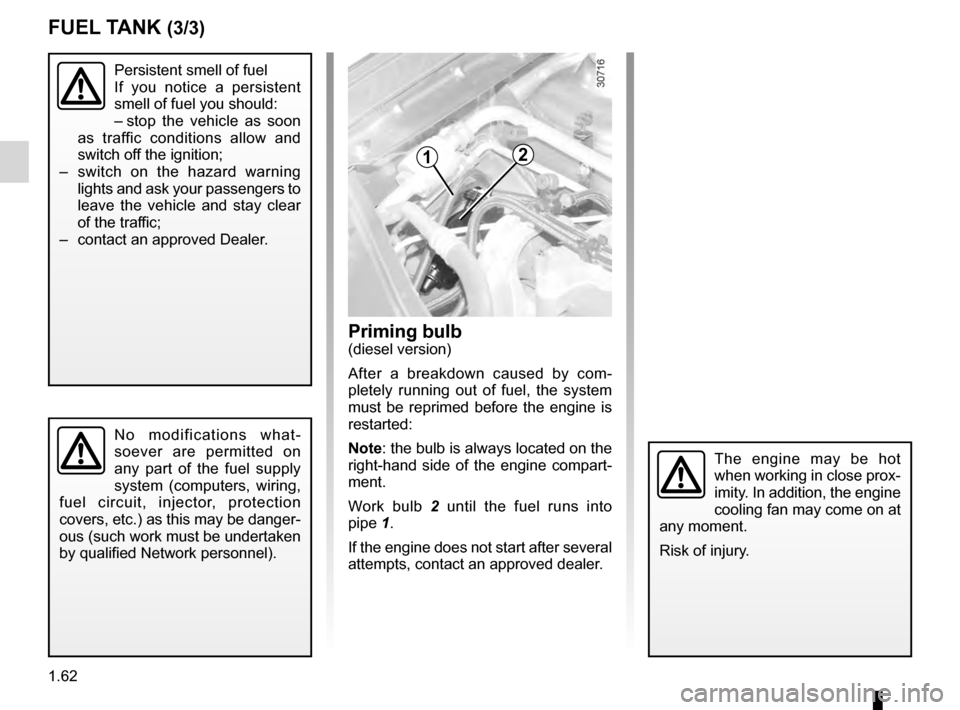
Priming bulb (diesel version)
After a breakdown caused by com-
pletely running out of fuel, the system
must be reprimed before the engine is
restarted:
Note: the bulb is always located on the
right-hand side of the engine compart-
ment.
Work bulb
2
until the fuel runs into
pipe
1.
If the engine does not start after several
attempts, contact an approved dealer.
The engine may be hot
when working in close prox-
imity. In addition, the engine
cooling fan may come on at
any moment.
Risk of injury.
FUEL TANK (3/3)
12
Page 73 of 200
driving ................................................... (up to the end of the DU)
special features of diesel versions........ (up to the end of the DU)
2.5
ENG_UD14105_1
Particularités des versions diesel (H79 - Dacia)
ENG_NU_898-5_H79_Dacia_2
Special features of diesel versions
SPECIAL FEATURES OF DIESEL VERSIONS
Diesel engine speed
Diesel engines are fitted with an injec-
tion pump which prevents the engine
speed being exceeded irrespective of
the gear selected.
If the
Ä and Ò warning lights
come on, consult an approved dealer
as soon as possible.
When driving, depending on the fuel
grade used, it is possible that white
smoke may be emitted.
This is due to the exhaust particle filter
being cleaned automatically, and does
not affect the way the vehicle runs.
Running out of fuel
If the tank has been completely
drained, the system must be reprimed
after the tank is refilled: see information
on the “Fuel tank” in Section 1 before
restarting the engine.
Precautions to be taken in
winter
To avoid any faults in icy weather:
–
ensure
that the battery is always fully
charged;
–
a
lways keep the diesel tank rela-
tively full to avoid water vapour con-
densing in it and accumulating at the
bottom of the tank.
Do not park the vehicle or
run the engine in locations
where combustible sub-
stances or materials such
as grass or leaves can come into
contact with a hot exhaust system.
Page 74 of 200
antipollutionadvice ............................................. (up to the end of the DU)
fuel advice on fuel economy .................. (up to the end of the DU)
driving ................................................... (up to the end of the DU)
fuel economy ........................................ (up to the end of the DU)
2.6
ENG_UD22435_3
Conseils : antipollution, économies de carburant, conduite (H79 - Da\
cia)
ENG_NU_898-5_H79_Dacia_2
Jaune NoirNoir texte
Advice: antipollution, fuel economy and driving
By virtue of its design, moderate fuel
consumption and initial settings, your
vehicle conforms to current antipol-
lution regulations. The manufacturer
is actively striving to reduce pollutant
exhaust gas emissions and to save
energy. But the fuel consumption of
your vehicle and the level of pollutant
exhaust gas emissions are also your
responsibility. Ensure that it is main-
tained and used correctly.Maintenance
It should be noted that failure to respect
antipollution regulations may lead to
legal action being taken against the
vehicle owner. In addition, replacing
engine, fuel supply system and exhaust
components with parts other than those
originally recommended by the manu-
facturer may alter your vehicle so that
it no longer complies with antipollution
standards. Have your vehicle adjusted
and checked by an authorised dealer,
in accordance with the instructions
given in your maintenance schedule:
they will have all the equipment nec-
essary for ensuring that your vehicle is
maintained to its original standard.
Engine adjustments
Air filter, diesel filter: a choked ele-
ment hinders performance. It must be
replaced. Exhaust gas monitoring system
The exhaust gas monitoring system will
detect any operating faults in the vehi-
cle’s antipollution system.
If this system malfunctions, toxic sub-
stances may be released into the at-
mosphere or damage may occur.
ÄThis warning light on the in-
strument panel will indicate if
there are any faults in the system:
This lights up when the ignition is
switched on and goes out when the
engine is started.
–
If
it lights up continuously, consult an
approved Dealer as soon as possi-
ble;
–
if
it flashes, reduce the engine speed
until the light stops flashing. Contact
your approved dealer as soon as
possible.
ADVICE: antipollution, fuel economy and driving (1/3)
Page 76 of 200

ENG_NU_898-5_H79_Dacia_2
ADVICE: antipollution, fuel economy and driving (3/3)
– In vehicles fitted w")
2.8
ENG_UD22435_3
Conseils : antipollution, économies de carburant, conduite (H79 - Da\
cia)
ENG_NU_898-5_H79_Dacia_2
ADVICE: antipollution, fuel economy and driving (3/3)
– In vehicles fitted with air condi-
tioning, it is normal to observe an
increase in fuel consumption (es-
pecially in urban conditions) when
it is used. For vehicles fitted with
manual air conditioning, switch off
the system when it is not required.
Advice for reducing consumption
and therefore helping to preserve
the environment:
If the vehicle has been parked in the
sun, open the doors for a few mo-
ments to let the hot air escape before
starting the engine.
–
N
ever fill the fuel tank right to the
brim to avoid overflow.
–
D
o not leave an empty roof rack
fitted to the vehicle.
–
It
is better to fit a trailer for bulky ob-
jects.
–
W
hen towing a caravan, fit a wind
deflector and adjust it carefully.
Advice on use
– Electricity is fuel; switch off all the electrical components which are
not really needed. However (safety
first), keep your lights on when the
visibility is bad (“see and be seen”).
–
U
se the air vents. Driving with the
windows open at 60 mph (100 km/h)
will increase fuel consumption by
4%. –
A
void using the vehicle for door-to-
door journeys (short journeys, with
long stops in-between) because in
these conditions, the engine never
reaches its ideal temperature.
Tyres
Increased fuel consumption could be
the result of:
–
insuf
ficient pressure,
–
using non-recommended tyres.
Page 80 of 200
2.12
ENG_UD20643_3
Transmission : 4 roues motrices (4WD) (H79 - Dacia)
ENG_NU_898-5_H79_Dacia_2
Jaune NoirNoir texte
TRANSMISSION: 4-wheel drive (4WD) (2/4)
This problem may be resolved by
changing the tyres. Always use four
identical tyres (same brand, profile,
etc.) and with similar wear.
In the event of excessive wheelspin,
the mechanical components may be
overheating.
If this happens:
–
a
t first, the
’ warning light
flashes. “4WD Lock” mode is still
active, however we recommend that
you stop as soon as possible to allow
the system to cool down (until the
warning light stops flashing);
–
if
the wheels still spin, the system au-
tomatically switches to “2WD” mode
to protect the mechanical compo-
nents.
The
‘ warning light flashes. The
mode cannot be changed while the
light is flashing.
After one minute, the system switches
to “2WD” or “AUTO” mode depending
on the position of the selector.
Note:
if the vehicle speed exceeds
36
m
ph (60
k
m/h) in 4WD Lock mode,
the system automatically switches back
to AUTO mode. The
’ indicator
light goes out.
Special features of the
4-wheel drive transmission
The vehicle may make more noise when
the “AUTO" or "4WD Lock" modes are
activated. This is normal. If the system
detects a difference in the dimensions
of the front and rear wheels (eg. un-
derinflation, severe wear on an axle),
the system automatically switches to
"2WD" mode.
The
‘ and Ò warning lights on
the instrument panel come on. Drive as
soon as possible at a moderate speed
to an approved dealer.
To deactivate this mode, turn selector
1
to the “AUTO” position. The
‘ indi-
cator light on the instrument panel goes
out.
“4WD Lock" mode
To activate this mode, turn selector 1 to
t he “4WD Lock” position. The selector
the returns to the “AUTO” position. The
’ indicator light will light up on the
instrument panel.
Operating principle
“4WD Lock” mode distributes the
engine torque between the front and
rear axles in order to optimise the per-
formance capacity of the vehicle in off-
road situations. This mode should only
be used in extreme driving conditions
(mud, steep slopes, sand).
To deactivate this mode, turn selector
1
to the “4WD Lock” position again. The
indicator light on the instrument panel
goes out. When the engine is switched
off, the system stays in “4WD Lock”
mode for one minute.
Page 81 of 200
JauneNoirNoir texte
2.13
ENG_UD20643_3
Transmission : 4 roues motrices (4WD) (H79 - Dacia)
ENG_NU_898-5_H79_Dacia_2
TRANSMISSION: 4-wheel drive (4WD) (3/4)
Electronic stability program and
traction control when driving off-
road
(vehicles equipped with ESP)
When driving on soft ground (sand,
mud, deep snow), we recommend that
you deactivate the ESP function by
pressing the “ESP” switch.
In this case, only individual wheel brak-
ing remains active. This function ap-
plies the brake to any wheel that is slip-
ping, allowing the engine torque to be
transferred to the wheels with the most
grip. This is particularly useful when
crossing a bridge.
All the ESP functions will be reactivated
when the vehicle speed reaches ap-
proximately 30 mph (50 km/h), (36 mph
(60 km/h) in “4WD Lock” mode), or
when the engine is restarted, or when
the “ESP” button is pressed again.Operating faults
If the system detects an operating
fault, it automatically switches to “2WD”
mode, and the
‘ and Ò warn-
ing lights come on.
Drive as soon as possible at a moder-
ate speed to an approved dealer.
For certain operating faults, the system
may not be able to switch to “2WD" or
"4WD Lock" mode. "AUTO" mode re-
mains active.
Contact an approved dealer as soon as
possible.
In this case, we recommend that you
stop as soon as possible to allow the
system to cool down (until the warning
light stops flashing).
Cooling may take up to five minutes.
If the system detects excessive wheel-
spin on the front wheels, it adapts the
engine to run in a way that reduces
wheelspin.
Anti-lock braking in “
LOCK” mode
(vehicles equipped with ABS)
When “4WD Lock" mode is active, the
ABS switches to off-road mode. In this
case, the wheels may lock intermit-
tently to achieve better grip, thus reduc-
ing braking distances on soft ground.
When this mode is active:
–
t
he vehicle’s manoeuvrability is lim-
ited during braking. This operating
mode is therefore not recommended
in very low-grip conditions (eg. ice).
–
t
here may be some noise. This is
normal, and does not indicate an op-
erating fault.
Page 84 of 200

2.16
ENG_UD22494_3
Dispositifs de correction et d’assistance à la conduite (H79 - Da\
cia)
ENG_NU_898-5_H79_Dacia_2
Jaune No")
emergency brake assist........................ (up to the end of the DU)
2.16
ENG_UD22494_3
Dispositifs de correction et d’assistance à la conduite (H79 - Da\
cia)
ENG_NU_898-5_H79_Dacia_2
Jaune NoirNoir texte
DRIVER CORRECTION DEVICES/AIDS (2/4)
Emergency brake assist with
electronic brake distribution
(depending on the vehicle)
This system supplements the ABS
and helps reduce vehicle stopping dis-
tances.
Operating principle
The system is for detecting an emer-
gency braking situation. In this case,
the braking assistance immediately de-
velops maximum power and may trig-
ger ABS regulation.
ABS braking is maintained as long as
the brake pedal is applied.
Operating faults –
If
the x warning light on the in-
strument panel comes on while you
are driving, the brakes will still
work normally without ABS;
–
I
f the
x and D warning
lights on the instrument panel come
on while you are driving, there is a
fault in the braking system.
In both cases, consult an approved
Dealer.
Yo u r b r a k i n g s y s t e m s
are partially operational.
However, it is dangerous
to brake suddenly and
it is essential to stop immediately,
as soon as traffic conditions allow.
Contact an approved dealer.
Page 86 of 200

ENG_NU_898-5_H79_Dacia_2
DRIVER CORRECTION DEVICES/AIDS (4/4)
Operating faults
When the system detects")
2.18
ENG_UD22494_3
Dispositifs de correction et d’assistance à la conduite (H79 - Da\
cia)
ENG_NU_898-5_H79_Dacia_2
DRIVER CORRECTION DEVICES/AIDS (4/4)
Operating faults
When the system detects an operating
fault, warning lights
Ò and ù
light up on the instrument panel. In this
case, the ESP and ASR are deacti-
vated.
Please consult an authorised dealer if
these warning lights remain displayed
on the instrument panel after the igni-
tion is switched off and on again.
Note:
the function is automatically re-
activated when the ignition is switched
on, or when the speed exceeds 30 mph
(50 km/h) in AUTO and 2WD modes,
and approximately 36 mph (60 km/h) in
4WD Lock mode.
Operating principle
A sensor in the steering wheel detects
the direction selected by the driver.
Other sensors throughout the vehicle
measure the actual direction.
The system compares driver input to
the actual trajectory of the vehicle and
corrects the trajectory if necessary by
controlling the braking of certain wheels
and/or engine power. In the event that
the system is engaged, indicator light
ù flashes on the instrument panel.
Page 127 of 200
bodywork (maintenance) ...................... (up to the end of the DU)
maintenance: bodywork ........................................ (up to the end of the DU)
washing ................................................ (up to the end of the DU)
paintwork maintenance .................................................... (current page)
4.13
ENG_UD20966_2
Entretien de la carrosserie / compartiment moteur (H79 - Dacia)
ENG_NU_898-5_H79_Dacia_4
Bodywork maintenance, engine compartment
BODyWORK MAINTENANCE, ENGINE COMPARTMENT (1/3)
A well-maintained vehicle has a longer
service life. It is therefore recom-
mended that attention is paid to the out-
side of the vehicle on a regular basis.
Protection against the effects
of corrosive agents
Although your vehicle has been treated
with very effective anti-corrosion prod-
ucts, it nevertheless remains subject to
the effects of:
–
corrosives in the atmosphere
–
atmospheric
pollution (urban and in-
dustrial areas);
–
s
aline atmosphere (near the sea,
particularly in hot weather);
–
s
easonal and damp climatic condi-
tions, (e.g.: road salt in winter, water
from road cleaners, etc.).
–
abrasives
W
ind-borne dust and sand, mud, road grit thrown up by other vehicles, etc.
–
mino
r impacts
You should take a minimum number of
precautions in order to safeguard your
vehicle against such risks and not to
lose the benefit of your vehicle’s anti-
corrosion protection.
you should not:
– Degrease or clean mechanical com-
ponents, underneath the body, parts
with hinges (eg. fuel filler cap, inside
the fuel flap) and painted plastic ex-
ternal fittings (eg. bumpers) using
high-pressure cleaning equipment
or by spraying on products not ap-
proved by our Technical Department.
If adequate precautions are not
taken, this could cause corrosion or
lead to operational faults.
–
Aim
a high pressure water jet directly
onto damaged parts of the vehicle
(eg. painted bumpers, lights, etc.).
Wash these parts carefully by hand.
–
W
ash the vehicle in bright sunlight or
freezing temperatures. –
U
se hard brushes to clean alloy
wheels. These can scratch or
damage the wheel’s protective coat-
ing.
–
S
crape off mud or dirt without
prewetting.
–
Allow
dirt to accumulate.
–
Allow
rust to form following minor im-
pacts.
–
U
se solvents not approved by the
Technical Department to remove
stains as this could damage the
paintwork.
–
D
rive when the vehicle is muddy or
covered in snow (the wheel arches,
underneath the body, radiator, etc.
must always be free from mud or
snow).
It is forbidden to wash the engine compartment using a high-pressure
water jet: this risks damaging the electrical/electronic components in the
engine compartment.
A label affixed in the engine compartment reminds you of this.
Page 128 of 200
4.14
ENG_UD20966_2
Entretien de la carrosserie / compartiment moteur (H79 - Dacia)
ENG_NU_898-5_H79_Dacia_4
Jaune NoirNoir texte
BODyWORK MAINTENANCE, ENGINE COMPARTMENT (2/3)
you should
– Respect local regulations about
washing vehicles (e.g. do not wash
your vehicle on a public highway).
–
A
lways follow the recommenda-
tions supplied with the high-pressure
cleaning equipment (jet distance and
pressure).
–
B
efore going through a roller type
car wash, return the windscreen
wiper stalk to park position (refer
to the information on “Windscreen
wash/wipe” in Section 1), check the
mounting of external accessories,
additional lights and door mirrors
and be sure to hold the wiper blades
and radio aerial in place with adhe-
sive tape. Remove the radio aerial
mast if your vehicle is fitted with this
equipment.
Remember to remove the tape and
refit the antenna after washing. –
After
driving off-road (eg. on muddy,
dusty or sandy terrain) quickly clean
the radiator from the outside of the
vehicle through the openings in the
bumper, to prevent it from becoming
blocked or clogged (risk of engine
overheating).
–
W
ash your vehicle frequently with
the engine off , using shampoo ap-
proved by our Technical Department
(never use abrasive products) and
rinse thoroughly using a warm or
cold water jet (never hot):
–
s
pots of tree resin and industrial
grime;
–
the
layer of dust or mud and any
insects;
–
b
ird droppings, which contain
chemicals that rapidly discolour
paintwork and may even cause
the paint to peel off ;
W
ash the vehicle immediately to
remove these marks since it is im-
possible to remove them by pol-
ishing; –
salt
deposited in the wheel arches
and underneath the body after
driving in areas where the roads
are chemically treated;
–
mud
in the wheel arches and un-
derneath the body which form
damp patches.
–
C
lean mud and sand from the
wheels, in particular the inside of the
wheels and the brakes, as this can:
–
reduce
the braking efficiency and
damage the components of the
braking system;
–
cause
vibrations in the bodywork
and steering column.
We have selected special products
to care for your vehicle and you can
obtain these from the manufactur-
er’s accessory outlets.