warning DACIA LODGY 2012 1.G Owner's Manual
[x] Cancel search | Manufacturer: DACIA, Model Year: 2012, Model line: LODGY, Model: DACIA LODGY 2012 1.GPages: 196, PDF Size: 5.73 MB
Page 62 of 196
Downloaded from www.Manualslib.com manuals search engine headlight flashers ................................. (up to the end of the DU)
horn ...................................................... (up to the end of the DU)
indicators .............................................. (up to the end of the DU)
lights: direction indicators .......................... (up to the end of the DU)
lights: hazard warning ............................... (up to the end of the DU)
indicators: direction indicators .......................... (up to the end of the DU)
hazard warning lights signal ................. (up to the end of the DU)
hazard warning lights signal ................. (up to the end of the DU)
horn ...................................................... (up to the end of the DU)
1.57
ENG_UD24422_1
Avertisseurs sonore et lumineux (X92 - Renault)
ENG_NU_975-3_X92_Dacia_1
Audible and visual signals
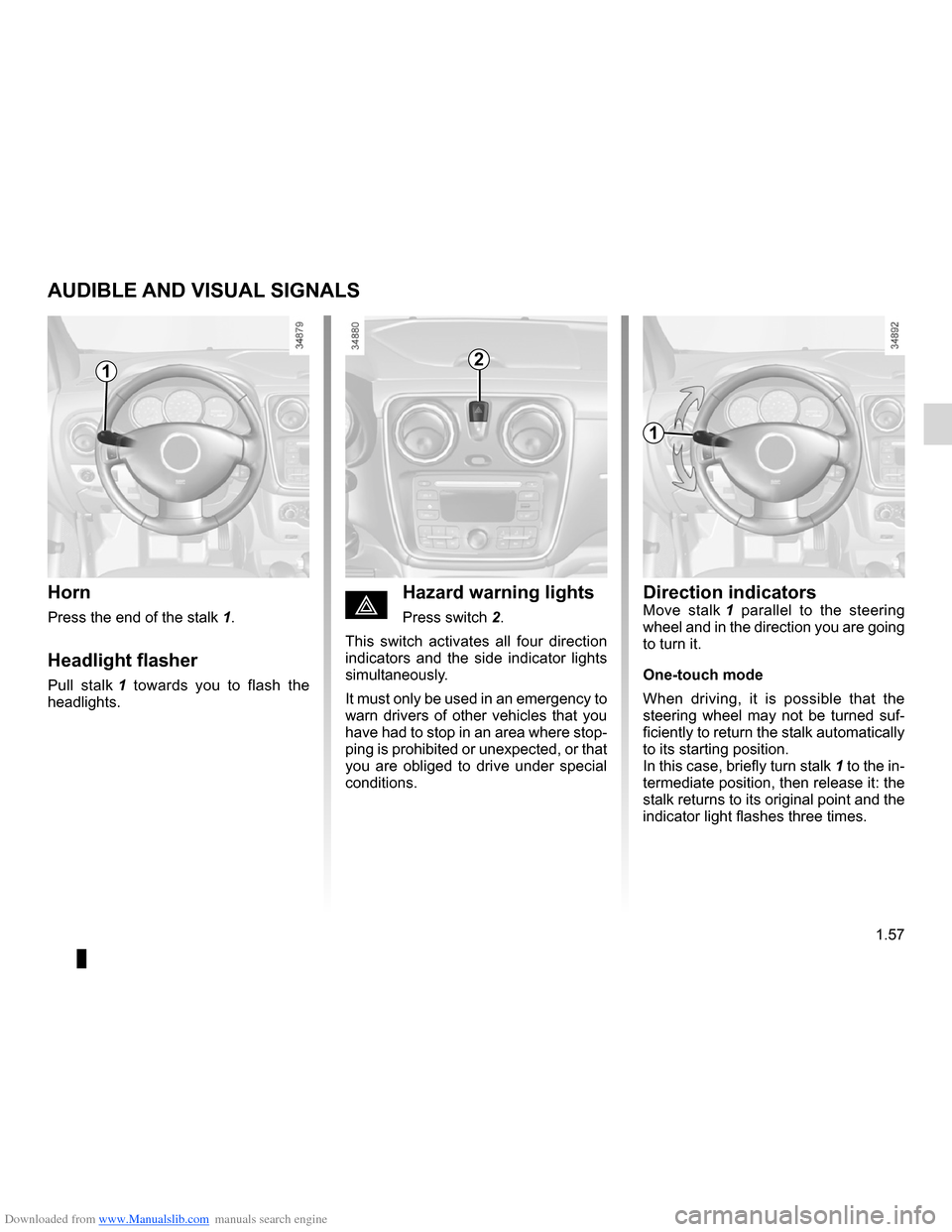
AUDIBLE AND VISUAL SIGNALS
Horn
Press the end of the stalk 1.
Headlight flasher
Pull stalk 1 towards you to flash the
headlights.
Direction indicatorsMove stalk 1 parallel to the steering
wheel and in the direction you are going
to turn it.
One-touch mode
When driving, it is possible that the
steering wheel may not be turned suf -
ficiently to return the stalk automatically
to its starting position.
In this case, briefly turn stalk 1 to the in-
termediate position, then release it: the
stalk returns to its original point and the
indicator light flashes three times.éHazard warning lights
Press switch 2.
This switch activates all four direction
indicators and the side indicator lights
simultaneously.
It must only be used in an emergency to
warn drivers of other vehicles that you
have had to stop in an area where stop-
ping is prohibited or unexpected, or that
you are obliged to drive under special
conditions.
1
1
2
Page 66 of 196
Downloaded from www.Manualslib.com manuals search engine fuelfilling ................................................................. (current page)
JauneNoirNoir texte
1.61
ENG_UD24425_1
Réservoir carburant (X92 - Renault)
ENG_NU_975-3_X92_Dacia_1
FUEL TANK (2/3)
Petrol version
It is essential to use unleaded petrol.
The octane rating (RON) should match
the information given on the label B lo-
cated inside the fuel filler flap.
Diesel versions
It is essential to use diesel fuel that
conforms to the specifications given on
the label inside fuel flap B.Filling with fuel
With the ignition off, insert the nozzle to
open the valve and insert it fully before
turning it on to fill the fuel tank (risk of
splashing).
Keep the nozzle in this position
throughout the entire filling operation.
When the pump cuts out automatically
at the end of the filling procedure, a
maximum of two further filling attempts
may be made, as there must be suffi -
cient space in the fuel tank to allow for
expansion.
Make sure that no water enters the fuel
tank during filling. The valve and its sur-
round must remain clean.
Petrol versions
Using leaded petrol will damage the
antipollution system and may lead to a
loss of warranty.
To ensure that the fuel tank is not filled
with leaded petrol, the fuel tank filler
neck contains a restrictor fitted with a
foolproof system which only allows
the nozzle for unleaded petrol to be
used (at the pump).
Persistent fuel odour
If you notice a persistent
fuel odour you should:
– stop the vehicle as soon as traf-
fic conditions allow and switch off
the ignition;
– switch on the hazard warning
lights and ask your passengers to
leave the vehicle and stay clear
of the traffic;
– contact an approved Dealer.
Page 70 of 196
Downloaded from www.Manualslib.com manuals search engine driving ................................................... (up to the end of the DU)
starting .................................................. (up to the end of the DU)
starting the engine ................................ (up to the end of the DU)
2.3
ENG_UD28712_3
Démarrage, Arrêt du moteur (X92 - Renault)
ENG_NU_975-3_X92_Dacia_2
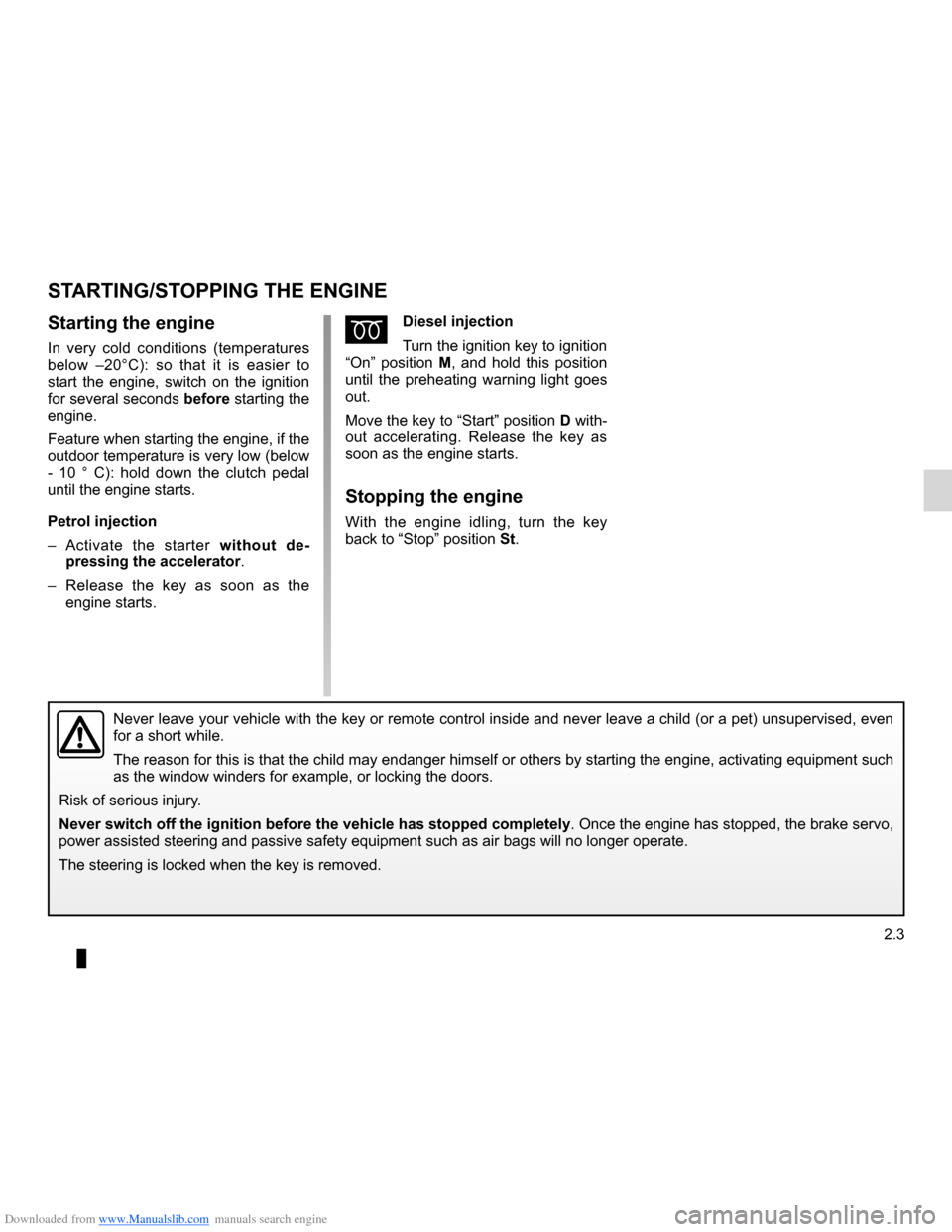
ÉDiesel injection
Turn the ignition key to ignition
“On” position M, and hold this position
until the preheating warning light goes
out.
Move the key to “Start” position D with-
out accelerating. Release the key as
soon as the engine starts.
Stopping the engine
With the engine idling, turn the key
back to “Stop” position St.
Starting the engine
In very cold conditions (temperatures
below –20°C): so that it is easier to
start the engine, switch on the ignition
for several seconds before starting the
engine.
Feature when starting the engine, if the
outdoor temperature is very low (below
- 10 ° C): hold down the clutch pedal
until the engine starts.
Petrol injection
– Activate the starter without de-
pressing the accelerator.
– Release the key as soon as the
engine starts.
Starting, Stopping the engine
STARTING/STOPPING THE ENGINE
Never leave your vehicle with the key or remote control inside and never leave a child (or a pet) unsupervised, even
for a short while.
The reason for this is that the child may endanger himself or others by starting the engine, activating equipment such
as the window winders for example, or locking the doors.
Risk of serious injury.
Never switch off the ignition before the vehicle has stopped completely. Once the engine has stopped, the brake servo,
power assisted steering and passive safety equipment such as air bags wi\
ll no longer operate.
The steering is locked when the key is removed.
Page 71 of 196
Downloaded from www.Manualslib.com manuals search engine special features of petrol vehicles ........ (up to the end of the DU)
driving ................................................... (up to the end of the DU)
catalytic converter ................................. (up to the end of the DU)
2.4
ENG_UD10826_1
Particularités des versions essence (X95 - J95 - R95 - Renault)
ENG_NU_975-3_X92_Dacia_2
Special features of petrol versions
SPECIAl fEATURES Of PETROl vERSIONS
Do not park the vehicle or
run the engine in locations
where combustible sub -
stances or materials such
as grass or leaves can come into
contact with the hot exhaust system.
The following operating conditions
should be avoided:
– driving for long periods when the low
fuel level warning light is lit;
– using leaded petrol;
– using fuel or lubrication additives
which are not approved.
Or operating faults such as:
– faulty ignition, running out of fuel or
disconnected spark plugs resulting
in the engine misfiring or cutting out
when driving;
– loss of power,
may cause the catalytic converter to
overheat, reducing its efficiency which
may irreparably damage it and cause
heat damage to the vehicle. If you notice any of the above operating
faults, have the necessary repairs car-
ried out as soon as possible by an ap-
proved dealer.
These faults may be avoided by regu
-
larly taking your vehicle to an approved
Dealer at the intervals specified in the
Maintenance Document.
Starting problems
To avoid damaging the catalytic con -
verter, do not keep trying to start the
engine (using the start button, or by
pushing or towing the vehicle) without
having identified and corrected the
cause of the fault.
If the fault cannot be identified, do not
continue to try and start the engine, but
contact an approved dealer.
Page 74 of 196

ENG_NU_975-3_X92_Da")
Downloaded from www.Manualslib.com manuals search engine JauneNoirNoir texte
2.7
ENG_UD19988_2
Conseils antipollution, économies de carburant, conduite (X65 - X65 \
PH5 - Renault)
ENG_NU_975-3_X92_Dacia_2
– Brake as little as possible by suitably
anticipating an obstacle or bend and
then simply releasing the accelerator
pedal.
– Avoid sudden acceleration.
– Do not overrev the engine in the in-
termediate gears.
Always use the highest gear possi -
ble without labouring the engine.
– Do not try to maintain the same
speed up a hill, accelerate no more
than you would on level roads. Keep
your foot in the same position on the
accelerator pedal.
– Double declutching and accelerating
before switching off the engine are
unnecessary in modern vehicles.
– Bad weather, flooded roads.
Do not drive through water
if it is higher than the lower
edge of the wheel rim.
Exhaust gas monitoring
system
The exhaust gas monitoring system will
detect any operating faults in the vehi-
cle’s antipollution system.
If this system malfunctions, toxic sub -
stances may be released into the at -
mosphere or damage may occur.
ÄThis warning light on the in -
strument panel will indicate if
there are any faults in the system:
This lights up when the ignition is
switched on and goes out when the
engine is started.
– If it lights up continuously, consult
your approved dealer as soon as
possible;
– if it flashes, reduce the engine speed
until the light stops flashing. Contact
your approved dealer as soon as
possible.
Driving
– Drive carefully for the first few miles
until the engine reaches its normal
operating temperature, rather than
let it warm up while the vehicle is sta-
tionary.
– Speed is expensive.
– Sporty driving uses a lot of fuel: drive
with a light right foot.
ADvICE: antipollution, fuel economy and driving (2/3)
Driver obstruction
On the driver’s side, only use mats suitable for the vehicle, attached with
the pre-fitted components, and check the fitting regularly. Do not lay sev-
eral mats on top of each other.
There is a risk of wedging the pedals.
Page 79 of 196
Downloaded from www.Manualslib.com manuals search engine driving ................................................... (up to the end of the DU)
ABS ...................................................... (up to the end of the DU)
anti-lock braking system: ABS ..............(up to the end of the DU)
ASR (traction control) ........................... (up to the end of the DU)
traction control: ASR .............................(up to the end of the DU)
ESP: Electronic Stability Program ........ (up to the end of the DU)
traction control: ASR .............................(up to the end of the DU)
emergency braking ............................... (up to the end of the DU)
Electronic Stability Program: ESP ........ (up to the end of the DU)
2.12
ENG_UD24436_1
Dispositifs de correction et d’assistance à la conduite (X92 - Re\
nault)
ENG_NU_975-3_X92_Dacia_2
Jaune NoirNoir texte
Driver correction devices and aids
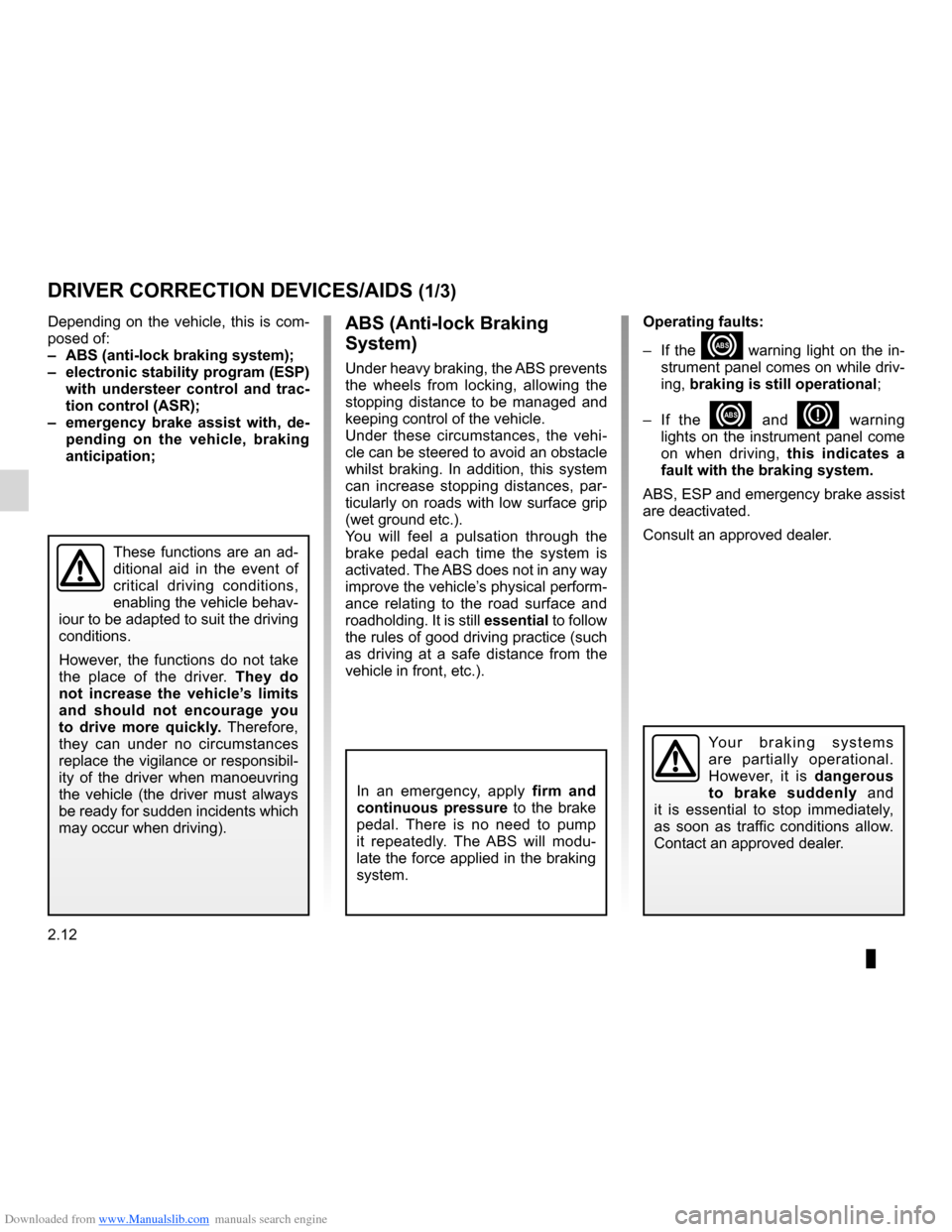
DRIvER CORRECTION DEvICES/AIDS (1/3)
ABS (Anti-lock Braking
System)
Under heavy braking, the ABS prevents
the wheels from locking, allowing the
stopping distance to be managed and
keeping control of the vehicle.
Under these circumstances, the vehi -
cle can be steered to avoid an obstacle
whilst braking. In addition, this system
can increase stopping distances, par -
ticularly on roads with low surface grip
(wet ground etc.).
You will feel a pulsation through the
brake pedal each time the system is
activated. The ABS does not in any way
improve the vehicle’s physical perform-
ance relating to the road surface and
roadholding. It is still essential to follow
the rules of good driving practice (such
as driving at a safe distance from the
vehicle in front, etc.). Operating faults:
–
If the
x warning light on the in-
strument panel comes on while driv-
ing, braking is still operational ;
– If the
x and D warning
lights on the instrument panel come
on when driving, this indicates a
fault with the braking system.
ABS, ESP and emergency brake assist
are deactivated.
Consult an approved dealer.
Depending on the vehicle, this is com-
posed of:
– ABS (anti-lock braking system);
– electronic stability program (ESP)
with understeer control and trac -
tion control (ASR);
– emergency brake assist with, de -
pending on the vehicle, braking
anticipation;
In an emergency, apply firm and
continuous pressure to the brake
pedal. There is no need to pump
it repeatedly. The ABS will modu -
late the force applied in the braking
system.
These functions are an ad-
ditional aid in the event of
critical driving conditions,
enabling the vehicle behav -
iour to be adapted to suit the driving
conditions.
However, the functions do not take
the place of the driver. They do
not increase the vehicle’s limits
and should not encourage you
to drive more quickly. Therefore,
they can under no circumstances
replace the vigilance or responsibil -
ity of the driver when manoeuvring
the vehicle (the driver must always
be ready for sudden incidents which
may occur when driving).
Yo u r b r a k i n g s y s t e m s
are partially operational.
However, it is dangerous
to brake suddenly and
it is essential to stop immediately,
as soon as traffic conditions allow.
Contact an approved dealer.
Page 80 of 196

ENG_NU_975-3_X92_Dacia_2
DR")
Downloaded from www.Manualslib.com manuals search engine JauneNoirNoir texte
2.13
ENG_UD24436_1
Dispositifs de correction et d’assistance à la conduite (X92 - Re\
nault)
ENG_NU_975-3_X92_Dacia_2
DRIvER CORRECTION DEvICES/AIDS (2/3)
Electronic stability program
(ESP) with understeer control
and traction control (ASR)
Electronic stability control ESC
This system helps you to keep control
of the vehicle in critical driving condi -
tions (avoiding an obstacle, loss of grip
on a bend, etc.).
Operating principle
A sensor in the steering wheel detects
the direction selected by the driver.
Other sensors throughout the vehicle
measure the actual direction.
The system compares driver input to
the actual trajectory of the vehicle and
corrects the trajectory if necessary by
controlling the braking of certain wheels
and/or engine power. In the event that
the system is engaged, indicator light
flashes on the instrument panel. Operating faults
When the system detects an operating
fault, the
and/or warning
lights on the instrument panel come on.
In this case, the ESP and traction con-
trol are deactivated.
Consult an approved dealer.
Understeer control
This system optimises the action of the
ESP in the case of pronounced unders-
teering (loss of front axle grip).
Traction control ASR
This system helps to limit wheelspin of
the drive wheels and to control the ve-
hicle when pulling away accelerating or
decelerating.
Operating principle
Using the wheel sensors, the system
measures and compares the speed of
the drive wheels at all times and slows
down their over-rotation. If a wheel is
starting to slip, the system brakes au
-
tomatically until the drive supplied be -
comes compatible with the level of grip
under the wheel again.
The system also adjusts the engine
speed to the grip available under the
wheels, independently of the pressure
exerted on the accelerator pedal.
Page 81 of 196
Downloaded from www.Manualslib.com manuals search engine emergency brake assist........................(up to the end of the DU)
2.14
ENG_UD24436_1
Dispositifs de correction et d’assistance à la conduite (X92 - Re\
nault)
ENG_NU_975-3_X92_Dacia_2
DRIvER CORRECTION DEvICES/AIDS (3/3)
The traction control ASR offers addi -
tional safety, it is recommended that
you do not drive with the function disa-
bled. Correct this as soon as possible
by pressing switch 1 again.
Note: The function is reactivated auto-
matically when the ignition is switched
on or when a speed of approximately
30 mph (50 km/h) is exceeded.
Emergency brake assist
This is an additional system to ABS
which helps reduce vehicle stopping
distances.
Operating principle
The system detects an emergency
braking situation. In this case, the brak-
ing assistance immediately develops
maximum power and may trigger ABS
regulation.
ABS braking is maintained as long as
the brake pedal is not released.
Hazard warning lights switching on
Depending on the vehicle, these may
light up in the event of sudden decel -
eration.
Operating faults
When the system detects an operating
fault, the warning light
x is dis -
played on the instrument panel.
Consult an approved dealer.
Braking anticipation
Depending on the vehicle, when you
rapidly release the accelerator, the
system anticipates the braking ma -
noeuvre in order to reduce stopping
distances.
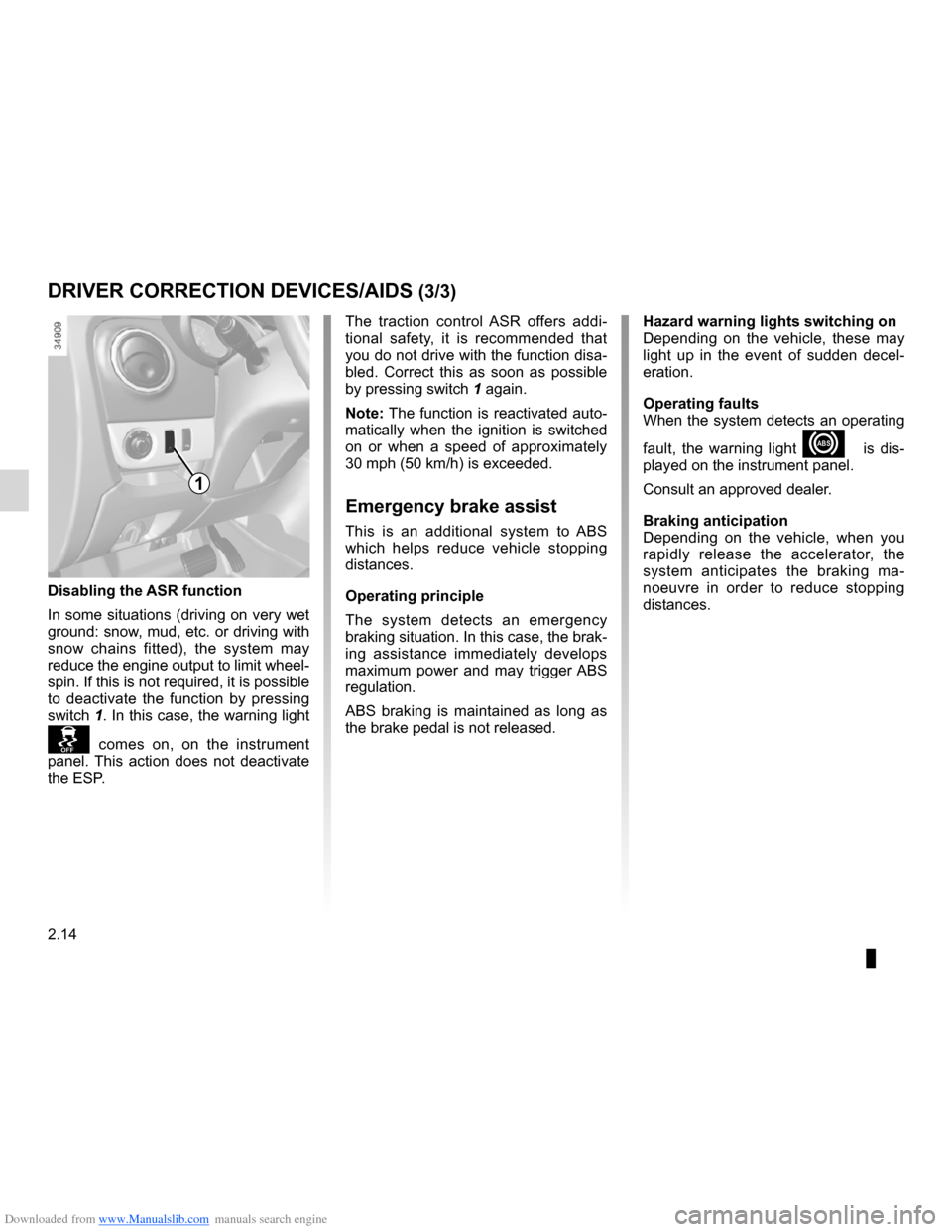
Disabling the ASR function
In some situations (driving on very wet
ground: snow, mud, etc. or driving with
snow chains fitted), the system may
reduce the engine output to limit wheel
-
spin. If this is not required, it is possible
to deactivate the function by pressing
switch 1. In this case, the warning light
comes on, on the instrument
panel. This action does not deactivate
the ESP.
1
Page 82 of 196
Downloaded from www.Manualslib.com manuals search engine speed limiter ......................................... (up to the end of the DU)
driving ................................................... (up to the end of the DU)
2.15
ENG_UD26663_2
Régulateur-limiteur de vitesses : fonction limiteur (X92 - Renault)\
ENG_NU_975-3_X92_Dacia_2
Speed limiter
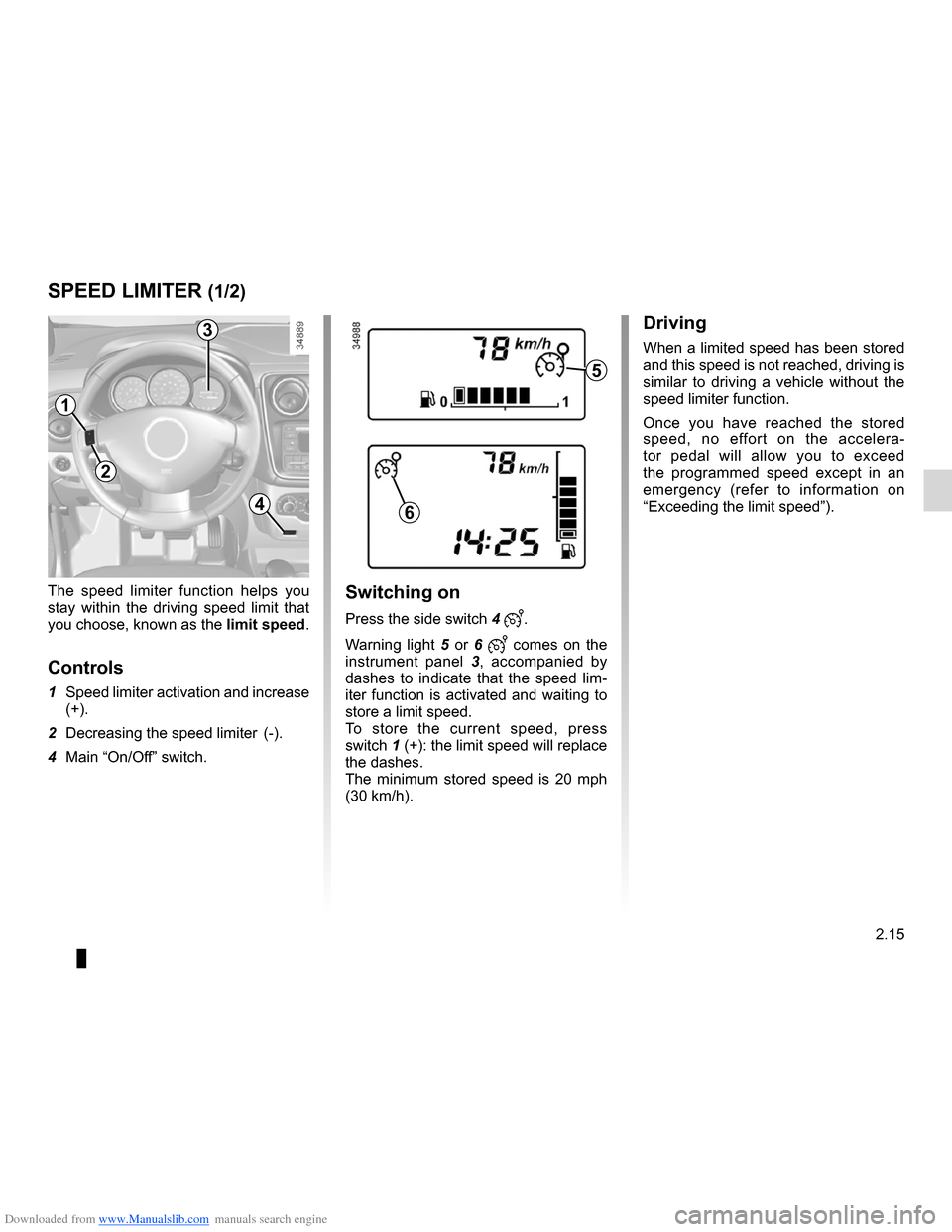
The speed limiter function helps you
stay within the driving speed limit that
you choose, known as the limit speed.
Controls
1 Speed limiter activation and increase
(+).
2 Decreasing the speed limiter (-).
4 Main “On/Off” switch.
SPEED lIMITER (1/2)
1
2
Driving
When a limited speed has been stored
and this speed is not reached, driving is
similar to driving a vehicle without the
speed limiter function.
Once you have reached the stored
speed, no effort on the accelera -
tor pedal will allow you to exceed
the programmed speed except in an
emergency (refer to information on
“Exceeding the limit speed”).
4
Switching on
Press the side switch 4 .
Warning light 5 or 6
comes on the
instrument panel 3 , accompanied by
dashes to indicate that the speed lim -
iter function is activated and waiting to
store a limit speed.
To store the current speed, press
switch 1 (+): the limit speed will replace
the dashes.
The minimum stored speed is 20 mph
(30 km/h).
5
6
3
Page 83 of 196
\
ENG_NU_975-3_X92_Dacia_2
SPEED lIMITER (2/2)
4
Switch")
Downloaded from www.Manualslib.com manuals search engine 2.16
ENG_UD26663_2
Régulateur-limiteur de vitesses : fonction limiteur (X92 - Renault)\
ENG_NU_975-3_X92_Dacia_2
SPEED lIMITER (2/2)
4
Switching off the function
The speed limiter function is deacti -
vated when you press switch 4. In this
case, the speed is no longer stored.
The instrument panel warning light 5
or 6
goes out 3, confirming that the
function is stopped.
v arying the limit speed
The limit speed may be changed by re-
peatedly pressing:
– switch 1 (+) to increase the speed;
– switch 2 (-) to decrease the speed.
1
2
Exceeding the limit speed
It is possible to exceed the limit speed
at any moment. To do this: press the
accelerator pedal firmly and fully
(beyond the kickdown point).
Whilst the speed is being exceeded,
the cruising speed displayed on the in-
strument panel flashes.
Then, release the accelerator pedal:
the speed limiter function will return as
soon as you reach a speed lower than
the stored speed.
limited speed cannot be maintained
When driving down a steep gradient,
the system is unable to maintain the
limit speed: the stored speed will flash
on the instrument panel information dis-
play to inform you of this situation.
The speed limiter function is
in no way linked to the brak-
ing system.
5
6
3