low DACIA SANDERO 2019 Manual PDF
[x] Cancel search | Manufacturer: DACIA, Model Year: 2019, Model line: SANDERO, Model: DACIA SANDERO 2019Pages: 238, PDF Size: 3.19 MB
Page 139 of 238
Downloaded from www.Manualslib.com manuals search engine JauneNoir Noir texte
3.27
ENG_UD30505_1
Rangements / aménagements coffre à bagage (X52 - Dacia)
ENG_NU_993-5_X52_Dacia_3
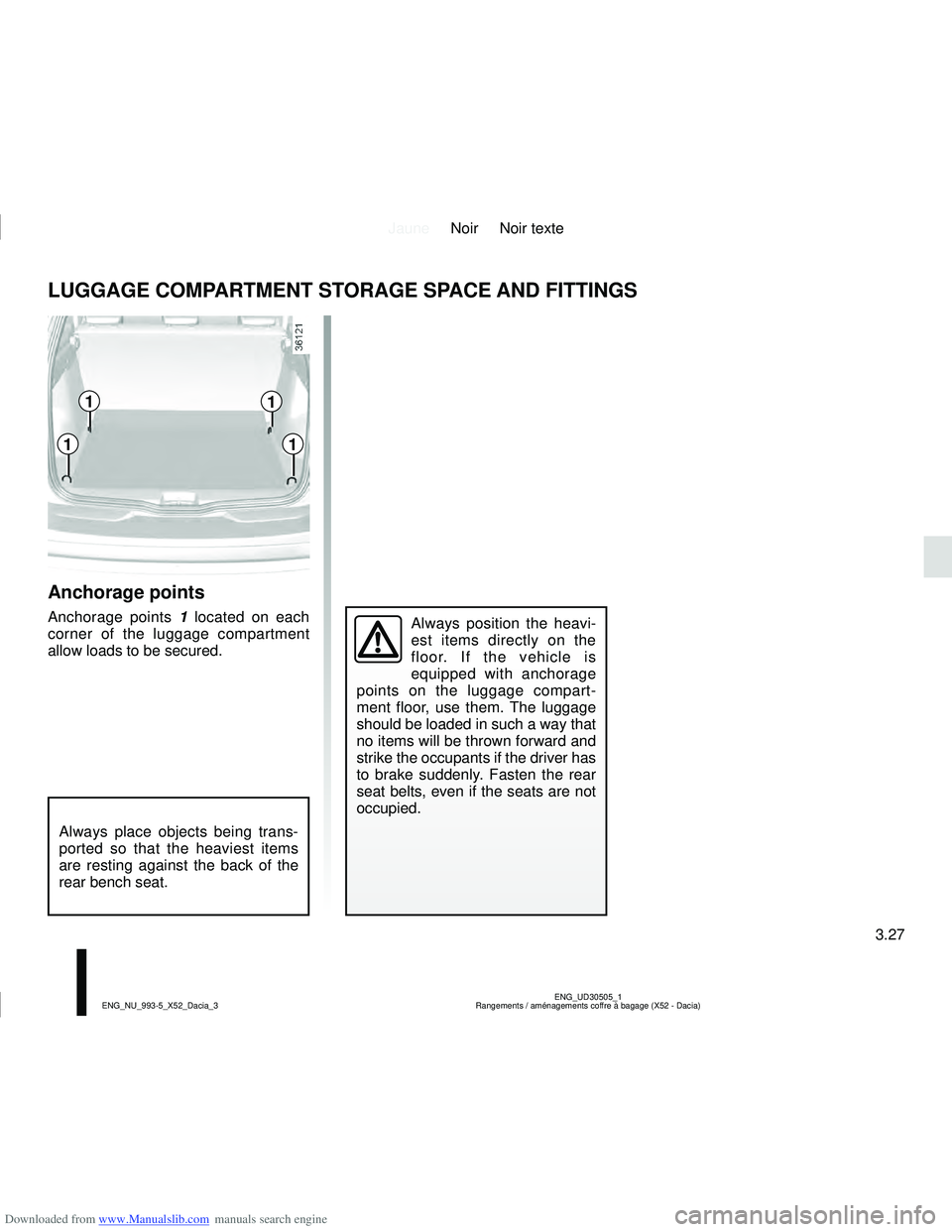
Anchorage points
Anchorage points 1 located on each
corner of the luggage compartment
allow loads to be secured.
Always place objects being trans-
ported so that the heaviest items
are resting against the back of the
rear bench seat.
Always position the heavi-
est items directly on the
floor. If the vehicle is
equipped with anchorage
points on the luggage compart-
ment floor, use them. The luggage
should be loaded in such a way that
no items will be thrown forward and
strike the occupants if the driver has
to brake suddenly. Fasten the rear
seat belts, even if the seats are not
occupied.
11
11
LUGGAGE COMPARTMENT STORAGE SPACE AND FITTINGS
Page 144 of 238

Downloaded from www.Manualslib.com manuals search engine JauneNoir Noir texte
3.32
ENG_UD30619_2
Filet de séparation (X52 - Dacia)
ENG_NU_993-5_X52_Dacia_3
TRANSPORTING OBJECTS Luggage net (1/2)
Estate version
Luggage net A
If fitted, this can be used when trans-
porting animals or luggage to isolate
them from the passenger section.
It fits behind the driver and passenger
seats or behind the rear bench seat. Fitting the luggage net behind the
front seats
Inside the vehicle on each side:
– lower cover 1
to gain access to the
anchoring points for the top part of
the luggage net;
– insert the top rod of net 3 into the an- choring points; – move the cut-out section 2
in the
carpet to access the lower mount-
ing 6 for the net;
– attach the two hooks 5 of the straps 4
from the net onto the anchoring
points 6;
– adjust the net strap 4 so that it is taut.
2
A
1
6
3
5
4
1
The luggage net must not
be used to restrain or hold
objects.
Risk of injury.
Page 145 of 238

Downloaded from www.Manualslib.com manuals search engine JauneNoir Noir texte
3.33
ENG_UD30619_2
Filet de séparation (X52 - Dacia)
ENG_NU_993-5_X52_Dacia_3
TRANSPORTING OBJECTS Luggage net (2/2)
Fitting the luggage net A behind the
rear bench seat
Inside the vehicle on each side:
– lower cover 7 to gain access to the
anchoring points for the top part of
the luggage net;
– insert the top rod of net 8 into the an- choring points;– attach the two hooks 10 of the
straps 9 from the net onto the an-
choring points 11;
– adjust the net strap 9 so that it is taut.
7
11
8
7
11
10
A
The luggage net must not
be used to restrain or hold
objects.
Risk of injury.
9
Page 150 of 238
Downloaded from www.Manualslib.com manuals search engine JauneNoir Noir texte
4.2
ENG_UD26967_1
Capot moteur (X52 - Dacia)
ENG_NU_993-5_X52_Dacia_4
BONNET
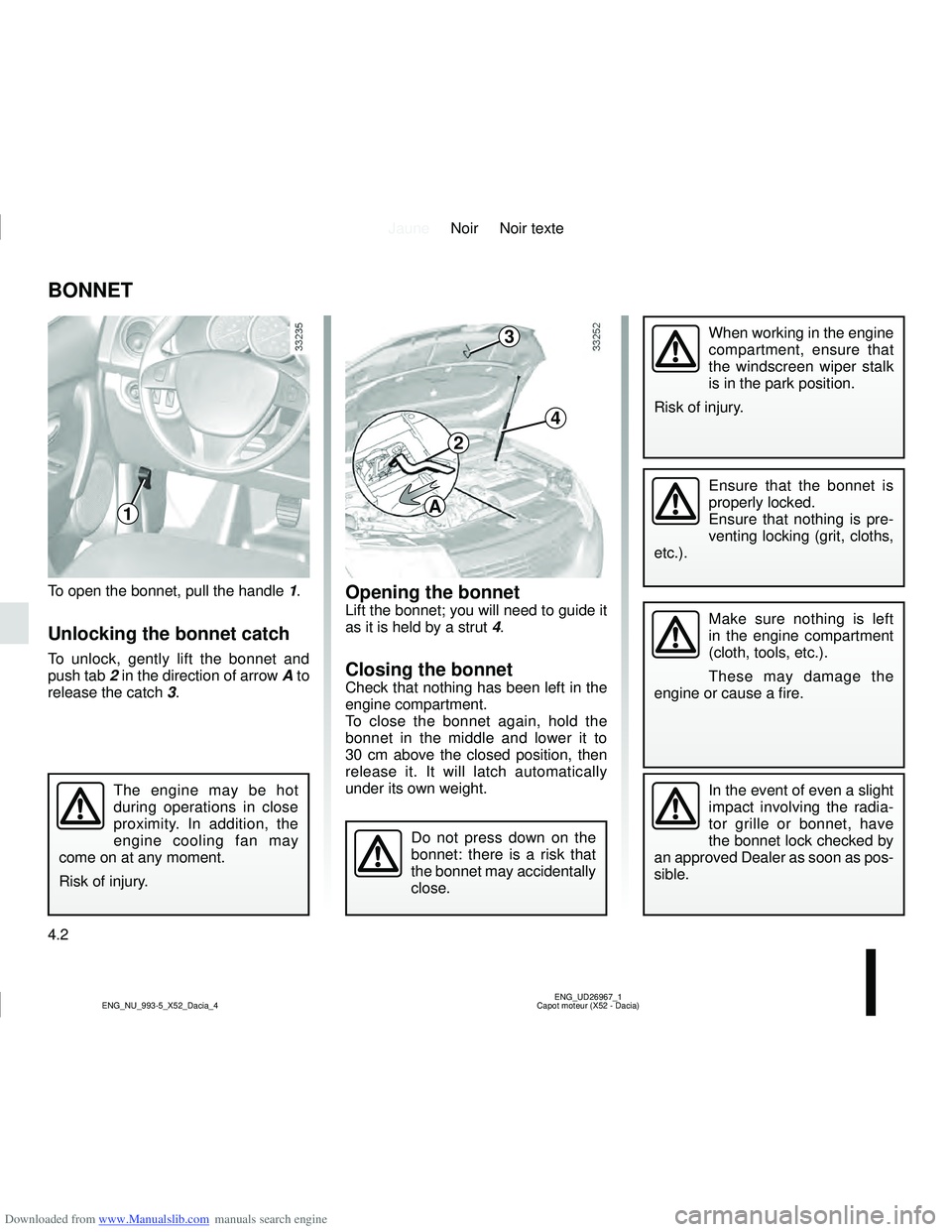
To open the bonnet, pull the handle 1.
Unlocking the bonnet catch
To unlock, gently lift the bonnet and
push tab 2 in the direction of arrow A to
release the catch 3.
Opening the bonnetLift the bonnet; you will need to guide it
as it is held by a strut 4.
Closing the bonnetCheck that nothing has been left in the
engine compartment.
To close the bonnet again, hold the
bonnet in the middle and lower it to
30 cm above the closed position, then
release it. It will latch automatically
under its own weight.
The engine may be hot
during operations in close
proximity. In addition, the
engine cooling fan may
come on at any moment.
Risk of injury.In the event of even a slight
impact involving the radia-
tor grille or bonnet, have
the bonnet lock checked by
an approved Dealer as soon as pos-
sible.
Do not press down on the
bonnet: there is a risk that
the bonnet may accidentally
close.
Make sure nothing is left
in the engine compartment
(cloth, tools, etc.).
These may damage the
engine or cause a fire.
Ensure that the bonnet is
properly locked.
Ensure that nothing is pre-
venting locking (grit, cloths,
etc.).
1
2
4
3
A
When working in the engine
compartment, ensure that
the windscreen wiper stalk
is in the park position.
Risk of injury.
Page 151 of 238
Downloaded from www.Manualslib.com manuals search engine JauneNoir Noir texte
4.3
ENG_UD35134_3
Niveau huile moteur : généralités (X52 - H79 Ph2 - Dacia)
ENG_NU_993-5_X52_Dacia_4
ENGINE OIL LEVEL: general information
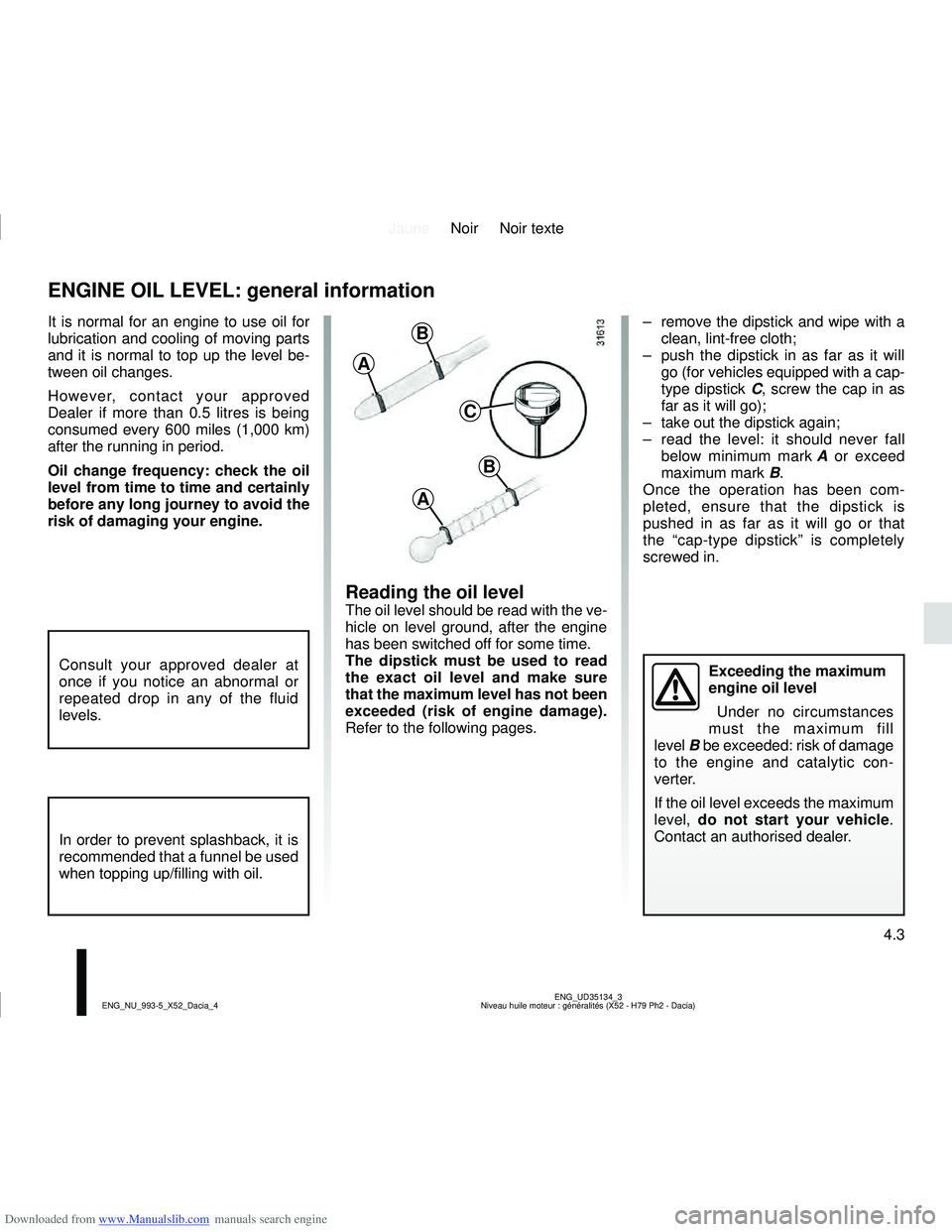
Reading the oil levelThe oil level should be read with the ve-
hicle on level ground, after the engine
has been switched off for some time.
The dipstick must be used to read
the exact oil level and make sure
that the maximum level has not been
exceeded (risk of engine damage).
Refer to the following pages.
C
A
B
A
B
Exceeding the maximum
engine oil level
Under no circumstances
must the maximum fill
level B be exceeded: risk of damage
to the engine and catalytic con-
verter.
If the oil level exceeds the maximum
level, do not start your vehicle .
Contact an authorised dealer.
It is normal for an engine to use oil for
lubrication and cooling of moving parts
and it is normal to top up the level be-
tween oil changes.
However, contact your approved
Dealer if more than 0.5 litres is being
consumed every 600 miles (1,000 km)
after the running in period.
Oil change frequency: check the oil
level from time to time and certainly
before any long journey to avoid the
risk of damaging your engine.
Consult your approved dealer at
once if you notice an abnormal or
repeated drop in any of the fluid
levels.
In order to prevent splashback, it is
recommended that a funnel be used
when topping up/filling with oil.
– remove the dipstick and wipe with a clean, lint-free cloth;
– push the dipstick in as far as it will go (for vehicles equipped with a cap-
type dipstick C, screw the cap in as
far as it will go);
– take out the dipstick again;
– read the level: it should never fall below minimum mark A or exceed
maximum mark B.
Once the operation has been com-
pleted, ensure that the dipstick is
pushed in as far as it will go or that
the “cap-type dipstick” is completely
screwed in.
Page 152 of 238
Downloaded from www.Manualslib.com manuals search engine JauneNoir Noir texte
4.4
ENG_UD34749_4
Niveau huile moteur : appoint / remplissage (X52 - Dacia)
ENG_NU_993-5_X52_Dacia_4
ENGINE OIL LEVEL: topping up, filling (1/3)
Topping up/Filling
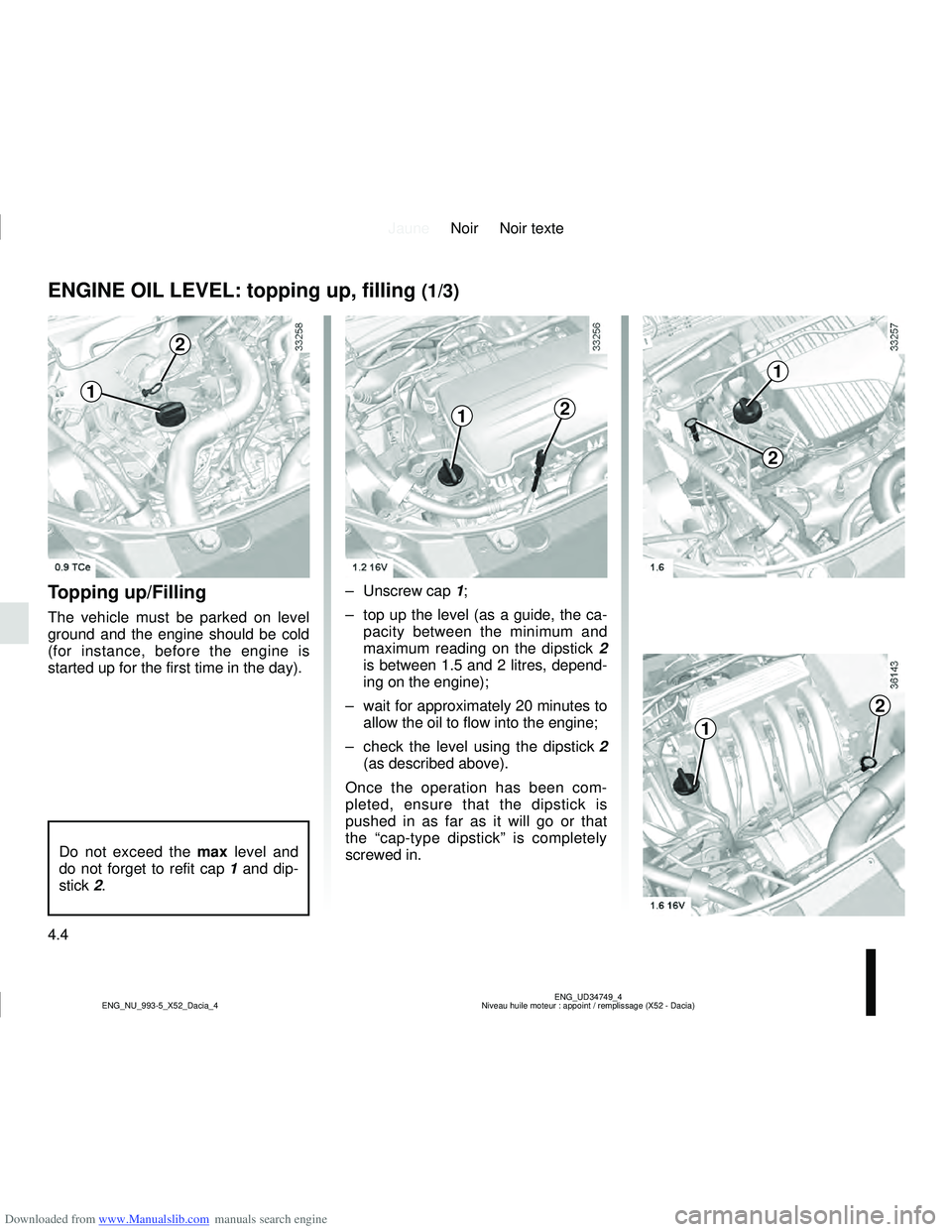
The vehicle must be parked on level
ground and the engine should be cold
(for instance, before the engine is
started up for the first time in the day). – Unscrew cap 1;
– top up the level (as a guide, the ca-
pacity between the minimum and
maximum reading on the dipstick 2
is between 1.5 and 2 litres, depend-
ing on the engine);
– wait for approximately 20 minutes to allow the oil to flow into the engine;
– check the level using the dipstick 2
(as described above).
Once the operation has been com-
pleted, ensure that the dipstick is
pushed in as far as it will go or that
the “cap-type dipstick” is completely
screwed in.
Do not exceed the max level and
do not forget to refit cap 1 and dip-
stick 2.
12
1
2
1
2
1
2
12
Page 153 of 238
Downloaded from www.Manualslib.com manuals search engine JauneNoir Noir texte
4.5
ENG_UD34749_4
Niveau huile moteur : appoint / remplissage (X52 - Dacia)
ENG_NU_993-5_X52_Dacia_4
ENGINE OIL LEVEL: topping up, filling (2/3)
Topping up/Filling
The vehicle must be parked on level
ground and the engine should be cold
(for instance, before the engine is
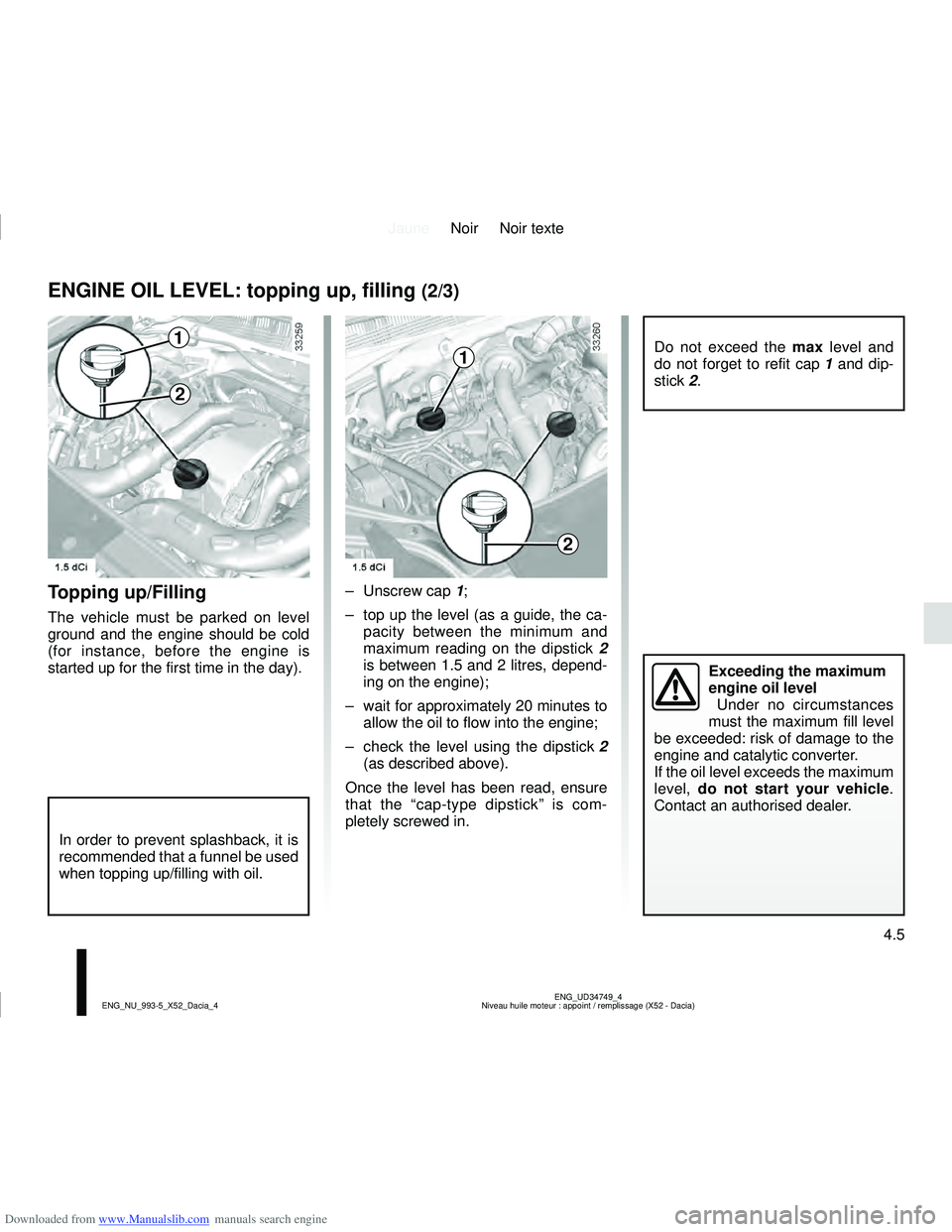
started up for the first time in the day). – Unscrew cap 1;
– top up the level (as a guide, the ca-
pacity between the minimum and
maximum reading on the dipstick 2
is between 1.5 and 2 litres, depend-
ing on the engine);
– wait for approximately 20 minutes to allow the oil to flow into the engine;
– check the level using the dipstick 2
(as described above).
Once the level has been read, ensure
that the “cap-type dipstick” is com-
pletely screwed in.
1
2
Do not exceed the max level and
do not forget to refit cap 1 and dip-
stick 2.
In order to prevent splashback, it is
recommended that a funnel be used
when topping up/filling with oil.
1
2
Exceeding the maximum
engine oil level
Under no circumstances
must the maximum fill level
be exceeded: risk of damage to the
engine and catalytic converter.
If the oil level exceeds the maximum
level, do not start your vehicle .
Contact an authorised dealer.
Page 154 of 238
Downloaded from www.Manualslib.com manuals search engine JauneNoir Noir texte
4.6
ENG_UD34749_4
Niveau huile moteur : appoint / remplissage (X52 - Dacia)
ENG_NU_993-5_X52_Dacia_4
ENGINE OIL LEVEL: topping up, filling (3/3)
Oil change
Service interval: refer to the
Maintenance Document for your vehi-
cle.
Oil change capacity
Please refer to the maintenance docu-
ment for your vehicle, or contact an au-
thorised dealer.
Always check the engine oil level using
the dipstick, as explained previously (it
should never fall below the minimum
level, or be over the maximum level on
the dipstick).
Engine oil grade
Refer to the maintenance document for
your vehicle.
Engine oil change: if you
are changing the oil when
the engine is hot, be careful
not to scald yourself if the
oil overflows.
The engine may be hot
during operations in close
proximity. In addition, the
engine cooling fan may
come on at any moment.
Risk of injury.
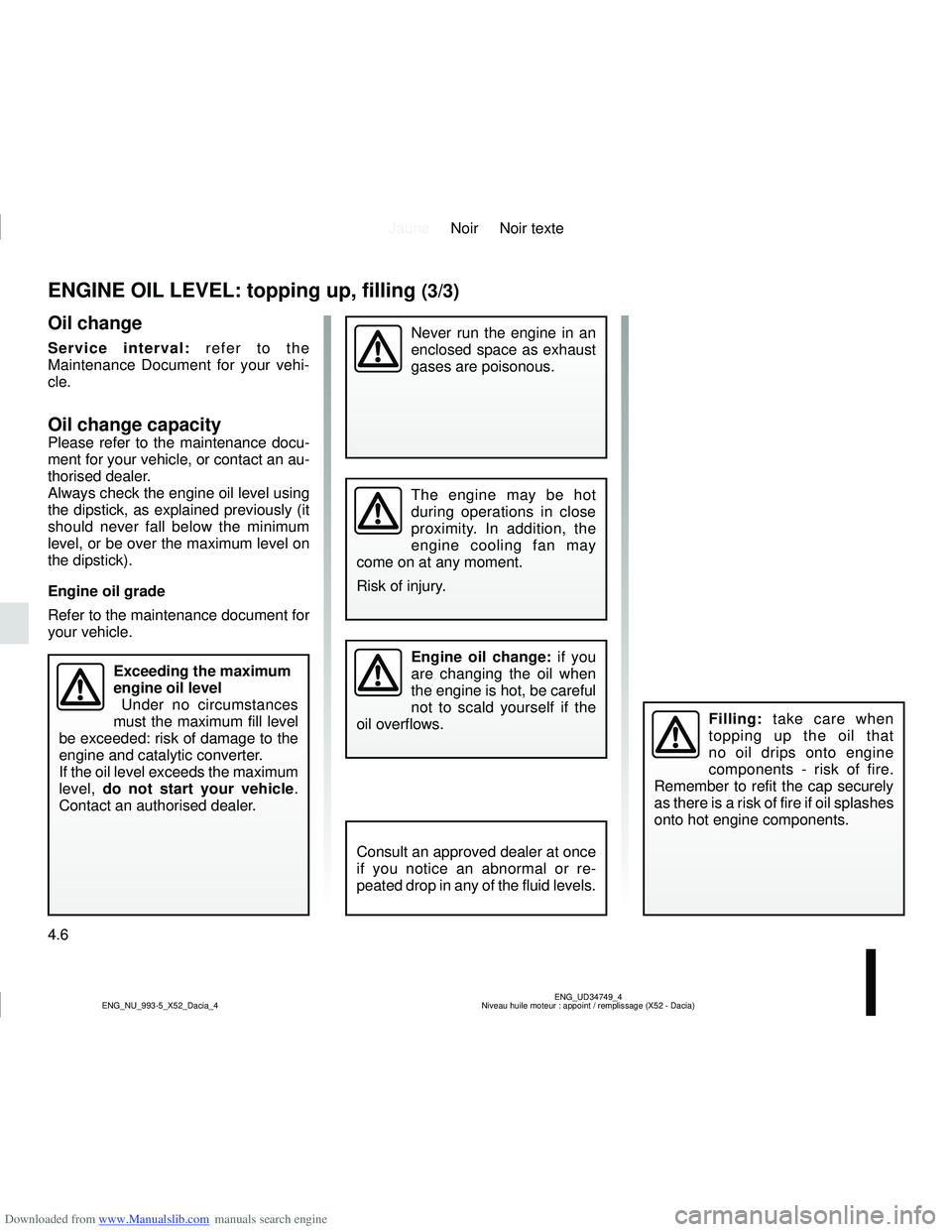
Filling: take care when
topping up the oil that
no oil drips onto engine
components - risk of fire.
Remember to refit the cap securely
as there is a risk of fire if oil splashes
onto hot engine components.
Never run the engine in an
enclosed space as exhaust
gases are poisonous.
Consult an approved dealer at once
if you notice an abnormal or re-
peated drop in any of the fluid levels.
Exceeding the maximum
engine oil level
Under no circumstances
must the maximum fill level
be exceeded: risk of damage to the
engine and catalytic converter.
If the oil level exceeds the maximum
level, do not start your vehicle .
Contact an authorised dealer.
Page 155 of 238
Downloaded from www.Manualslib.com manuals search engine JauneNoir Noir texte
4.7
ENG_UD32521_2
Niveaux / Filtres (X52 - Dacia)
ENG_NU_993-5_X52_Dacia_4
LEVELS (1/4)
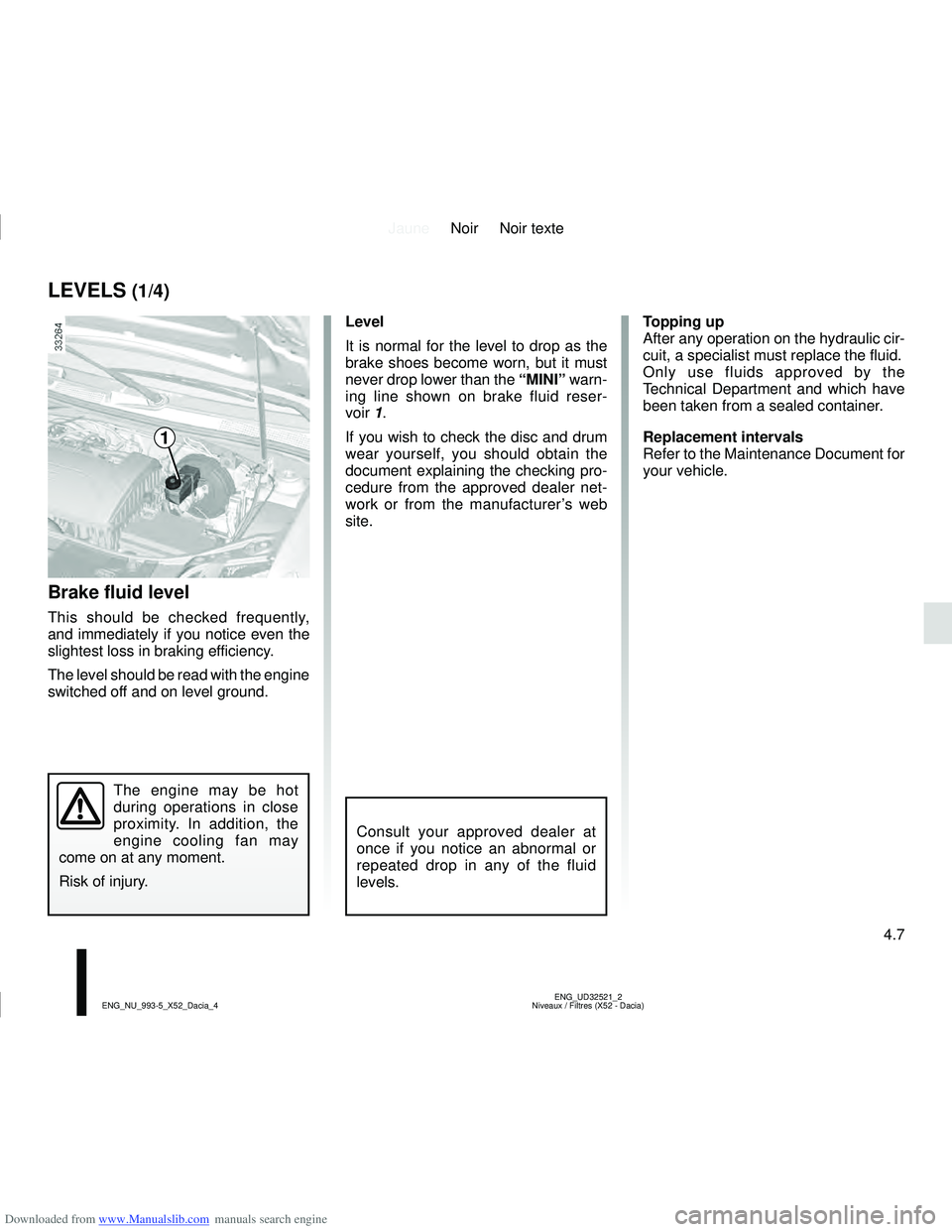
Brake fluid level
This should be checked frequently,
and immediately if you notice even the
slightest loss in braking efficiency.
The level should be read with the engine
switched off and on level ground. Level
It is normal for the level to drop as the
brake shoes become worn, but it must
never drop lower than the “MINI” warn-
ing line shown on brake fluid reser-
voir 1.
If you wish to check the disc and drum
wear yourself, you should obtain the
document explaining the checking pro-
cedure from the approved dealer net-
work or from the manufacturer’s web
site.
The engine may be hot
during operations in close
proximity. In addition, the
engine cooling fan may
come on at any moment.
Risk of injury.
Consult your approved dealer at
once if you notice an abnormal or
repeated drop in any of the fluid
levels.
Topping up
After any operation on the hydraulic cir-
cuit, a specialist must replace the fluid.
Only use fluids approved by the
Technical Department and which have
been taken from a sealed container.
Replacement intervals
Refer to the Maintenance Document for
your vehicle.
1
Page 161 of 238
 (X44 - X77 - J77 - X85 - \
B90 - X61 - TEST - X77 ph2 - X95")
Downloaded from www.Manualslib.com manuals search engine JauneNoir Noir texte
4.13
ENG_UD26811_2
Entretien de la carrosserie (peinture mate) (X44 - X77 - J77 - X85 - \
B90 - X61 - TEST - X77 ph2 - X95 - B95 - D95 - K95 - J95 - R95 - L90 Ph2 - F90 Ph2 - R90 Ph2 - X62
ENG_NU_993-5_X52_Dacia_4
BODYWORK MAINTENANCE (1/2)
You should
Wash your car frequently, with the
engine off , with cleaning products rec-
ommended by the manufacturer (never
use abrasive products). Rinse thor-
oughly beforehand with a jet:
– spots of tree resin and industrial
grime;
– mud in the wheel arches and under-
neath the body which forms damp
patches;
– bird droppings , which cause a
chemical reaction with the paint that
rapidly discolours paintwork and
may even cause the paint to peel
off;
wash the vehicle immediately to
remove these marks since it is im-
possible to remove them by polish-
ing;
– salt, particularly in the wheel arches
and underneath the body after driv-
ing in areas where the roads have
been gritted.
Remove any plant matter (resin, leaves,
etc.) from the vehicle regularly.
What you should not doDo not degrease or clean mechani-
cal components (e.g. the engine com-
partment), underneath the body, parts
with hinges (e.g. inside the doors) and
painted plastic external fittings (e.g.
bumpers) using high-pressure clean-
ing equipment or by spraying on prod-
ucts not approved by our Technical
Department. Doing this could give rise
to corrosion or operational faults.
Wash the vehicle in bright sunlight or
freezing temperatures.
Do not scrape off mud or dirt without
pre-wetting.
Allow dirt to accumulate on the exterior.
Allow rust to form following minor im-
pacts.
Do not use solvents not approved by
our Technical Department to remove
stains as this could damage the paint-
work.
Do not drive in snow or muddy condi-
tions without washing the vehicle, par-
ticularly under the wheel arches and
body.
A well-maintained vehicle will last
longer. It is therefore recommended to
maintain the exterior of the vehicle reg-
ularly.
Your vehicle has been treated with very
effective anti-corrosion products. It is
nevertheless subject to various outside
influences.
Corrosive agents in the atmosphere
–
atmospheric pollution (built-up and
industrial areas),
– saline atmospheres (near the sea,
particularly in hot weather),
– seasonal and damp weather condi-
tions (e.g. road salt in winter, water
from road cleaners, etc.).
Minor impacts
Abrasive action
Dust and sand in the air, mud, road grit
thrown up by other vehicles, etc.
You should take a number of minor pre-
cautions in order to safeguard your ve-
hicle against such risks.