type DACIA SANDERO 2019 Owners Manual
[x] Cancel search | Manufacturer: DACIA, Model Year: 2019, Model line: SANDERO, Model: DACIA SANDERO 2019Pages: 238, PDF Size: 3.19 MB
Page 9 of 238

ENG_NU_993-5_X52")
Downloaded from www.Manualslib.com manuals search engine JauneNoir Noir texte
1.3
ENG_UD29226_2
Clés / télécommande à radiofréquence: généralité\
s (X67 - X92 - X52 - Renault)
ENG_NU_993-5_X52_Dacia_1
The remote control unit
operating range
This varies according to the environ-
ment. It is therefore important when
handling the remote control to ensure
that you do not lock or unlock the ve-
hicle by inadvertently pressing the but-
tons.
Interference
The presence of certain objects (metal
objects, mobile telephones, or an area
with strong electromagnetic radiation,
etc.) close to the key may create inter-
ference and affect the operation of the
system.
KEYS, RADIO FREQUENCY REMOTE CONTROL: general information (2/2)
Replacement and additional keys
or remote controls
If you lose your remote control key
or require another, you can obtain
one from an approved dealer.
If a remote control or key is re-
placed, it will be necessary to take
the vehicle and all of its remote
control keys to an authorised
dealer to reset them.
You may use up to four remote con-
trol keys per vehicle.
Remote control key failure
Make sure that the correct battery
type is being used, and that the
battery is in good condition and in-
serted correctly. These batteries
have a service life of approximately
two years.
Refer to the information on “Radio
frequency remote control: Batteries”
in Section 5.
Page 34 of 238
Downloaded from www.Manualslib.com manuals search engine JauneNoir Noir texte
1.28
ENG_UD34943_3
Sécurité enfants : généralités GPL (X52 - Dacia)
ENG_NU_993-5_X52_Dacia_1
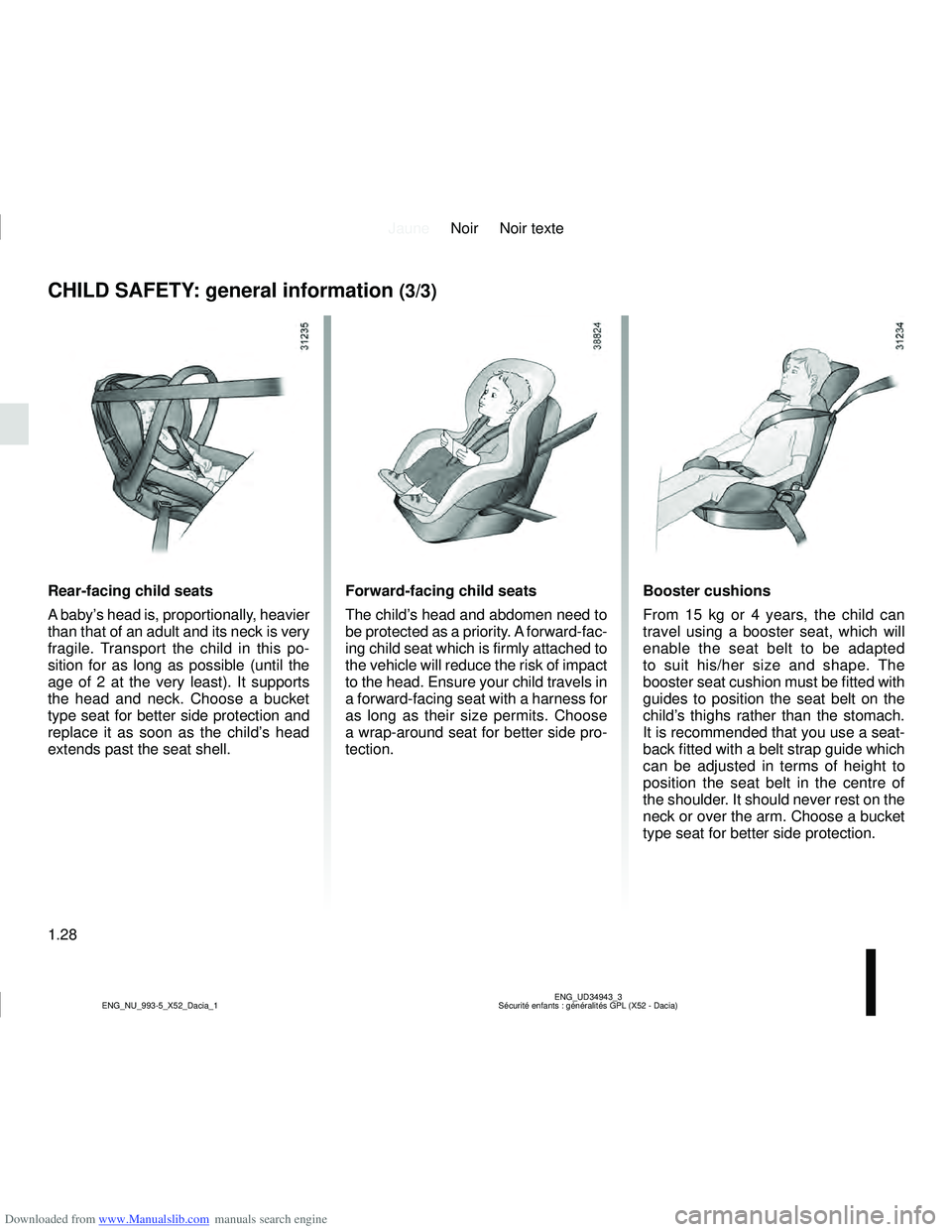
Rear-facing child seats
A baby’s head is, proportionally, heavier
than that of an adult and its neck is very
fragile. Transport the child in this po-
sition for as long as possible (until the
age of 2 at the very least). It supports
the head and neck. Choose a bucket
type seat for better side protection and
replace it as soon as the child’s head
extends past the seat shell. Forward-facing child seats
The child’s head and abdomen need to
be protected as a priority. A forward-fac-
ing child seat which is firmly attached to
the vehicle will reduce the risk of impact
to the head. Ensure your child travels in
a forward-facing seat with a harness for
as long as their size permits. Choose
a wrap-around seat for better side pro-
tection.Booster cushions
From 15 kg or 4 years, the child can
travel using a booster seat, which will
enable the seat belt to be adapted
to suit his/her size and shape. The
booster seat cushion must be fitted with
guides to position the seat belt on the
child’s thighs rather than the stomach.
It is recommended that you use a seat-
back fitted with a belt strap guide which
can be adjusted in terms of height to
position the seat belt in the centre of
the shoulder. It should never rest on the
neck or over the arm. Choose a bucket
type seat for better side protection.
CHILD SAFETY: general information (3/3)
Page 36 of 238
Downloaded from www.Manualslib.com manuals search engine JauneNoir Noir texte
1.30
ENG_UD26919_1
Sécurité enfants : fixation du siège enfant (X52 - Dacia)
ENG_NU_993-5_X52_Dacia_1
CHILD SAFETY: child/baby seat mounting (2/3)
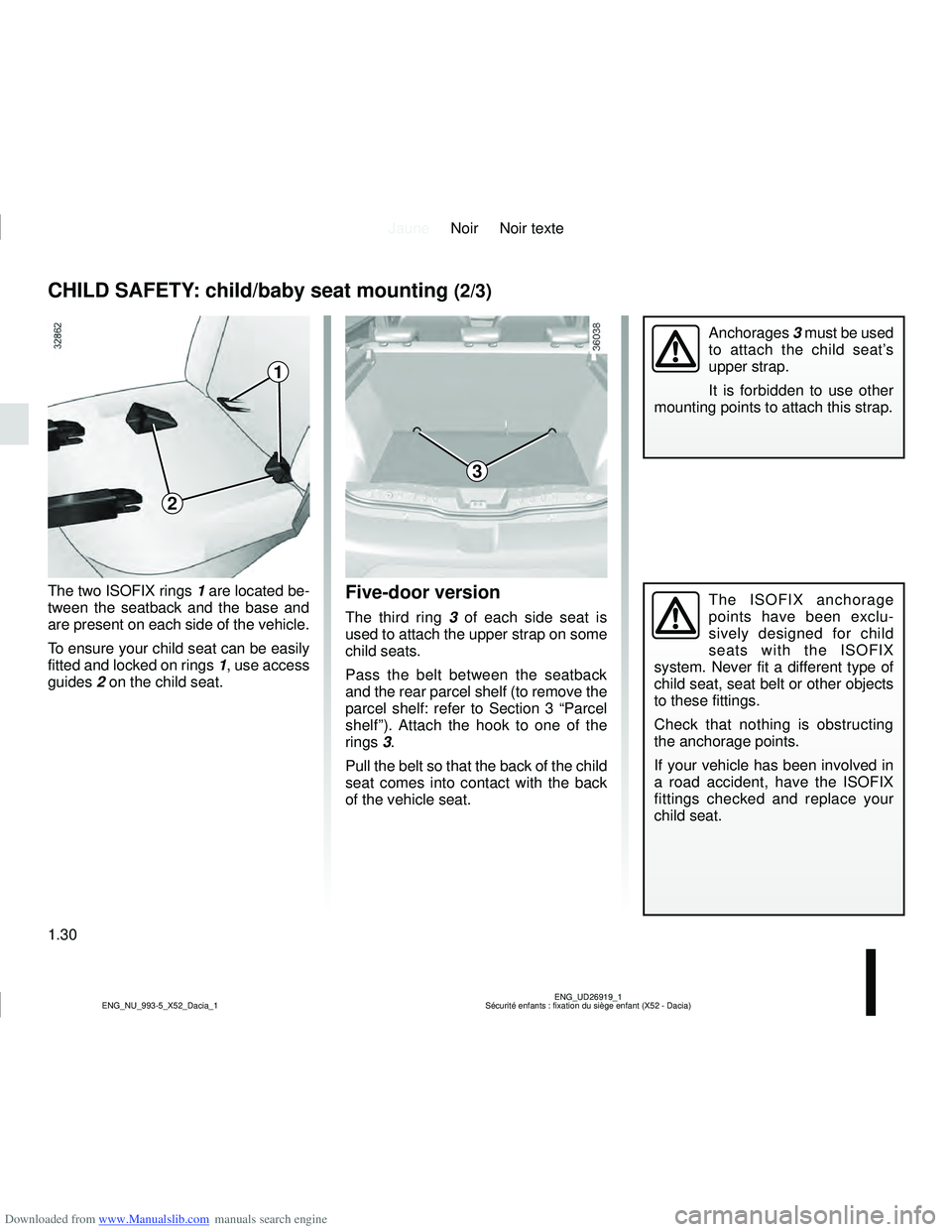
The two ISOFIX rings 1 are located be-
tween the seatback and the base and
are present on each side of the vehicle.
To ensure your child seat can be easily
fitted and locked on rings 1, use access
guides 2 on the child seat.Five-door version
The third ring 3 of each side seat is
used to attach the upper strap on some
child seats.
Pass the belt between the seatback
and the rear parcel shelf (to remove the
parcel shelf: refer to Section 3 “Parcel
shelf”). Attach the hook to one of the
rings 3.
Pull the belt so that the back of the child
seat comes into contact with the back
of the vehicle seat.
Anchorages 3 must be used
to attach the child seat’s
upper strap.
It is forbidden to use other
mounting points to attach this strap.
1
2
The ISOFIX anchorage
points have been exclu-
sively designed for child
seats with the ISOFIX
system. Never fit a different type of
child seat, seat belt or other objects
to these fittings.
Check that nothing is obstructing
the anchorage points.
If your vehicle has been involved in
a road accident, have the ISOFIX
fittings checked and replace your
child seat.
3
Page 37 of 238
Downloaded from www.Manualslib.com manuals search engine JauneNoir Noir texte
1.31
ENG_UD26919_1
Sécurité enfants : fixation du siège enfant (X52 - Dacia)
ENG_NU_993-5_X52_Dacia_1
CHILD SAFETY: child/baby seat mounting (3/3)
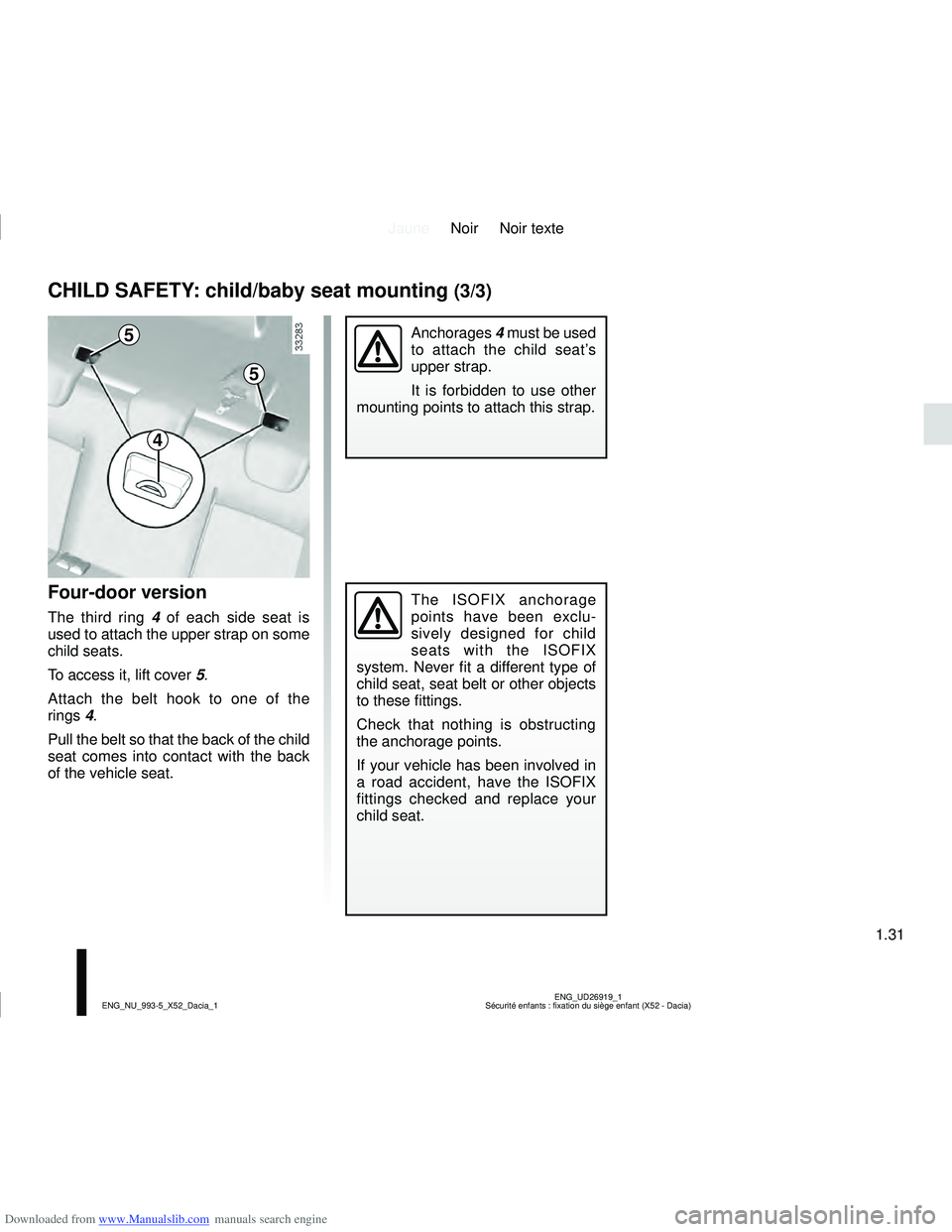
Four-door version
The third ring 4 of each side seat is
used to attach the upper strap on some
child seats.
To access it, lift cover 5.
Attach the belt hook to one of the
rings 4.
Pull the belt so that the back of the child
seat comes into contact with the back
of the vehicle seat.
Anchorages 4 must be used
to attach the child seat’s
upper strap.
It is forbidden to use other
mounting points to attach this strap.
The ISOFIX anchorage
points have been exclu-
sively designed for child
seats with the ISOFIX
system. Never fit a different type of
child seat, seat belt or other objects
to these fittings.
Check that nothing is obstructing
the anchorage points.
If your vehicle has been involved in
a road accident, have the ISOFIX
fittings checked and replace your
child seat.
4
5
5
Page 38 of 238
\
ENG_NU_993-5_X52_Dacia_1
CHILD SAFET")
Downloaded from www.Manualslib.com manuals search engine JauneNoir Noir texte
1.32
ENG_UD33184_5
Sécurité enfants : installation du siège enfant (X52 - Dacia)\
ENG_NU_993-5_X52_Dacia_1
CHILD SAFETY: fitting a child seat (1/7)
In the front seat
The laws concerning children travel-
ling in the front passenger seat differ in
every country. Consult the legislation in
force and follow the indications on the
diagram on the following page.
Before fitting a child seat in this seat (if
authorised):
– deactivate the front passenger air
bag;
– lower the seat belt as far as possible;
– move the seat as far back as possi- ble;
– gently tilt the seatback away from vertical (approximately 25°);
– on equipped vehicles, raise the seat base as far as possible.
In all situations, reinsert the headrest to
its full extent so that it does not interfere
with the child seat (see the information
on “Front headrests” in Section 1);
RISK OF DEATH OR
SERIOUS INJURY: Before
installing a child seat on
this seat, check that the
airbag has been deactivated (refer
to “Front passenger airbag deacti-
vation” in Section 1).
Some seats are not suitable for fitting
child seats. The diagram on the follow-
ing page shows you how to attach a
child seat.
The types of child seats indicated may
not be available. Before using a differ-
ent child seat, check with the manufac-
turer that it can be fitted.
Fit the child seat in a rear
seat wherever possible.
Check that when installing
the child seat in the vehicle
it is not at risk of coming loose from
its base.
If you have to remove the headrest,
check that it is correctly stored so
that it does not come loose under
harsh braking or impact.
Always attach the child seat to the
vehicle even if it is not in use so that
it does not come loose under harsh
braking or impact.
After installing the child seat, if neces-
sary, the seat may be advanced (so as
to leave enough space in the rear seats
for passengers or other child seats).
For a rear-facing child seat, do not let
it touch the dashboard or move it to the
furthest forward position.
Do not change other settings after in-
stalling the child seat.
Page 40 of 238
\
ENG_NU_993-5_X52_Dacia_1
The table b")
Downloaded from www.Manualslib.com manuals search engine JauneNoir Noir texte
1.34
ENG_UD33184_5
Sécurité enfants : installation du siège enfant (X52 - Dacia)\
ENG_NU_993-5_X52_Dacia_1
The table below summarises the information already shown in the diagram \
on the following pages, to ensure the applicable regu-
lations are respected.
Four and five door or estate versions
Type of child seat Weight of
the child Seat
size Front passenger seat
Rear seats
with airbag without
deactivation (1) without
airbag or
with airbag
deactivated (2)(3) Side seats
Centre
seat
Transverse carrycot
Approved for group 0 < 10 kg F - G
XX U - IL (4) U (4)
Rear-facing shell seat
Approved for group 0 or 0+ < 13 kg E
XU U - IL (5) U (5)
Rear-facing seat
Approved for group 0+ or 1 < 13 kg and
9 to 18 kg C
X UU (5) U (5)
D X U U - IL (5) U (5)
Forward-facing seat
Approved for group 1 9 kg to 18 kg A, B, B1 X
U U - IUF IL (6) U (6)
Booster seat
Approved for group 2 or 3 15 kg to 25 kg
and 22 kg to 36 kg –
X XU (6) U (6)
(1) RISK OF DEATH OR SERIOUS INJURY: never fit a child seat on the front seat if the vehicle has a passenger\
airbag which cannot be deactivated.
(2) RISK OF DEATH OR SERIOUS INJURY: Before fitting a child seat on the front passenger seat, check that the\
airbag has been deactivated (please refer to “Child safety: front pa\
ssenger airbag deactivation, activation” in Section 1).
CHILD SAFETY: fitting a child seat (3/7)
Page 70 of 238
Downloaded from www.Manualslib.com manuals search engine JauneNoir Noir texte
1.64
ENG_UD33183_4
Réservoir carburant (X52 - Dacia)
ENG_NU_993-5_X52_Dacia_1
FUEL TANK (1/5)
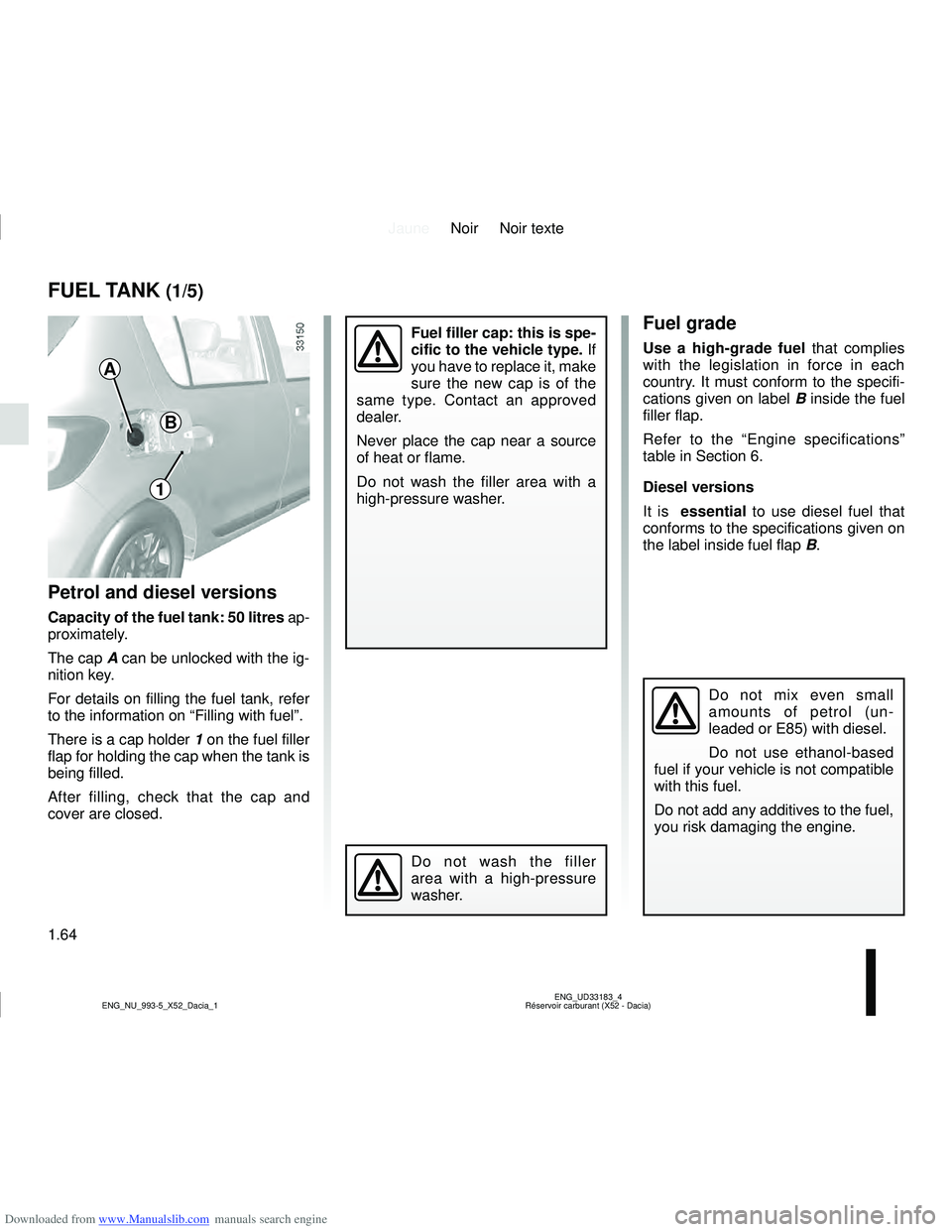
Petrol and diesel versions
Capacity of the fuel tank: 50 litres ap-
proximately.
The cap A can be unlocked with the ig-
nition key.
For details on filling the fuel tank, refer
to the information on “Filling with fuel”.
There is a cap holder 1 on the fuel filler
flap for holding the cap when the tank is
being filled.
After filling, check that the cap and
cover are closed.
Fuel filler cap: this is spe-
cific to the vehicle type. If
you have to replace it, make
sure the new cap is of the
same type. Contact an approved
dealer.
Never place the cap near a source
of heat or flame.
Do not wash the filler area with a
high-pressure washer.Fuel grade
Use a high-grade fuel that complies
with the legislation in force in each
country. It must conform to the specifi-
cations given on label B inside the fuel
filler flap.
Refer to the “Engine specifications”
table in Section 6.
Diesel versions
It is essential to use diesel fuel that
conforms to the specifications given on
the label inside fuel flap B.
Do not wash the filler
area with a high-pressure
washer.
A
B
1
Do not mix even small
amounts of petrol (un-
leaded or E85) with diesel.
Do not use ethanol-based
fuel if your vehicle is not compatible
with this fuel.
Do not add any additives to the fuel,
you risk damaging the engine.
Page 71 of 238
Downloaded from www.Manualslib.com manuals search engine JauneNoir Noir texte
1.65
ENG_UD33183_4
Réservoir carburant (X52 - Dacia)
ENG_NU_993-5_X52_Dacia_1
Petrol version
It is essential to use unleaded petrol.
The octane rating (RON) should match
the information given on the label B lo-
cated inside the fuel filler flap.
Vehicles running on ethanol-based
fuel
Always use unleaded petrol or fuel
containing a maximum of 85 percent
ethanol (E85).
In very cold conditions it may be difficult
or even impossible to start the engine.
To avoid this problem, use unleaded
petrol.
Note: you may notice an increase in
fuel consumption with this type of fuel.
When the fuel is changed the engine
must adjust, which may cause minor in-
conveniences for a few minutes (longer
starting times, cutting out, etc.).
FUEL TANK (2/5)
Filling up with petrol or dieselWith the ignition off, insert the nozzle to
open the valve and insert it fully before
turning it on to fill the fuel tank (risk of
splashing).
Keep the nozzle in this position
throughout the entire filling operation.
When the pump cuts out automatically
at the end of the filling procedure, a
maximum of two further filling attempts
may be made, as there must be suffi-
cient space in the fuel tank to allow for
expansion.
Make sure that no water enters the fuel
tank during filling. The valve and its sur-
round must remain clean.
Petrol versions
Using leaded petrol will damage the
antipollution system and may lead to a
loss of warranty.
To ensure that the fuel tank is not filled
with leaded petrol, the fuel tank filler
neck contains a restrictor fitted with a
foolproof system which only allows
the nozzle for unleaded petrol to be
used (at the pump).
Persistent fuel odour
If you notice a persistent
fuel odour you should:
– stop the vehicle as soon as traf- fic conditions allow and switch off
the ignition;
– switch on the hazard warning lights and ask your passengers to
leave the vehicle and stay clear
of the traffic;
– contact an approved Dealer.
Page 88 of 238
Downloaded from www.Manualslib.com manuals search engine JauneNoir Noir texte
2.14
ENG_UD34407_2
Conseils entretien et antipollution (X98 - X87 - X07 - Renault)
ENG_NU_993-5_X52_Dacia_2
MAINTENANCE AND ANTIPOLLUTION ADVICE
Your vehicle complies with criteria for
recycling and recovering vehicles at the
end of their service life which will come
into force in 2015.
Some parts of your vehicle have there-
fore been designed to facilitate future
recycling.
These parts are easy to remove so
that they can be recovered and reproc-
essed by recycling companies.
By virtue of its design, moderate fuel
consumption and initial settings, your
vehicle also conforms to current anti-
pollution regulations. The manufac-
turer is actively striving to reduce pol-
lutant exhaust gas emissions and to
save energy. But the fuel consumption
of your vehicle and the level of pollutant
exhaust gas emissions are also your
responsibility. Ensure that it is main-
tained and used correctly.
Maintenance
It is important to remember that fai-
lure to respect antipollution regulations
could lead to legal action being taken
against the vehicle owner. In addition, replacing engine, fuel
supply system and exhaust compo-
nents with parts other than those origi-
nally recommended by the manufactu-
rer may alter your vehicle so that it no
longer complies with antipollution regu-
lations.
Have your vehicle adjusted and
checked by an approved Dealer, in ac-
cordance with the instructions given in
your maintenance schedule: they will
have all the equipment necessary for
ensuring that your vehicle is maintained
to its original standard.
Engine adjustments
– Spark plugs:
for optimum condi-
tions of use, output and performance
the specifications laid down by our
Design Department must be strictly
applied.
If the spark plugs have to be changed, use the make, type and gap specified
for your vehicle’s engine. Contact an
authorised dealer for this.
– Air filter: a choked element will reduce efficiency. It must be re-
placed.
– Ignition and idle speed: no adjust-
ment is needed.
Exhaust gas monitoring
system
The exhaust gas monitoring system will
detect any operating faults in the vehi-
cle’s antipollution system.
If this system malfunctions, toxic sub-
stances may be released into the at-
mosphere or damage may occur.
ÄThis warning light on the in-
strument panel will indicate if
there are any faults in the system:
This lights up when the ignition is
switched on and goes out when the
engine is started.
– If it lights up continuously, consult an approved Dealer as soon as pos-
sible;
– if it flashes, reduce the engine speed until the light stops flashing. Contact
your approved dealer as soon as
possible.
Page 151 of 238
Downloaded from www.Manualslib.com manuals search engine JauneNoir Noir texte
4.3
ENG_UD35134_3
Niveau huile moteur : généralités (X52 - H79 Ph2 - Dacia)
ENG_NU_993-5_X52_Dacia_4
ENGINE OIL LEVEL: general information
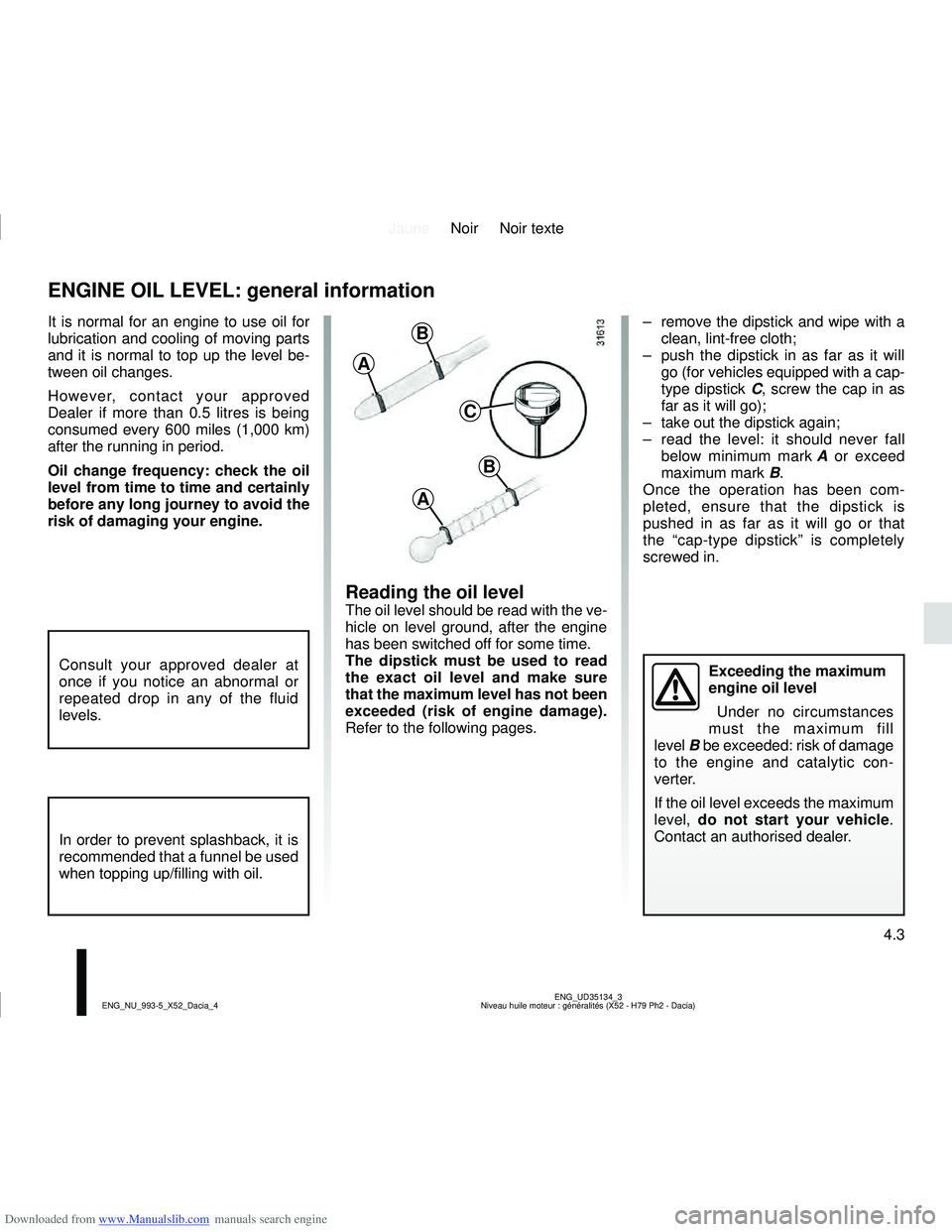
Reading the oil levelThe oil level should be read with the ve-
hicle on level ground, after the engine
has been switched off for some time.
The dipstick must be used to read
the exact oil level and make sure
that the maximum level has not been
exceeded (risk of engine damage).
Refer to the following pages.
C
A
B
A
B
Exceeding the maximum
engine oil level
Under no circumstances
must the maximum fill
level B be exceeded: risk of damage
to the engine and catalytic con-
verter.
If the oil level exceeds the maximum
level, do not start your vehicle .
Contact an authorised dealer.
It is normal for an engine to use oil for
lubrication and cooling of moving parts
and it is normal to top up the level be-
tween oil changes.
However, contact your approved
Dealer if more than 0.5 litres is being
consumed every 600 miles (1,000 km)
after the running in period.
Oil change frequency: check the oil
level from time to time and certainly
before any long journey to avoid the
risk of damaging your engine.
Consult your approved dealer at
once if you notice an abnormal or
repeated drop in any of the fluid
levels.
In order to prevent splashback, it is
recommended that a funnel be used
when topping up/filling with oil.
– remove the dipstick and wipe with a clean, lint-free cloth;
– push the dipstick in as far as it will go (for vehicles equipped with a cap-
type dipstick C, screw the cap in as
far as it will go);
– take out the dipstick again;
– read the level: it should never fall below minimum mark A or exceed
maximum mark B.
Once the operation has been com-
pleted, ensure that the dipstick is
pushed in as far as it will go or that
the “cap-type dipstick” is completely
screwed in.