Iat DAEWOO LACETTI 2004 Service Repair Manual
[x] Cancel search | Manufacturer: DAEWOO, Model Year: 2004, Model line: LACETTI, Model: DAEWOO LACETTI 2004Pages: 2643, PDF Size: 80.54 MB
Page 807 of 2643

ENGINE CONTROLS 1F – 561
DAEWOO V–121 BL4
DIAGNOSTIC TROUBLE CODE (DTC) P1396
ABS WSS SIGNAL VARIATION
Circuit Description
The Engine Control Module (ECM) determines linear
wheel speed excessive variation. The wheel speed varia-
tion test detects at least one missing edge from the wheel
speed sensor signal.
Conditions for Setting the DTC
S WSS variation is greater than 18km/h (11.2 mph).
S Vehicle speed is greater than 10km/h (6.2 mph).
Action Taken When the DTC Sets
S The Malfunction Indicator Lamp (MIL) will not illumi-
nate.
S The ECM will store conditions which were present
when the DTC set as Failure Records data only.
This information will not be stored as Freeze Frame
data.
S A history DTC is stored.
Conditions for Clearing the MIL/DTC
S A history DTC will clear after 40 consecutive warm–
up cycles without a fault.
S The DTC(s) can be cleared by using the scan tool.
Diagnostic Aids
Check for the following conditions:S Poor connection at the ECM – Inspect the harness
connections for backed–out terminals, improper
mating, broken locks, improperly formed or dam-
aged terminals, and poor terminal–to–wire connec-
tion.
S Damaged harness – Inspect the wiring harness for
damage. If the harness appears to be OK, observe
the G sensor display on the scan tool while moving
connectors and wiring harnesses related to the sen-
sor. A change in the display will indicate the loca-
tion of the fault.
An open signal circuit of open PWM serial data line be-
tween the ECM and the EBCM will be the cause of this
DTC.
Test Description
The number(s) below refer to specific step(s) on the diag-
nostic table.
1. The On–Board Diagnostic (EOBD) System Check
prompts the technician to complete some basic
checks and store the freeze frame and failure re-
cords data on the scan tool if applicable. This
creates an electronic copy of the data taken when
the malfunction occurred. The information is then
stored on the scan tool for later reference.
6. The replacement ECM must be reprogrammed.
Refer to the latest Techline procedure for ECM re-
programming.
Page 808 of 2643

1F – 562IENGINE CONTROLS
DAEWOO V–121 BL4
DTC P1396 – ABS WSS Signal Variation
StepActionValue(s)YesNo
1Perform an On–Board Diagnostic (EOBD) System
Check.
Was the check performed?–Go to Step 2Go to
”On–Board
Diagnostic Sys-
tem Check”
21. Turn the ignition ON, with the engine OFF.
2. Install a scan too.
Are any additional Diagnostic Trouble Codes
(DTCs) set?–Go to
applicable DTC
tableGo to Step 3
31. Review and record the scan tool Failure Re-
cords data.
2. Operate the vehicle within Failure Records
conditions as noted.
3. Using the scan tool, monitor specific DTC info
for DTC P1391.
Does the scan tool indicate that DTC P1391 failed?–Go to Step 4Go to
”Diagnostic
Aids”
41. Turn the ignition OFF.
2. Disconnect the engine control module (ECM)
and check for an open or short in the wire be-
tween ECM connector terminal K7 and Elec-
tronic Brake Control Module (EBCM) connector
terminal 25.
Is the problem found?–Go to Step 5Go to Step 6
5Repair an open or short in the wire between ECM
connector terminal K7 and EBCM connector termi-
nal 25.
Is the repair complete?–Go to Step 7–
61. Turn the ignition OFF.
2. Replace the ECM.
Is the repair complete?–Go to Step 7–
71. Using the scan tool, clear the DTCs.
2. Start the engine and idle at normal operating
temperature.
3. Operate the vehicle within the conditions for
setting this DTC as supported in the text.
Does the scan tool indicate that this diagnostic ran
and passed?–Go to Step 8Go to Step 2
8Check if any additional DTCs are set.
Are any DTCs displayed that have not been diag-
nosed?–Go to
Applicable DTC
tableSystem OK
Page 811 of 2643

ENGINE CONTROLS 1F – 565
DAEWOO V–121 BL4
DIAGNOSTIC TROUBLE CODE (DTC) P1404
EXHAUST GAS RECIRCULATION CLOSED VALVE
PINTLE ERROR
Circuit Description
An Exhaust Gas Recirculation (EGR) system is used to
lower Oxides of Nitrogen (NOx) emission levels caused by
high combustion temperatures. It accomplishes this by
feeding small amounts of exhaust gases back into the
combustion chamber.When the air/fuelmixture is diluted
with the exhaust gases, combustion temperatures are re-
duced.
A linear EGR valve is used on this system. The linear EGR
valve is designed to accurately supply exhaust gases to
the engine without the use of intake manifold vacuum. The
valve controls exhaust flow going into the intake manifold
from the exhaust manifold through an orifice with an En-
gine Control Module (ECM) controlled pintle. The ECM
controls the pintle position using inputs from the Throttle
Position (TP) and Manifold Absolute Pressure (MAP) sen-
sors. The ECM then commands the EGR valve to operate
when necessary by controlling an ignition signal through
the ECM. This can be monitored on a scan tool as the De-
sired EGR Position.
The ECM monitors the results of its command through a
feedback signal. By sending a 5 volt reference and a
ground to the EGR valve, a voltage signal representing the
EGR valve pintle position is sent to the ECM. This feed-
back signal can also be monitored on a scan tool and is the
actual position of the EGR pintle. The Actual EGR Position
should always be near the commanded or Desired EGR
Position.
Conditions for Setting the DTC
S Difference between current and learned low posi-
tion is greater than 10%.S Desired EGR position is equal to 0.
S Engine is running.
S Ignition voltage is between 11.7 and 16 volts.
S Intake Air Temperature (IAT) is greater than 3°C
(37.4°F).
S DTCs P0112, P0113, P0405, P0406, and P0502
are not set.
Action Taken When the DTC Sets
S The Malfunction Indicator Lamp (MIL) will illuminate
after three consecutive trip with a fail.
S The ECM will record operating conditions at the
time the diagnostic fails. This information will be
stored in the Freeze Frame and Failure Records
buffers.
S A history Diagnostic Trouble Code (DTC) is stored.
S EGR is disabled.
Conditions for Clearing the MIL/DTC
S The MIL will turn off after three consecutive ignition
cycles in which the diagnostic runs without a fault.
S A history DTC will clear after 80 consecutive warm–
up cycles without a fault.
S DTC(s) can be cleared by using the scan tool.
S Disconnecting the ECM battery feed for more than
10 seconds.
Diagnostic Aids
Due to moisture associated with exhaust systems, the
EGR valve may freeze and stick in cold weather. After the
vehicle is brought into a warm shop for repairs, the valve
warms and the problem disappears. By watching the Actu-
al EGR and Desired EGR Positions on a cold vehicle with
a scan tool, the fault can be easily verified. Check the
Page 822 of 2643

1F – 576IENGINE CONTROLS
DAEWOO V–121 BL4
HARD START
Definition : The engine cranks OK, but does not start for
a long time. The engine eventually runs or may start and
immediately die.Important : Ensure that the driver is using the correct
starting procedure. Before diagnosing, check service bul-
letins for updates.
Step
ActionValue(s)YesNo
1Were the Important Preliminary Checks performed?–Go toStep 2Go to
”Important Pre-
liminary
Checks”
21. Connect the scan tool to the Data Link Con-
nector (DLC).
2. Check the Engine Coolant Temperature (ECT)
sensor and the Intake Air Temperature (IAT)
sensor using the scan tool.
3. Compare the coolant temperature and the IAT
with the ambient temperature when the engine
is cold.
Do the ECT and the IAT readings differ from the am-
bient temperature by more than the value specified?5°F (3°C)Go toStep 3Go toStep 4
31. Measure the resistance of the ECT and the IAT
sensor.
2. Compare the resistance value to specifications
using the Temperature Vs. Resistance tables
for diagnostic trouble codes (DTCs) P0118 and
P0113.
3. If the resistance is not the same, replace the
faulty sensor.
Is the repair complete?–System OK–
41. Check for a sticking throttle shaft or a binding
linkage that may cause a high Throttle Position
(TP) sensor voltage. Repair or replace as
needed.
2. Check the TP sensor voltage reading with the
throttle closed.
Does the voltage measure within the value speci-
fied?0.4–0.8 vGo toStep 5Go toStep 26
51. Check the Manifold Absolute Pressure (MAP)
sensor response and accuracy.
2. Replace the MAP sensor as needed.
Is the repair complete?–System OKGo toStep 6
6Check the fuel pump operation.
Does the fuel pump operate for the specified time
when the ignition switch is turned ON?2 secGo toStep 7Go to
”Fuel Pump
Relay Circuit
Check”
7Check the fuel system pressure.
Is the fuel pressure within the specifications?41–47 psi
(284–325 kPa)Go toStep 8Go toStep 29
8Check for water contamination in the fuel.
Is fuel contaminated?–Go toStep 9Go toStep 10
9Replace the contaminated fuel.
Is the repair complete?–System OK–
Page 823 of 2643

ENGINE CONTROLS 1F – 577
DAEWOO V–121 BL4
StepNo Yes Value(s) Action
101. Check the fuel injector driver circuit.
2. Disconnect all of the fuel injector harness con-
nectors at the fuel injectors.
3. Connect an injector test light between the har-
ness terminals of each fuel injector connector.
4. Note the test light while cranking the engine.
Does the test light blink at all connectors?–Go toStep 13Go toStep 11
11Check the fuel injector driver wiring harness, the
connectors, and the connector terminals for the
proper connections.
Is the problem found?–Go toStep 12Go toStep 30
12Repair the wiring harness, the connector, or the con-
nector terminal as needed.
Is the repair complete?–System OK
13Measure the resistance of each fuel injector at 68°F
(20°C). The resistance will increase slightly at high-
er temperatures.
Is the fuel injector resistance within the value speci-
fied?11.6–12.4 ΩGo toStep 15Go toStep 14
14Replace any fuel injector with a resistance that is out
of specifications.
Is the repair complete?–System OK–
15Perform an injector balance test.
Is the problem found?–Go toStep 16Go toStep 17
16Replace any restricted or leaking fuel injectors as
needed.
Is the repair complete?–System OK–
171. Check for the proper ignition voltage output for
each cylinder with a spark tester.
2. Inspect the spark plugs for cracks, wear, im-
proper gap, burned electrodes, or heavy de-
posits.
3. Inspect the ignition wires for short conditions.
4. Inspect all of the ignition grounds for loose con-
nections.
5. Inspect the powertrain control module
(PCM)/engine control module (ECM) for the
proper operation.
Is the problem found?–Go toStep 18Go toStep 19
18Correct or replace any faulty ignition components.
Is the repair complete?–System OK–
19Does the engine misfire or cut out under load or at
idle?Go to
”Ignition Sys-
tem Check”Go toStep 20
20Does the engine start, but then immediately stall?–Go toStep 21Go toStep 23
211. Remove the Crankshaft Position (CKP) sensor.
2. Inspect for faulty connections and repair as
needed.
Is the problem found?–Go toStep 22Go toStep 25
22Repair the faulty connections as needed.
Is the repair complete?–System OK–
Page 846 of 2643
1F – 600IENGINE CONTROLS
DAEWOO V–121 BL4
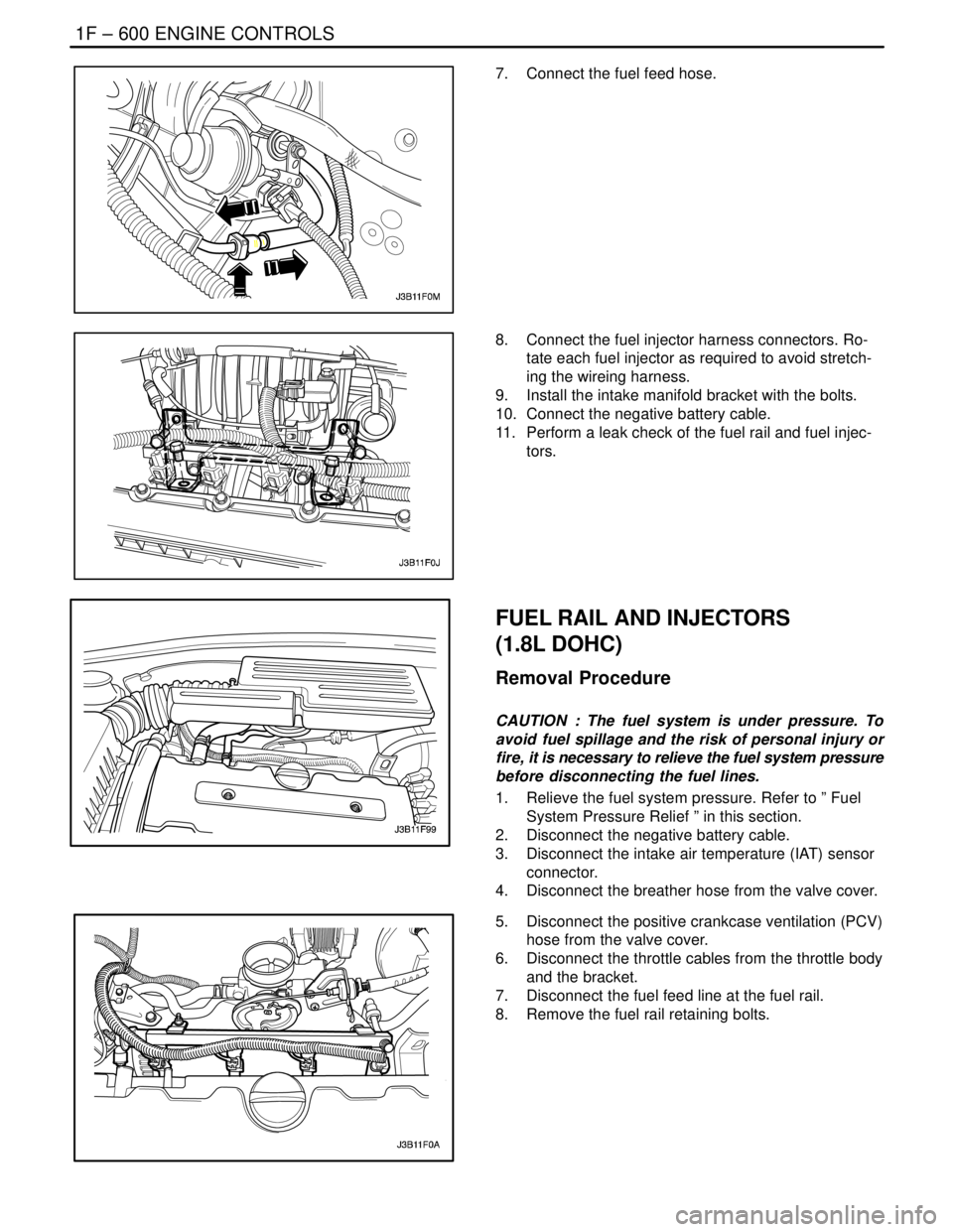
7. Connect the fuel feed hose.
8. Connect the fuel injector harness connectors. Ro-
tate each fuel injector as required to avoid stretch-
ing the wireing harness.
9. Install the intake manifold bracket with the bolts.
10. Connect the negative battery cable.
11. Perform a leak check of the fuel rail and fuel injec-
tors.
FUEL RAIL AND INJECTORS
(1.8L DOHC)
Removal Procedure
CAUTION : The fuel system is under pressure. To
avoid fuel spillage and the risk of personal injury or
fire, it is necessary to relieve the fuel system pressure
before disconnecting the fuel lines.
1. Relieve the fuel system pressure. Refer to ” Fuel
System Pressure Relief ” in this section.
2. Disconnect the negative battery cable.
3. Disconnect the intake air temperature (IAT) sensor
connector.
4. Disconnect the breather hose from the valve cover.
5. Disconnect the positive crankcase ventilation (PCV)
hose from the valve cover.
6. Disconnect the throttle cables from the throttle body
and the bracket.
7. Disconnect the fuel feed line at the fuel rail.
8. Remove the fuel rail retaining bolts.
Page 848 of 2643
1F – 602IENGINE CONTROLS
DAEWOO V–121 BL4
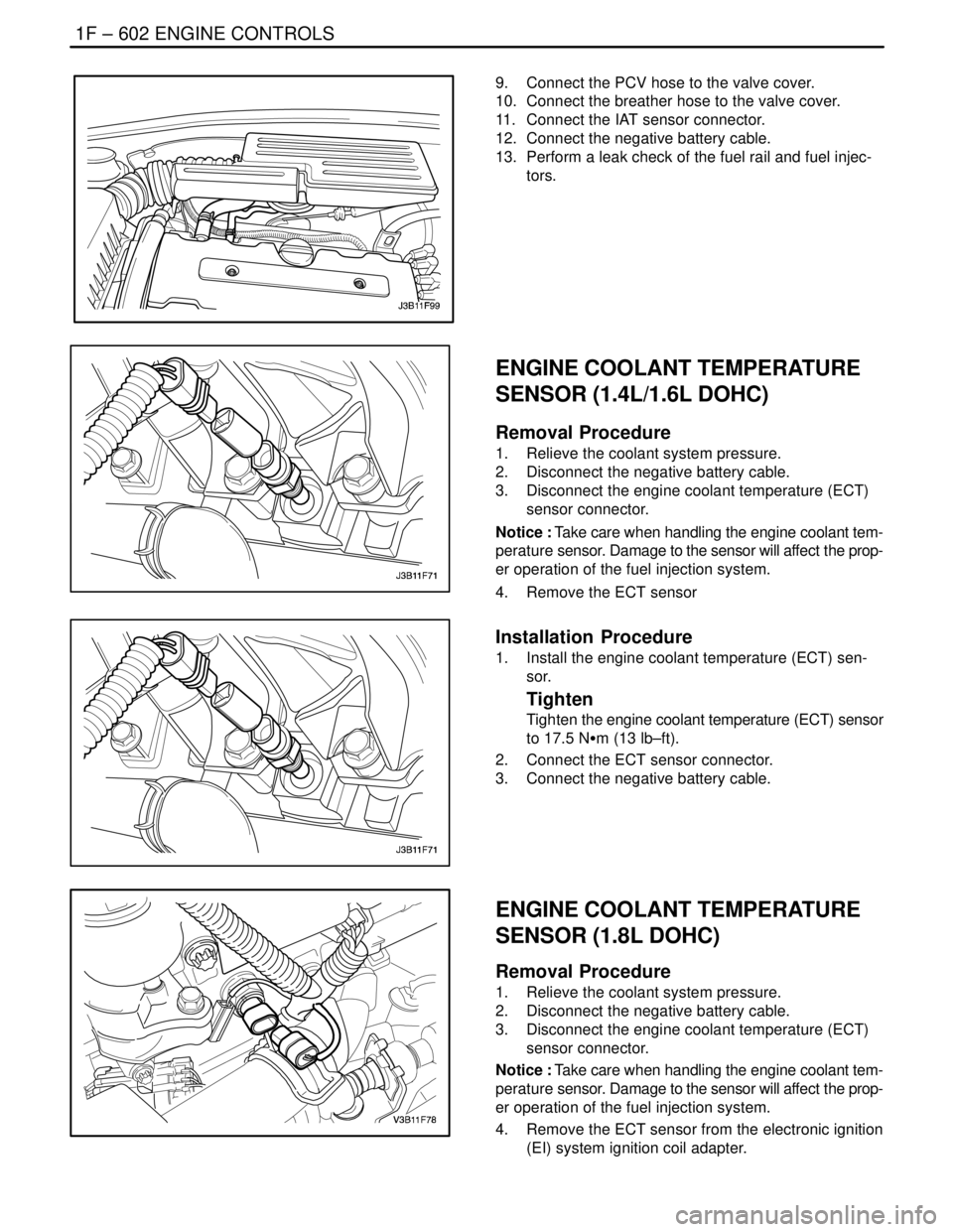
9. Connect the PCV hose to the valve cover.
10. Connect the breather hose to the valve cover.
11. Connect the IAT sensor connector.
12. Connect the negative battery cable.
13. Perform a leak check of the fuel rail and fuel injec-
tors.
ENGINE COOLANT TEMPERATURE
SENSOR (1.4L/1.6L DOHC)
Removal Procedure
1. Relieve the coolant system pressure.
2. Disconnect the negative battery cable.
3. Disconnect the engine coolant temperature (ECT)
sensor connector.
Notice : Take care when handling the engine coolant tem-
perature sensor. Damage to the sensor will affect the prop-
er operation of the fuel injection system.
4. Remove the ECT sensor
Installation Procedure
1. Install the engine coolant temperature (ECT) sen-
sor.
Tighten
Tighten the engine coolant temperature (ECT) sensor
to 17.5 NSm (13 lb–ft).
2. Connect the ECT sensor connector.
3. Connect the negative battery cable.
ENGINE COOLANT TEMPERATURE
SENSOR (1.8L DOHC)
Removal Procedure
1. Relieve the coolant system pressure.
2. Disconnect the negative battery cable.
3. Disconnect the engine coolant temperature (ECT)
sensor connector.
Notice : Take care when handling the engine coolant tem-
perature sensor. Damage to the sensor will affect the prop-
er operation of the fuel injection system.
4. Remove the ECT sensor from the electronic ignition
(EI) system ignition coil adapter.
Page 850 of 2643
1F – 604IENGINE CONTROLS
DAEWOO V–121 BL4
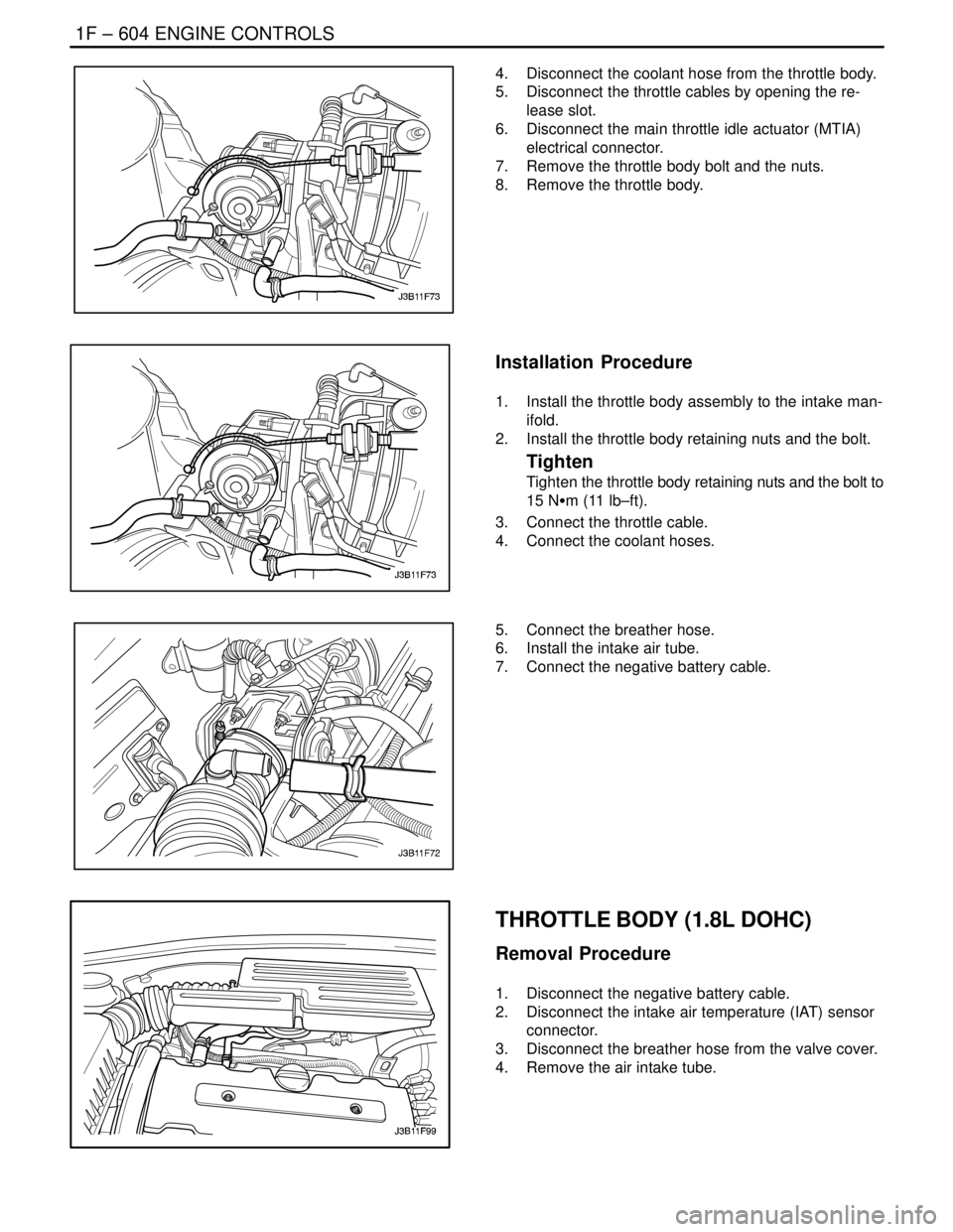
4. Disconnect the coolant hose from the throttle body.
5. Disconnect the throttle cables by opening the re-
lease slot.
6. Disconnect the main throttle idle actuator (MTIA)
electrical connector.
7. Remove the throttle body bolt and the nuts.
8. Remove the throttle body.
Installation Procedure
1. Install the throttle body assembly to the intake man-
ifold.
2. Install the throttle body retaining nuts and the bolt.
Tighten
Tighten the throttle body retaining nuts and the bolt to
15 NSm (11 lb–ft).
3. Connect the throttle cable.
4. Connect the coolant hoses.
5. Connect the breather hose.
6. Install the intake air tube.
7. Connect the negative battery cable.
THROTTLE BODY (1.8L DOHC)
Removal Procedure
1. Disconnect the negative battery cable.
2. Disconnect the intake air temperature (IAT) sensor
connector.
3. Disconnect the breather hose from the valve cover.
4. Remove the air intake tube.
Page 852 of 2643
1F – 606IENGINE CONTROLS
DAEWOO V–121 BL4
7. Connect the TP sensor connector and the IAC
valve connector.
8. Connect the coolant hoses to the throttle body.
9. Connect the vacuum hoses to the throttle body.
Important : Make sure the throttle/cruise control cables
do not hold the throttle open. With the engine off, check to
see that the accelerator pedal is free.
10. Connect the throttle cable.
11. Install the air intake tube.
12. Connect the breather hose to the valve cover.
13. Connect the IAT sensor connector.
14. Connect the negative battery cable.
15. Fill the cooling system.
FRONT HEATED OXYGEN SENSOR
(HO2S1) (1.4L/1.6L DOHC)
Removal Procedure
1. Disconnect the negative battery cable.
Notice : The oxygen sensor uses a permanently attached
pigtail and connector. This pigtail should not be removed
from the oxygen sensor. Damage or removal of the pigtail
or the connector could affect proper operation of the oxy-
gen sensor. Take care when handling the oxygen sensor.
Do not drop the oxygen sensor.
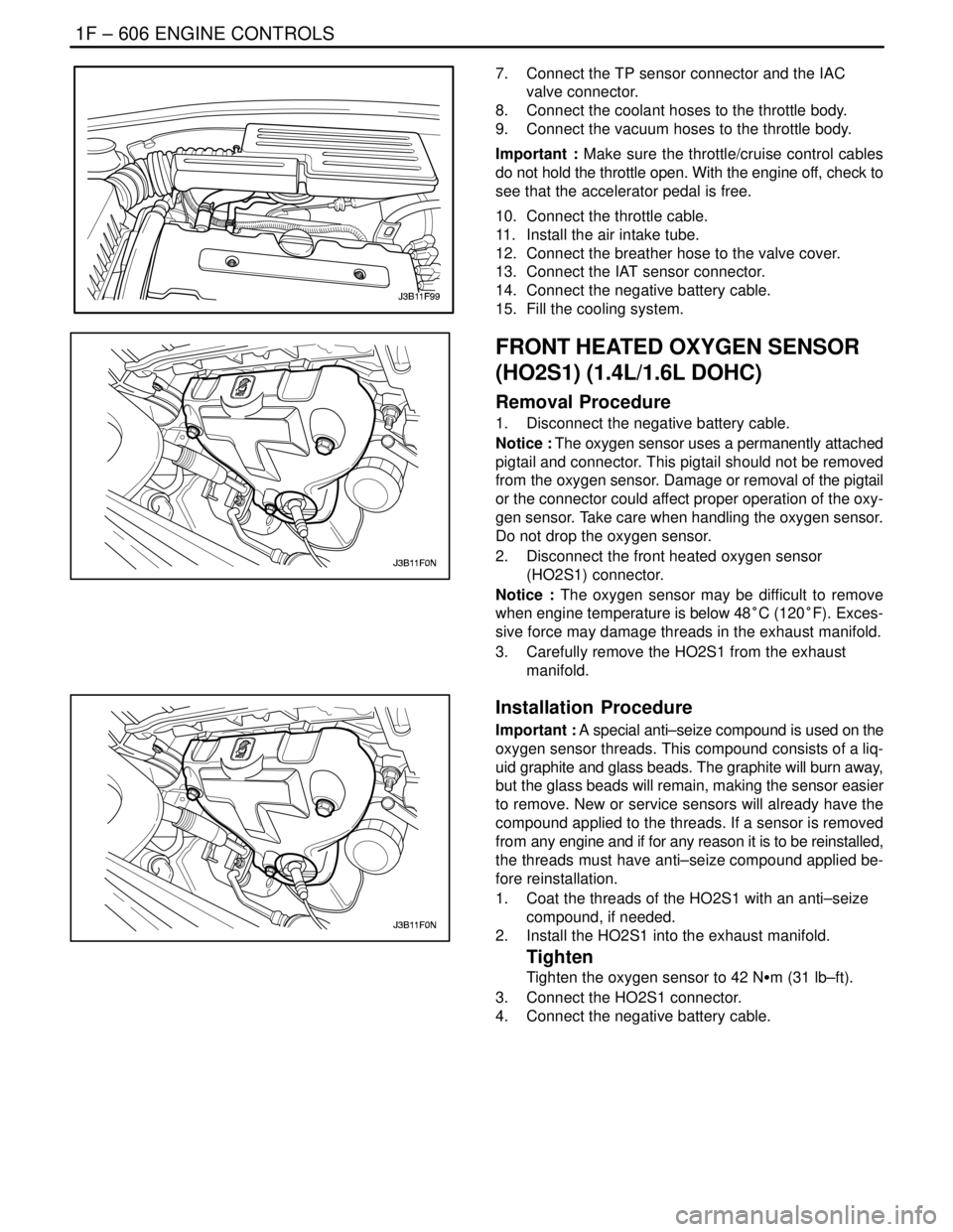
2. Disconnect the front heated oxygen sensor
(HO2S1) connector.
Notice : The oxygen sensor may be difficult to remove
when engine temperature is below 48°C (120°F). Exces-
sive force may damage threads in the exhaust manifold.
3. Carefully remove the HO2S1 from the exhaust
manifold.
Installation Procedure
Important : A special anti–seize compound is used on the
oxygen sensor threads. This compound consists of a liq-
uid graphite and glass beads. The graphite will burn away,
but the glass beads will remain, making the sensor easier
to remove. New or service sensors will already have the
compound applied to the threads. If a sensor is removed
from any engine and if for any reason it is to be reinstalled,
the threads must have anti–seize compound applied be-
fore reinstallation.
1. Coat the threads of the HO2S1 with an anti–seize
compound, if needed.
2. Install the HO2S1 into the exhaust manifold.
Tighten
Tighten the oxygen sensor to 42 NSm (31 lb–ft).
3. Connect the HO2S1 connector.
4. Connect the negative battery cable.
Page 854 of 2643
1F – 608IENGINE CONTROLS
DAEWOO V–121 BL4
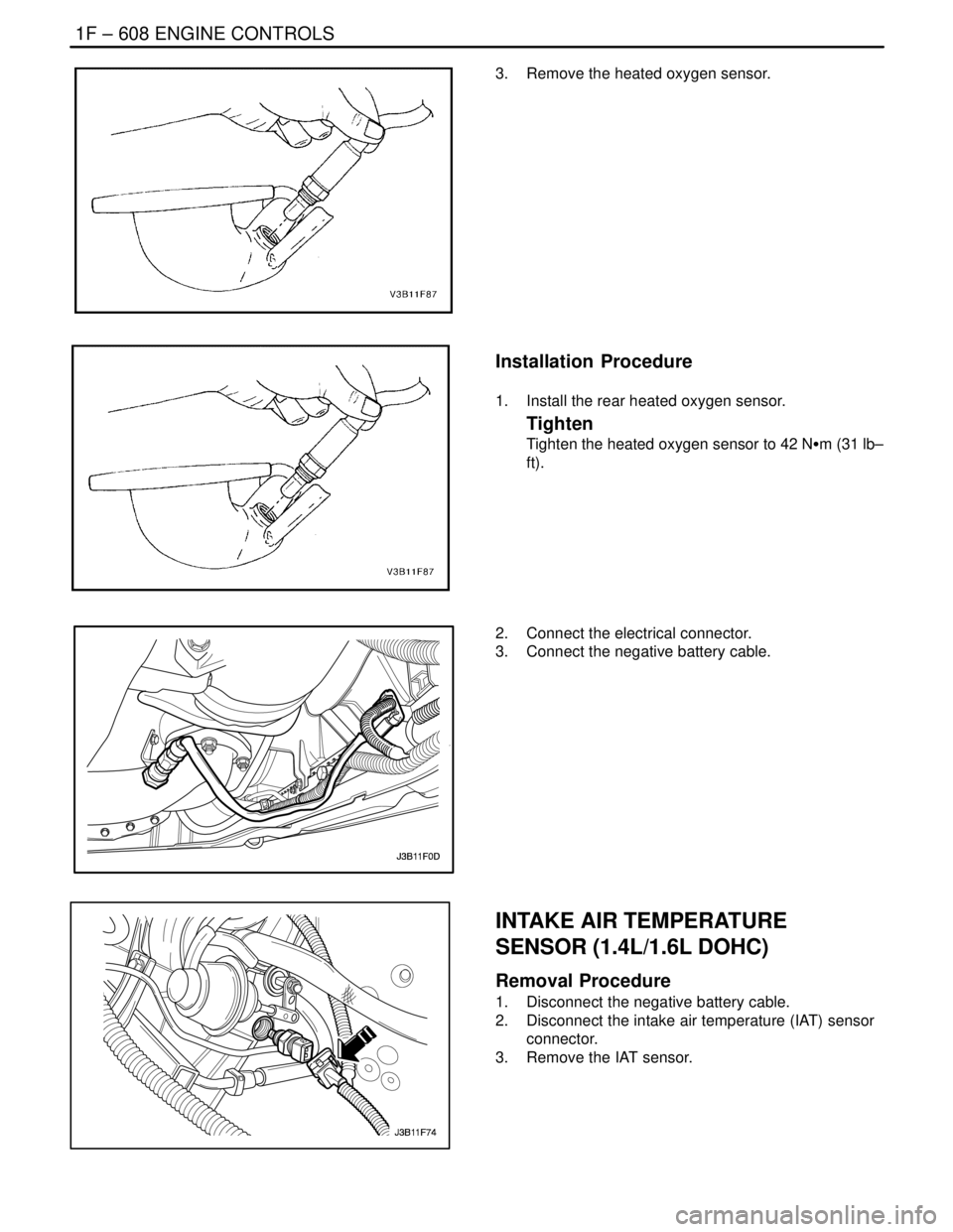
3. Remove the heated oxygen sensor.
Installation Procedure
1. Install the rear heated oxygen sensor.
Tighten
Tighten the heated oxygen sensor to 42 NSm (31 lb–
ft).
2. Connect the electrical connector.
3. Connect the negative battery cable.
INTAKE AIR TEMPERATURE
SENSOR (1.4L/1.6L DOHC)
Removal Procedure
1. Disconnect the negative battery cable.
2. Disconnect the intake air temperature (IAT) sensor
connector.
3. Remove the IAT sensor.