Iat DAEWOO LACETTI 2004 Service Repair Manual
[x] Cancel search | Manufacturer: DAEWOO, Model Year: 2004, Model line: LACETTI, Model: DAEWOO LACETTI 2004Pages: 2643, PDF Size: 80.54 MB
Page 889 of 2643

ENGINE EXHAUST 1G – 9
DAEWOO V–121 BL4
GENERAL DESCRIPTION
AND SYSTEM OPERATION
EXHAUST SYSTEM
Notice : When you are inspecting or replacing the exhaust
system components, make sure there is adequate clear-
ance from all points on the underbody to avoid possible
overheating of the floor pan and possible damage to the
passenger compartment insulation and trim materials.
CAUTION : Check the complete exhaust system and
the nearby body areas and the trunk lid for broken,
damaged, missing, or mispositioned parts, open
seams, holes, loose connections, or other deteriora-
tion which could permit hazardous exhaust fumes to
seep into the trunk or the passenger compartment.
Dust or water in the trunk may be an indication of a
problem in one of these areas. Any defects should be
corrected immediately.
MUFFLER
If holes, open seams or any deterioration is discovered
upon inspection of the front muffler and pipe assembly, the
complete assembly should be replaced. The same proce-
dure is applicable to the rear muffler assembly.
Heat shields in the front and the rear muffler assembly
positions, as well as for the catalytic converter and the
connecting pipe, protect the vehicle and the environment
from high temperatures the exhaust system develops.
CATALYTIC CONVERTERS
Notice : The catalytic converter requires the use of un-
leaded fuel only, or damage to the catalyst will result.
The catalytic converters are emission control devices add-
ed to the exhaust system to reduce pollutants from the ex-
haust pipes.
The three–way catalyst has coatings which contain palla-
dium, platinum and rhodium, which simultaneouly lower
the levels of HC, CO and NOx.
Page 900 of 2643
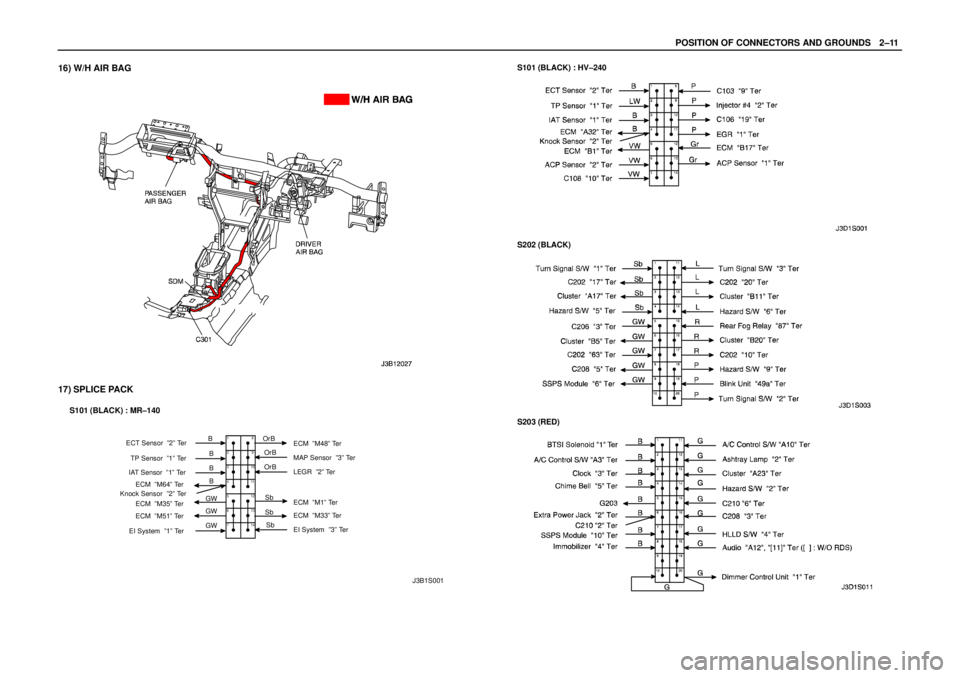
POSITION OF CONNECTORS AND GROUNDSW2–11
16) W/H AIR BAG
17) SPLICE PACK
S101 (BLACK) : MR–140
1
2
3
4
5
6
7
8
9
10
11
12
13
14
ECT Sensor ”2” Ter
TP Sensor ”1” Ter
Knock Sensor ”2” TerIAT Sensor ”1” TerLEGR ”2” Ter ECM ”M48” Ter
ECM ”M51” Ter ECM ”M35” Ter ECM ”M64” TerMAP Sensor ”3” Ter
ECM ”M1” Ter B
B
B
B
GW GW
GWOrB
OrB
OrB
EI System ”3” Ter
EI System ”1” TerSb Sb Sb
ECM ”M33” Ter
J3B1S001
S101 (BLACK) : HV–240
S202 (BLACK)
S203 (RED)
Page 902 of 2643

SECTION : 2A
SUSPENSION DIAGNOSIS
TABLE OF CONTENTS
DIAGNOSIS2A–1 . . . . . . . . . . . . . . . . . . . . . . . . . . . . . . . .
General Diagnosis 2A–1. . . . . . . . . . . . . . . . . . . . . . . . . Torque Steer 2A–5. . . . . . . . . . . . . . . . . . . . . . . . . . . . . .
Tapered Roller Bearing 2A–6. . . . . . . . . . . . . . . . . . . . .
DIAGNOSIS
GENERAL DIAGNOSIS
Problems in the steering, the suspension, the tires, and
the wheels involve several systems. Consider all systems
when diagnosing a complaint. Some problems, such as
abnormal or excessive tire wear and scuffed tires, may be
the result of hard driving. Always road test the vehicle first.If possible, do this road test with the customer.
Proceed with the following preliminary checks. Correct
any substandard conditions.
Preliminary Checks
ChecksAction
Inspect the tires for improper pressure and uneven wear.Inflate the tires to the proper pressure.
Inspect the joint from the steering column to the steering
gear for loose connections or wear.Tighten the intermediate shaft pinch bolts. Replace the in-
termediate shaft as needed.
Inspect the front and the rear suspension, the steering
gear, and the linkage for loose or damaged parts.Tighten the front and the rear suspension. Tighten the
steering gear mounting bracket bolts. Tighten the coupling
flange pinch bolts. Replace the front and the rear suspen-
sion as needed. Replace the steering gear as needed. Re-
place the intermediate shaft as needed.
Inspect for out–of–round tires.Perform a free runout test. Match–mount the tires.
Inspect for out–of–balance tires, bent wheels, and worn or
loose wheel bearings.Balance the wheels. Replace the wheels. Replace the
wheel bearings.
Check the power steering pump serpentine belt tension.Tighten the power steering pump serpentine belt.
Inspect the power steering system for leaks. Check the
power steering fluid level.Repair any leaks. Perform a power steering gear test. Add
power steering fluid.
Car Lead/Pull
ChecksAction
Inspect for mismatched or uneven tires.Replace the tires.
Inspect for a broken or a sagging spring.Replace the spring.
Inspect for a radial tire lateral force.Check the wheel alignment. Switch the wheels. Replace
the tires as needed.
Check the front–wheel alignment.Align the front wheels.
Inspect for an off–center steering gear.Reseat the pinion valve assembly. Replace the pinion
valve assembly as needed.
Inspect for front–brake dragging.Adjust the front brakes.
Page 904 of 2643

SUSPENSION DIAGNOSIS 2A – 3
DAEWOO V–121 BL4
Too Much Play in Steering
ChecksAction
Inspect for worn or loose wheel bearings.Tighten the drive axle nut. Replace the wheel bearings as
needed.
Inspect for a loose steering gear mounting.Tighten the steering gear mounting bracket nuts.
Inspect the joint from the column to the steering gear for
loose connections or wear.Tighten the intermediate shaft pinch bolts. Replace the in-
termediate shaft as needed.
Check the steering gear preload adjustment.Perform a rack bearing preload adjustment.
Poor Returnability
ChecksAction
Inspect for lack of lubrication of the ball joints and the tie
rod ends.Replace the ball joints and the outer tie rods.
Inspect for binding in the ball joints.Replace the ball joint.
Inspect for binding in the steering column.Lubricate the steering column. Replace the steering col-
umn as needed.
Check the front–wheel alignment.Align the front wheels.
Check the steering gear preload adjustment.Perform a rack bearing preload adjustment.
Inspect for a sticking valve.Lubricate the pinion valve assembly. Replace the pinion
valve assembly as needed.
Inspect for binding in the intermediate shaft on the steering
gear.Replace the intermediate shaft.
Abnormal Noise, Front Suspension
ChecksAction
Inspect for a lack of lubrication of the ball joints and the tie
rod ends.Replace the ball joints and the outer tie rods.
Inspect for damaged suspension components.Replace the damaged suspension components.
Inspect for worn control arm bushings or tie rod ends.Replace the control arm bushings or the tie rods.
Inspect for a loose stabilizer shaft link.Tighten the stabilizer shaft link.
Inspect for loose wheel bolts.Tighten the wheel bolts.
Inspect for loose suspension bolts or nuts.Tighten the suspension bolts or the nuts.
Inspect for worn strut dampeners or strut mountings.Replace the strut dampeners. Tighten the strut mounting
bolts.
Inspect for an improperly positioned strut spring.Adjust the strut spring to the proper position.
Wander or Poor Steering Ability
ChecksAction
Inspect for mismatched or uneven tires.Replace the tires.
Inspect for lack of lubrication of the ball joints and the tie
rod ends.Replace the ball joints and the outer tie rods.
Inspect for worn strut dampeners.Replace the strut dampeners.
Inspect for a loose stabilizer shaft link.Tighten the stabilizer shaft link.
Inspect for a broken or a sagging spring.Replace the spring.
Page 906 of 2643

SUSPENSION DIAGNOSIS 2A – 5
DAEWOO V–121 BL4
Steering Wheel Kickback
ChecksAction
Inspect for air in the power steering system.Purge the power steering system of air.
Inspect for a loose steering gear mounting.Tighten the steering gear mounting bracket nuts.
Inspect the joint from the column to the steering gear for
loose connections or wear.Tighten the intermediate shaft pinch bolts. Replace the in-
termediate shaft as needed.
Inspect for loose tie rod ends.Tighten the tie rod ends. Replace the outer tie rods as
needed.
Inspect for loose or worn wheel bearings.Tighten the drive axle nut. Replace the wheel bearings as
needed.
Steering Wheel Surges or Jerks
ChecksAction
Check the hydraulic system. Test the power steering sys-
tem pressure with a gauge.Replace the seals and the hoses as needed.
Inspect for a sluggish steering gear valve.Clean the pinion valve assembly. Replace the pinion valve
assembly as needed.
Inspect for a loose power steering pump serpentine belt.Adjust the power steering pump serpentine belt.
Cupped Tires
ChecksAction
Check the front–wheel and the rear–wheel alignment.Align the front and the rear wheels.
Inspect for worn strut dampeners.Replace the strut dampeners.
Inspect for worn or loose wheel bearings.Tighten the drive axle nut. Replace the wheel bearings as
needed.
Inspect for excessive tire or wheel runout.Match–mount the tires. Replace the tires as needed. Re-
place the wheels as needed.
Inspect for a worn ball joint.Replace the ball joint.
Check the steering gear preload adjustment.Perform a rack bearing preload adjustment.
TORQUE STEER
A degree of torque steer to the right may be experienced
during the use of heavy throttle on some front–wheel drive
cars with drive axles of unequal length. This torque steer
to the right results from the right drive axle being longer
than the left drive axle, which creates a difference in the
drive axle angle. Cars with intermediate shaft assemblies
have axles of almost equal length.
A difference in the drive axle lengths results in more torque
toe–in in the left front wheel. You will notice the torque toe–
in when the vehicle accelerates from a standing start or at
lower speeds.
Inspection Procedure
1. Place a small piece of tape at the top center of the
steering wheel.2. Note the inches of steering wheel deflection re-
quired to keep the vehicle straight during heavy ac-
celeration.
3. Compare this finding with similar cars.
Factors that may cause torque steer to be more apparent
on a particular vehicle include:
S Variations in the tire and wheel assemblies. This
has the most significant effect on torque steer. A
slightly smaller diameter on the right front tire will
increase a right torque lead.
S Large differences in the right and the left front tire
pressure.
S Looseness in the control arm bushings, the tie rod
assemblies, or the steering gear mounting. This
looseness permits a front wheel to pull forward and
toe–in under a torque greater than the wheel on the
opposite side. A loose suspension component may
result in an opposite lead upon deceleration.
Page 910 of 2643
WHEEL ALIGNMENT 2B – 3
DAEWOO V–121 BL4
4. Install original tires one at a time to find the offend-
ing tire.
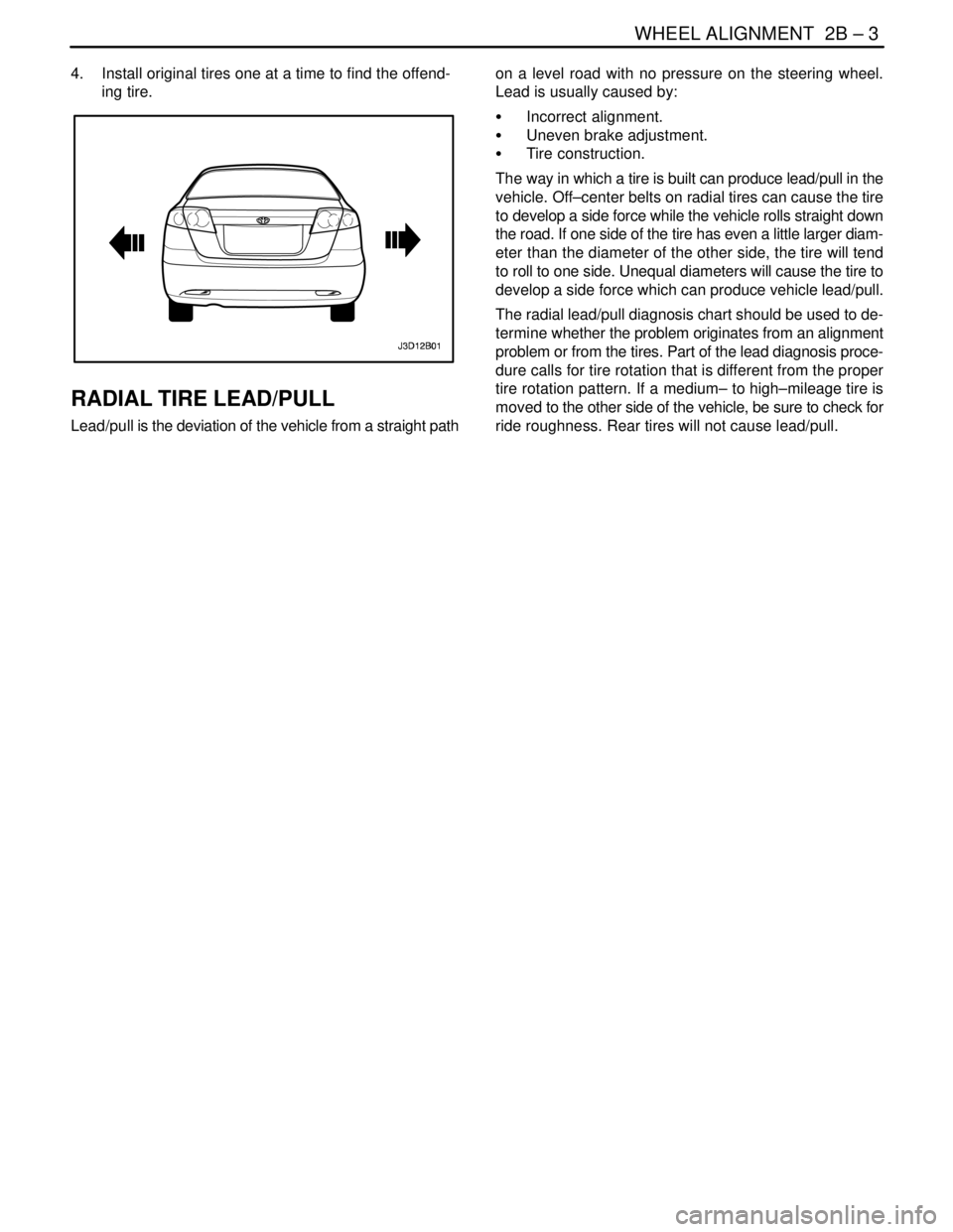
RADIAL TIRE LEAD/PULL
Lead/pull is the deviation of the vehicle from a straight pathon a level road with no pressure on the steering wheel.
Lead is usually caused by:
S Incorrect alignment.
S Uneven brake adjustment.
S Tire construction.
The way in which a tire is built can produce lead/pull in the
vehicle. Off–center belts on radial tires can cause the tire
to develop a side force while the vehicle rolls straight down
the road. If one side of the tire has even a little larger diam-
eter than the diameter of the other side, the tire will tend
to roll to one side. Unequal diameters will cause the tire to
develop a side force which can produce vehicle lead/pull.
The radial lead/pull diagnosis chart should be used to de-
termine whether the problem originates from an alignment
problem or from the tires. Part of the lead diagnosis proce-
dure calls for tire rotation that is different from the proper
tire rotation pattern. If a medium– to high–mileage tire is
moved to the other side of the vehicle, be sure to check for
ride roughness. Rear tires will not cause lead/pull.
Page 912 of 2643
WHEEL ALIGNMENT 2B – 5
DAEWOO V–121 BL4
VIBRATION DIAGNOSIS
Wheel imbalance causes most highway speed vibration
problems. A vibration can remain after dynamic balancing
because:
S A tire is out of round.
S A rim is out of round.
S A tire stiffness variation exists.
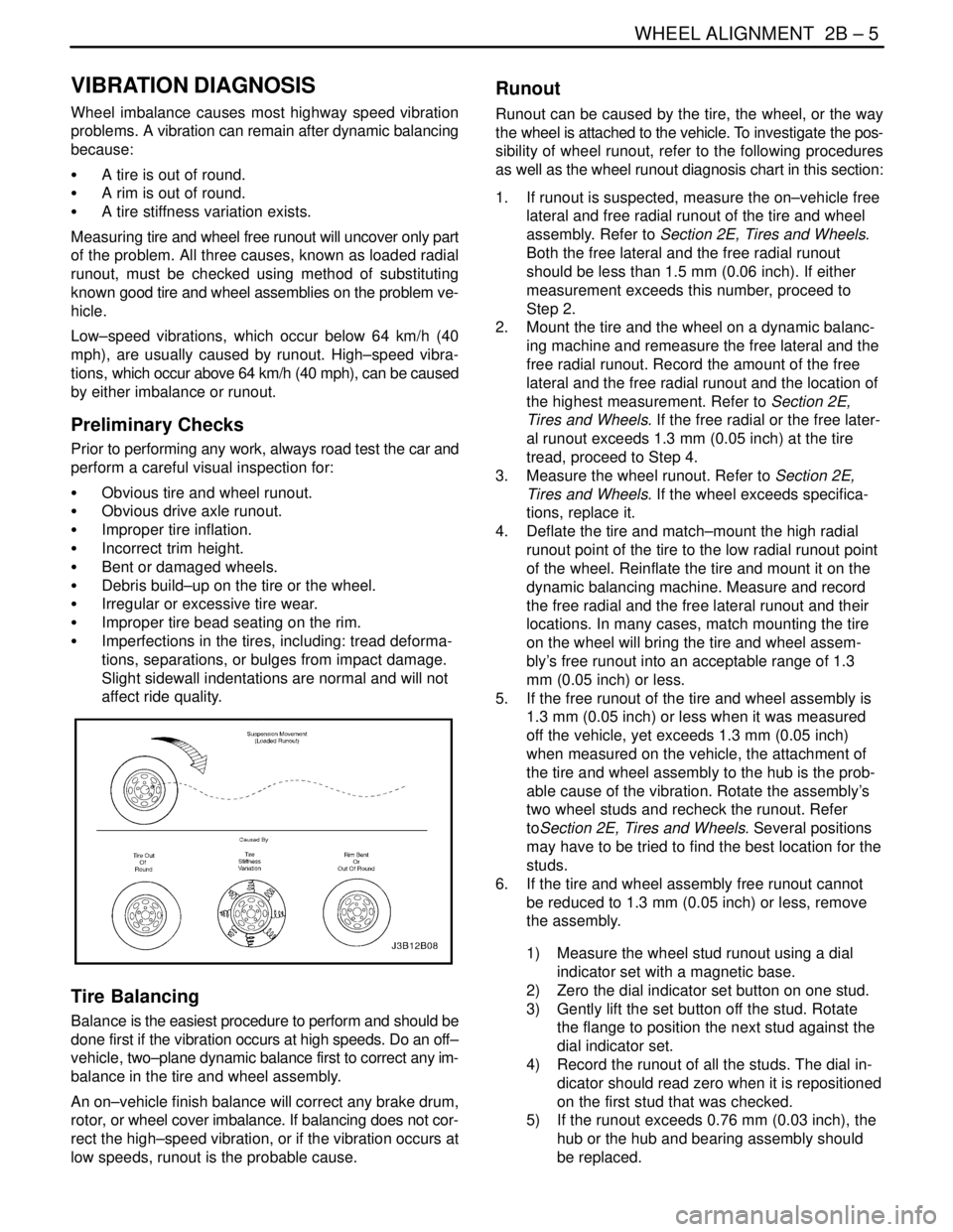
Measuring tire and wheel free runout will uncover only part
of the problem. All three causes, known as loaded radial
runout, must be checked using method of substituting
known good tire and wheel assemblies on the problem ve-
hicle.
Low–speed vibrations, which occur below 64 km/h (40
mph), are usually caused by runout. High–speed vibra-
tions, which occur above 64 km/h (40 mph), can be caused
by either imbalance or runout.
Preliminary Checks
Prior to performing any work, always road test the car and
perform a careful visual inspection for:
S Obvious tire and wheel runout.
S Obvious drive axle runout.
S Improper tire inflation.
S Incorrect trim height.
S Bent or damaged wheels.
S Debris build–up on the tire or the wheel.
S Irregular or excessive tire wear.
S Improper tire bead seating on the rim.
S Imperfections in the tires, including: tread deforma-
tions, separations, or bulges from impact damage.
Slight sidewall indentations are normal and will not
affect ride quality.
Tire Balancing
Balance is the easiest procedure to perform and should be
done first if the vibration occurs at high speeds. Do an off–
vehicle, two–plane dynamic balance first to correct any im-
balance in the tire and wheel assembly.
An on–vehicle finish balance will correct any brake drum,
rotor, or wheel cover imbalance. If balancing does not cor-
rect the high–speed vibration, or if the vibration occurs at
low speeds, runout is the probable cause.
Runout
Runout can be caused by the tire, the wheel, or the way
the wheel is attached to the vehicle. To investigate the pos-
sibility of wheel runout, refer to the following procedures
as well as the wheel runout diagnosis chart in this section:
1. If runout is suspected, measure the on–vehicle free
lateral and free radial runout of the tire and wheel
assembly. Refer to Section 2E, Tires and Wheels.
Both the free lateral and the free radial runout
should be less than 1.5 mm (0.06 inch). If either
measurement exceeds this number, proceed to
Step 2.
2. Mount the tire and the wheel on a dynamic balanc-
ing machine and remeasure the free lateral and the
free radial runout. Record the amount of the free
lateral and the free radial runout and the location of
the highest measurement. Refer to Section 2E,
Tires and Wheels. If the free radial or the free later-
al runout exceeds 1.3 mm (0.05 inch) at the tire
tread, proceed to Step 4.
3. Measure the wheel runout. Refer to Section 2E,
Tires and Wheels. If the wheel exceeds specifica-
tions, replace it.
4. Deflate the tire and match–mount the high radial
runout point of the tire to the low radial runout point
of the wheel. Reinflate the tire and mount it on the
dynamic balancing machine. Measure and record
the free radial and the free lateral runout and their
locations. In many cases, match mounting the tire
on the wheel will bring the tire and wheel assem-
bly’s free runout into an acceptable range of 1.3
mm (0.05 inch) or less.
5. If the free runout of the tire and wheel assembly is
1.3 mm (0.05 inch) or less when it was measured
off the vehicle, yet exceeds 1.3 mm (0.05 inch)
when measured on the vehicle, the attachment of
the tire and wheel assembly to the hub is the prob-
able cause of the vibration. Rotate the assembly’s
two wheel studs and recheck the runout. Refer
toSection 2E, Tires and Wheels. Several positions
may have to be tried to find the best location for the
studs.
6. If the tire and wheel assembly free runout cannot
be reduced to 1.3 mm (0.05 inch) or less, remove
the assembly.
1) Measure the wheel stud runout using a dial
indicator set with a magnetic base.
2) Zero the dial indicator set button on one stud.
3) Gently lift the set button off the stud. Rotate
the flange to position the next stud against the
dial indicator set.
4) Record the runout of all the studs. The dial in-
dicator should read zero when it is repositioned
on the first stud that was checked.
5) If the runout exceeds 0.76 mm (0.03 inch), the
hub or the hub and bearing assembly should
be replaced.
Page 915 of 2643
2B – 8IWHEEL ALIGNMENT
DAEWOO V–121 BL4
PRELIMINARY INSPECTION
ChecksAction
Check the tires for proper inflation pressures and normal
tread wear.Inflate the tires to the proper tire pressure. Replace the
tires as needed.
Check the wheel bearings for looseness.Tighten the axle nut to the proper specification. Replace
the strut wheel bearing as needed.
Check for loose ball joints and tie rod ends.Tighten the ball joints and the tie rods.
Check the runout of the wheels and the tires.Measure and correct the tire runout.
Check the vehicle trim heights.Correct the trim heights. Make the correction before ad-
justing the toe.
Check for loose rack and pinion mounting.Tighten the mounting brackets for the rack and pinion as-
sembly.
Check for improperly operating struts.Replace the strut assembly.
Check for loose control arms.Tighten the control arm attachment bolts. Replace the con-
trol arm bushings as needed.
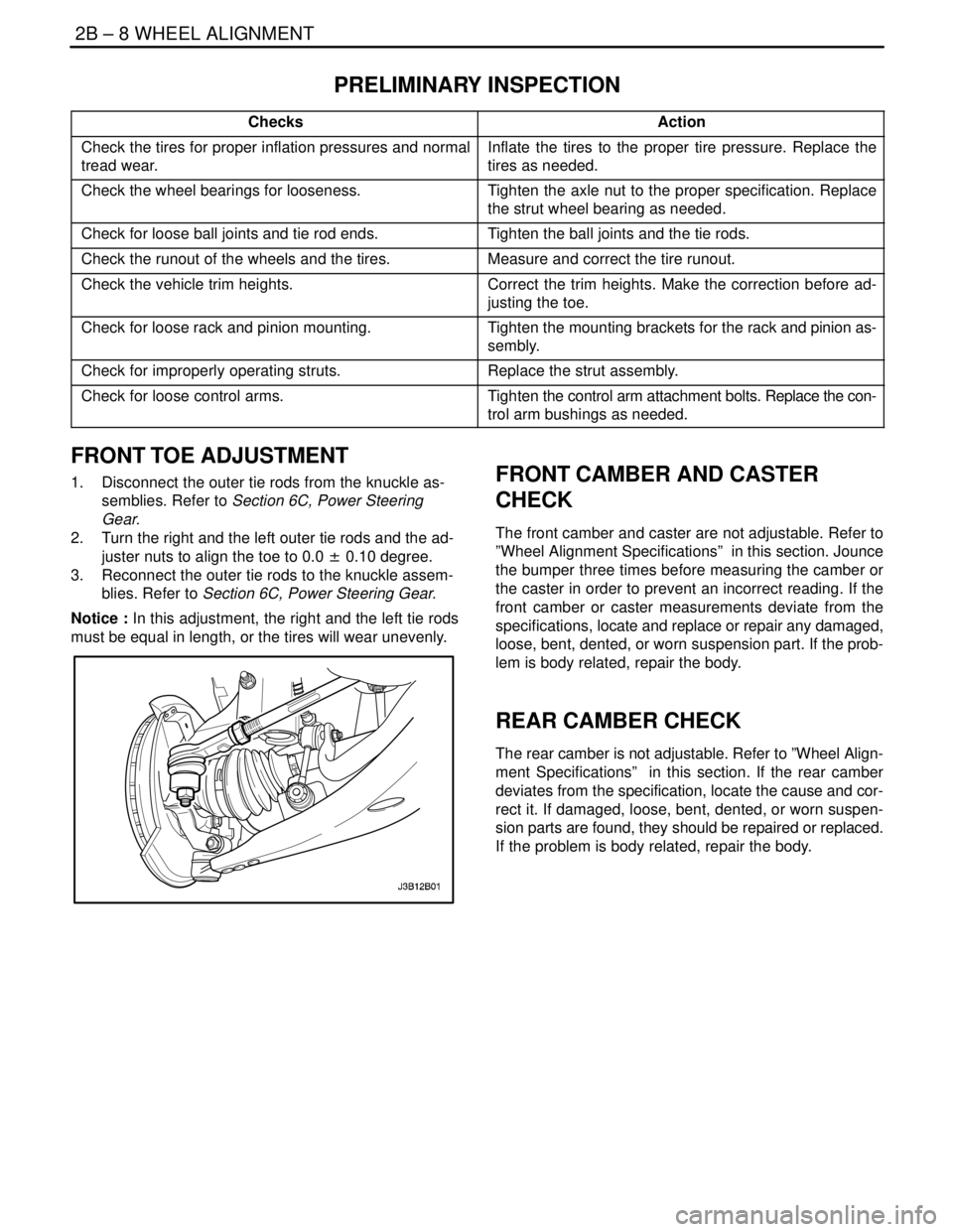
FRONT TOE ADJUSTMENT
1. Disconnect the outer tie rods from the knuckle as-
semblies. Refer to Section 6C, Power Steering
Gear.
2. Turn the right and the left outer tie rods and the ad-
juster nuts to align the toe to 0.0 ± 0.10 degree.
3. Reconnect the outer tie rods to the knuckle assem-
blies. Refer to Section 6C, Power Steering Gear.
Notice : In this adjustment, the right and the left tie rods
must be equal in length, or the tires will wear unevenly.FRONT CAMBER AND CASTER
CHECK
The front camber and caster are not adjustable. Refer to
”Wheel Alignment Specifications” in this section. Jounce
the bumper three times before measuring the camber or
the caster in order to prevent an incorrect reading. If the
front camber or caster measurements deviate from the
specifications, locate and replace or repair any damaged,
loose, bent, dented, or worn suspension part. If the prob-
lem is body related, repair the body.
REAR CAMBER CHECK
The rear camber is not adjustable. Refer to ”Wheel Align-
ment Specifications” in this section. If the rear camber
deviates from the specification, locate the cause and cor-
rect it. If damaged, loose, bent, dented, or worn suspen-
sion parts are found, they should be repaired or replaced.
If the problem is body related, repair the body.
Page 1018 of 2643

4A – 2IHYDRAULIC BRAKES
DAEWOO V–121 BL4
SPECIFICATIONS
GENERAL SPECIFCATIONS
1.4/1.6/1.8/2.0 DOHC Engine
ApplicationMillimetersInches
Brake Drums:
Inside Diameter
Maximum Rebore Diameter
Out–of–Round200.00
201.00
0.047.87
7.91
0.0016
Front Brake Rotors:
Discard Thickness
Lateral Runout (Installed)
Rotor Diameter
Rotor Thickness (New)
Thickness Variation22.00
0.030
256
24.00
0.010.87
0.001
10.07
0.95
0.0004
Rear Brake Rotors:
Discard Thickness
Lateral Runout (Installed)
Rotor Diameter
Rotor Thickness (New)
Thickness Variation8
0.030
258
10.4
0.010.31
0.001
10.15
0.40
0.0004
Master Cylinder:
Bore Diameter (Nominal)
Bore Diameter (Maximum)22.22
22.290.875
0.878
Caliper:
Minimum Piston Diameter (Front)
Minimum Piston Diameter (Rear)54.00
322.126
1.260
Wheel Cylinder Diameter:
Maximum
Nominal20.7
20.640.815
0.812
FASTENER TIGHTENING SPECIFICATIONS
ApplicationNSmLb–FtLb–In
Bleeder Screw8–71
Brake Lines1612–
Brake Pedal–to–Pedal Bracket Hex Nut1813–
Front Disc Brake Hose–to–Caliper Bolt4030–
Rear Disc Brake Hose–to–Caliper Bol3224–
Page 1028 of 2643
4A – 12IHYDRAULIC BRAKES
DAEWOO V–121 BL4
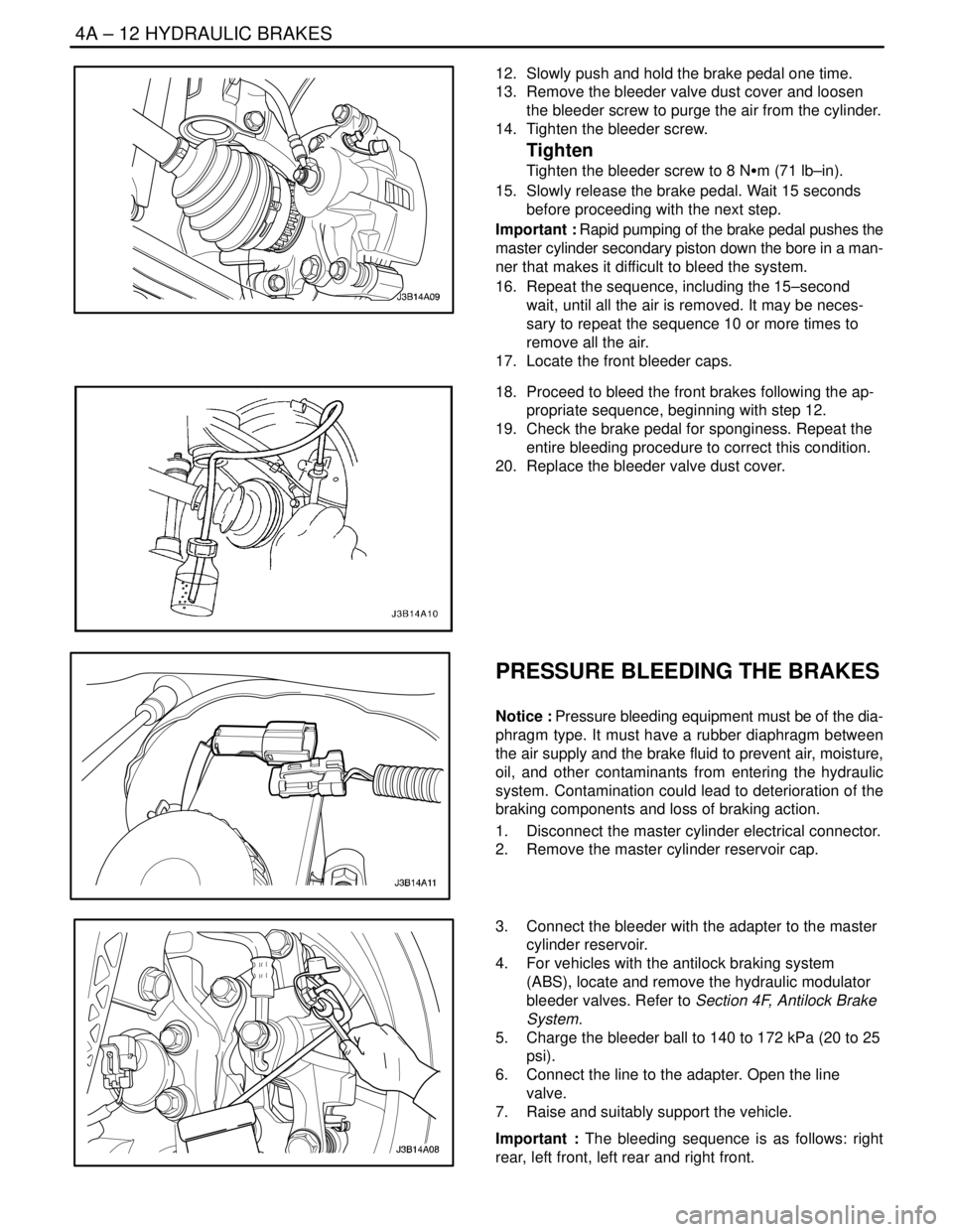
12. Slowly push and hold the brake pedal one time.
13. Remove the bleeder valve dust cover and loosen
the bleeder screw to purge the air from the cylinder.
14. Tighten the bleeder screw.
Tighten
Tighten the bleeder screw to 8 NSm (71 lb–in).
15. Slowly release the brake pedal. Wait 15 seconds
before proceeding with the next step.
Important : Rapid pumping of the brake pedal pushes the
master cylinder secondary piston down the bore in a man-
ner that makes it difficult to bleed the system.
16. Repeat the sequence, including the 15–second
wait, until all the air is removed. It may be neces-
sary to repeat the sequence 10 or more times to
remove all the air.
17. Locate the front bleeder caps.
18. Proceed to bleed the front brakes following the ap-
propriate sequence, beginning with step 12.
19. Check the brake pedal for sponginess. Repeat the
entire bleeding procedure to correct this condition.
20. Replace the bleeder valve dust cover.
PRESSURE BLEEDING THE BRAKES
Notice : Pressure bleeding equipment must be of the dia-
phragm type. It must have a rubber diaphragm between
the air supply and the brake fluid to prevent air, moisture,
oil, and other contaminants from entering the hydraulic
system. Contamination could lead to deterioration of the
braking components and loss of braking action.
1. Disconnect the master cylinder electrical connector.
2. Remove the master cylinder reservoir cap.
3. Connect the bleeder with the adapter to the master
cylinder reservoir.
4. For vehicles with the antilock braking system
(ABS), locate and remove the hydraulic modulator
bleeder valves. Refer to Section 4F, Antilock Brake
System.
5. Charge the bleeder ball to 140 to 172 kPa (20 to 25
psi).
6. Connect the line to the adapter. Open the line
valve.
7. Raise and suitably support the vehicle.
Important : The bleeding sequence is as follows: right
rear, left front, left rear and right front.