belt DAEWOO LACETTI 2004 Service Repair Manual
[x] Cancel search | Manufacturer: DAEWOO, Model Year: 2004, Model line: LACETTI, Model: DAEWOO LACETTI 2004Pages: 2643, PDF Size: 80.54 MB
Page 1912 of 2643
POWER STEERING PUMP 6B – 3
DAEWOO V–121 BL4
MAINTENANCE AND REPAIR
ON–VEHICLE SERVICE
SERPENTINE ACCESSORY DRIVE
BELT
Removal Procedure
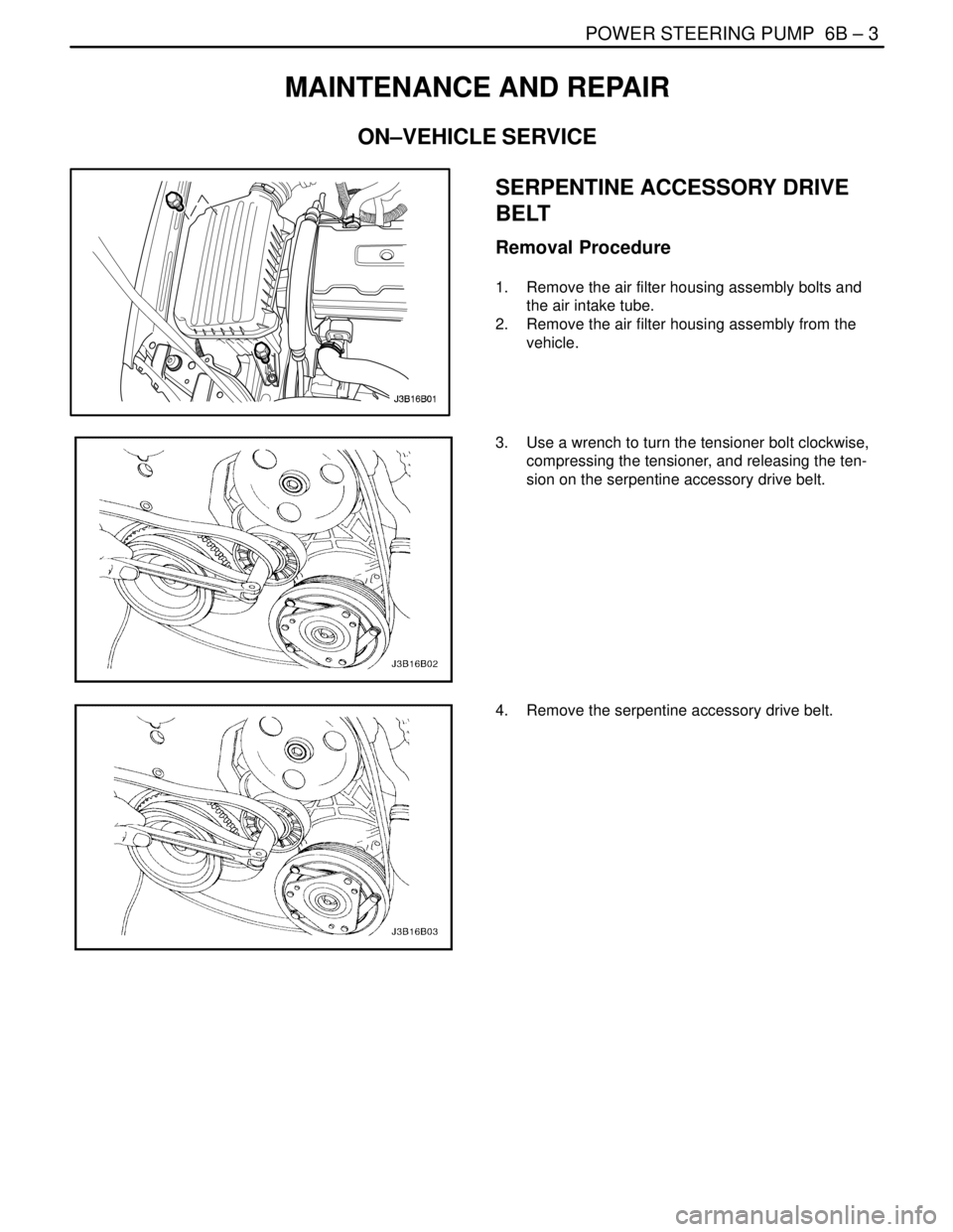
1. Remove the air filter housing assembly bolts and
the air intake tube.
2. Remove the air filter housing assembly from the
vehicle.
3. Use a wrench to turn the tensioner bolt clockwise,
compressing the tensioner, and releasing the ten-
sion on the serpentine accessory drive belt.
4. Remove the serpentine accessory drive belt.
Page 1913 of 2643
6B – 4IPOWER STEERING PUMP
DAEWOO V–121 BL4
Installation Procedure
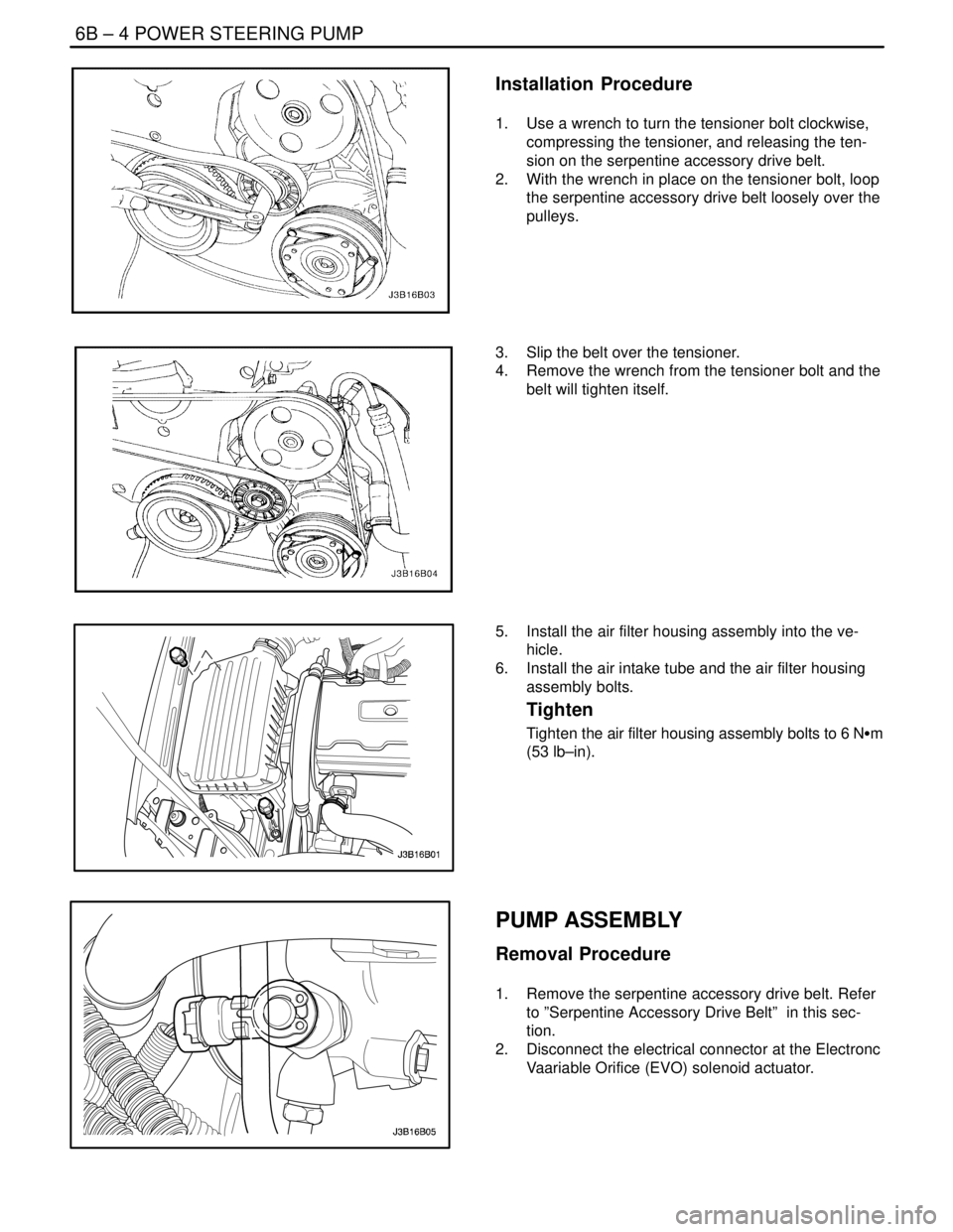
1. Use a wrench to turn the tensioner bolt clockwise,
compressing the tensioner, and releasing the ten-
sion on the serpentine accessory drive belt.
2. With the wrench in place on the tensioner bolt, loop
the serpentine accessory drive belt loosely over the
pulleys.
3. Slip the belt over the tensioner.
4. Remove the wrench from the tensioner bolt and the
belt will tighten itself.
5. Install the air filter housing assembly into the ve-
hicle.
6. Install the air intake tube and the air filter housing
assembly bolts.
Tighten
Tighten the air filter housing assembly bolts to 6 NSm
(53 lb–in).
PUMP ASSEMBLY
Removal Procedure
1. Remove the serpentine accessory drive belt. Refer
to ”Serpentine Accessory Drive Belt” in this sec-
tion.
2. Disconnect the electrical connector at the Electronc
Vaariable Orifice (EVO) solenoid actuator.
Page 1915 of 2643
6B – 6IPOWER STEERING PUMP
DAEWOO V–121 BL4
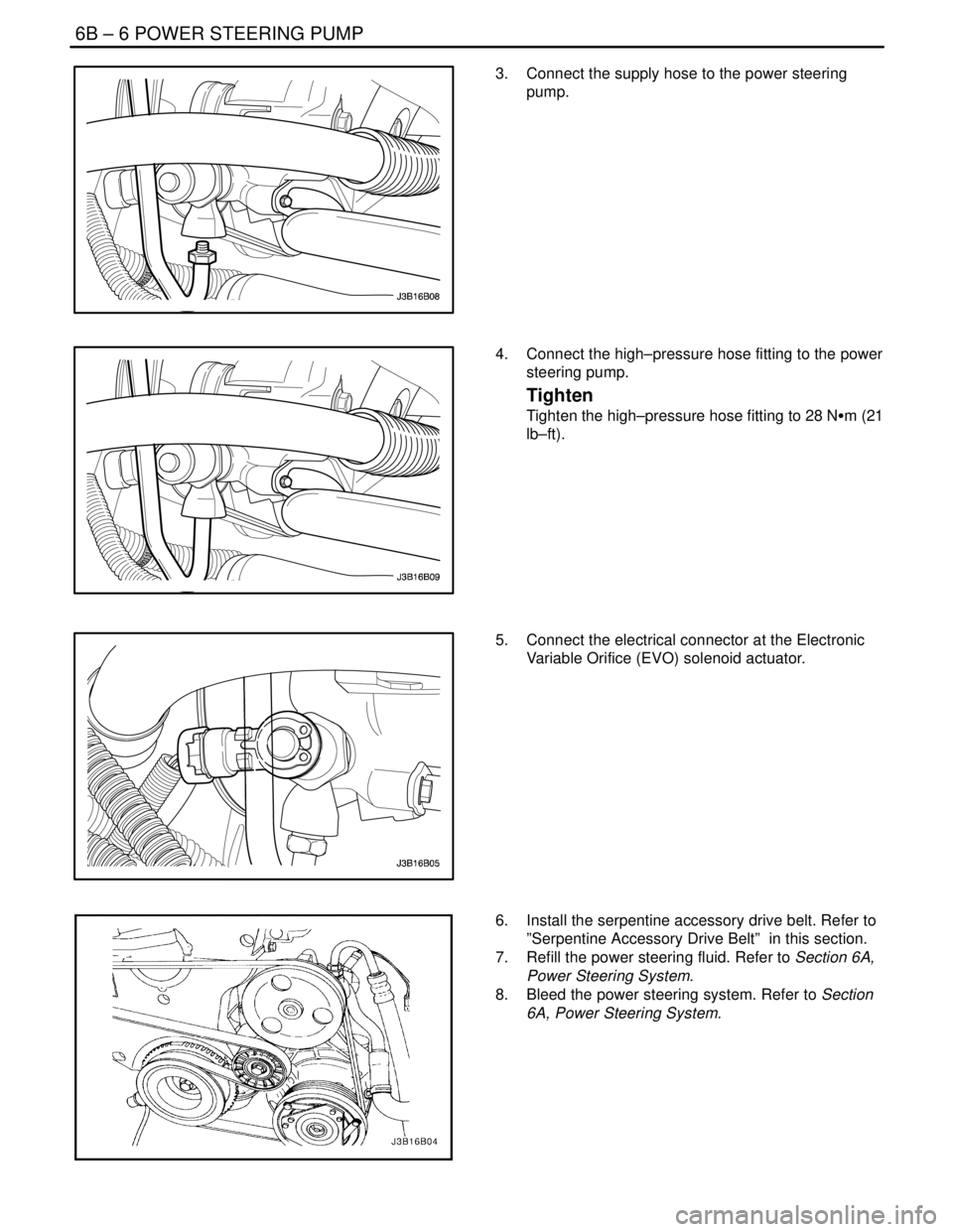
3. Connect the supply hose to the power steering
pump.
4. Connect the high–pressure hose fitting to the power
steering pump.
Tighten
Tighten the high–pressure hose fitting to 28 NSm (21
lb–ft).
5. Connect the electrical connector at the Electronic
Variable Orifice (EVO) solenoid actuator.
6. Install the serpentine accessory drive belt. Refer to
”Serpentine Accessory Drive Belt” in this section.
7. Refill the power steering fluid. Refer to Section 6A,
Power Steering System.
8. Bleed the power steering system. Refer to Section
6A, Power Steering System.
Page 1917 of 2643

6B – 8IPOWER STEERING PUMP
DAEWOO V–121 BL4
GENERAL DESCRIPTION
AND SYSTEM OPERATION
POWER STEERING PUMP
The power steering pump is a multivaned hydraulic pump.
The serpentine accessory drive belt on the engine drives
the power steering pump.The power steering pump provides the hydraulic pressure
to the power steering gear.
The power steering gear uses the hydraulic pressure to
assist in steering the vehicle.
The power steering system uses a remote reservoir in or-
der to make available more space in the engine compart-
ment.
Page 1921 of 2643

6C – 4IPOWER STEERING GEAR
DAEWOO V–121 BL4
Steering Surges or Jerks When Turning with Engine Running
ChecksAction
Check the power steering pump for insufficient pressure.Replace the power steering pump.
Check the power steering pump flow control valve for
sticking and improper operation.Replace the power steering pump.
Check the power steering pump serpentine belt for slip-
page.Tighten the power steering serpentine belt.
Check for air contamination in the power steering system.Bleed the power steering system.
Steering Vibrates During Low Speed or Static Steering
ChecksAction
Check for air contamination in the power steering system.Bleed the power steering system.
Check the power steering pump serpentine belt for loose-
ness.Tighten the power steering serpentine belt.
Excessive Wheel Kickback or Loose Steering
ChecksAction
Check for air contamination in the power steering system.Bleed the power steering system.
Check the wheel bearings for wear or damage.Replace the wheel bearings.
Check the steering gear mounting for improper installa-
tion.Tighten the steering gear mounting bracket nuts and bolts.
Check the intermediate shaft joints for improper installa-
tion.Adjust the intermediate shaft between the steering gear
and the steering column.
Replace the intermediate shaft.
Check the outer tie rods and ball joints for looseness.Tighten the tie rods and the ball joints. Replace the tie rods
and the ball joints.
Hard Steering or Lack of Assist (Especially During Parking)
ChecksAction
Adjust the intermediate shaft between the steering gear
and the steering column. Replace the coupling flange.Adjust the steering coupling flange on the steering gear
and the steering column. Replace the coupling flange as
needed.
Check the power steering pump flow control valve for
sticking and improper installation.Replace the power steering pump.
Check the power steering pump for insufficient pressure.Replace the power steering pump.
Check the power steering pump for internal leaks.Replace the power steering pump.
Check for a loose or a worn intermediate shaft.Tighten the intermediate shaft. Replace the intermediate
shaft as needed.
Check the power steering pump serpentine belt tension.Tighten the power steering serpentine belt.
Page 1980 of 2643

7A – 6IHEATING AND VENTILATION SYSTEM
DAEWOO V–121 BL4
DIAGNOSIS
HEATER SYSTEM
INSUFFICIENT HEATING OR DEFROSTING
CAUTION : The cooling system is pressurized when hot. Injury can result from removing the surge tank cap be-
fore the engine is sufficiently cool.
Step
ActionValue(s)YesNo
1Verify the customer’s complaint.
Are the customer’s concerns verified?–Go to Step 2System OK
2Check the coolant level.
Is the coolant level correct?–Go to Step 4Go to Step 3
3Add coolant as needed.
Is the repair complete?–System OKGo to Step 4
4Check the timing belt for tension or damage.
Are the drive belts OK?–Go to Step 6Go to Step 5
5Correct any problem with the timing belt.
Is the repair complete?–System OKGo to Step 6
6Check the coolant hoses for leaks or kinks.
Are the coolant hoses OK?–Go to Step 8Go to Step 7
7Repair any problem with the coolant hoses.
Is the repair complete?–System OKGo to Step 8
8Check the surge tank cap. Refer to Section 2D, En-
gine Cooling.
Is the surge tank cap OK?–Go to Step 10Go to Step 9
9Repair or replace the surge tank cap as needed.
Is the repair complete?–System OKGo to Step 10
101. Turn the A/C switch OFF on vehicles equipped
with air conditioning (A/C).
2. Set the blower motor switch on maximum
speed.
3. Set the heater control to full hot.
4. Turn the ignition ON.
5. Check for airflow from the vent outlet.
Is there heavy airflow from the heater outlet?–Go to Step 11Go to Step 26
11Check for a change in the airflow at various blower
speeds.
Does the blower speed increase as the switch is
turned from 1 to 4.–Go to Step 12Go to ”Blower
Electrical
(Manual and
Non–A/C)”
121. Turn the A/C switch OFF.
2. Set the temperature lever to full hot.
3. Set the blower motor switch on maximum
speed.
4. With the engine sufficiently cool, remove the
surge tank cap.
5. Start the vehicle and idle the engine.
6. Watch for the flow of the coolant.
Is the coolant flow visible?–Go to Step 14Go to Step 13
Page 2010 of 2643

7B – 8IMANUAL CONTROL HEATING, VENTILATION AND AIR CONDITIONING SYSTEM
DAEWOO V–121 BL4
DIAGNOSIS
GENERAL DIAGNOSIS
TESTING THE REFRIGERANT
SYSTEM
If you suspect a problem in the refrigerant system, check
for the following conditions:
1. Check the outer surfaces of the radiator and the
condenser cores to be sure that the airflow is not
blocked by dirt, leaves, or other foreign material.
Check between the condenser and the radiator, as
well as all outer surfaces.
2. Check for restrictions or kinks in the condenser
core, the hoses, and the tubes.
3. Check the operation of the blower fan.
4. Check all the air ducts for leaks or restrictions. Low
airflow rate may indicate a restricted evaporator
core.
5. Check for slippage of the compressor clutch.
6. Check the drive belt tension.
INSUFFICIENT COOLING ”QUICK
CHECK” PROCEDURE
Perform the following ”hand–feel” procedure to get a quick
idea of whether the A/C system has the proper charge of
Refrigerant–134a. The air temperature must be above
21°C (70°F) for most models.
1. Warm up engine. Run the engine at idle.
2. Open the hood and all the doors.
3. Turn the A/C switch ON.
4. Set the temperature control to the full cold position.
5. Set the blower speed switch on the maximum
speed setting.
6. ”Hand–feel” the temperature of the evaporator out-
let pipe. The pipe should be cold.
7. Check for other problems. Refer to ”Testing the Re-
frigerant System” in this section.
8. Leak check the system. Refer to ”Leak Testing the
Refrigerant System” in this section. If you find a
leak, discharge the system and repair the leak as
required. After completing the repair, evacuate the
system and charge it.
9. If there is no leak, refer to ”Insufficient Cooling
Diagnosis” in this section.
Page 2014 of 2643

7B – 12IMANUAL CONTROL HEATING, VENTILATION AND AIR CONDITIONING SYSTEM
DAEWOO V–121 BL4
V5 SYSTEM AIR CONDITIONING DIAGNOSIS
INSUFFICIENT COOLING DIAGNOSIS
Test Description
The numbers below refer to steps on the diagnostic table.
13. See the Important below.
32. See the Important below.Important : Perform this test under garage conditions with
the air temperature at 21–32°C (70–90°F), and no sun
load. Follow this test carefully for accurate results.
Important : Perform this test exactly as described to ob-
tain accurate results.
Step
ActionValue(s)YesNo
1Record the customer’s complaint.
Can you verify the customer’s complaint?–Go to Step 2System OK
21. Check the A/C fuse.
2. Check the blower fan operation.
3. Check the engine cooling fan operation.
4. Check the A/C compressor belt.
5. Check the A/C condenser for restricted airflow.
6. Check the clutch coil connection.
7. Repair or replace any components as needed.
8. Check the discharge air temperature with the
A/C turned ON.
Is the discharge air temperature normal?At least 7°C
(12°F) below
ambient air
temperatureSystem OKGo to Step 3
31. Turn the ignition switch to LOCK.
2. Connect the high– and the low–pressure
gauges.
Are both pressures within the value specified?69–345 kPa
(10–50 psi)Go to Step 4Go to Step 5
41. Check the A/C system for leaks.
2. Repair any refrigerant leaks as needed.
3. Recover, evacuate, and recharge the A/C sys-
tem.
4. Observe the two pressure gauges.
Are both pressures above the value specified?345 kPa
(50 psi)Go to Step 7–
5Observe the two pressure gauges.
Are both pressures below the value specified?69 kPa
(10 psi)Go to Step 6Go to Step 7
61. Add 0.45 kg (1 pound) of refrigerant R–134a.
2. Check the A/C system for leaks.
3. Repair any refrigerant leaks, as needed.
4. Recover, evacuate, and recharge the A/C sys-
tem.
5. Observe the two pressure gauges.
Are both pressures above the value specified?345 kPa
(50 psi)Go to Step 7–
71. Start the engine and allow it to run at idle.
2. Set the A/C controls to the following positions:
S The A/C switch to the ON.
S The fresh air control switch to fresh air (in-
dicator lamp OFF).
S The blower motor to 4.
S The temperature to full cold.
Does the A/C compressor clutch engage?–Go to Step 8Go to Step 10
Page 2036 of 2643
7B – 34IMANUAL CONTROL HEATING, VENTILATION AND AIR CONDITIONING SYSTEM
DAEWOO V–121 BL4
COMPRESSOR
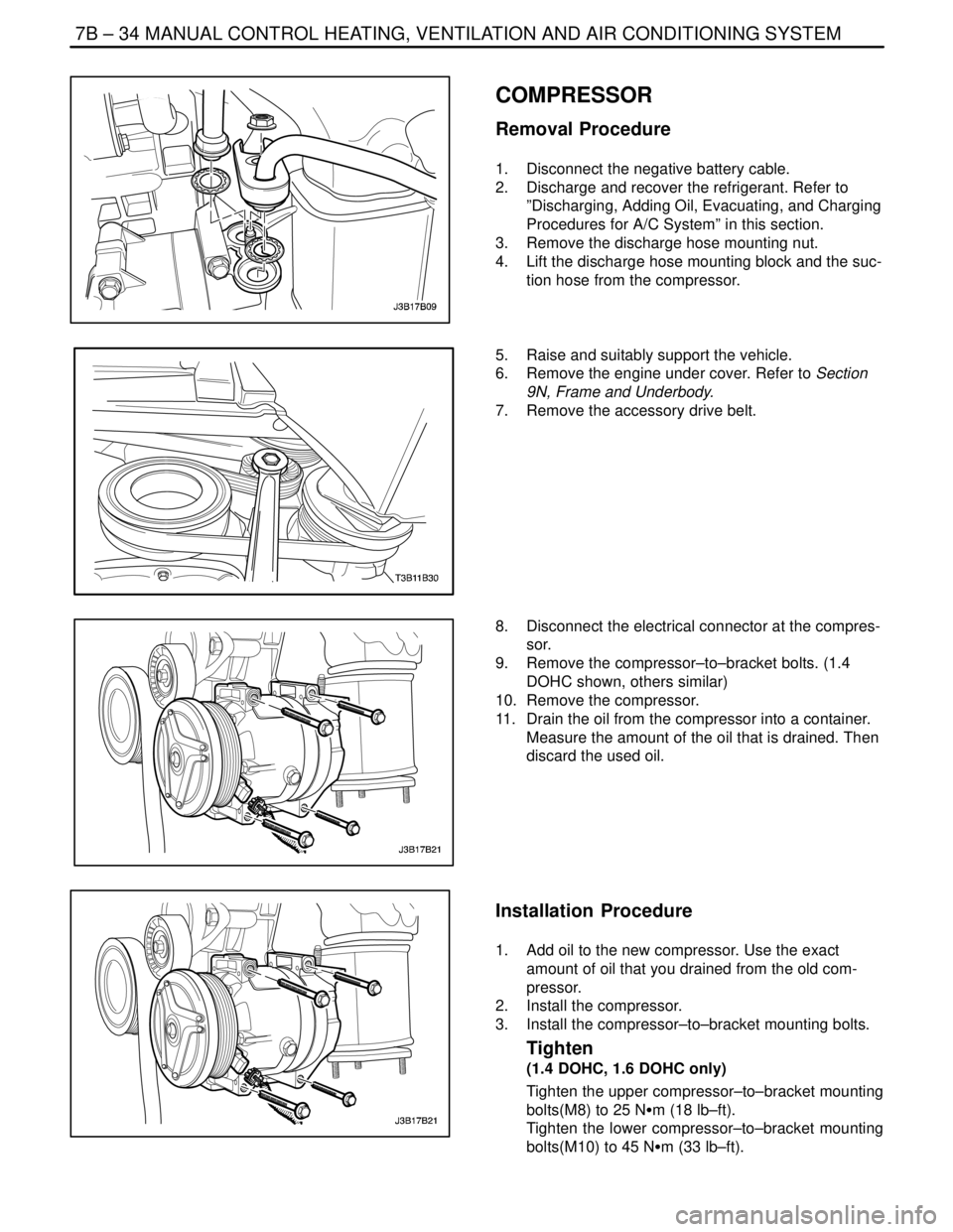
Removal Procedure
1. Disconnect the negative battery cable.
2. Discharge and recover the refrigerant. Refer to
”Discharging, Adding Oil, Evacuating, and Charging
Procedures for A/C System” in this section.
3. Remove the discharge hose mounting nut.
4. Lift the discharge hose mounting block and the suc-
tion hose from the compressor.
5. Raise and suitably support the vehicle.
6. Remove the engine under cover. Refer to Section
9N, Frame and Underbody.
7. Remove the accessory drive belt.
8. Disconnect the electrical connector at the compres-
sor.
9. Remove the compressor–to–bracket bolts. (1.4
DOHC shown, others similar)
10. Remove the compressor.
11. Drain the oil from the compressor into a container.
Measure the amount of the oil that is drained. Then
discard the used oil.
Installation Procedure
1. Add oil to the new compressor. Use the exact
amount of oil that you drained from the old com-
pressor.
2. Install the compressor.
3. Install the compressor–to–bracket mounting bolts.
Tighten
(1.4 DOHC, 1.6 DOHC only)
Tighten the upper compressor–to–bracket mounting
bolts(M8) to 25 NSm (18 lb–ft).
Tighten the lower compressor–to–bracket mounting
bolts(M10) to 45 NSm (33 lb–ft).
Page 2037 of 2643
MANUAL CONTROL HEATING, VENTILATION AND AIR CONDITIONING SYSTEM 7B – 35
DAEWOO V–121 BL4
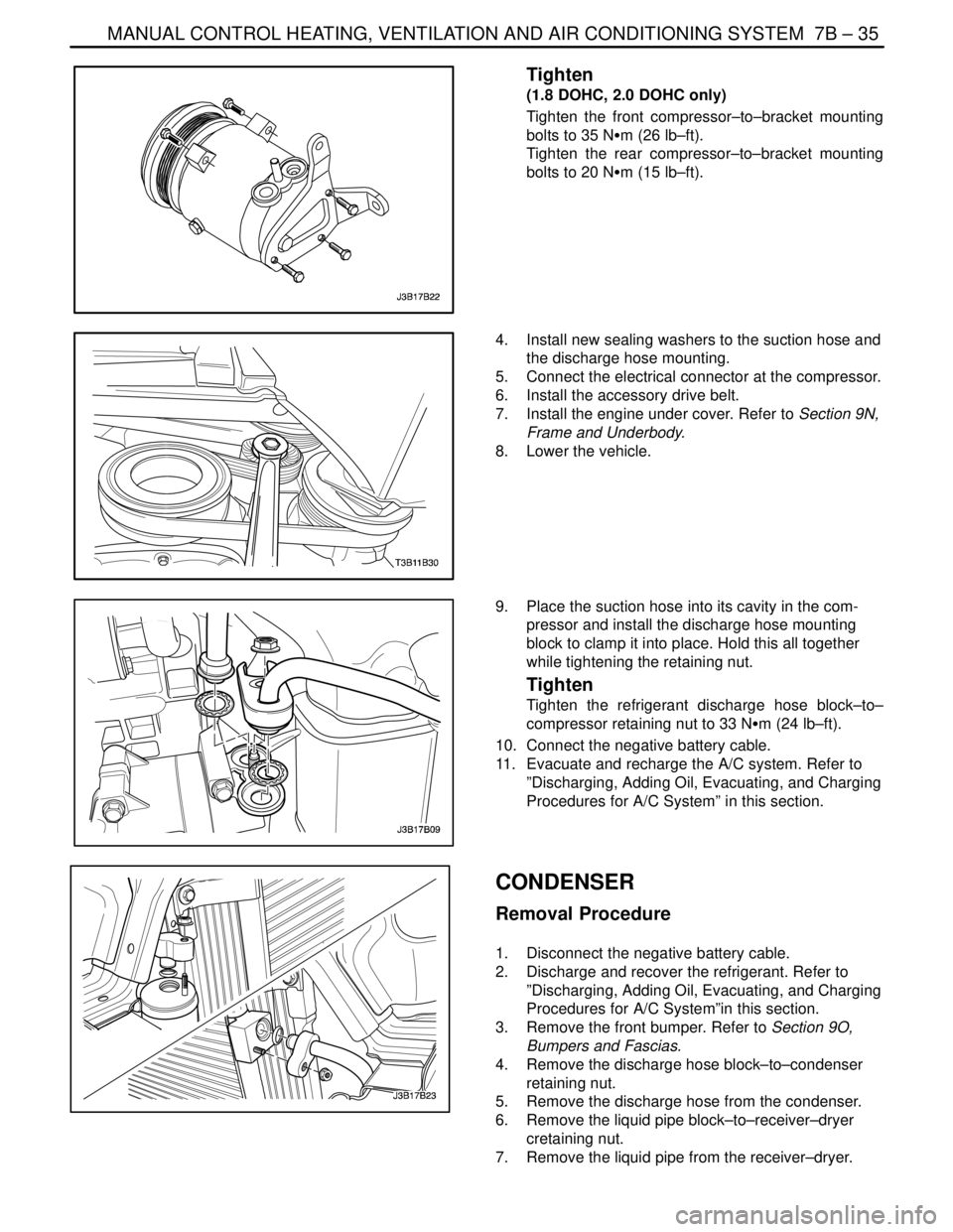
Tighten
(1.8 DOHC, 2.0 DOHC only)
Tighten the front compressor–to–bracket mounting
bolts to 35 NSm (26 lb–ft).
Tighten the rear compressor–to–bracket mounting
bolts to 20 NSm (15 lb–ft).
4. Install new sealing washers to the suction hose and
the discharge hose mounting.
5. Connect the electrical connector at the compressor.
6. Install the accessory drive belt.
7. Install the engine under cover. Refer to Section 9N,
Frame and Underbody.
8. Lower the vehicle.
9. Place the suction hose into its cavity in the com-
pressor and install the discharge hose mounting
block to clamp it into place. Hold this all together
while tightening the retaining nut.
Tighten
Tighten the refrigerant discharge hose block–to–
compressor retaining nut to 33 NSm (24 lb–ft).
10. Connect the negative battery cable.
11. Evacuate and recharge the A/C system. Refer to
”Discharging, Adding Oil, Evacuating, and Charging
Procedures for A/C System” in this section.
CONDENSER
Removal Procedure
1. Disconnect the negative battery cable.
2. Discharge and recover the refrigerant. Refer to
”Discharging, Adding Oil, Evacuating, and Charging
Procedures for A/C System”in this section.
3. Remove the front bumper. Refer to Section 9O,
Bumpers and Fascias.
4. Remove the discharge hose block–to–condenser
retaining nut.
5. Remove the discharge hose from the condenser.
6. Remove the liquid pipe block–to–receiver–dryer
cretaining nut.
7. Remove the liquid pipe from the receiver–dryer.