belt DAEWOO LACETTI 2004 Service Manual Online
[x] Cancel search | Manufacturer: DAEWOO, Model Year: 2004, Model line: LACETTI, Model: DAEWOO LACETTI 2004Pages: 2643, PDF Size: 80.54 MB
Page 225 of 2643
ENGINE ELECTRICAL 1E – 11
DAEWOO V–121 BL4
MAINTENANCE AND REPAIR
ON–VEHICLE SERVICE
GENERATOR
Removal Procedure
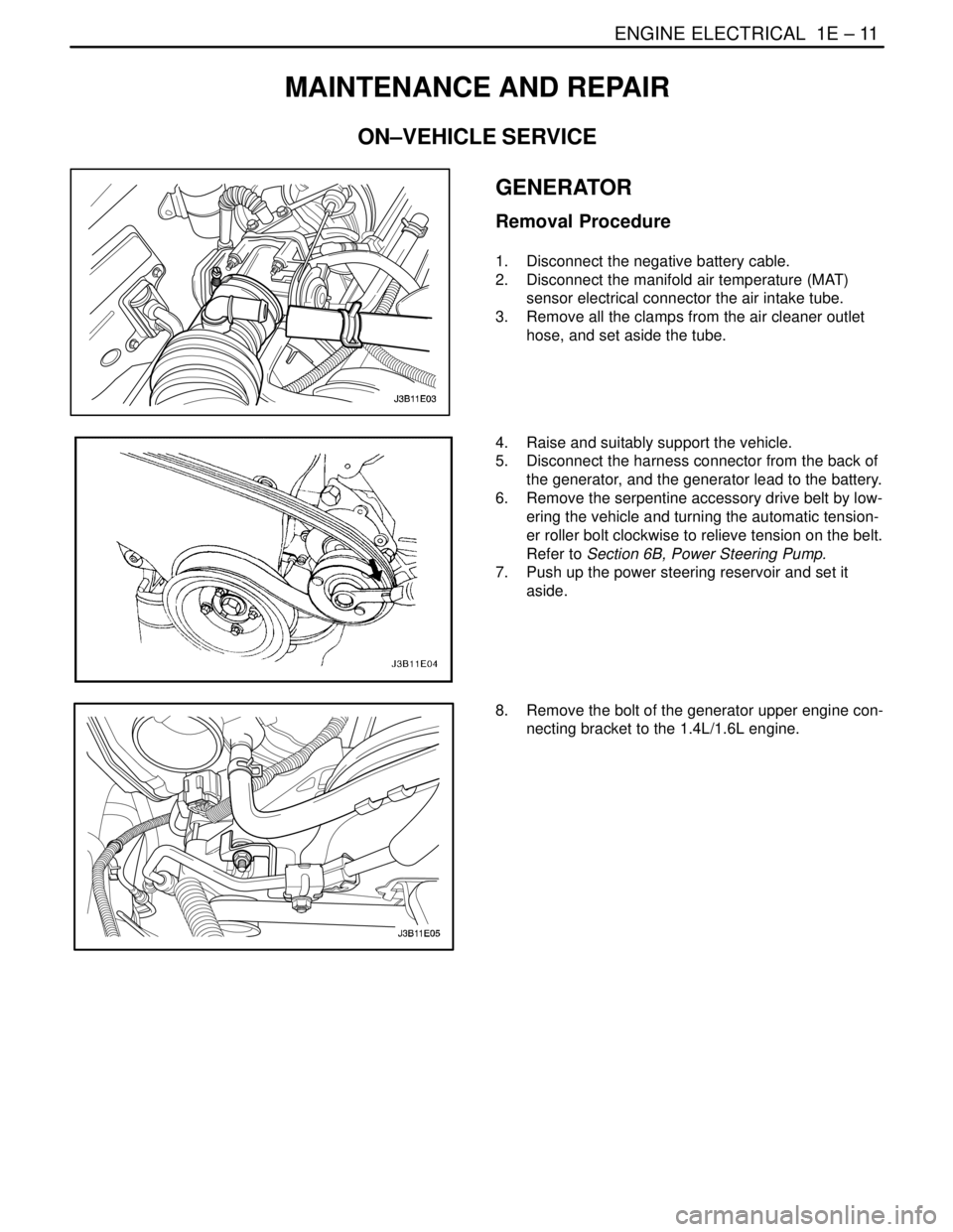
1. Disconnect the negative battery cable.
2. Disconnect the manifold air temperature (MAT)
sensor electrical connector the air intake tube.
3. Remove all the clamps from the air cleaner outlet
hose, and set aside the tube.
4. Raise and suitably support the vehicle.
5. Disconnect the harness connector from the back of
the generator, and the generator lead to the battery.
6. Remove the serpentine accessory drive belt by low-
ering the vehicle and turning the automatic tension-
er roller bolt clockwise to relieve tension on the belt.
Refer to Section 6B, Power Steering Pump.
7. Push up the power steering reservoir and set it
aside.
8. Remove the bolt of the generator upper engine con-
necting bracket to the 1.4L/1.6L engine.
Page 227 of 2643
ENGINE ELECTRICAL 1E – 13
DAEWOO V–121 BL4
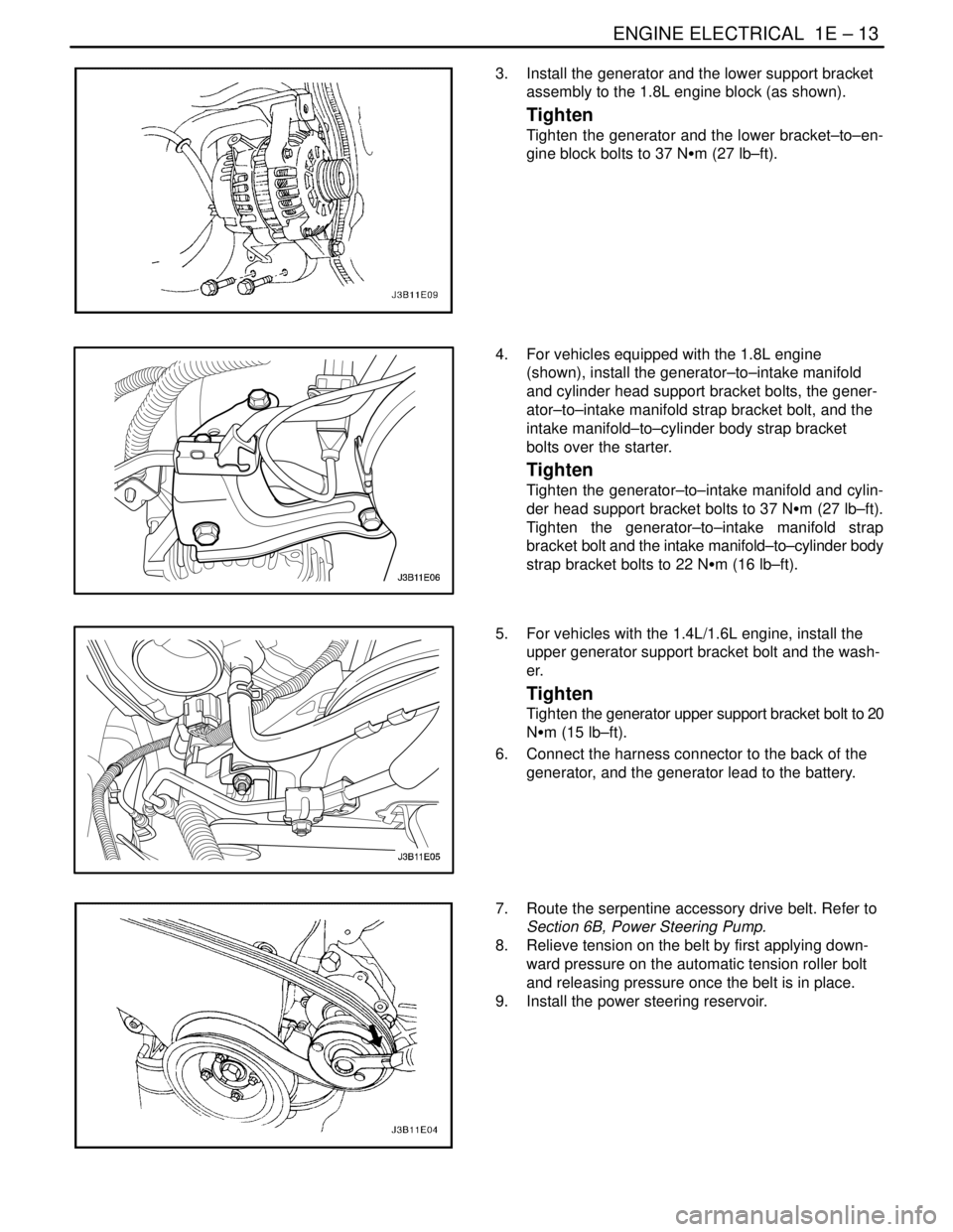
3. Install the generator and the lower support bracket
assembly to the 1.8L engine block (as shown).
Tighten
Tighten the generator and the lower bracket–to–en-
gine block bolts to 37 NSm (27 lb–ft).
4. For vehicles equipped with the 1.8L engine
(shown), install the generator–to–intake manifold
and cylinder head support bracket bolts, the gener-
ator–to–intake manifold strap bracket bolt, and the
intake manifold–to–cylinder body strap bracket
bolts over the starter.
Tighten
Tighten the generator–to–intake manifold and cylin-
der head support bracket bolts to 37 NSm (27 lb–ft).
Tighten the generator–to–intake manifold strap
bracket bolt and the intake manifold–to–cylinder body
strap bracket bolts to 22 NSm (16 lb–ft).
5. For vehicles with the 1.4L/1.6L engine, install the
upper generator support bracket bolt and the wash-
er.
Tighten
Tighten the generator upper support bracket bolt to 20
NSm (15 lb–ft).
6. Connect the harness connector to the back of the
generator, and the generator lead to the battery.
7. Route the serpentine accessory drive belt. Refer to
Section 6B, Power Steering Pump.
8. Relieve tension on the belt by first applying down-
ward pressure on the automatic tension roller bolt
and releasing pressure once the belt is in place.
9. Install the power steering reservoir.
Page 244 of 2643

1E – 30IENGINE ELECTRICAL
DAEWOO V–121 BL4
GENERAL DESCRIPTION
AND SYSTEM OPERATION
BATTERY
The sealed battery is standard on all cars. There are no
vent plugs in the cover. The battery is completely sealed,
except for two small vent holes in the sides. These vent
holes allow the small amount of gas produced in the bat-
tery to escape. The battery has the following advantages
over conventional batteries:
S No water addition for the life of the battery.
S Overcharge protection. If too much voltage is ap-
plied to the battery, it will not accept as much cur-
rent as a conventional battery. In a conventional
battery, the excess voltage will still try to charge the
battery, leading to gassing, which causes liquid
loss.
S Not as liable to self–discharge as compared to a
conventional battery. This is particularly important
when a battery is left standing for long periods of
time.
S More power available in a lighter and smaller case.
The battery has three major functions in the electrical sys-
tem. First, the battery provides a source of energy for
cranking the engine. Second, the battery acts as a voltage
stabilizer for the electrical system. Finally, the battery can,
for a limited time, provide energy when the electrical de-
mand exceeds the output of the generator.
RATINGS
A battery has two ratings: (1) a reserve capacity rating
designated at 27°C (80°F), which is the time a fully
charged battery will provide 25 amperes current flow at or
above 10.5 volts; (2) a cold cranking amp rating deter-
mined under testing at –18°C (0°F), which indicates the
cranking load capacity.
RESERVE CAPACITY
The reserve capacity is the maximum length of time it is
possible to travel at night with the minimum electrical load
and no generator output. Expressed in minutes, Reserve
Capacity (or RC rating) is the time required for a fully
charged battery, at a temperature of 27°C (80°F) and be-
ing discharged at a current of 25 amperes, to reach a ter-
minal voltage of 10.5 volts.
COLD CRANKING AMPERAGE
The cold cranking amperage test is expressed at a battery
temperature of –18°C (0°F). The current rating is the mini-
mum amperage, which must be maintained by the battery
for 30 seconds at the specified temperature, while meeting
a minimum voltage requirement of 7.2 volts. This rating is
a measure of cold cranking capacity.The battery is not designed to last indefinitely. However,
with proper care, the battery will provide many years of
service.
If the battery tests well, but fails to perform satisfactorily
in service for no apparent reason, the following factors
may point to the cause of the trouble:
S Vehicle accessories are left on overnight.
S Slow average driving speeds are used for short pe-
riods.
S The vehicle’s electrical load is more than the gener-
ator output, particularly with the addition of after-
market equipment.
S Defects in the charging system, such as electrical
shorts, a slipping generator belt, a faulty generator,
or a faulty voltage regulator.
S Battery abuse, including failure to keep the battery
cable terminals clean and tight, or a loose battery
hold–down clamp.
S Mechanical problems in the electrical system, such
as shorted or pinched wires.
BUILT – IN HYDROMETER
The sealed battery has a built–in, temperature–compen-
sated hydrometer in the top of the battery. This hydrome-
ter is to be used with the following diagnostic procedure:
1. When observing the hydrometer, make sure that
the battery has a clean top.
2. Under normal operation, two indications can be ob-
served:
S GREEN DOT VISIBLE – Any green appearance
is interpreted as a ”green dot,” meaning the bat-
tery is ready for testing.
S DARK GREEN DOT IS NOT VISIBLE – If there
is a cranking complaint, the battery should be
tested. The charging and electrical systems
should also be checked at this time.
3. Occasionally, a third condition may appear:
S CLEAR OR BRIGHT YELLOW – This means
the fluid level is below the bottom of the hydrom-
eter. This may have been caused by excessive
or prolonged charging, a broken case, excessive
tipping, or normal battery wear. Finding a battery
in this condition may indicate high charging by a
faulty charging system. Therefore, the charging
and the electrical systems may need to be
checked if a cranking complaint exists. If the
cranking complaint is caused by the battery, re-
place the battery.
CHARGING PROCEDURE
1. Batteries with the green dot showing do not require
charging unless they have just been discharged
(such as in cranking a vehicle).
2. When charging sealed–terminal batteries out of the
vehicle, install the adapter kit. Make sure all the
charger connections are clean and tight. For best
results, batteries should be charged while the elec-
Page 286 of 2643

1F – 40IENGINE CONTROLS
DAEWOO V–121 BL4
ENGINE CRANKS BUT WILL NOT RUN (1.4L/1.6L DOHC)
Test Description
The number(s) below refer to step(s) on the diagnostic
table.
1. The On–Board Diagnostic (EOBD) System Check
prompts the technician to complete some basic
checks and store the freeze frame and failure re-
cords data on the scan tool if applicable. This
creates an electronic copy of the data taken when
the occurred. The information is then stored on the
scan tool for later reference.
2. By performing a compression test, it can be deter-
mined if the engine has the mechanical ability to
run.
3. It is important to check for the presence of sparkfrom all of the ignition wires. If spark is present from
one to three of the ignition coil terminals, the Crank-
shaft Position (CKP) sensor is OK.
19. In checking the engine control module (ECM) out-
puts for the electronic spark timing signal, it recom-
mended to use an oscilloscope to view the varying
voltage signals. In measuring these outputs with a
voltmeter, intermittent errors may occur that cannot
be seen by a voltmeter.
35. This step checks for proper operation of the ECM’s
control of the fuel pump circuit.
59. This step checks for a ground signal being supplied
by the ECM to operate the fuel injectors. If there is
no ground present during the cranking of the en-
gine, and the fuel injector wiring is OK, the ECM is
at fault.
Engine Cranks But Will Not Run (1.4L/1.6L DOHC)
CAUTION : Use only electrically insulated pliers when
handling ignition wires with the engine running to
prevent an electrical shock.
CAUTION : Do not pinch or restrict nylon fuel lines.Damage to the lines could cause a fuel leak, resulting
in possible fire or personal injury.
Step
ActionValue(s)YesNo
1Perform an Euro On–Board Diagnostic (EOBD)
System Check.
Is the check complete.–Go to Step 2Go to
”Euro On–
Board Diagnos-
tic System
Check”
2Crank the engine.
Does the engine start and continue to run?–System OKGo to Step 3
3Perform a cylinder compression test.
Is the cylinder compression for all of the cylinders at
or above the value specified?689 kPa
(100 psi)Go to Step 7Go to Step 4
4Inspect the timing belt alignment.
Is the timing belt in alignment?–Go to Step 6Go to Step 5
5Align or replace the timing belt as needed.
Is the repair complete?–Go to Step 2–
6Repair internal engine damage as needed.
Is the repair complete?–Go to Step 2–
7Inspect the fuel pump fuse.
Is the problem found?–Go to Step 8Go to Step 9
8Replace the fuse.
Is the repair complete?–Go to Step 2–
9Check for the presence of spark from all of the igni-
tion wires while cranking the engine.
Is spark present from all of the ignition wires?–Go to Step 23Go to Step 10
101. Measure the resistance of the ignition wires.
2. Replace any of the ignition wire(s) with a resist-
ance above the value specified.
3. Check for the presence of spark from all of the
ignition wire.
Is spark present from all of the ignition wires?30000 WGo to Step 2Go to Step 11
Page 293 of 2643

ENGINE CONTROLS 1F – 47
DAEWOO V–121 BL4
ENGINE CRANKS BUT WILL NOT RUN (1.8L DOHC)
Test Description
The number(s) below refer to step(s) on the diagnostic
table.
1. The On–Board Diagnostic (EOBD) System Check
prompts the technician to complete some basic
checks and store the freeze frame and failure re-
cords data on the scan tool if applicable. This
creates an electronic copy of the data taken when
the occurred. The information is then stored on the
scan tool for later reference.
2. By performing a compression test, it can be deter-
mined if the engine has the mechanical ability to
run.
3. It is important to check for the presence of sparkfrom all of the ignition wires. If spark is present from
one to three of the ignition coil terminals, the Crank-
shaft Position (CKP) sensor is OK.
19. In checking the engine control module (ECM) out-
puts for the electronic spark timing signal, it recom-
mended to use an oscilloscope to view the varying
voltage signals. In measuring these outputs with a
voltmeter, intermittent errors may occur that cannot
be seen by a voltmeter.
35. This step checks for proper operation of the ECM’s
control of the fuel pump circuit.
59. This step checks for a ground signal being supplied
by the ECM to operate the fuel injectors. If there is
no ground present during the cranking of the en-
gine, and the fuel injector wiring is OK, the ECM is
at fault.
Engine Cranks But Will Not Run (1.8L DOHC)
CAUTION : Use only electrically insulated pliers when
handling ignition wires with the engine running to
prevent an electrical shock.
CAUTION : Do not pinch or restrict nylon fuel lines.Damage to the lines could cause a fuel leak, resulting
in possible fire or personal injury.
Step
ActionValue(s)YesNo
1Perform an On–Board Diagnostic (EOBD) System
Check.
Was the check performed?–Go to Step 2Go to
”On–Board
Diagnostic
(EOBD) Sys-
tem Check”
2Check for set Diagnostic Trouble Code (DTC)
P0601.
Is the DTC set?–Go to applica-
ble DTC tableGo to Step 4
3Crank the engine.
Does the engine start and continue to run?–System OKGo to Step 5
4Perform a cylinder compression test.
Is the cylinder compression for all of the cylinders at
or above the value specified?689 kPa
(100 psi)Go to Step 8Go to Step 5
5Inspect the timing belt alignment.
Is the timing belt in alignment?–Go to Step 7Go to Step 6
6Align or replace the timing belt as needed.
Is the repair complete?–Go to Step 3–
7Repair the internal engine damage as needed.
Is the repair complete?–Go to Step 3–
8Inspect the fuel pump fuse.
Is the problem found?–Go to Step 9Go to Step 10
9Replace the fuse.
Is the repair complete?–Go to Step 3–
101. Install a scan tool.
2. Turn the ignition ON, the engine OFF and close
the throttle.
Does the Throttle Position (TP) sensor read less
than the specified value.1.0 vGo to Step 11Go to ”DTC
P0123 Throttle
Position Sensor
High Voltage”
Page 839 of 2643

ENGINE CONTROLS 1F – 593
DAEWOO V–121 BL4
BACKFIRE
Definition : Fuel ignites in the intake manifold, or in the ex-
haust system, making a loud popping noise.Important : Before diagnosing the symptom, check ser-
vice bulletins for updates.
Step
ActionValue(s)YesNo
1Were the Important Preliminary Checks performed?–Go toStep 2Go to
”Important Pre-
liminary
Checks”
21. Inspect for crossed or crossfiring ignition wires.
2. Check the ignition system output voltage for all
cylinders using a spark tester.
3. Inspect the spark plugs for excessive wear,
burned electrodes, improper gap, or heavy de-
posits..
Is the problem found?–Go toStep 3Go toStep 4
3Repair or replace any ignition system components
as needed.
Is the repair complete?–System OK–
41. Check the fuel system operation.
2. Check the fuel injectors by performing an injec-
tor diagnosis.
Is the problem found?–Go toStep 5Go toStep 6
5Repair or replace any fuel system components as
needed.
Is the repair complete?–System OK–
61. Inspect the Exhaust Gas Recirculation (EGR)
gasket for a leak or a loose fit.
2. Check the EGR valve for proper operation.
3. Inspect the intake manifold and the exhaust
manifold for a casting flash.
Is the problem found?–Go toStep 7Go toStep 8
7Repair or replace any components as needed.
Is the repair complete?–System OK–
81. Inspect the timing belt for proper installation
and tension.
2. Check the engine compression.
3. Inspect the intake manifold gasket and the ex-
haust manifold gasket for leaks.
4. Check for sticking or leaking valves.
5. Repair or replace any components as needed.
Are all checks and corrections complete?–System OK–
Page 864 of 2643
1F – 618IENGINE CONTROLS
DAEWOO V–121 BL4
CAMSHAFT POSITION SENSOR
(1.4L/1.6L DOHC)
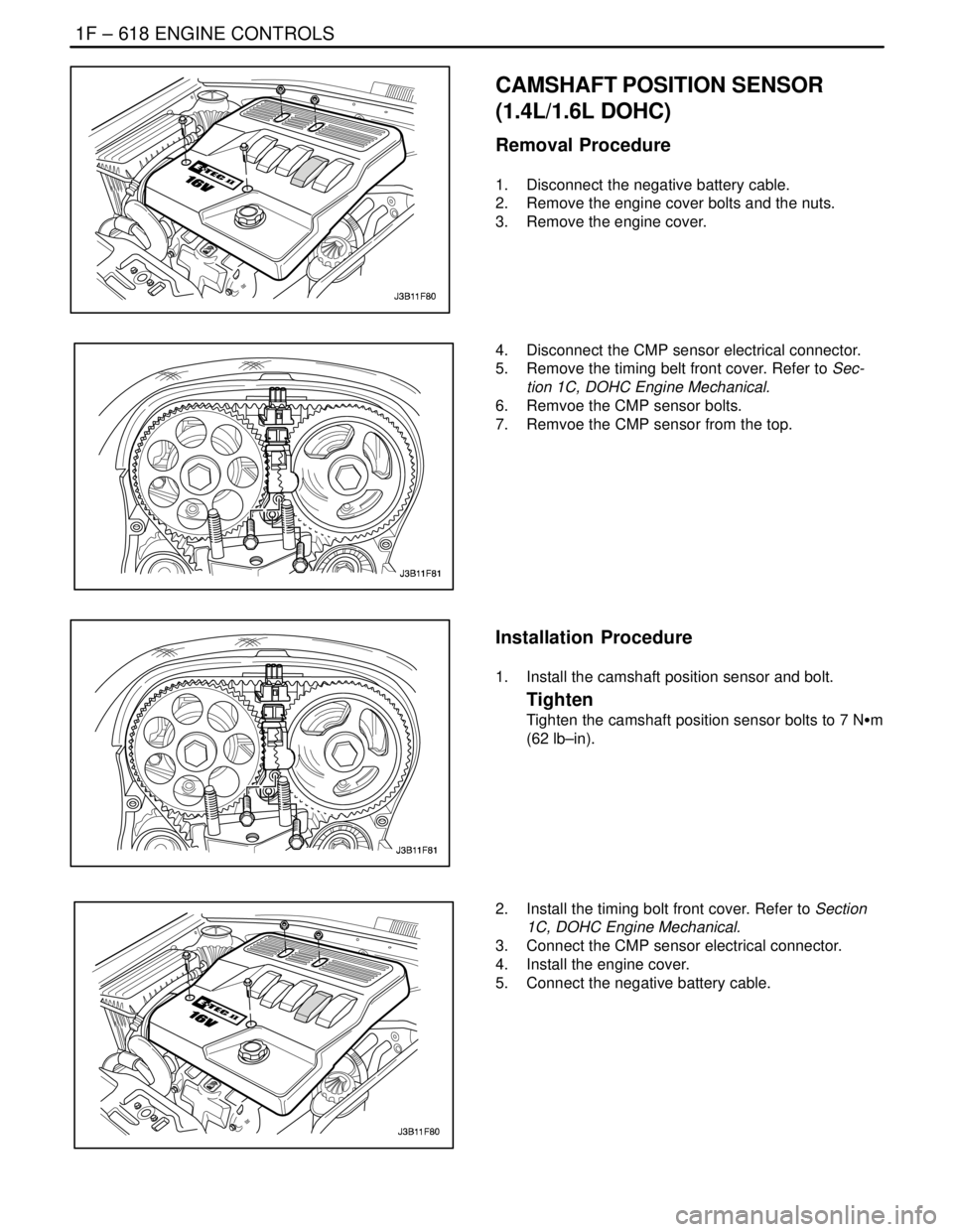
Removal Procedure
1. Disconnect the negative battery cable.
2. Remove the engine cover bolts and the nuts.
3. Remove the engine cover.
4. Disconnect the CMP sensor electrical connector.
5. Remove the timing belt front cover. Refer to Sec-
tion 1C, DOHC Engine Mechanical.
6. Remvoe the CMP sensor bolts.
7. Remvoe the CMP sensor from the top.
Installation Procedure
1. Install the camshaft position sensor and bolt.
Tighten
Tighten the camshaft position sensor bolts to 7 NSm
(62 lb–in).
2. Install the timing bolt front cover. Refer to Section
1C, DOHC Engine Mechanical.
3. Connect the CMP sensor electrical connector.
4. Install the engine cover.
5. Connect the negative battery cable.
Page 865 of 2643
ENGINE CONTROLS 1F – 619
DAEWOO V–121 BL4
CAMSHAFT POSITION SENSOR
(1.8L DOHC)
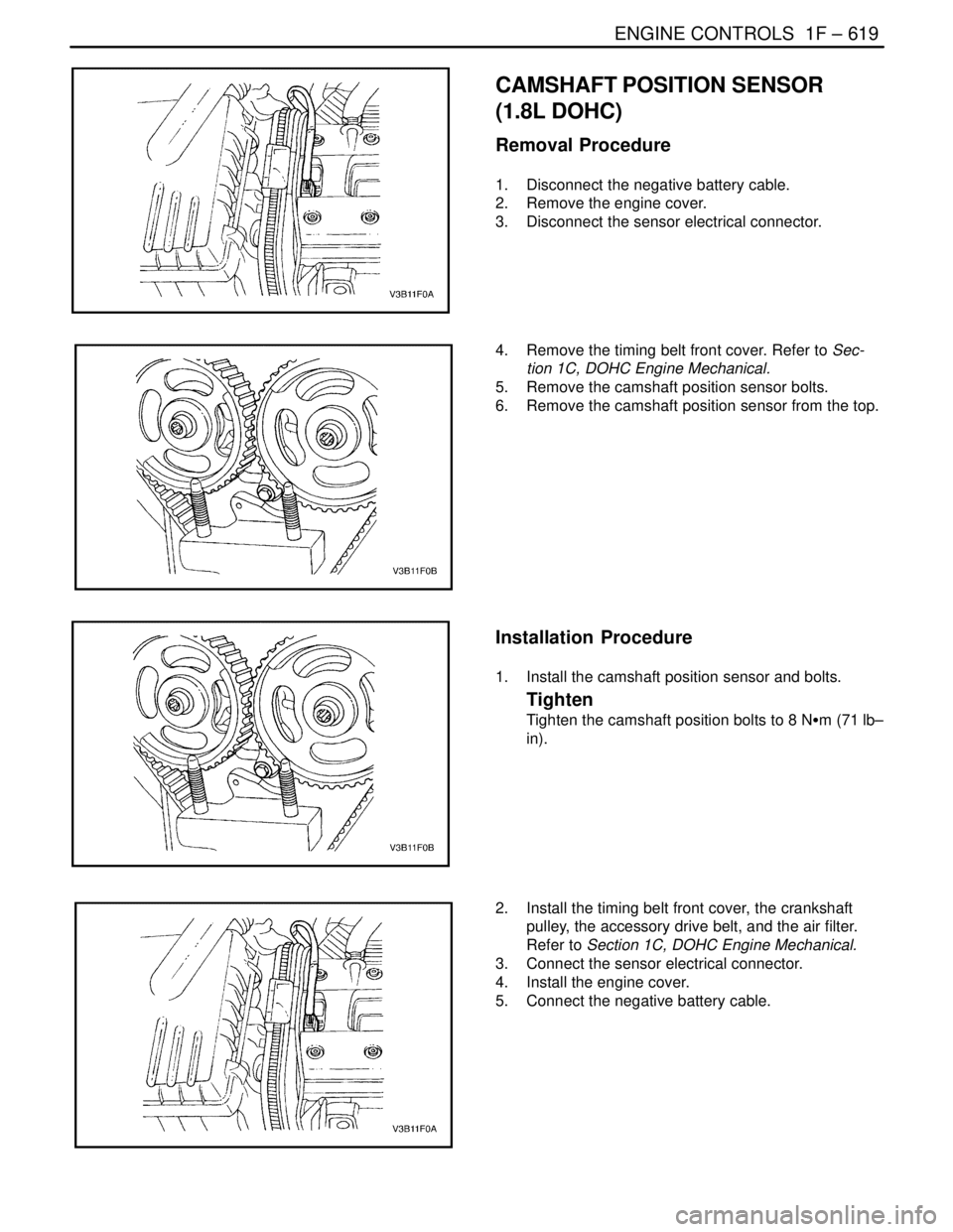
Removal Procedure
1. Disconnect the negative battery cable.
2. Remove the engine cover.
3. Disconnect the sensor electrical connector.
4. Remove the timing belt front cover. Refer to Sec-
tion 1C, DOHC Engine Mechanical.
5. Remove the camshaft position sensor bolts.
6. Remove the camshaft position sensor from the top.
Installation Procedure
1. Install the camshaft position sensor and bolts.
Tighten
Tighten the camshaft position bolts to 8 NSm (71 lb–
in).
2. Install the timing belt front cover, the crankshaft
pulley, the accessory drive belt, and the air filter.
Refer to Section 1C, DOHC Engine Mechanical.
3. Connect the sensor electrical connector.
4. Install the engine cover.
5. Connect the negative battery cable.
Page 902 of 2643

SECTION : 2A
SUSPENSION DIAGNOSIS
TABLE OF CONTENTS
DIAGNOSIS2A–1 . . . . . . . . . . . . . . . . . . . . . . . . . . . . . . . .
General Diagnosis 2A–1. . . . . . . . . . . . . . . . . . . . . . . . . Torque Steer 2A–5. . . . . . . . . . . . . . . . . . . . . . . . . . . . . .
Tapered Roller Bearing 2A–6. . . . . . . . . . . . . . . . . . . . .
DIAGNOSIS
GENERAL DIAGNOSIS
Problems in the steering, the suspension, the tires, and
the wheels involve several systems. Consider all systems
when diagnosing a complaint. Some problems, such as
abnormal or excessive tire wear and scuffed tires, may be
the result of hard driving. Always road test the vehicle first.If possible, do this road test with the customer.
Proceed with the following preliminary checks. Correct
any substandard conditions.
Preliminary Checks
ChecksAction
Inspect the tires for improper pressure and uneven wear.Inflate the tires to the proper pressure.
Inspect the joint from the steering column to the steering
gear for loose connections or wear.Tighten the intermediate shaft pinch bolts. Replace the in-
termediate shaft as needed.
Inspect the front and the rear suspension, the steering
gear, and the linkage for loose or damaged parts.Tighten the front and the rear suspension. Tighten the
steering gear mounting bracket bolts. Tighten the coupling
flange pinch bolts. Replace the front and the rear suspen-
sion as needed. Replace the steering gear as needed. Re-
place the intermediate shaft as needed.
Inspect for out–of–round tires.Perform a free runout test. Match–mount the tires.
Inspect for out–of–balance tires, bent wheels, and worn or
loose wheel bearings.Balance the wheels. Replace the wheels. Replace the
wheel bearings.
Check the power steering pump serpentine belt tension.Tighten the power steering pump serpentine belt.
Inspect the power steering system for leaks. Check the
power steering fluid level.Repair any leaks. Perform a power steering gear test. Add
power steering fluid.
Car Lead/Pull
ChecksAction
Inspect for mismatched or uneven tires.Replace the tires.
Inspect for a broken or a sagging spring.Replace the spring.
Inspect for a radial tire lateral force.Check the wheel alignment. Switch the wheels. Replace
the tires as needed.
Check the front–wheel alignment.Align the front wheels.
Inspect for an off–center steering gear.Reseat the pinion valve assembly. Replace the pinion
valve assembly as needed.
Inspect for front–brake dragging.Adjust the front brakes.
Page 906 of 2643

SUSPENSION DIAGNOSIS 2A – 5
DAEWOO V–121 BL4
Steering Wheel Kickback
ChecksAction
Inspect for air in the power steering system.Purge the power steering system of air.
Inspect for a loose steering gear mounting.Tighten the steering gear mounting bracket nuts.
Inspect the joint from the column to the steering gear for
loose connections or wear.Tighten the intermediate shaft pinch bolts. Replace the in-
termediate shaft as needed.
Inspect for loose tie rod ends.Tighten the tie rod ends. Replace the outer tie rods as
needed.
Inspect for loose or worn wheel bearings.Tighten the drive axle nut. Replace the wheel bearings as
needed.
Steering Wheel Surges or Jerks
ChecksAction
Check the hydraulic system. Test the power steering sys-
tem pressure with a gauge.Replace the seals and the hoses as needed.
Inspect for a sluggish steering gear valve.Clean the pinion valve assembly. Replace the pinion valve
assembly as needed.
Inspect for a loose power steering pump serpentine belt.Adjust the power steering pump serpentine belt.
Cupped Tires
ChecksAction
Check the front–wheel and the rear–wheel alignment.Align the front and the rear wheels.
Inspect for worn strut dampeners.Replace the strut dampeners.
Inspect for worn or loose wheel bearings.Tighten the drive axle nut. Replace the wheel bearings as
needed.
Inspect for excessive tire or wheel runout.Match–mount the tires. Replace the tires as needed. Re-
place the wheels as needed.
Inspect for a worn ball joint.Replace the ball joint.
Check the steering gear preload adjustment.Perform a rack bearing preload adjustment.
TORQUE STEER
A degree of torque steer to the right may be experienced
during the use of heavy throttle on some front–wheel drive
cars with drive axles of unequal length. This torque steer
to the right results from the right drive axle being longer
than the left drive axle, which creates a difference in the
drive axle angle. Cars with intermediate shaft assemblies
have axles of almost equal length.
A difference in the drive axle lengths results in more torque
toe–in in the left front wheel. You will notice the torque toe–
in when the vehicle accelerates from a standing start or at
lower speeds.
Inspection Procedure
1. Place a small piece of tape at the top center of the
steering wheel.2. Note the inches of steering wheel deflection re-
quired to keep the vehicle straight during heavy ac-
celeration.
3. Compare this finding with similar cars.
Factors that may cause torque steer to be more apparent
on a particular vehicle include:
S Variations in the tire and wheel assemblies. This
has the most significant effect on torque steer. A
slightly smaller diameter on the right front tire will
increase a right torque lead.
S Large differences in the right and the left front tire
pressure.
S Looseness in the control arm bushings, the tie rod
assemblies, or the steering gear mounting. This
looseness permits a front wheel to pull forward and
toe–in under a torque greater than the wheel on the
opposite side. A loose suspension component may
result in an opposite lead upon deceleration.