speed sensor DAEWOO LACETTI 2004 Service User Guide
[x] Cancel search | Manufacturer: DAEWOO, Model Year: 2004, Model line: LACETTI, Model: DAEWOO LACETTI 2004Pages: 2643, PDF Size: 80.54 MB
Page 275 of 2643
ENGINE CONTROLS 1F – 29
DAEWOO V–121 BL4
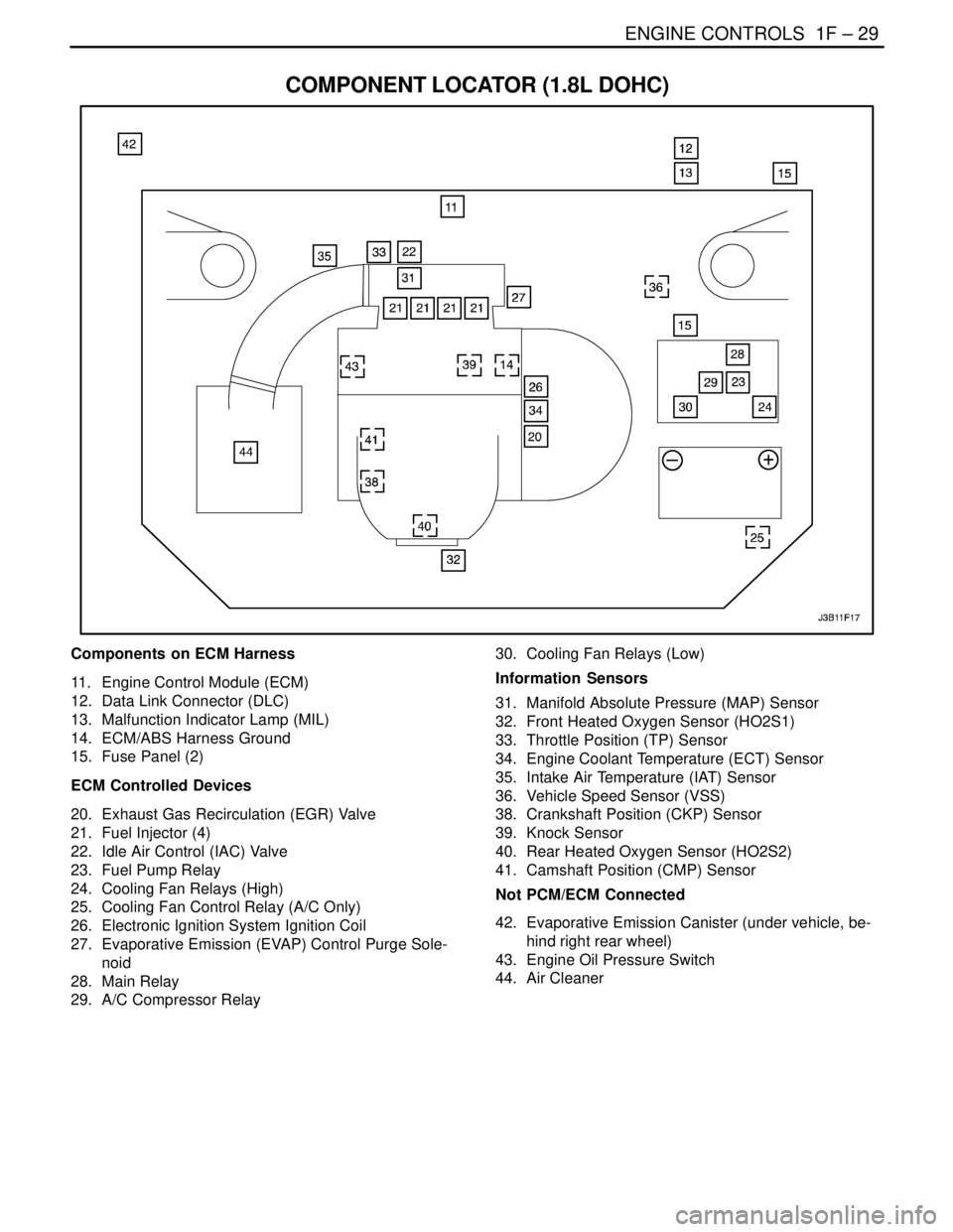
COMPONENT LOCATOR (1.8L DOHC)
Components on ECM Harness
11. Engine Control Module (ECM)
12. Data Link Connector (DLC)
13. Malfunction Indicator Lamp (MIL)
14. ECM/ABS Harness Ground
15. Fuse Panel (2)
ECM Controlled Devices
20. Exhaust Gas Recirculation (EGR) Valve
21. Fuel Injector (4)
22. Idle Air Control (IAC) Valve
23. Fuel Pump Relay
24. Cooling Fan Relays (High)
25. Cooling Fan Control Relay (A/C Only)
26. Electronic Ignition System Ignition Coil
27. Evaporative Emission (EVAP) Control Purge Sole-
noid
28. Main Relay
29. A/C Compressor Relay30. Cooling Fan Relays (Low)
Information Sensors
31. Manifold Absolute Pressure (MAP) Sensor
32. Front Heated Oxygen Sensor (HO2S1)
33. Throttle Position (TP) Sensor
34. Engine Coolant Temperature (ECT) Sensor
35. Intake Air Temperature (IAT) Sensor
36. Vehicle Speed Sensor (VSS)
38. Crankshaft Position (CKP) Sensor
39. Knock Sensor
40. Rear Heated Oxygen Sensor (HO2S2)
41. Camshaft Position (CMP) Sensor
Not PCM/ECM Connected
42. Evaporative Emission Canister (under vehicle, be-
hind right rear wheel)
43. Engine Oil Pressure Switch
44. Air Cleaner
Page 339 of 2643

ENGINE CONTROLS 1F – 93
DAEWOO V–121 BL4
ENGINE COOLING FAN CIRCUIT CHECK – DUAL FAN
(1.4L/1.6L DOHC)
Circuit Description
The engine cooling fan circuit operates the main cooling
fan and the auxiliary cooling fan. The cooling fans are con-
trolled by the engine control module (ECM) based on in-
puts from the Engine Coolant Temperature (ECT) sensor
and the Air Conditioning Pressure (ACP) sensor. The
ECM controls the low speed cooling fan operation by inter-
nally grounding the ECM connector terminal 10. This ener-
gizes the low speed cooling fan relay and operates the
main cooling fan and the auxiliary cooling fan at low speed
as the cooling fans are connected in a series circuit. The
ECM controls the high speed cooling fan operation by in-
ternally grounding the ECM connector terminal 10 and the
ECM connector terminal 9 at the same time. This ener-
gizes the low speed cooling fan relay, the high speed cool-
ing fan relay, and the series/parallel cooling fan relay re-
sulting in high speed fan operation as the cooling fans are
now connected in a parallel circuit.
Diagnostic Aids
S If the owner complained of an overheating problem,
it must be determined if the complaint was due to
an actual boil over, or the engine coolant tempera-
ture gauge indicated overheating. If the engine is
overheating and the cooling fans are on, the cooling
system should be checked.
S If the engine fuse block fuses Ef11 become open
(blown) immediately after installation, inspect for a
short to ground in the wiring of the appropriate cir-
cuit. If the fuses become open (blown) when the
cooling fans are to be turned on by the ECM, sus-
pect a faulty cooling fan motor.
S The ECM will turn the cooling fans on at low speed
when the coolant temperature is 97°C (207°F). The
ECM will turn the cooling fans off when the coolant
temperature is 94°C(201°F).
S The ECM will turn the cooling fans on at high speed
when the coolant temperature is 101°C (214°F).
The ECM will change the cooling fans from high
speed to low speed when the coolant temperature
is 98°C (208°F).S The ECM will turn the cooling fans on at low speed
when the A/C system is on. The ECM will change
the cooling fans from low speed to high speed
when the high side A/C pressure is 1882 kPa (273
psi) then return to low speed when the high side
A/C pressure is 1448 kPa (210 psi). When the A/C
system is on, the ECM will change the cooling fans
from low to high speed when the coolant tempera-
ture reaches 117°C (244°F) then return to low
speed when the coolant temperature reaches
11 4°C (237°F).
S The cooling fan circuit can be checked quickly by
disconnecting the ECM connector 2 and grounding
the connector terminal 10. This should create low
speed cooling fan operation with the ignition ON. By
grounding the ECM connector terminals 10 and 9
and turning the ignition ON, high speed cooling fan
operation should be achieved.
Test Description
The number(s) below refer to step(s) on the diagnostic
table.
4. This step, along with step 5, checks for the ability of
the ECM to operate the cooling fans.
8. This step, along with step 9, checks for the ability of
the ECM to operate the cooling fans in response to
A/C pressure readings.
16. After confirming battery voltage and the ECM sup-
plying a ground to the coil side of the cooling fan
relay A, by jumpering connector terminals 30 and
87 it will be determined if the relay is at fault or a
wiring problem is present.
31. This step checks for the presence of battery volt-
age to the main cooling fan when the A/C is on. If
battery voltage is present and the cooling fans are
not operating, the problem is in the ground side of
the cooling fan circuit.
37. By directly grounding the ECM connector terminals
10 and 9, the main and auxiliary cooling fans
should run at high speed.
Engine Cooling Fan Circuit Check – Dual Fan (1.4L/1.6L DOHC)
StepActionValue(s)YesNo
1Perform an On–Board Diagnostic (EOBD) system
check.
Is the check completed?–Go to Step 2Go to
”On–Board
Diagnostic Sys-
tem Check”
21. Check the engine fuse block fuse Ef11.
2. Replace the fuse as needed.
Is the fuse OK?–Go to Step 3Go to
”Diagnostic
Aids”
Page 346 of 2643

1F – 100IENGINE CONTROLS
DAEWOO V–121 BL4
ENGINE COOLING FAN CIRCUIT CHECK – DUAL FAN
(1.8L DOHC)
Circuit Description
The engine cooling fan circuit operates the main cooling
fan and the auxiliary cooling fan. The cooling fans are con-
trolled by the engine control module (ECM) based on in-
puts from the Engine Coolant Temperature (ECT) sensor
and the Air Conditioning Pressure (ACP) sensor. The
ECM controls the low speed cooling fan operation by inter-
nally grounding the ECM connector terminal K28. This en-
ergizes the low speed cooling fan relay and operates the
main cooling fan and the auxiliary cooling fan at low speed
as the cooling fans are connected in a series circuit. The
ECM controls the high speed cooling fan operation by in-
ternally grounding the ECM connector terminal K28 and
the ECM connector terminal K12 at the same time. This
energizes the low speed cooling fan relay, the high speed
cooling fan relay, and the series/parallel cooling fan relay
resulting in high speed fan operation as the cooling fans
are now connected in a parallel circuit.
Diagnostic Aids
S If the owner complained of an overheating problem,
it must be determined if the complaint was due to
an actual boil over, or the engine coolant tempera-
ture gauge indicated overheating. If the engine is
overheating and the cooling fans are on, the cooling
system should be checked.
S If the engine fuse block fuses Ef21, Ef6, Ef8 be-
come open (blown) immediately after installation,
inspect for a short to ground in the wiring of the ap-
propriate circuit. If the fuses become open (blown)
when the cooling fans are to be turned on by the
ECM, suspect a faulty cooling fan motor.
S The ECM will turn the cooling fans on at low speed
when the coolant temperature is 97°C (207°F). The
ECM will turn the cooling fans off when the coolant
temperature is 94°C(201°F).
S The ECM will turn the cooling fans on at high speed
when the coolant temperature is 101°C (214°F).
The ECM will change the cooling fans from high
speed to low speed when the coolant temperature
is 98°C (208°F).S The ECM will turn the cooling fans on at low speed
when the A/C system is on. The ECM will change
the cooling fans from low speed to high speed
when the high side A/C pressure is 1882 kPa (273
psi) then return to low speed when the high side
A/C pressure is 1448 kPa (210 psi). When the A/C
system is on, the ECM will change the cooling fans
from low to high speed when the coolant tempera-
ture reaches 117°C (244°F) then return to low
speed when the coolant temperature reaches
11 4°C (237°F).
S The cooling fan circuit can be checked quickly by
disconnecting the ECM connector 2 and grounding
the connector terminal K28. This should create low
speed cooling fan operation with the ignition ON. By
grounding the ECM connector terminals K28 and
K12 and turning the ignition ON, high speed cooling
fan operation should be achieved.
Test Description
The number(s) below refer to step(s) on the diagnostic
table.
4. This step, along with step 5, checks for the ability of
the ECM to operate the cooling fans.
8. This step, along with step 9, checks for the ability of
the ECM to operate the cooling fans in response to
A/C pressure readings.
16. After confirming battery voltage and the ECM sup-
plying a ground to the coil side of the cooling fan
relay A, by jumpering connector terminals 30 and
87 it will be determined if the relay is at fault or a
wiring problem is present.
31. This step checks for the presence of battery volt-
age to the main cooling fan when the A/C is on. If
battery voltage is present and the cooling fans are
not operating, the problem is in the ground side of
the cooling fan circuit.
37. By directly grounding the ECM connector terminals
K28 and K12, the main and auxiliary cooling fans
should run at high speed.
Engine Cooling Fan Circuit Check – Dual Fan (1.8L DOHC)
StepActionValue(s)YesNo
1Perform an On–Board Diagnostic (EOBD) system
check.
Is the check completed?–Go to Step 2Go to
”On–Board
Diagnostic Sys-
tem Check”
21. Check the I/P fuse block fuse F2.
2. Replace the fuse as needed.
Is the fuse OK?–Go to Step 3Go to
”Diagnostic
Aids”
Page 358 of 2643

1F – 112IENGINE CONTROLS
DAEWOO V–121 BL4
DTCIlluminate MIL Error
Type Function
P0300Multiple Cylinder Misfire (Increase Emission)EYES
P0327Knock Sensor Circuit Fault (1.4L DOHC)CnlNO
P0327Knock Sensor Circuit Fault (1.6L DOHC)EYES
P0335Magnetic Crankshaft Position Sensor Electrical ErrorEYES
P033658X Crankshaft Position Sensor Extra/missing PulseEYES
P033758X Crankshaft Sensor No SignalEYES
P0341Camshaft Position Sensor RationalityEYES
P0342Camshaft Position Sensor No SignalEYES
P0351Ignition Signal Coil A FaultAYES
P0352Ignition Signal Coil B FaultAYES
P0400Exhaust Gas Recirculation Out of LimitEYES
P0404Exhaust Gas Recirculation (EGR) PpendEYES
P0405EGR Pintle Position Sensor Low VoltageEYES
P0406EGR Pintle Position Sensor High voltageEYES
P0420Catalyst Low EfficiencyAYES
P0444EVAP Purge Control Circuit No SignalEYES
P0445EVAP Purge Control Circuit FaultEYES
P0462Fuel Level Sensor Low Voltage (1.6L DOHC Only)CnlNO
P0463Fuel Level Sensor High Voltage (1.6L DOHC Only)CnlNO
P0480Low Speed Cooling Fan Relay Circuit Fault (1.4L DOHC)EYES
P0480Low Speed Cooling Fan Relay Circuit Fault (1.6L DOHC)CnlNO
P0481High Speed Cooling Fan Relay High Voltage (1.4L DOHC)EYES
P0481High Speed Cooling Fan Relay High Voltage (1.6L DOHC)CnlNO
P0501Vehicle Speed No Signal (M/T Only)AYES
P0510Throttle Positon Switch Circuit Fault (1.4L DOHC)CnlNO
P0510Throttle Positon Switch Circuit Fault (1.6L DOHC)AYES
P0532A/C Pressure Sensor Low VoltageCnlNO
P0533A/C Pressure Sensor High VoltageCnlNO
P0562System Voltage (Engine Side) Too LowCnlNO
P0563System Voltage (Engine Side) Too HighCnlNO
P0601Engine Control Module Checksum ErrorEYES
P0604Engine Control Module RAM ErrorEYES
P0605Engine Control Module INMVY Write ErrorEYES
P0656Fuel Level Gauge High Circuit FaultCnlNO
P1181Variable Intake Manifold Solenoid Low VoltageEYES
P1182Variable Intake Manifold Solenoid High VoltageEYES
P1230Fuel Pump Relay Low Voltage (1.4L DOHC)CnlNO
P1230Fuel Pump Relay Low Voltage (1.6L DOHC)AYES
P1231Fuel Pump Relay High Voltage (1.4L DOHC)CnlNO
P1231Fuel Pump Relay High Voltage (1.6L DOHC)AYES
P1320Crankshaft Segment Period Segment Adaptation At LimitEYES
Page 360 of 2643

1F – 114IENGINE CONTROLS
DAEWOO V–121 BL4
DIAGNOSTIC TROUBLE CODE (DTC) P0107
MANIFOLD ABSOLUTE PRESSURE SENSOR LOW
VOLTAGE
Circuit Description
The engine control module (ECM) uses the Manifold Ab-
solute Pressure (MAP) sensor to control the fuel delivery
and the ignition timing. The MAP sensor measures the
changes in the intake manifold pressure, which results
from engine load (intake manifold vacuum) and the rpm
changes; and converts these into voltage outputs. The
ECM sends a 5 volt–reference voltage to the MAP sensor.
As the manifold pressure changes, the output voltage of
the MAP sensor also changes. By monitoring the MAP
sensor output voltage, the ECM knows the manifold pres-
sure. A low–pressure (low voltage) output voltage will be
about 1.0 to 1.5 volts at idle, while higher pressure (high
voltage) output voltage will be about 4.5 to 4.8 at wide
open throttle (WOT). The MAP sensor is metric pressure,
allowing the ECM to make adjustments for different alti-
tudes.
Conditions for Setting the DTC
S This DTC can be stored in ”key–on” status.
(Case A)
S When the engine idling.
S No throttle position(TP) sensor MTIA fail conditions
present.
S Engine speed(rpm) is less than 2,500rpm.
S The MAP is less than 12.0 kPa.
(Case A)
S When the engine part load.
S The engine revolution speed is less than 4,000rpm.S No Throttle Position (TP) Sensor fails conditions
present.
S The Throttle Position (TP) angle greather than
30.0°.
S The MAP is less than 11.5 kPa.
S An open or low voltage condition exists.
Action Taken When the DTC Sets
S The Malfunction Indicator Lamp (MIL) will illumi-
nate.
S The ECM will record operating conditions at the
time the diagnostic fails. This information will be
stored in the Freeze Frame and Failure Records
buffers.
S A history DTC is stored.
S The coolant fan turns ON.
S The ECM will substitutes a fixed MAP value and
use TP to control the fuel delivery (the scan tool will
not show defaulted)
Conditions for Clearing the MIL/DTC
S The MIL will turn off after four consecutive ignition
cycles in which the diagnostic runs without a fault.
S A history DTC will clear after 40 consecutive warm–
up cycles without a fault.
S DTC(s) can be cleared by using the scan tool.
S Disconnecting the ECM battery feed for more than
10 seconds.
Diagnostic Aids
With the ignition ON and the engine stopped, the manifold
pressure is equal to atmosphere pressure and the signal
voltage will be high.
Page 363 of 2643

ENGINE CONTROLS 1F – 117
DAEWOO V–121 BL4
DIAGNOSTIC TROUBLE CODE (DTC) P0108
MANIFOLD ABSOLUTE PRESSURE SENSOR HIGH
VOLTAGE
Circuit Description
The engine control module (ECM) uses the Manifold Ab-
solute Pressure (MAP) sensor to control the fuel delivery
and the ignition timing. The MAP sensor measures the
changes in the intake manifold pressure, which results
from engine load (intake manifold vacuum) and the rpm
changes; and converts these into voltage outputs. The
ECM sends a 5 volt–reference voltage to the MAP sensor.
As the manifold pressure changes, the output voltage of
the MAP sensor also changes. By monitoring the MAP
sensor output voltage, the ECM knows the manifold pres-
sure. A low–pressure (low voltage) output voltage will be
about 1.0 to 1.5 volts at idle, while higher pressure (high
voltage) output voltage will be about 4.5 to 4.8 at wide
open throttle (WOT). The MAP sensor is metric pressure,
allowing the ECM to make adjustments for different alti-
tudes.
Conditions for Setting the DTC
S This DTC can be stored in ”key–on” status.
S When the engine idling.
S Engine speed is greater than 700rpm.
S No throttle position sensor (TPS) fail conditions
present.
S The MAP is greater than 95kPA.
S A high voltage condition exists.
Action Taken When the DTC Sets
S The Malfunction Indicator Lamp (MIL) will illumi-
nate.
S The ECM will record operating conditions at the
time the diagnostic fails. This information will be
stored in the Freeze Frame and Failure Records
buffers.S A history DTC is stored.
S The ECM will substitutes a fixed MAP value and
use TP to control the fuel delivery (the scan tool will
not show defaulted)
Conditions for Clearing the MIL/DTC
S The MIL will turn off after four consecutive ignition
cycles in which the diagnostic runs without a fault.
S A history DTC will clear after 40 consecutive warm–
up cycles without a fault.
S DTC(s) can be cleared by using the scan tool.
S Disconnecting the ECM battery feed for more than
10 seconds.
Diagnostic Aids
With the ignition ON and the engine stopped, the manifold
pressure is equal to atmosphere pressure and the signal
voltage will be high.
The ECM as an indication of vehicle altitude uses this in-
formation. Comparison of this reading with a known good
vehicle with the same sensor is a good way to check the
accuracy of a suspect sensor. Readings should be the
same ±0.4volt.
If a DTC P0108 is intermittent, refer to ”Manifold Absolute
Pressure Check” in this section for further diagnosis.
If the connections are OK monitor the manifold absolute
pressure(MAP) sensor signal voltage while moving re-
lated connectors and the wiring harness. If the failure is in-
duced, the display on the scan tool will change. This may
help to isolate the location of an intermittent malfunction.
Page 377 of 2643

ENGINE CONTROLS 1F – 131
DAEWOO V–121 BL4
DIAGNOSTIC TROUBLE CODE (DTC) P0122
THROTTLE POSITION SENSOR LOW VOLTAGE
Circuit Description
The aim of the MTIA (Main Throttle Idle Actuator) is to con-
trol the idle speed with the throttle body itself. The throttle
is motorized for low opening angle (05, 195). The charac-
teristics of the airflow are not the same for low and high
opening angles. As a matter of fact, the gradient of the
mass air flow function of TPS is lower for small angles that
permits to be more precise during the idle speed control.
Out of idle speed the throttle is actuated mechanically by
a classical bowdencable.
The throttle position sensor (TPS) provides a voltage sig-
nal that changes in relation to the throttle plate angle. The
signal voltage will vary from about nearly 5.0 V at idles to
about 0.2V to 0.4 V at wide–open throttle. The TPS is one
of the most important inputs used by the ECM for fuel con-
trol and other functions such as idle, wide open throttle,
deceleration enleanment, and acceleration enrichment.
Conditions for Setting the DTC
S TPS voltage is less than 0.3V.
Action Taken When the DTC Sets
S The Malfunction Indicator Lamp (MIL) will illumi-
nate.S The ECM will record operating conditions at the
time the diagnostic fails. This information will be
stored in the Freeze Frame and Failure Records
buffers.
S A history DTC is stored.
S The coolant fan turns ON.
S The ECM will default to 20°C (68°F) for the first 60
seconds of the engine run time, and then 92 °C
(198 °F).
S The scan tool will not show the defaulted value.
Conditions for Clearing the MIL/DTC
S The MIL will turn off after four consecutive ignition
cycles in which the diagnostic runs without a fault.
S A history DTC will clear after 40 consecutive warm–
up cycles without a fault.
S DTC(s) can be cleared by using the scan tool.
S Disconnecting the ECM battery feed for more than
10 seconds.
Diagnostic Aids
If the DTC P0122 cannot be duplicated, the information in-
cluded in the Freeze Frame data can be useful. Use the
scan tool DTC information data to determine the status of
the DTC. If the DTC occurs intermittently, using the DTC
P0121 diagnostic table may help isolate the problem.
Page 380 of 2643

1F – 134IENGINE CONTROLS
DAEWOO V–121 BL4
DIAGNOSTIC TROUBLE CODE (DTC) P0123
THROTTLE POSITION SENSOR HIGH VOLTAGE
Circuit Description
The aim of the MTIA (Main Throttle Idle Actuator) is to con-
trol the idle speed with the throttle body itself. The throttle
is motorized for low opening angle (05, 195). The charac-
teristics of the airflow are not the same for low and high
opening angles. As a matter of fact, the gradient of the
mass air flow function of TPS is lower for small angles that
permits to be more precise during the idle speed control.
Out of idle speed the throttle is actuated mechanically by
a classical bowdencable.
The throttle position sensor (TPS) provides a voltage sig-
nal that changes in relation to the throttle plate angle. The
signal voltage will vary from about nearly 5.0 V at idles to
about 0.2V to 0.4 V at wide–open throttle. The TPS is one
of the most important inputs used by the ECM for fuel con-
trol and other functions such as idle, wide open throttle,
deceleration enleanment, and acceleration enrichment.
Conditions for Setting the DTC
S TPS voltage is greater than 4.8V.
Action Taken When the DTC Sets
S The Malfunction Indicator Lamp (MIL) will illumi-
nate.
S The ECM will record operating conditions at the
time the diagnostic fails. This information will be
stored in the Freeze Frame and Failure Records
buffers.S A history DTC is stored.
S The coolant fan turns ON.
S The ECM will default to 20°C (68°F) for the first 60
seconds of the engine run time, and then 92 °C
(198 °F).
Conditions for Clearing the MIL/DTC
S The MIL will turn off after four consecutive ignition
cycles in which the diagnostic runs without a fault.
S A history DTC will clear after 40 consecutive warm–
up cycles without a fault.
S DTC(s) can be cleared by using the scan tool.
S Disconnecting the ECM battery feed for more than
10 seconds.
Diagnostic Aids
If the DTC P0123 cannot be duplicated, the information in-
cluded in the Freeze Frame data can be useful. Use the
scan tool DTC information data to determine the status of
the DTC. If the DTC occurs intermittently, using the DTC
P0121 diagnostic table may help isolate the problem.
With the ignition ON and the throttle at closed position the
voltage should read between 0.20 V and 0.90V and in-
crease steadily to over 4.5V at WOT.
DTCs P0123 and P0113 stored at the same time could be
the result of an open sensor ground circuit.
Page 383 of 2643

ENGINE CONTROLS 1F – 137
DAEWOO V–121 BL4
DIAGNOSTIC TROUBLE CODE (DTC) P0131
FRONT HEATED OXYGEN SENSOR LOW VOLTAGE
Circuit Description
The engine control module (ECM) supplies a voltage of
about 450mm volts between the ECM terminals 44 and 13.
The oxygen (O2) sensor varies the voltage within a range
of about 1volt if the exhaust is rich, down to about 100mm
volts if the exhaust is lean. The O2 sensor is like an open
circuit and produces no voltage when it is below
360°C(600°F). An open O2 sensor circuit or a cold O2
sensor causes ”open loop” operation.
Conditions for Setting the DTC
(Case A)
S The engine controls system is in closed loop.
S Engine speed is less than 6,000rpm.
S The oxygen sensor voltage is below 0.07V for at
least 40seconds.
S DTCs P0107, P0108, P0117, P0118, P0122,
P0123, P0335, P0336, P0341, P0342, P0400,
P0404, P0405, P0406 are NOT SET.
(Case B)
S The engine controls system is in closed loop.
S Engine speed is less than 6,000rpm.
S The oxygen sensor voltage is between 0.352 and
0.499 at least 10 seconds.Action Taken When the DTC Sets
S The Malfunction Indicator Lamp (MIL) will illumi-
nate.
S The ECM will record operating conditions at the
time the diagnostic fails. This information will be
stored in the Freeze Frame and Failure Records
buffers.
S A history DTC is stored.
S The coolant fan turns ON.
Conditions for Clearing the MIL/DTC
S The MIL will turn off after four consecutive ignition
cycles in which the diagnostic runs without a fault.
S A history DTC will clear after 40 consecutive warm–
up cycles without a fault.
S DTC(s) can be cleared by using the scan tool.
S Disconnecting the ECM battery feed for more than
10 seconds.
Diagnostic Aids
Normal scan tool voltage varies between 0.1volts and 0.9
volts while in closed loop.
Inspect the oxygen (O2) sensor wire. The O2 sensor may
be positioned incorrectly and contacting the exhaust man-
ifold.
Page 388 of 2643

1F – 142IENGINE CONTROLS
DAEWOO V–121 BL4
DIAGNOSTIC TROUBLE CODE (DTC) P0133
FRONT HEATED OXYGEN SENSOR NO ACTIVITY
Circuit Description
The engine control module (ECM) supplies a voltage of
about 450mm volts between the ECM terminals 44 and 13.
The oxygen (O2) sensor varies the voltage within a range
of about 1volt if the exhaust is rich, down to about 100mm
volts if the exhaust is lean. The O2 sensor is like an open
circuit and produces no voltage when it is below
360°C(600°F). An open O2 sensor circuit or a cold O2
sensor causes ”open loop” operation.
Conditions for Setting the DTC
S The engine controls system is in closed loop.
S Engine Coolant Temperature is higher than
70°C(158°F). (1.4L DOHC)
S Engine Coolant Temperature is higher than
60°C(140°F). (1.6L DOHC)
S The mass air flow (MAF) is between 100mg/tdc and
250mg/tdc. (1.4L DOHC)
S The mass air flow (MAF) is between 60mg/tdc and
160mg/tdc. (1.6L DOHC)
S The engine speed is between 1,700 rpm and 2,200
rpm. (1.4L DOHC)
S The engine speed is between 1,800 rpm and 2,900
rpm. (1.6L DOHC)S The vehicle speed is between 40 km/h (24.9 mph)
and 60 km/h (37.3 mph). (1.4L DOHC)
S The vehicle speed is between 45 km/h (28.0 mph)
and 55 km/h (34.2 mph). (1.6L DOHC)
S The manifold air pressure is higher than 700hPa.
S The ignition is at 10 volts.
S The upstream O2 sensor periods higher than 1.6
seconds.
S A number of glitches higher than 5 during the test.
S DTCs P0107, P0108, P0112, P0113, P0117,
P0118, P0122, P0123, P0131, P0132, P0137,
P0138, P1671, P0300, P0335, P0336, P0341,
P0400, P0404, P0405, P0444, P0445 are NOT
SET.
Action Taken When the DTC Sets
S The Malfunction Indicator Lamp (MIL) will illumi-
nate.
S The ECM will record operating conditions at the
time the diagnostic fails. This information will be
stored in the Freeze Frame and Failure Records
buffers.
S A history DTC is stored.
S The coolant fan turns ON.
S The vehicle will operate in Open Loop.