warning DAEWOO LACETTI 2004 Service User Guide
[x] Cancel search | Manufacturer: DAEWOO, Model Year: 2004, Model line: LACETTI, Model: DAEWOO LACETTI 2004Pages: 2643, PDF Size: 80.54 MB
Page 1086 of 2643
ANTILOCK BRAKE SYSTEM 4F – 5
DAEWOO V–121 BL4
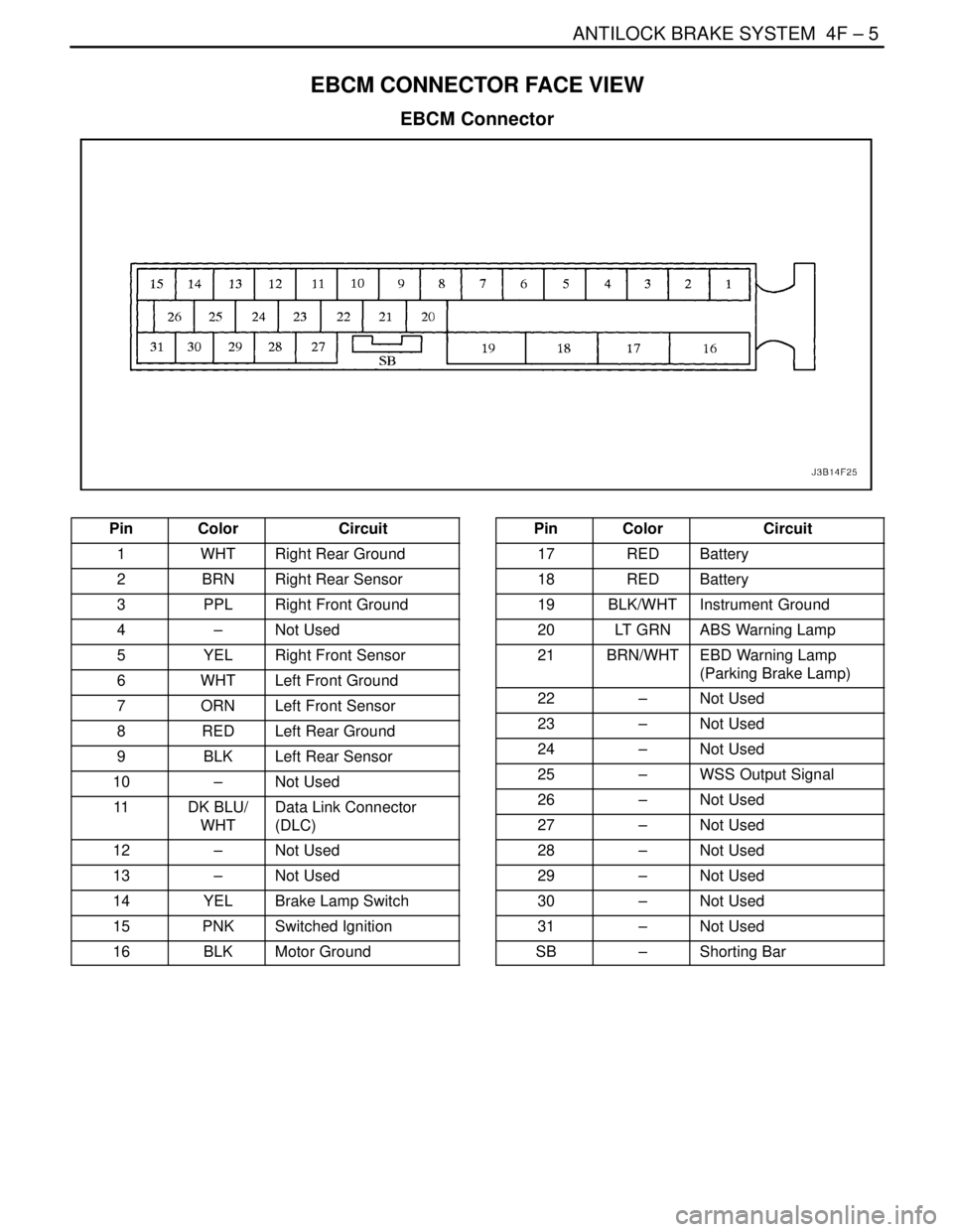
EBCM CONNECTOR FACE VIEW
EBCM Connector
PinColorCircuit
1WHTRight Rear Ground
2BRNRight Rear Sensor
3PPLRight Front Ground
4–Not Used
5YELRight Front Sensor
6WHTLeft Front Ground
7ORNLeft Front Sensor
8REDLeft Rear Ground
9BLKLeft Rear Sensor
10–Not Used
11DK BLU/
WHTData Link Connector
(DLC)
12–Not Used
13–Not Used
14YELBrake Lamp Switch
15PNKSwitched Ignition
16BLKMotor Ground
PinColorCircuit
17REDBattery
18REDBattery
19BLK/WHTInstrument Ground
20LT GRNABS Warning Lamp
21BRN/WHTEBD Warning Lamp
(Parking Brake Lamp)
22–Not Used
23–Not Used
24–Not Used
25–WSS Output Signal
26–Not Used
27–Not Used
28–Not Used
29–Not Used
30–Not Used
31–Not Used
SB–Shorting Bar
Page 1090 of 2643

ANTILOCK BRAKE SYSTEM 4F – 9
DAEWOO V–121 BL4
J3B14F04
60A Ef230A Ef5
2
42
C107 C105
2
C110
G106
A19
A13 A1 A14
C110 C202
C202WHT LT GRN
DK
GRN LT GRN/
BLK
BLK
DK BLUDK BLU
PPL/WHT
PPL/WHT ABS
TCS Parking
Brake
Hot at all times
RED REDRED/WHT
Ignition
Switch
RED
RED
I/P Cluster
EBCM8
20
22 2216 41
1211
18 1621
1
C107
10A F410AF11
32 31
43
6 62 C201
C201 C201C201
C110 C202
Hot in Run and Start
30
4
1711
C202
15
B15
DLC
(Data Link
Connector)12
G106
BLK/WHTOil Feeding
Connector
”2” Ter.
BRNBRN BRN
BRN PNK PNK PNK
19J1
59B1
ONStart Lock
Acc
IG1
19
ABS INDICATOR LAMP INOPERATIVE
Circuit Description
Battery voltage is supplied to the ABS warning lamp with
the ignition switch in the ON or START positions. The
warning lamp can be activated only by the ABS control
module internally supplying ground to terminal 20 or by the
shorting bar in the ABS module connector when it is dis-
connected from the module.
Diagnosis
This procedure checks for a problem in the wiring, a faulty
ground, a voltage supply problem, a burned out indicator
lamp, or a contact problem in a connector.
Cause(s)
S A fuse has blown.
S The indicator lamp has burned out.S There is a corroded or broken connector terminal.
S There is a faulty ground connection.
S There is a broken wire in a wiring harness.
S The EBCM is faulty.
Test Description
The number(s) below refer to step(s) on the diagnostic
table.
1. This test checks for any DTCs that may cause the
ABS indicator lamp to be inoperative.
2. This test verifies an inoperative lamp condition.
3. This test checks for voltage on the lamp circuit.
4. This begins a series of tests of the circuit from the
indicator lamp to the EBCM and ground.
19. This begins a series of tests of the voltage supply
circuits that power the indicator lamp.
ABS Indicator Lamp Inoperative
StepActionValue(s)YesNo
1Install the scan tool and check for any DTCs.
Is any DTC set?–Go to the chart
for the DTCGo to Step 2
21. Turn the ignition switch to LOCK.
2. Disconnect the scan tool.
3. Turn the ignition switch to ON.
4. Observe the ABS indicator lamp.
Does the lamp illuminate for about 4 seconds, then
turn off?–Go to ”Intermit-
tents and Poor
Connections”Go to Step 3
Page 1097 of 2643

4F – 16IANTILOCK BRAKE SYSTEM
DAEWOO V–121 BL4
J3B14F04
60A Ef230A Ef5
2
42
C107 C105
2
C110
G106
A19
A13 A1 A14
C110 C202
C202WHT LT GRN
DK
GRN LT GRN/
BLK
BLK
DK BLUDK BLU
PPL/WHT
PPL/WHT ABS
TCS Parking
Brake
Hot at all times
RED REDRED/WHT
Ignition
Switch
RED
RED
I/P Cluster
EBCM8
20
22 2216 41
1211
18 1621
1
C107
10A F410AF11
32 31
43
6 62 C201
C201 C201C201
C110 C202
Hot in Run and Start
30
4
1711
C202
15
B15
DLC
(Data Link
Connector)12
G106
BLK/WHTOil Feeding
Connector
”2” Ter.
BRNBRN BRN
BRN PNK PNK PNK
19J1
59B1
ONStart Lock
Acc
IG1
19
ABS INDICATOR LAMP ILLUMINATED CONTINUOUSLY,
NO DTCS STORED
Circuit Description
Battery voltage is supplied to the ABS warning lamp with
the ignition switch in the ON or START position. The warn-
ing lamp should be activated only by the ABS control mod-
ule internally supplying ground to terminal 20.
Diagnosis
This procedure checks for a short to ground in the wiring
or a defective electronic brake control module (EBCM).Cause(s)
S There is a short to ground in the circuit between the
cluster terminal A13 and the EBCM terminal 20.
S The EBCM is faulty.
Test Description
The number(s) below refer to step(s) on the diagnostic
table.
3. This step determines whether the EBCM is faulty.
5. This begins a search for a short to ground in the
circuit between the ABS indicator lamp and the
EBCM.
Page 1099 of 2643

4F – 18IANTILOCK BRAKE SYSTEM
DAEWOO V–121 BL4
J3B14F04
60A Ef230A Ef5
2
42
C107 C105
2
C110
G106
A19
A13 A1 A14
C110 C202
C202WHT LT GRN
DK
GRN LT GRN/
BLK
BLK
DK BLUDK BLU
PPL/WHT
PPL/WHT ABS
TCS Parking
Brake
Hot at all times
RED REDRED/WHT
Ignition
Switch
RED
RED
I/P Cluster
EBCM8
20
22 2216 41
1211
18 1621
1
C107
10A F410AF11
32 31
43
6 62 C201
C201 C201C201
C110 C202
Hot in Run and Start
30
4
1711
C202
15
B15
DLC
(Data Link
Connector)12
G106
BLK/WHTOil Feeding
Connector
”2” Ter.
BRNBRN BRN
BRN PNK PNK PNK
19J1
59B1
ONStart Lock
Acc
IG1
19
ELECTRONIC BRAKE–FORCE DISTRIBUTION (EBD)
SYSTEM INDICATOR LAMP INOPERATIVE
Circuit Description
Battery voltage is supplied to the EBD warning lamp with
the ignition switch in the ON or START position. The warn-
ing lamp can be activated only by the ABS control module
internally supplying ground to terminal 21.
Diagnosis
This procedure checks for a problem in the wiring, a faulty
ground, a voltage supply problem, a burned out indicator
lamp, or a contact problem in a connector.
Cause(s)
S A fuse has blown.
S The indicator lamp has burned out.
S There is a corroded or broken connector terminal.S There is a faulty ground connection.
S There is a broken wire in a wiring harness.
S The EBCM is faulty.
Test Description
The number(s) below refer to step(s) on the diagnostic
table.
1. This test checks for any DTCs that may cause the
EBD indicator lamp to be inoperative.
2. This test verifies an inoperative lamp condition.
3. This test checks for voltage on the lamp circuit.
4. This begins a series of tests of the circuit from the
indicator lamp to the EBCM and ground.
19. This begins a series of tests of the voltage supply
circuits that power the indicator lamp.
Page 1104 of 2643

ANTILOCK BRAKE SYSTEM 4F – 23
DAEWOO V–121 BL4
J3B14F05
Left Front
Wheel Speed
Sensor
EBCM
LH BLU BRN1
2
76
DIAGNOSTIC TROUBLE CODE (DTC) C0035
LEFT FRONT WHEEL SPEED SENSOR CIRCUIT
MALFUNCTION
Circuit Description
The toothed wheel generates a voltage pulse as it moves
past the sensor. Each tooth–gap–tooth series on the
wheel generates the pulses. The electronic brake control
module (EBCM) uses the frequency of these pulses to de-
termine the wheel speed. The voltage generated depends
on the air gap between the sensor and the toothed wheel,
and on the wheel speed.
Diagnosis
This procedure checks for a malfunctioning wheel speed
sensor, a short to ground or to voltage in the wiring, or a
contact problem in a connector.
Cause(s)
S The wheel speed sensor is defective or discon-
nected.
S There is a problem in the wiring.
S There is a problem with a connector.
S There is a problem in the toothed ring.
S Wrong installed WSS.
S Wrong sensor signal.
S Signal noise via WSS.
Fail Action
ABS action is disabled, and the ABS warning lamp is ON.
EBD is enabled. (Refer to the EBD failure matrix in this
section).
Test Description
The number(s) below refer to step(s) on the diagnostic
table.1. This step begins an examination for a defective
wheel speed sensor.
6. This step tests the wiring for a short to voltage.
8. This step tests the wiring for a short to ground.
10. This step tests for an open or a high resistance in
the wiring.
Diagnostic Aids
Be sure that the speed sensor wiring is properly routed and
retained. This will help to prevent false signals due to the
pickup of electrical noise.
It is very important to perform a thorough inspection of the
wiring and the connectors. Failure to inspect the wiring
and the connectors carefully and completely may result in
misdiagnosis, causing part replacement with the reap-
pearance of the malfunction.
You can use the scan tool to monitor wheel speeds during
a road test. Watch the wheel speeds being displayed on
the scan tool to see if any of the readings is unusual, such
as one sensor varying in speed from the other three, a sig-
nal going intermittently high or low, etc. If this does not
identify the intermittent, wet the speed sensor harness on
the underside of the vehicle and perform a road test, moni-
toring the wheel speeds with the scan tool.
Important : If the WSS signal fault input to the EBCM, the
ABS warning lamp turns on. As if a sensor signal fault can
be removed by the scan tool, the ABS warning lamp
doesn’t turn off. In order to turn ABS warning lamp off, you
should driver a car up to 12 km/h.
Page 1107 of 2643

4F – 26IANTILOCK BRAKE SYSTEM
DAEWOO V–121 BL4
J3B14F06
Right Front
Wheel Speed
Sensor
EBCM
PPL
GRYYEL
C111
WHT 1
12
2
4 5
DIAGNOSTIC TROUBLE CODE (DTC) C0040
RIGHT FRONT WHEEL SPEED SENSOR CIRCUIT
MALFUNCTION
Circuit Description
The toothed wheel generates a voltage pulse as it moves
past the sensor. Each tooth–gap–tooth series on the
wheel generates the pulses. The electronic brake control
module (EBCM) uses the frequency of these pulses to de-
termine the wheel speed. The voltage generated depends
on the air gap between the sensor and the toothed wheel,
and on the wheel speed.
Diagnosis
This procedure checks for a malfunctioning wheel speed
sensor, a short to ground or to voltage in the wiring, or a
contact problem in a connector.
Cause(s)
S The wheel speed sensor is defective or discon-
nected.
S There is a problem in the wiring.
S There is a problem with a connector.
S There is a problem in the toothed ring.
S Wrong installed WSS.
S Wrong sensor signal.
S Signal noise via WSS.
Fail Action
ABS action is disabled, and the ABS warning lamp is ON.
EBD is enabled. (Refer to the EBD failure matrix in this
section)
Test Description
The number(s) below refer to step(s) on the diagnostic
table.1. This step begins an examination for a defective
wheel speed sensor.
6. This step tests the wiring for a short to voltage.
8. This step tests the wiring for a short to ground.
10. This step tests for an open or high resistance in the
wiring.
Diagnostic Aids
Be sure that the speed sensor wiring is properly routed and
retained. This will help to prevent false signals due to the
pickup of electrical noise.
It is very important to perform a thorough inspection of the
wiring and the connectors. Failure to inspect the wiring
and the connectors carefully and completely may result in
misdiagnosis, causing part replacement with the reap-
pearance of the malfunction.
You can use the scan tool to monitor wheel speeds during
a road test. Watch the wheel speeds being displayed on
the scan tool to see if any of the readings is unusual, such
as one sensor varying in speed from the other three, a sig-
nal going intermittently high or low, etc. If this does not
identify the intermittent, wet the speed sensor harness on
the underside of the vehicle and perform a road test, moni-
toring the wheel speeds with the scan tool.
Important : If the WSS signal fault input to the EBCM, the
ABS warning lamp turns on. As if a sensor signal fault can
be removed by the scan tool, the ABS warning lamp
doesn’t turn off. In order to turn ABS warning lamp off, you
should drive a car up to 12 km/h.
Page 1110 of 2643

ANTILOCK BRAKE SYSTEM 4F – 29
DAEWOO V–121 BL4
J3B14F07
Left Rear
Wheel Speed
Sensor EBCM
RED
DK BLUBLK
GRYBLK
C302 C110
WHT5 8
14 9
43
2
DIAGNOSTIC TROUBLE CODE (DTC) C0045
LEFT REAR WHEEL SPEED SENSOR CIRCUIT
MALFUNCTION
Circuit Description
The toothed wheel generates a voltage pulse as it moves
past the sensor. Each tooth–gap–tooth series on the
wheel generates the pulses. The electronic brake control
module (EBCM) uses the frequency of these pulses to de-
termine the wheel speed. The voltage generated depends
on the air gap between the sensor and the toothed wheel,
and on the wheel speed.
Diagnosis
This procedure checks for a malfunctioning wheel speed
sensor, a short to ground or to voltage in the wiring, or a
contact problem in a connector.
Cause(s)
S The wheel speed sensor is defective or discon-
nected.
S There is a problem in the wiring.
S There is a problem with a connector.
S There is a problem in the toothed ring.
S Wrong installed WSS.
S Wrong sensor signal.
S Signal noise via WSS.
Fail Action
ABS action is disabled, and the ABS warning lamp is ON.
EBD is enabled. (Refer to the EBD failure matrix in this
section)
Test Description
The number(s) below refer to step(s) on the diagnostic
table.1. This step begins an examination for a defective
wheel speed sensor.
6. This step tests the wiring for a short to voltage.
8. This step tests the wiring for a short to ground.
10. This step tests for an open or a high resistance in
the wiring.
Diagnostic Aids
Be sure that the speed sensor wiring is properly routed and
retained. This will help to prevent false signals due to the
pickup of electrical noise.
It is very important to perform a thorough inspection of the
wiring and the connectors. Failure to inspect the wiring
and the connectors carefully and completely may result in
misdiagnosis, causing part replacement with the reap-
pearance of the malfunction.
You can use the scan tool to monitor wheel speeds during
a road test. Watch the wheel speeds being displayed on
the scan tool to see if any of the readings is unusual, such
as one sensor varying in speed from the other three, a sig-
nal going intermittently high or low, etc. If this does not
identify the intermittent, wet the speed sensor harness on
the underside of the vehicle and perform a road test, moni-
toring wheel speeds with the scan tool.
Important : If the WSS signal fault input to the EBCM, the
ABS warning lamp turns on. As if a sensor signal fault can
be removed by the scan tool, the ABS warning lamp
doesn’t turn off. In order to turn ABS warning lamp off, you
should drive a car up to 12 km/h.
Page 1113 of 2643

4F – 32IANTILOCK BRAKE SYSTEM
DAEWOO V–121 BL4
J3B14F08
Right Rear
Wheel Speed
Sensor EBCM
BRN
BRN
GRYC302 C110
WHT WHT
WHT1
110
1 3
3
2
2
DIAGNOSTIC TROUBLE CODE (DTC) C0050
RIGHT REAR WHEEL SPEED SENSOR CIRCUIT
MALFUNCTION
Circuit Description
The toothed wheel generates a voltage pulse as it moves
past the sensor. Each tooth–gap–tooth series on the
wheel generates the pulses. The electronic brake control
module (EBCM) uses the frequency of these pulses to de-
termine the wheel speed. The voltage generated depends
on the air gap between the sensor and the toothed wheel,
and on the wheel speed.
Diagnosis
This procedure checks for a malfunctioning wheel speed
sensor, a short to ground or to voltage in the wiring, or a
contact problem in a connector.
Cause(s)
S The wheel speed sensor is defective or discon-
nected.
S There is a problem in the wiring.
S There is a problem with a connector.
S There is a problem in the toothed ring.
S Wrong installed WSS.
S Wrong sensor signal.
S Signal noise via WSS.
Fail Action
ABS action is disabled, and the ABS warning lamp is ON.
EBD is enabled. (Refer to the EBD failure matrix in this
section)
Test Description
The number(s) below refer to step(s) on the diagnostic
table.1. This step begins an examination for a defective
wheel speed sensor.
6. This step tests the wiring for a short to voltage.
8. This step tests the wiring for a short to ground.
10. This step tests for an open or high resistance in the
wiring.
Diagnostic Aids
Be sure that the speed sensor wiring is properly routed and
retained. This will help to prevent false signals due to the
pickup of electrical noise.
It is very important to perform a thorough inspection of the
wiring and the connectors. Failure to inspect the wiring
and the connectors carefully and completely may result in
misdiagnosis, causing part replacement with the reap-
pearance of the malfunction.
You can use the scan tool to monitor wheel speeds during
a road test. Watch the wheel speeds being displayed on
the scan tool to see if any of the readings is unusual, such
as one sensor varying in speed from the other three, a sig-
nal going intermittently high or low, etc. If this does not
identify the intermittent, wet the speed sensor harness on
the underside of the vehicle and perform a road test, moni-
toring wheel speeds with the scan tool.
Important : If the WSS signal fault input to the EBCM, the
ABS warning lamp turns on. As if a sensor signal fault can
be removed by the scan tool, the ABS warning lamp
doesn’t turn off. In order to turn ABS warning lamp off, you
should drive a car up to 12 km/h.
Page 1116 of 2643

ANTILOCK BRAKE SYSTEM 4F – 35
DAEWOO V–121 BL4
J3B14F09
DLC
(Data Link
Connector)
EBCM
DK BLUDK BLU
BLK/WHTC202
C110
11 2
1912 19
G106
DIAGNOSTIC TROUBLE CODE (DTC) C0060/C0065
LEFT FRONT INLET AND OUTLET VALVE SOLENOID
FAULT
Circuit Description
The solenoid valve coil circuits are supplied with power
from the battery when the valve relay is energized.
Switched ground is provided by the electronic brake con-
trol module (EBCM) to each coil.
Diagnosis
This procedure checks whether the left front inlet and out-
let valves are functioning.
Cause(s)
S A valve has failed.S A solenoid coil is open or shorted.
Fail Action
ABS is disabled, and the ABS warning lamp is turned ON
for the remainder of the ignition cycle. EBD is disabled. If
the failure is intermittent, the EBCM will enable the system
at the next ignition cycle and set a history DTC.
Test Description
The number(s) below refer to step(s) on the diagnostic
table.
1. This step begins the test of the inlet valve.
3. This step tests the outlet valve.
Page 1118 of 2643

ANTILOCK BRAKE SYSTEM 4F – 37
DAEWOO V–121 BL4
J3B14F09
DLC
(Data Link
Connector)
EBCM
DK BLUDK BLU
BLK/WHTC202
C110
11 2
1912 19
G106
DIAGNOSTIC TROUBLE CODE (DTC) C0070/C0075
RIGHT FRONT INLET AND OUTLET VALVE SOLENOID
FAULT
Circuit Description
The solenoid valve coil circuits are supplied with power
from the battery when the valve relay is energized.
Switched ground is provided by the electronic brake con-
trol module (EBCM) to each coil.
Diagnosis
This procedure checks whether the right front inlet and
outlet valves are functioning.
Cause(s)
S A solenoid coil is open or shorted.Fail Action
ABS is disabled, and the ABS warning lamp is turned ON
for the remainder of the ignition cycle. EBD is disabled. If
the failure is intermittent, the EBCM will enable the system
at the next ignition cycle and set a history DTC.
Test Description
The number(s) below refer to step(s) on the diagnostic
table.
1. This begins the test of the inlet valve.
3. This tests the outlet valve.