solenoid DAEWOO LACETTI 2004 Service Repair Manual
[x] Cancel search | Manufacturer: DAEWOO, Model Year: 2004, Model line: LACETTI, Model: DAEWOO LACETTI 2004Pages: 2643, PDF Size: 80.54 MB
Page 2378 of 2643

9K – 2ISQUEAKS AND RATTLES
DAEWOO V–121 BL4
Glass Knock Coming From the Rear of the Vehicle When Driving
Over Bumps
ChecksAction
Check for an out–of–adjustment hatchback latch.S Test drive the vehicle in order to verify this condition.
S Loosen the latch nuts and adjust the latch downward.
Rattle Coming From Door
Checks Action
Check the door lock solenoid.S Remove the door trim panel and check if the sole-
noid is loose.
S Tighten the solenoid bolts.
Check for rattling electrical connectors inside the door trim
panel.S Tap on the trim panel and listen for a rattle.
S Remove the trim panel and wrap foam padding
around the connectors as required.
Squeak When Operating Doors
ChecksAction
Check for a lack of lubrication of the door hinge pins.S Operate the doors and listen for squeaks.
S Lubricate the door hinge pins with light oil and coat
with lithium grease.
Squeak Coming From Console When Shifting Manual Transaxle
(Condition Occurs In Cold Weather with a Cold Engine)
Checks Action
Check the manual transaxle control lever lower boot.S Move the control lever between gears and listen for
squeaks.
S Remove the floor console and replace the lower shift
boot or apply talcum powder to the lower shift boot.
Buzz From the Left Side of Instrument Panel
ChecksAction
Check for vibration of the fuse box cover against the instru-
ment panel side trim.S Tap on the cover with a finger and listen for a buzz.
S Apply 6.35 mm (0.250 inch) by 25.4 mm (1.00 inch)
felt pads to the side trim where the cover makes con-
tact.
Squeak Coming From Instrument Cluster Trim Plate
Checks Action
Check for rubbing of the cluster trim plate on the instru-
ment panel.S Test drive the vehicle in order to verify this condition.
S Remove the instrument cluster trim plate and install
felt tape to the edges.
Page 2449 of 2643

DOORS 9P – 29
DAEWOO V–121 BL4
GENERAL DESCRIPTION
AND SYSTEM OPERATION
DOOR LOCK STRIKER
The front and the rear door lock strikers each consist of a
striker with two screws threaded into a floating cage plate
in the B–pillars and the C–pillars. The door is secured in
the closed position when the door lock fork snaps over and
engages the striker.
CHILDPROOF REAR DOOR LOCK
The childproof rear door locks help prevent passengers,
especially children, from opening the rear doors of the ve-
hicle from the inside.
To activate the locks, move the levers of both rear doors
to the lock position. Then, close both doors. The rear pas-
sengers will be unable to open the doors from inside of the
vehicle.
To deactivate the locks, unlock the door from the inside of
the vehicle and open the door from the outside. Move the
lever to the unlock position. The rear door will now work
normally.
POWER DOOR LOCKS
The power door locks use a solenoid that is contained in
each door lock assembly. The door locks are activated by
the actuator on the inside door handle or by the lock cylin-
der on the driver’s side door only. When the driver’s side
door is locked or unlocked by the actuator or the lock cylin-
der, all doors are locked or unlocked accordingly.
POWER WINDOWS
The power windows are controlled by electrical switches
on the door panels and are operated by a motor at each
window regulator. Each door has a switch to control its
window, and the driver’s side door has four switches to
control all door windows on the vehicle. The windows are
lowered by pressing the switch and raised by pulling up on
the switch. The window will stop movement when the
switch is released or when the window is completely open
or closed.
The driver’s side window opens automatically. By pressing
and releasing the switch, the driver ’s side window will low-
er and will stop only when the switch is activated again, or
when the window is completely open.
The driver’s side door control also contains a window lock
button that will prevent the operation of the front passen-
ger door or the rear door windows when pressed.
Page 2571 of 2643
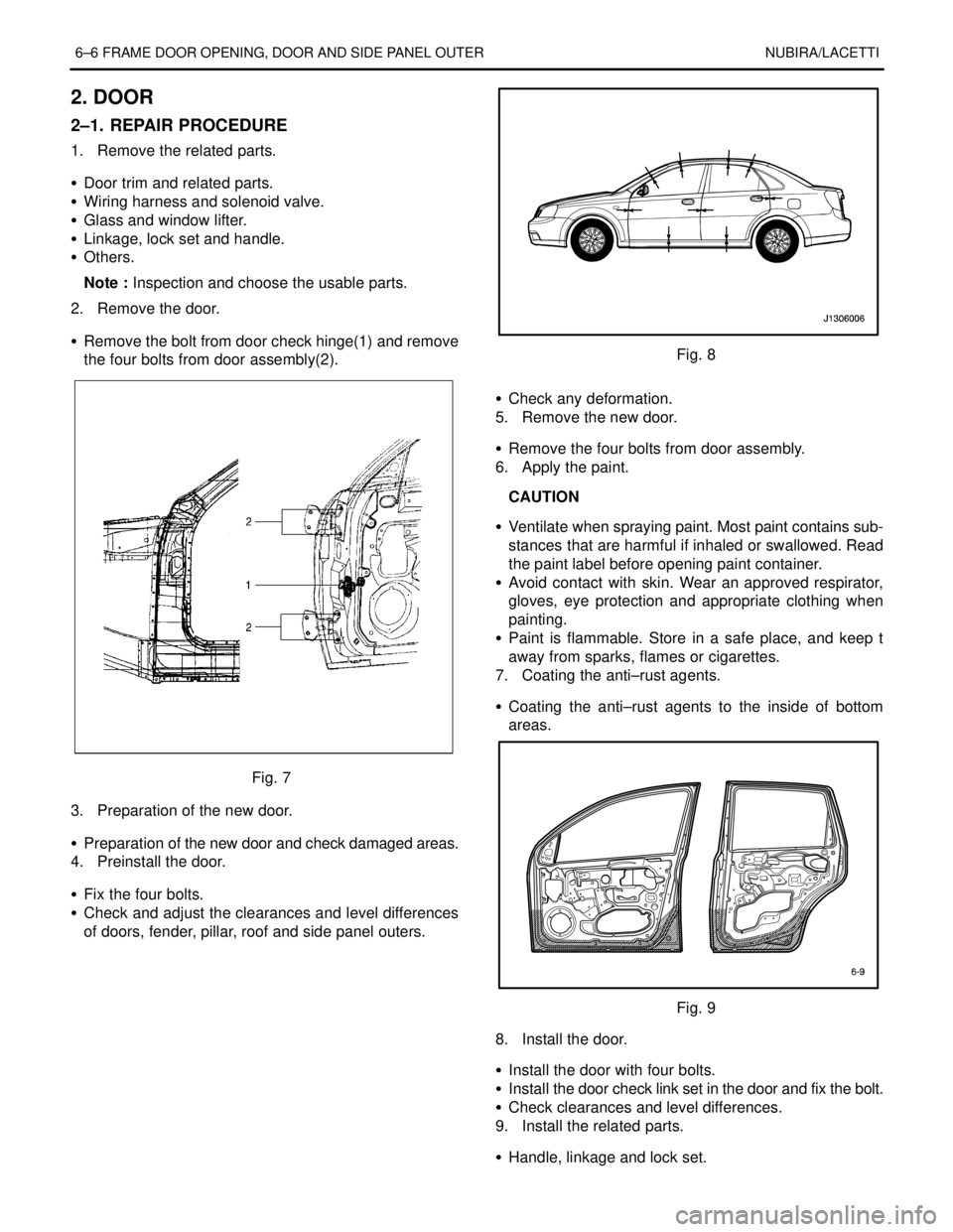
6–6 FRAME DOOR OPENING, DOOR AND SIDE PANEL OUTER NUBIRA/LACETTI
2. DOOR
2–1. REPAIR PROCEDURE
1. Remove the related parts.
S Door trim and related parts.
S Wiring harness and solenoid valve.
S Glass and window lifter.
S Linkage, lock set and handle.
S Others.
Note : Inspection and choose the usable parts.
2. Remove the door.
S Remove the bolt from door check hinge(1) and remove
the four bolts from door assembly(2).
Fig. 7
3. Preparation of the new door.
S Preparation of the new door and check damaged areas.
4. Preinstall the door.
S Fix the four bolts.
S Check and adjust the clearances and level differences
of doors, fender, pillar, roof and side panel outers.
Fig. 8
S Check any deformation.
5. Remove the new door.
S Remove the four bolts from door assembly.
6. Apply the paint.
CAUTION
S Ventilate when spraying paint. Most paint contains sub-
stances that are harmful if inhaled or swallowed. Read
the paint label before opening paint container.
S Avoid contact with skin. Wear an approved respirator,
gloves, eye protection and appropriate clothing when
painting.
S Paint is flammable. Store in a safe place, and keep t
away from sparks, flames or cigarettes.
7. Coating the anti–rust agents.
S Coating the anti–rust agents to the inside of bottom
areas.
Fig. 9
8. Install the door.
S Install the door with four bolts.
S Install the door check link set in the door and fix the bolt.
S Check clearances and level differences.
9. Install the related parts.
S Handle, linkage and lock set.
Page 2572 of 2643

NUBIRA/LACETTI FRAME DOOR OPENING, DOOR AND SIDE PANEL OUTER 6–7
S Glass and window lifter.
S Solenoid valve and wiring harness.
S Install door trim and others.
Note : Before install the door trim and related parts, rub
in grease to the moving parts and check all operation.
10. Check and adjust.
S Check clearance and level differences.
S Check the door locking and unlocking condition.
S Check for water leaks in the passenger compartment.
S Install door trim and others.
Page 2581 of 2643

7–4 FENDER, HOOD, TAILGATE AND TRUNK LID NUBIRA/LACETTI
3. TAILGATE (HATCHBACK)
3–1. REPAIR PROCEDURE
1. Remove the related parts.
S Wiring harness.
S Rear wiper arm and motor.
S Rear window glass.
S Lock set, latch and others.
.
2. Remove the tailgate.
S Remove the tailgate mounting bolts from two hinge
bows.
Fig. 6
3. Preparation of the new tailgate.
S Preparation of the new tailgate and check damaged
areas.
.
4. Apply the paint.
CAUTION
S Ventilate when spraying paint. Most paint contains sub-
stances that are harmful if inhaled or swallowed.
S Avoid contact with skin. Wear an approved respirator,
gloves, eye protection and approriate clothing when
painting.
S Paint is flammable. Store in a safe place, and keep it
away from sparks, flames or cigarettes.
5. Preinstall the tailgate.
S Fasten to the tailgate hinges at two places with four
bolts, carefully.
S Install bumper.
S Close the tailgate and check the clearances and level
difference of tailgate, side panel outers and rear com-
bination lamps.Fig. 7
6. Tighten fully.
S After checking and adjusting the mounting position,
tighten all bolts fully.
.
7. Install the related parts.
S Wiring harness and solenoid valve.
S Lock set, latches and linkages.
S Install the rear window glass.
S Install in the reverse order in which they were removed.
.
8. Check and adjust.
S Clean the luggage compartment.
S Check clearances and level differences.
S Check the luggage locking and unlocking condition.
S Check for water leaks in the luggage compartment.
S Check the rear glass demist operation.
Page 2582 of 2643
NUBIRA/LACETTI FENDER, HOOD, TAILGATE AND TRUNK LID 7–5
4. TRUNK LID (NOTCHBACK)
4–1. REPAIR PROCEDURE
1. Remove the related parts.
S Wiring harness and solenoid valve.
S Lock set, latch set and others.
.
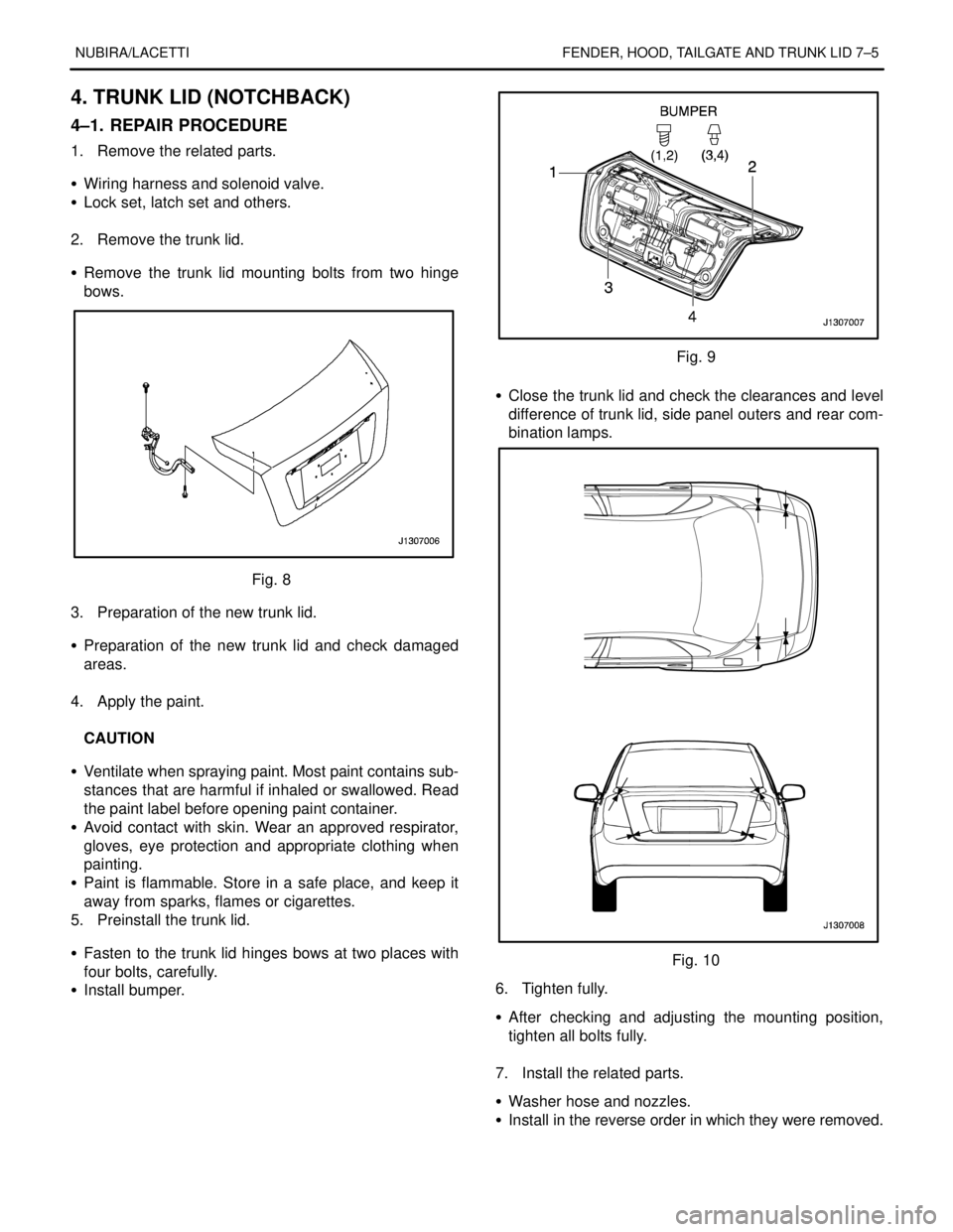
2. Remove the trunk lid.
S Remove the trunk lid mounting bolts from two hinge
bows.
Fig. 8
3. Preparation of the new trunk lid.
S Preparation of the new trunk lid and check damaged
areas.
.
4. Apply the paint.
.
CAUTION
S Ventilate when spraying paint. Most paint contains sub-
stances that are harmful if inhaled or swallowed. Read
the paint label before opening paint container.
S Avoid contact with skin. Wear an approved respirator,
gloves, eye protection and appropriate clothing when
painting.
S Paint is flammable. Store in a safe place, and keep it
away from sparks, flames or cigarettes.
5. Preinstall the trunk lid.
S Fasten to the trunk lid hinges bows at two places with
four bolts, carefully.
S Install bumper.
Fig. 9
S Close the trunk lid and check the clearances and level
difference of trunk lid, side panel outers and rear com-
bination lamps.
Fig. 10
6. Tighten fully.
S After checking and adjusting the mounting position,
tighten all bolts fully.
.
7. Install the related parts.
S Washer hose and nozzles.
S Install in the reverse order in which they were removed.
.