Iat DAEWOO LACETTI 2004 Service Owner's Manual
[x] Cancel search | Manufacturer: DAEWOO, Model Year: 2004, Model line: LACETTI, Model: DAEWOO LACETTI 2004Pages: 2643, PDF Size: 80.54 MB
Page 197 of 2643
1D – 2IENGINE COOLING
DAEWOO V–121 BL4
SPECIFICATIONS
CAPACITY
ApplicationDescription
Coolant in the Cooling System
(1.4L/1.6L DOHC MPFI System)7.0L (1.85 gal) for automatic transaxle
7.0L (1.85 gal) for manual transaxle
Coolant in the Cooling System
(1.8L DOHC MPFI System)7.1L (1.88 gal) for automatic transaxle
7.1L (1.88 gal) for manual transaxle
FASTENER TIGHTENING SPECIFICATIONS
ApplicationNSmLb–FtLb–In
Water Pump Mounting Bolts (1.4L/1.6L DOHC)10–89
Water Pump Mounting Bolts (1.8L DOHC)2518–
Fan Assembly Mounting Bolts4–35
Fan Motor Nut3.2–28
Fan Motor Retaining Screws4–35
Radiator Retaining Bolts, Upper Left and Upper Right8–71
Surge Tank Attaching Bolt5–44
Thermostat Housing Mounting Bolts (1.6L DOHC)2015–
Thermostat Housing Mounting Bolts (1.8L DOHC)1511–
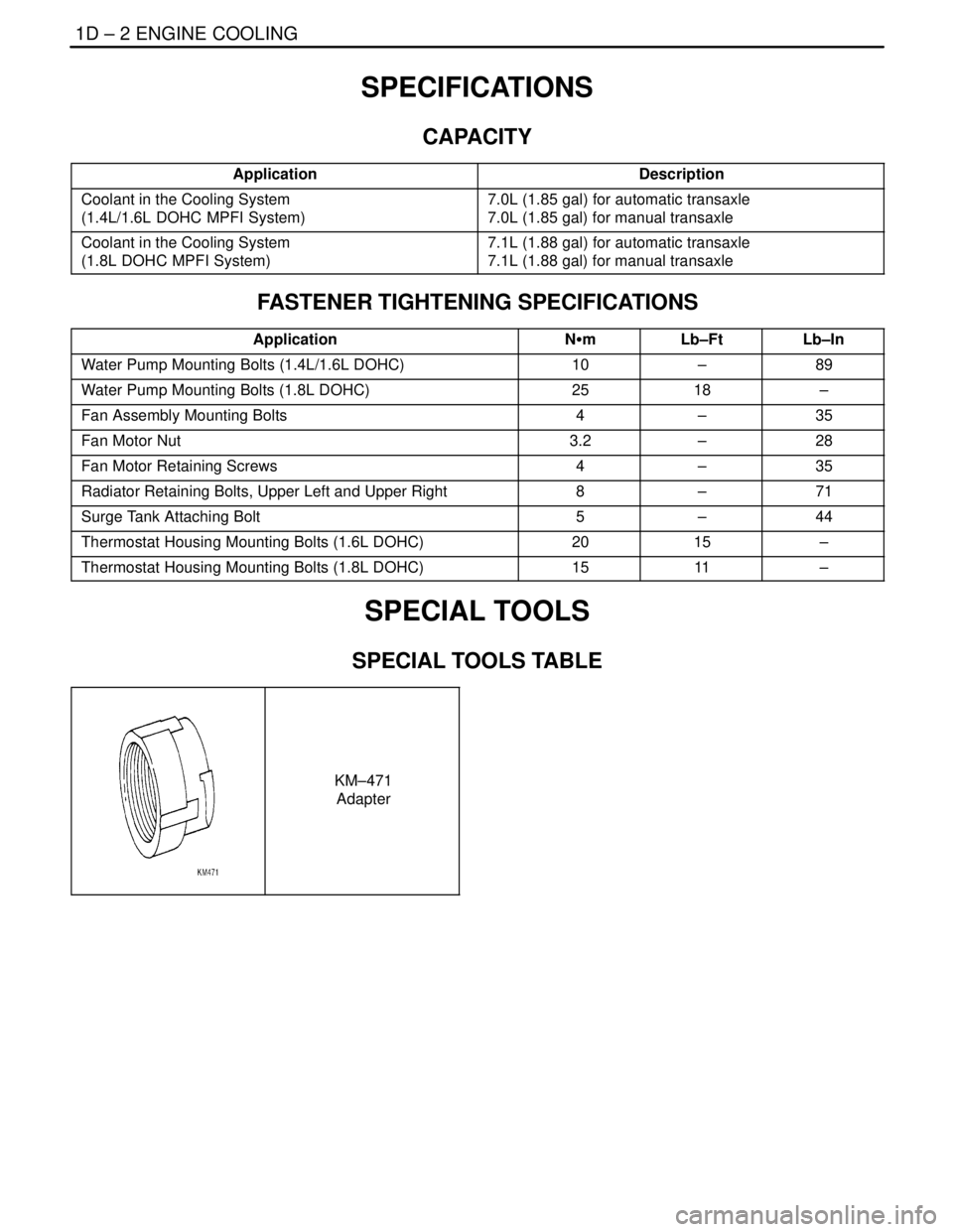
SPECIAL TOOLS
SPECIAL TOOLS TABLE
KM–471
Adapter
Page 199 of 2643

1D – 4IENGINE COOLING
DAEWOO V–121 BL4
COOLING SYSTEM DIAGNOSIS
Engine Overheats
ChecksAction
Check for a loss of the coolant.Add the coolant.
Check for a weak coolant solution.Confirm that the coolant solution is a 50/50 mixture of eth-
ylene glycol and water.
Check the front of the radiator for any dirt, any leaves, or
any insects.Clean the front of the radiator.
Check for leakage from the hoses, the coolant pump, the
heater, the thermostat housing, the radiator, the core
plugs, or the head gasket.Replace any damaged components.
Check for a faulty thermostat.Replace a damaged thermostat.
Check for retarded ignition timing.Perform an ECM code diagnosis. Confirm the integrity of
the timing belt.
Check for an improperly operating electric cooling fan.Replace the electric cooling fan.
Check for radiator hoses that are plugged or rotted.Replace any damaged radiator hoses.
Check for a faulty water pump.Replace a faulty water pump.
Check for a faulty surge tank cap.Replace a faulty surge tank cap.
Check for a cylinder head or an engine block that is
cracked or plugged.Repair the damaged cylinder head or the damaged engine
block.
Loss of Coolant
ChecksAction
Check for a leak in the radiator.Replace a damaged radiator.
Check for a leak in the following locations:
S Surge tank.
S Hose.Replace the following parts, as needed:
S Surge tank.
S Hose.
Check for loose or damaged radiator hoses, heater hoses,
and connections.Reseat the hoses.
Replace the hoses or the clamps.
Check for leaks in the coolant pump seal.Replace the coolant pump seal.
Check for leaks in the coolant pump gasket.Replace the coolant pump gasket.
Check for an improper cylinder head torque.Tighten the cylinder head bolts to specifications.
Replace the cylinder head gasket, if needed.
Check for leaks in the following locations:
S Intake manifold.
S Cylinder head gasket.
S Cylinder block plug.
S Heater core.
S Radiator drain plug.Repair or replace any components, as needed, to correct
the leak.
Engine Fails to Reach Normal Operating Temperature or Cool Air
from the Heater
ChecksAction
Check to determine if the thermostat is stuck open or is the
wrong type of thermostat.Install a new thermostat of the correct type and heat range.
Check the coolant level to determine if it is below the MIN
mark on the surge tank.Add sufficient coolant to raise the fluid to the specified
mark on the surge tank.
Page 200 of 2643

ENGINE COOLING 1D – 5
DAEWOO V–121 BL4
COMPONENT LOCATOR
RADIATOR/FAN
1. Holder Transmission Fluid Pipe (Automatic Trans-
mission Only)
2. Upper Radiator Bumper
3. Front Upper Center Panel
4. Radiator
5. Lower Radiator Bumper6. Spring Clamp
7. Upper Radiator Hose
8. Main Cooling Fan
9. Auxiliary Cooling Fan
10. Drain Cock
Page 203 of 2643
1D – 8IENGINE COOLING
DAEWOO V–121 BL4
MAINTENANCE AND REPAIR
ON–VEHICLE SERVICE
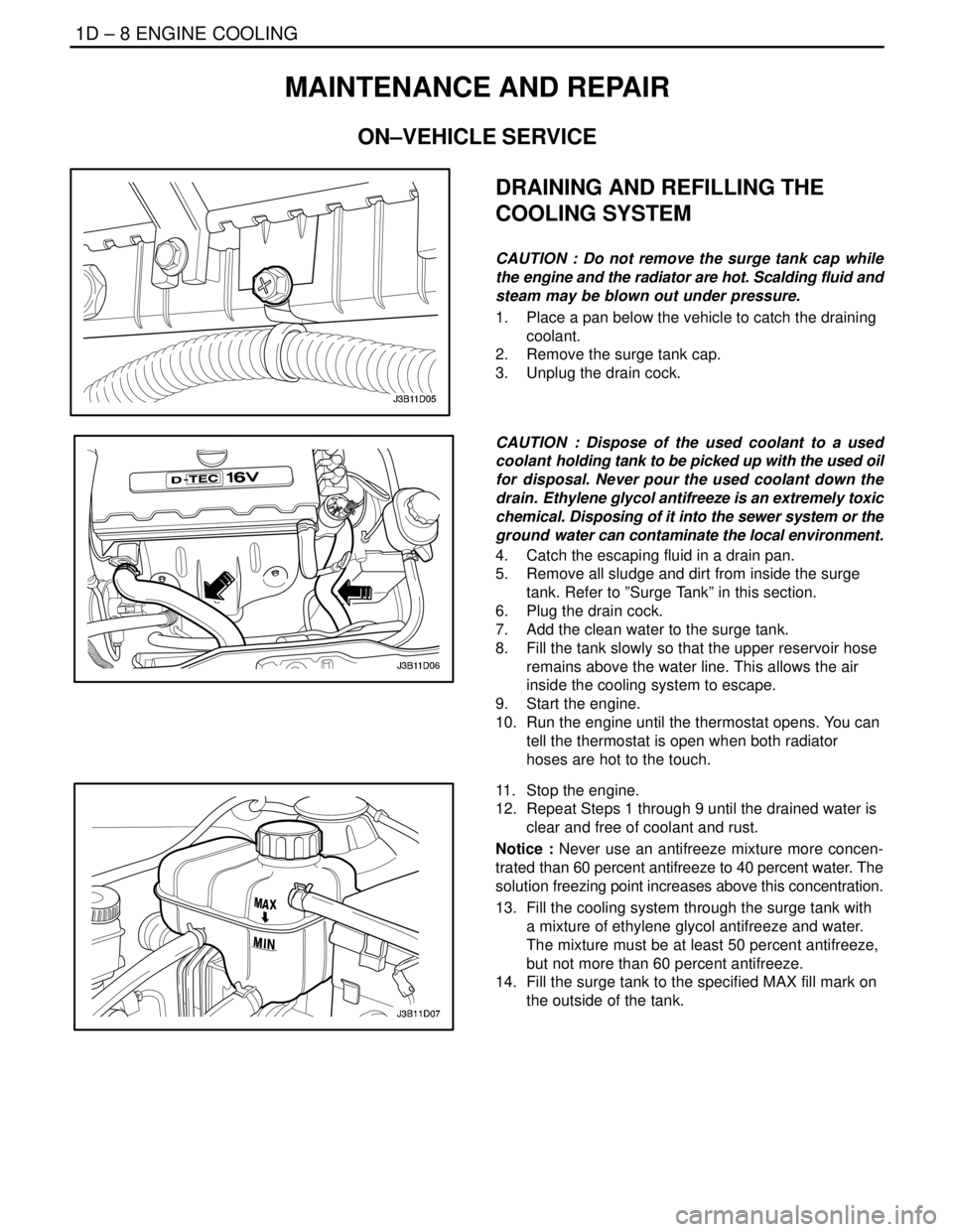
DRAINING AND REFILLING THE
COOLING SYSTEM
CAUTION : Do not remove the surge tank cap while
the engine and the radiator are hot. Scalding fluid and
steam may be blown out under pressure.
1. Place a pan below the vehicle to catch the draining
coolant.
2. Remove the surge tank cap.
3. Unplug the drain cock.
CAUTION : Dispose of the used coolant to a used
coolant holding tank to be picked up with the used oil
for disposal. Never pour the used coolant down the
drain. Ethylene glycol antifreeze is an extremely toxic
chemical. Disposing of it into the sewer system or the
ground water can contaminate the local environment.
4. Catch the escaping fluid in a drain pan.
5. Remove all sludge and dirt from inside the surge
tank. Refer to ”Surge Tank” in this section.
6. Plug the drain cock.
7. Add the clean water to the surge tank.
8. Fill the tank slowly so that the upper reservoir hose
remains above the water line. This allows the air
inside the cooling system to escape.
9. Start the engine.
10. Run the engine until the thermostat opens. You can
tell the thermostat is open when both radiator
hoses are hot to the touch.
11. Stop the engine.
12. Repeat Steps 1 through 9 until the drained water is
clear and free of coolant and rust.
Notice : Never use an antifreeze mixture more concen-
trated than 60 percent antifreeze to 40 percent water. The
solution freezing point increases above this concentration.
13. Fill the cooling system through the surge tank with
a mixture of ethylene glycol antifreeze and water.
The mixture must be at least 50 percent antifreeze,
but not more than 60 percent antifreeze.
14. Fill the surge tank to the specified MAX fill mark on
the outside of the tank.
Page 204 of 2643
ENGINE COOLING 1D – 9
DAEWOO V–121 BL4
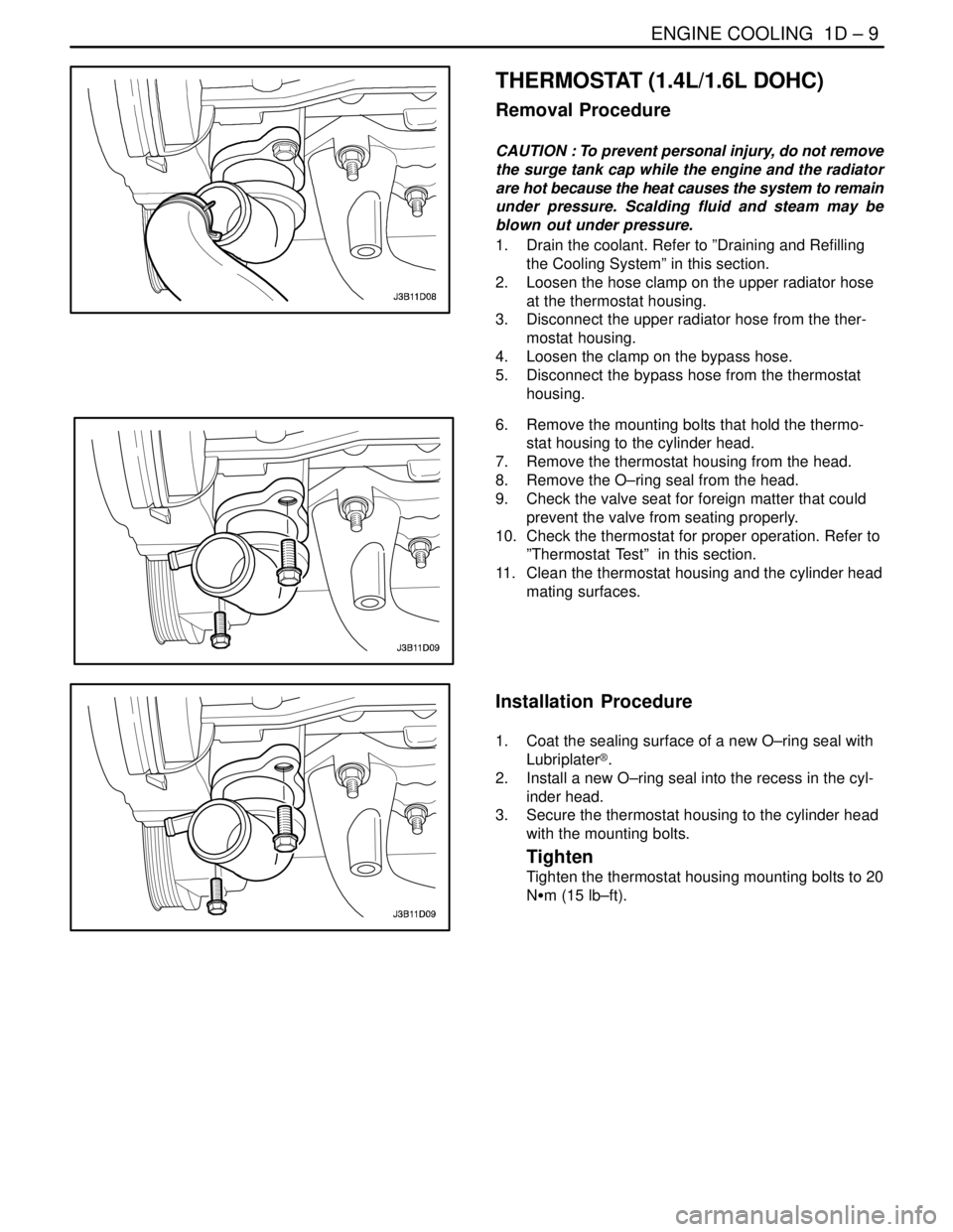
THERMOSTAT (1.4L/1.6L DOHC)
Removal Procedure
CAUTION : To prevent personal injury, do not remove
the surge tank cap while the engine and the radiator
are hot because the heat causes the system to remain
under pressure. Scalding fluid and steam may be
blown out under pressure.
1. Drain the coolant. Refer to ”Draining and Refilling
the Cooling System” in this section.
2. Loosen the hose clamp on the upper radiator hose
at the thermostat housing.
3. Disconnect the upper radiator hose from the ther-
mostat housing.
4. Loosen the clamp on the bypass hose.
5. Disconnect the bypass hose from the thermostat
housing.
6. Remove the mounting bolts that hold the thermo-
stat housing to the cylinder head.
7. Remove the thermostat housing from the head.
8. Remove the O–ring seal from the head.
9. Check the valve seat for foreign matter that could
prevent the valve from seating properly.
10. Check the thermostat for proper operation. Refer to
”Thermostat Test” in this section.
11. Clean the thermostat housing and the cylinder head
mating surfaces.
Installation Procedure
1. Coat the sealing surface of a new O–ring seal with
Lubriplater®.
2. Install a new O–ring seal into the recess in the cyl-
inder head.
3. Secure the thermostat housing to the cylinder head
with the mounting bolts.
Tighten
Tighten the thermostat housing mounting bolts to 20
NSm (15 lb–ft).
Page 205 of 2643
1D – 10IENGINE COOLING
DAEWOO V–121 BL4
4. Connect the upper radiator hose to the thermostat
housing.
5. Secure the upper radiator hose to the thermostat
housing with a hose clamp.
6. Connect the bypass hose to the thermostat hous-
ing.
7. Secure the bypass hose with a hose clamp.
8. Refill the engine cooling system. Refer to ”Draining
and Refilling the Cooling System” in this section.
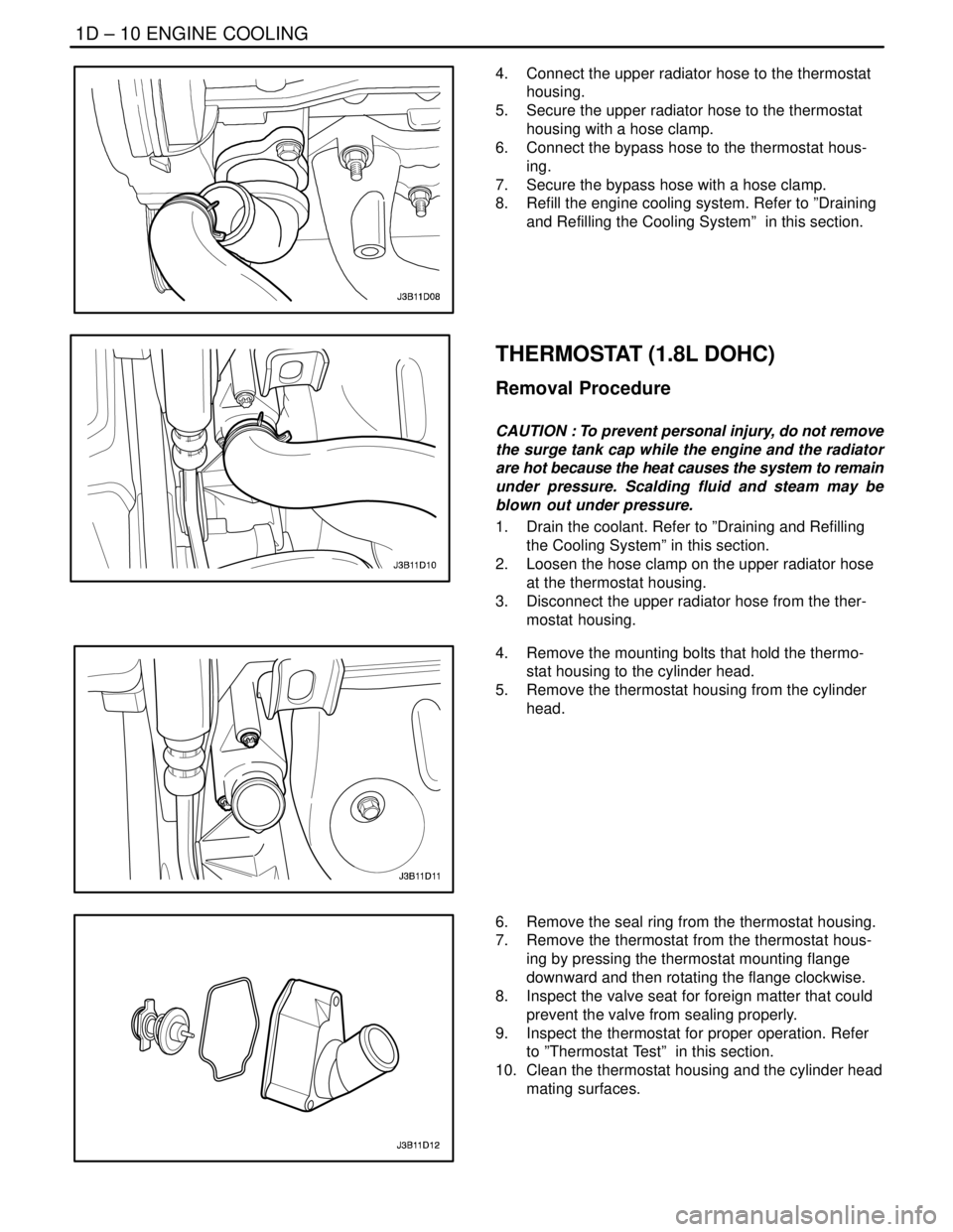
THERMOSTAT (1.8L DOHC)
Removal Procedure
CAUTION : To prevent personal injury, do not remove
the surge tank cap while the engine and the radiator
are hot because the heat causes the system to remain
under pressure. Scalding fluid and steam may be
blown out under pressure.
1. Drain the coolant. Refer to ”Draining and Refilling
the Cooling System” in this section.
2. Loosen the hose clamp on the upper radiator hose
at the thermostat housing.
3. Disconnect the upper radiator hose from the ther-
mostat housing.
4. Remove the mounting bolts that hold the thermo-
stat housing to the cylinder head.
5. Remove the thermostat housing from the cylinder
head.
6. Remove the seal ring from the thermostat housing.
7. Remove the thermostat from the thermostat hous-
ing by pressing the thermostat mounting flange
downward and then rotating the flange clockwise.
8. Inspect the valve seat for foreign matter that could
prevent the valve from sealing properly.
9. Inspect the thermostat for proper operation. Refer
to ”Thermostat Test” in this section.
10. Clean the thermostat housing and the cylinder head
mating surfaces.
Page 206 of 2643
ENGINE COOLING 1D – 11
DAEWOO V–121 BL4
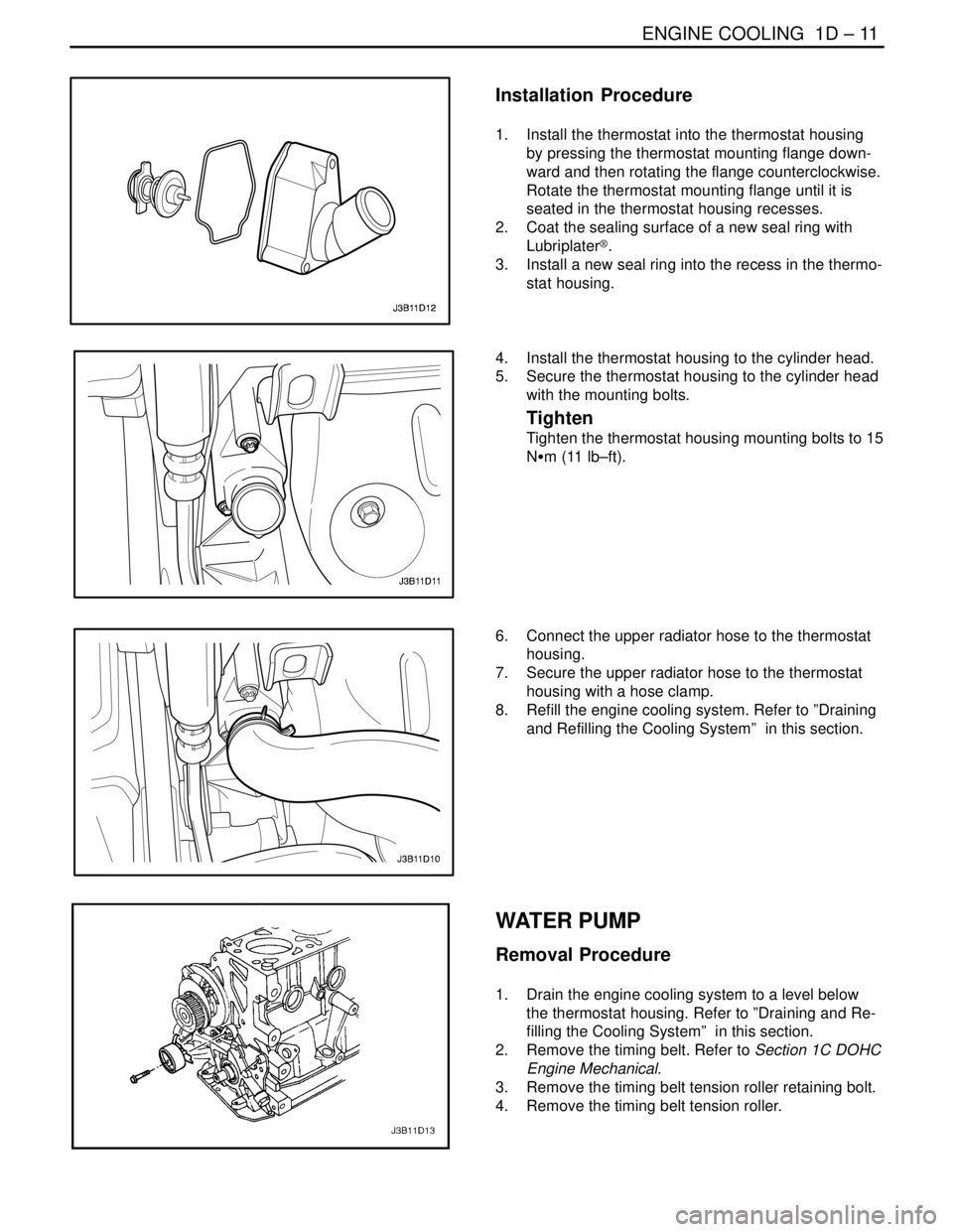
Installation Procedure
1. Install the thermostat into the thermostat housing
by pressing the thermostat mounting flange down-
ward and then rotating the flange counterclockwise.
Rotate the thermostat mounting flange until it is
seated in the thermostat housing recesses.
2. Coat the sealing surface of a new seal ring with
Lubriplater®.
3. Install a new seal ring into the recess in the thermo-
stat housing.
4. Install the thermostat housing to the cylinder head.
5. Secure the thermostat housing to the cylinder head
with the mounting bolts.
Tighten
Tighten the thermostat housing mounting bolts to 15
NSm (11 lb–ft).
6. Connect the upper radiator hose to the thermostat
housing.
7. Secure the upper radiator hose to the thermostat
housing with a hose clamp.
8. Refill the engine cooling system. Refer to ”Draining
and Refilling the Cooling System” in this section.
WATER PUMP
Removal Procedure
1. Drain the engine cooling system to a level below
the thermostat housing. Refer to ”Draining and Re-
filling the Cooling System” in this section.
2. Remove the timing belt. Refer to Section 1C DOHC
Engine Mechanical.
3. Remove the timing belt tension roller retaining bolt.
4. Remove the timing belt tension roller.
Page 209 of 2643
1D – 14IENGINE COOLING
DAEWOO V–121 BL4
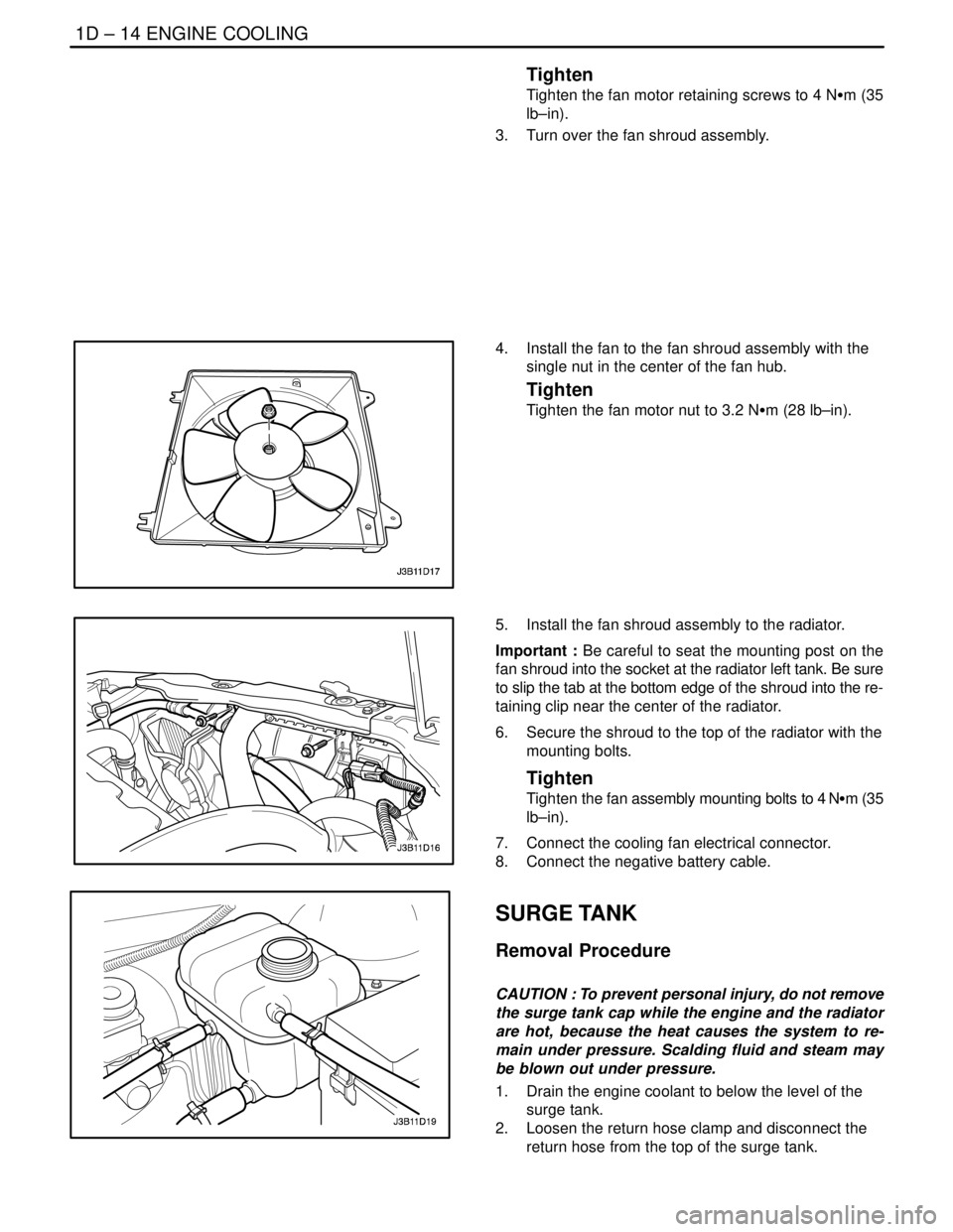
Tighten
Tighten the fan motor retaining screws to 4 NSm (35
lb–in).
3. Turn over the fan shroud assembly.
4. Install the fan to the fan shroud assembly with the
single nut in the center of the fan hub.
Tighten
Tighten the fan motor nut to 3.2 NSm (28 lb–in).
5. Install the fan shroud assembly to the radiator.
Important : Be careful to seat the mounting post on the
fan shroud into the socket at the radiator left tank. Be sure
to slip the tab at the bottom edge of the shroud into the re-
taining clip near the center of the radiator.
6. Secure the shroud to the top of the radiator with the
mounting bolts.
Tighten
Tighten the fan assembly mounting bolts to 4 NSm (35
lb–in).
7. Connect the cooling fan electrical connector.
8. Connect the negative battery cable.
SURGE TANK
Removal Procedure
CAUTION : To prevent personal injury, do not remove
the surge tank cap while the engine and the radiator
are hot, because the heat causes the system to re-
main under pressure. Scalding fluid and steam may
be blown out under pressure.
1. Drain the engine coolant to below the level of the
surge tank.
2. Loosen the return hose clamp and disconnect the
return hose from the top of the surge tank.
Page 211 of 2643
1D – 16IENGINE COOLING
DAEWOO V–121 BL4
RADIATOR
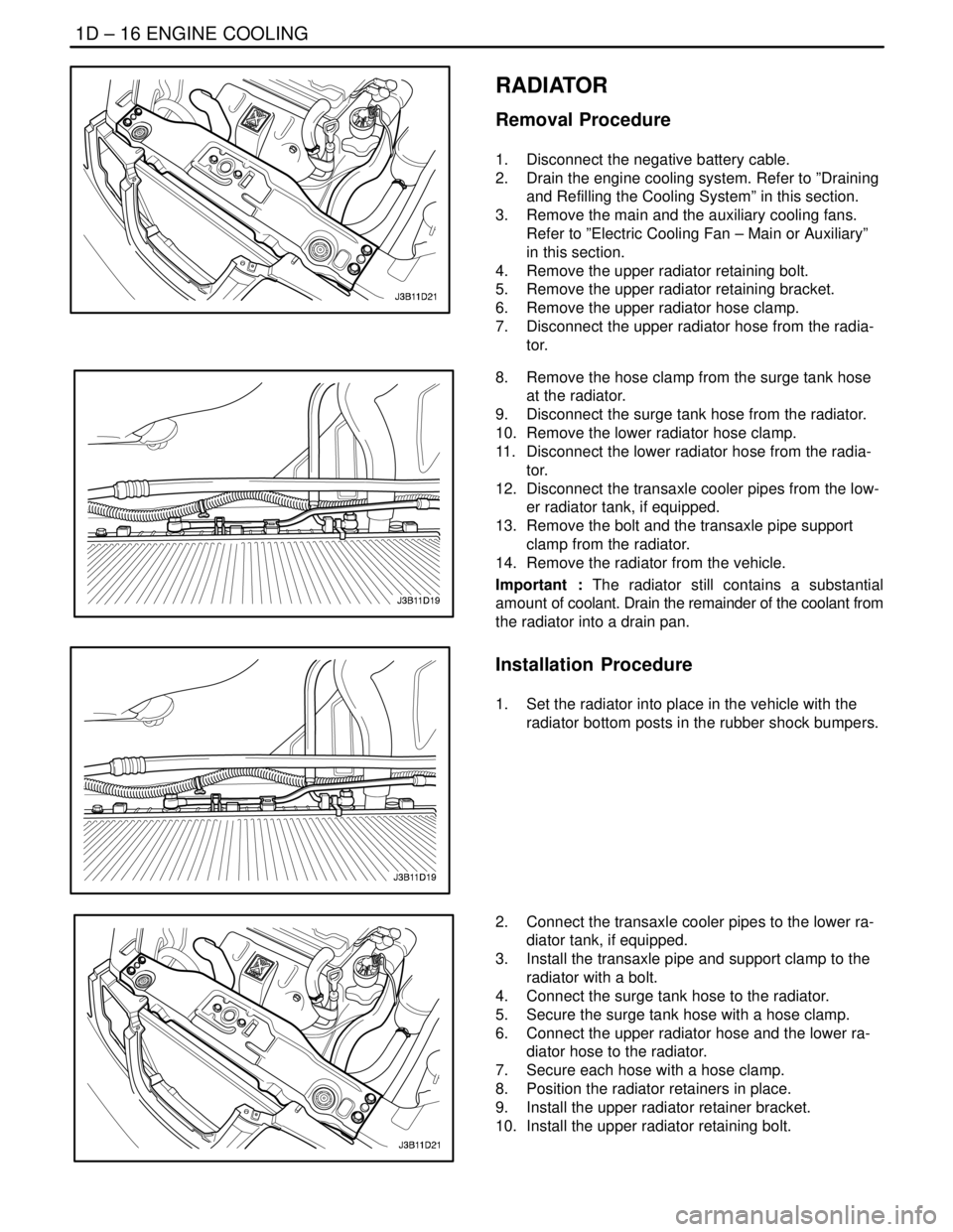
Removal Procedure
1. Disconnect the negative battery cable.
2. Drain the engine cooling system. Refer to ”Draining
and Refilling the Cooling System” in this section.
3. Remove the main and the auxiliary cooling fans.
Refer to ”Electric Cooling Fan – Main or Auxiliary”
in this section.
4. Remove the upper radiator retaining bolt.
5. Remove the upper radiator retaining bracket.
6. Remove the upper radiator hose clamp.
7. Disconnect the upper radiator hose from the radia-
tor.
8. Remove the hose clamp from the surge tank hose
at the radiator.
9. Disconnect the surge tank hose from the radiator.
10. Remove the lower radiator hose clamp.
11. Disconnect the lower radiator hose from the radia-
tor.
12. Disconnect the transaxle cooler pipes from the low-
er radiator tank, if equipped.
13. Remove the bolt and the transaxle pipe support
clamp from the radiator.
14. Remove the radiator from the vehicle.
Important : The radiator still contains a substantial
amount of coolant. Drain the remainder of the coolant from
the radiator into a drain pan.
Installation Procedure
1. Set the radiator into place in the vehicle with the
radiator bottom posts in the rubber shock bumpers.
2. Connect the transaxle cooler pipes to the lower ra-
diator tank, if equipped.
3. Install the transaxle pipe and support clamp to the
radiator with a bolt.
4. Connect the surge tank hose to the radiator.
5. Secure the surge tank hose with a hose clamp.
6. Connect the upper radiator hose and the lower ra-
diator hose to the radiator.
7. Secure each hose with a hose clamp.
8. Position the radiator retainers in place.
9. Install the upper radiator retainer bracket.
10. Install the upper radiator retaining bolt.
Page 212 of 2643

ENGINE COOLING 1D – 17
DAEWOO V–121 BL4
11. Install the main and the auxiliary cooling fans. Refer
to ”Electric Cooling Fan – Main or Auxiliary” in this
section.
12. Refill the engine cooling system. Refer to ”Draining
and Refilling the Cooling System” in this section.
13. Connect the negative battery cable.
Tighten
Tighten the radiator retaining bolt to 8 NSm (71 lb–in).