Iat DAEWOO LACETTI 2004 Service Owner's Guide
[x] Cancel search | Manufacturer: DAEWOO, Model Year: 2004, Model line: LACETTI, Model: DAEWOO LACETTI 2004Pages: 2643, PDF Size: 80.54 MB
Page 213 of 2643

1D – 18IENGINE COOLING
DAEWOO V–121 BL4
GENERAL DESCRIPTION
AND SYSTEM OPERATION
GENERAL DESCRIPTION
The cooling system maintains the engine temperature at
an efficient level during all engine operating conditions.
When the engine is cold, the cooling system cools the en-
gine slowly or not at all. This slow cooling of the engine al-
lows the engine to warm up quickly.
The cooling system includes a radiator and recovery sub-
system, cooling fans, a thermostat and housing, a coolant
pump, and a coolant pump drive belt. The timing belt
drives the coolant pump.
All components must function properly in order for the
cooling system to operate. The coolant pump draws the
coolant from the radiator. The coolant then circulates
through water jackets in the engine block, the intake man-
ifold, and the cylinder head. When the coolant reaches the
operating temperature of the thermostat, the thermostat
opens. The coolant then goes back to the radiator where
it cools.
This system directs some coolant through the hoses to the
heater core. This provides for heating and defrosting. The
surge tank is connected to the radiator to recover the cool-
ant displaced by expansion from the high temperatures.
The surge tank maintains the correct coolant level.
The cooling system for this vehicle has no radiator cap or
filler neck. The coolant is added to the cooling system
through the surge tank.
RADIATOR
This vehicle has a lightweight tube–and–fin aluminum ra-
diator. Plastic tanks are mounted on the right and the left
sides of the radiator core.
On vehicles equipped with automatic transaxles, the
transaxle fluid cooler lines run through the left radiator
tank. A radiator drain cock is on this radiator.
To drain the cooling system, open the drain cock.
SURGE TANK
The surge tank is a transparent plastic reservoir, similar to
the windshield washer reservoir.
The surge tank is connected to the radiator by a hose and
to the engine cooling system by another hose. As the ve-
hicle is driven, the engine coolant heats and expands. The
portion of the engine coolant displaced by this expansion
flows from the radiator and the engine into the surge tank.
The air trapped in the radiator and the engine is degassed
into the surge tank.When the engine stops, the engine coolant cools and con-
tracts. The displaced engine coolant is then drawn back
into the radiator and the engine. This keeps the radiator
filled with the coolant to the desired level at all times and
increases the cooling efficiency.
Maintain the coolant level between the MIN and the MAX
marks on the surge tank when the system is cold.
WATER PUMP
The belt–driven centrifugal water pump consists of an im-
peller, a drive shaft, and a belt pulley. The water pump is
mounted on the front of the transverse–mounted engine,
and is driven by the timing belt.
The impeller is supported by a completely sealed bearing.
The water pump is serviced as an assembly and, there-
fore, cannot be disassembled.
THERMOSTAT
A wax pellet–type thermostat controls the flow of the en-
gine coolant through the engine cooling system. The ther-
mostat is mounted in the thermostat housing to the front
of the cylinder head.
The thermostat stops the flow of the engine coolant from
the engine to the radiator in order to provide faster warm–
up, and to regulate the coolant temperature. The thermo-
stat remains closed while the engine coolant is cold, pre-
venting circulation of the engine coolant through the
radiator. At this point, the engine coolant is allowed to cir-
culate only throughout the heater core to warm it quickly
and evenly.
As the engine warms, the thermostat opens. This allows
the engine coolant to flow through the radiator, where the
heat is dissipated through the radiator. This opening and
closing of the thermostat permits enough engine coolant
to enter the radiator to keep the engine within proper en-
gine temperature operating limits.
The wax pellet in the thermostat is hermetically sealed in
a metal case. The wax element of the thermostat expands
when it is heated and contracts when it is cooled.
As the vehicle is driven and the engine warms, the engine
coolant temperature increases. When the engine coolant
reaches a specified temperature, the wax pellet element
in the thermostat expands and exerts pressure against the
metal case, forcing the valve open. This allows the engine
coolant to flow through the engine cooling system and cool
the engine.
As the wax pellet cools, the contraction allows a spring to
close the valve.
The thermostat begins to open at 87°C (189°F) and is fully
open at 102°C (216°F). The thermostat closes at 86°C
(187°F).
Page 214 of 2643

ENGINE COOLING 1D – 19
DAEWOO V–121 BL4
ELECTRIC COOLING FAN
CAUTION : Keep hands, tools, and clothing away
from the engine cooling fans to help prevent personal
injury. This fan is electric and can turn ON whether or
not the engine is running.
CAUTION : If a fan blade is bent or damaged in any
way, no attempt should be made to repair or reuse the
damaged part. A bent or damaged fan assembly
should always be replaced with a new one. Failure to
do so can result in personal injury.
The cooling fans are mounted behind the radiator in the
engine compartment. The electric cooling fans increase
the flow of air across the radiator fins and across the con-
denser on air condition (A/C)–equipped vehicles. This
helps to speed cooling when the vehicle is at idle or moving
at low speeds.
1.4L DOHC engine fan size is 340mm (13.4 in.) and
1.6L/1.8L DOHC engine main fan size is 300 mm (11.8
inches) in diameter with five blades to aid the air flow
through the radiator and the condenser. An electric motor
attached to the radiator support drives the fan.
A/C models have two fans – the main fan and the auxiliary
fan. The auxiliary fan is 300 mm (11.8 inches) in diameter.
Non–A/C models have only the main fan.
A/C OFF or Non–A/C Model (1.4L/1.6L)
S The cooling fans are actuated by the electronic
control module (ECM) using a low–speed cooling
fan relay and a high–speed cooling fan relay. On
A/C–equipped vehicles, a series/parallel cooling fan
relay is also used.
S The ECM will turn the cooling fans on at low speed
when the coolant temperature reaches 97.5°C
(207.5°F) and the cooling fans off at 95.25°C
(203.4°F).
A/C OFF or Non–A/C Model (1.8L)
S The cooling fans are actuated by the electronic
control module (ECM) using a low–speed cooling
fan relay and a high–speed cooling fan relay. On
A/C–equipped vehicles, a series/parallel cooling fan
relay is also used.
S The ECM will turn the cooling fans on at low speed
when the coolant temperature reaches 93°C
(199°F) and the cooling fans off at 90°C (194°F).
A/C ON (1.4L/1.6L)
S The ECM will turn the cooling fans on at low speed
when the A/C system is on. The ECM will change
to high speed when the coolant temperature reach-
es 101.25°C (214°F) or the high side A/C pressure
reaches 1859 kPa (270 psi).
S The cooling fans will return to low speed when the
coolant temperature reaches 99°C (210°F) and the
high side A/C pressure reaches 1449 kPa (210 psi).
A/C ON (1.8L)
S The ECM will turn the cooling fans on at low speed
when the A/C system is on. The ECM will change
to high speed when the coolant temperature reach-
es 97°C (207°F) or the high side A/C pressure
reaches 1859 kPa (270 psi).
S The cooling fans will return to low speed when the
coolant temperature reaches 94°C (201°F) and the
high side A/C pressure reaches 1449 kPa (210 psi).
ENGINE BLOCK HEATER
The vehicle is designed to accept an engine block heater
that helps to warm the engine and to improve starting in
cold weather. It also can help to reduce fuel consumption
while a cold engine warms up.
The engine block heater is located under the intake man-
ifold and uses an existing expansion plug for installation.
Page 231 of 2643
ENGINE ELECTRICAL 1E – 17
DAEWOO V–121 BL4
UNIT REPAIR
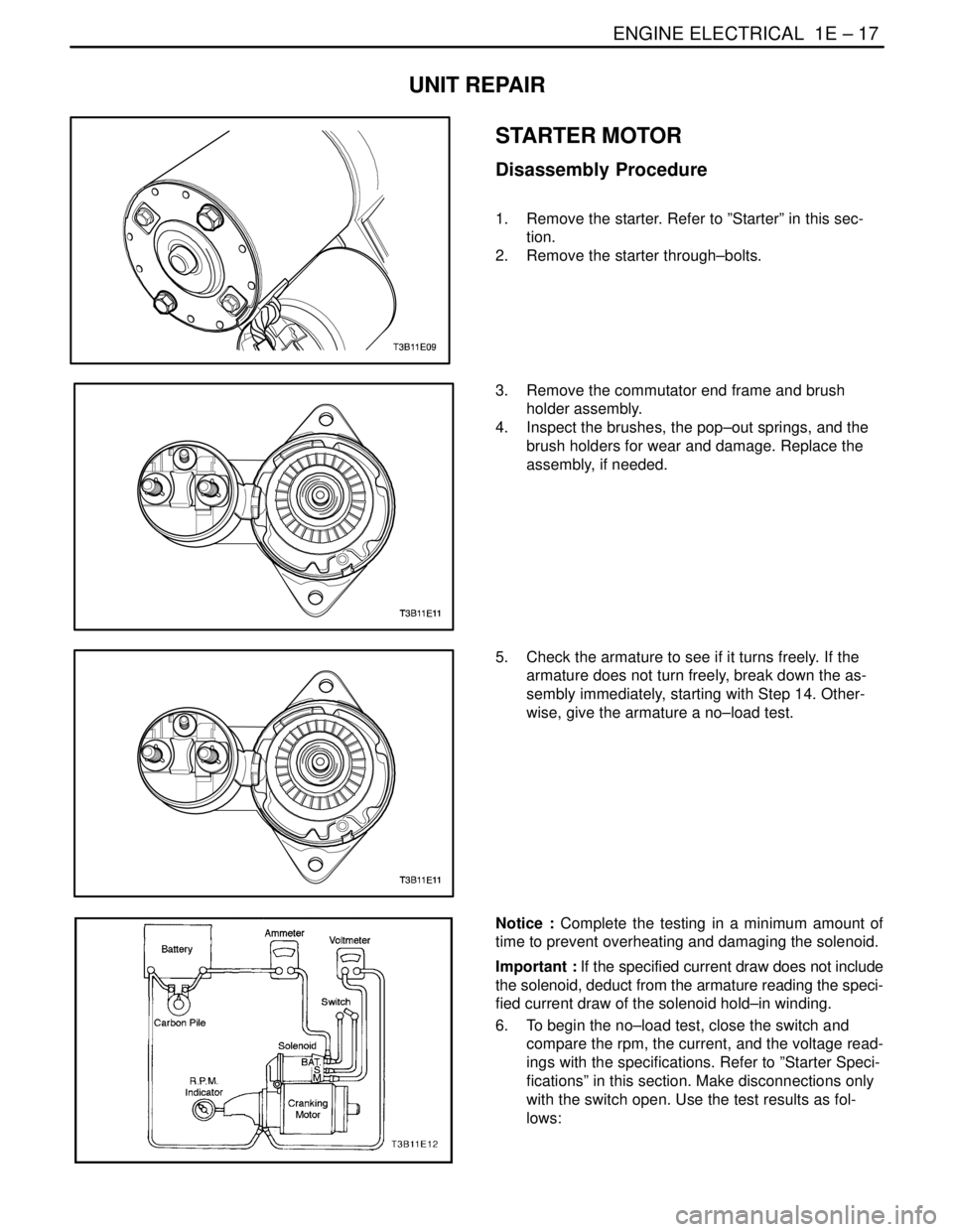
STARTER MOTOR
Disassembly Procedure
1. Remove the starter. Refer to ”Starter” in this sec-
tion.
2. Remove the starter through–bolts.
3. Remove the commutator end frame and brush
holder assembly.
4. Inspect the brushes, the pop–out springs, and the
brush holders for wear and damage. Replace the
assembly, if needed.
5. Check the armature to see if it turns freely. If the
armature does not turn freely, break down the as-
sembly immediately, starting with Step 14. Other-
wise, give the armature a no–load test.
Notice : Complete the testing in a minimum amount of
time to prevent overheating and damaging the solenoid.
Important : If the specified current draw does not include
the solenoid, deduct from the armature reading the speci-
fied current draw of the solenoid hold–in winding.
6. To begin the no–load test, close the switch and
compare the rpm, the current, and the voltage read-
ings with the specifications. Refer to ”Starter Speci-
fications” in this section. Make disconnections only
with the switch open. Use the test results as fol-
lows:
Page 243 of 2643
ENGINE ELECTRICAL 1E – 29
DAEWOO V–121 BL4
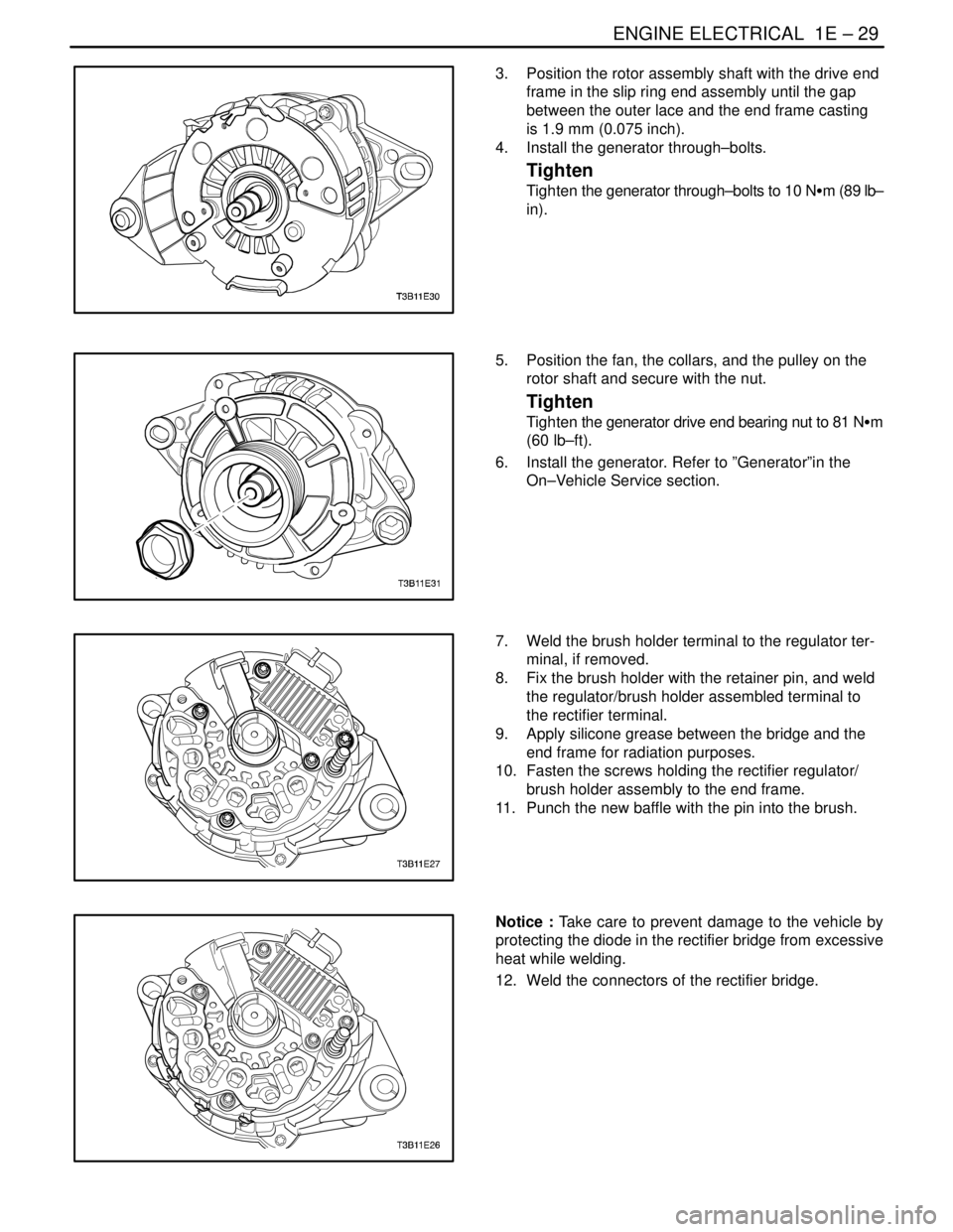
3. Position the rotor assembly shaft with the drive end
frame in the slip ring end assembly until the gap
between the outer lace and the end frame casting
is 1.9 mm (0.075 inch).
4. Install the generator through–bolts.
Tighten
Tighten the generator through–bolts to 10 NSm (89 lb–
in).
5. Position the fan, the collars, and the pulley on the
rotor shaft and secure with the nut.
Tighten
Tighten the generator drive end bearing nut to 81 NSm
(60 lb–ft).
6. Install the generator. Refer to ”Generator”in the
On–Vehicle Service section.
7. Weld the brush holder terminal to the regulator ter-
minal, if removed.
8. Fix the brush holder with the retainer pin, and weld
the regulator/brush holder assembled terminal to
the rectifier terminal.
9. Apply silicone grease between the bridge and the
end frame for radiation purposes.
10. Fasten the screws holding the rectifier regulator/
brush holder assembly to the end frame.
11. Punch the new baffle with the pin into the brush.
Notice : Take care to prevent damage to the vehicle by
protecting the diode in the rectifier bridge from excessive
heat while welding.
12. Weld the connectors of the rectifier bridge.
Page 246 of 2643

1E – 32IENGINE ELECTRICAL
DAEWOO V–121 BL4
the same cable to the positive terminal on the other
battery. Never connect the other end to the nega-
tive terminal of the discharged battery.
CAUTION : To avoid injury do not attach the cable di-
rectly to the negative terminal of the discharged bat-
tery. Doing so could cause sparks and a possible bat-
tery explosion.
6. Clamp one end of the second cable to the negative
terminal of the booster battery. Make the final con-
nection to a solid engine ground (such as the en-
gine lift bracket) at least 450 millimeters (18 inches)
from the discharged battery.
7. Start the engine of the vehicle with the good bat-
tery. Run the engine at a moderate speed for sever-
al minutes. Then start the engine of the vehicle
which has the discharged battery.
8. Remove the jumper cables by reversing the above
sequence exactly. Remove the negative cable from
the vehicle with the discharged battery first. While
removing each clamp, take care that it does not
touch any other metal while the other end remains
attached.
GENERATOR
The Delco–Remy CS charging system has several mod-
els available, including the CS. The number denotes the
outer diameter in millimeters of the stator lamination.
CS generators are equipped with internal regulators. A
Delta stator, a rectifier bridge, and a rotor with slip rings
and brushes are electrically similar to earlier generators.
A conventional pulley and fan are used. There is no test
hole.
Unlike three–wire generators, the CS may be used with
only two connections: battery positive and an ”L’’ terminal
to the charge indicator lamp.
As with other charging systems, the charge indicator lamp
lights when the ignition switch is turned to RUN, and goes
out when the engine is running. If the charge indicator is
on with the engine running, a charging system defect is in-
dicated. This indicator light will glow at full brilliance for
several kinds of defects as well as when the system volt-
age is too high or too low.The regulator voltage setting varies with temperature and
limits the system voltage by controlling rotor field current.
At high speeds, the on–time may be 10 percent and the
off–time 90 percent. At low speeds, with high electrical
loads, on–time may be 90 percent and the off–time 10 per-
cent.
CHARGING SYSTEM
CS generators use a new type of regulator that incorpo-
rates a diode trio. A Delta stator, a rectifier bridge, and a
rotor with slip rings and brushes are electrically similar to
earlier generators. A conventional pulley and fan are used.
There is no test hole.
STARTER
Wound field starter motors have pole pieces, arranged
around the armature, which are energized by wound field
coils.
Enclosed shift lever cranking motors have the shift lever
mechanism and the solenoid plunger enclosed in the drive
housing, protecting them from exposure to dirt, icy condi-
tions, and splashes.
In the basic circuit, solenoid windings are energized when
the switch is closed. The resulting plunger and shift lever
movement causes the pinion to engage the engine fly-
wheel ring gear. The solenoid main contacts close. Crank-
ing then takes place.
When the engine starts, pinion overrun protects the arma-
ture from excessive speed until the switch is opened, at
which time the return spring causes the pinion to disen-
gage. To prevent excessive overrun, the switch should be
released immediately after the engine starts.
STARTING SYSTEM
The engine electrical system includes the battery, the igni-
tion, the starter, the generator, and all the related wiring.
Diagnostic tables will aid in troubleshooting system faults.
When a fault is traced to a particular component, refer to
that component section of the service manual.
The starting system circuit consists of the battery, the
starter motor, the ignition switch, and all the related electri-
cal wiring. All of these components are connected electri-
cally.
Page 250 of 2643

1F – 4IENGINE CONTROLS
DAEWOO V–121 BL4
DTC P0203 Injector 3 Circuit Fault 1F–414. . . . . . . . .
DTC P0204 Injector 4 Circuit Fault 1F–417. . . . . . . . .
DTC P0300 Multiple Cylinder Misfire Detected 1F–421
DTC P0301 Cylinder 1 Misfire 1F–426. . . . . . . . . . . . .
DTC P0302 Cylinder 2 Misfire 1F–431. . . . . . . . . . . . .
DTC P0303 Cylinder 3 Misfire 1F–436. . . . . . . . . . . . .
DTC P0304 Cylinder 4 Misfire 1F–441. . . . . . . . . . . . .
DTC P0317 Rough Road Sensor Source Not
Detected 1F–445. . . . . . . . . . . . . . . . . . . . . . . . . . . . . .
DTC P0325 Knock Sensor Internal
Malfunction 1F–447. . . . . . . . . . . . . . . . . . . . . . . . . . .
DTC P0327 Knock Sensor Circuit Fault 1F–449. . . . .
DTC P0336 58X Crank Position Extra/Missing
Pulses 1F–452. . . . . . . . . . . . . . . . . . . . . . . . . . . . . . . .
DTC P0337 58X Crank Position Sensor No
Signal 1F–455. . . . . . . . . . . . . . . . . . . . . . . . . . . . . . . .
DTC P0341 Camshaft Position Sensor
Rationality 1F–458. . . . . . . . . . . . . . . . . . . . . . . . . . . .
DTC P0342 Camshaft Position Sensor No
Signal 1F–461. . . . . . . . . . . . . . . . . . . . . . . . . . . . . . . .
DTC P0351 Ignition Control Circuit A Fault
(Cylinder 1 and 4) 1F–464. . . . . . . . . . . . . . . . . . . . . .
DTC P0352 Ignition Control Circuit B Fault
(Cylinder 2 and 3) 1F–466. . . . . . . . . . . . . . . . . . . . . .
DTC P0401 Exhaust Gas Recirculation Insufficient
Flow 1F–468. . . . . . . . . . . . . . . . . . . . . . . . . . . . . . . . .
DTC P0402 Exhaust Gas Recirculation Excessive
Flow 1F–470. . . . . . . . . . . . . . . . . . . . . . . . . . . . . . . . .
DTC P0404 Exhaust Gas Recirculation Open
Valve Position Error 1F–474. . . . . . . . . . . . . . . . . . . .
DTC P0405 Exhaust Gas Recirculation Pintle
Position Low Voltage 1F–478. . . . . . . . . . . . . . . . . . .
DTC P0406 Exhaust Gas Recirculation Pintle
Position High Voltage 1F–481. . . . . . . . . . . . . . . . . . .
DTC P0420 Catalyst Oxygen Sensor Low
Efficiency 1F–484. . . . . . . . . . . . . . . . . . . . . . . . . . . . .
DTC P0443 Evaporative Emission System Purge
Solenoid Control Circuit 1F–486. . . . . . . . . . . . . . . . .
DTC P0461 Fuel Level Struck 1F–489. . . . . . . . . . . . .
DTC P0462 Fuel Level Low Voltage 1F–492. . . . . . . .
DTC P0463 Fuel Level High Voltage 1F–495. . . . . . .
DTC P0502 Vehicle Speed Sensor No Signal
(Engine Side) 1F–498. . . . . . . . . . . . . . . . . . . . . . . . . .
DTC P0506 Idle Speed RPM Lower Than Desired
Idle Speed 1F–501. . . . . . . . . . . . . . . . . . . . . . . . . . . .
DTC P0507 Idle Speed RPM Higher Than Desired
Idle Speed 1F–504. . . . . . . . . . . . . . . . . . . . . . . . . . . .
DTC P0532 A/C Pressure Sensor Low Voltage 1F–507
DTC P0533 A/C Pressure Sensor High
Voltage 1F–510. . . . . . . . . . . . . . . . . . . . . . . . . . . . . . . DTC P0562 System Voltage Too Low
(Engine Side) 1F–513. . . . . . . . . . . . . . . . . . . . . . . . . .
DTC P0563 System Voltage Too High
(Engine Side) 1F–515. . . . . . . . . . . . . . . . . . . . . . . . . .
DTC P0601 ECM Checksum Fault
(Engine Side) 1F–517. . . . . . . . . . . . . . . . . . . . . . . . . .
DTC P0602 ECM Reprogrom Error 1F–518. . . . . . . .
DTC P0607 Lower Power Counter Error 1F–519. . . .
DTC P0700 Transaxle Control Module
Malfunction 1F–520. . . . . . . . . . . . . . . . . . . . . . . . . . .
DTC P1106 Manifold Abosolute Pressure
Intermittent High Voltage 1F–522. . . . . . . . . . . . . . . .
DTC P1107 Manifold Abosolute Pressure
Intermittent Low Voltage 1F–524. . . . . . . . . . . . . . . .
DTC P1111 Intake Air Temperature Intermittent
High Voltage 1F–526. . . . . . . . . . . . . . . . . . . . . . . . . .
DTC P1112 Intake Air Temperature Intermittent
Low Voltage 1F–529. . . . . . . . . . . . . . . . . . . . . . . . . . .
DTC P1114 Engine Coolant Temperature
Intermittent Low Voltage 1F–531. . . . . . . . . . . . . . . .
DTC P1115 Engine Coolant Temperature
Intermittent High Voltage 1F–533. . . . . . . . . . . . . . . .
DTC P1121 Throttle Position Sensor Intermittent
High Voltage 1F–535. . . . . . . . . . . . . . . . . . . . . . . . . .
DTC P1122 Throttle Position Sensor Intermittent
Low Voltage 1F–537. . . . . . . . . . . . . . . . . . . . . . . . . . .
DTC P1133 Front Heated Oxyzen Sensor
(HO2S1) Too Few Transitions 1F–539. . . . . . . . . . .
DTC P1134 Front Heated Oxyzen Sensor
(HO2S1) Transitions Ratio 1F–543. . . . . . . . . . . . . .
DTC P1167 Front Heated Oxyzen Sensor
(HO2S1) Rich in Decel Fuel Cutoff (DFCO) 1F–546
DTC P1171 Fuel Trim System Lean During Power
Enrichment 1F–548. . . . . . . . . . . . . . . . . . . . . . . . . . . .
DTC P1336 58X Crank Position Tooth Error Not
Learned 1F–550. . . . . . . . . . . . . . . . . . . . . . . . . . . . . .
DTC P1391 G Sensor Rough Road Rationality 1F–552
DTC P1392 G Sensor Rough Low Voltage 1F–555. .
DTC P1393 G Sensor Rough High Voltage 1F–558. .
DTC P1396 ABS WSS Signal Variation 1F–561. . . . .
DTC P1397 ABS WSS No Signal 1F–563. . . . . . . . . .
DTC P1404 Exhaust Gas Recirculation Closed
Valve Pintle Error 1F–565. . . . . . . . . . . . . . . . . . . . . .
DTC P1601 SPI Communications Between
ECM and TCM 1F–568. . . . . . . . . . . . . . . . . . . . . . . .
DTC P1607 Lower Power Counter Reset 1F–569. . .
DTC P1626 Immobilizer No Response 1F–570. . . . . .
DTC P1631 Immobilizer Invalid Response 1F–571. .
DTC P1650 SPI Communications Between Error
with SIDM Chip 1F–572. . . . . . . . . . . . . . . . . . . . . . . .
DTC P1655 SPI Communications Between Error
with PSVI Chip 1F–573. . . . . . . . . . . . . . . . . . . . . . . .
Page 252 of 2643

1F – 6IENGINE CONTROLS
DAEWOO V–121 BL4
SPECIFICATIONS
ENGINE DATA DISPLAY TABLES
Engine Data Display
Parameter
ScalingValue
Desired Idle SpeedRPMECM idle command (varies with temperature)
Engine RPMRPM± 50 RPM from desired RPM in drive (A/T) ± 50 RPM
from desired RPM in neutral (M/T)
MAPkPa29 – 55 (varies with manifold and barometric pressure)
Throttle Position VoltV0 v
Start–up IAT°Cvaries
Intake Air Temperature°C10 – 90 °C
Coolant Temperature (Start–up)°Cvaries
Engine Coolant Temperature°C85 – 105 °C
IAC Motor Position–1 – 50
O2 Sensor (B1–S1)mV1–1000 mV (varies continuously)
O2 Sensor (B1–S2)mV1–1000 mV (varies continuously)
Fuel System StatusClosed Loop/Open
Loop”Closed Loop” (may enter ”Open Loop” at extended idle)
Rich/Lean (B1–S1)Rich/Leanvaries
Lean to Rich AveragemS10 –211 ms or 0 ms
Rich to Lean AveragemS10 –211 ms or 0 ms
Engine Load Value%0 – 100 % (varies)
Short Term Fuel Trim%–30 – 30%
Long Term Fuel Trim%–30 – 30%
Linear EGR FeedbackVvaries
EGR Duty Cycle%0 %
EGR EWMA Result–< = 0
Spark Advance°varies
MIL OdometerKm0 Km
MIL On TimeMin0 Min
Base Injection PWMmS1.0 – 5.0 ms
Barometric PressurekPavaries with altitude
Ignition VoltageV13.5 – 14.8 V
Air/Fuel RatioRatio14.6 (Closed Loop Enable)
Calculated Air FlowG/Svaries
Total Misfire (Current)–0
Misfire History Cyl. 1–0
Misfire History Cyl. 2–0
Misfire History Cyl. 3–0
Misfire History Cyl. 4–0
Vehicle SpeedKm/H0 Km/H
A/C PressureVvaries
Page 254 of 2643

1F – 8IENGINE CONTROLS
DAEWOO V–121 BL4
EGR Desired Position
The desired exhaust gas recirculation (EGR) position is
the commanded EGR position. The ECM calculates the
desired EGR position. The higher the percentage, the lon-
ger the ECM is commanding the EGR valve ON.
Engine Load
Indicates engine load based on manifold absolute pres-
sure. The higher the percentage, the more load the engine
is under.
Engine Run Time
The engine run time is a measure of how long the engine
has been running. When the engine stops running, the tim-
er resets to zero.
Engine Speed
Engine Speed is computed by the ECM from the fuel con-
trol reference input. It should remain close to desired idle
under the various engine loads with the engine idling.
Fan
The Fan Control (FC) Relay is commanded by the ECM.
The FC Relay displays the command as ON or OFF.
Fuel Level Sensor
The Fuel Level Sensor monitors the fuel level in the tank.
The Fuel Level Sensor monitors the rate of change of the
air pressure in the EVAP system. Several of the Enhanced
EVAP System diagnostics are dependent upon the correct
fuel level.
Fuel System Status
The Closed Loop is displayed indicating that the ECM is
controlling the fuel delivery according to the Front Heated
Oxygen Sensor (HO2S1) voltage as close to an air/fuel ra-
tio of 14.7 to 1 as possible.
IAC Position
The scan tool displays the ECM command for the Idle Air
Control (IAC) pintle position in counts. The higher the
number of counts, the greater the commanded idle speed
reads. The Idle Air Control responds to changes in the en-
gine load in order to maintain the desired idle rpm.
Ignition 1 (Voltage)
The ignition volts represent the system voltage measured
by the ECM at the ignition feed circuit.
Intake Air Temperature
The ECM converts the resistance of the Intake Air Tem-
perature (IAT) sensor to degrees in the same manner as
the engine coolant temperature (ECT) sensor. In take air
temperature is used by the ECM to adjust fuel delivery and
spark timing according to incoming air density.Knock Present
The KS Noise Channel indicates when the ECM detects
the KS signal. The ECM should display NO at idle.
Long Term FT
The Long Term Fuel Trim (FT) is derived from the short
term fuel trim value. The Long Term FT is used for the long
term correction of the fuel delivery. A value of 128 counts
(0%) indicates that the fuel delivery requires no com-
pensation in order to maintain a 14.7:1 air to fuel ratio. A
value below 128 counts means that the fuel system is too
rich and the fuel delivery is being reduced. The ECM is de-
creasing the injector pulse width. A value above 128
counts indicates that a lean condition exists for which the
ECM is compensating.
MAP
The Manifold Absolute Pressure (MAP) sensor measures
the change in the intake manifold pressure which results
from engine load and speed changes. As the intake man-
ifold pressure increases, the air density in the intake also
increases and the additional fuel is required.
Misfire History #1–4
Indicates the number of misfires that have occurred after
195 current misfires have been counted. The current mis-
fire counter will add its misfires to the history misfire count-
er after 195 total misfires have taken place. If 1 cylinder is
misfiring, the misfiring current counter will have 195 mis-
fires counted before adding to its history counter. If 2 cylin-
ders are misfiring, the misfiring current counter will add to
their history counters after 97 misfires. The counter incre-
ments only after a misfire diagnostic trouble code (DTC)
has been set.
Front Heated Oxygen Sensor
The pre–converter Front Heated Oxygen Sensor
(HO2S1) reading represents the exhaust oxygen sensor
output voltage. This voltage will fluctuate constantly be-
tween 100 mv (lean exhaust) and 900 mv (rich exhaust)
when the system is operating in a Closed Loop.
Rear Heated Oxygen Sensor
The post–converter Rear Heated Oxygen Sensor
(HO2S2) represents the exhaust oxygen output voltage
past the catalytic converter. This voltage remains inactive,
or the voltage will appear lazy within a range of 100 mv
(lean exhaust) and 900 mv (rich exhaust) when operating
in a Closed Loop.
Short Term FT
The Short Term FT represents a short term correction to
fuel delivery by the ECM in response to the amount of time
the oxygen sensor voltage spends above or below the 450
mv threshold. If the oxygen sensor has mainly been below
450 mv, indicating a lean air/fuel mixture, short term fuel
trim will increase to tell the ECM to add fuel. If the oxygen
sensor voltage stays mainly above the threshold, the ECM
will reduce fuel delivery to compensate for the indicated
rich condition.
Page 257 of 2643

ENGINE CONTROLS 1F – 11
DAEWOO V–121 BL4
FUEL SYSTEM SPECIFICATIONS
Gasoline
All engines are designed to use unleaded fuel only. Un-
leaded fuel must be used for proper emission control sys-
tem operation. Its use will also minimize spark plug fouling
and extend engine oil life. Using leaded fuel can damage
the emission warranty coverage. The fuel should meet
specification ASTM D4814 for the U.S. or CGSB 3.5 M93
for Canada. All engines are designed to use unleaded fuel
with a minimum U(R+M)/2e (pump) octane number of 87,
where R=research octane number, and M=motor octane
number.
Ethanol
You may use fuel containing ethanol (ethyl alcohol) orgrain alcohol providing that there is no more than 10 per-
cent ethyl alcohol by volume.
Methanol
Do not use fuels containing methanol. Methanol can cor-
rode metal parts and cause damage to plastic and rubber
parts in the fuel system.
Methyl Tertiary–Butyl Ether (MTBE)
You may use fuel containing Methyl Tertiary–Butyl Ether
(MTBE) providing there is no more than 15 percent MTBE
by volume.
TEMPERATURE VS RESISTANCE
°C°FECT SensorIAT Sensor
OHMS
Temperature vs Resistance Values (Approximate)
100212177187
90194241246
80176332327
70158467441
60140667603
50122973837
4511 31188991
4010414591180
359518021412
308622381700
257727962055
206835202500
155944503055
105056703760
54172804651
03294205800
–523123007273
–1014161809200
–155214509200
–20–42868015080
–30–225270025600
–40–4010070045300
Page 274 of 2643
1F – 28IENGINE CONTROLS
DAEWOO V–121 BL4
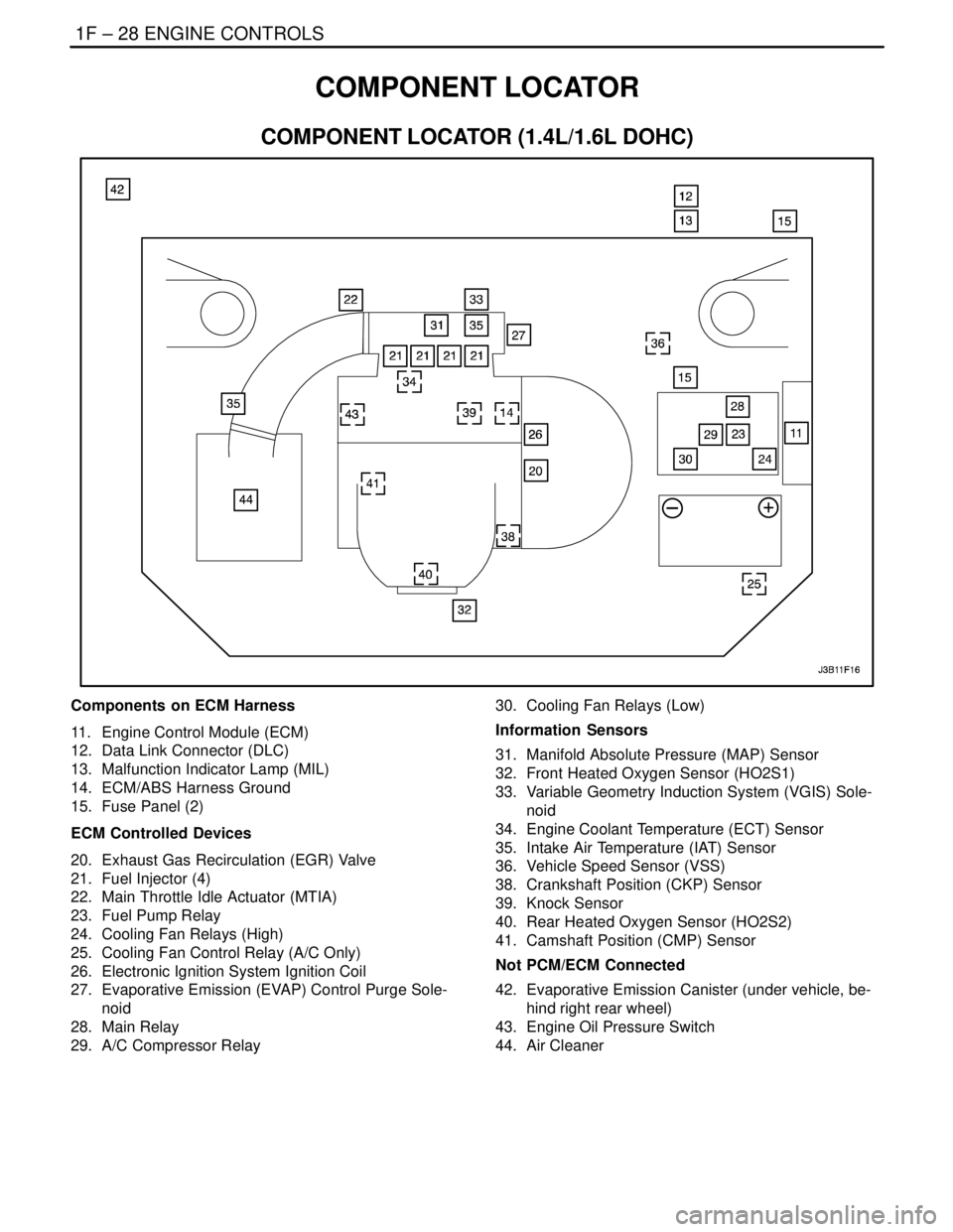
COMPONENT LOCATOR
COMPONENT LOCATOR (1.4L/1.6L DOHC)
Components on ECM Harness
11. Engine Control Module (ECM)
12. Data Link Connector (DLC)
13. Malfunction Indicator Lamp (MIL)
14. ECM/ABS Harness Ground
15. Fuse Panel (2)
ECM Controlled Devices
20. Exhaust Gas Recirculation (EGR) Valve
21. Fuel Injector (4)
22. Main Throttle Idle Actuator (MTIA)
23. Fuel Pump Relay
24. Cooling Fan Relays (High)
25. Cooling Fan Control Relay (A/C Only)
26. Electronic Ignition System Ignition Coil
27. Evaporative Emission (EVAP) Control Purge Sole-
noid
28. Main Relay
29. A/C Compressor Relay30. Cooling Fan Relays (Low)
Information Sensors
31. Manifold Absolute Pressure (MAP) Sensor
32. Front Heated Oxygen Sensor (HO2S1)
33. Variable Geometry Induction System (VGIS) Sole-
noid
34. Engine Coolant Temperature (ECT) Sensor
35. Intake Air Temperature (IAT) Sensor
36. Vehicle Speed Sensor (VSS)
38. Crankshaft Position (CKP) Sensor
39. Knock Sensor
40. Rear Heated Oxygen Sensor (HO2S2)
41. Camshaft Position (CMP) Sensor
Not PCM/ECM Connected
42. Evaporative Emission Canister (under vehicle, be-
hind right rear wheel)
43. Engine Oil Pressure Switch
44. Air Cleaner