Lamp DAEWOO LACETTI 2004 Service Owner's Manual
[x] Cancel search | Manufacturer: DAEWOO, Model Year: 2004, Model line: LACETTI, Model: DAEWOO LACETTI 2004Pages: 2643, PDF Size: 80.54 MB
Page 230 of 2643
1E – 16IENGINE ELECTRICAL
DAEWOO V–121 BL4
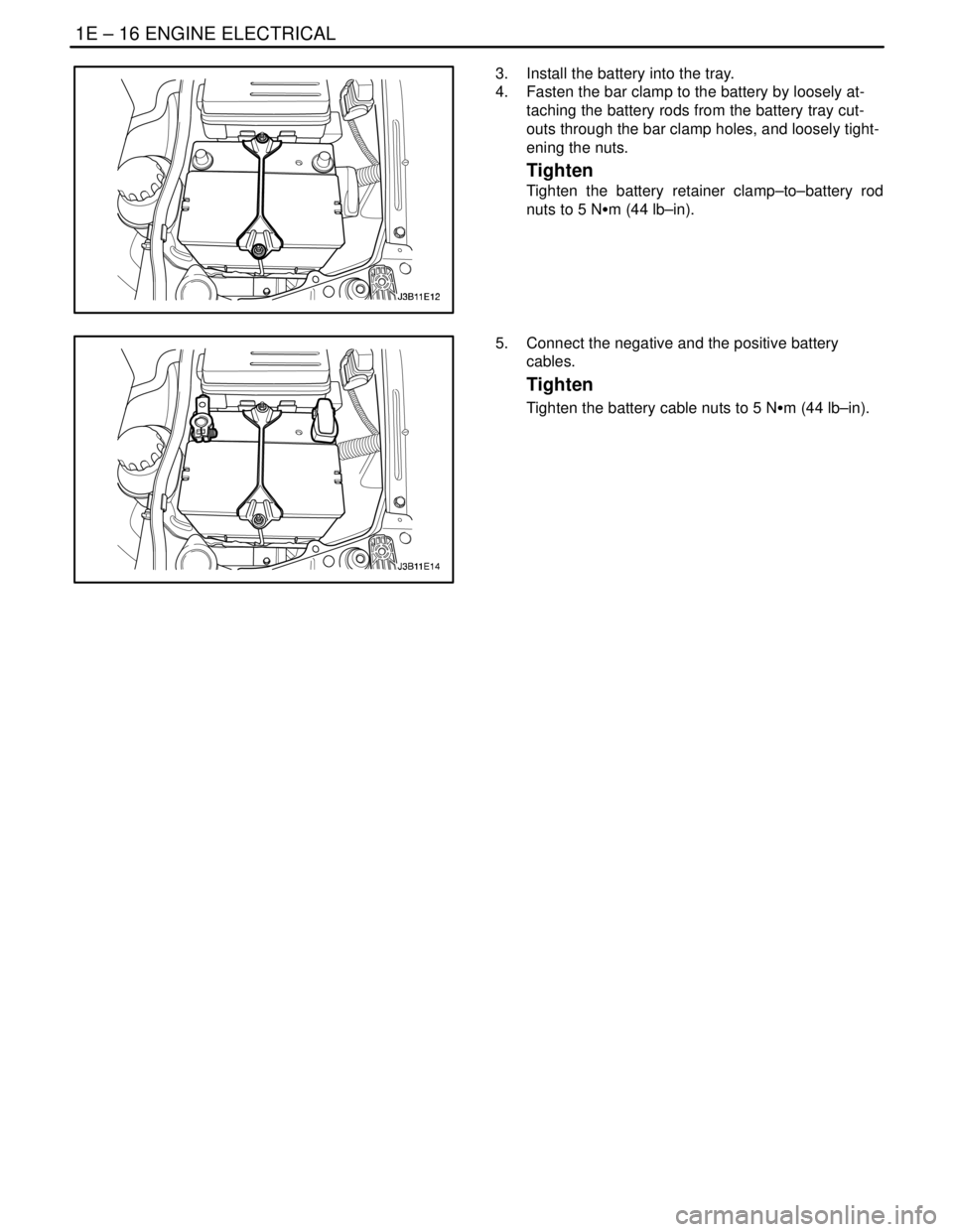
3. Install the battery into the tray.
4. Fasten the bar clamp to the battery by loosely at-
taching the battery rods from the battery tray cut-
outs through the bar clamp holes, and loosely tight-
ening the nuts.
Tighten
Tighten the battery retainer clamp–to–battery rod
nuts to 5 NSm (44 lb–in).
5. Connect the negative and the positive battery
cables.
Tighten
Tighten the battery cable nuts to 5 NSm (44 lb–in).
Page 244 of 2643

1E – 30IENGINE ELECTRICAL
DAEWOO V–121 BL4
GENERAL DESCRIPTION
AND SYSTEM OPERATION
BATTERY
The sealed battery is standard on all cars. There are no
vent plugs in the cover. The battery is completely sealed,
except for two small vent holes in the sides. These vent
holes allow the small amount of gas produced in the bat-
tery to escape. The battery has the following advantages
over conventional batteries:
S No water addition for the life of the battery.
S Overcharge protection. If too much voltage is ap-
plied to the battery, it will not accept as much cur-
rent as a conventional battery. In a conventional
battery, the excess voltage will still try to charge the
battery, leading to gassing, which causes liquid
loss.
S Not as liable to self–discharge as compared to a
conventional battery. This is particularly important
when a battery is left standing for long periods of
time.
S More power available in a lighter and smaller case.
The battery has three major functions in the electrical sys-
tem. First, the battery provides a source of energy for
cranking the engine. Second, the battery acts as a voltage
stabilizer for the electrical system. Finally, the battery can,
for a limited time, provide energy when the electrical de-
mand exceeds the output of the generator.
RATINGS
A battery has two ratings: (1) a reserve capacity rating
designated at 27°C (80°F), which is the time a fully
charged battery will provide 25 amperes current flow at or
above 10.5 volts; (2) a cold cranking amp rating deter-
mined under testing at –18°C (0°F), which indicates the
cranking load capacity.
RESERVE CAPACITY
The reserve capacity is the maximum length of time it is
possible to travel at night with the minimum electrical load
and no generator output. Expressed in minutes, Reserve
Capacity (or RC rating) is the time required for a fully
charged battery, at a temperature of 27°C (80°F) and be-
ing discharged at a current of 25 amperes, to reach a ter-
minal voltage of 10.5 volts.
COLD CRANKING AMPERAGE
The cold cranking amperage test is expressed at a battery
temperature of –18°C (0°F). The current rating is the mini-
mum amperage, which must be maintained by the battery
for 30 seconds at the specified temperature, while meeting
a minimum voltage requirement of 7.2 volts. This rating is
a measure of cold cranking capacity.The battery is not designed to last indefinitely. However,
with proper care, the battery will provide many years of
service.
If the battery tests well, but fails to perform satisfactorily
in service for no apparent reason, the following factors
may point to the cause of the trouble:
S Vehicle accessories are left on overnight.
S Slow average driving speeds are used for short pe-
riods.
S The vehicle’s electrical load is more than the gener-
ator output, particularly with the addition of after-
market equipment.
S Defects in the charging system, such as electrical
shorts, a slipping generator belt, a faulty generator,
or a faulty voltage regulator.
S Battery abuse, including failure to keep the battery
cable terminals clean and tight, or a loose battery
hold–down clamp.
S Mechanical problems in the electrical system, such
as shorted or pinched wires.
BUILT – IN HYDROMETER
The sealed battery has a built–in, temperature–compen-
sated hydrometer in the top of the battery. This hydrome-
ter is to be used with the following diagnostic procedure:
1. When observing the hydrometer, make sure that
the battery has a clean top.
2. Under normal operation, two indications can be ob-
served:
S GREEN DOT VISIBLE – Any green appearance
is interpreted as a ”green dot,” meaning the bat-
tery is ready for testing.
S DARK GREEN DOT IS NOT VISIBLE – If there
is a cranking complaint, the battery should be
tested. The charging and electrical systems
should also be checked at this time.
3. Occasionally, a third condition may appear:
S CLEAR OR BRIGHT YELLOW – This means
the fluid level is below the bottom of the hydrom-
eter. This may have been caused by excessive
or prolonged charging, a broken case, excessive
tipping, or normal battery wear. Finding a battery
in this condition may indicate high charging by a
faulty charging system. Therefore, the charging
and the electrical systems may need to be
checked if a cranking complaint exists. If the
cranking complaint is caused by the battery, re-
place the battery.
CHARGING PROCEDURE
1. Batteries with the green dot showing do not require
charging unless they have just been discharged
(such as in cranking a vehicle).
2. When charging sealed–terminal batteries out of the
vehicle, install the adapter kit. Make sure all the
charger connections are clean and tight. For best
results, batteries should be charged while the elec-
Page 245 of 2643

ENGINE ELECTRICAL 1E – 31
DAEWOO V–121 BL4
trolyte and the plates are at room temperature. A
battery that is extremely cold may not accept cur-
rent for several hours after starting the charger.
3. Charge the battery until the green dot appears. The
battery should be checked every half–hour while
charging. Tipping or shaking the battery may be
necessary to make the green dot appear.
4. After charging, the battery should be load tested.
Refer to ”Starter Motor” in this section.
CHARGING TIME REQUIRED
The time required to charge a battery will vary depending
upon the following factors:
S Size of Battery – A completely discharged large
heavy–duty battery requires more than twice the re-
charging time as a completely discharged small pas-
senger car battery.
S Temperature – A longer time will be needed to
charge any battery at –18°C (0°F) than at 27°C
(80°F). When a fast charger is connected to a cold
battery, the current accepted by the battery will be
very low at first. The battery will accept a higher cur-
rent rate as the battery warms.
S Charger Capacity – A charger which can supply only
5 amperes will require a much longer charging period
than a charger that can supply 30 amperes or more.
S State–of–Charge – A completely discharged battery
requires more than twice as much charge as a one–
half charged battery. Because the electrolyte is nearly
pure water and a poor conductor in a completely dis-
charged battery, the current accepted by the battery
is very low at first. Later, as the charging current
causes the electrolyte acid content to increase, the
charging current will likewise increase.
CHARGING A COMPLETELY
DISCHARGED BATTERY (OFF THE
VEHICLE)
Unless this procedure is properly followed, a perfectly
good battery may need to be replaced.
The following procedure should be used to recharge a
completely discharged battery:
1. Measure the voltage at the battery terminals with
an accurate voltmeter. If the reading is below 10
volts, the charge current will be very low, and it
could take some time before the battery accepts
the current in excess of a few milliamperes. Refer
to ””Charging Time Required” in this section, which
focuses on the factors affecting both the charging
time required and the rough estimates in the table
below. Such low current may not be detectable on
ammeters available in the field.
2. Set the battery charger on the high setting.Important : Some chargers feature polarity protection cir-
cuitry, which prevents charging unless the charger leads
are correctly connected to the battery terminals. A com-
pletely discharged battery may not have enough voltage
to activate this circuitry, even though the leads are con-
nected properly, making it appear that the battery will not
accept charging current. Therefore, follow the specific
charger manufacturer’s instruction for bypassing or over-
riding the circuitry so that the charger will turn on and
charge a low–voltage battery.
3. Continue to charge the battery until the charge cur-
rent is measurable. Battery chargers vary in the
amount of voltage and current provided. The time
required for the battery to accept a measurable
charge current at various voltages may be as fol-
lows:
Voltage
Hours
16.0 or moreUp to 4 hours
14.0–15.9Up to 8 hours
13.9 or lessUp to 16 hours
S If the charge current is not measurable at the
end of the above charging times, the battery
should be replaced.
S If the charge current is measurable during the
charging time, the battery is good, and charging
should be completed in the normal manner.
Important : It is important to remember that a completely
discharged battery must be recharged for a sufficient num-
ber of ampere hours (AH) to restore the battery to a usable
state. As a general rule, using the reserve capacity rating
(RC) as the number of ampere hours of charge usually
brings the green dot into view.
S If the charge current is still not measurable after
using the charging time calculated by the above
method, the battery should be replaced.
JUMP STARTING PROCEDURE
1. Position the vehicle with the good (charged) battery
so that the jumper cables will reach.
2. Turn off the ignition, all the lights, and all the electri-
cal loads in both vehicles. Leave the hazard flasher
on if jump starting where there may be other traffic
and any other lights needed for the work area.
3. In both vehicles, apply the parking brake firmly.
Notice : To avoid vehicle damage,Make sure the cables
are not on or near pulleys, fans, or other parts that will
move when the engine starts.
4. Shift an automatic transaxle to PARK, or a manual
transaxle to NEUTRAL.
CAUTION : In order to avoid injury, do not use cables
that have loose or missing insulation.
5. Clamp one end of the first jumper cable to the posi-
tive terminal on the battery. Make sure it does not
touch any other metal parts. Clamp the other end of
Page 246 of 2643

1E – 32IENGINE ELECTRICAL
DAEWOO V–121 BL4
the same cable to the positive terminal on the other
battery. Never connect the other end to the nega-
tive terminal of the discharged battery.
CAUTION : To avoid injury do not attach the cable di-
rectly to the negative terminal of the discharged bat-
tery. Doing so could cause sparks and a possible bat-
tery explosion.
6. Clamp one end of the second cable to the negative
terminal of the booster battery. Make the final con-
nection to a solid engine ground (such as the en-
gine lift bracket) at least 450 millimeters (18 inches)
from the discharged battery.
7. Start the engine of the vehicle with the good bat-
tery. Run the engine at a moderate speed for sever-
al minutes. Then start the engine of the vehicle
which has the discharged battery.
8. Remove the jumper cables by reversing the above
sequence exactly. Remove the negative cable from
the vehicle with the discharged battery first. While
removing each clamp, take care that it does not
touch any other metal while the other end remains
attached.
GENERATOR
The Delco–Remy CS charging system has several mod-
els available, including the CS. The number denotes the
outer diameter in millimeters of the stator lamination.
CS generators are equipped with internal regulators. A
Delta stator, a rectifier bridge, and a rotor with slip rings
and brushes are electrically similar to earlier generators.
A conventional pulley and fan are used. There is no test
hole.
Unlike three–wire generators, the CS may be used with
only two connections: battery positive and an ”L’’ terminal
to the charge indicator lamp.
As with other charging systems, the charge indicator lamp
lights when the ignition switch is turned to RUN, and goes
out when the engine is running. If the charge indicator is
on with the engine running, a charging system defect is in-
dicated. This indicator light will glow at full brilliance for
several kinds of defects as well as when the system volt-
age is too high or too low.The regulator voltage setting varies with temperature and
limits the system voltage by controlling rotor field current.
At high speeds, the on–time may be 10 percent and the
off–time 90 percent. At low speeds, with high electrical
loads, on–time may be 90 percent and the off–time 10 per-
cent.
CHARGING SYSTEM
CS generators use a new type of regulator that incorpo-
rates a diode trio. A Delta stator, a rectifier bridge, and a
rotor with slip rings and brushes are electrically similar to
earlier generators. A conventional pulley and fan are used.
There is no test hole.
STARTER
Wound field starter motors have pole pieces, arranged
around the armature, which are energized by wound field
coils.
Enclosed shift lever cranking motors have the shift lever
mechanism and the solenoid plunger enclosed in the drive
housing, protecting them from exposure to dirt, icy condi-
tions, and splashes.
In the basic circuit, solenoid windings are energized when
the switch is closed. The resulting plunger and shift lever
movement causes the pinion to engage the engine fly-
wheel ring gear. The solenoid main contacts close. Crank-
ing then takes place.
When the engine starts, pinion overrun protects the arma-
ture from excessive speed until the switch is opened, at
which time the return spring causes the pinion to disen-
gage. To prevent excessive overrun, the switch should be
released immediately after the engine starts.
STARTING SYSTEM
The engine electrical system includes the battery, the igni-
tion, the starter, the generator, and all the related wiring.
Diagnostic tables will aid in troubleshooting system faults.
When a fault is traced to a particular component, refer to
that component section of the service manual.
The starting system circuit consists of the battery, the
starter motor, the ignition switch, and all the related electri-
cal wiring. All of these components are connected electri-
cally.
Page 247 of 2643

SECTION : 1F
ENGINE CONTROLS
CAUTION : Disconnect the negative battery cable before removing or installing any electrical unit o r w hen a
tool or equipment could easily come in contact with exposed electrical terminals. Disconnecting this cable will
help prevent personal injury and damage to the vehicle. The ignition must also be in LOCK unless otherwise
noted.
TABLE OF CONTENTS
SPECIFICATIONS1F–6 . . . . . . . . . . . . . . . . . . . . . . . . . .
Engine Data Display Tables 1F–6. . . . . . . . . . . . . . . . .
Engine Data Display Table Definitions 1F–7. . . . . . . .
Fastener Tightening Specifications 1F–10. . . . . . . . .
Fuel System Specifications 1F–11. . . . . . . . . . . . . . . . .
Temperature Vs Resistance 1F–11. . . . . . . . . . . . . . . .
SCHEMATIC AND ROUTING DIAGRAMS1F–12 . . . .
ECM Wiring Diagram
(1.4L/1.6L DOHC – 1 OF 6) 1F–12. . . . . . . . . . . . . .
ECM Wiring Diagram
(1.4L/1.6L DOHC – 2 OF 6) 1F–13. . . . . . . . . . . . . .
ECM Wiring Diagram
(1.4L/1.6L DOHC – 3 OF 6) 1F–14. . . . . . . . . . . . . .
ECM Wiring Diagram
(1.4L/1.6L DOHC – 4 OF 6) 1F–15. . . . . . . . . . . . . .
ECM Wiring Diagram
(1.4L/1.6L DOHC – 5 OF 6) 1F–16. . . . . . . . . . . . . .
ECM Wiring Diagram
(1.4L/1.6L DOHC – 6 OF 6) 1F–17. . . . . . . . . . . . . .
ECM Wiring Diagram (1.8L DOHC – 1 OF 6) 1F–18.
ECM Wiring Diagram (1.8L DOHC – 2 OF 6) 1F–19.
ECM Wiring Diagram (1.8L DOHC – 3 OF 6) 1F–20.
ECM Wiring Diagram (1.8L DOHC – 4 OF 6) 1F–21.
ECM Wiring Diagram (1.8L DOHC – 5 OF 6) 1F–22.
ECM Wiring Diagram (1.8L DOHC – 6 OF 6) 1F–23.
Connector End View 1F–24. . . . . . . . . . . . . . . . . . . . . .
COMPONENT LOCATOR1F–28 . . . . . . . . . . . . . . . . . . .
Component Locator (1.4L/1.6L DOHC) 1F–28. . . . . .
Component Locator (1.8L DOHC) 1F–29. . . . . . . . . . .
DIAGNOSIS1F–30 . . . . . . . . . . . . . . . . . . . . . . . . . . . . . . .
SYSTEM DIAGNOSIS 1F–30. . . . . . . . . . . . . . . . . . . . . .
Diagnostic Aids 1F–30. . . . . . . . . . . . . . . . . . . . . . . . . . .
Idle Learn Procedure 1F–30. . . . . . . . . . . . . . . . . . . . . .
TEC (Tooth Error Correction) Learn Procedure 1F–31ON–Board Diagnostic (EOBD) System Check
(1.4L/1.6L DOHC) 1F–32. . . . . . . . . . . . . . . . . . . . . . .
ON–Board Diagnostic (EOBD) System Check
(1.8L DOHC) 1F–34. . . . . . . . . . . . . . . . . . . . . . . . . . .
Multiple ECM Informationn Sensor Dtcs Set 1F–36. .
Engine Cranks But Will Not Run
(1.4L/1.6L DOHC) 1F–40. . . . . . . . . . . . . . . . . . . . . . .
Engine Cranks But Will Not Run (1.8L DOHC) 1F–47
No Malfunction Indicator Lamp (
1.4L/1.6L DOHC) 1F–54. . . . . . . . . . . . . . . . . . . . . . .
No Malfunction Indicator Lamp (1.8L DOHC) 1F–56.
Malfunction Indicator Lamp On Steady (1.4L/1.6L
DOHC) 1F–58. . . . . . . . . . . . . . . . . . . . . . . . . . . . . . . .
Malfunction Indicator Lamp On Steady
(1.8L DOHC) 1F–60. . . . . . . . . . . . . . . . . . . . . . . . . . .
Fuel System Diagnosis 1F–62. . . . . . . . . . . . . . . . . . . .
Fuel Pump Relay Circuit Check
(1.4L/1.6L DOHC) 1F–65. . . . . . . . . . . . . . . . . . . . . . .
Fuel Pump Relay Circuit Check (1.8L DOHC) 1F–68.
Main Relay Circuit Check (1.4L/1.6L DOHC) 1F–71.
Main Relay Circuit Check (1.8L DOHC) 1F–73. . . . . .
Manifold Absolute Pressure Check
(1.4L/1.6L DOHC) 1F–75. . . . . . . . . . . . . . . . . . . . . . .
Manifold Absolute Pressure Check
(1.8L DOHC) 1F–77. . . . . . . . . . . . . . . . . . . . . . . . . . .
Idle Air Control System Check
(1.4L/1.6L DOHC) 1F–79. . . . . . . . . . . . . . . . . . . . . . .
Idle Air Control System Check (1.8L DOHC) 1F–82. .
Ignition System Check (1.4L/1.6L DOHC) 1F–85. . . .
Ignition System Check (1.8L DOHC) 1F–88. . . . . . . .
Engine Cooling Fan Circuit Check – Dual Fan
(1.4L/1.6L DOHC) 1F–93. . . . . . . . . . . . . . . . . . . . . . .
Engine Cooling Fan Circuit Check – Dual Fan
(1.8L DOHC) 1F–100. . . . . . . . . . . . . . . . . . . . . . . . . .
Data Link Connector Diagnosis
(1.4L/1.6L DOHC) 1F–106. . . . . . . . . . . . . . . . . . . . . .
Data Link Connector Diagnosis (1.8L DOHC) 1F–108
Fuel Injector Balance Test 1F–110. . . . . . . . . . . . . . . .
Page 249 of 2643

ENGINE CONTROLS 1F – 3
DAEWOO V–121 BL4
DTC P0562 System Voltage(Engine Side) Too
Low 1F–270. . . . . . . . . . . . . . . . . . . . . . . . . . . . . . . . . .
DTC P0563 System Voltage(Engine Side) Too
High 1F–272. . . . . . . . . . . . . . . . . . . . . . . . . . . . . . . . . .
DTC P0601 Engine Control Module Checksum
Error 1F–274. . . . . . . . . . . . . . . . . . . . . . . . . . . . . . . . .
DTC P0604 Engine Control Module Internal/External
RAM Error 1F–275. . . . . . . . . . . . . . . . . . . . . . . . . . . .
DTC P0605 Engine Control Module INMVY Write
Error 1F–276. . . . . . . . . . . . . . . . . . . . . . . . . . . . . . . . .
DTC P0656 Fuel Level Gauge Circuit Fault 1F–277. .
DTC P1181 Variable Intake Manifold Solenoid
Low Voltage 1F–279. . . . . . . . . . . . . . . . . . . . . . . . . . .
DTC P1182 Variable Intake Manifold Solenoid
High Voltage 1F–281. . . . . . . . . . . . . . . . . . . . . . . . . .
DTC P1230 Fuel Pump Relay Low Voltage
(1.4L DOHC) 1F–283. . . . . . . . . . . . . . . . . . . . . . . . . .
DTC P1230 Fuel Pump Relay Low Voltage
(1.6L DOHC) 1F–286. . . . . . . . . . . . . . . . . . . . . . . . . .
DTC P1231 Fuel Pump Relay High Voltage
(1.4L DOHC) 1F–289. . . . . . . . . . . . . . . . . . . . . . . . . .
DTC P1231 Fuel Pump Relay High Voltage
(1.6L DOHC) 1F–292. . . . . . . . . . . . . . . . . . . . . . . . . .
DTC P1320 Crankshaft Segment Period
Segment Adaptation At Limit 1F–295. . . . . . . . . . . .
DTC P1321 Crankshaft Segment Period Tooth
Error 1F–297. . . . . . . . . . . . . . . . . . . . . . . . . . . . . . . . .
DTC P1382 Rough Road Data Invalid
(NON ABS) 1F–299. . . . . . . . . . . . . . . . . . . . . . . . . . .
DTC P1382 Rough Road Data Invalid (ABS) 1F–302
DTC P1385 Rough Road Sensor Circuit Fault
(NON ABS) 1F–305. . . . . . . . . . . . . . . . . . . . . . . . . . .
DTC P1402 Exhaust Gas Recirculation
Blocked 1F–308. . . . . . . . . . . . . . . . . . . . . . . . . . . . . . .
DTC P1403 Exhaust Gas Recirculation Valve
Failure 1F–310. . . . . . . . . . . . . . . . . . . . . . . . . . . . . . . .
DTC P1404 Exhaust Gas Recirculation Closed1F–313
DTC P1511 Idle Charge Actuator Circuit Fault 1F–316
DTC P1512 Idle Charge Actuator Mechanical
Error 1F–319. . . . . . . . . . . . . . . . . . . . . . . . . . . . . . . . .
DTC P1513 Idle Charge Actuator Functional
Error 1F–321. . . . . . . . . . . . . . . . . . . . . . . . . . . . . . . . .
DTC P1537 A/C Compressor Relay High
Voltage 1F–324. . . . . . . . . . . . . . . . . . . . . . . . . . . . . . .
DTC P1538 A/C Compressor Relay Low
Voltage 1F–326. . . . . . . . . . . . . . . . . . . . . . . . . . . . . . .
DTC P1610 Main Relay High Voltage
(1.4L DOCH) 1F–328. . . . . . . . . . . . . . . . . . . . . . . . . .
DTC P1610 Main Relay High Voltage
(1.6L DOHC) 1F–330. . . . . . . . . . . . . . . . . . . . . . . . . .
DTC P1611 Main Relay Low Voltage
(1.4L DOHC) 1F–332. . . . . . . . . . . . . . . . . . . . . . . . . . DTC P1611 Main Relay Low Voltage
(1.6L DOHC) 1F–334. . . . . . . . . . . . . . . . . . . . . . . . . .
DTC P1628 Immobilizer No Successful
Communication 1F–336. . . . . . . . . . . . . . . . . . . . . . . .
DTC P1629 Immobilizer Wrong Computation 1F–338
DTC P1660 Malfunction Indicator Lamp (MIL)
High Voltage 1F–340. . . . . . . . . . . . . . . . . . . . . . . . . .
DTC P1661 Malfunction Indicator Lamp (MIL)
Low Voltage 1F–342. . . . . . . . . . . . . . . . . . . . . . . . . . .
TROUBLE CODE DIAGNOSIS (1.8L DOHC) 1F–344.
Clearing Trouble Codes 1F–344. . . . . . . . . . . . . . . . . . .
Diagnostic Trouble Codes (1.8L DOHC) 1F–344. . . .
DTC P0106 Manifold Absolute Pressure
Rationality 1F–347. . . . . . . . . . . . . . . . . . . . . . . . . . . .
DTC P0107 Manifold Absolut Pressure Low
Voltage 1F–349. . . . . . . . . . . . . . . . . . . . . . . . . . . . . . .
DTC P0108 Manifold Absolut Pressure High
Voltage 1F–352. . . . . . . . . . . . . . . . . . . . . . . . . . . . . . .
DTC P0112 Intake Air Temperature Low
Voltage 1F–355. . . . . . . . . . . . . . . . . . . . . . . . . . . . . . .
DTC P0113 Intake Air Temperature High
Voltage 1F–358. . . . . . . . . . . . . . . . . . . . . . . . . . . . . . .
DTC P0117 Engine Coolant Temperature Low
Voltage 1F–361. . . . . . . . . . . . . . . . . . . . . . . . . . . . . . .
DTC P0118 Engine Coolant Temperature High
Voltage 1F–363. . . . . . . . . . . . . . . . . . . . . . . . . . . . . . .
DTC P0122 Throttle Position Sensor Low
Voltage 1F–366. . . . . . . . . . . . . . . . . . . . . . . . . . . . . . .
DTC P0123 Throttle Position Sensor High
Voltage 1F–369. . . . . . . . . . . . . . . . . . . . . . . . . . . . . . .
DTC P0131 Front Heated Oxygen Sensor
(HO2S1) Low Voltage 1F–372. . . . . . . . . . . . . . . . . .
DTC P0132 Front Heated Oxygen Sensor
(HO2S1) High Voltage 1F–375. . . . . . . . . . . . . . . . . .
DTC P0133 Front Heated Oxygen Sensor
(HO2S1) Slow Response 1F–378. . . . . . . . . . . . . . .
DTC P0134 Front Heated Oxygen Sensor
(HO2S1) No Activity or Open 1F–382. . . . . . . . . . . .
DTC P0135 Front Heated Oxygen Sensor
(HO2S1) Heater Circuit Not Functioning 1F–385. . .
DTC P0137 Rear Heated Oxygen Sensor
(HO2S2) Low Voltage 1F–388. . . . . . . . . . . . . . . . . .
DTC P0138 Rear Heated Oxygen Sensor
(HO2S2) High Voltage 1F–391. . . . . . . . . . . . . . . . . .
DTC P0140 Rear Heated Oxygen Sensor
(HO2S2) No Activity or Open 1F–394. . . . . . . . . . . .
DTC P0141 Rear Heated Oxygen Sensor
(HO2S2) Heater Circuit Not Functioning 1F–397. . .
DTC P0171 Fuel Trim System Too Lean 1F–400. . . .
DTC P0172 Fuel Trim System Too Rich 1F–404. . . . .
DTC P0201 Injector 1 Circuit Fault 1F–408. . . . . . . . .
DTC P0202 Injector 2 Circuit Fault 1F–411. . . . . . . . .
Page 274 of 2643
1F – 28IENGINE CONTROLS
DAEWOO V–121 BL4
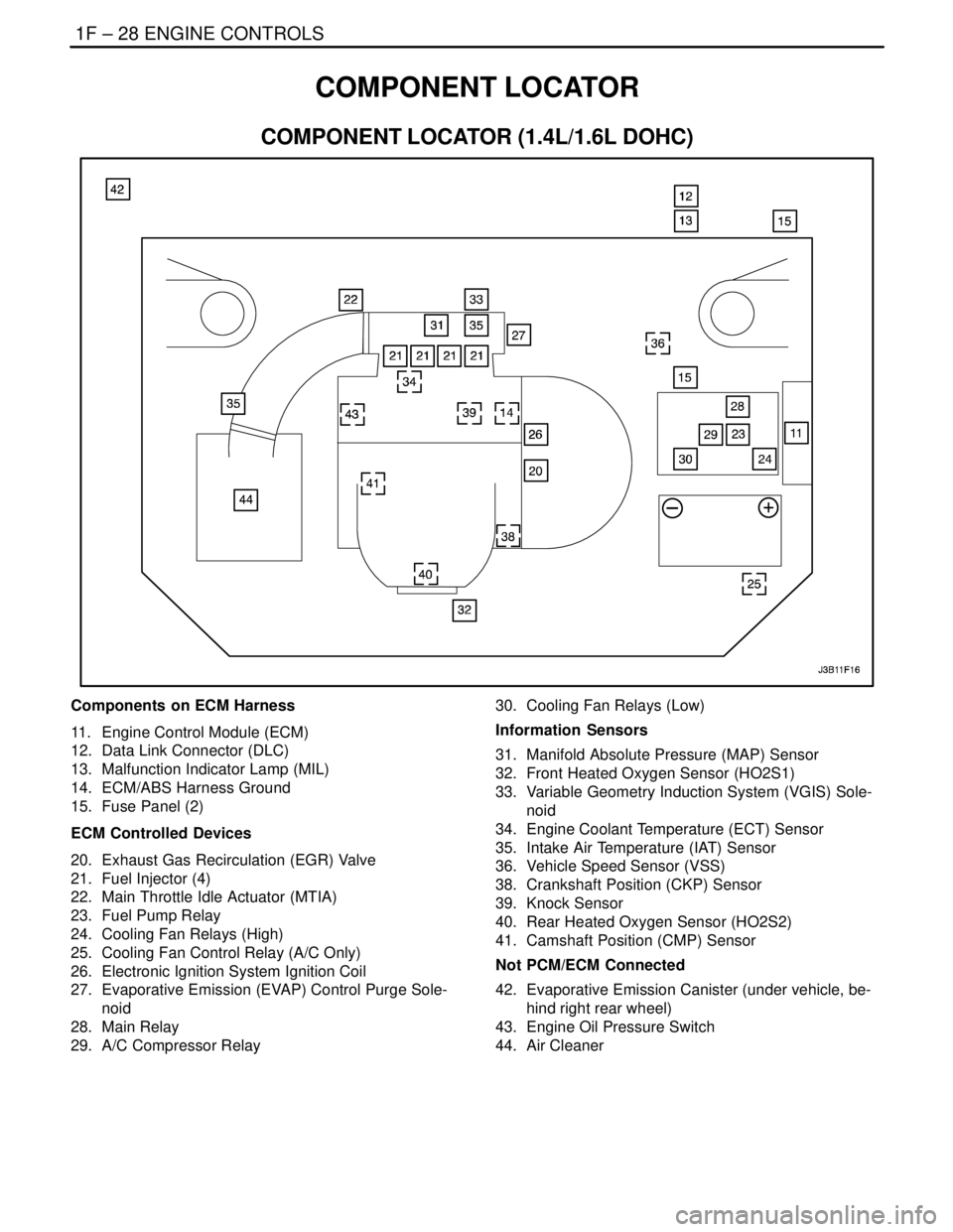
COMPONENT LOCATOR
COMPONENT LOCATOR (1.4L/1.6L DOHC)
Components on ECM Harness
11. Engine Control Module (ECM)
12. Data Link Connector (DLC)
13. Malfunction Indicator Lamp (MIL)
14. ECM/ABS Harness Ground
15. Fuse Panel (2)
ECM Controlled Devices
20. Exhaust Gas Recirculation (EGR) Valve
21. Fuel Injector (4)
22. Main Throttle Idle Actuator (MTIA)
23. Fuel Pump Relay
24. Cooling Fan Relays (High)
25. Cooling Fan Control Relay (A/C Only)
26. Electronic Ignition System Ignition Coil
27. Evaporative Emission (EVAP) Control Purge Sole-
noid
28. Main Relay
29. A/C Compressor Relay30. Cooling Fan Relays (Low)
Information Sensors
31. Manifold Absolute Pressure (MAP) Sensor
32. Front Heated Oxygen Sensor (HO2S1)
33. Variable Geometry Induction System (VGIS) Sole-
noid
34. Engine Coolant Temperature (ECT) Sensor
35. Intake Air Temperature (IAT) Sensor
36. Vehicle Speed Sensor (VSS)
38. Crankshaft Position (CKP) Sensor
39. Knock Sensor
40. Rear Heated Oxygen Sensor (HO2S2)
41. Camshaft Position (CMP) Sensor
Not PCM/ECM Connected
42. Evaporative Emission Canister (under vehicle, be-
hind right rear wheel)
43. Engine Oil Pressure Switch
44. Air Cleaner
Page 275 of 2643
ENGINE CONTROLS 1F – 29
DAEWOO V–121 BL4
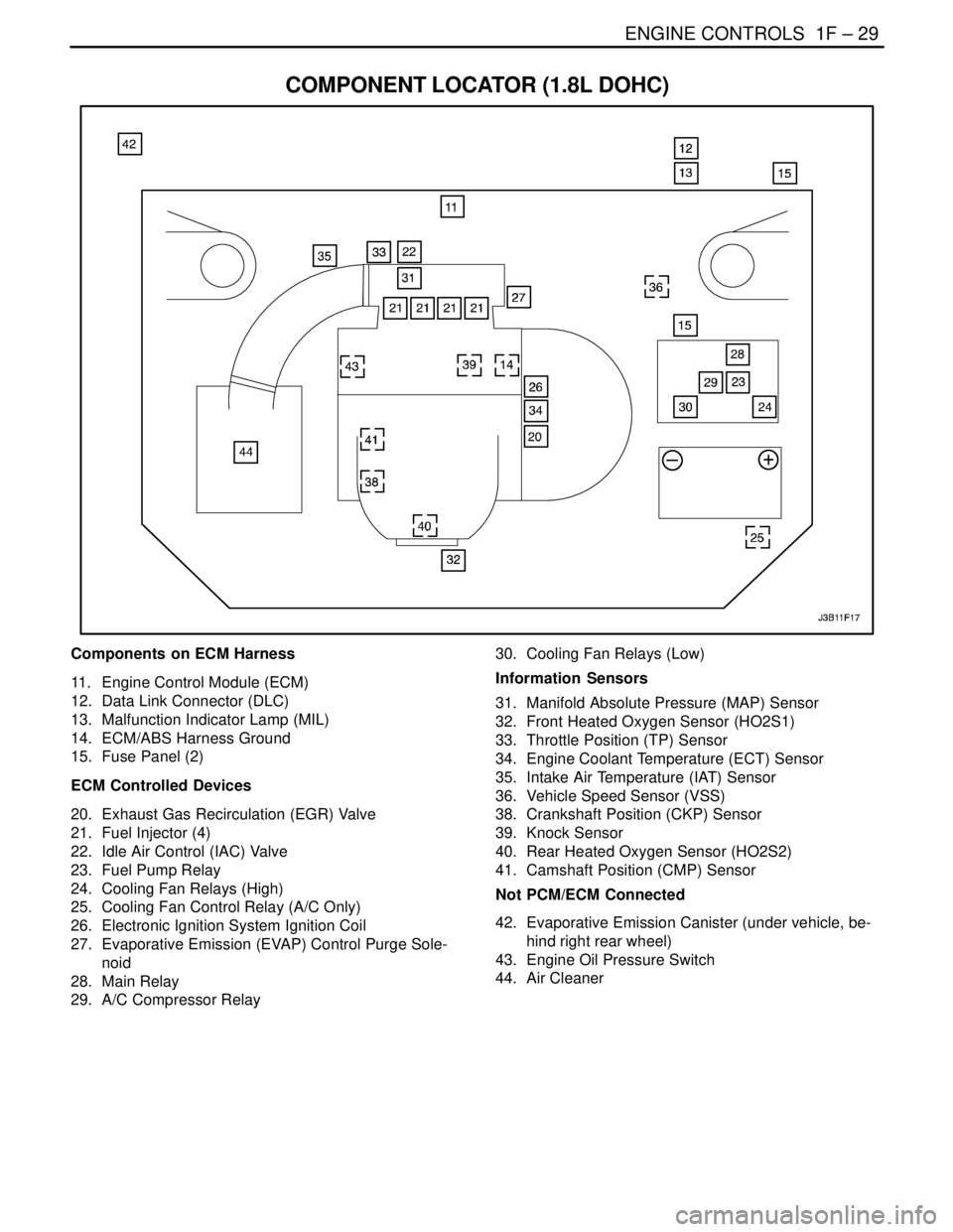
COMPONENT LOCATOR (1.8L DOHC)
Components on ECM Harness
11. Engine Control Module (ECM)
12. Data Link Connector (DLC)
13. Malfunction Indicator Lamp (MIL)
14. ECM/ABS Harness Ground
15. Fuse Panel (2)
ECM Controlled Devices
20. Exhaust Gas Recirculation (EGR) Valve
21. Fuel Injector (4)
22. Idle Air Control (IAC) Valve
23. Fuel Pump Relay
24. Cooling Fan Relays (High)
25. Cooling Fan Control Relay (A/C Only)
26. Electronic Ignition System Ignition Coil
27. Evaporative Emission (EVAP) Control Purge Sole-
noid
28. Main Relay
29. A/C Compressor Relay30. Cooling Fan Relays (Low)
Information Sensors
31. Manifold Absolute Pressure (MAP) Sensor
32. Front Heated Oxygen Sensor (HO2S1)
33. Throttle Position (TP) Sensor
34. Engine Coolant Temperature (ECT) Sensor
35. Intake Air Temperature (IAT) Sensor
36. Vehicle Speed Sensor (VSS)
38. Crankshaft Position (CKP) Sensor
39. Knock Sensor
40. Rear Heated Oxygen Sensor (HO2S2)
41. Camshaft Position (CMP) Sensor
Not PCM/ECM Connected
42. Evaporative Emission Canister (under vehicle, be-
hind right rear wheel)
43. Engine Oil Pressure Switch
44. Air Cleaner
Page 278 of 2643

1F – 32IENGINE CONTROLS
DAEWOO V–121 BL4
ON–BOARD DIAGNOSTIC (EOBD) SYSTEM CHECK
(1.4L/1.6L DOHC)
Circuit Description
The On–Board Diagnostic (EOBD) system check is the
starting point for any driveability complaint diagnosis. Be-
fore using this procedure, perform a careful visual/physi-
cal check of the engine control module (ECM) and the en-
gine grounds for cleanliness and tightness.
The EOBD system check is an organized approach to
identifying a problem created by an electronic engine con-
trol system malfunction.
Diagnostic Aids
An intermittent may be caused by a poor connection,
rubbed–through wire insulation or a wire broken inside the
insulation. Check for poor connections or a damaged har-
ness. Inspect the ECM harness and connections for im-
proper mating, broken locks, improperly formed or dam-
aged terminals, poor terminal–to–wire connection, and
damaged harness.Test Description
Numbers below refer to the step number on the Diagnostic
Chart:
1. The Malfunction Indicator Lamp (MIL) should be
ON steady with the ignition ON and the engine
OFF. If not, go to ”Diagnostic Aids”.
2. Checks the Class 2 data circuit and ensures that
the ECM is able to transmit serial data.
3. This test ensures that the ECM is capable of con-
trolling the MIL and the MIL driver circuit is not
shorted to ground.
4. If the engine will not start, refer to ”Engine Cranks
But Will Not Run” in this section.
7. A scan tool parameter which is not within the typical
range may help to isolate the area which is causing
the problem.
10. This vehicle is equipped with a ECM which utilizes
an Electrically Erasable Programmable Read Only
Memory (EEPROM). The replacement ECM must
be programmed. Refer to the latest Techline proce-
dure for ECM reprogramming.
Page 279 of 2643

ENGINE CONTROLS 1F – 33
DAEWOO V–121 BL4
On–Board Diagnostic (EOBD) System Check (1.4L/1.6L DOHC)
StepActionValue(s)YesNo
11. Turn the ignition switch to ON.
2. Observe the Malfunction Indicator Lamp (MIL).
Is the MIL illuminate?–Go to Step 2Go to
”No Malfunction
Indicator Lamp”
21. Turn the ignition switch to LOCK.
2. Install the scan tool to the Data link Connector
(DLC).
3. Turn the ignition switch to ON.
4. Attempt to display the Engine Control Module
(ECM) engine data with the scan tool.
Does the scan tool display the ECM engine data?–Go to Step 3Go to Step 8
31. Using the scan tool output test function, select
the MIL lamp control and command the MIL off.
2. Observe the MIL.
Does the MIL turn OFF?–Go to Step 4Go to
”Malfunction In-
dicator Lamp
on Steady”
4Attempt to start the engine.
Does the engine start and continue to run?–Go to Step 5Go to
”Engine Cranks
But Will Not
Run”
5Select DISPLAY DTC with the scan tool.
Are any Diagnostic Trouble Codes (DTCs) stored?–Go to Step 6Go to Step 7
6Check the display for DTCs P0107, P0108, P0113,
P0118, P0122, P0123, P0712, P1392.
Are two or more of the following DTCs stored?–Go to
”Multiple ECM
Information
Sensor DTCs
Set”Go to applica-
ble DTC table
7Compare the ECM data values displayed on the
scan tool to the typical engine scan data values.
Are the displayed values normal or close to the typi-
cal values?–Go to
”ECM Output
Diagnosis”Go to indicated
component
system check
81. Turn the ignition switch to LOCK.
2. Disconnect the ECM connector.
3. Turn the ignition switch to ON.
4. Check the serial data circuit for an open, short
to ground, or short to voltage. Also check the
DLC ignition feed circuit for an open or short to
ground, and check the DLC ground circuits for
an open.
Is a problem found?–Go to Step 9Go to Step 10
9Repair the open, short to ground, or short to voltage
in the serial data circuit or the DLC ignition feed cir-
cuit.
Is the repair complete?–System OK–
101. Attempt to reprogram the ECM.
2. Attempt to display the ECM data with the scan
tool.
Does the scan tool display ECM engine data?–Go to Step 2Go to Step 11
11Replace the ECM.
Is the replacement complete?–System OK–