lock DAEWOO LACETTI 2004 Service Repair Manual
[x] Cancel search | Manufacturer: DAEWOO, Model Year: 2004, Model line: LACETTI, Model: DAEWOO LACETTI 2004Pages: 2643, PDF Size: 80.54 MB
Page 1028 of 2643
4A – 12IHYDRAULIC BRAKES
DAEWOO V–121 BL4
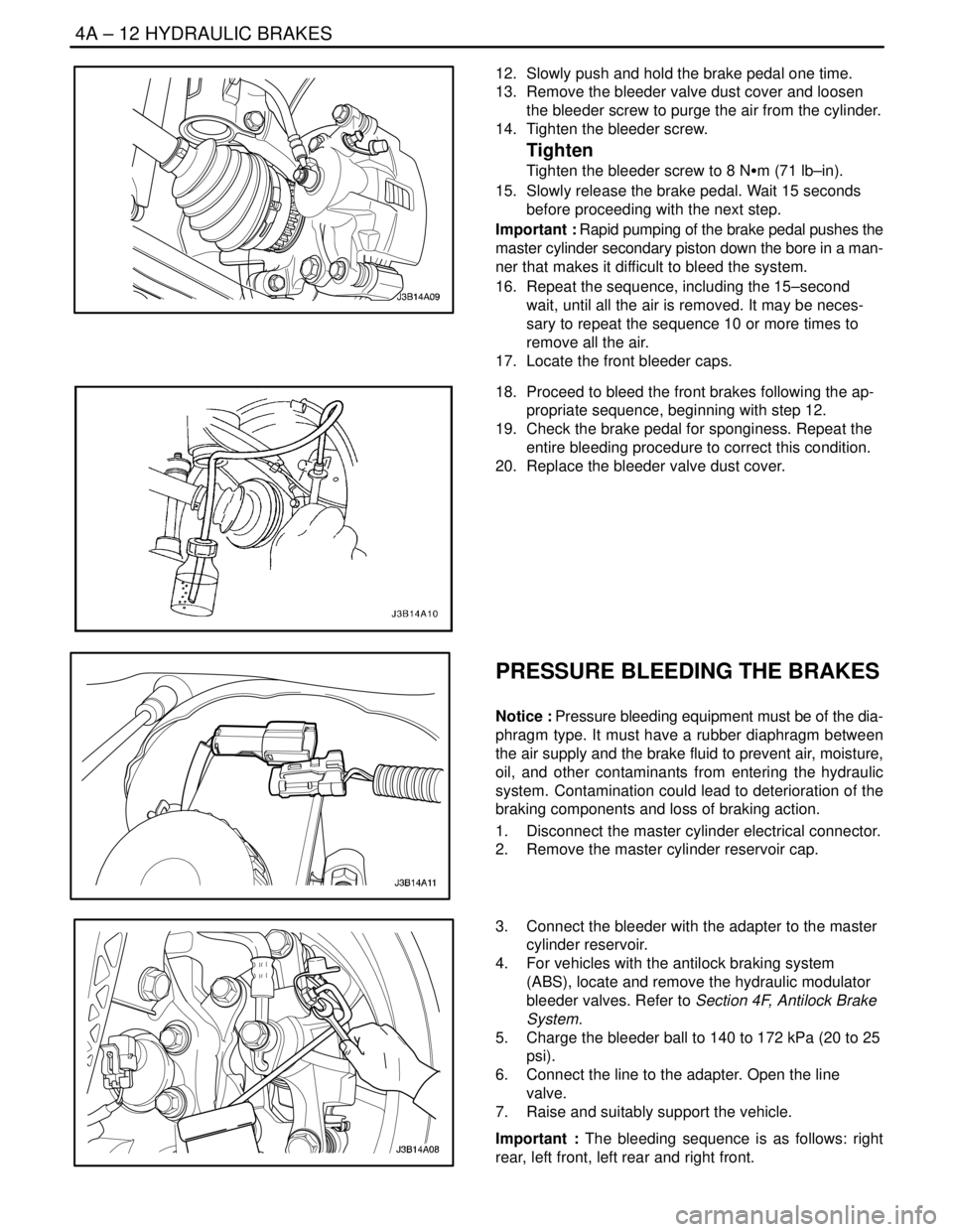
12. Slowly push and hold the brake pedal one time.
13. Remove the bleeder valve dust cover and loosen
the bleeder screw to purge the air from the cylinder.
14. Tighten the bleeder screw.
Tighten
Tighten the bleeder screw to 8 NSm (71 lb–in).
15. Slowly release the brake pedal. Wait 15 seconds
before proceeding with the next step.
Important : Rapid pumping of the brake pedal pushes the
master cylinder secondary piston down the bore in a man-
ner that makes it difficult to bleed the system.
16. Repeat the sequence, including the 15–second
wait, until all the air is removed. It may be neces-
sary to repeat the sequence 10 or more times to
remove all the air.
17. Locate the front bleeder caps.
18. Proceed to bleed the front brakes following the ap-
propriate sequence, beginning with step 12.
19. Check the brake pedal for sponginess. Repeat the
entire bleeding procedure to correct this condition.
20. Replace the bleeder valve dust cover.
PRESSURE BLEEDING THE BRAKES
Notice : Pressure bleeding equipment must be of the dia-
phragm type. It must have a rubber diaphragm between
the air supply and the brake fluid to prevent air, moisture,
oil, and other contaminants from entering the hydraulic
system. Contamination could lead to deterioration of the
braking components and loss of braking action.
1. Disconnect the master cylinder electrical connector.
2. Remove the master cylinder reservoir cap.
3. Connect the bleeder with the adapter to the master
cylinder reservoir.
4. For vehicles with the antilock braking system
(ABS), locate and remove the hydraulic modulator
bleeder valves. Refer to Section 4F, Antilock Brake
System.
5. Charge the bleeder ball to 140 to 172 kPa (20 to 25
psi).
6. Connect the line to the adapter. Open the line
valve.
7. Raise and suitably support the vehicle.
Important : The bleeding sequence is as follows: right
rear, left front, left rear and right front.
Page 1039 of 2643

4B – 6IMASTER CYLINDER
DAEWOO V–121 BL4
4. Add brake fluid.
5. Raise and suitably support the vehicle.
6. Bleed the braking system. Refer to Section 4A, Hy-
draulic Brakes orSection 4F, Antilock Brake Sys-
tem.Bleed the clutch master cylinder. Refer to Sec-
tion 5C, Clutch.
7. Lower the vehicle.
8. Connect the reservoir electrical connector.
Page 1041 of 2643

4B – 8IMASTER CYLINDER
DAEWOO V–121 BL4
6. Press the pistons into the cylinder bore using a
wooden or a plastic drift.
Notice : When installing the new retaining ring, take care
not to damage the cylinder bore.
7. Insert the new retaining ring into the groove in the
cylinder bore (the non–ABS cylinder body is
shown). Remove the welding rod.
8. Move the pistons backward and forward after instal-
lation to check for free movement.
9. Lubricate the seal ring and insert the seal into the
cylinder bore. The open side must face outward
until the seal rests on the piston.
10. Install the brake fluid reservoir to the master cylin-
der. Refer to ”Brake Fluid Reservoir” in this section.
11. Install the master cylinder assembly. Refer to Mas-
ter Cylinder Assembly in this section
12. Raise and suitably support the vehicle.
13. Bleed the braking system. Refer to Section 4A, Hy-
draulic Brakes orSection 4F, Antilock Brake Sys-
tem.
14. Lower the vehicle.
Page 1042 of 2643

MASTER CYLINDER 4B – 9
DAEWOO V–121 BL4
GENERAL DESCRIPTION
AND SYSTEM OPERATION
MASTER CYLINDER
The master cylinder is designed for use in a diagonal–split
system. One front and one diagonally opposite rear brake
are served by the primary piston. The opposite front and
rear brakes are served by the secondary piston. The mas-
ter cylinder incorporates the functions of the standard dual
master cylinder, plus a low fluid level indicator and the pro-
portioning valves in the non–antilock braking system. The
proportioning valves limit the outlet pressure to the rear
brakes after a predetermined master cylinder pressure
has been reached.
Important :
S Replace all the components included in the repair
kits used to service this master cylinder.S Lubricate rubber parts with clean brake fluid to ease
assembly.
S Do not use lubricated shop air on brake parts, as
this may damage rubber components.
S If any hydraulic component is removed or discon-
nected, it may be necessary to bleed all or part of
the brake system.
S The torque values specified are for dry, unlubri-
cated fasteners.
S Perform all service operations on a clean bench,
free from all traces of mineral oil.
FLUID LEVEL SENSOR
The master cylinder is equipped with a fluid level sensor.
This sensor will activate the BRAKE light if a low fluid level
condition is detected. Once the fluid level is corrected, the
BRAKE light will go out.
Page 1062 of 2643
REAR DISC BRAKES 4E1 – 5
DAEWOO V–121 BL4
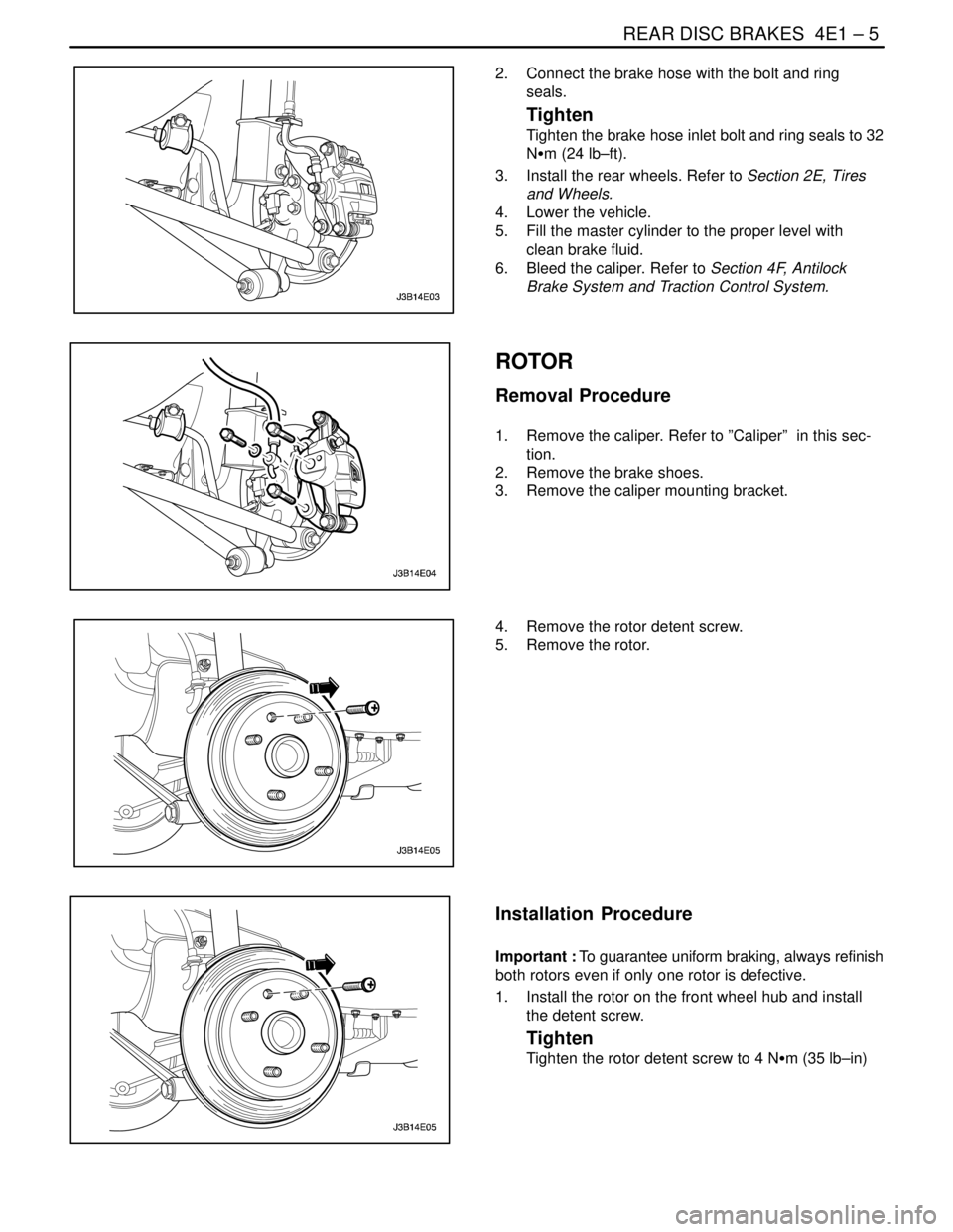
2. Connect the brake hose with the bolt and ring
seals.
Tighten
Tighten the brake hose inlet bolt and ring seals to 32
NSm (24 lb–ft).
3. Install the rear wheels. Refer to Section 2E, Tires
and Wheels.
4. Lower the vehicle.
5. Fill the master cylinder to the proper level with
clean brake fluid.
6. Bleed the caliper. Refer to Section 4F, Antilock
Brake System and Traction Control System.
ROTOR
Removal Procedure
1. Remove the caliper. Refer to ”Caliper” in this sec-
tion.
2. Remove the brake shoes.
3. Remove the caliper mounting bracket.
4. Remove the rotor detent screw.
5. Remove the rotor.
Installation Procedure
Important : To guarantee uniform braking, always refinish
both rotors even if only one rotor is defective.
1. Install the rotor on the front wheel hub and install
the detent screw.
Tighten
Tighten the rotor detent screw to 4 NSm (35 lb–in)
Page 1063 of 2643
4E1 – 6IREAR DISC BRAKES
DAEWOO V–121 BL4
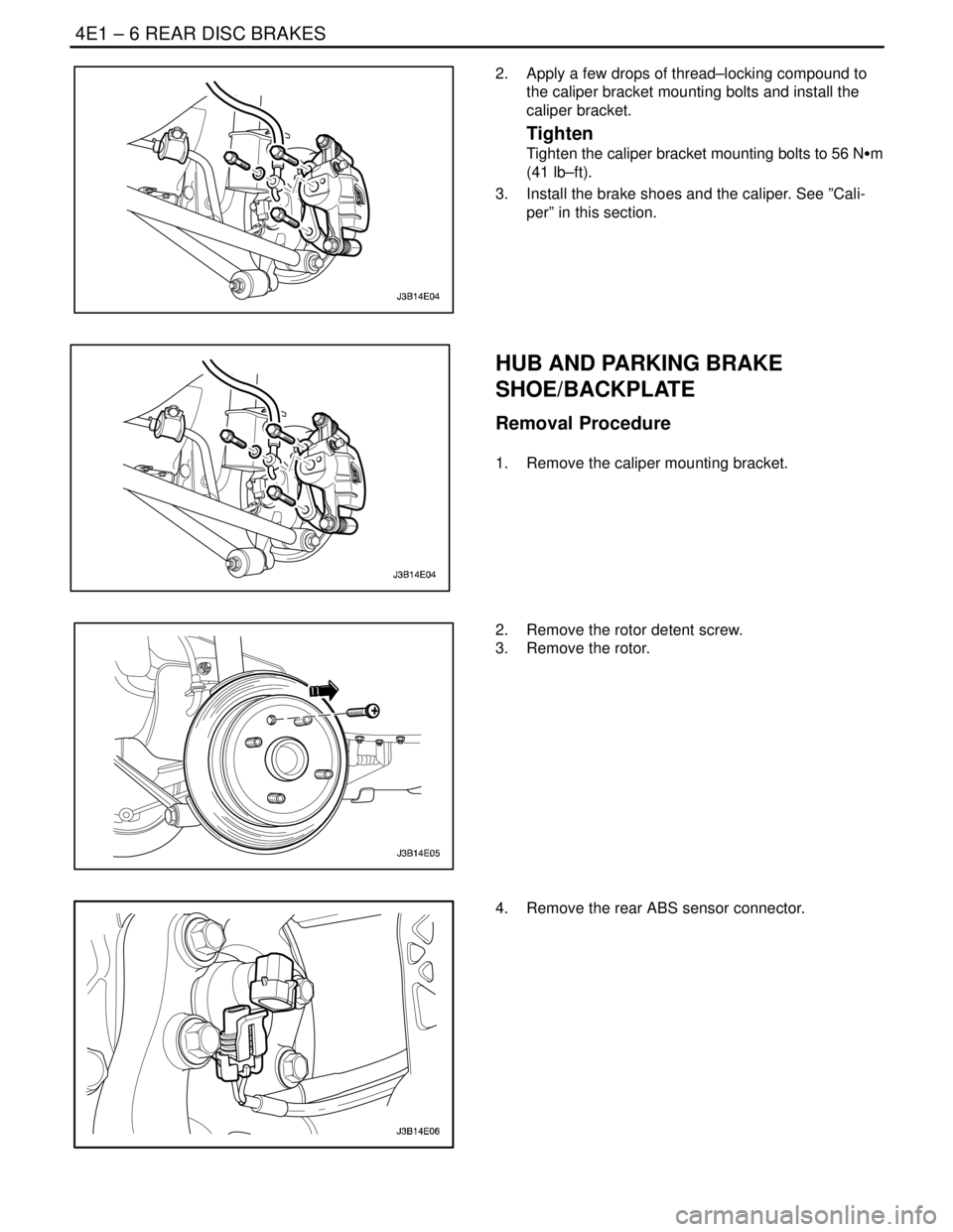
2. Apply a few drops of thread–locking compound to
the caliper bracket mounting bolts and install the
caliper bracket.
Tighten
Tighten the caliper bracket mounting bolts to 56 NSm
(41 lb–ft).
3. Install the brake shoes and the caliper. See ”Cali-
per” in this section.
HUB AND PARKING BRAKE
SHOE/BACKPLATE
Removal Procedure
1. Remove the caliper mounting bracket.
2. Remove the rotor detent screw.
3. Remove the rotor.
4. Remove the rear ABS sensor connector.
Page 1065 of 2643
4E1 – 8IREAR DISC BRAKES
DAEWOO V–121 BL4
Installation Procedure
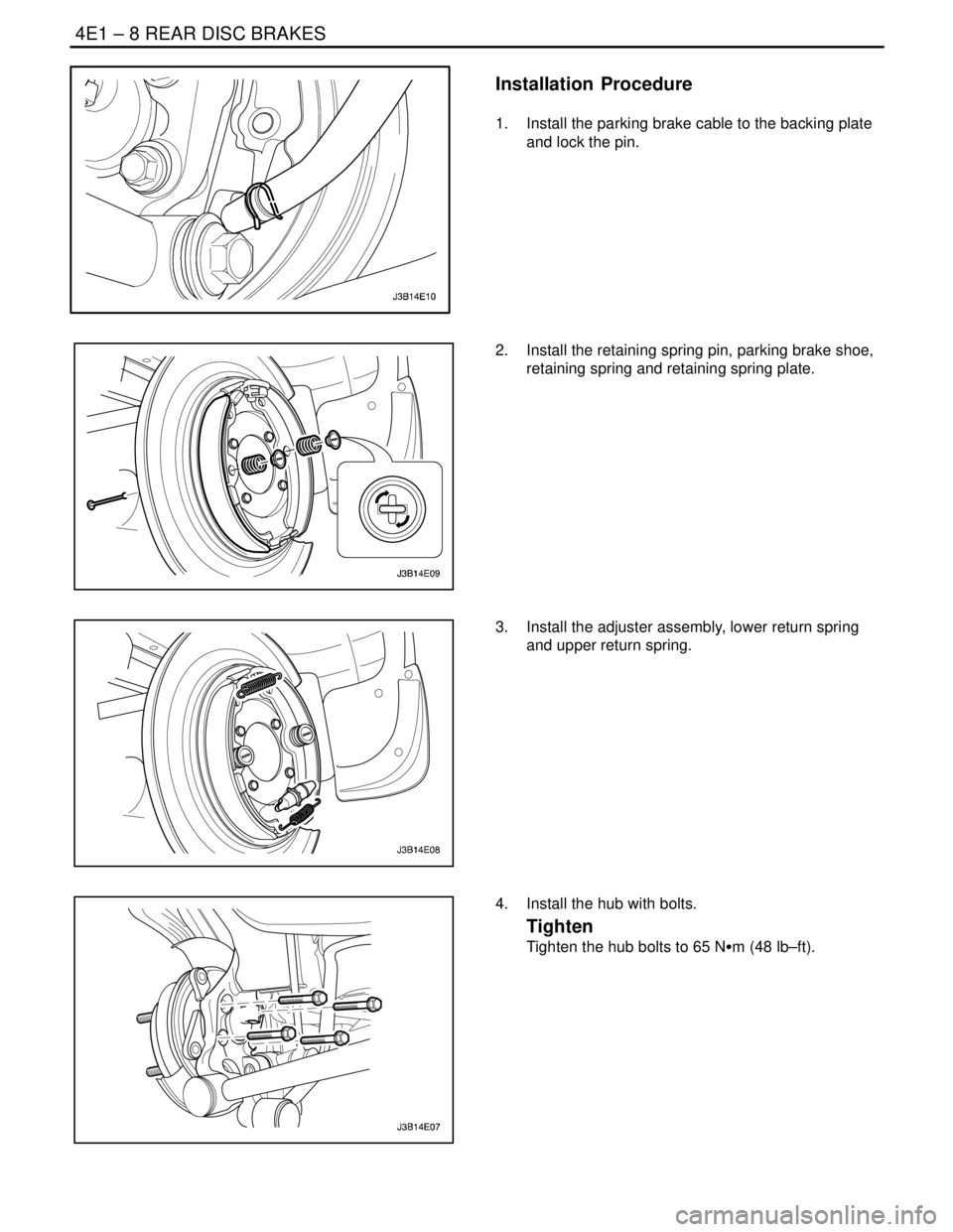
1. Install the parking brake cable to the backing plate
and lock the pin.
2. Install the retaining spring pin, parking brake shoe,
retaining spring and retaining spring plate.
3. Install the adjuster assembly, lower return spring
and upper return spring.
4. Install the hub with bolts.
Tighten
Tighten the hub bolts to 65 NSm (48 lb–ft).
Page 1068 of 2643
REAR DISC BRAKES 4E1 – 11
DAEWOO V–121 BL4
3. Install the bleeder valve and the dust cap.
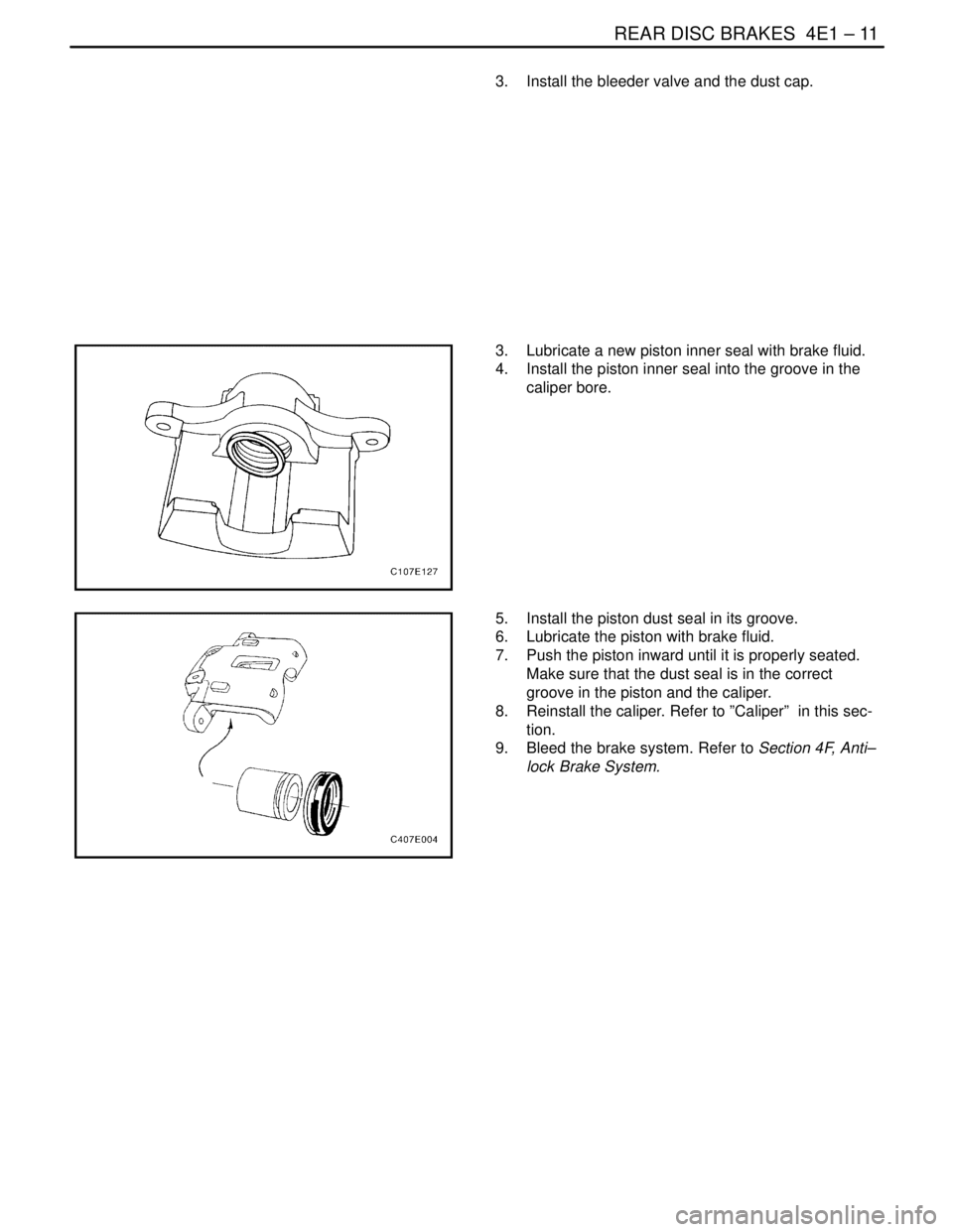
3. Lubricate a new piston inner seal with brake fluid.
4. Install the piston inner seal into the groove in the
caliper bore.
5. Install the piston dust seal in its groove.
6. Lubricate the piston with brake fluid.
7. Push the piston inward until it is properly seated.
Make sure that the dust seal is in the correct
groove in the piston and the caliper.
8. Reinstall the caliper. Refer to ”Caliper” in this sec-
tion.
9. Bleed the brake system. Refer to Section 4F, Anti–
lock Brake System.
Page 1069 of 2643

4E1 – 12IREAR DISC BRAKES
DAEWOO V–121 BL4
GENERAL DESCRIPTION
AND SYSTEM OPERATION
DISC BRAKE CALIPER ASSEMBLY
The caliper has a single bore and is mounted to the steer-
ing knuckle with two mounting bolts. Hydraulic pressure,
created by applying the brake pedal, is converted by the
caliper to a stopping force. This force acts equally against
the piston and the bottom of the caliper bore to move the
piston outward and to slide the caliper inward, resulting in
a clamping action on the rotor. This clamping action forces
the linings against the rotor, creating friction to stop the ve-
hicle.S Replace all components included in the repair kits
used to service the caliper.
S Lubricate the rubber parts with clean brake fluid to
ease assembly.
S Do not use lubricated shop air on brake parts, as
damage to the rubber components may result.
S If any hydraulic component is removed or discon-
nected, it may be necessary to bleed all or part of
the brake system. Refer to Section 4F, Anti–lock
Brake System.
S Replace the shoes in axle sets only.
S The torque values specified are for dry, unlubri-
cated fasteners.
S Perform the service operations on a clean bench,
free from oily material.
Page 1075 of 2643
4E2 – 6IREAR DRUM BRAKES
DAEWOO V–121 BL4
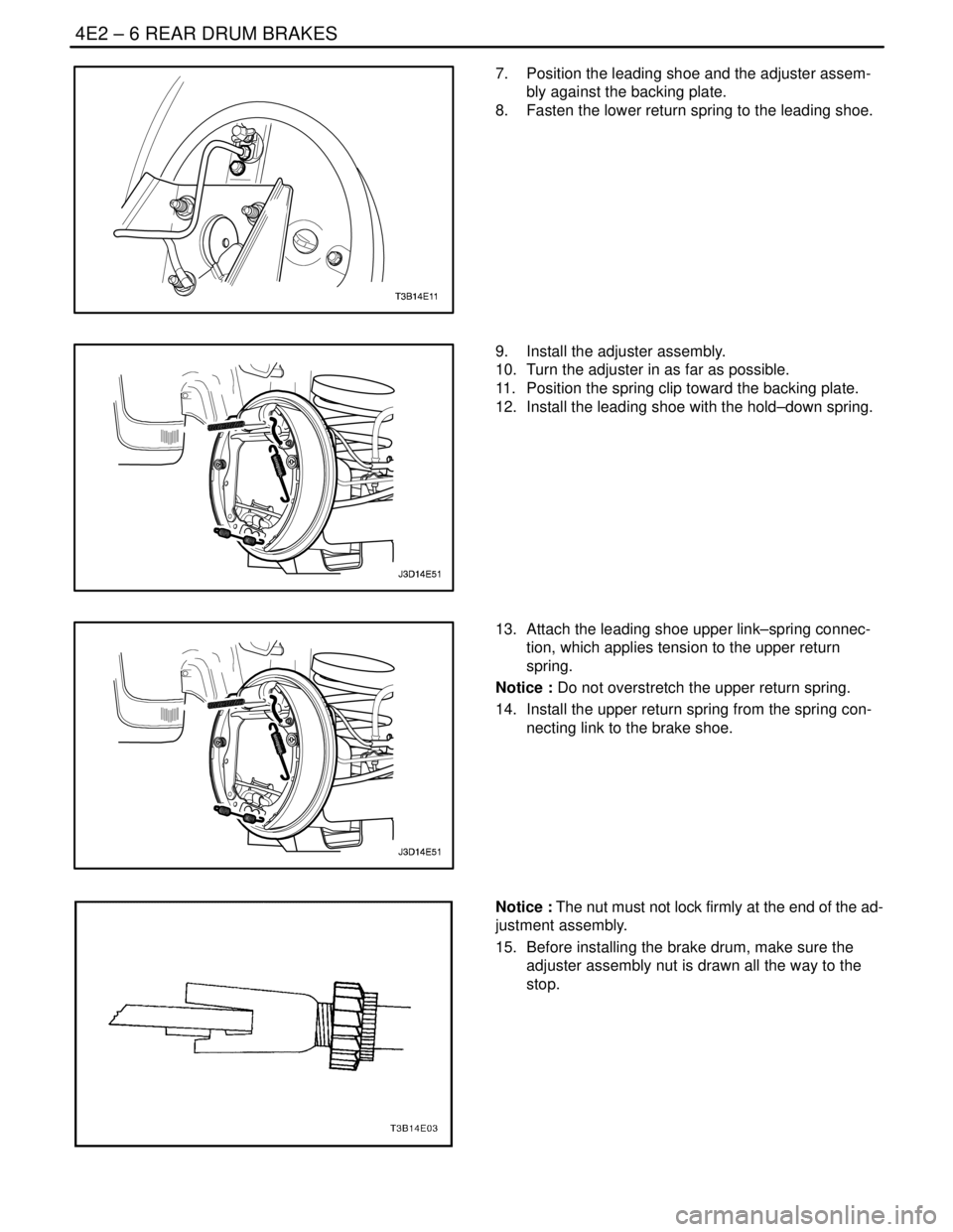
7. Position the leading shoe and the adjuster assem-
bly against the backing plate.
8. Fasten the lower return spring to the leading shoe.
9. Install the adjuster assembly.
10. Turn the adjuster in as far as possible.
11. Position the spring clip toward the backing plate.
12. Install the leading shoe with the hold–down spring.
13. Attach the leading shoe upper link–spring connec-
tion, which applies tension to the upper return
spring.
Notice : Do not overstretch the upper return spring.
14. Install the upper return spring from the spring con-
necting link to the brake shoe.
Notice : The nut must not lock firmly at the end of the ad-
justment assembly.
15. Before installing the brake drum, make sure the
adjuster assembly nut is drawn all the way to the
stop.