lock DAEWOO LACETTI 2004 Service Repair Manual
[x] Cancel search | Manufacturer: DAEWOO, Model Year: 2004, Model line: LACETTI, Model: DAEWOO LACETTI 2004Pages: 2643, PDF Size: 80.54 MB
Page 960 of 2643

2D – 18IREAR SUSPENSION
DAEWOO V–121 BL4
5. Install the lock nut onto the strut dampener rod.
Tighten
Tighten the ball joint–to–control arm nuts to 100 NSm
(74 lb–ft). Tighten the strut dampener–to–strut mount
nut to 75 NSm (55 lb–ft).
6. Release the spring.
7. Remove the strut assembly from the spring com-
pressor and install the strut assembly into the ve-
hicle. Refer to ”Strut Assembly” in this section.
KNUCKLE
Disassembly Procedure
1. Remove the knuckle from the vehicle. Refer to
”Knuckle Assembly” in this section.
2. Remove the brake drum. Refer to Section 4E2,
Rear Drum Brakes.
3. Remove the wheel hub. Refer to ”Hub and Bearing
Assembly” in this section.
4. On vehicles equipped with rear drum brakes, re-
move the rear drum brake assembly. On vehicles
equipped with rear disc brakes, remove the rear
disc brake assembly. Refer to Section 4E1, Rear
Disc Brakes.
5. Remove the brake splash shield. Refer to Section
4E2, Rear Drum Brakes.
Assembly Procedure
1. Install the brake splash shield. Refer to Section
4E1, Rear Disc Brakes.
2. On vehicles equipped with rear drum brakes, install
the rear drum brake assembly. On vehicles
equipped with rear disc brakes, install the rear disc
brake assembly. Refer to Section 4E1, Rear Disc
Brakes.
3. Install the wheel hub. Refer to ”Hub and Bearing
Assembly” in this section.
4. Install the brake caliper and brake rotor or the
brake drum. Refer to Section 4E1, Rear Disc
Brakes and 4E2, Rear Drum Brakes.
5. Install the knuckle into the vehicle. Refer to
”Knuckle Assembly” in this section.
Page 968 of 2643

2E – 6ITIRES AND WHEELS
DAEWOO V–121 BL4
S Amchem Alodine No. 1001. Stock No. DX50T or
equivalent coating chemical for alloys.
S Ditzler Delclear Acrylic Urethane Clear, Stock No.
DAU–75 or equivalent.
S Ditzler Delthane Ultra–Urethane Additive, Stock No.
DXR–80 or equivalent.
Before repairing the alloy damage or the clear coat dam-
age, prepare the wheels and the tires.
1. Remove the wheel from the vehicle.
2. Mark the location of the outboard weights and re-
move them.
3. Wash the wheel inside and out with a water–based,
all–purpose cleaner. Remove the grease and oil
with a solvent cleaner.
4. Mask the tire prior to painting.
5. Using a 400–grit wet or dry sandpaper, sand over
the painted areas that will not require recoloring.
Sanding will promote the adhesion of the clear coat.
Alloy Damage on Wheel Surface
1. Mount the wheel on a brake lathe and spin the as-
sembly slowly.
2. Sand the wheel with a backing block or pad. Hold
the backing block or pad flat to the surface of the
wheel and sand slowly back and forth from the cen-
ter to the outer edge of the tire to remove the dam-
age. Use the following sandpaper grits in the order
listed:
1) 80 grit.
2) 150 grit.
3) 240 grit.
Clear Coat Damage on Unpainted Wheels
1. Apply the chemical stripper Amchem Alumi Prep
No. 33. Use a small 1/4–inch detail brush to apply
the stripper around the perimeter and spoke–like
areas.
2. Remove the stripper according to the manufactur-
er’s recommendations.
CAUTION : To avoid serious personal injury, do not
use engine power to rotate the wheel while sanding.
3. Sand the wheel with 240–grit sandpaper by rotating
the wheel on a slow–spinning brake lathe or by
mounting the wheel on the car and spinning it by
hand. Sanding restores the machined appearance
and promotes adhesion.
After repairing the alloy or clear coat damage, the wheels
must be recoated.
Page 971 of 2643
TIRES AND WHEELS 2E – 9
DAEWOO V–121 BL4
GENERAL DESCRIPTION
AND SYSTEM OPERATION
TIRE AND WHEEL BALANCING
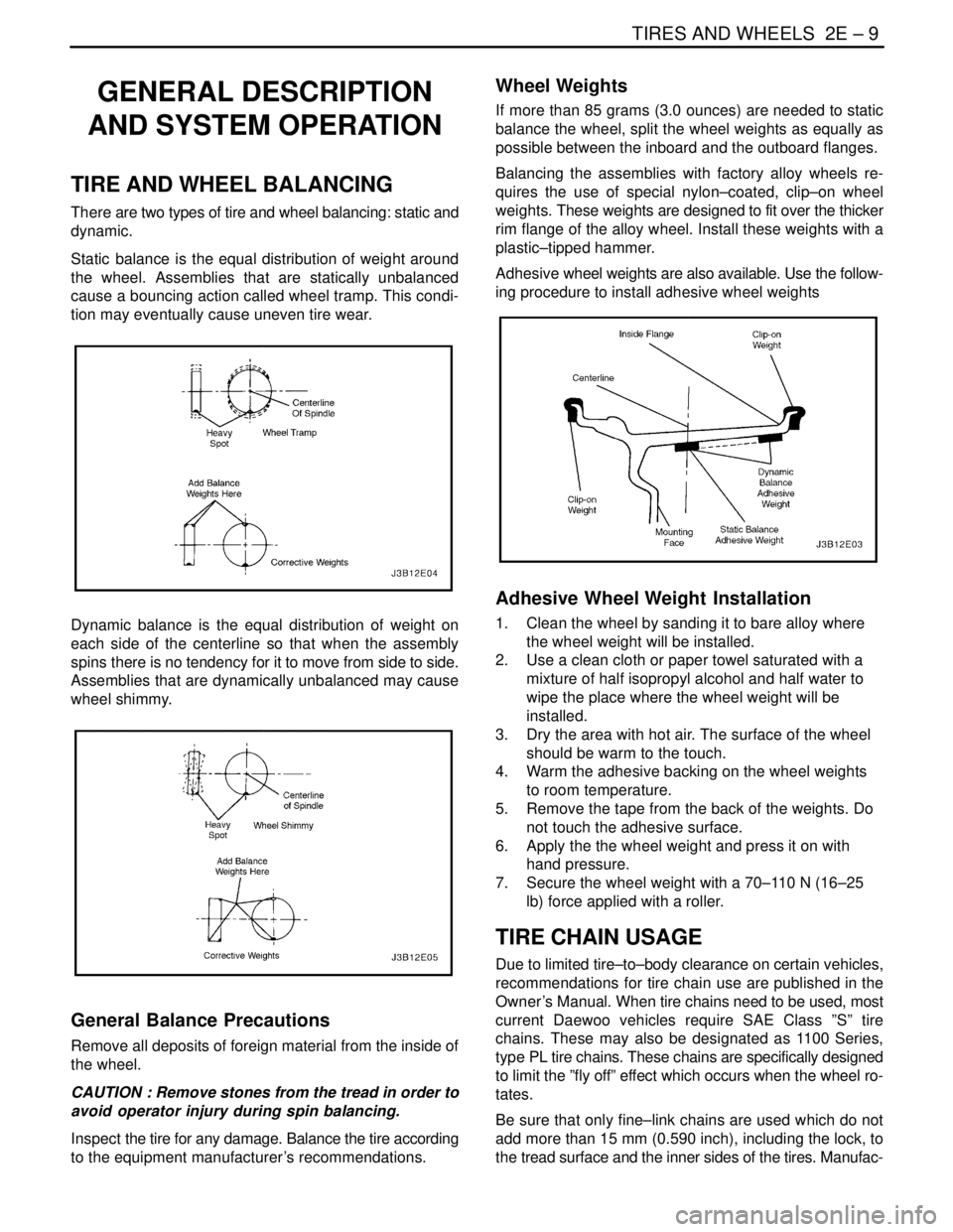
There are two types of tire and wheel balancing: static and
dynamic.
Static balance is the equal distribution of weight around
the wheel. Assemblies that are statically unbalanced
cause a bouncing action called wheel tramp. This condi-
tion may eventually cause uneven tire wear.
Dynamic balance is the equal distribution of weight on
each side of the centerline so that when the assembly
spins there is no tendency for it to move from side to side.
Assemblies that are dynamically unbalanced may cause
wheel shimmy.
General Balance Precautions
Remove all deposits of foreign material from the inside of
the wheel.
CAUTION : Remove stones from the tread in order to
avoid operator injury during spin balancing.
Inspect the tire for any damage. Balance the tire according
to the equipment manufacturer’s recommendations.
Wheel Weights
If more than 85 grams (3.0 ounces) are needed to static
balance the wheel, split the wheel weights as equally as
possible between the inboard and the outboard flanges.
Balancing the assemblies with factory alloy wheels re-
quires the use of special nylon–coated, clip–on wheel
weights. These weights are designed to fit over the thicker
rim flange of the alloy wheel. Install these weights with a
plastic–tipped hammer.
Adhesive wheel weights are also available. Use the follow-
ing procedure to install adhesive wheel weights
Adhesive Wheel Weight Installation
1. Clean the wheel by sanding it to bare alloy where
the wheel weight will be installed.
2. Use a clean cloth or paper towel saturated with a
mixture of half isopropyl alcohol and half water to
wipe the place where the wheel weight will be
installed.
3. Dry the area with hot air. The surface of the wheel
should be warm to the touch.
4. Warm the adhesive backing on the wheel weights
to room temperature.
5. Remove the tape from the back of the weights. Do
not touch the adhesive surface.
6. Apply the the wheel weight and press it on with
hand pressure.
7. Secure the wheel weight with a 70–110 N (16–25
lb) force applied with a roller.
TIRE CHAIN USAGE
Due to limited tire–to–body clearance on certain vehicles,
recommendations for tire chain use are published in the
Owner ’s Manual. When tire chains need to be used, most
current Daewoo vehicles require SAE Class ”S” tire
chains. These may also be designated as 1100 Series,
type PL tire chains. These chains are specifically designed
to limit the ”fly off” effect which occurs when the wheel ro-
tates.
Be sure that only fine–link chains are used which do not
add more than 15 mm (0.590 inch), including the lock, to
the tread surface and the inner sides of the tires. Manufac-
Page 972 of 2643

2E – 10ITIRES AND WHEELS
DAEWOO V–121 BL4
turers of tire chains have a specific chain size for each tire
size to ensure a proper fit when the chain is installed. Be
sure to purchase the correct chains for the tires on which
they are to be used. Use rubber adjusters to take up any
slack or clearance in loose chains.
Use of chains may adversely affect vehicle handling.
When tire chains are installed, follow these precautions:
S Adjust speed to road conditions.
S Avoid sharp turns.
S Avoid locked–wheel braking.
To prevent chain damage to the vehicle, install the chains
on the front tires as tightly as possible. Tighten them again
after driving 0.4 to 0.8 kilometer (0.3 to 0.5 mile). The use
of chains on the rear tires is not recommended because
they may contact the vehicle and possibly damage it. If
chains must be used on the rear tires, be sure there is suffi-
cient clearance between the chains and the body. Do not
exceed 70 km/h (45 mph) or the chain manufacturer’s
speed limit, if lower. Avoid large bumps, potholes, severe
turns and any other maneuvers which could cause the
tires to bounce. Follow any other instructions of the chain
manufacturer which do not disagree with the above in-
structions.
REPLACEMENT TIRES
A tire performance criteria (TPC) specification number is
molded in the sidewall near the tire size of all original
equipment tires. This specification number assures that
the tire meets performance standards for traction, endur-
ance, dimensions, noise, handling and rolling resis–tance.
Usually a specific TPC number is assigned to each tire
size.
CAUTION : Do not mix different types of tires on the
same vehicle such as radial, bias and bias–belted
tires except in emergencies, because vehicle han-
dling may be seriously affected and may result in loss
of control.
Use only replacement tires with the same size, load range,
and construction as the original. The use of any other tire
size or construction type may seriously affect ride, han-
dling, speedometer/odometer calibration, vehicle ground
clearance, and tire clearance to the body and the chassis.
This does not apply to the spare tire furnished with the ve-
hicle.
It is recommended that new tires be installed in pairs on
the same axle.
If it is necessary to replace only one tire, pair it with the tire
having the most tread to equalize the braking action.
Although they may appear different in tread design, tires
built by different manufacturers with identical TPC specifi-
cations may be used on the same vehicle.
ALL SEASON TIRES
Most vehicles are now equipped with steel–belted all sea-
son radial tires as standard equipment. These tires qualify
as snow tires, with a 37 percent higher average rating for
snow traction than the non–all season radial tires pre-
viously used. Other performance areas, such as wet trac-
tion, rolling resistance, tread life, and air retention, have
also been improved. This was done by improvements in
both tread design and tread compounds. These tires are
identified by an ”M + S” molded in the tire sidewall following
the size number. The suffix ”MS” is also molded in the side-
wall after the TPC specification number.
The optional handling tires used on some vehicles are not
all season tires. These will not have the ”MS” marking after
the tire size or the TPC specification number.
PASSENGER METRIC SIZED TIRES
All Daewoo vehicles now use Passenger (P) metric sized
tires. P–metric tires are available in two load ranges: stan-
dard load (35 psi maximum) and extra load (41 psi maxi-
mum). Most passenger vehicle tires are standard load.
Most P–metric tire sizes do not have exact corresponding
alphanumeric tire sizes. For example, a P175/70R13 is
not exactly equal in size and load–carrying capacity to an
FR70–13. For this reason, replacement tires should be of
the same TPC specification number as the originals. If P–
metric tires must be replaced with other sizes, consult a
tire dealer. Tire companies can best recommend the clos-
est match of alphanumeric to P–metric sizes within their
own tire lines.
The metric term for measuring tire inflation pressure is the
kilopascal (kPa). Tire pressure may be printed in both kPa
and psi. One psi equals 6.895 kPa.
See the tire label or refer to ”Tire Size and Pressure Speci-
fications” in this section for tire inflation pressures.
TIRE LABEL
The tire label is permanently located on the rear face of the
driver’s door and should be referred to for tire information.
It lists the maximum vehicle load, the tire size (including
the spare tire), and the cold inflation pressure (including
the spare tire).
SPARE TIRE
The notchback and the wagon come equipped with a full–
sized tire on a steel wheel. The hatchback comes
equipped with a reduced–sized temporary tire on a steel
wheel.
WHEELS
Wheels must be replaced if they are bent, dented, have
excessive lateral or radial runout, leak air through welds,
have elongated bolt holes, or if the wheel bolts won’t stay
tight or are heavily rusted. Wheels with excessive runout
may cause vehicle vibration. Replacement wheels must
be equivalent to the original equipment wheels in load ca-
Page 974 of 2643

SECTION 3
WIRING DIAGRAM FOR POWER SUPPLIES
CONTENTS
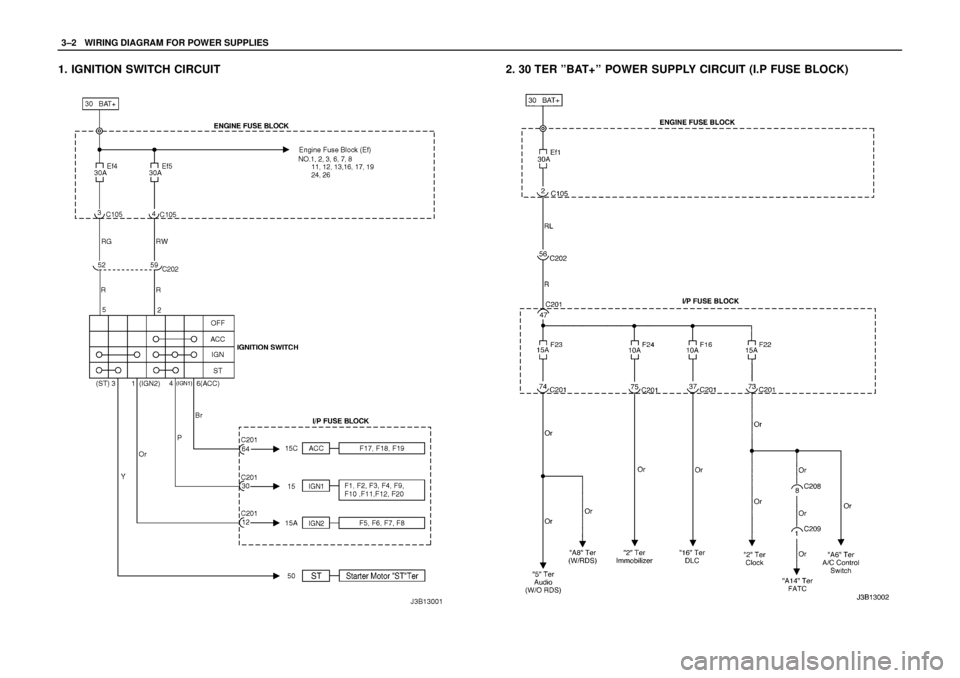
1. IGNITION SWITCH CIRCUIT3–2 . . . . . . . . . . . . . . . . . . . . . . . . . . . . . . . . . . . . . . . . . . . . . . . . . . . . . . . . . . . . . . . . . . . . . .
2. 30 TER ”BAT+” POWER SUPPLY CIRCUIT(I.P FUSE BLOCK) 3–2. . . . . . . . . . . . . . . . . . . . . . . . . . . . . . . . . . . . . . .
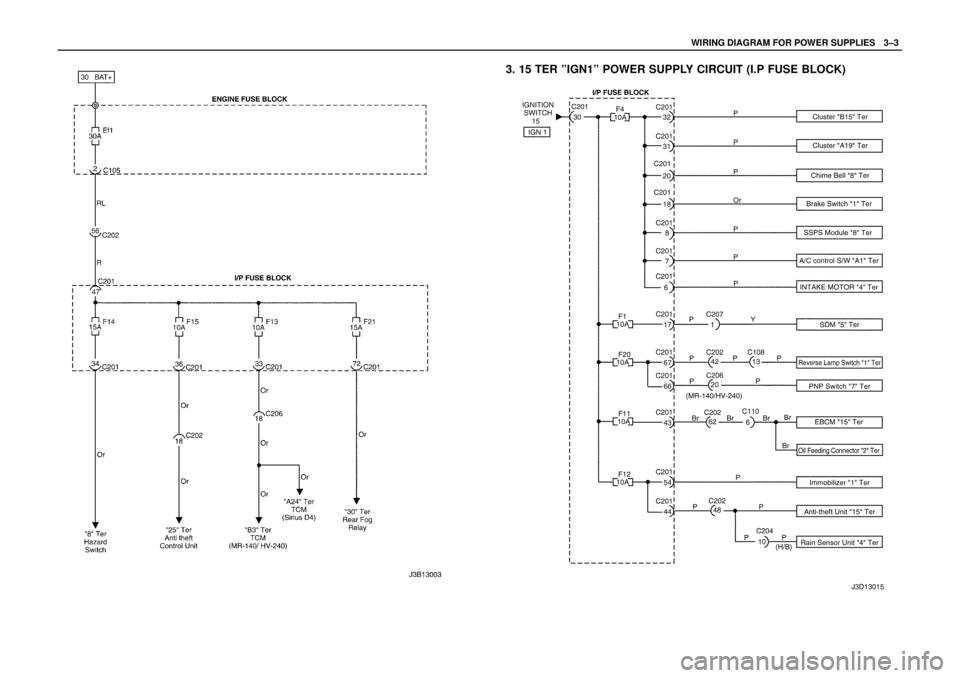
3. 15 TER ”IGN 1” POWER SUPPLY CIRCUIT(I.P FUSE BLOCK) 3–3. . . . . . . . . . . . . . . . . . . . . . . . . . . . . . . . . . . . . . .
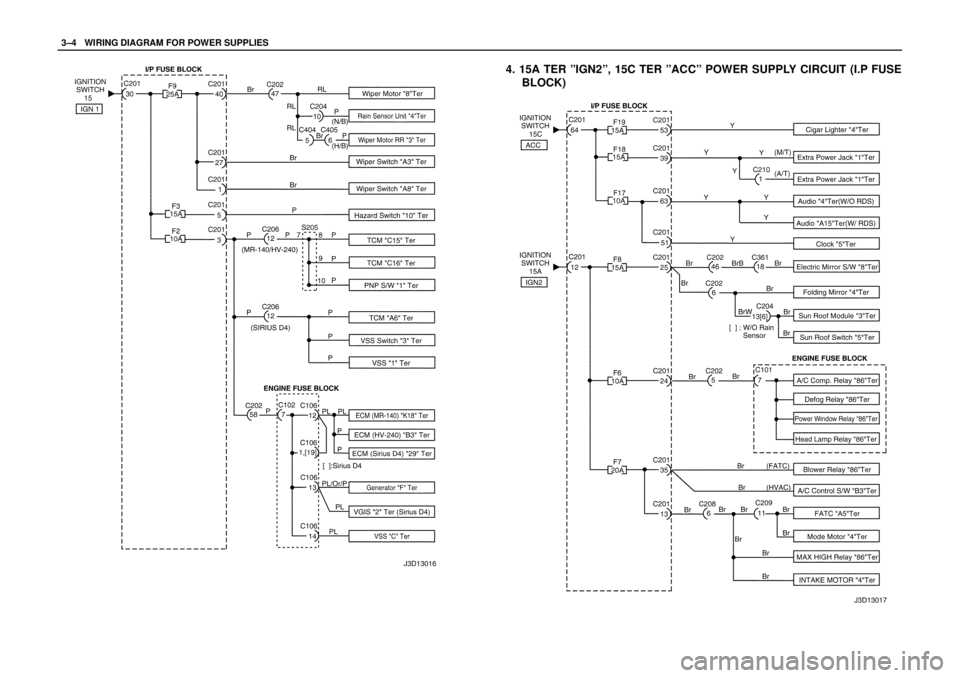
4. 15A TER ”IGN2”, 15C TER ”ACC” POWER SUPPLY CIRCUIT(I.P FUSE BLOCK) 3–4. . . . . . . . . . . . . . . . . . . . . .
5. ENGINE FUSE BLOCK & RELAY CIRCUIT 3–5. . . . . . . . . . . . . . . . . . . . . . . . . . . . . . . . . . . . . . . . . . . . . . . . . . . . . . . . .
Page 975 of 2643
3–2WWIRING DIAGRAM FOR POWER SUPPLIES
1. IGNITION SWITCH CIRCUIT2. 30 TER ”BAT+” POWER SUPPLY CIRCUIT (I.P FUSE BLOCK)
Page 976 of 2643
WIRING DIAGRAM FOR POWER SUPPLIESW3–3
3. 15 TER ”IGN1” POWER SUPPLY CIRCUIT (I.P FUSE BLOCK)
Page 977 of 2643
3–4WWIRING DIAGRAM FOR POWER SUPPLIES
4. 15A TER ”IGN2”, 15C TER ”ACC” POWER SUPPLY CIRCUIT (I.P FUSE
BLOCK)
Page 978 of 2643
WIRING DIAGRAM FOR POWER SUPPLIESW3–5
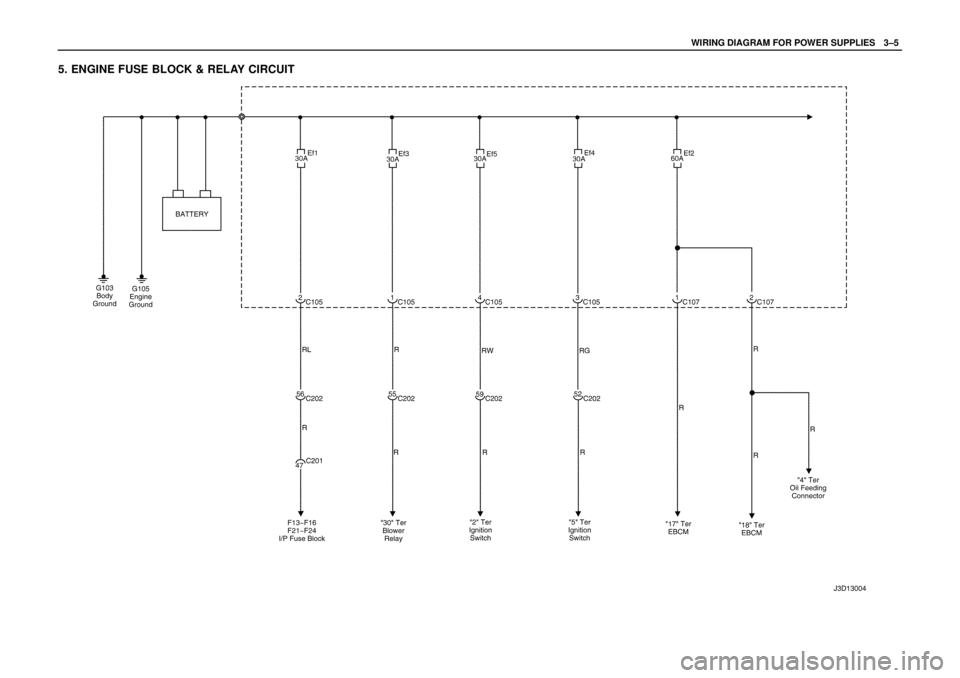
5. ENGINE FUSE BLOCK & RELAY CIRCUIT
Page 994 of 2643
AUTOMATIC TRANSAXLE DRIVE AXLE 3A – 5
DAEWOO V–121 BL4
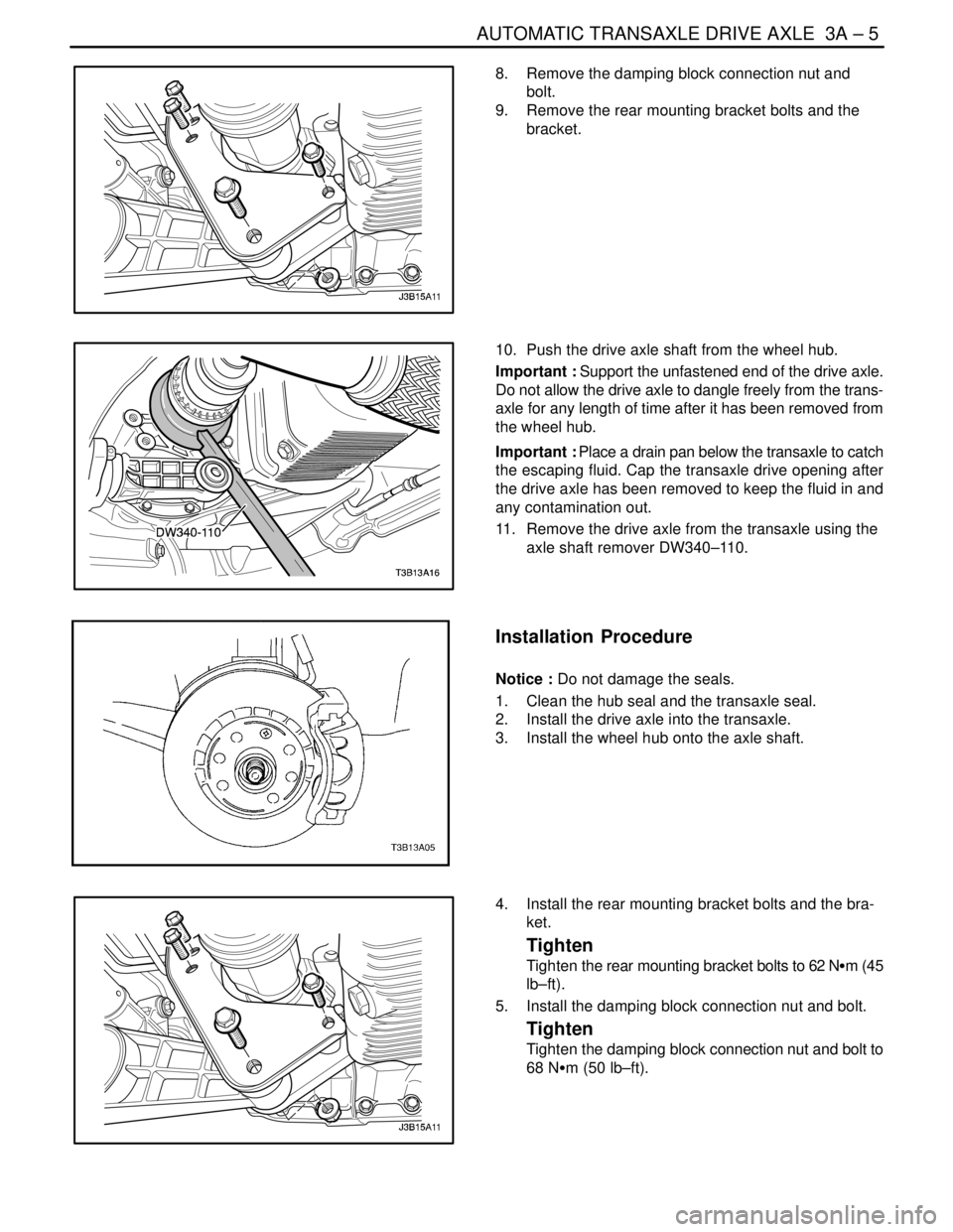
8. Remove the damping block connection nut and
bolt.
9. Remove the rear mounting bracket bolts and the
bracket.
10. Push the drive axle shaft from the wheel hub.
Important : Support the unfastened end of the drive axle.
Do not allow the drive axle to dangle freely from the trans-
axle for any length of time after it has been removed from
the wheel hub.
Important : Place a drain pan below the transaxle to catch
the escaping fluid. Cap the transaxle drive opening after
the drive axle has been removed to keep the fluid in and
any contamination out.
11. Remove the drive axle from the transaxle using the
axle shaft remover DW340–110.
Installation Procedure
Notice : Do not damage the seals.
1. Clean the hub seal and the transaxle seal.
2. Install the drive axle into the transaxle.
3. Install the wheel hub onto the axle shaft.
4. Install the rear mounting bracket bolts and the bra-
ket.
Tighten
Tighten the rear mounting bracket bolts to 62 NSm (45
lb–ft).
5. Install the damping block connection nut and bolt.
Tighten
Tighten the damping block connection nut and bolt to
68 NSm (50 lb–ft).