battery DAEWOO LACETTI 2004 Service Repair Manual
[x] Cancel search | Manufacturer: DAEWOO, Model Year: 2004, Model line: LACETTI, Model: DAEWOO LACETTI 2004Pages: 2643, PDF Size: 80.54 MB
Page 1099 of 2643
4F – 18IANTILOCK BRAKE SYSTEM
DAEWOO V–121 BL4
J3B14F04
60A Ef230A Ef5
2
42
C107 C105
2
C110
G106
A19
A13 A1 A14
C110 C202
C202WHT LT GRN
DK
GRN LT GRN/
BLK
BLK
DK BLUDK BLU
PPL/WHT
PPL/WHT ABS
TCS Parking
Brake
Hot at all times
RED REDRED/WHT
Ignition
Switch
RED
RED
I/P Cluster
EBCM8
20
22 2216 41
1211
18 1621
1
C107
10A F410AF11
32 31
43
6 62 C201
C201 C201C201
C110 C202
Hot in Run and Start
30
4
1711
C202
15
B15
DLC
(Data Link
Connector)12
G106
BLK/WHTOil Feeding
Connector
”2” Ter.
BRNBRN BRN
BRN PNK PNK PNK
19J1
59B1
ONStart Lock
Acc
IG1
19
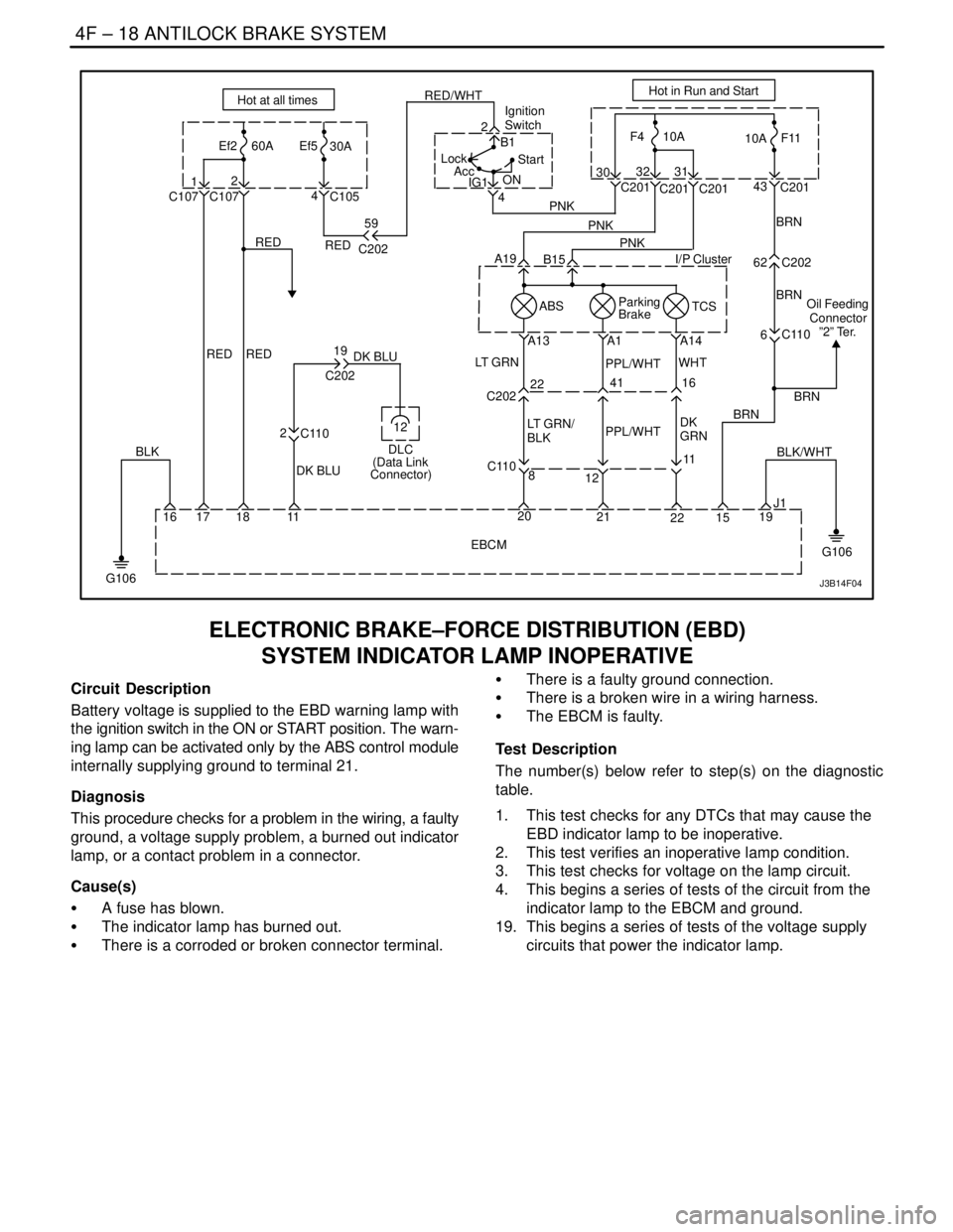
ELECTRONIC BRAKE–FORCE DISTRIBUTION (EBD)
SYSTEM INDICATOR LAMP INOPERATIVE
Circuit Description
Battery voltage is supplied to the EBD warning lamp with
the ignition switch in the ON or START position. The warn-
ing lamp can be activated only by the ABS control module
internally supplying ground to terminal 21.
Diagnosis
This procedure checks for a problem in the wiring, a faulty
ground, a voltage supply problem, a burned out indicator
lamp, or a contact problem in a connector.
Cause(s)
S A fuse has blown.
S The indicator lamp has burned out.
S There is a corroded or broken connector terminal.S There is a faulty ground connection.
S There is a broken wire in a wiring harness.
S The EBCM is faulty.
Test Description
The number(s) below refer to step(s) on the diagnostic
table.
1. This test checks for any DTCs that may cause the
EBD indicator lamp to be inoperative.
2. This test verifies an inoperative lamp condition.
3. This test checks for voltage on the lamp circuit.
4. This begins a series of tests of the circuit from the
indicator lamp to the EBCM and ground.
19. This begins a series of tests of the voltage supply
circuits that power the indicator lamp.
Page 1100 of 2643

ANTILOCK BRAKE SYSTEM 4F – 19
DAEWOO V–121 BL4
EBD System Indicator Lamp Inoperative
StepActionValue(s)YesNo
1Install the scan tool and check for any DTCs.
Is any DTC set?–Go to the chart
for the DTCGo to Step 2
21. Turn the ignition switch to LOCK.
2. Disconnect the scan tool.
3. Release the parking brake fully.
4. Push the brake pedal.
5. Turn the ignition switch to ON.
6. Observe the EBD indicator lamp.
Does the lamp illuminate for about 4 seconds, then
turn off?–Go to ”Intermit-
tents and Poor
Connections”Go to Step 3
3With the ignition still ON, observe the oil pressure
lamp.
Is the oil pressure lamp illuminated?–Go to Step 4Go to Step 19
41. Turn the ignition switch to LOCK.
2. Disconnect connector from the EBCM.
3. Connect a jumper from terminal 21 to the
grounding bar in the connector.
4. Turn the ignition switch to ON.
Does the EBD indicator illuminate?–Go to Step 5Go to Step 8
5S Turn the ignition switch to LOCK.
S Examine terminals 19 and 21 at the EBCM
connector on both the ABS wiring harness and
on the EBCM.
Is there a poor connection at any of these terminals?–Go to Step 6Go to Step 7
6Repair the faulty terminals or replace the ABS unit
as required.
Is the repair complete?–System OK–
7Replace the ABS unit.
Is the repair complete?–System OK–
8S Turn the ignition switch to LOCK.
S Disconnect the wire from the negative battery
terminal.
S Measure the resistance between the negative
battery wire, which is attached to ground, and
the shorting bar in the EBCM connector.
Does the resistance match the specified value?0 WGo to Step 10Go to Step 9
9Repair the open or high resistance in the circuit from
EBCM connector, terminal 19 to ground G106.
Is the repair complete?–System OK–
101. Remove the I/P cluster.
2. Remove and check the EBD indicator bulb.
Is the bulb burned out?–Go to Step 11Go to Step 12
111. Replace the EBD indicator bulb.
2. Install the I/P cluster.
Is the repair complete?–System OK–
12Check the continuity at the I/P cluster connector ter-
minal A1.
Does the ohmmeter show the specified value?0 WGo to Step 14Go to Step 13
Page 1103 of 2643

4F – 22IANTILOCK BRAKE SYSTEM
DAEWOO V–121 BL4
SELF–DIAGNOSTICS
Important : The electronic brake control module (EBCM)
turns the valve relay off when a diagnostic trouble code
(DTC) is set. The scan tool will indicate that the valve relay
is off when it is used to monitor the data list. This is normal
and should not be considered a malfunction.
Important : For safety reasons it is recommended that the
vehicle not be driven with test equipment connected. Ex-
ception : for testing of wheel speeds provided the test reg-
ulations are met.
The EBCM performs system self–diagnostics and can de-
tect and often isolate system malfunctions. When it de-
tects a malfunction, the EBCM sets a DTC that represents
the malfunction, turns ON the ABS and/or the EBD indica-
tors in most instances, and may disable the ABS and/or
the EBD functions as necessary for the duration of the igni-
tion cycle.
Once each ignition cycle, the EBCM performs an automat-
ic test when the vehicle speed > 6 km/h and the brake ped-
al is not actuated or when the vehicle speed > 15 km/h and
the brake pedal is actuated. In the course of this test, the
system cycles each valve solenoid and the pump motor,
along with the necessary relays, to check component op-
eration. If the EBCM detects any malfunctions, it will set
a DTC as described above.
DISPLAYING DTCS
Tools Required
Scan Tool
DTCs can be read through the use of the scan tool.
CLEARING DTCS
Tools Required
Scan Tool
The diagnostic trouble codes (DTCs) in the electronic
brake control module (EBCM) memory are erased:S Use the scan tool ”Clear DTCs” selection.
The method is detailed below. Be sure to verify proper sys-
tem operation and absence of DTCs when the clearing
procedure is completed.
The EBCM will not permit DTC clearing until all DTCs have
been displayed. Also, DTCs cannot be cleared by discon-
necting the EBCM, disconnecting the battery cables, or
turning the ignition switch to LOCK.
Scan Tool Method
The scan tool can clear ABS system DTCs using the mass
storage cartridge.
1. Install the scan tool and the mass storage cartridge.
2. Select ”Fault Memory.”
3. Select ”Clear Fault Memory.”
Clearing the fault memory cannot reset a valve relay which
was shut down when the fault was recognized. Changes
are possible only after the fault has been eliminated and
the next ignition cycle has begun.
INTERMITTENTS AND POOR
CONNECTIONS
As with most electronic systems, intermittent malfunctions
may be difficult to diagnose accurately. The following is a
method to try to isolate an intermittent malfunction, espe-
cially in wheel speed circuitry.
If an ABS malfunction occurs, the ABS indicator will illumi-
nate during the ignition cycle in which the malfunction was
detected. If it is an intermittent problem which seems to
have corrected itself (ABS indicator off), a history DTC will
be stored. Also stored will be the history data of the DTC
at the time the malfunction occurred. Use the scan tool
modular diagnostic system to read ABS history data.
Most intermittents are caused by faulty electrical connec-
tions or wiring, although a sticking relay or solenoid can oc-
casionally be at fault.
Page 1116 of 2643

ANTILOCK BRAKE SYSTEM 4F – 35
DAEWOO V–121 BL4
J3B14F09
DLC
(Data Link
Connector)
EBCM
DK BLUDK BLU
BLK/WHTC202
C110
11 2
1912 19
G106
DIAGNOSTIC TROUBLE CODE (DTC) C0060/C0065
LEFT FRONT INLET AND OUTLET VALVE SOLENOID
FAULT
Circuit Description
The solenoid valve coil circuits are supplied with power
from the battery when the valve relay is energized.
Switched ground is provided by the electronic brake con-
trol module (EBCM) to each coil.
Diagnosis
This procedure checks whether the left front inlet and out-
let valves are functioning.
Cause(s)
S A valve has failed.S A solenoid coil is open or shorted.
Fail Action
ABS is disabled, and the ABS warning lamp is turned ON
for the remainder of the ignition cycle. EBD is disabled. If
the failure is intermittent, the EBCM will enable the system
at the next ignition cycle and set a history DTC.
Test Description
The number(s) below refer to step(s) on the diagnostic
table.
1. This step begins the test of the inlet valve.
3. This step tests the outlet valve.
Page 1118 of 2643

ANTILOCK BRAKE SYSTEM 4F – 37
DAEWOO V–121 BL4
J3B14F09
DLC
(Data Link
Connector)
EBCM
DK BLUDK BLU
BLK/WHTC202
C110
11 2
1912 19
G106
DIAGNOSTIC TROUBLE CODE (DTC) C0070/C0075
RIGHT FRONT INLET AND OUTLET VALVE SOLENOID
FAULT
Circuit Description
The solenoid valve coil circuits are supplied with power
from the battery when the valve relay is energized.
Switched ground is provided by the electronic brake con-
trol module (EBCM) to each coil.
Diagnosis
This procedure checks whether the right front inlet and
outlet valves are functioning.
Cause(s)
S A solenoid coil is open or shorted.Fail Action
ABS is disabled, and the ABS warning lamp is turned ON
for the remainder of the ignition cycle. EBD is disabled. If
the failure is intermittent, the EBCM will enable the system
at the next ignition cycle and set a history DTC.
Test Description
The number(s) below refer to step(s) on the diagnostic
table.
1. This begins the test of the inlet valve.
3. This tests the outlet valve.
Page 1120 of 2643

ANTILOCK BRAKE SYSTEM 4F – 39
DAEWOO V–121 BL4
J3B14F09
DLC
(Data Link
Connector)
EBCM
DK BLUDK BLU
BLK/WHTC202
C110
11 2
1912 19
G106
DIAGNOSTIC TROUBLE CODE (DTC) C0080/C0085
LEFT REAR INLET AND OUTLET VALVE SOLENOID
FAULT
Circuit Description
The solenoid valve coil circuits are supplied with power
from the battery when the valve relay is energized.
Switched ground is provided by the electronic brake con-
trol module (EBCM) to each coil.
Diagnosis
This procedure checks whether the left rear inlet and outlet
valves are functioning.
Cause(s)
S A valve has failed.S A solenoid coil is open or shorted.
Fail Action
ABS is disabled, and the ABS warning lamp is turned ON
for the remainder of the ignition cycle. EBD is disabled. If
the failure is intermittent, the EBCM will enable the system
at the next ignition cycle and set a history DTC.
Test Description
The number(s) below refer to step(s) on the diagnostic
table.
1. This begins the test of the inlet valve.
3. This tests the outlet valve.
Page 1122 of 2643

ANTILOCK BRAKE SYSTEM 4F – 41
DAEWOO V–121 BL4
J3B14F09
DLC
(Data Link
Connector)
EBCM
DK BLUDK BLU
BLK/WHTC202
C110
11 2
1912 19
G106
DIAGNOSTIC TROUBLE CODE (DTC) C0090/C0095
RIGHT REAR INLET AND OUTLET VALVE SOLENOID
FAULT
Circuit Description
The solenoid valve coil circuits are supplied with power
from the battery when the valve relay is energized.
Switched ground is provided by the electronic brake con-
trol module (EBCM) to each coil.
Diagnosis
This procedure checks whether the right rear inlet and out-
let valves are functioning.
Cause(s)
S A valve has failed.S A solenoid coil is open or shorted.
Fail Action
ABS is disabled, and the ABS warning lamp is turned ON
for the remainder of the ignition cycle. EBD is disabled. If
the failure is intermittent, the EBCM will enable the system
at the next ignition cycle and set a history DTC.
Test Description
The number(s) below refer to step(s) on the diagnostic
table.
1. This begins the test of the inlet valve.
3. This tests the outlet valve.
Page 1137 of 2643
4F – 56IANTILOCK BRAKE SYSTEM
DAEWOO V–121 BL4
J3B14F04
60A Ef230A Ef5
2
42
C107 C105
2
C110
G106
A19
A13 A1 A14
C110 C202
C202WHT LT GRN
DK
GRN LT GRN/
BLK
BLK
DK BLUDK BLU
PPL/WHT
PPL/WHT ABS
TCS Parking
Brake
Hot at all times
RED REDRED/WHT
Ignition
Switch
RED
RED
I/P Cluster
EBCM8
20
22 2216 41
1211
18 1621
1
C107
10A F410AF11
32 31
43
6 62 C201
C201 C201C201
C110 C202
Hot in Run and Start
30
4
1711
C202
15
B15
DLC
(Data Link
Connector)12
G106
BLK/WHTOil Feeding
Connector
”2” Ter.
BRNBRN BRN
BRN PNK PNK PNK
19J1
59B1
ONStart Lock
Acc
IG1
19
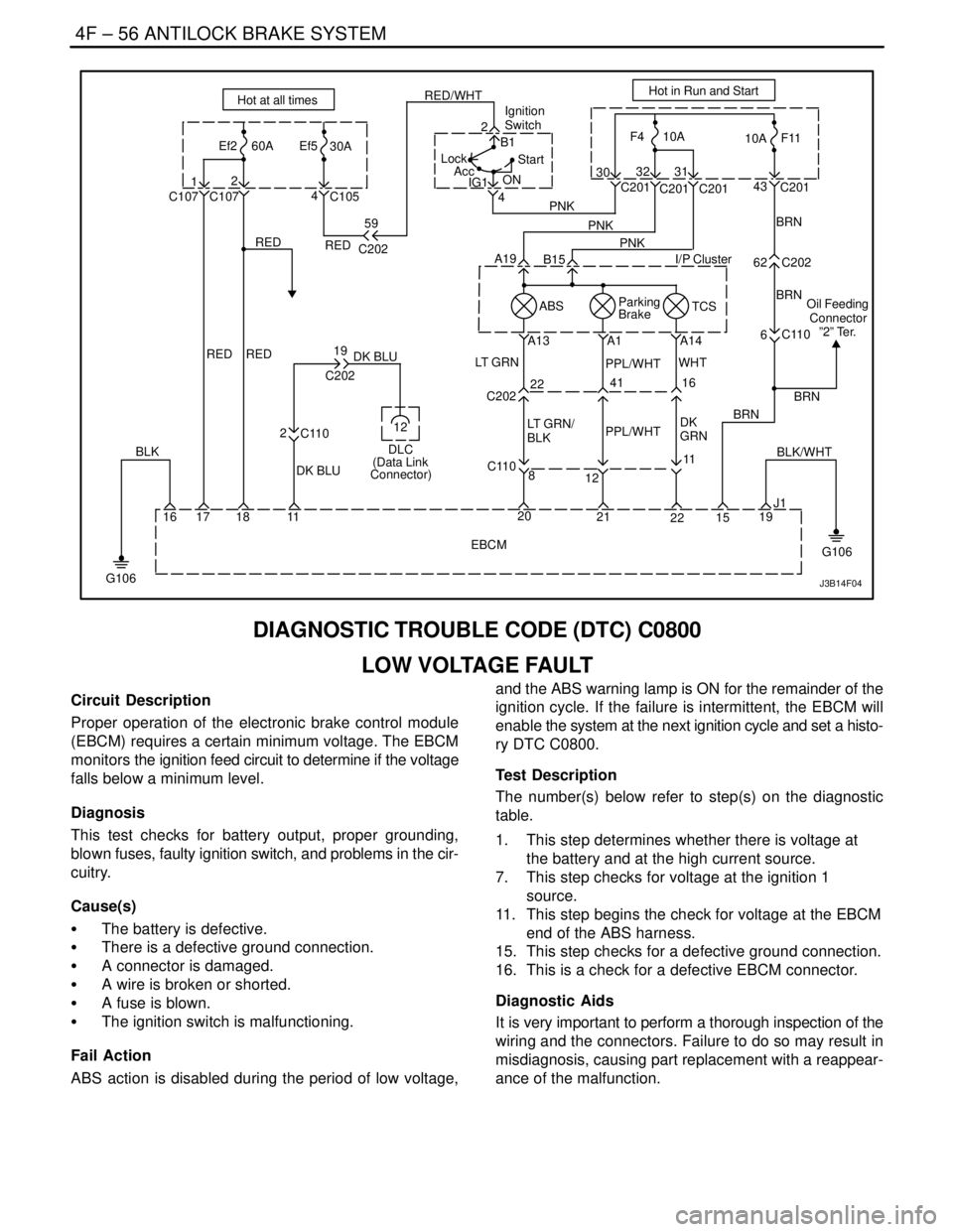
DIAGNOSTIC TROUBLE CODE (DTC) C0800
LOW VOLTAGE FAULT
Circuit Description
Proper operation of the electronic brake control module
(EBCM) requires a certain minimum voltage. The EBCM
monitors the ignition feed circuit to determine if the voltage
falls below a minimum level.
Diagnosis
This test checks for battery output, proper grounding,
blown fuses, faulty ignition switch, and problems in the cir-
cuitry.
Cause(s)
S The battery is defective.
S There is a defective ground connection.
S A connector is damaged.
S A wire is broken or shorted.
S A fuse is blown.
S The ignition switch is malfunctioning.
Fail Action
ABS action is disabled during the period of low voltage,and the ABS warning lamp is ON for the remainder of the
ignition cycle. If the failure is intermittent, the EBCM will
enable the system at the next ignition cycle and set a histo-
ry DTC C0800.
Test Description
The number(s) below refer to step(s) on the diagnostic
table.
1. This step determines whether there is voltage at
the battery and at the high current source.
7. This step checks for voltage at the ignition 1
source.
11. This step begins the check for voltage at the EBCM
end of the ABS harness.
15. This step checks for a defective ground connection.
16. This is a check for a defective EBCM connector.
Diagnostic Aids
It is very important to perform a thorough inspection of the
wiring and the connectors. Failure to do so may result in
misdiagnosis, causing part replacement with a reappear-
ance of the malfunction.
Page 1138 of 2643

ANTILOCK BRAKE SYSTEM 4F – 57
DAEWOO V–121 BL4
DTC C0800 – Low Voltage Fault
StepActionValue(s)YesNo
1Check the voltage at the battery.
Is the voltage within the specified value?11–14 vGo to Step 3Go to Step 2
2Charge or replace the battery as required.
Is the repair complete?–System OK–
3Check fuse EF2 in the engine fuse block.
Is the fuse blown?–Go to Step 4Go to Step 7
41. Replace fuse EF2.
2. Turn the ignition to ON.
Does the fuse blow again?–Go to Step 5Go to Step 6
51. Turn the ignition to OFF.
2. Trace the RED wires in the ABS wiring harness
from terminal 1 of C107 at the engine fuse
block to terminals 17 and 18 of the EBCM con-
nector.
3. Repair any short circuit found along this path.
Is the repair complete?–System OK–
61. Turn the ignition switch to OFF.
2. Install the scan tool.
3. Clear all DTCs.
4. Road test the vehicle.
Does DTC C0800 reset?–System OK–
7Check fuse F11 in the I/P fuse block.
Is the fuse blown?–Go to Step 8Go to Step 11
81. Replace fuse F11.
2. Turn the ignition to ON.
Does the fuse blow again?–Go to Step 9Go to Step 10
91. Turn the ignition to OFF.
2. Trace the BRN wire from fuse F11 to terminal
43 of connector C201, from terminal 62 of con-
nector C202 to terminal 6 of connector C110,
and from there to terminal 15 of the EBCM
connector.
3. Repair any short circuit found along this path.
Is the repair complete?–System OK–
101. Turn the ignition switch to OFF.
2. Install the scan tool.
3. Clear all DTCs.
4. Road test the vehicle.
Does DTC C0800 reset?–System OK–
111. Disconnect the EBCM connector from the
EBCM.
2. Turn the ignition to ON.
3. Check for the presence of battery voltage be-
tween ground and terminal 17, and between
ground and terminal 18.
Is the voltage within the specified value?11–14 vGo to Step 13Go to Step 12
Page 1141 of 2643

4F – 60IANTILOCK BRAKE SYSTEM
DAEWOO V–121 BL4
MAINTENANCE AND REPAIR
ON–VEHICLE SERVICE
SERVICE PRECAUTIONS
CAUTION : Brake fluid may irritate eyes and skin. In
case of contact, take the following actions:
S Eye contact – rinse thoroughly with water.
S Skin contact – wash with soap and water.
S Ingestion – consult a physician immediately.
CAUTION : To help avoid personal injury due to poor
braking, DO NOT tap into the vehicle’s brake system
to operate a trailer brake system.
Notice : When fasteners are removed, always reinstall
them at the same location from which they were removed.
If a fastener needs to be replaced, use the correct part
number fastener for that application. If the correct part
number fastener is not available, a fastener of equal size
and strength (or stronger) may be used. Fasteners that
are not reused, and those requiring thread–locking com-
pound will be called out. The correct torque values must
be used when installing fasteners that require them. If the
above procedures are not followed, parts or system dam-
age could result.
Notice : Use only DOT 3 equivalent hydraulic brake fluid.
The use of DOT 5 (silicone) brake fluid is not recom-
mended. Reduced brake performance or durability may
result.
Notice : Avoid spilling brake fluid on any of the vehicle’s
painted surfaces, wiring, cables, or electrical connectors.
Brake fluid will damage paint and electrical connections.
If any fluid is spilled on the vehicle, flush the area with wa-
ter to lessen the damage.
Computer System Service Precautions
Take care to avoid electronic brake control module
(EBCM) circuit overloading. In testing for opens or shorts,
do not ground or apply voltage to any circuit unless
instructed to do so by the diagnostic procedure. Test cir-
cuits only with a high–impedance multimeter. Never re-
move or apply power to any control module with the igni-
tion switch in the ON position. Always turn the ignition to
the OFF position before removing or connecting battery
cables, fuses, or connectors.
General Service Precautions
S Disconnect the EBCM connector before performing
any vehicle welding work using an electric arc weld-
er.
S Do not attempt to disassemble any component des-
ignated as nonserviceable. The hydraulic modulator
and the EBCM can be separated from each other
and replaced separately but cannot be serviced.
They have no replaceable parts, and there is no
access to the components they contain.