battery replacement DAEWOO LACETTI 2004 Service Service Manual
[x] Cancel search | Manufacturer: DAEWOO, Model Year: 2004, Model line: LACETTI, Model: DAEWOO LACETTI 2004Pages: 2643, PDF Size: 80.54 MB
Page 721 of 2643

ENGINE CONTROLS 1F – 475
DAEWOO V–121 BL4
the Actual EGR and Desired EGR Positions on a cold ve-
hicle with a scan tool, the fault can be easily verified.
Check the freeze frame data to determine if the DTC set
when the vehicle was cold by viewing the Engine Coolant
Temperature (ECT).
Test Description
Number(s) below refer to the step number(s) on the Diag-
nostic Table.
1. The On–Board Diagnostic (EOBD) System Check
prompts the technician to complete some basic
checks and store the freeze frame and failure re-
cords data on the scan tool if applicable. This
creates an electronic copy of the data taken when
the malfunction occurred. The information is then
stored on the scan tool for later reference.
2. Commanding the EGR valve open determines
whether the EGR system can control the EGR
valve accurately and if the fault is present. The dif-
ference between the current and commanded posi-
tion is greater than 15%.
3. When the EGR valve electrical connector is discon-
nected, the scan tool should display the Actual
EGR Position as 0%. If it does not, the fault lies
either in the EGR signal circuit or the ECM.
4. There may be a slight delay for the voltage dis-
played on the DVM to change after the scan tool
commands the EGR valve to operate.
5. An open or poor connection condition may have
caused this DTC to set. Be sure to check the termi-
nals for being backed out, improperly formed or
damaged, and for poor tension.
7. The test light will have glowed brightly in the pre-
vious step if the EGR control circuit was shorted to
B+ and the Actual EGR Position on the scan toolwill display 100%. A test light that did not illuminate,
indicates that the circuit may be open or shorted to
ground.
9. If the EGR valve 5 volt reference is shorted to volt-
age, the digital voltmeter (DVM) will read battery
voltage and additional DTCs may be set and the
engine performance will be poor.
12. The replacement ECM must be reprogrammed.
Refer to the latest Techline procedure for ECM re-
programming.
13. Although the circuitry acted correctly when
checked, a problem may still lie within the terminals
which would not show up in probe type testing. Be
sure to check the terminals for being backed out,
improperly formed or damaged, and for poor ten-
sion.
17. All circuits to the EGR valve are OK at this point.
The fault lies internally in the EGR valve and, there-
fore, must be replaced. Be sure all gasket material
is removed from the EGR mounting surface. Even
a small amount of material may cause a DTC
P0401 to set.
18. Check the terminals for being backed out, improp-
erly formed or damaged, and for poor tension.
19. Clearing DTCs is a very important step for this
diagnostic. The clearing function allows the EGR
valve to relearn a new pintle position as the old
pintle position was inaccurate due to the failure that
caused the DTC. The DTC must be cleared with
the ignition ON, engine OFF or when the engine is
idling. If the ECM sees a EGR command, the new
pintle will not be learned.
20. If no malfunctions have been found at this point and
no additional DTCs were set, refer to ”Diagnostic
Aids” in this section for additional checks and infor-
mation.
DTC P0404 – Exhaust Gas Recirculation Open Valve Position Error
StepActionValue(s)YesNo
1Perform an On–Board Diagnostic (EOBD) System
Check.
Was the check performed?–Go to Step 2Go to
”On–Board
Diagnostic Sys-
tem Check”
21. Install a scan tool to the Data Link Connector
(DLC).
2. Turn the ignition ON.
3. Command the Exhaust Gas Recirculation
(EGR) valve to the specific values.
Does the Actual EGR Position follow the Desired
EGR Position?25%, 50%,
75%, 100%Go to Step 19Go to Step 3
31. Turn the ignition OFF.
2. Disconnect the EGR valve.
3. Turn the ignition ON.
4. With a test light connected to B+, probe the
EGR valve wiring harness connector terminal
2.
Does the test light illuminate?–Go to Step 4Go to Step 5
Page 745 of 2643

ENGINE CONTROLS 1F – 499
DAEWOO V–121 BL4
S The MIL will turn off after four consecutive ignition
cycles in which the diagnostic runs without a fault.
S A history DTC will clear after 40 consecutive warm–
up cycles without a fault.
S DTC(s) can be cleared by using the scan tool.
S Disconnecting the ECM battery feed for more than
10 seconds.
Diagnostic Aids
An intermittent problem may be caused by a poor connec-
tion, rubbed–through wire insulation, or a wire that is bro-
ken inside the insulation.
VSS signal circuit should be thoroughly checked for the
following conditions:
S Backed–out terminals
S Improper mating
S Broken locks
S Improperly formed
S Damaged terminals
S Poor terminal–to–wire connection
S Physical damage to the wiring harness
Ensure the VSS is correctly tightened with proper torque
to the transmission housing.
Refer to ”Intermittents”in this section.
Test Description
Number(s) below refer to the step number(s) on the Diag-
nostic Table.
1. The On–Board Diagnostic (EOBD) System Check
prompts the technician to complete some basic
checks and store the freeze frame and failure re-cords data on the scan tool if applicable. This
creates an electronic copy of the data taken when
the malfunction occurred. The information is then
stored on the scan tool for later reference.
2. The permanent magnet generator only produces a
signal if the drive wheels are turning greater than 5
mph (8 km/h). This step determines if DTC P0502
is the result of a hard failure or an intermittent con-
dition.
3. Proper engine loads cannot be achieved in a shop
environment to properly run the vehicle within the
Freeze Frame Data conditions. It will be necessary
to drive the vehicle on the road to obtain the proper
engine loads.
4. This step verifies that the ECM is receiving a signal
from the vehicle speed sensor.
5. Refer to service bulletin information for the latest
calibration update.
6. Refer to the latest Techline information for program-
ming procedures.
8. A resistance reading that is higher than the speci-
fied value indicates that the VSS circuitry is open.
10. If the displayed resistance is less than the 1300
ohms, the VSS high and low circuits are shorted
together.
11. This checks the resistance of the VSS if no opens
or shorts were found on the VSS high and low cir-
cuits.
13. The replacement ECM must be reprogrammed.
Refer to the latest Techline procedure for ECM re-
programming.
DTC P0502 – Vehicle Speed Sensor No Signal (Engine Side)
StepActionValue(s)YesNo
1Perform an On–Board Diagnostic (EOBD) System
Check.
Was the check performed?–Go to Step 2Go to
”On–Board
Diagnostic Sys-
tem Check”
2Notice : Running the vehicle in gear with the wheels
hanging down at full travel will damage the drive
axles.
1. Install a scan tool to the Data Link Connector
(DLC).
2. Raise the drive wheels.
3. Support the lower control arms so that the
drive axles are in a horizontal (straight) posi-
tion.
4. Start the engine and allow to idle in gear.
Does the scan tool display vehicle speed above the
specific value?0 mphGo to Step 3Go to Step 4
Page 759 of 2643

ENGINE CONTROLS 1F – 513
DAEWOO V–121 BL4
DIAGNOSTIC TROUBLE CODE (DTC) P0562
SYSTEM VOLTAGE TOO LOW (ENGINE SIDE)
Circuit Description
The Engine Control Module (ECM) monitors the ignition
voltage on the ignition feed circuit to terminal K18 at the
ECM. A system voltage Diagnostic Trouble Code (DTC)
will set whenever the voltage is below a calibrated value.
Conditions for Setting the DTC
S System voltage is less than 11 volts.
S Engine is running.
Action Taken When the DTC Sets
S The Malfunction Indicator Lamp (MIL) will not illumi-
nate.
S The ECM will record operating conditions at the
time the diagnostic fails. This information will be
stored in the Failure Records buffers.
S A history DTC is stored.
Conditions for Clearing the MIL/DTC
S A history DTC will clear after 40 consecutive warm–
up cycles without a fault.
S DTC(s) can be cleared by using the scan tool.
S Disconnecting the ECM battery feed for more than
10 seconds.
Diagnostic Aids
If the DTC sets when an accessory is operated, check for
a poor connection or excessive current draw.
Any circuitry, that is suspected as causing the intermittent
complaint, should be thoroughly checked for the following
conditions:S Backed–out terminals
S Improper mating
S Broken locks
S Improperly formed
S Damaged terminals
S Poor terminal–to–wiring connections
S Physical damage to the wiring harness
Test Description
Number(s) below refer to the step number(s) on the Diag-
nostic Table.
1. The On–Board Diagnostic (EOBD) System Check
prompts the technician to complete some basic
checks and store the freeze frame and failure re-
cords data on the scan tool if applicable. This
creates an electronic copy of the data taken when
the malfunction occurred. The information is then
stored on the scan tool for later reference.
2. This checks if the generator is malfunctioning under
load conditions.
4. Checks the ignition feed circuit for excessive resist-
ance. An open circuit will cause a no start condi-
tion.
7. The replacement ECM must be reprogrammed.
Refer to the latest Techline procedure for ECM re-
programming.
9. If no malfunctions have been found at this point and
no additional DTCs were set, refer to ”Diagnostic
Aids” in this section for additional checks and infor-
mation for additional checks and information.
Page 761 of 2643

ENGINE CONTROLS 1F – 515
DAEWOO V–121 BL4
DIAGNOSTIC TROUBLE CODE (DTC) P0563
SYSTEM VOLTAGE TOO HIGH (ENGINE SIDE)
Circuit Description
The Engine Control Module (ECM) monitors the ignition
voltage on the ignition feed circuit to terminal K18 at the
ECM. A system voltage Diagnostic Trouble Code (DTC)
will set whenever the voltage is above a calibrated value.
Conditions for Setting the DTC
S System voltage is less than 16 volts.
S Engine is running.
Action Taken When the DTC Sets
S The Malfunction Indicator Lamp (MIL) will not illumi-
nate.
S The ECM will record operating conditions at the
time the diagnostic fails. This information will be
stored in the Failure Records buffers.
S A history DTC is stored.
Conditions for Clearing the MIL/DTC
S A history DTC will clear after 40 consecutive warm–
up cycles without a fault.
S DTC(s) can be cleared by using the scan tool.
S Disconnecting the ECM battery feed for more than
10 seconds.
Diagnostic Aids
If the DTC sets when an accessory is operated, check for
a poor connection or excessive current draw.Any circuitry, that is suspected as causing the intermittent
complaint, should be thoroughly checked for the following
conditions:
S Backed–out terminals
S Improper mating
S Broken locks
S Improperly formed
S Damaged terminals
S Poor terminal–to–wiring connections
S Physical damage to the wiring harness
Test Description
Number(s) below refer to the step number(s) on the Diag-
nostic Table.
1. The On–Board Diagnostic (EOBD) System Check
prompts the technician to complete some basic
checks and store the freeze frame and failure re-
cords data on the scan tool if applicable. This
creates an electronic copy of the data taken when
the malfunction occurred. The information is then
stored on the scan tool for later reference.
2. This checks if the generator is malfunctioning under
load conditions.
7. The replacement ECM must be reprogrammed.
Refer to the latest Techline procedure for ECM re-
programming.
9. If no malfunctions have been found at this point and
no additional DTCs were set, refer to ”Diagnostic
Aids” in this section for additional checks and infor-
mation for additional checks and information.
Page 763 of 2643

ENGINE CONTROLS 1F – 517
DAEWOO V–121 BL4
DIAGNOSTIC TROUBLE CODE (DTC) P0601
ECM CHECKSUM ERROR (ENGINE SIDE)
Circuit Description
The Engine Control Module (ECM) is the control center of
the fuel injection system. It constantly looks at the informa-
tion from various sensors, and controls the systems that
affect vehicle performance. The ECM also performs the
diagnostic function of the system. It can recognize opera-
tional problems, alert the driver through the Malfunction In-
dicator Lamp (MIL) (Check Engine), and store a Diagnos-
tic Trouble Code (DTC) or DTCs which identify the
problem areas to aid the technician in making repairs. An
Electrically Erasable Programmable Read Only Memory
(EEPROM) is used to house the program information and
the calibrations required for engine, transmission, and
powertrain diagnostics operation. The ECM uses a value
called a checksum for error detection of the software. The
checksum is a value that is equal to all the numbers in the
software added together. The ECM adds all the values in
the software, and if that value does not equal the check-
sum value, a checksum error is indicated.
Conditions for Setting the DTC
S Program ID is not equal to the value in the soft-
ware.
S Ignition switch is turned to ON.
Action Taken When the DTC Sets
S The Malfunction Indicator Lamp (MIL) will illumi-
nate.S The ECM will attempt to record operating condi-
tions at the time the failure is detected. However,
since this is the internal ECM fault, this information
may be or may not be reliable. This information will
be stored in the freeze Frame and Failure Records
buffers.
S A history DTC is stored.
Conditions for Clearing the MIL/DTC
S The MIL turn off after four consecutive ignition
cycles in which the diagnostic runs without a fault.
S A history DTC will clear after 40 consecutive warm–
up cycles without a fault.
S DTC(s) can be cleared by using the scan tool.
S Disconnecting the ECM battery feed for more than
10 seconds.
Test Description
Number(s) below refer to the step number(s) on the Diag-
nostic Table.
1. The On–Board Diagnostic (EOBD) System Check
prompts the technician to complete some basic
checks and store the freeze frame and failure re-
cords data on the scan tool if applicable. This
creates an electronic copy of the data taken when
the malfunction occurred. The information is then
stored on the scan tool for later reference.
2. The replacement ECM must be reprogrammed.
Refer to the latest Techline procedure for ECM re-
programming.
DTC P0601 – ECM Checksum Error (Engine Side)
StepActionValue(s)YesNo
1Perform an On–Board Diagnostic (EOBD) System
Check.
Was the check performed?–Go to Step 2Go to
”On–Board
Diagnostic Sys-
tem Check”
21. Turn the ignition OFF.
2. Replace the Engine Control Module (ECM).
Is the repair complete?–Go to Step 3–
31. Using the scan tool, clear the Diagnostic
Trouble Codes (DTCs).
2. Start the engine and idle at normal operating
temperature.
3. Operate the vehicle within the conditions for
setting this DTC as specified in the supporting
text.
Does the scan tool indicate that this diagnostic has
run and passed?–Go to Step 4Go to Step 2
4Check if any additional DTCs are set.
Are any DTCs displayed that have not been diag-
nosed?–Go to
Applicable DTC
tableSystem OK
Page 790 of 2643

1F – 544IENGINE CONTROLS
DAEWOO V–121 BL4
S The DTC(s) can be cleared by using the scan tool.
S Disconnecting the ECM battery feed for more than
10 seconds.
Diagnostic Aids
A malfunction in the HO2S1 ignition feed or ground circuit
may cause a DTC P1134 to set. Check HO2S1 circuitry for
intermittent faults or poor connections. If connections and
wiring are OK and DTC P1134 continues to set, replace
the HO2S1.
Reviewing the Failure Records vehicle mileage since the
diagnostic test last failed may help determine how open
the condition that caused the DTC to be set occurs. This
may assist in diagnosing the condition.Test Description
Number(s) below refer to the step number(s) on the Diag-
nostic Chart.
3. A condition that affects pre–converter and post–
converter oxygen sensors indicates probable con-
tamination. To avoid damaging replacement sen-
sors, correct the condition which caused the
contamination before replacing the affected sen-
sors.
5. This step checks for conditions which may cause
the oxygen sensor to appear faulty. Correct any of
the described conditions if present.
8. To avoid damaging replacement sensors, correct
the condition which caused the contamination be-
fore replacing the affected sensors
DTC P1134 – Front Heated Oxygen Sensor (HO2S1) Transition
Ratio
StepActionValue(s)YesNo
1Perform an On–Board Diagnostic (EOBD) System
Check.
Was the check performed?–Go to Step 2Go to
”On–Board
Diagnostic Sys-
tem Check”
2Important : If any Diagnostic Trouble Codes (DTCs)
are set, refer to those DTCs before processing with
this diagnostic chart.
1. Install a scan tool to the Data Link Connector
(DLC).
2. Start the engine and idle at normal operating
temperature.
3. Operate the engine within parameters specified
under Conditions for Setting the DTC.
4. Using a scan tool, monitor specific DTC info for
DTC P1134 until the DTC P1134 test runs.
5. Note the test result.
Does the scan tool indicate DTC P1134 failed this
ignition?–Go to Step 3Go to
”Diagnostic
Aids”
3Perform an exhaust system leak test.
If an exhaust leak is found, repair as needed.
The exhaust leak isolated?–Go to Step 14Go to Step 4
4Visually/physically inspect for the following items:
S Front Heated Oxygen Sensor (HO2S1) is se-
curely installed.
S Corrosion on the terminals.
S Terminal tension.
S HO2S1 wiring harness for poor terminal con-
nection or damaged wiring.
Is a problem found in any of the above areas?–Go to Step 7Go to Step 5
Page 796 of 2643

1F – 550IENGINE CONTROLS
DAEWOO V–121 BL4
DIAGNOSTIC TROUBLE CODE (DTC) P1336
58X CRANK POSITION TOOTH ERROR NOT LEARNED
Circuit Description
In order to detect engine misfire at higher engine speeds,
the Engine Control Module (ECM) must know of any varia-
tion between the crankshaft sensor pulses. Most varia-
tions are due to the machining of the crankshaft reluctor
wheel. However, other sources of variation are also pos-
sible. A Crankshaft Position (CKP) system variation learn-
ing procedure must be performed any time a change is
made to the crankshaft sensor to crankshaft relationship
of if the ECM is replaced or reprogrammed. The ECM
measures the variations and then calculates compensa-
tion factors needed to enable the ECM to accurately de-
tect engine misfire at all speeds and loads. A scan tool
must be used to command the ECM to learn these varia-
tions. If for any reason the ECM is unable to learn these
variations or they are out of an acceptable range, the ECM
will set Diagnostic Trouble Code (DTC) P1336. An ECM
that has not had the CKP system variation learning proce-
dure performed due to replacement or reprogramming will
also set DTC P1336.
Conditions for Setting the DTC
S Tooth error not learned if the manufacture enable
counter is set to zero.
S DTCs P0106, P0107, P0108, P0117, P0118,
P0122, P0123, P0132, P0201, P0202, P0203,
P0204, P0325 , 0327, P0336, P0337, P0341,
P0342, P0351, P0352, P0402, P1404, P0404,
P0405, P0406 and P0502 are not set.
Action Taken When the DTC Sets
S The Malfunction Indicator Lamp (MIL) will illumi-
nate.
S The ECM will record operating conditions at the
time the diagnostic fails. This information will be
stored in the Freeze Frame and Failure Records
buffer.
S A history DTC is stored.
Conditions for Clearing the MIL/DTC
S The MIL will turn OFF after four consecutive igni-
tion cycles in which the diagnostic runs without a
fault.
S A history DTC will clear after 40 consecutive warm
up cycles without a fault.
S Disconnecting the ECM battery feed for more than
10 seconds.
S DTC(s) can be cleared by using the scan tool.Diagnostic Aids
CAUTION : To avoid personal injury when performing
the crankshaft position system variation learning
procedure, always set the vehice parking brake and
block the drive wheels. Release the throttle immedi-
ately when the engine starts to decelerate. Once the
learn procedure is completed, engine control will be
returned to the operator, and the engine will respond
to throttle position.
DTC P1336 will only set if the ECM has not learned the
CKP system variation. The ECM only needs to learn this
variation once per life cycle of the vehicle unless the crank
sensor to crankshaft relationship is disturbed. Removing
a part is considered a disturbance. A fully warmed engine
is critical to learning the variation correctly. If a valid learn
occurs, no other learns can be completed that ignition
cycle.
If the engine cuts out before the specified learn procedure
engine speed or at normal fuel cutoff rpm, the ECM is not
in the learn procedure mode.
Test Description
The number(s) below refer to step(s) on the diagnostic
table.
1. The On–Board Diagnostic (EOBD) System Check
prompts the technician to complete some basic
checks and store the freeze frame and failure re-
cords data on the scan tool if applicable. This
creates an electronic copy of the data taken when
the fault occurred. The information is then stored on
the scan tool for later reference.
2. Engine temperature is critical to properly learn the
CKP system variation. Failure to properly warm the
engine before performing this procedure will result
in an inaccurate measurement of the CKP system
variation. The ECM learns this variation as the en-
gine is decelerating and then allows engine control
to be returned to the operator. All accessories must
be OFF when learning the CKP system angle varia-
tion. If the A/C is not disabled when the learn pro-
cedure is enabled, the ECM will disable the A/C.
3. If after the specified number attempts the ECM
cannot learn the CKP system variation, then the
variation is too large and no further attempts should
be made until the variation problem is corrected.
4. Being unable to learn the procedure indicates that
the variation is out of range.
5. After the CKP system variation has been learned,
wait above 10 seconds with ignition switch OFF to
prevent being cleared the learned value.
Page 812 of 2643

1F – 566IENGINE CONTROLS
DAEWOO V–121 BL4
freeze frame data to determine if the DTC set when the ve-
hicle was cold by viewing the Engine Coolant Temperature
(ECT).
Test Description
Number(s) below refer to the step number(s) on the Diag-
nostic Table.
1. The On–Board Diagnostic (EOBD) System Check
prompts the technician to complete some basic
checks and store the freeze frame and failure re-
cords data on the scan tool if applicable. This
creates an electronic copy of the data taken when
the malfunction occurred. The information is then
stored on the scan tool for later reference.
2. Commanding the EGR valve open determines
whether the EGR system can control the EGR
valve accurately and if the fault is present.
3. When the EGR valve electrical connector is discon-
nected, the scan tool should display the Actual
EGR Position as 0%. If it does not, the fault lies
either in the EGR signal circuit or the ECM.
5. If the ERG valve 5 volt reference is shorted to volt-
age, the Digital Voltmeter (DVM) will read battery
voltage and additional DTCs may be set and engine
performance will be poor.6. The replacement ECM must be reprogrammed.
Refer to the latest Techline procedure for ECM re-
programming.
10. An open or poor connection condition may have
caused this DTC to set. Be sure to check the termi-
nals for being backed out, improperly formed or
damaged, and for poor tension.
11. All circuits to the EGR valve are OK at this point.
The fault lies internally in the EGR valve and there-
fore must be replaced. Be sure all gasket material
is removed from the EGR mounting surface. Even
a small amount of material may cause a DTC
P0401 to set.
12. Check the terminals for being backed out, improp-
erly formed or damaged, and for poor tension.
13. Clearing DTCs is a very important step for this
diagnostic. The clearing function allows the EGR
valve to relearn a new pintle position as the old
pintle position was inaccurate due to the failure that
caused the DTC. The DTC must be cleared with
the ignition ON, engine OFF or when the engine is
idling. If the ECM sees a EGR command, the new
pintle will not be learned.
14. If no malfunctions have been found at this point and
no additional DTCs were set, refer to ”Diagnostic
Aids” in this section for additional checks and infor-
mation.
DTC P1404 – Exhaust Gas Recirculation Closed Valve Pintle Error
StepActionValue(s)YesNo
1Perform an On–Board Diagnostic (EOBD) System
Check.
Was tht check Performed?–Go to Step 2Go to
”On–Board
Diagnostic Sys-
tem Check”
21. Install a scan tool to the Data Link Connector
(DLC).
2. Turn the ignition ON.
3. Command the Exhaust Gas Recirculation
(EGR) valve to the specific values.
Does the Actual EGR Position follow the Desired
EGR Position?25%, 50%,
75%, 100%Go to Step 13Go to Step 3
31. Turn the ignition OFF.
2. Disconnect the EGR valve.
Is the Actual EGR Position near the specified value?100%Go to Step 4Go to Step 5
4Check the signal circuit terminal 3 at the EGR wiring
harness connector for a short to voltage and repair
as needed.
Is a repair complete?–Go to Step 13Go to Step 6
5With a voltmeter connected to the ground, probe the
5 volt reference circuit at terminal 4 of the EGR valve
wiring harness connector.
Is the voltage near the specified value?5 vGo to Step 7Go to Step 8
61. Turn the ignition OFF.
2. Replace the Engine Control Module (ECM).
Is the repair complete?–Go to Step 13–
Page 1093 of 2643
4F – 12IANTILOCK BRAKE SYSTEM
DAEWOO V–121 BL4
J3B14F04
60A Ef230A Ef5
2
42
C107 C105
2
C110
G106
A19
A13 A1 A14
C110 C202
C202WHT LT GRN
DK
GRN LT GRN/
BLK
BLK
DK BLUDK BLU
PPL/WHT
PPL/WHT ABS
TCS Parking
Brake
Hot at all times
RED REDRED/WHT
Ignition
Switch
RED
RED
I/P Cluster
EBCM8
20
22 2216 41
1211
18 1621
1
C107
10A F410AF11
32 31
43
6 62 C201
C201 C201C201
C110 C202
Hot in Run and Start
30
4
1711
C202
15
B15
DLC
(Data Link
Connector)12
G106
BLK/WHTOil Feeding
Connector
”2” Ter.
BRNBRN BRN
BRN PNK PNK PNK
19J1
59B1
ONStart Lock
Acc
IG1
19
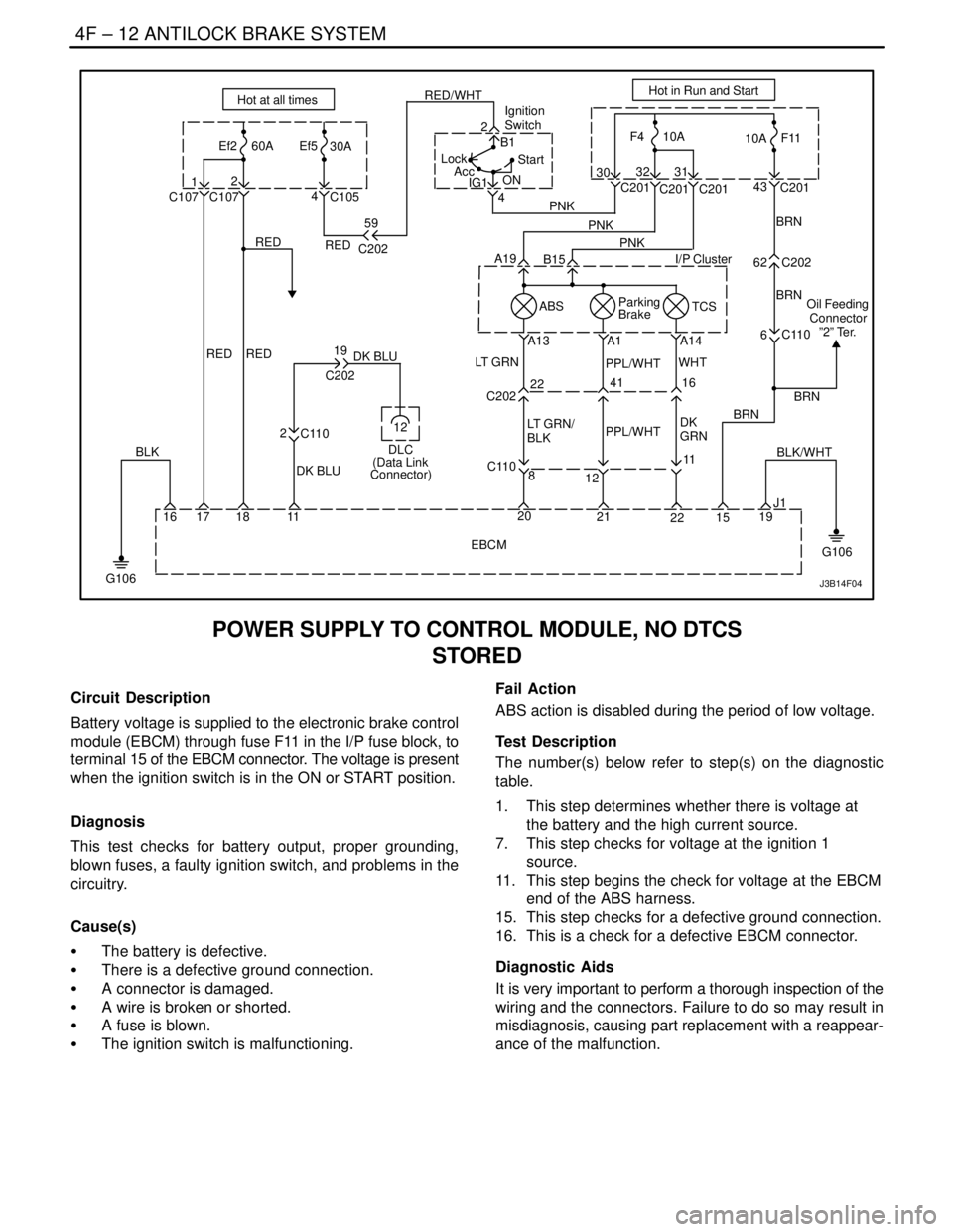
POWER SUPPLY TO CONTROL MODULE, NO DTCS
STORED
Circuit Description
Battery voltage is supplied to the electronic brake control
module (EBCM) through fuse F11 in the I/P fuse block, to
terminal 15 of the EBCM connector. The voltage is present
when the ignition switch is in the ON or START position.
Diagnosis
This test checks for battery output, proper grounding,
blown fuses, a faulty ignition switch, and problems in the
circuitry.
Cause(s)
S The battery is defective.
S There is a defective ground connection.
S A connector is damaged.
S A wire is broken or shorted.
S A fuse is blown.
S The ignition switch is malfunctioning.Fail Action
ABS action is disabled during the period of low voltage.
Test Description
The number(s) below refer to step(s) on the diagnostic
table.
1. This step determines whether there is voltage at
the battery and the high current source.
7. This step checks for voltage at the ignition 1
source.
11. This step begins the check for voltage at the EBCM
end of the ABS harness.
15. This step checks for a defective ground connection.
16. This is a check for a defective EBCM connector.
Diagnostic Aids
It is very important to perform a thorough inspection of the
wiring and the connectors. Failure to do so may result in
misdiagnosis, causing part replacement with a reappear-
ance of the malfunction.
Page 1137 of 2643
4F – 56IANTILOCK BRAKE SYSTEM
DAEWOO V–121 BL4
J3B14F04
60A Ef230A Ef5
2
42
C107 C105
2
C110
G106
A19
A13 A1 A14
C110 C202
C202WHT LT GRN
DK
GRN LT GRN/
BLK
BLK
DK BLUDK BLU
PPL/WHT
PPL/WHT ABS
TCS Parking
Brake
Hot at all times
RED REDRED/WHT
Ignition
Switch
RED
RED
I/P Cluster
EBCM8
20
22 2216 41
1211
18 1621
1
C107
10A F410AF11
32 31
43
6 62 C201
C201 C201C201
C110 C202
Hot in Run and Start
30
4
1711
C202
15
B15
DLC
(Data Link
Connector)12
G106
BLK/WHTOil Feeding
Connector
”2” Ter.
BRNBRN BRN
BRN PNK PNK PNK
19J1
59B1
ONStart Lock
Acc
IG1
19
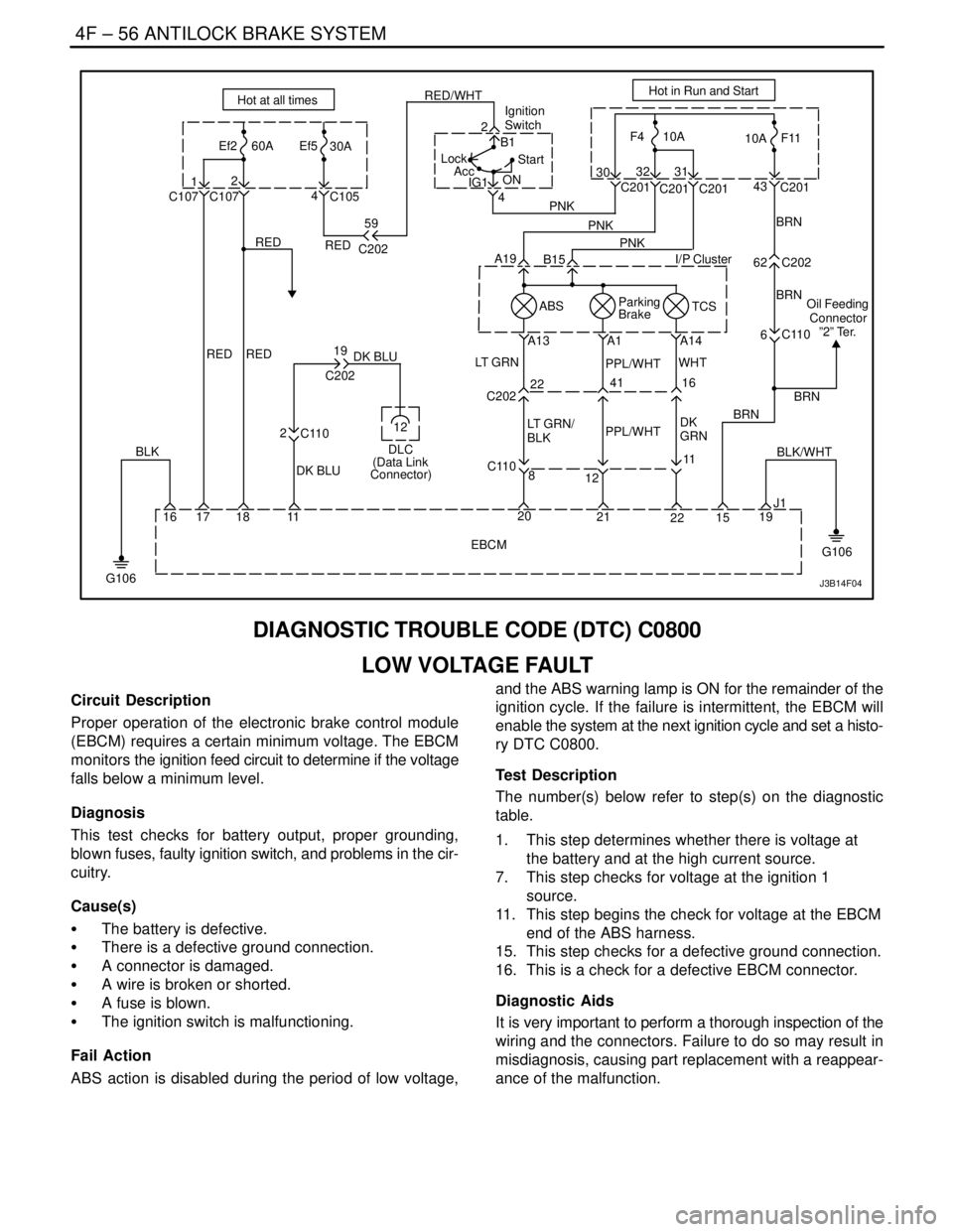
DIAGNOSTIC TROUBLE CODE (DTC) C0800
LOW VOLTAGE FAULT
Circuit Description
Proper operation of the electronic brake control module
(EBCM) requires a certain minimum voltage. The EBCM
monitors the ignition feed circuit to determine if the voltage
falls below a minimum level.
Diagnosis
This test checks for battery output, proper grounding,
blown fuses, faulty ignition switch, and problems in the cir-
cuitry.
Cause(s)
S The battery is defective.
S There is a defective ground connection.
S A connector is damaged.
S A wire is broken or shorted.
S A fuse is blown.
S The ignition switch is malfunctioning.
Fail Action
ABS action is disabled during the period of low voltage,and the ABS warning lamp is ON for the remainder of the
ignition cycle. If the failure is intermittent, the EBCM will
enable the system at the next ignition cycle and set a histo-
ry DTC C0800.
Test Description
The number(s) below refer to step(s) on the diagnostic
table.
1. This step determines whether there is voltage at
the battery and at the high current source.
7. This step checks for voltage at the ignition 1
source.
11. This step begins the check for voltage at the EBCM
end of the ABS harness.
15. This step checks for a defective ground connection.
16. This is a check for a defective EBCM connector.
Diagnostic Aids
It is very important to perform a thorough inspection of the
wiring and the connectors. Failure to do so may result in
misdiagnosis, causing part replacement with a reappear-
ance of the malfunction.