sensor DAEWOO LACETTI 2004 Service Repair Manual
[x] Cancel search | Manufacturer: DAEWOO, Model Year: 2004, Model line: LACETTI, Model: DAEWOO LACETTI 2004Pages: 2643, PDF Size: 80.54 MB
Page 1553 of 2643
5A1 – 204IZF 4 HP 16 AUTOMATIC TRANSAXLE
DAEWOO V–121 BL4
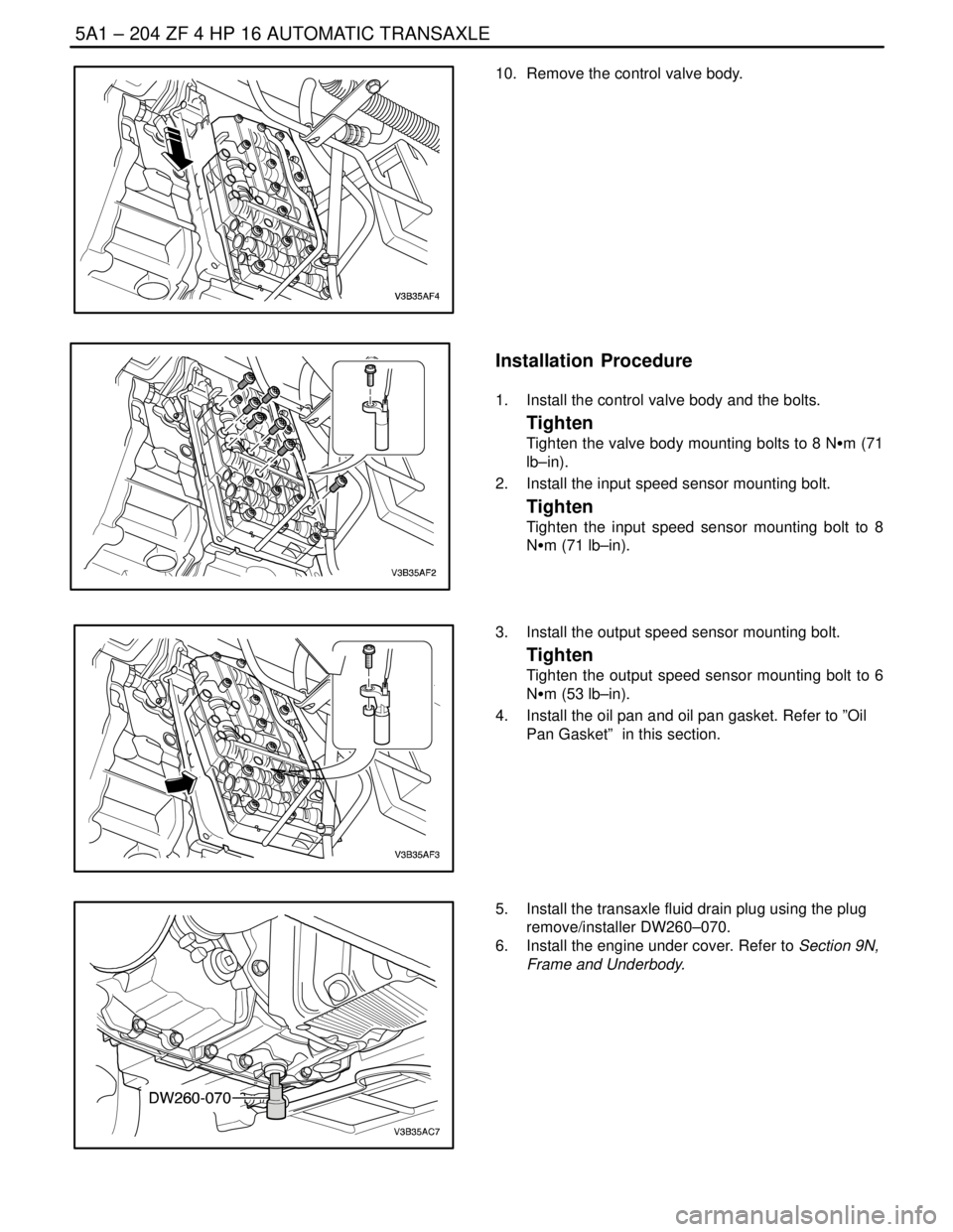
10. Remove the control valve body.
Installation Procedure
1. Install the control valve body and the bolts.
Tighten
Tighten the valve body mounting bolts to 8 NSm (71
lb–in).
2. Install the input speed sensor mounting bolt.
Tighten
Tighten the input speed sensor mounting bolt to 8
NSm (71 lb–in).
3. Install the output speed sensor mounting bolt.
Tighten
Tighten the output speed sensor mounting bolt to 6
NSm (53 lb–in).
4. Install the oil pan and oil pan gasket. Refer to ”Oil
Pan Gasket” in this section.
5. Install the transaxle fluid drain plug using the plug
remove/installer DW260–070.
6. Install the engine under cover. Refer to Section 9N,
Frame and Underbody.
Page 1562 of 2643
ZF 4 HP 16 AUTOMATIC TRANSAXLE 5A1 – 213
DAEWOO V–121 BL4
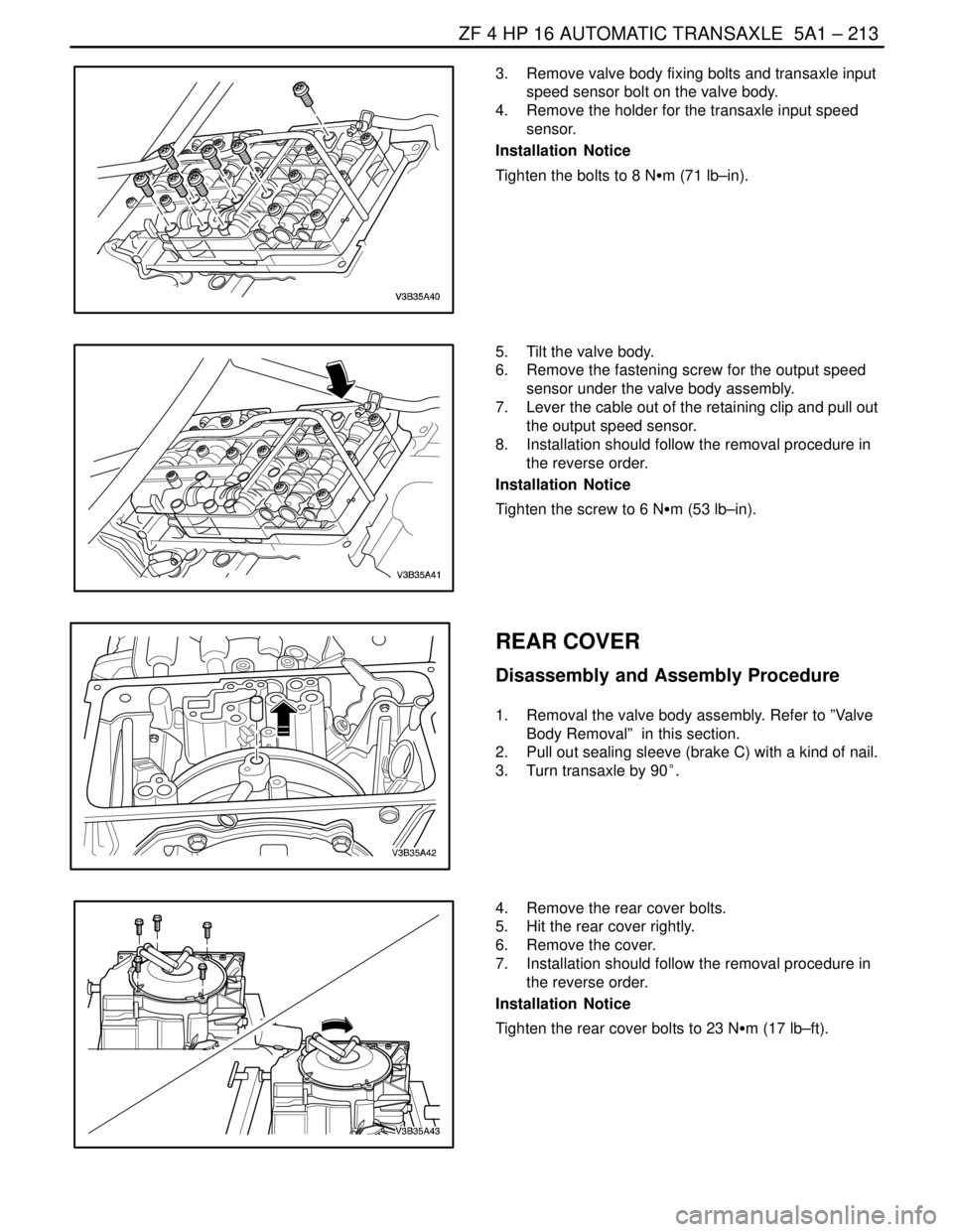
3. Remove valve body fixing bolts and transaxle input
speed sensor bolt on the valve body.
4. Remove the holder for the transaxle input speed
sensor.
Installation Notice
Tighten the bolts to 8 NSm (71 lb–in).
5. Tilt the valve body.
6. Remove the fastening screw for the output speed
sensor under the valve body assembly.
7. Lever the cable out of the retaining clip and pull out
the output speed sensor.
8. Installation should follow the removal procedure in
the reverse order.
Installation Notice
Tighten the screw to 6 NSm (53 lb–in).
REAR COVER
Disassembly and Assembly Procedure
1. Removal the valve body assembly. Refer to ”Valve
Body Removal” in this section.
2. Pull out sealing sleeve (brake C) with a kind of nail.
3. Turn transaxle by 90°.
4. Remove the rear cover bolts.
5. Hit the rear cover rightly.
6. Remove the cover.
7. Installation should follow the removal procedure in
the reverse order.
Installation Notice
Tighten the rear cover bolts to 23 NSm (17 lb–ft).
Page 1566 of 2643
ZF 4 HP 16 AUTOMATIC TRANSAXLE 5A1 – 217
DAEWOO V–121 BL4
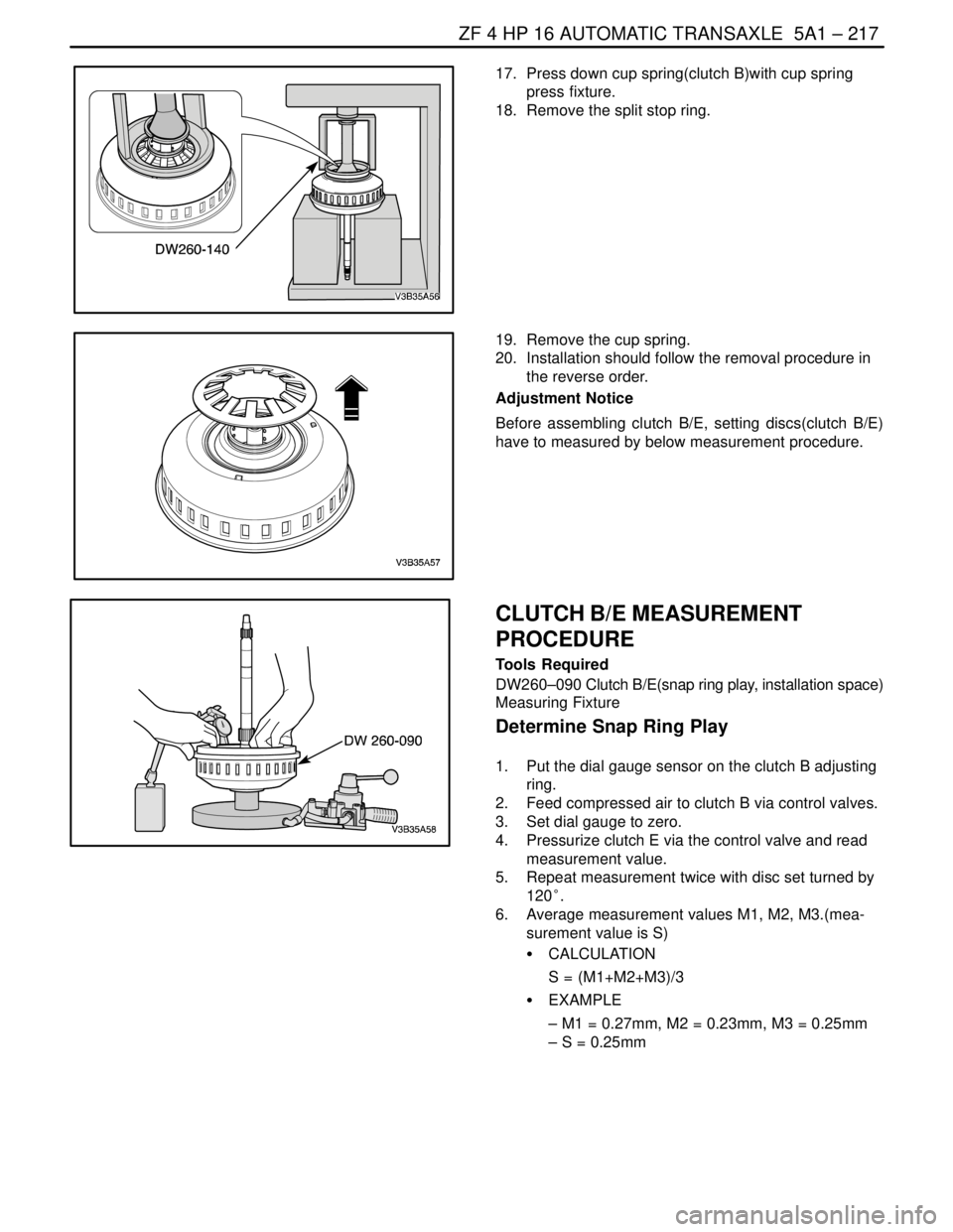
17. Press down cup spring(clutch B)with cup spring
press fixture.
18. Remove the split stop ring.
19. Remove the cup spring.
20. Installation should follow the removal procedure in
the reverse order.
Adjustment Notice
Before assembling clutch B/E, setting discs(clutch B/E)
have to measured by below measurement procedure.
CLUTCH B/E MEASUREMENT
PROCEDURE
Tools Required
DW260–090 Clutch B/E(snap ring play, installation space)
Measuring Fixture
Determine Snap Ring Play
1. Put the dial gauge sensor on the clutch B adjusting
ring.
2. Feed compressed air to clutch B via control valves.
3. Set dial gauge to zero.
4. Pressurize clutch E via the control valve and read
measurement value.
5. Repeat measurement twice with disc set turned by
120°.
6. Average measurement values M1, M2, M3.(mea-
surement value is S)
S CALCULATION
S = (M1+M2+M3)/3
S EXAMPLE
– M1 = 0.27mm, M2 = 0.23mm, M3 = 0.25mm
– S = 0.25mm
Page 1567 of 2643
5A1 – 218IZF 4 HP 16 AUTOMATIC TRANSAXLE
DAEWOO V–121 BL4
Tools Required
DW260–090 Clutch B/E (snap ring play, installation
space) Measuring Fixture
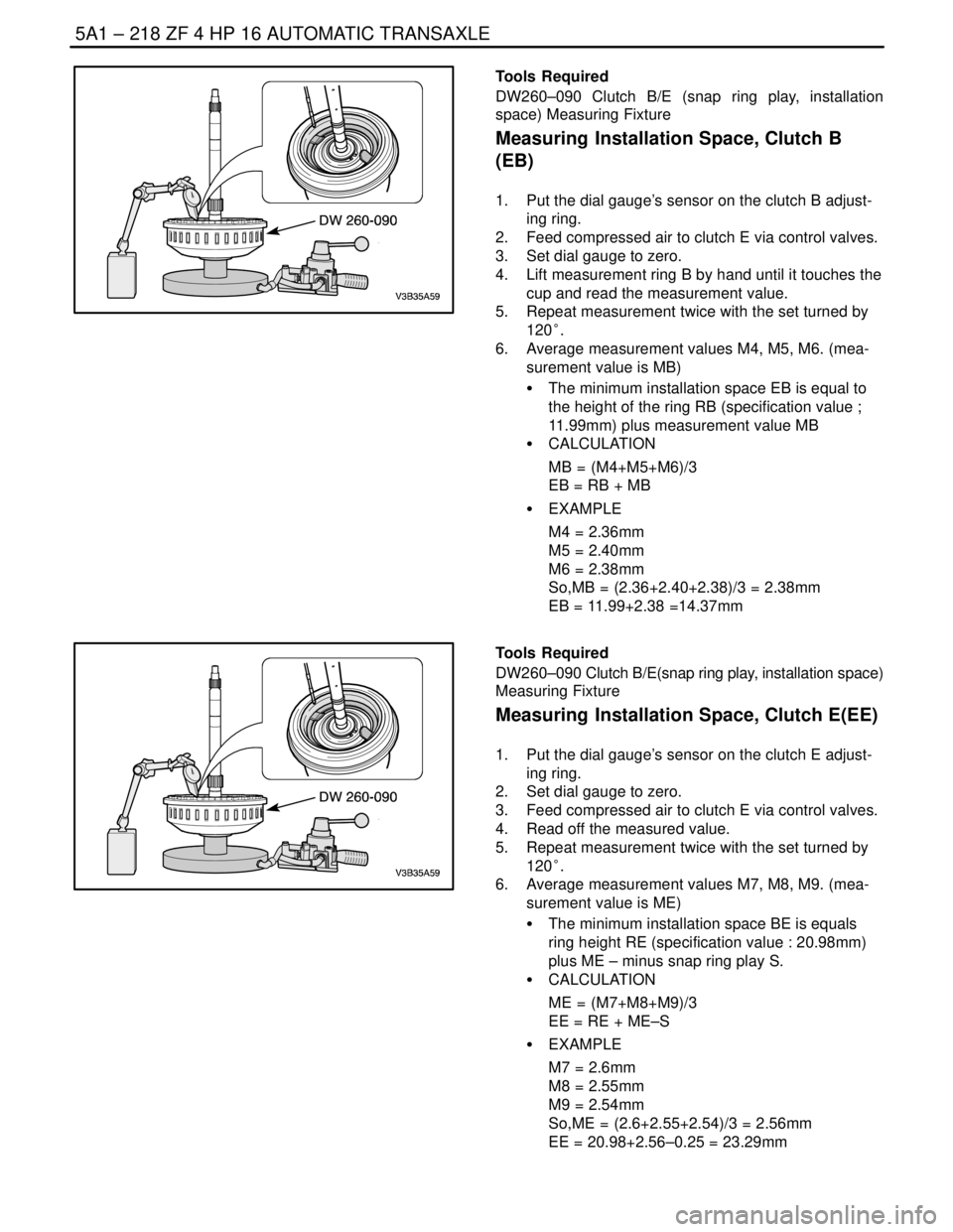
Measuring Installation Space, Clutch B
(EB)
1. Put the dial gauge’s sensor on the clutch B adjust-
ing ring.
2. Feed compressed air to clutch E via control valves.
3. Set dial gauge to zero.
4. Lift measurement ring B by hand until it touches the
cup and read the measurement value.
5. Repeat measurement twice with the set turned by
120°.
6. Average measurement values M4, M5, M6. (mea-
surement value is MB)
S The minimum installation space EB is equal to
the height of the ring RB (specification value ;
11.99mm) plus measurement value MB
S CALCULATION
MB = (M4+M5+M6)/3
EB = RB + MB
S EXAMPLE
M4 = 2.36mm
M5 = 2.40mm
M6 = 2.38mm
So,MB = (2.36+2.40+2.38)/3 = 2.38mm
EB = 11.99+2.38 =14.37mm
Tools Required
DW260–090 Clutch B/E(snap ring play, installation space)
Measuring Fixture
Measuring Installation Space, Clutch E(EE)
1. Put the dial gauge’s sensor on the clutch E adjust-
ing ring.
2. Set dial gauge to zero.
3. Feed compressed air to clutch E via control valves.
4. Read off the measured value.
5. Repeat measurement twice with the set turned by
120°.
6. Average measurement values M7, M8, M9. (mea-
surement value is ME)
S The minimum installation space BE is equals
ring height RE (specification value : 20.98mm)
plus ME – minus snap ring play S.
S CALCULATION
ME = (M7+M8+M9)/3
EE = RE + ME–S
S EXAMPLE
M7 = 2.6mm
M8 = 2.55mm
M9 = 2.54mm
So,ME = (2.6+2.55+2.54)/3 = 2.56mm
EE = 20.98+2.56–0.25 = 23.29mm
Page 1581 of 2643

5A1 – 232IZF 4 HP 16 AUTOMATIC TRANSAXLE
DAEWOO V–121 BL4
GENERAL DESCRIPTION
AND SYSTEM OPERATION
The ZF 4HP 16 automatic transaxle consists primarily of
the following components.
Mechanical
S Torque converter with TCC
S Drive link assembly
S Two multiple disk clutch assemblies : Clutch B,E
S Three multiple brake assemblies : Brake C,D,F
S Lock–up clutch valve
S Two planetary gear sets
S One oil pump
S Final drive and differential assembly
Electronic
S Two shift solenoid valve(sol.1,2)
S Four pressure control solenoid valve(EDS)
S Two speed sensors : A/T ISS and A/T OSS
S Fluid temperature sensor
S Automatic transaxle control module(TCM)
S Wiring harness assembly
MECHANICAL COMPONENTS
Torque Converter
The converter consists of the impeller, the turbine wheel,
the reaction member (stator) and the oil to transmit torque.
The impeller, which is driven by the engine, causes the oil
in the converter to flow in a circular pattern. This oil flow
meets the turbine wheel, where is direction of flow is de-
flected. At the hub, the oil leaves the turbine and reaches
the reaction member (stator), where it is once again de-
flected so that it reaches the impeller at the correct angle
of flow.
The reversal effect generates movement in the stator, the
reaction torque then amplifies the turbine torque.
The ratio between turbine torque and torque is referred to
as torque multiplication.
The greater the difference is speed between the pump and
turbine, the greater the torque multiplication; it is at its
highest when the turbine is at a standstill. The higher the
speed of the turbine, the lower the torque multiplication.
When the turbine speed reaches about 85%of the pump
speed, torque multiplication=1, i.e. the turbine torque
equivalent to pump torque.
The stator, which bears against the housing via the free-
wheel, is then rotating freely in the oil flow and the free-
wheel is over–come. From this point onwards, the con-
verter acts as a straightforward fluid coupling.
Space Behind Lock–up Clutch Piston
1. Friction lining
2. Lock–up clutch piston
3. Converter cover
4. Turbine wheel
5. Impeller
6. Stator
7. Turbine hub
8. Torque converter impeller hub
Torque Converter Lock–up Clutch (TCC)
The converter lock–up clutch is a device, which eliminates
converter slip and thus helps to improve fuel consumption.
The previous control principle for converter lock–up clutch
operation has been replaced by a controlling function on
the 4 HP 16. The converter lock–up clutch is engaged and
released in a controlled manner. During the controlled
phase, a slight speed difference between the impeller and
turbine wheel is established. This ensures that the en-
gine’s rotating vibration is not phased on to the transaxle.
The result is optimum shift quality.
An electronic pressure–regulating valve determines pres-
sure regulation of the lock–up converter clutch’s piston.
When open (conversion range), the oil pressure behind
the converter lock–up clutch piston and in the turbine zone
is equal. The direction of flow is through the turbine shaft
and through the space behind the piston, to the turbine
chamber.
Page 1585 of 2643

5A1 – 236IZF 4 HP 16 AUTOMATIC TRANSAXLE
DAEWOO V–121 BL4
ELECTRONICAL COMPONENTS
Selector Lever/Program Switch
The driver engages the travel position via the selector le-
ver:
P : Park Position
R : Reverse
N : Neutral
D : Forward Speeds
Park/Neutral Position Switch
The Park/Neutral Position Switch is located on the selec-
tor shaft and informs the TCM of the current selector lever
position P–R–N–D–3–2–1.
The selector lever position is transmitted to the TCM in en-
coded form along 4 lines. The encoding is such that mal-
functions in the connecting lead are identified.
The Park/Neutral Position Switch is located on the selec-
tor shaft, which is connected to the selector lever via a pull
cable. In addition, the Park/Neutral Position Switch con-
trols the starter interlock, the reversing light and the selec-
tor lever position indicator on the instrument panel.
Signal Combination
L1L2L3L4
P00120
R00012
N01200
D1212120
31212012
21201212
10121212
Automatic Transaxle Output Speed Sensor
(A/T OSS)
The vehicle A/T OSS is a magnetic inductive pickup that
relays information relative to vehicle speed to the TCM.
Vehicle speed information is used by the TCM to control
shift timing, line pressure, and TCC (lock–up clutch) apply
and release.
The output speed sensor mounts in the case at the speed
sensor rotor, which is pressed onto the spur gear. An air
gap of 0.1mm~1.3mm(0.004~0.05in) is maintained be-
tween the sensor and the teeth on the spur gear teeth. The
sensor consists of a permanent magnet surrounded by a
coil of wire.
As the differential rotates, an AC signal is generated by the
output speed sensor (OSS).
Automatic Transaxle Input Speed Sensor
(A/T ISS)
The A/T ISS is a magnetic inductive pickup that relays in-
formation relative to transaxle input speed to the TCM.
The TCM uses transaxle input speed information to con-
trol line pressure, TCC apply and release and transaxle
shift patterns. This information is also uses to calculate the
appropriate operating gear ratios and TCC slippage.
The input speed sensor mounts onto piston B that is inside
of valve body.
An air gap of 1.8~2.2mm(0.07~0.086inch) is maintained
between the sensor and the piston B.
The sensor consists of a permanent magnet surrounded
by a coil of wire. As the piston B is driven by the turbine
shaft, an AC signal induced in the input speed sensor.
Higher vehicle speeds induce a higher frequency and volt-
age measurement at the sensor.
Sensor resistance should measure between 825~835
ohms at 20°C (68°F). Sensor can measure from
1,000~8,000HZ.
Page 1587 of 2643

5A1 – 238IZF 4 HP 16 AUTOMATIC TRANSAXLE
DAEWOO V–121 BL4
Transaxle Fluid Temperature (TFT) Sensor
The TFT sensor is a positive temperature coefficient
thermistor (temperature sensitive resistor) that provides
information to the TCM regarding transaxle fluid tempera-
ture. The temperature sensor is located in valve body. Cal-
culated temperature is a factor used to determine the shift
time and shift delay time.
The internal electrical resistance of the sensor varies in
relation to the operating temperature of the transaxle fluid
(see chart).
The TCM sends a 5 volt–reference signal to the tempera-
ture sensor and measures the voltage rise in the electrical
circuit. A higher fluid temperature creates a higher resist-
ance in the temperature sensor, thereby measuring a low-
er voltage signal.
The TCM measures this voltage as another input to help
control line pressure, shift schedules and TCC apply.
When transaxle fluid temperature reaches 140°C (284°F)
the TCM enters ”hot mode.” Above this temperature the
TCM modifies transaxle shift schedules and TCC apply in
an attempt to reduce fluid temperature by reducing trans-
axle heat generation. During hot mode the TCM applies
the TCC at all times in fourth gear.
Also, the TCM commands the 2–3 and 3–4 shifts earlier
to help reduce fluid heat generation. Hot mode may not be
available on some applications.
Transaxle Sensor – Temperature To
Resistance To Voltage (approximate)
°C (°F)R high (ohms)R low (ohms)°C (°F)R high (ohms)R low (ohms)
–40 (–40)58655650 (122)1,2061,173
–30 (–22)64161160 (146)1,2951,256
–20 (–4)69967070 (158)1,3881,341
–10 (14)76073280 (176)1,4851,430
0 (32)82579990 (194)1,5851,522
10 (50)893868100 (212)1,6901,617
20 (68)963942110 (230)1,7981,715
25 (77)1,000980120 (248)1,9101,816
30 (86)1,0391,017130 (266)2,0251,920
140 (284)2,1452,027
Transaxle Electrical Connector
The transaxle electrical connector is a very important part
of the transaxle operating system. Any interference with
the electrical connection can cause the transaxle to set
Diagnostic Trouble Codes (DTCs) and/or affect proper op-
eration.
The following items can affect the electrical connections:S Bent pins in the connector from rough handling dur-
ing connection and disconnection.
S Wires backing away from the pins or coming un-
clamped (in either internal or external wiring har-
ness).
S Dirt contamination entering the connector when dis-
connected.
S Pins in the internal wiring connector backing out of
the connector or pushed out during reconnection.
Page 1588 of 2643

ZF 4 HP 16 AUTOMATIC TRANSAXLE 5A1 – 239
DAEWOO V–121 BL4
S Excessive transaxle fluid leaking into the connector,
wicking up into the external wiring harness, and
degrading the wire insulation.
S Water/moisture intrusion in the connector.
S Low pin retention in the external connector from
excessive connection and disconnection of the wir-
ing connector assembly.
S Pin corrosion from contamination.
S Broken/cracked connector assembly.
S Points to remember when working with transaxle
wiring connector assembly.
S To remove the connector, squeeze the two tabs
towards each other and pull straight up (refer to
illustration).Carefully limit twisting or wiggling the connector during re-
moval. Bent pins can occur.
DO NOT pry the connector off with a screwdriver or other
tool.
To reinstall the external wiring connector, first orient the
pins by lining up arrows on each half of the connector.
Push the connector straight down into the transaxle with-
out twisting or angling the mating parts.
The connector should click into place with a positive feel
and/or noise.
Transaxle Control Module (TCM)
The transaxle control module (TCM) is an electronic de-
vice which monitors inputs to control various transaxle
functions including shift quality and transaxle sensors,
switches, and components to process for use within its’
control program. Based on this input information, the TCM
controls various transaxle output functions and devices.
Data Link Connector (DLC)
The data link connector (DLC) is a multiple cavity connec-
tor. The DLC provides the means to access serial data
from the TCM to aid in powertrain diagnosis. The DLC al-
lows the technician to use a scan tool to monitor various
systems and display diagnostic trouble codes (DTCs).
The DLC connector is located within the driver’s compart-
ment, directly below the steering column.
Page 1589 of 2643

5A1 – 240IZF 4 HP 16 AUTOMATIC TRANSAXLE
DAEWOO V–121 BL4
Data Link Connector (CAN TYPE) 1.8L DOHC (Delphi 32 bit)
A Connector (Blue)B Connector (Green)C Connector (Gray)
1Solenoid 2Fluid Temperature GroundSelector Lever Line L1
2Not UsedInput Speed Sensor (+)Not Used
3Pressure Control Solenoid Valve
(EDS 4)BAT +Not Used
4TFT SensorInput Speed Sensor (–)Hold Mode Switch
5Stoplamp SwitchOutput Speed Sensor (–)Not Used
6Hold Mode IndicatorSelector Lever Line L3EDS Supply
7DLCInput Speed Sensor GroundEDS Supply
8CAN HighSpeedometerSolenoid Supply
9Solenoid 1Not UsedNot Used
10Pressure Control Solenoid Valve
(EDS 5)Output Speed Sensor (+)Not Used
11Pressure Control Solenoid Valve
(EDS 3)Selector Lever Line L4Not Used
12Pressure Control Solenoid Valve
(EDS 6)GroundNot Used
13Not UsedGroundNot Used
14Not UsedNot UsedNot Used
15Not UsedSelector Lever Line L2IG ON
16CAN LowNot UsedIG ON
Page 1590 of 2643

ZF 4 HP 16 AUTOMATIC TRANSAXLE 5A1 – 241
DAEWOO V–121 BL4
TCM INPUTS THAT AFFECT THE 4HP
16 TRANSAXLE
Throttle Position Sensor
S Provides throttle position data to the TCM for deter-
mining shift patterns and TCC apply/release.
S An incorrect throttle position sensor input could
causes erratic or shift pattern, poor shift quality or
TCC function
Automatic Transaxle Output (Shaft) Speed
Sensor
S Provides vehicle speed data to the TCM for deter-
mining shift patterns and TCC apply/release, and
gear ratio calculations.
S An incorrect throttle position sensor input could
causes erratic or shift pattern, poor shift quality or
TCC function
Automatic Transaxle Input (Shaft) Speed
Sensor
S Provides transaxle input speed data to the TCM for
determining shift patterns and TCC apply/release,
and gear ratio.
Engine Coolant Temperature Sensor
S Provides coolant temperature data to the TCM for
determining initial TCC engagement.
S An incorrect engine coolant temperature sensor
input could causes an incorrect initial TCC apply
Engine Speed
S The ignition module provides engine speed data the
TCM.
S The TCM uses engine speed information for con-
trolling wide open throttle shifts and the TCC PWM
solenoid duty cycle.
Stoplamp Switch
S Provides brake apply information to the TCM for
controlling TCC apply and release.
S An incorrect TCC stoplamp switch input could
causes an incorrect TCC apply or release.
Transaxle Fluid Temperature (TFT) Sensor
S Provides transaxle fluid temperature information to
the TCM for determining alternate shift patterns and
TCC apply during high temperature conditions (hot
mode operation).
S An incorrect transaxle temperature sensor input
could causes altered shift patterns, poor shift quali-
ty and incorrect TCC apply.