engine coolant DAEWOO LACETTI 2004 Service Workshop Manual
[x] Cancel search | Manufacturer: DAEWOO, Model Year: 2004, Model line: LACETTI, Model: DAEWOO LACETTI 2004Pages: 2643, PDF Size: 80.54 MB
Page 252 of 2643

1F – 6IENGINE CONTROLS
DAEWOO V–121 BL4
SPECIFICATIONS
ENGINE DATA DISPLAY TABLES
Engine Data Display
Parameter
ScalingValue
Desired Idle SpeedRPMECM idle command (varies with temperature)
Engine RPMRPM± 50 RPM from desired RPM in drive (A/T) ± 50 RPM
from desired RPM in neutral (M/T)
MAPkPa29 – 55 (varies with manifold and barometric pressure)
Throttle Position VoltV0 v
Start–up IAT°Cvaries
Intake Air Temperature°C10 – 90 °C
Coolant Temperature (Start–up)°Cvaries
Engine Coolant Temperature°C85 – 105 °C
IAC Motor Position–1 – 50
O2 Sensor (B1–S1)mV1–1000 mV (varies continuously)
O2 Sensor (B1–S2)mV1–1000 mV (varies continuously)
Fuel System StatusClosed Loop/Open
Loop”Closed Loop” (may enter ”Open Loop” at extended idle)
Rich/Lean (B1–S1)Rich/Leanvaries
Lean to Rich AveragemS10 –211 ms or 0 ms
Rich to Lean AveragemS10 –211 ms or 0 ms
Engine Load Value%0 – 100 % (varies)
Short Term Fuel Trim%–30 – 30%
Long Term Fuel Trim%–30 – 30%
Linear EGR FeedbackVvaries
EGR Duty Cycle%0 %
EGR EWMA Result–< = 0
Spark Advance°varies
MIL OdometerKm0 Km
MIL On TimeMin0 Min
Base Injection PWMmS1.0 – 5.0 ms
Barometric PressurekPavaries with altitude
Ignition VoltageV13.5 – 14.8 V
Air/Fuel RatioRatio14.6 (Closed Loop Enable)
Calculated Air FlowG/Svaries
Total Misfire (Current)–0
Misfire History Cyl. 1–0
Misfire History Cyl. 2–0
Misfire History Cyl. 3–0
Misfire History Cyl. 4–0
Vehicle SpeedKm/H0 Km/H
A/C PressureVvaries
Page 253 of 2643

ENGINE CONTROLS 1F – 7
DAEWOO V–121 BL4
Parameter ValueScaling
A/C RequestYes/NoNo
A/C ClutchOn/OffOff
Fuel Pump CommandOn/OffOn
Closed LoopYes/NoYe s
Throttle At IdleYes/NoNo
O2 Ready (B1–S1)Yes/NoYe s
Knock PresentYes/NoNo
Fan LowOn/OffOn/Off
Fan HighOn/OffOn/Off
TCC Engaged (Only AT)Yes/NoYe s
Park/Neutral (Only AT)P/N and R/N/DP/N
Fuel Level InputVvaries
Fuel Level Output%varies
Fuel Trim Cell–18
G–SensorV1.1 – 3.7 V (Non–ABS Only)
Engine RuntimeHH:MM:SSHours:Minutes:Seconds
* Condition: Warmed up, idle, park or neutral, A/C off
ENGINE DATA DISPLAY TABLE
DEFINITIONS
ECM Data Description
The following information will assist in diagnosing emis-
sion or driveability problems. A first technician can view
the displays while the vehicle is being driven by second
technician. Refer to Powertrain On–Board Diagnostic
(EOBD) System Check for addition information.
A/C Clutch
The A/C Relay represents the commanded state of the
A/C clutch control relay. The A/C clutch should be en-
gaged when the scan tool displays ON.
A/C Pressure
The A/C High Side displays the pressure value of the A/C
refrigerant pressure sensor. The A/C High Side helps to
diagnose the diagnostic trouble code (DTC) P0533.
A/C Request
The A/C Request represents whether the air conditioning
is being requested from the HVAC selector. The input is re-
ceived by the instrument panel cluster and then sent serial
data to the ECM and finally to the scan tool over KWP 2000
serial data.
Air Fuel Ratio
The Air Fuel Ration indicates the air to fuel ratio based on
the Front Heated Oxygen Sensor (HO2S1) inputs. The
ECM uses the fuel trims to adjust fueling in order to at-
tempt to maintain an air fuel ratio of 14.7:1.BARO
The Barometric Pressure (BARO) sensor measures the
change in the intake manifold pressure which results from
altitude changes. This value is updated at ignition ON and
also at Wide Open Throttle (WOT).
Base Injection PWM
Indicates the base Pulse Width Modulation (PWM) or ON
time of the indicated cylinder injector in milliseconds.
When the engine load is increased, the injector pulse width
will increase.
Calculated Air Flow
The calculated air flow is a calculation based on manifold
absolute pressure. The calculation is used in several diag-
nostics to determine when to run the diagnostics.
Desired Idle Speed
The ECM commands the idle speed. The ECM compen-
sates for various engine loads in order to maintain the de-
sired idle speed. The actual engine speed should remain
close to the desired idle under the various engine loads
with the engine idling.
Engine Coolant Temperature
The Engine Coolant Temperature (ECT) sensor sends en-
gine temperature information to the ECM. The ECM sup-
plies 5 volts to the engine coolant temperature sensor cir-
cuit. The sensor is a thermistor which changes internal
resistance as temperature changes. When the sensor is
cold (internal resistance high), the ECM monitors a high
voltage which it interprets as a cold engine. As the sensor
warms (internal resistance decreases), the voltage signal
will decrease and the ECM will interpret the lower voltage
as a warm engine.
Page 254 of 2643

1F – 8IENGINE CONTROLS
DAEWOO V–121 BL4
EGR Desired Position
The desired exhaust gas recirculation (EGR) position is
the commanded EGR position. The ECM calculates the
desired EGR position. The higher the percentage, the lon-
ger the ECM is commanding the EGR valve ON.
Engine Load
Indicates engine load based on manifold absolute pres-
sure. The higher the percentage, the more load the engine
is under.
Engine Run Time
The engine run time is a measure of how long the engine
has been running. When the engine stops running, the tim-
er resets to zero.
Engine Speed
Engine Speed is computed by the ECM from the fuel con-
trol reference input. It should remain close to desired idle
under the various engine loads with the engine idling.
Fan
The Fan Control (FC) Relay is commanded by the ECM.
The FC Relay displays the command as ON or OFF.
Fuel Level Sensor
The Fuel Level Sensor monitors the fuel level in the tank.
The Fuel Level Sensor monitors the rate of change of the
air pressure in the EVAP system. Several of the Enhanced
EVAP System diagnostics are dependent upon the correct
fuel level.
Fuel System Status
The Closed Loop is displayed indicating that the ECM is
controlling the fuel delivery according to the Front Heated
Oxygen Sensor (HO2S1) voltage as close to an air/fuel ra-
tio of 14.7 to 1 as possible.
IAC Position
The scan tool displays the ECM command for the Idle Air
Control (IAC) pintle position in counts. The higher the
number of counts, the greater the commanded idle speed
reads. The Idle Air Control responds to changes in the en-
gine load in order to maintain the desired idle rpm.
Ignition 1 (Voltage)
The ignition volts represent the system voltage measured
by the ECM at the ignition feed circuit.
Intake Air Temperature
The ECM converts the resistance of the Intake Air Tem-
perature (IAT) sensor to degrees in the same manner as
the engine coolant temperature (ECT) sensor. In take air
temperature is used by the ECM to adjust fuel delivery and
spark timing according to incoming air density.Knock Present
The KS Noise Channel indicates when the ECM detects
the KS signal. The ECM should display NO at idle.
Long Term FT
The Long Term Fuel Trim (FT) is derived from the short
term fuel trim value. The Long Term FT is used for the long
term correction of the fuel delivery. A value of 128 counts
(0%) indicates that the fuel delivery requires no com-
pensation in order to maintain a 14.7:1 air to fuel ratio. A
value below 128 counts means that the fuel system is too
rich and the fuel delivery is being reduced. The ECM is de-
creasing the injector pulse width. A value above 128
counts indicates that a lean condition exists for which the
ECM is compensating.
MAP
The Manifold Absolute Pressure (MAP) sensor measures
the change in the intake manifold pressure which results
from engine load and speed changes. As the intake man-
ifold pressure increases, the air density in the intake also
increases and the additional fuel is required.
Misfire History #1–4
Indicates the number of misfires that have occurred after
195 current misfires have been counted. The current mis-
fire counter will add its misfires to the history misfire count-
er after 195 total misfires have taken place. If 1 cylinder is
misfiring, the misfiring current counter will have 195 mis-
fires counted before adding to its history counter. If 2 cylin-
ders are misfiring, the misfiring current counter will add to
their history counters after 97 misfires. The counter incre-
ments only after a misfire diagnostic trouble code (DTC)
has been set.
Front Heated Oxygen Sensor
The pre–converter Front Heated Oxygen Sensor
(HO2S1) reading represents the exhaust oxygen sensor
output voltage. This voltage will fluctuate constantly be-
tween 100 mv (lean exhaust) and 900 mv (rich exhaust)
when the system is operating in a Closed Loop.
Rear Heated Oxygen Sensor
The post–converter Rear Heated Oxygen Sensor
(HO2S2) represents the exhaust oxygen output voltage
past the catalytic converter. This voltage remains inactive,
or the voltage will appear lazy within a range of 100 mv
(lean exhaust) and 900 mv (rich exhaust) when operating
in a Closed Loop.
Short Term FT
The Short Term FT represents a short term correction to
fuel delivery by the ECM in response to the amount of time
the oxygen sensor voltage spends above or below the 450
mv threshold. If the oxygen sensor has mainly been below
450 mv, indicating a lean air/fuel mixture, short term fuel
trim will increase to tell the ECM to add fuel. If the oxygen
sensor voltage stays mainly above the threshold, the ECM
will reduce fuel delivery to compensate for the indicated
rich condition.
Page 256 of 2643

1F – 10IENGINE CONTROLS
DAEWOO V–121 BL4
FASTENER TIGHTENING SPECIFICATIONS
ApplicationNSmLb–FtLb–In
Camshaft Position Sensor Bolts (1.4L/1.6L DOHC)7–62
Camshaft Position Sensor Bolts (1.8 DOHC)8–71
Crankshaft Position Sensor Retaining Bolt (1.4L/1.6L DOHC)6.5–58
Crankshaft Position Sensor Retaining Bolt (1.8 DOHC)8–71
Electronic Ignition System Ignition Coil Retaining Bolts10–89
Exhaust Gas Recirculation Valve Retaining Bolts3022–
Engine Control Module Bolts12–106
Engine Coolant Temperature Sensor Bolt (1.4L/1.6L DOHC)17.513–
Engine Coolant Temperature Sensor Bolt (1.8 DOHC)2015–
Evaporative Emission Canister Flange Bolt4–35
Evaporative Emission Canister Purge Solenoid Bracket Bolt5–44
Fuel Filter Mounting Bracket Assembly Bolt4–35
Fuel Tank Retaining Bolts2015–
Fuel Rail Retaining Bolts2518–
Idle Air Control Valve Retaining Bolts (1.8 DOHC)3–27
Intake Air Temperature Sensor2216–
Knock Sensor Bolt2015–
Manifold Absolute Pressure Sensor Bolts (1.4L/1.6L DOHC)8–71
Manifold Absolute Pressure Sensor Bolts (1.8 DOHC)4–35
Oxygen Sensor Bolt4231–
Throttle Body Retaining Nuts (1.4L/1.6L DOHC)1511–
Throttle Body Retaining Nuts (1.8 DOHC)10–89
Throttle Position Sensor Retaining Bolts (1.8 DOHC)2–18
Page 274 of 2643
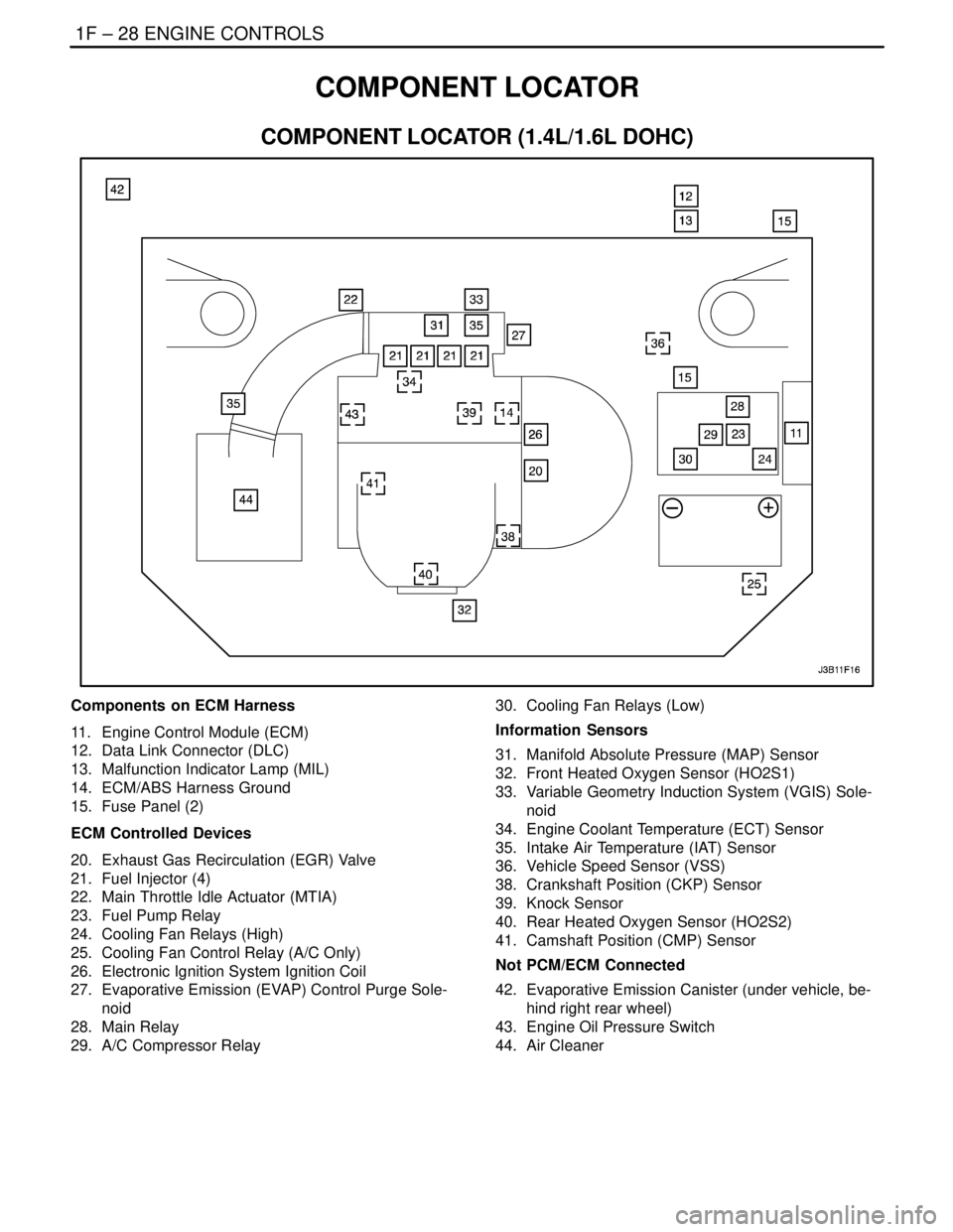
1F – 28IENGINE CONTROLS
DAEWOO V–121 BL4
COMPONENT LOCATOR
COMPONENT LOCATOR (1.4L/1.6L DOHC)
Components on ECM Harness
11. Engine Control Module (ECM)
12. Data Link Connector (DLC)
13. Malfunction Indicator Lamp (MIL)
14. ECM/ABS Harness Ground
15. Fuse Panel (2)
ECM Controlled Devices
20. Exhaust Gas Recirculation (EGR) Valve
21. Fuel Injector (4)
22. Main Throttle Idle Actuator (MTIA)
23. Fuel Pump Relay
24. Cooling Fan Relays (High)
25. Cooling Fan Control Relay (A/C Only)
26. Electronic Ignition System Ignition Coil
27. Evaporative Emission (EVAP) Control Purge Sole-
noid
28. Main Relay
29. A/C Compressor Relay30. Cooling Fan Relays (Low)
Information Sensors
31. Manifold Absolute Pressure (MAP) Sensor
32. Front Heated Oxygen Sensor (HO2S1)
33. Variable Geometry Induction System (VGIS) Sole-
noid
34. Engine Coolant Temperature (ECT) Sensor
35. Intake Air Temperature (IAT) Sensor
36. Vehicle Speed Sensor (VSS)
38. Crankshaft Position (CKP) Sensor
39. Knock Sensor
40. Rear Heated Oxygen Sensor (HO2S2)
41. Camshaft Position (CMP) Sensor
Not PCM/ECM Connected
42. Evaporative Emission Canister (under vehicle, be-
hind right rear wheel)
43. Engine Oil Pressure Switch
44. Air Cleaner
Page 275 of 2643
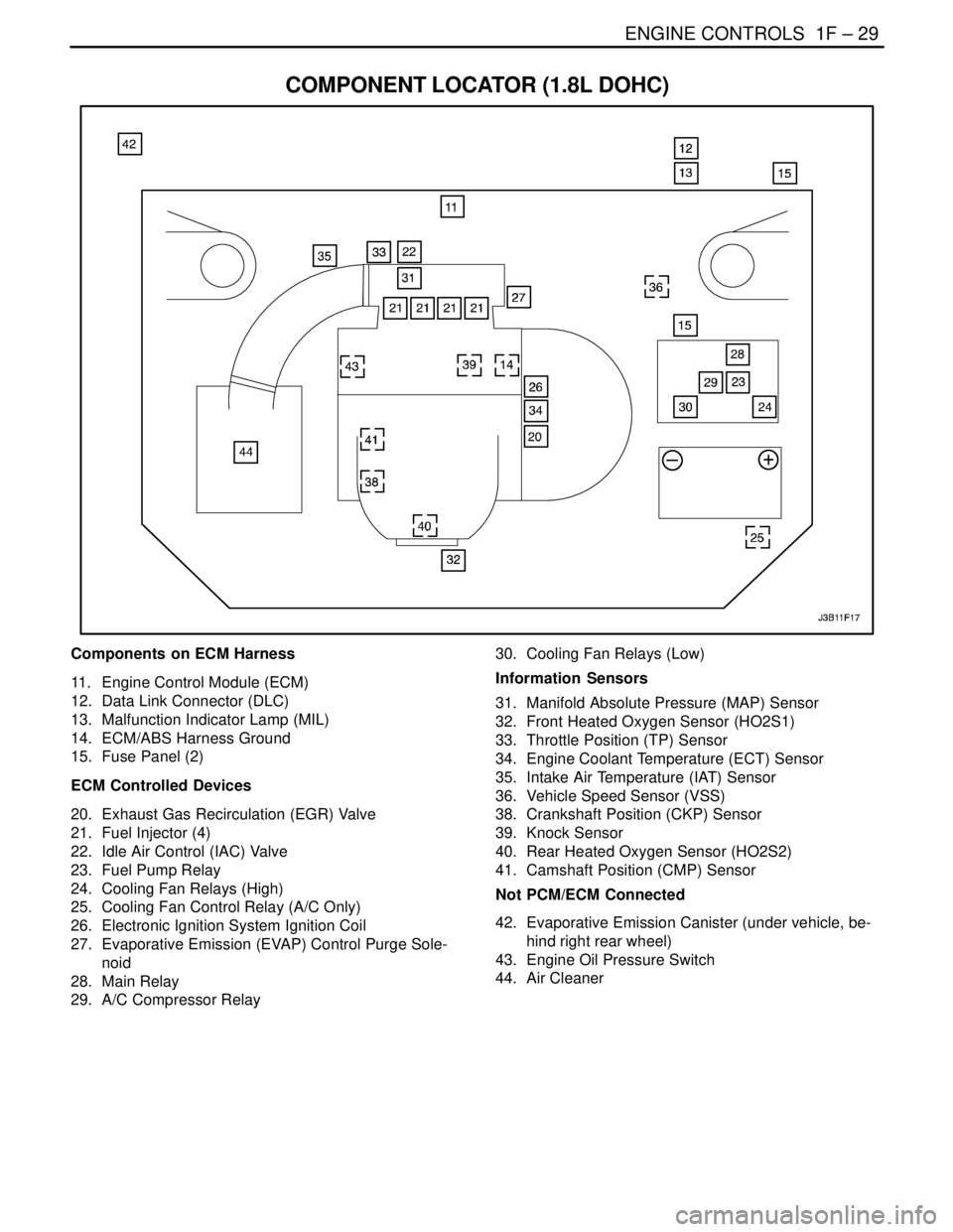
ENGINE CONTROLS 1F – 29
DAEWOO V–121 BL4
COMPONENT LOCATOR (1.8L DOHC)
Components on ECM Harness
11. Engine Control Module (ECM)
12. Data Link Connector (DLC)
13. Malfunction Indicator Lamp (MIL)
14. ECM/ABS Harness Ground
15. Fuse Panel (2)
ECM Controlled Devices
20. Exhaust Gas Recirculation (EGR) Valve
21. Fuel Injector (4)
22. Idle Air Control (IAC) Valve
23. Fuel Pump Relay
24. Cooling Fan Relays (High)
25. Cooling Fan Control Relay (A/C Only)
26. Electronic Ignition System Ignition Coil
27. Evaporative Emission (EVAP) Control Purge Sole-
noid
28. Main Relay
29. A/C Compressor Relay30. Cooling Fan Relays (Low)
Information Sensors
31. Manifold Absolute Pressure (MAP) Sensor
32. Front Heated Oxygen Sensor (HO2S1)
33. Throttle Position (TP) Sensor
34. Engine Coolant Temperature (ECT) Sensor
35. Intake Air Temperature (IAT) Sensor
36. Vehicle Speed Sensor (VSS)
38. Crankshaft Position (CKP) Sensor
39. Knock Sensor
40. Rear Heated Oxygen Sensor (HO2S2)
41. Camshaft Position (CMP) Sensor
Not PCM/ECM Connected
42. Evaporative Emission Canister (under vehicle, be-
hind right rear wheel)
43. Engine Oil Pressure Switch
44. Air Cleaner
Page 276 of 2643

1F – 30IENGINE CONTROLS
DAEWOO V–121 BL4
DIAGNOSIS
SYSTEM DIAGNOSIS
DIAGNOSTIC AIDS
If an intermittent problem is evident, follow the guidelines
below.
Preliminary Checks
Before using this section you should have already per-
formed the ”On–Board Diagnostic System Check.”
Perform a thorough visual inspection. This inspection can
often lead to correcting a problem without further checks
and can save valuable time. Inspect for the following con-
ditions:
S Engine control module (ECM) grounds for being
clean, tight, and in their proper location.
S Vacuum hoses for splits, kinks, collapsing and prop-
er connections as shown on the Vehicle Emission
Control Information label. Inspect thoroughly for
any type of leak or restriction.
S Air leaks at the throttle body mounting area and the
intake manifold sealing surfaces.
S Ignition wires for cracks, hardness, proper routing,
and carbon tracking.
S Wiring for proper connections.
S Wiring for pinches or cuts.
Diagnostic Trouble Code Tables
Do not use the Diagnostic Trouble Code (DTC) tables to
try to correct an intermittent fault. The fault must be pres-
ent to locate the problem.
Incorrect use of the DTC tables may result in the unneces-
sary replacement of parts.
Faulty Electrical Connections or Wiring
Most intermittent problems are caused by faulty electrical
connections or wiring. Perform a careful inspection of sus-
pect circuits for the following:
S Poor mating of the connector halves.
S Terminals not fully seated in the connector body.
S Improperly formed or damaged terminals. All con-
nector terminals in a problem circuit should be care-
fully inspected, reformed, or replaced to insure con-
tact tension.S Poor terminal–to–wire connection. This requires
removing the terminal from the connector body.
Road Test
If a visual inspection does not find the cause of the prob-
lem, the vehicle can be driven with a voltmeter or a scan
tool connected to a suspected circuit. An abnormal voltage
or scan tool reading will indicate that the problem is in that
circuit.
If there are no wiring or connector problems found and a
DTC was stored for a circuit having a sensor, except for
DTC P0171 and DTC P0172, replace the sensor.
Fuel System
Some intermittent driveability problems can be attributed
to poor fuel quality. If a vehicle is occasionally running
rough, stalling, or otherwise performing badly, ask the cus-
tomer about the following fuel buying habits:
S Do they always buy from the same source? If so,
fuel quality problems can usually be discounted.
S Do they buy their fuel from whichever fuel station
that is advertising the lowest price? If so, check the
fuel tank for signs of debris, water, or other contam-
ination.
IDLE LEARN PROCEDURE
Whenever the battery cables, the engine control module
(ECM), or the ECM fuse is disconnected or replaced, the
following idle learn procedure must be performed:
1. Turn the ignition ON for 5 seconds.
2. Turn the ignition OFF for 5 seconds.
3. Turn the ignition ON for 5 seconds.
4. Start the engine in park/neutral.
5. Allow the engine to run until the engine coolant is
above 185° F (85°C ).
6. Turn the A/C ON for 10 seconds, if equipped.
7. Turn the A/C OFF for 10 seconds, if equipped.
8. If the vehicle is equipped with an automatic trans-
axle, apply the parking brake. While pressing the
brake pedal, place the transaxle in D (drive).
9. Turn the A/C ON for 10 seconds, if equipped.
10. Turn the A/C OFF for 10 seconds, if equipped.
11. Turn the ignition OFF. The idle learn procedure is
complete.
Page 277 of 2643

ENGINE CONTROLS 1F – 31
DAEWOO V–121 BL4
TEC (TOOTH ERROR CORRECTION)
LEARN PROCEDURE
When an ECM is reflashed, initialized or replaced, and dri-
veplate of fly wheel has been replaced, follow these proce-
dures to relearn the crankshaft position (CKP) system
variation :
CAUTION : To avoid personal injury when performing
the TEC learn procedure, always set the vehicle park-
ing brake and block the drive wheels. Release the
throttle immediately when the engine starts to decel-
erate. Once the learning procedure is completed, en-
gine control will be learned to the operator, and the
engine will respond to throttle position.1. Stay the gear parking or neutral.
2. Install the scan tool and select ”TEC (Toth Error
Correction) LEARN” menu.
3. Start the engine with A/C off.
4. Keep the engine coolant temperature above 65°C
(149° F)
5. Put the acceleration pedal above 4000 RPM until
the fuel cut–off occurs.
6. Wait 10–15 seconds.
7. Fulfill this procedure again if the scan tool does not
display ”OK” message.
8. Turn the ignition switch OFF.
9. Turn the ignition swtich ON and then clear the DTC
code.
Page 282 of 2643

1F – 36IENGINE CONTROLS
DAEWOO V–121 BL4
MULTIPLE ECM INFORMATION SENSOR DTCS SET
Circuit Description
The Engine Control Module (ECM) monitors various sen-
sors to determine engine operating conditions. The ECM
controls fuel delivery, spark advance, transaxle operation,
and emission control device operation based on the sen-
sor inputs.
The ECM provides a sensor ground to all of the sensors.
The ECM applies 5 volts through a pull–up resistor and
monitors the voltage present between the sensor and the
resistor to determine the status of the Engine Coolant
Temperature (ECT) sensor, the Intake Air Temperature
(IAT) sensor. The ECM provides the Exhaust Gas Recir-
culation (EGR) Pintle Position Sensor, the Throttle Posi-
tion (TP) sensor, the Manifold Absolute Pressure (MAP)
sensor, and the Fuel Tank Pressure Sensor with a 5 volt
reference and a sensor ground signal. The ECM monitors
the separate feedback signals from these sensors to de-
termine their operating status.
Diagnostic Aids
Be sure to inspect the ECM and the engine grounds for be-
ing secure and clean.
A short to voltage in one of the sensor circuits can cause
one or more of the following DTCs to be set: P0108,
P0113, P0118, P0123, P1106, P1111, P1115, P1121,
P0463, P0533.
If a sensor input circuit has been shorted to voltage, en-
sure that the sensor is not damaged. A damaged sensor
will continue to indicate a high or low voltage after the af-
fected circuit has been repaired. If the sensor has been
damaged, replace it.
An open in the sensor ground circuit between the ECM and
the splice will cause one or more of the following DTCs to
be set: P0107, P0108, P0113, P0118, P0122, P0123,
P1106, P1111, P1115, P1121, P0462, P0532.
A short to ground in the 5 volt reference circuit or an open
in the 5 volt reference circuit between the ECM and the
splice will cause one or more of the following DTCs to be
set: P0107, P0112, P0117, P0122, P1107, P1112, P1114,
P1122, P0462, P0532.Check for the following conditions:
S Inspect for a poor connection at the ECM. Inspect
harness connectors for backed–out terminals, im-
proper mating, broken locks, improperly formed or
damaged terminals, and poor terminal–to–wire con-
nection.
S Inspect the wiring harness for damage. If the har-
ness appears to be OK, observe an affected sen-
sor ’s displayed value on the scan tool with the igni-
tion ON and the engine OFF while moving
connectors and wiring harnesses related to the af-
fected sensors. A change in the affected sensor’s
displayed value will indicate the location of the fault.
Test Description
Number(s) below refer to the step number(s) on the Diag-
nostic Table.
1. The Powertrain On–Board Diagnostic (EOBD) Sys-
tem Check prompts the technician to complete
some basic checks and store the freeze frame and
failure records data on the scan tool if applicable.
This creates an electronic copy of the data taken
when the malfunction occurred. The information is
then stored on the scan tool for later reference.
9. A faulty EGR valve can leak a small amount of cur-
rent from the ignition feed circuit to the 5 volt refer-
ence circuit. If the problem does not exist with the
EGR valve disconnected, replace the EGR valve.
0. If a sensor input circuit has been shorted to voltage,
ensure that the sensor has not been damaged. A
damaged IAT or ECT sensor will continue to indi-
cate a high voltage or low temperature after the
affected circuit has been repaired. A damaged ACT,
TP, MAP, Fuel Tank Pressure, or EGR Pintle Posi-
tion sensor will indicate a high or low voltage or
may be stuck at a fixed value after the affected cir-
cuit has been repaired. If the sensor has been dam-
aged, replace it.
21. The replacement ECM must be reprogrammed.
Refer to the latest Techline procedure for ECM re-
programming.
Page 283 of 2643

ENGINE CONTROLS 1F – 37
DAEWOO V–121 BL4
Multiple ECM Information Sensor DTCs Set
StepActionValue(s)YesNo
1Perform an On–Board Diagnostic (EOBD) system
check.
Is the check complete.–Go to Step 2Go to
”On–Board
Diagnostic Sys-
tem Check”
21. Turn the ignition switch to LOCK.
2. Disconnect the Engine Control Module (ECM)
connector.
3. Turn the ignition switch to ON.
4. Check the 5V reference circuit for the following
conditions:
S Poor connection at the ECM.
S Open between the ECM connector affected
sensors shorted to ground or voltage.
5. If a problem is found, locate and repair the
open or short circuit as needed.
Is a problem found?–Go to Step 19Go to Step 3
31. Check the sensor ground circuit for the follow-
ing conditions:
S Poor connection at the ECM or affected
sensors.
S Open between the ECM connector and the
affected sensors.
2. If a problem is found, repair it as needed.
Is a problem found?–Go to Step 19Go to Step 4
4Measure the voltage of the Exhaust Gas Recircula-
tion (EGR) Pintle Position Sensor signal circuit be-
tween ECM harness connector and ground.
Does the voltage near the specified value?0 VGo to Step 5Go to Step 9
5Measure the voltage of the Manifold Absolute Pres-
sure (MAP) sensor signal circuit between the ECM
harness connector and ground.
Does the voltage near the specified value?0 VGo to Step 6Go to Step 12
6Measure the voltage of the Throttle Position (TP)
sensor signal circuit between the ECM harness con-
nector and ground.
Does the voltage near the specified value?0 VGo to Step 7Go to Step 12
7Measure the voltage of the Intake Air Temperature
(IAT) sensor signal circuit between the ECM har-
ness connector and ground.
Does the voltage near the specified value?0 VGo to Step 8Go to Step 13
8Measure the voltage of the Engine Coolant Temper-
ature (ECT) sensor signal circuit between the ECM
harness connector and ground.
Does the voltage near the specified value?0 VGo to Step 16Go to Step 14
91. Disconnect the EGR valve connector.
2. Measure the voltage of the EGR Pintle Position
sensor signal circuit between the ECM harness
connector and ground.
Does the voltage near the specified value?0 VGo to Step 10Go to Step 15