steering DAEWOO LACETTI 2004 Service Workshop Manual
[x] Cancel search | Manufacturer: DAEWOO, Model Year: 2004, Model line: LACETTI, Model: DAEWOO LACETTI 2004Pages: 2643, PDF Size: 80.54 MB
Page 934 of 2643
FRONT SUSPENSION 2C – 17
DAEWOO V–121 BL4
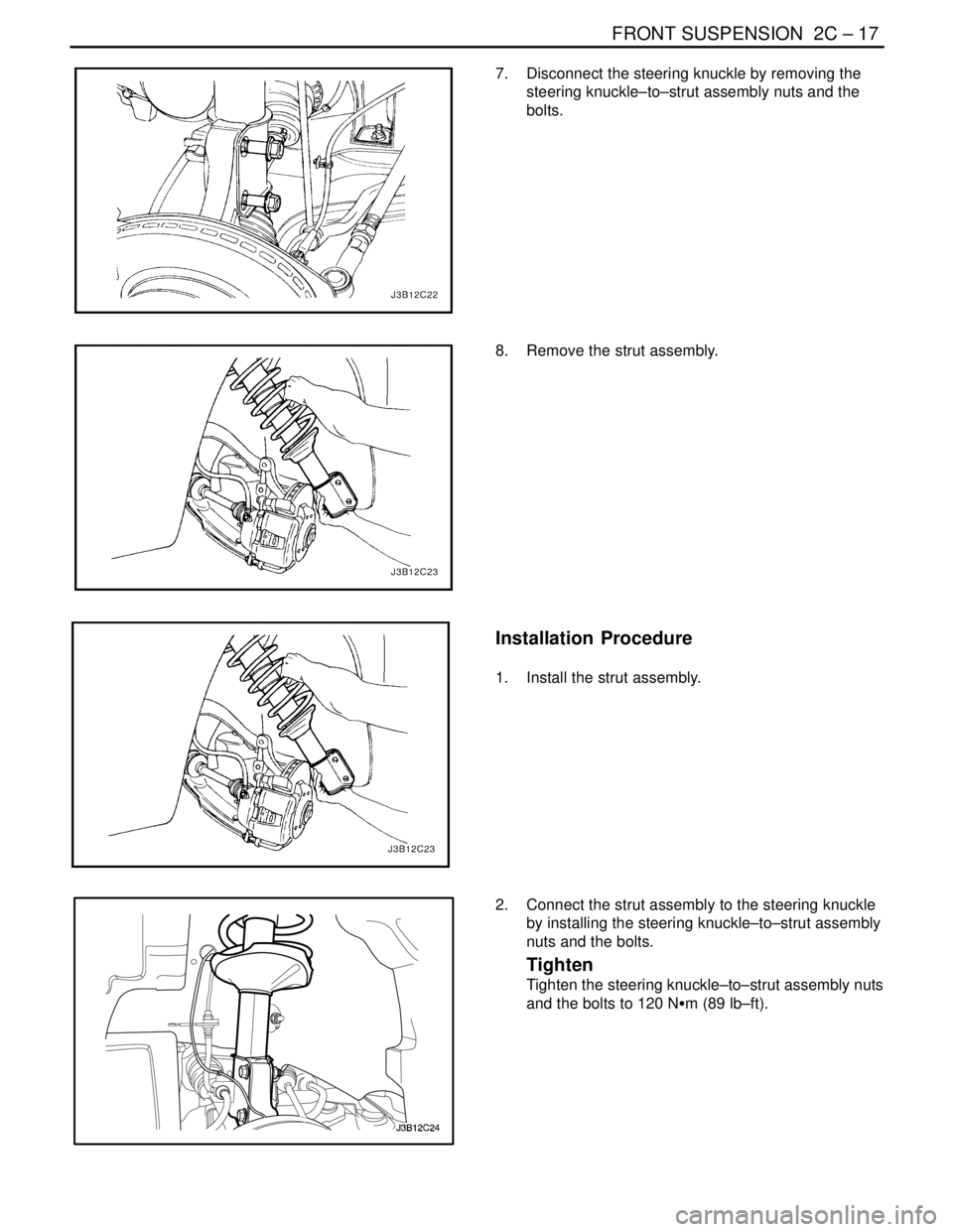
7. Disconnect the steering knuckle by removing the
steering knuckle–to–strut assembly nuts and the
bolts.
8. Remove the strut assembly.
Installation Procedure
1. Install the strut assembly.
2. Connect the strut assembly to the steering knuckle
by installing the steering knuckle–to–strut assembly
nuts and the bolts.
Tighten
Tighten the steering knuckle–to–strut assembly nuts
and the bolts to 120 NSm (89 lb–ft).
Page 935 of 2643
2C – 18IFRONT SUSPENSION
DAEWOO V–121 BL4
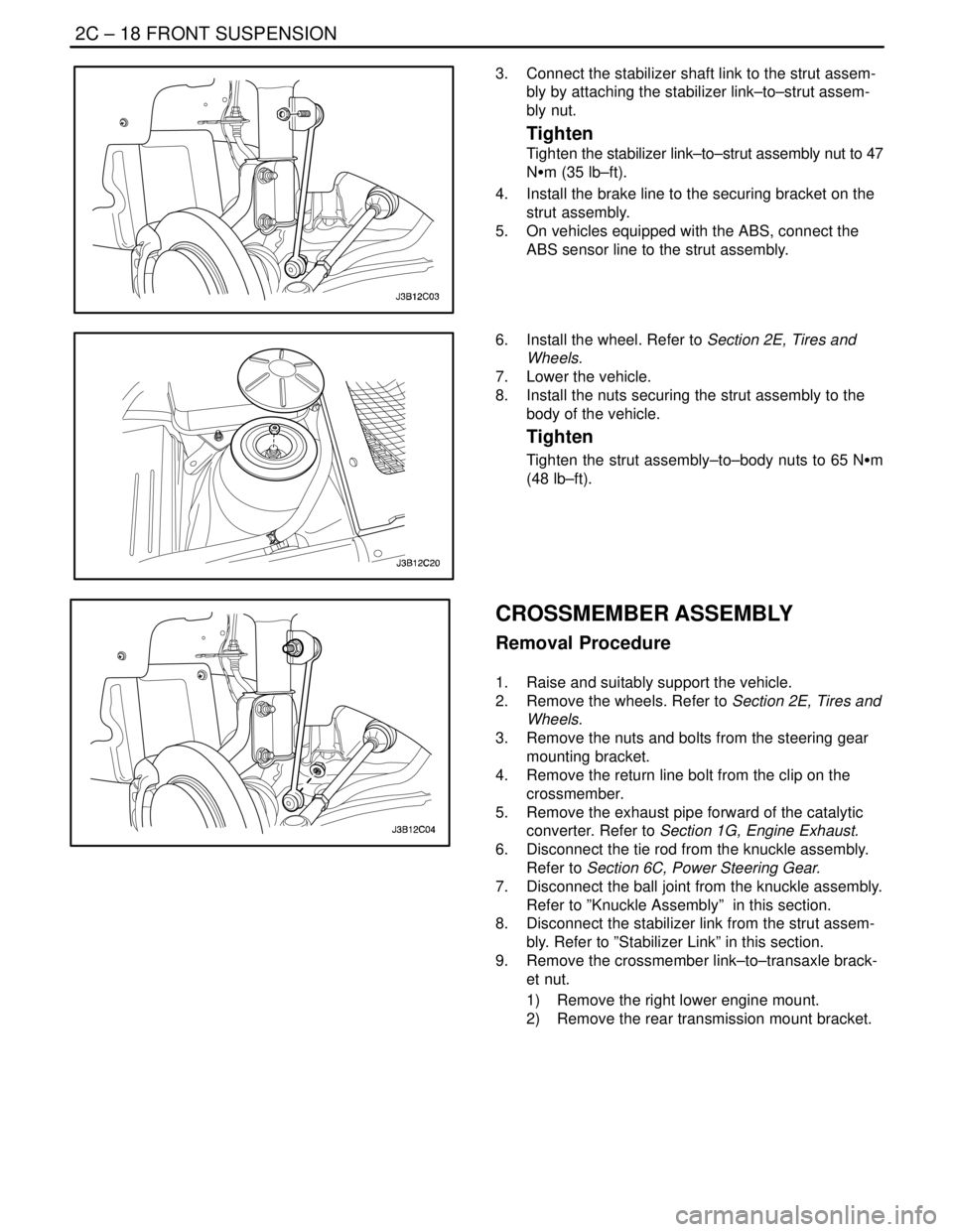
3. Connect the stabilizer shaft link to the strut assem-
bly by attaching the stabilizer link–to–strut assem-
bly nut.
Tighten
Tighten the stabilizer link–to–strut assembly nut to 47
NSm (35 lb–ft).
4. Install the brake line to the securing bracket on the
strut assembly.
5. On vehicles equipped with the ABS, connect the
ABS sensor line to the strut assembly.
6. Install the wheel. Refer to Section 2E, Tires and
Wheels.
7. Lower the vehicle.
8. Install the nuts securing the strut assembly to the
body of the vehicle.
Tighten
Tighten the strut assembly–to–body nuts to 65 NSm
(48 lb–ft).
CROSSMEMBER ASSEMBLY
Removal Procedure
1. Raise and suitably support the vehicle.
2. Remove the wheels. Refer to Section 2E, Tires and
Wheels.
3. Remove the nuts and bolts from the steering gear
mounting bracket.
4. Remove the return line bolt from the clip on the
crossmember.
5. Remove the exhaust pipe forward of the catalytic
converter. Refer to Section 1G, Engine Exhaust.
6. Disconnect the tie rod from the knuckle assembly.
Refer to Section 6C, Power Steering Gear.
7. Disconnect the ball joint from the knuckle assembly.
Refer to ”Knuckle Assembly” in this section.
8. Disconnect the stabilizer link from the strut assem-
bly. Refer to ”Stabilizer Link” in this section.
9. Remove the crossmember link–to–transaxle brack-
et nut.
1) Remove the right lower engine mount.
2) Remove the rear transmission mount bracket.
Page 936 of 2643
FRONT SUSPENSION 2C – 19
DAEWOO V–121 BL4
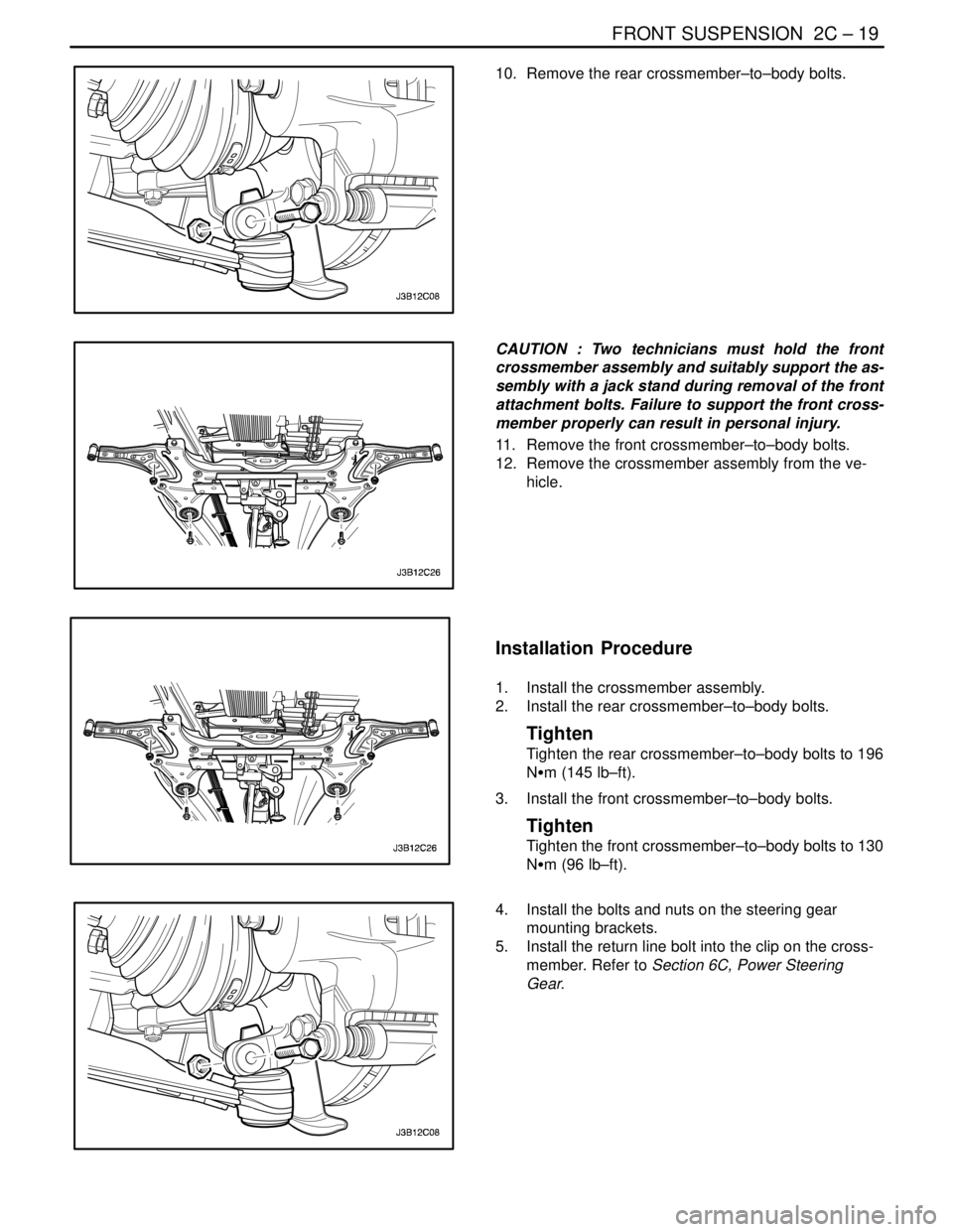
10. Remove the rear crossmember–to–body bolts.
CAUTION : Two technicians must hold the front
crossmember assembly and suitably support the as-
sembly with a jack stand during removal of the front
attachment bolts. Failure to support the front cross-
member properly can result in personal injury.
11. Remove the front crossmember–to–body bolts.
12. Remove the crossmember assembly from the ve-
hicle.
Installation Procedure
1. Install the crossmember assembly.
2. Install the rear crossmember–to–body bolts.
Tighten
Tighten the rear crossmember–to–body bolts to 196
NSm (145 lb–ft).
3. Install the front crossmember–to–body bolts.
Tighten
Tighten the front crossmember–to–body bolts to 130
NSm (96 lb–ft).
4. Install the bolts and nuts on the steering gear
mounting brackets.
5. Install the return line bolt into the clip on the cross-
member. Refer to Section 6C, Power Steering
Gear.
Page 937 of 2643
2C – 20IFRONT SUSPENSION
DAEWOO V–121 BL4
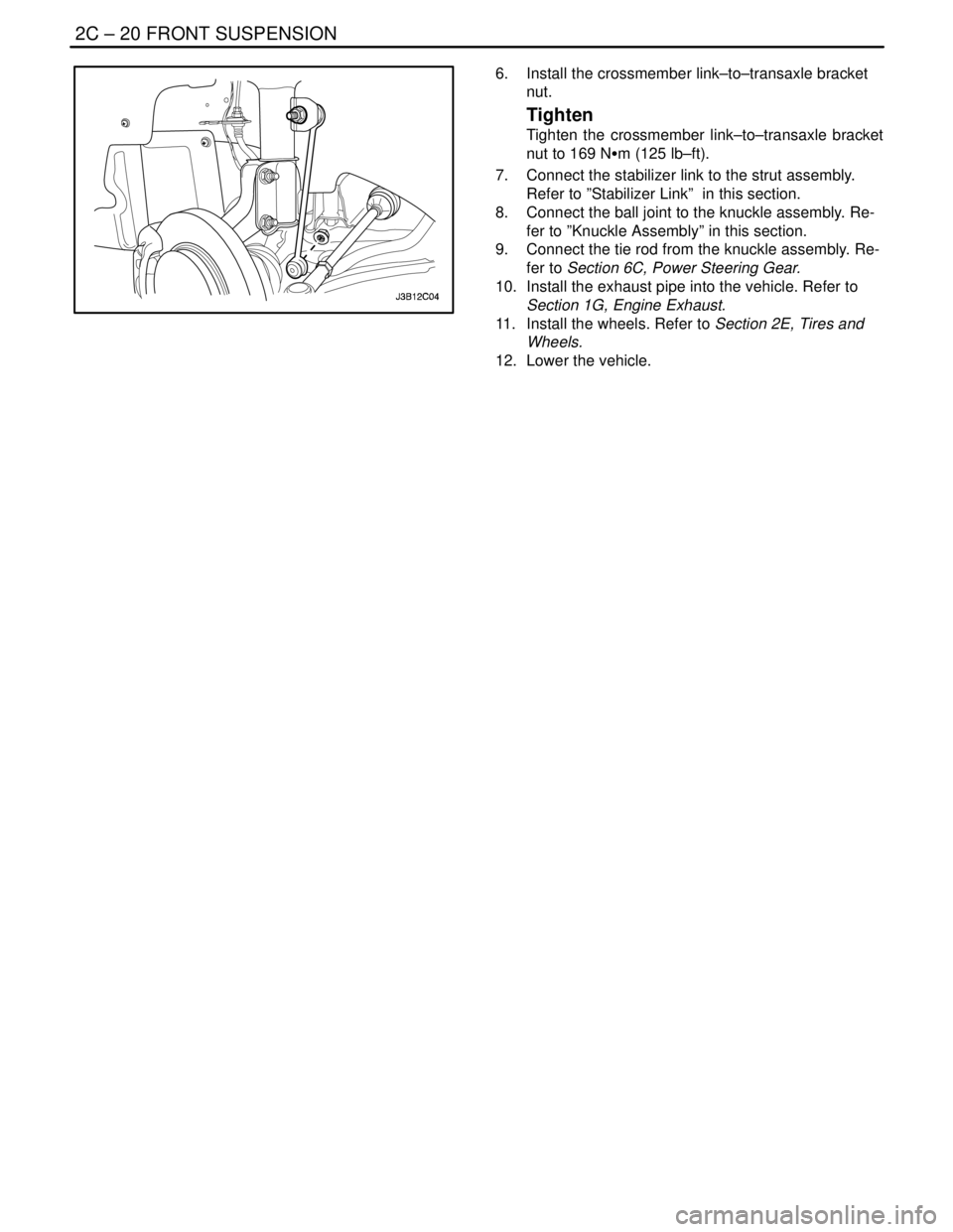
6. Install the crossmember link–to–transaxle bracket
nut.
Tighten
Tighten the crossmember link–to–transaxle bracket
nut to 169 NSm (125 lb–ft).
7. Connect the stabilizer link to the strut assembly.
Refer to ”Stabilizer Link” in this section.
8. Connect the ball joint to the knuckle assembly. Re-
fer to ”Knuckle Assembly” in this section.
9. Connect the tie rod from the knuckle assembly. Re-
fer to Section 6C, Power Steering Gear.
10. Install the exhaust pipe into the vehicle. Refer to
Section 1G, Engine Exhaust.
11. Install the wheels. Refer to Section 2E, Tires and
Wheels.
12. Lower the vehicle.
Page 942 of 2643

FRONT SUSPENSION 2C – 25
DAEWOO V–121 BL4
GENERAL DESCRIPTION
AND SYSTEM OPERATION
FRONT SUSPENSION
The front suspension for this vehicle is a combination of
a strut assembly and a knuckle assembly. The strut as-
sembly combines a strut dampener and spring mounted
to the body of the vehicle. The upper end of the strut is iso-
lated by a rubber mount and contains a bearing to allow the
strut to turn. The knuckle is attached to the strut assembly
and pivots on a ball joint bolted to the control arm. The con-
trol arms pivot from the body using rubber bushings.
The ball joint is fastened to the steering knuckle with a
pinch bolt and nut, and to the lower control arm with rivets.
The stabilizer bar interconnects both strut assemblies ofthe vehicle through the stabilizer link and is attached to the
front suspension crossmember. Jounce and rebound
movements affecting one wheel are partially transmitted
to the opposite wheel of the vehicle to stabilize body roll.
When servicing the control arm–to–body attachment and
the stabilizer shaft–to–body insulators, make sure the at-
taching bolts are loose until the control arms are moved to
the trim height, which is curb height. Trim height is the nor-
mal position to which the control arms move when the ve-
hicle is sitting on the ground. Refer to ”General Specifica-
tions” in this section.
The springs in the front suspension of engine family II are
stronger and the strut dampeners heavier than are the
springs and strut dampeners found in the front suspension
of engine family I.
Page 973 of 2643

TIRES AND WHEELS 2E – 11
DAEWOO V–121 BL4
pacity, diameter, rim width, offset, and mounting configu-
ration. A wheel of improper size or type may affect wheel
and bearing life, brake cooling, speedometer/odometer
calibration, vehicle ground clearance, and tire clearance
to the body and the chassis. The wheel offset is 49 ± 1 mm
(1.93 ± 0.04 inches). Steel wheels may be identified by a
two– or three–letter code stamped into the rim near the
valve stem. Alloy wheels should have the code, the part
number, and the manufacturer ID cast into the back side.
INFLATION O TIRES
The pressure recommended for any vehicle line is careful-
ly calculated to give a satisfactory ride, handling, tread life,
and load–carrying capacity.
Tire pressure should be checked monthly or before any
extended trip. Check the tires when they are cold, after the
vehicle has sat for 3 hours or more, or has been driven less
than 1 mile. Set the tire pressure to the specifications on
the tire label located on the rear face of the driver’s door.
Tire inflation pressure is also given under ”Tire Size and
Pressure Specifications” in this section.
Valve caps or extensions should be on the valves to keep
dust and water out.
For sustained driving at speeds up to 140 km/h (85 mph),
inflate the tires to the pressure recommended on the tire.
Sustained driving at speeds faster than 140 km/h (85mph), even if permitted by law, is not advised unless the
vehicle has special high–speed tires available from many
tire dealers. Tire pressures may increase as much as 41
kPa (6 psi) when the tires are hot.
Higher than recommended tire pressure can cause
S Hard ride.
S Tire bruising or damage.
S Rapid tread wear at the center of the tire.
Lower than recommended pressure can cause
S Tire squeal on turns.
S Hard steering.
S Rapid and uneven wear on the edges of the tread.
S Tire rim bruises and rupture.
S Tire cord breakage.
S High tire temperatures.
Unequal tire pressures on same axle can cause
S Uneven braking.
S Steering lead.
S Reduced handling.
S Swerve on acceleration.
S Torque steer.
Page 993 of 2643
3A – 4IAUTOMATIC TRANSAXLE DRIVE AXLE
DAEWOO V–121 BL4
MAINTENANCE AND REPAIR
ON–VEHICLE SERVICE
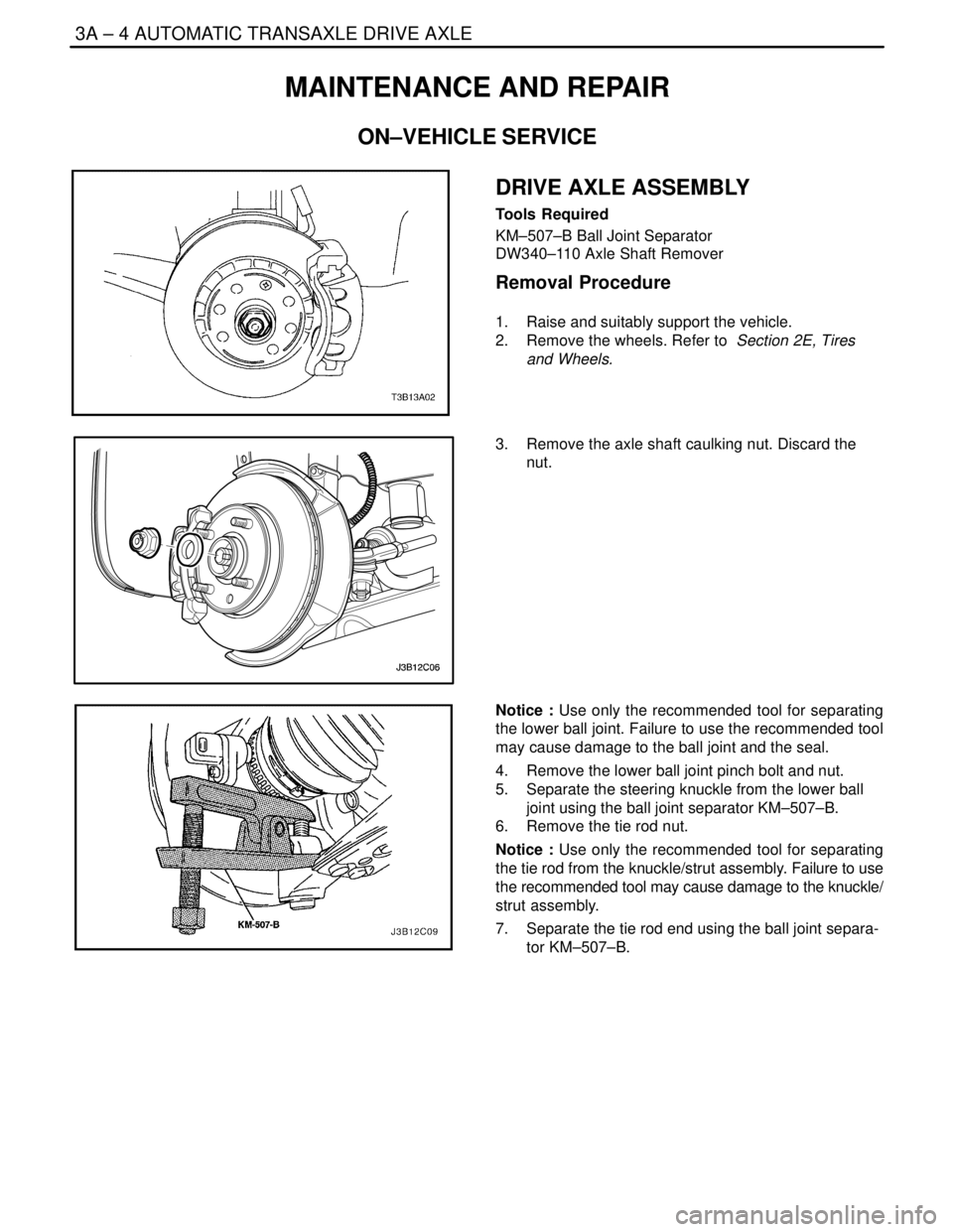
DRIVE AXLE ASSEMBLY
Tools Required
KM–507–B Ball Joint Separator
DW340–110 Axle Shaft Remover
Removal Procedure
1. Raise and suitably support the vehicle.
2. Remove the wheels. Refer to Section 2E, Tires
and Wheels.
3. Remove the axle shaft caulking nut. Discard the
nut.
Notice : Use only the recommended tool for separating
the lower ball joint. Failure to use the recommended tool
may cause damage to the ball joint and the seal.
4. Remove the lower ball joint pinch bolt and nut.
5. Separate the steering knuckle from the lower ball
joint using the ball joint separator KM–507–B.
6. Remove the tie rod nut.
Notice : Use only the recommended tool for separating
the tie rod from the knuckle/strut assembly. Failure to use
the recommended tool may cause damage to the knuckle/
strut assembly.
7. Separate the tie rod end using the ball joint separa-
tor KM–507–B.
Page 1004 of 2643
MANUAL TRANSAXLE DRIVE AXLE 3B – 5
DAEWOO V–121 BL4
MAINTENANCE AND REPAIR
ON–VEHICLE SERVICE
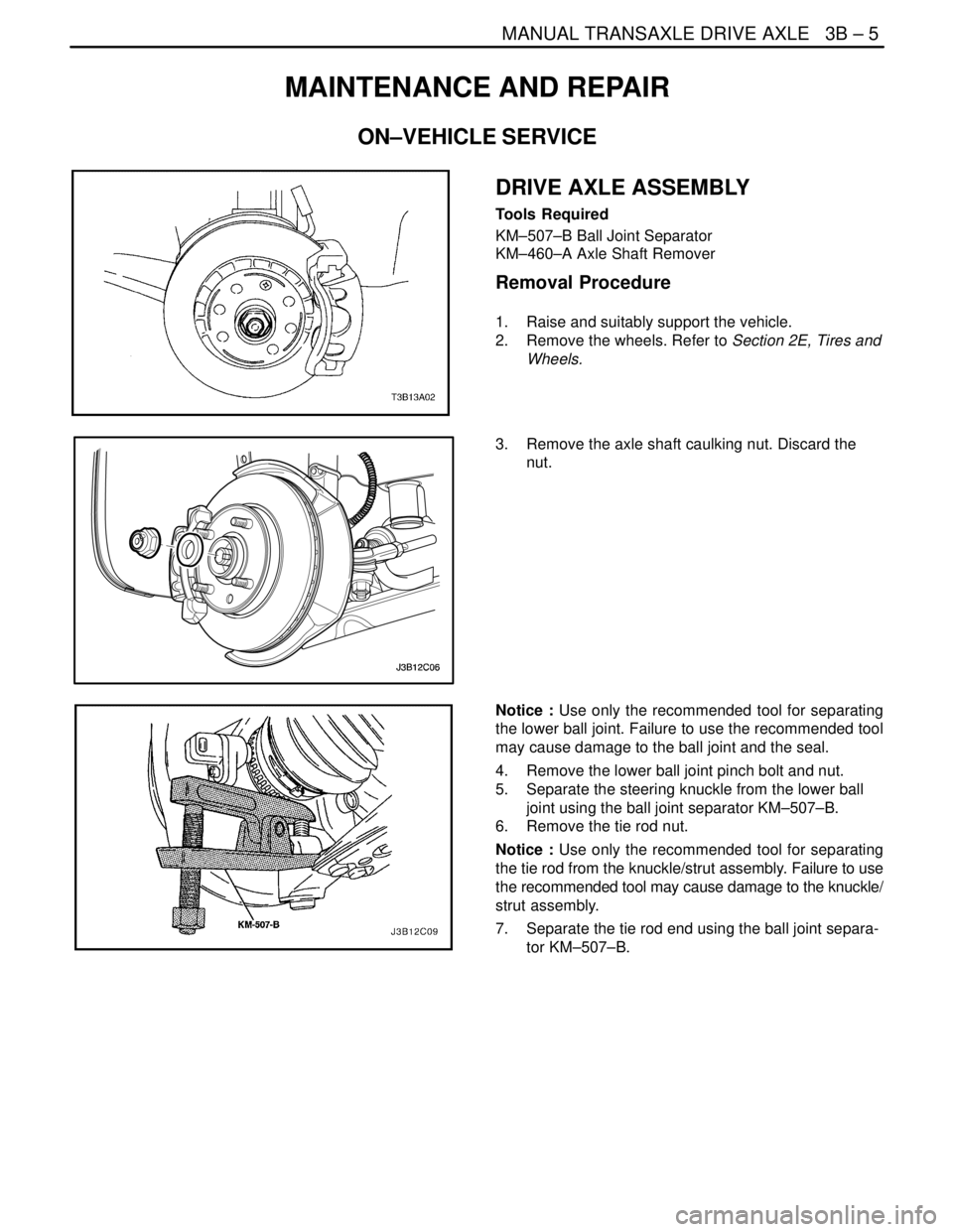
DRIVE AXLE ASSEMBLY
Tools Required
KM–507–B Ball Joint Separator
KM–460–A Axle Shaft Remover
Removal Procedure
1. Raise and suitably support the vehicle.
2. Remove the wheels. Refer to Section 2E, Tires and
Wheels.
3. Remove the axle shaft caulking nut. Discard the
nut.
Notice : Use only the recommended tool for separating
the lower ball joint. Failure to use the recommended tool
may cause damage to the ball joint and the seal.
4. Remove the lower ball joint pinch bolt and nut.
5. Separate the steering knuckle from the lower ball
joint using the ball joint separator KM–507–B.
6. Remove the tie rod nut.
Notice : Use only the recommended tool for separating
the tie rod from the knuckle/strut assembly. Failure to use
the recommended tool may cause damage to the knuckle/
strut assembly.
7. Separate the tie rod end using the ball joint separa-
tor KM–507–B.
Page 1029 of 2643
HYDRAULIC BRAKES 4A – 13
DAEWOO V–121 BL4
8. Attach the bleeder hose to the bleeder valve. Sub-
merge the opposite end of the hose in a clean con-
tainer partially filled with brake fluid.
9. Open the bleeder valve one–half to three–fourths
turn and allow the fluid to flow until no air is seen in
the fluid.
Notice : After the bleeding operation, the brake reservoir
may be pressurized. While disconnecting the bleeder
hose or the unthreaded adapter cap, cover the cap and the
connection with a shop towel to protect painted surfaces
from contact with the brake fluid.
10. Inspect the brake pedal for sponginess. Repeat the
entire bleeding procedure to correct this condition.
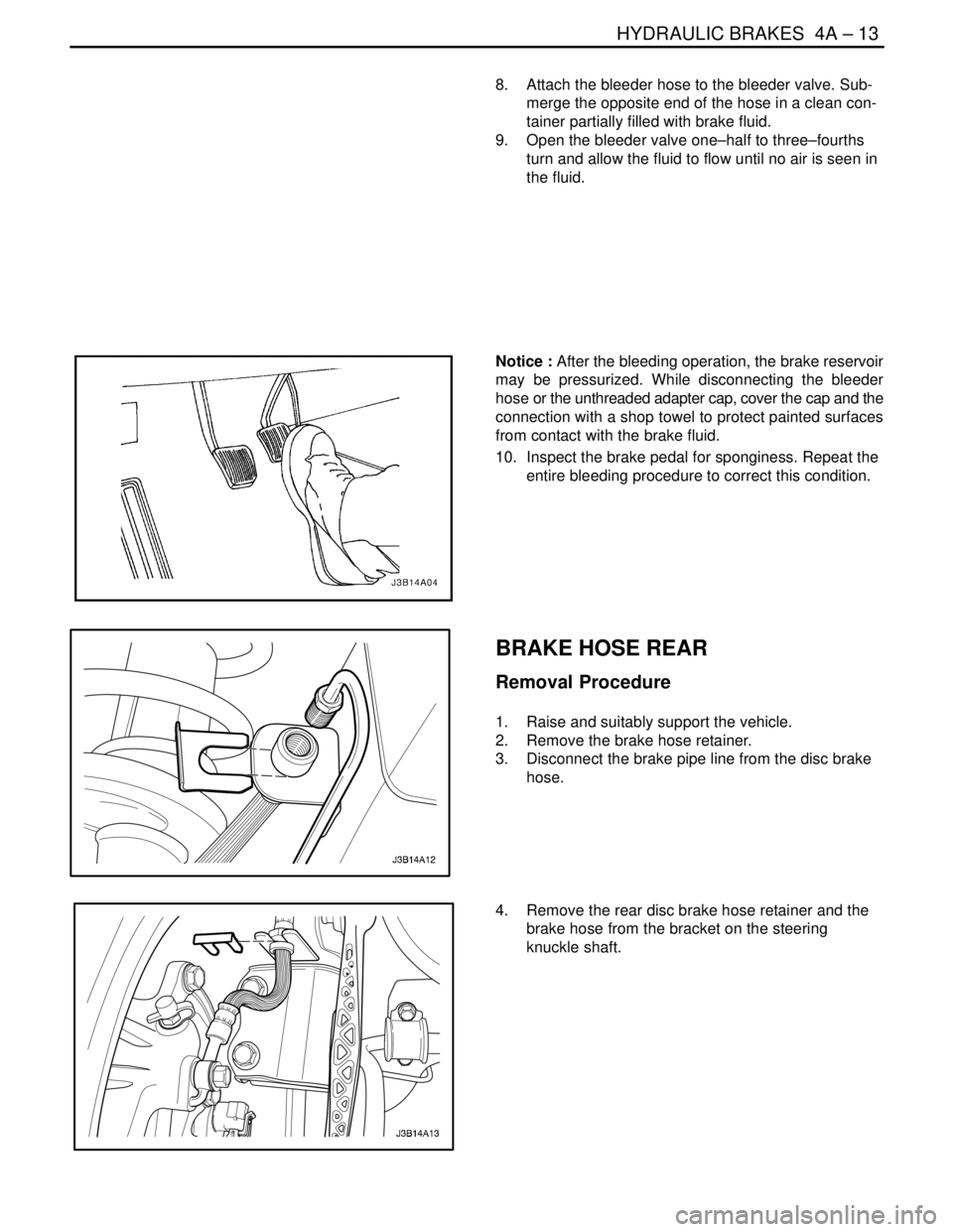
BRAKE HOSE REAR
Removal Procedure
1. Raise and suitably support the vehicle.
2. Remove the brake hose retainer.
3. Disconnect the brake pipe line from the disc brake
hose.
4. Remove the rear disc brake hose retainer and the
brake hose from the bracket on the steering
knuckle shaft.
Page 1030 of 2643
4A – 14IHYDRAULIC BRAKES
DAEWOO V–121 BL4
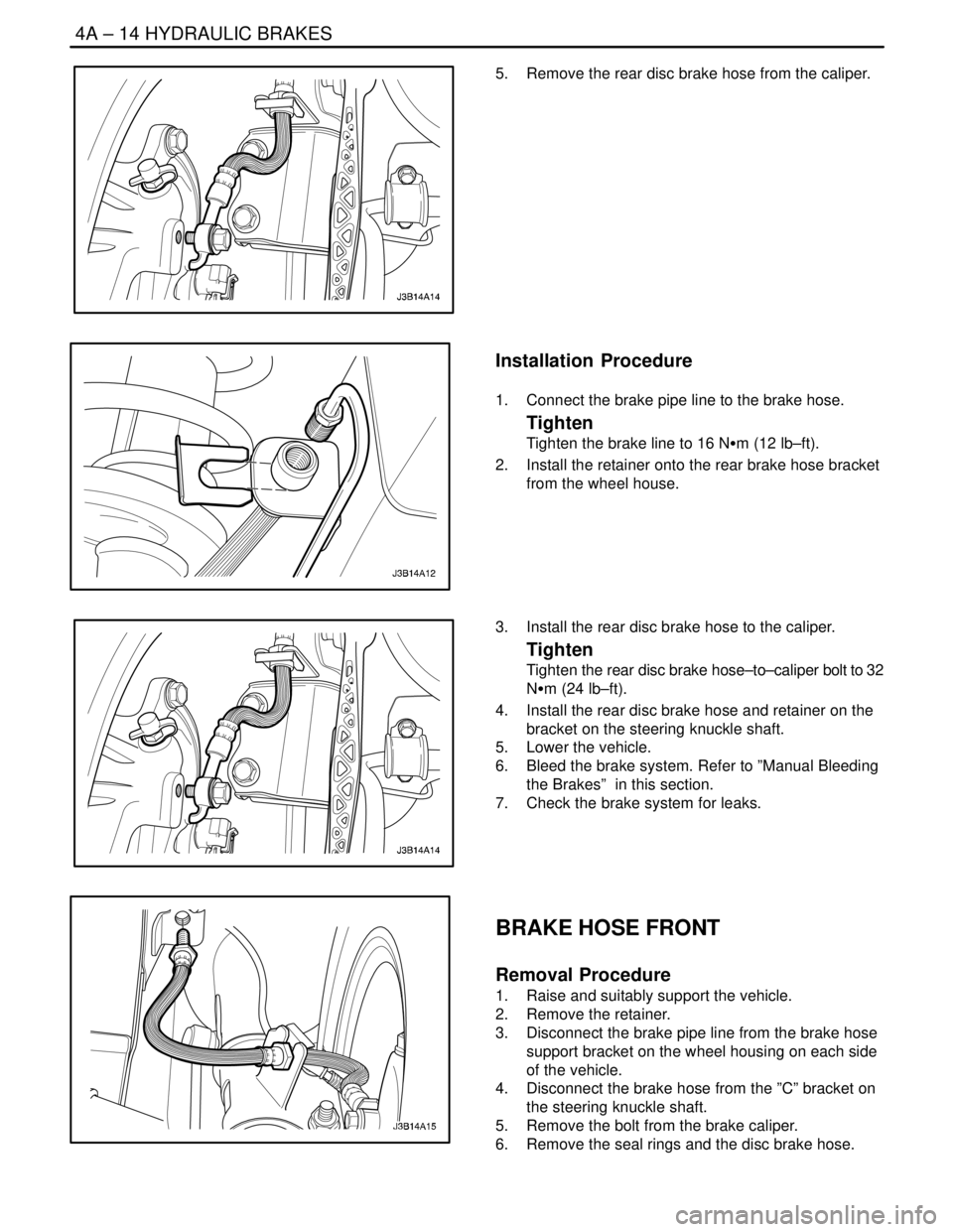
5. Remove the rear disc brake hose from the caliper.
Installation Procedure
1. Connect the brake pipe line to the brake hose.
Tighten
Tighten the brake line to 16 NSm (12 lb–ft).
2. Install the retainer onto the rear brake hose bracket
from the wheel house.
3. Install the rear disc brake hose to the caliper.
Tighten
Tighten the rear disc brake hose–to–caliper bolt to 32
NSm (24 lb–ft).
4. Install the rear disc brake hose and retainer on the
bracket on the steering knuckle shaft.
5. Lower the vehicle.
6. Bleed the brake system. Refer to ”Manual Bleeding
the Brakes” in this section.
7. Check the brake system for leaks.
BRAKE HOSE FRONT
Removal Procedure
1. Raise and suitably support the vehicle.
2. Remove the retainer.
3. Disconnect the brake pipe line from the brake hose
support bracket on the wheel housing on each side
of the vehicle.
4. Disconnect the brake hose from the ”C” bracket on
the steering knuckle shaft.
5. Remove the bolt from the brake caliper.
6. Remove the seal rings and the disc brake hose.