Fuel tank DAEWOO LACETTI 2004 Service Manual PDF
[x] Cancel search | Manufacturer: DAEWOO, Model Year: 2004, Model line: LACETTI, Model: DAEWOO LACETTI 2004Pages: 2643, PDF Size: 80.54 MB
Page 874 of 2643

1F – 628IENGINE CONTROLS
DAEWOO V–121 BL4
STRATEGY – BASED DIAGNOSTICS
Strategy–Based Diagnostics
The strategy–based diagnostic is a uniform approach to
repair all Electrical/Electronic (E/E) systems. The diag-
nostic flow can always be used to resolve an E/E system
problem and is a starting point when repairs are neces-
sary. The following steps will instruct the technician on
how to proceed with a diagnosis:
S Verify the customer complaint. To verify the cus-
tomer complaint, the technician should know the
normal operation of the system.
S Perform preliminary checks as follows:
S Conduct a thorough visual inspection.
S Review the service history.
S Detect unusual sounds or odors.
S Gather Diagnostic Trouble Code (DTC) informa-
tion to achieve an effective repair.
S Check bulletins and other service information. This
includes videos, newsletters, etc.
S Refer to service information (manual) system
check(s).
S Refer to service diagnostics.
No Trouble Found
This condition exists when the vehicle is found to operate
normally. The condition described by the customer may be
normal. Verify the customer complaint against another ve-
hicle that is operating normally. The condition may be in-
termittent. Verify the complaint under the conditions de-
scribed by the customer before releasing the vehicle.
Re–examine the complaint.
When the complaint cannot be successfully found or iso-
lated, a re–evaluation is necessary. The complaint should
be re–verified and could be intermittent as defined in ”In-
termittents,” or could be normal.
After isolating the cause, the repairs should be made. Vali-
date for proper operation and verify that the symptom has
been corrected. This may involve road testing or other
methods to verify that the complaint has been resolved un-
der the following conditions:
S Conditions noted by the customer.
S If a DTC was diagnosed, verify a repair by duplicat-
ing conditions present when the DTC was set as
noted in the Failure Records or Freeze Frame data.
Verifying Vehicle Repair
Verification of the vehicle repair will be more comprehen-
sive for vehicles with On–Board Diagnostic (EOBD) sys-
tem diagnostics. Following a repair, the technician should
perform these steps:
Important : Follow the steps below when you verify re-
pairs on EOBD systems. Failure to follow these steps
could result in unnecessary repairs.S Review and record the Failure Records and the
Freeze Frame data for the DTC which has been
diagnosed (Freeze Fame data will only be stored
for an A or B type diagnostic and only if the MIL
has been requested).
S Clear the DTC(s).
S Operate the vehicle within conditions noted in the
Failure Records and Freeze Frame data.
S Monitor the DTC status information for the specific
DTC which has been diagnosed until the diagnostic
test associated with that DTC runs.
EOBD SERVICEABILITY ISSUES
Based on the knowledge gained from On–Board Diagnos-
tic (EOBD) experience in the 1994 and 1995 model years,
this list of non–vehicle faults that could affect the perfor-
mance of the EOBD system has been compiled. These
non–vehicle faults vary from environmental conditions to
the quality of fuel used. With the introduction of EOBD
diagnostics across the entire passenger car and light–duty
truck market in 1996, illumination of the MIL due to a non–
vehicle fault could lead to misdiagnosis of the vehicle, in-
creased warranty expense and customer dissatisfaction.
The following list of non–vehicle faults does not include ev-
ery possible fault and may not apply equally to all product
lines.
Fuel Quality
Fuel quality is not a new issue for the automotive industry,
but its potential for turning on the Malfunction Indicator
Lamp (MIL) with EOBD systems is new.
Fuel additives such as ”dry gas” and ”octane enhancers”
may affect the performance of the fuel. If this results in an
incomplete combustion or a partial burn, it will set DTC
P0300. The Reed Vapor Pressure of the fuel can also
create problems in the fuel system, especially during the
spring and fall months when severe ambient temperature
swings occur. A high Reed Vapor Pressure could show up
as a Fuel Trim DTC due to excessive canister loading.
High vapor pressures generated in the fuel tank can also
affect the Evaporative Emission diagnostic as well.
Using fuel with the wrong octane rating for your vehicle
may cause driveability problems. Many of the major fuel
companies advertise that using ”premium” gasoline will
improve the performance of your vehicle. Most premium
fuels use alcohol to increase the octane rating of the fuel.
Although alcohol–enhanced fuels may raise the octane
rating, the fuel’s ability to turn into vapor in cold tempera-
tures deteriorates. This may affect the starting ability and
cold driveability of the engine.
Low fuel levels can lead to fuel starvation, lean engine op-
eration, and eventually engine misfire.
Non–OEM Parts
All of the EOBD diagnostics have been calibrated to run
with Original Equipment Manufacturer (OEM) parts.
Something as simple as a high–performance exhaust sys-
tem that affects exhaust system back pressure could po-
Page 919 of 2643

2C – 2IFRONT SUSPENSION
DAEWOO V–121 BL4
SPECIFICATIONS
GENERAL SPECIFICATIONS
ApplicationTrim Height
Center of Front Wheel to Bottom of Front Wheel Well368 mm (14.4 in.)
Center of Rear Wheel to Bottom of Rear Wheel Well367 mm (14.4 in.)
* CONDITION : Full Fuel in the Tank
FASTENER TIGHTENING SPECIFICATIONS
ApplicationNSmLb–FtLb–In
Ball Joint Pinch Bolt Nut6044–
Ball Joint–to–Control Arm Nuts10074–
Front Control Arm–to–Crossmember Bolt12592–
Rear Contral Arm–to–Crossmember Bolt11 081–
Crossmember Link–to–Crossmember Bolt11 484–
Crossmember Link–to–Transaxle Bracket Nut169125–
Drive Axle–to–Hub Caulking Nut300221–
Front Crossmember–to–Body Bolts13096–
Piston Rod Nut7555–
Rear Crossmember–to–Body Bolts196145–
Stabilizer Link–to–Strut Assembly Nut4735–
Stabilizer Shaft–to–Crossmember Clamp Bolts2518–
Stabilizer Shaft–to–Stabilizer Link Nut4735–
Steering Knuckle–to–Strut Assembly Nuts/Bolts12089–
Strut Assembly–to–Body Nut6548–
Page 1158 of 2643
4G – 6IPARKING BRAKE
DAEWOO V–121 BL4
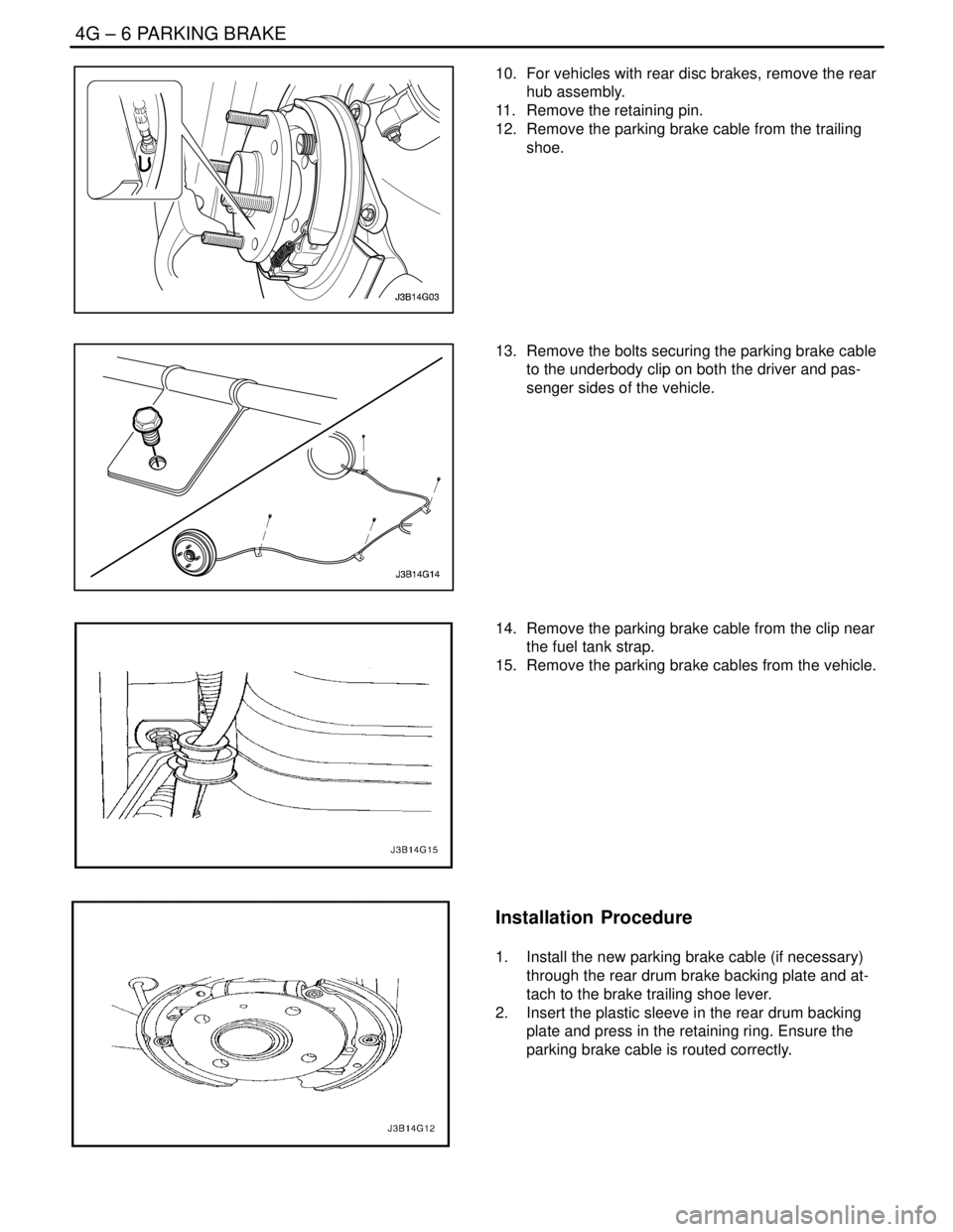
10. For vehicles with rear disc brakes, remove the rear
hub assembly.
11. Remove the retaining pin.
12. Remove the parking brake cable from the trailing
shoe.
13. Remove the bolts securing the parking brake cable
to the underbody clip on both the driver and pas-
senger sides of the vehicle.
14. Remove the parking brake cable from the clip near
the fuel tank strap.
15. Remove the parking brake cables from the vehicle.
Installation Procedure
1. Install the new parking brake cable (if necessary)
through the rear drum brake backing plate and at-
tach to the brake trailing shoe lever.
2. Insert the plastic sleeve in the rear drum backing
plate and press in the retaining ring. Ensure the
parking brake cable is routed correctly.
Page 1159 of 2643
PARKING BRAKE 4G – 7
DAEWOO V–121 BL4
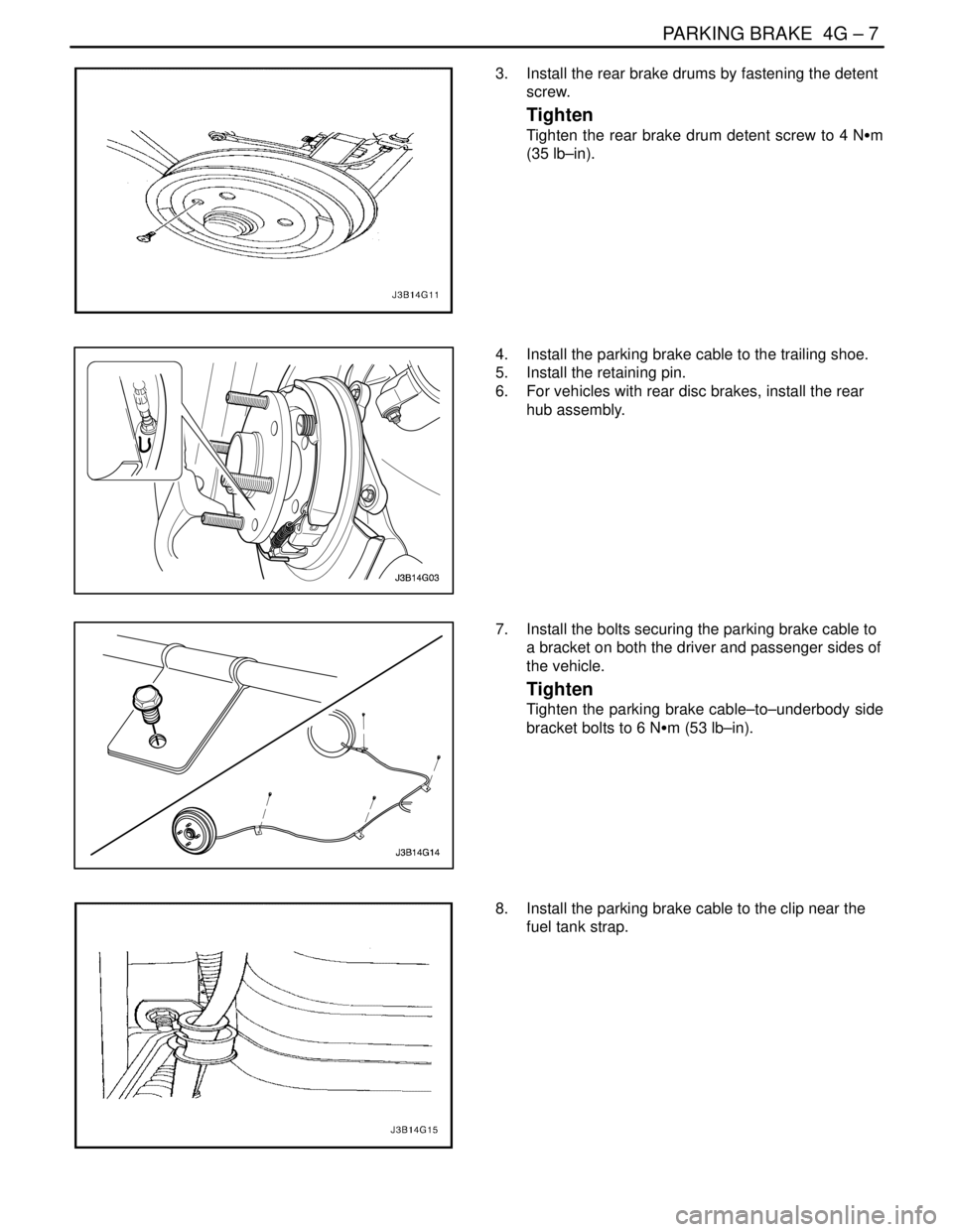
3. Install the rear brake drums by fastening the detent
screw.
Tighten
Tighten the rear brake drum detent screw to 4 NSm
(35 lb–in).
4. Install the parking brake cable to the trailing shoe.
5. Install the retaining pin.
6. For vehicles with rear disc brakes, install the rear
hub assembly.
7. Install the bolts securing the parking brake cable to
a bracket on both the driver and passenger sides of
the vehicle.
Tighten
Tighten the parking brake cable–to–underbody side
bracket bolts to 6 NSm (53 lb–in).
8. Install the parking brake cable to the clip near the
fuel tank strap.
Page 2329 of 2643

9E – 30IINSTRUMENTATION/DRIVER INFORMATION
DAEWOO V–121 BL4
GENERAL DESCRIPTION
AND SYSTEM OPERATION
CIGAR LIGHTER
The cigar lighter is located in the front portion of the floor
console. To use the lighter, push it in completely. When the
lighter is hot, it will release itself from contact with the heat-
ing element. The lighter and the heating element can be
damaged if the lighter is not allowed to release itself fully
from the heating element.
ASHTRAY
The ashtray is located below the audio system. To access
the ashtray, pull it out from the center console. The ashtray
lamp will go on when the parking lamps or the headlamps
are turned on.
INSTRUMENT PANEL VENTS
The center and the side vents in the instrument panel can
be adjusted up and down and from side to side. The side
vents can also be aimed toward the side windows in order
to defog them.
GLOVE BOX
The glove box can be opened by pulling up on the latch
handle. The glove box must be removed in order to gain
access to the passenger’s side airbag module.
DIGTAL CLOCK
The digital clock is located in the instrument panel, above
the audio system. The clock is capable of a 12–hour or a
24–hour display.
INSTRUMENT CLUSTER
The instrument cluster is located above the steering col-
umn and in the instrument cluster trim panel. The instru-
ment cluster contains the instruments that provide the
driver with vehicle performance information. The instru-
ment cluster contains a speedometer, an odometer, a trip
odometer, a temperature gauge, a fuel gauge, and several
indicator lamps. For replacement of the indicator lamp
bulbs contained in the instrument cluster, refer to ”Instru-
ment Cluster Indicator Lamps Specifications” and”Instru-
ment Cluster Indicator Lamps” in this section.
SPEEDOMETER/ODOMETER/TRIP
ODOMETER
The speedometer measures the speed of the vehicle in
km/h (mph in some countries). It consists of an instrument
cluster gauge connected to the vehicle speed sensor
(VSS) on the transaxle output shaft.The odometer measures in kilometers (miles in some
countries) the total distance the vehicle has traveled since
it was manufactured. It consists of an instrument cluster
gauge connected to the VSS on the transaxle output shaft.
The trip odometer measures the distance the vehicle has
traveled since the odometer was last reset. It consists of
an instrument cluster gauge connected to the VSS on the
transaxle output shaft. The trip odometer can be reset to
zero at any time so that the driver can record the distance
traveled from any starting point.
FUEL GAUGE
The fuel gauge consists of an instrument cluster gauge
connected to a sending unit in the fuel tank.
The fuel gauge indicates the quantity of fuel in the tank
only when the ignition switch is turned to ON or ACC.
When the ignition is turned to LOCK or START, the pointer
may come to rest at any position.
TEMPERATURE GAUGE
The temperature gauge consists of an instrument cluster
gauge connected to a temperature sensor that is in con-
tact with the circulating engine coolant.
The temperature gauge indicates the temperature of the
coolant. Prolonged driving or idling in very hot weather
may cause the pointer to move beyond the center of the
gauge. The engine is overheating if the pointer moves into
the red zone at the upper limit of the gauge.
INSTRUMENT CLUSTER INDICATOR
LAMPS
The instrument cluster contains indicator lamps that indi-
cate the functioning of certain systems or the existence of
potential problems with the operation of the vehicle. The
indicator lamps are replaceable. For replacement of the in-
dicator lamps contained in the instrument cluster, refer to
”Instrument Cluster Indicator Lamps Specifications”
and”Instrument Cluster Indicator Lamps” in this section.
CHIME MODULE
The chime module is located above the instrument panel
fuse block and will sound in order to bring attention to one
or more of the following conditions:
S The lamps are on, the door is ajar, and the ignition
switch is not in ACC, ON, or START.
S The seat belt is unbuckled when the ignition switch
is in ON or START.
S The door is open when the ignition switch is in ON
or START.
S The key is left in the ignition switch when the igni-
tion is in LOCK and the door is open.
Page 2481 of 2643

9S – 10IBODY REAR END
DAEWOO V–121 BL4
GENERAL DESCRIPTION
AND SYSTEM OPERATION
FUEL FILLER DOOR
The fuel filler door attaches to the fuel tank pocket on the
right side of the vehicle. The door is opened by pulling on
the fuel filler door remote handle located on the floor in
front of the driver’s seat.
REAR DECK LID (NOTCHBACK)
The rear deck lid consists of an inner and outer panel thatis hemmed around the perimeter and bonded together
with structural adhesive. The deck lid torque rods assist in
the opening of the rear deck lid and hold it in the open posi-
tion.
HATCHBACK DOOR
The Hatchback door consists of the rear hatch glass within
a steel frame. The steel frame is made of an inner and an
outer panel hemmed around the perimeter, and bonded
together with structural adhesive. The gas support assem-
blies assist in the opening of the hatchback door, and can
hold the door open.
Page 2510 of 2643

1–2 GENERAL INFORMATIONNUBIRA/LACETTI
1. GENERAL INSTRUCTION
This publication is designed to help you the body repair
technician with your specialized work. Vehicle bodywork
has changed a great deal over the years. As vehicles
have developed technically, vehicle bodywork has also
had to meet new requirements with design, changes to
reconcile apparently conflicting demands to name just a
few examples:
S strength and safety ; low weight
S spaciousness ; good aerodynamices
S high quality ; low price
.
The durability and ease of repair of the bodywork also
plays an important part.
.
Nowadays, the use of highly automated production
equipment makes it possible to maintain the tightest
tolerances and thus ensure a high level of quality.
.
When bodywork is damaged, the customer rightly ex-
pects it to be expertly repaired to the same quality stan-
dards.
.
At the same time, for his safety, the customer expects
you to have comprehensive knowledge of materials,
measuring and straightening methods, possible distor-
tion, optimum corrosion prevention and much more be-
sides.
.
This publication is designed to help you update your
knowledge and give you an idea of what you require to
rectify moderate or severe accident damage, for your
own safety and for the satisfaction of your customers.
2. IMPORTANT SAFETY NOTICE
2–1. BEFORE BEGINNING WORK
S Disconnect the battery to reduce the possibility of fire
caused by electrical shorts.
S Check for fuel leaks and repair as necessary.
S Remove the fuel tank and/or fuel lines if welding equip-
ment is to be used near the fuel system.
S Before welding, sanding or cutting, protect carpets and
seats with fire–proof covers.
S Follow standard safety practices when using toxic or
flammable liquids.
S Use standard safety equipment when spraying paint,
welding, cutting, sanding or grinding. Standard safety
equipment includes.
S Respirator and filter masks: Designed to filter out toxic
fumes, mist, dust or other airborn particles. Use a respi-
rator or filter mask designed to protect you from the haz-
ards of the particular job; some respirators, for example,
are designed to filter out only dust and airborn particles,
not toxic fumes.
S Safety goggles or glasses: Designed to protect your
eyes from projectiles, dust particles or splashing liquid.
S Gloves: Rubber gloves protect against corrosive chemi-
cals. Welding gloves protect against burns and abra-
sions caused by welding, sanding or grinding.
S Safety shoes: Non–slip soles protect against slipping.
Metal toe inserts protect against falling objects.
S Ear plugs: Protect eardrums from harmful noise levels.
.
2–2. DURING WORK
S Do not smoke while working near the fuel system.
S Deposit gas or solvent–soaked shop towels in an ap-
proved container.
S Brake lining contains asbestos, which can cause cancer.
Do not use an air hose to blow off brake assemblies: use
only an approved vacuum cleaner, and wear an ap-
proved filter mask or respirator.
S Always attach a safety cable when using a hydraulic ram
or a frame straightening table: do not stand in direct line
with the chains used on such equipment.
Page 2563 of 2643
NUBIRA/LACETTI ROOF, BACK PANEL AND REAR FLOOR PANEL 5–11
3–2. REPAIR PROCEDURE
1. Remove the related parts.
S Parts to be removed when removing the back panel.
S Rear seat belt and rear seat.
S Muffler, fuel tank and related parts.
S Chassis parts.
S Other related parts.
CAUTION : Do not smoke while working near the
fuel system. Keep open flame away from the fuel
system. If necessary, remove the fuel tank and off
lines.
2. Roughly pull out and straighten the damaged area.
S Check the damage and roughly pull out and re pair the
related back panel, side panel, wheel house inner, rear
longitudinal and other damaged parts with the frame
straightener before remov ing the extension rear floor
panel, rear floor pane and back panel.
S Attach the car to the frame straightener by tightening the
underbody clamps located at the jack up designated
points on the bottom of the frame door opening.
Note : Measure in reference to the dimensions on the
body repair chart.
3. Cut and pry off the back panel.
S The back panel to be cut and pried off when removing
the back panel.
4. Cut and pry off the rear floor and extension rear floor
panel.
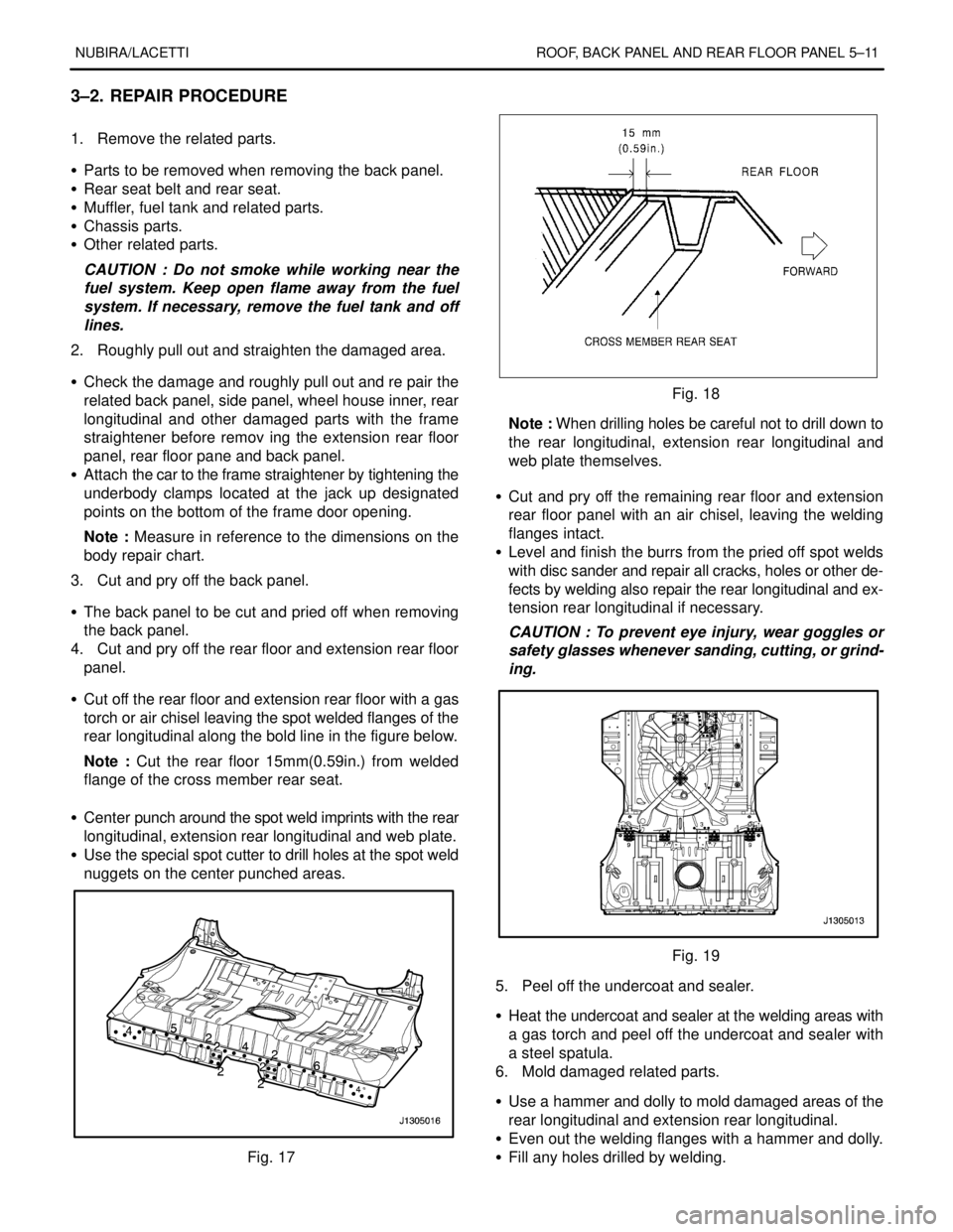
S Cut off the rear floor and extension rear floor with a gas
torch or air chisel leaving the spot welded flanges of the
rear longitudinal along the bold line in the figure below.
Note : Cut the rear floor 15mm(0.59in.) from welded
flange of the cross member rear seat.
S Center punch around the spot weld imprints with the rear
longitudinal, extension rear longitudinal and web plate.
S Use the special spot cutter to drill holes at the spot weld
nuggets on the center punched areas.
Fig. 17
Fig. 18
Note : When drilling holes be careful not to drill down to
the rear longitudinal, extension rear longitudinal and
web plate themselves.
S Cut and pry off the remaining rear floor and extension
rear floor panel with an air chisel, leaving the welding
flanges intact.
S Level and finish the burrs from the pried off spot welds
with disc sander and repair all cracks, holes or other de-
fects by welding also repair the rear longitudinal and ex-
tension rear longitudinal if necessary.
CAUTION : To prevent eye injury, wear goggles or
safety glasses whenever sanding, cutting, or grind-
ing.
Fig. 19
5. Peel off the undercoat and sealer.
S Heat the undercoat and sealer at the welding areas with
a gas torch and peel off the undercoat and sealer with
a steel spatula.
6. Mold damaged related parts.
S Use a hammer and dolly to mold damaged areas of the
rear longitudinal and extension rear longitudinal.
S Even out the welding flanges with a hammer and dolly.
S Fill any holes drilled by welding.
Page 2575 of 2643
6–10 FRAME DOOR OPENING, DOOR AND SIDE PANEL OUTER NUBIRA/LACETTI
3–2. REPAIR PROCEDURE
1. Remove the related parts.
S Rear and trunk trims.
S Rear combination lamps and wiring harness.
S Rear bumper and related parts.
S Rear seat and rear seat belt.
S Chassis and fuel parts.
S Other related parts.
CAUTION : Do not smoke while working near the
fuel system. Keep open flame away from the fuel
system. If necessary, remove the fuel tank and off
lines.
2. Pull out and straighten the damaged area to approxi-
mately the original shape.
S Attach the car to the frame straightener by tightening the
underbody clamps at the four designated support points.
S Before cutting off the damaged sections, pull them out
so that they are restored to the original shape.
S Do not pull out more than necessary.
S Pull out and straighten the damaged areas of the rear
side outer panel, side inner panel and wheelhouse inner.
Note : Check the rear door locking and unlocking condi-
tion.
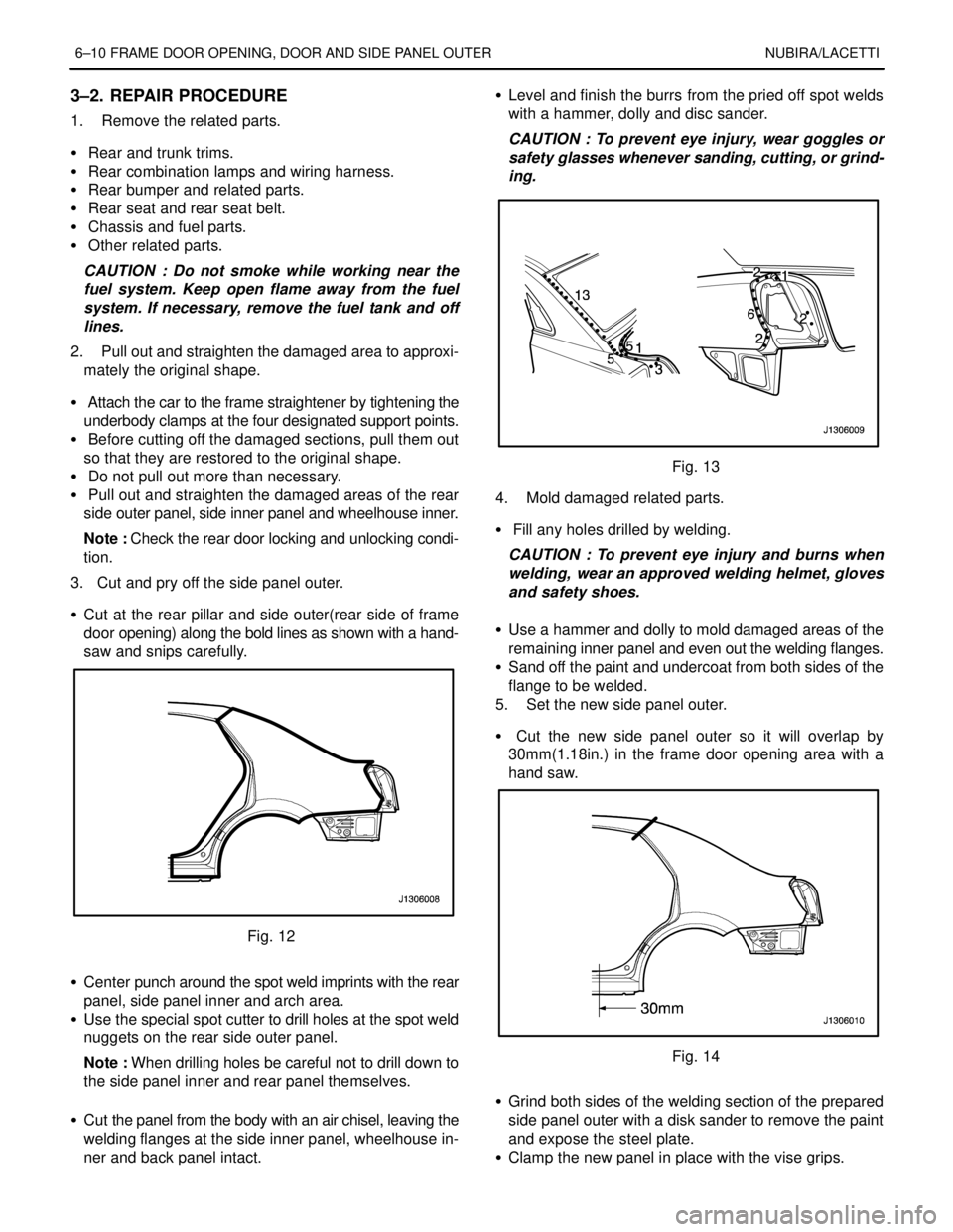
3. Cut and pry off the side panel outer.
S Cut at the rear pillar and side outer(rear side of frame
door opening) along the bold lines as shown with a hand-
saw and snips carefully.
Fig. 12
S Center punch around the spot weld imprints with the rear
panel, side panel inner and arch area.
S Use the special spot cutter to drill holes at the spot weld
nuggets on the rear side outer panel.
Note : When drilling holes be careful not to drill down to
the side panel inner and rear panel themselves.
S Cut the panel from the body with an air chisel, leaving the
welding flanges at the side inner panel, wheelhouse in-
ner and back panel intact.S Level and finish the burrs from the pried off spot welds
with a hammer, dolly and disc sander.
CAUTION : To prevent eye injury, wear goggles or
safety glasses whenever sanding, cutting, or grind-
ing.
Fig. 13
4. Mold damaged related parts.
S Fill any holes drilled by welding.
CAUTION : To prevent eye injury and burns when
welding, wear an approved welding helmet, gloves
and safety shoes.
S Use a hammer and dolly to mold damaged areas of the
remaining inner panel and even out the welding flanges.
S Sand off the paint and undercoat from both sides of the
flange to be welded.
5. Set the new side panel outer.
S Cut the new side panel outer so it will overlap by
30mm(1.18in.) in the frame door opening area with a
hand saw.
Fig. 14
S Grind both sides of the welding section of the prepared
side panel outer with a disk sander to remove the paint
and expose the steel plate.
S Clamp the new panel in place with the vise grips.