Tires DAEWOO LACETTI 2004 Service Manual PDF
[x] Cancel search | Manufacturer: DAEWOO, Model Year: 2004, Model line: LACETTI, Model: DAEWOO LACETTI 2004Pages: 2643, PDF Size: 80.54 MB
Page 1006 of 2643
MANUAL TRANSAXLE DRIVE AXLE 3B – 7
DAEWOO V–121 BL4
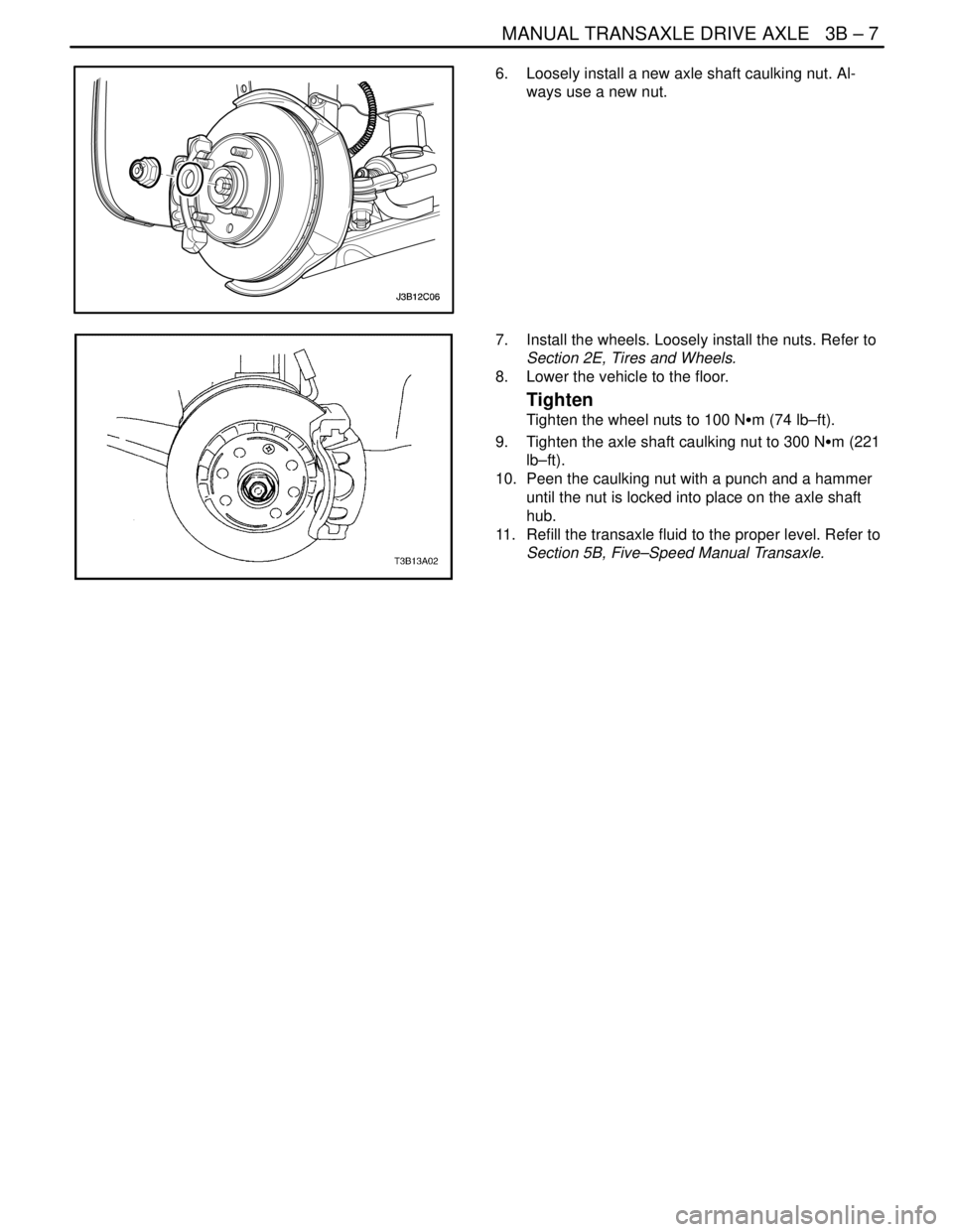
6. Loosely install a new axle shaft caulking nut. Al-
ways use a new nut.
7. Install the wheels. Loosely install the nuts. Refer to
Section 2E, Tires and Wheels.
8. Lower the vehicle to the floor.
Tighten
Tighten the wheel nuts to 100 NSm (74 lb–ft).
9. Tighten the axle shaft caulking nut to 300 NSm (221
lb–ft).
10. Peen the caulking nut with a punch and a hammer
until the nut is locked into place on the axle shaft
hub.
11. Refill the transaxle fluid to the proper level. Refer to
Section 5B, Five–Speed Manual Transaxle.
Page 1021 of 2643

HYDRAULIC BRAKES 4A – 5
DAEWOO V–121 BL4
DIAGNOSIS
BRAKE SYSTEM TESTING
Brakes should be tested on a dry, clean, reasonably
smooth and level roadway. A true test of brake perfor-
mance cannot be made if the roadway is wet, greasy, or
covered with loose dirt whereby all tires do not grip the
road equally. Testing will also be adversely affected if the
roadway is crowned so as to throw the weight so roughly
that the wheels tend to bounce.
Test the brakes at different vehicle speeds with both light
and heavy pedal pressure; however, avoid locking the
brakes and sliding the tires. Locked brakes and sliding
tires do not indicate brake efficiency since heavily braked,
but turning, wheels will stop the vehicle in less distance
than locked brakes. More tire–to–road friction is present
with a heavily–braked, turning tire than with a sliding tire.
Because of the high deceleration capability, a firmer pedal
may be felt at higher deceleration levels.
There are three major external conditions that affect brake
performance:
S Tires having unequal contact and grip of the road
will cause unequal braking. Tires must be equally
inflated, and the tread pattern of the right and the
left tires must be approximately equal.
S Unequal loading of the vehicle can affect the brake
performance since the most heavily loaded wheels
require more braking power, and thus more braking
effort, than the others.
S Misalignment of the wheels, particularly conditions
of excessive camber and caster, will cause the
brakes to pull to one side.
To check for brake fluid leaks, hold constant foot pressure
on the pedal with the engine running at idle and the shift
lever in NEUTRAL. If the pedal gradually falls away with
the constant pressure, the hydraulic system may be leak-
ing. Perform a visual check to confirm any suspected
leaks.
Check the master cylinder fluid level. While a slight drop
in the reservoir level results from normal lining wear, an ab-
normally low level indicates a leak in the system. The hy-
draulic system may be leaking either internally or external-
ly. Refer to the procedure below to check the master
cylinder. Also, the system may appear to pass this test
while still having a slight leak. If the fluid level is normal,
check the vacuum booster pushrod length. If an incorrect
pushrod length is found, adjust or replace the rod.
Check the master cylinder using the following procedure:
S Check for a cracked master cylinder casting or
brake fluid leaking around the master cylinder.
Leaks are indicated only if there is at least one drop
of fluid. A damp condition is not abnormal.S Check for a binding pedal linkage and for an incor-
rect pushrod length. If both of these parts are in
satisfactory condition, disassemble the master cyl-
inder and check for an elongated or swollen primary
cylinder or piston seals. If swollen seals are found,
substandard or contaminated brake fluid should be
suspected. If contaminated brake fluid is found, all
the components should be disassembled and
cleaned, and all the rubber components should be
replaced. All of the pipes must also be flushed.
Improper brake fluid, or mineral oil or water in the fluid,
may cause the brake fluid to boil or cause deterioration of
the rubber components. If the primary piston cups in the
master cylinder are swollen, then the rubber parts have
deteriorated. This deterioration may also be evidenced by
swollen wheel cylinder piston seals on the drum brake
wheels.
If deterioration of rubber is evident, disassemble all the hy-
draulic parts and wash the parts with alcohol. Dry these
parts with compressed air before reassembly to keep alco-
hol out of the system. Replace all the rubber parts in the
system, including the hoses. Also, when working on the
brake mechanisms, check for fluid on the linings. If exces-
sive fluid is found, replace the linings.
If the master cylinder piston seals are in satisfactory condi-
tion, check for leaks or excessive heat conditions. If these
conditions are not found, drain the fluid, flush the master
cylinder with brake fluid, refill the master cylinder, and
bleed the system. Refer to ”Manual Bleeding the Brakes”
or”Pressure Bleeding the Brakes” in this section.
BRAKE HOSE INSPECTION
The hydraulic brake hoses should be inspected at least
twice a year. The brake hose assembly should be checked
for road hazard damage, cracks, chafing of the outer cov-
er, and for leaks or blisters. Inspect the hoses for proper
routing and mounting. A brake hose that rubs on a suspen-
sion component will wear and eventually fail. A light and
a mirror may be needed for an adequate inspection. If any
of the above conditions are observed on the brake hose,
adjust or replace the hose as necessary.
WARNING LAMP OPERATION
This brake system uses a BRAKE warning lamp located
in the instrument panel cluster. When the ignition switch
is in the START position, the BRAKE warning lamp should
glow and go OFF when the ignition switch returns to the
RUN position.
The following conditions will activate the BRAKE lamp:
S Parking brake applied. The light should be ON
whenever the parking brake is applied and the igni-
tion switch is ON.
S Low fluid level. A low fluid level in the master cylin-
der will turn the BRAKE lamp ON.
S EBD system is disabled. The light should be ON
when the EBD system is malfunctioning.
Page 1049 of 2643

SECTION : 4D
FRONT DISC BRAKES
TABLE OF CONTENTS
SPECIFICATIONS4D–1 . . . . . . . . . . . . . . . . . . . . . . . . . .
Fastener Tightening Specirications 4D–1. . . . . . . . . .
DIAGNOSIS4D–1 . . . . . . . . . . . . . . . . . . . . . . . . . . . . . . . .
Lining Inspection 4D–1. . . . . . . . . . . . . . . . . . . . . . . . . .
Rotor Inspection 4D–1. . . . . . . . . . . . . . . . . . . . . . . . . .
MAINTENANCE AND REPAIR4D–3 . . . . . . . . . . . . . . .
ON–VEHICLE SERVICE 4D–3. . . . . . . . . . . . . . . . . . . . .
Shoe and Lining 4D–3. . . . . . . . . . . . . . . . . . . . . . . . . . Caliper Assembly 4D–3. . . . . . . . . . . . . . . . . . . . . . . . . .
Rotor 4D–4. . . . . . . . . . . . . . . . . . . . . . . . . . . . . . . . . . . .
Splash Shield 4D–5. . . . . . . . . . . . . . . . . . . . . . . . . . . . .
UNIT REPAIR 4D–6. . . . . . . . . . . . . . . . . . . . . . . . . . . . . .
Caliper Overhaul 4D–6. . . . . . . . . . . . . . . . . . . . . . . . . .
GENERAL DESCRIPTION AND SYSTEM
OPERATION4D–9 . . . . . . . . . . . . . . . . . . . . . . . . . . . . . .
Disc Brake Caliper Assembly 4D–9. . . . . . . . . . . . . . . .
SPECIFICATIONS
FASTENER TIGHTENING SPECIRICATIONS
ApplicationNSmLb–FtLb–In
Brake Hose Inlet Fitting–to–Caliper Bolt4030–
Caliper Bleeder Valve8–71
Caliper–to–Steering Knuckle Mounting Bolts9570–
Retaining Frame–to–Caliper Housing Bolts2720–
Rotor–to–Front Wheel Hub Detent Screw4–35
Splash Shield–to–Steering Knuckle Screws4–35
DIAGNOSIS
LINING INSPECTION
1. Raise and suitably support the vehicle.
2. Remove the front wheels. Refer to Section 2E,
Tires and Wheels.
3. Visually check the linings for minimum thickness
and wear.
4. Measure the thickness.
Important : The minimum thickness of the inner or the
outer pad is 7 mm (0.28 inch).
5. Install the brake pads in axle sets only.
6. Install the front wheels. Refer to Section 2E, Tires
and Wheels.
7. Lower the vehicle.ROTOR INSPECTION
Thickness variation can be checked by measuring the
thickness of the rotor at four or more points around the cir-
cumference of the rotor. All measurements must be made
at the same distance in from the edge of the rotor.
A rotor that varies by more than 0.01 mm (0.0004 inch) can
cause pedal pulsations and/or front end vibration during
brake applications. A rotor that does not meet these speci-
fications should be refinished to specifications or re-
placed.
Page 1051 of 2643
FRONT DISC BRAKES 4D – 3
DAEWOO V–121 BL4
MAINTENANCE AND REPAIR
ON–VEHICLE SERVICE
SHOE AND LINING
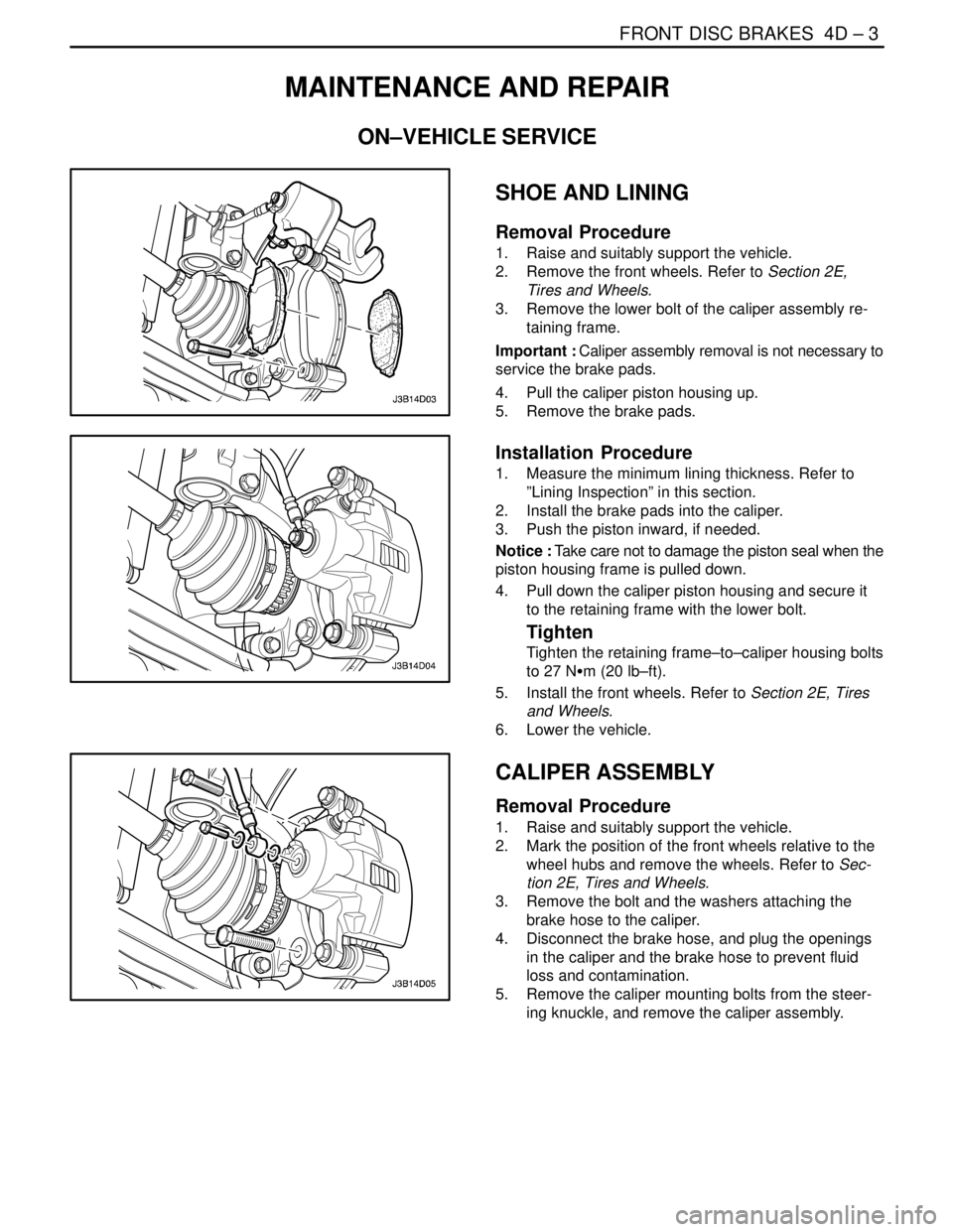
Removal Procedure
1. Raise and suitably support the vehicle.
2. Remove the front wheels. Refer to Section 2E,
Tires and Wheels.
3. Remove the lower bolt of the caliper assembly re-
taining frame.
Important : Caliper assembly removal is not necessary to
service the brake pads.
4. Pull the caliper piston housing up.
5. Remove the brake pads.
Installation Procedure
1. Measure the minimum lining thickness. Refer to
”Lining Inspection” in this section.
2. Install the brake pads into the caliper.
3. Push the piston inward, if needed.
Notice : Take care not to damage the piston seal when the
piston housing frame is pulled down.
4. Pull down the caliper piston housing and secure it
to the retaining frame with the lower bolt.
Tighten
Tighten the retaining frame–to–caliper housing bolts
to 27 NSm (20 lb–ft).
5. Install the front wheels. Refer to Section 2E, Tires
and Wheels.
6. Lower the vehicle.
CALIPER ASSEMBLY
Removal Procedure
1. Raise and suitably support the vehicle.
2. Mark the position of the front wheels relative to the
wheel hubs and remove the wheels. Refer to Sec-
tion 2E, Tires and Wheels.
3. Remove the bolt and the washers attaching the
brake hose to the caliper.
4. Disconnect the brake hose, and plug the openings
in the caliper and the brake hose to prevent fluid
loss and contamination.
5. Remove the caliper mounting bolts from the steer-
ing knuckle, and remove the caliper assembly.
Page 1052 of 2643
4D – 4IFRONT DISC BRAKES
DAEWOO V–121 BL4
Installation Procedure
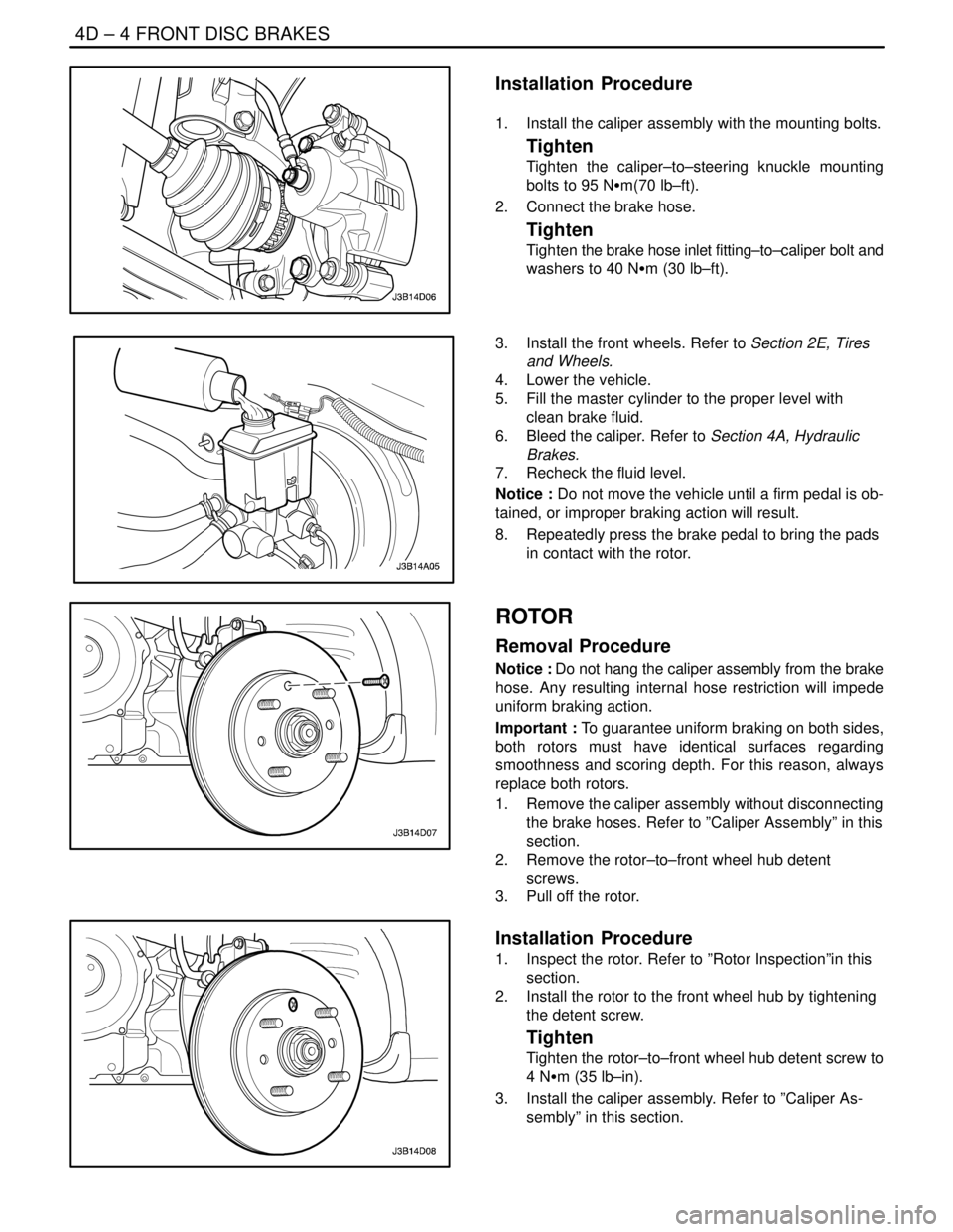
1. Install the caliper assembly with the mounting bolts.
Tighten
Tighten the caliper–to–steering knuckle mounting
bolts to 95 NSm(70 lb–ft).
2. Connect the brake hose.
Tighten
Tighten the brake hose inlet fitting–to–caliper bolt and
washers to 40 NSm (30 lb–ft).
3. Install the front wheels. Refer to Section 2E, Tires
and Wheels.
4. Lower the vehicle.
5. Fill the master cylinder to the proper level with
clean brake fluid.
6. Bleed the caliper. Refer to Section 4A, Hydraulic
Brakes.
7. Recheck the fluid level.
Notice : Do not move the vehicle until a firm pedal is ob-
tained, or improper braking action will result.
8. Repeatedly press the brake pedal to bring the pads
in contact with the rotor.
ROTOR
Removal Procedure
Notice : Do not hang the caliper assembly from the brake
hose. Any resulting internal hose restriction will impede
uniform braking action.
Important : To guarantee uniform braking on both sides,
both rotors must have identical surfaces regarding
smoothness and scoring depth. For this reason, always
replace both rotors.
1. Remove the caliper assembly without disconnecting
the brake hoses. Refer to ”Caliper Assembly” in this
section.
2. Remove the rotor–to–front wheel hub detent
screws.
3. Pull off the rotor.
Installation Procedure
1. Inspect the rotor. Refer to ”Rotor Inspection”in this
section.
2. Install the rotor to the front wheel hub by tightening
the detent screw.
Tighten
Tighten the rotor–to–front wheel hub detent screw to
4 NSm (35 lb–in).
3. Install the caliper assembly. Refer to ”Caliper As-
sembly” in this section.
Page 1058 of 2643

SECTION : 4E1
REAR DISC BRAKES
TABLE OF CONTENTS
SPECIFICATIONS4E1–1 . . . . . . . . . . . . . . . . . . . . . . . . .
Fastener Tightening Specifications 4E1–1. . . . . . . . . .
DIAGNOSIS4E1–1 . . . . . . . . . . . . . . . . . . . . . . . . . . . . . . .
Lining Inspection 4E1–1. . . . . . . . . . . . . . . . . . . . . . . . .
Rotor Inspection 4E1–1. . . . . . . . . . . . . . . . . . . . . . . . . .
MAINTENANCE AND REPAIR4E1–3 . . . . . . . . . . . . . .
ON–VEHICLE SERVICE 4E1–3. . . . . . . . . . . . . . . . . . . .
Shoe and Lining 4E1–3. . . . . . . . . . . . . . . . . . . . . . . . . . Caliper 4E1–4. . . . . . . . . . . . . . . . . . . . . . . . . . . . . . . . . .
Rotor 4E1–5. . . . . . . . . . . . . . . . . . . . . . . . . . . . . . . . . . .
Hub and Parking Brake Shoe/Backplate 4E1–6. . . . .
UNIT REPAIR 4E1–10. . . . . . . . . . . . . . . . . . . . . . . . . . . .
Caliper Overhaul 4E1–10. . . . . . . . . . . . . . . . . . . . . . . .
GENERAL DESCRIPTION AND SYSTEM
OPERATION4E1–12 . . . . . . . . . . . . . . . . . . . . . . . . . . . .
Disc Brake Caliper Assembly 4E1–12. . . . . . . . . . . . . .
SPECIFICATIONS
FASTENER TIGHTENING SPECIFICATIONS
ApplicationNSmLb–FtLb–In
Brake Hose Inlet Bolt and Ring Seals3224–
Caliper Mounting Bolts5641–
Lower Caliper Mounting Bolt2720–
Parking Brake Shoe Hold–Down Spring As-
sembly Screw4–35
Rotor Detent Screw4–35
Hub Bolts6548–
DIAGNOSIS
LINING INSPECTION
1. Raise and suitably support the vehicle.
2. Remove the rear wheels. Refer to Section 2E, Tires
and Wheels.
3. Visually check the brake shoe linings for minimum
thickness and wear.
4. Measure the thickness.
Important : The minimum discard thickness of the brake
shoe lining is 2 mm (0.08 inch).
5. Install the shoes in axle sets only.
6. Install the rear wheels. Refer to Section 2E, Tires
and Wheels.
7. Lower the vehicle.
ROTOR INSPECTION
Brake rotors are manufactured with close tolerances for
thickness variation, flatness, and lateral runout, but pits
and grooves are created in rotors during usage. Lack of
uniformity of the braking surfaces of the rotor can cause
inadequate braking and a pulsating pedal during braking.
The surface finish of the rotor is also important because
an unsuitable surface finish can cause pulling and rapid
wear of the brake shoe lining. If a rotor does not meet the
specification, it should be refinished to specification or re-
placed. Refinishing of the rotor should only be done with
precision equipment.
Thickness variation can be checked by measuring the
thickness of the rotor at four or more points around the cir-
cumference of the rotor. All measurements must be made
at the same distance from the edge of the rotor. A rotor that
varies by more than. 1.0 mm (0.04 inch) can cause pedal
Page 1060 of 2643
REAR DISC BRAKES 4E1 – 3
DAEWOO V–121 BL4
MAINTENANCE AND REPAIR
ON–VEHICLE SERVICE
SHOE AND LINING
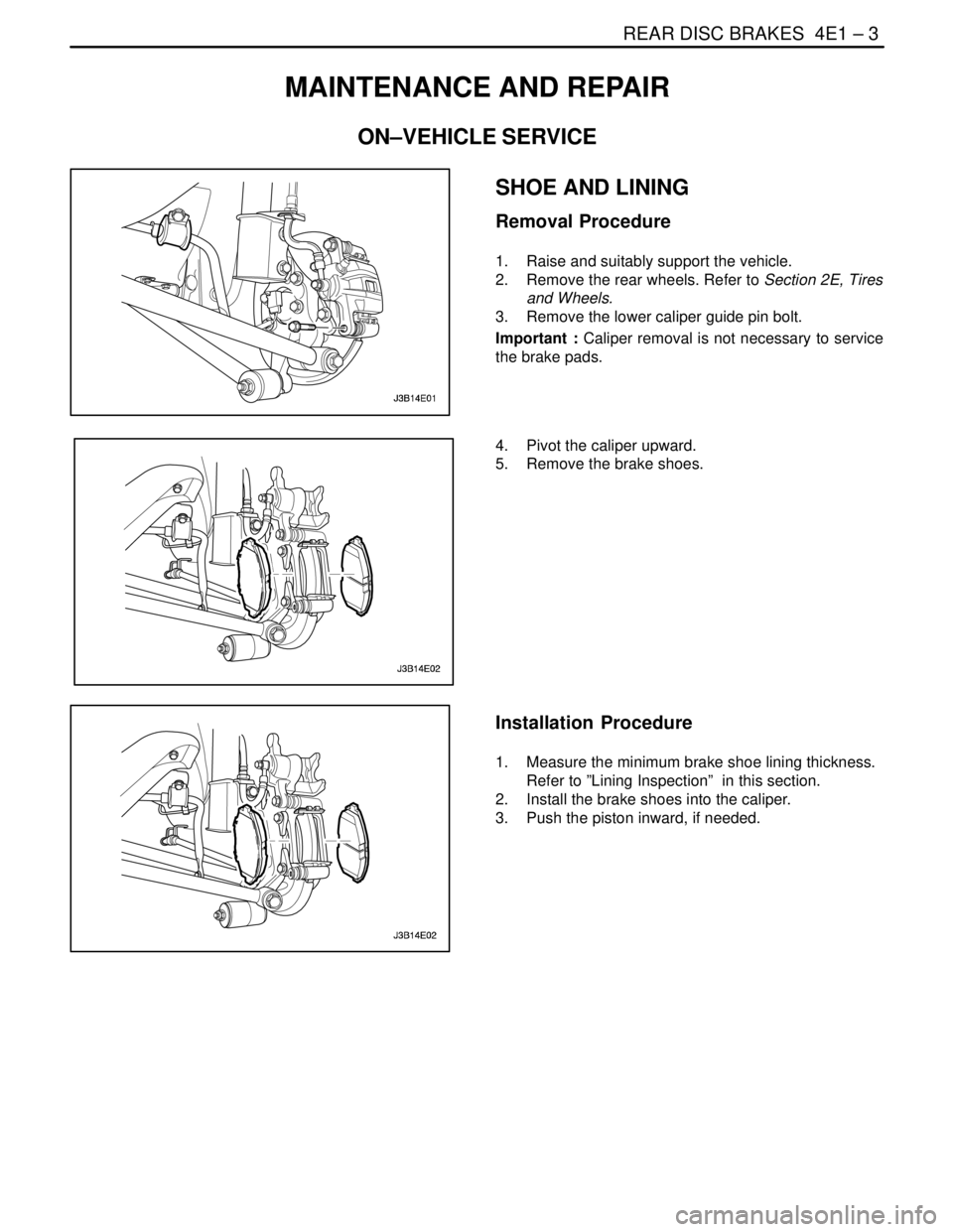
Removal Procedure
1. Raise and suitably support the vehicle.
2. Remove the rear wheels. Refer to Section 2E, Tires
and Wheels.
3. Remove the lower caliper guide pin bolt.
Important : Caliper removal is not necessary to service
the brake pads.
4. Pivot the caliper upward.
5. Remove the brake shoes.
Installation Procedure
1. Measure the minimum brake shoe lining thickness.
Refer to ”Lining Inspection” in this section.
2. Install the brake shoes into the caliper.
3. Push the piston inward, if needed.
Page 1061 of 2643
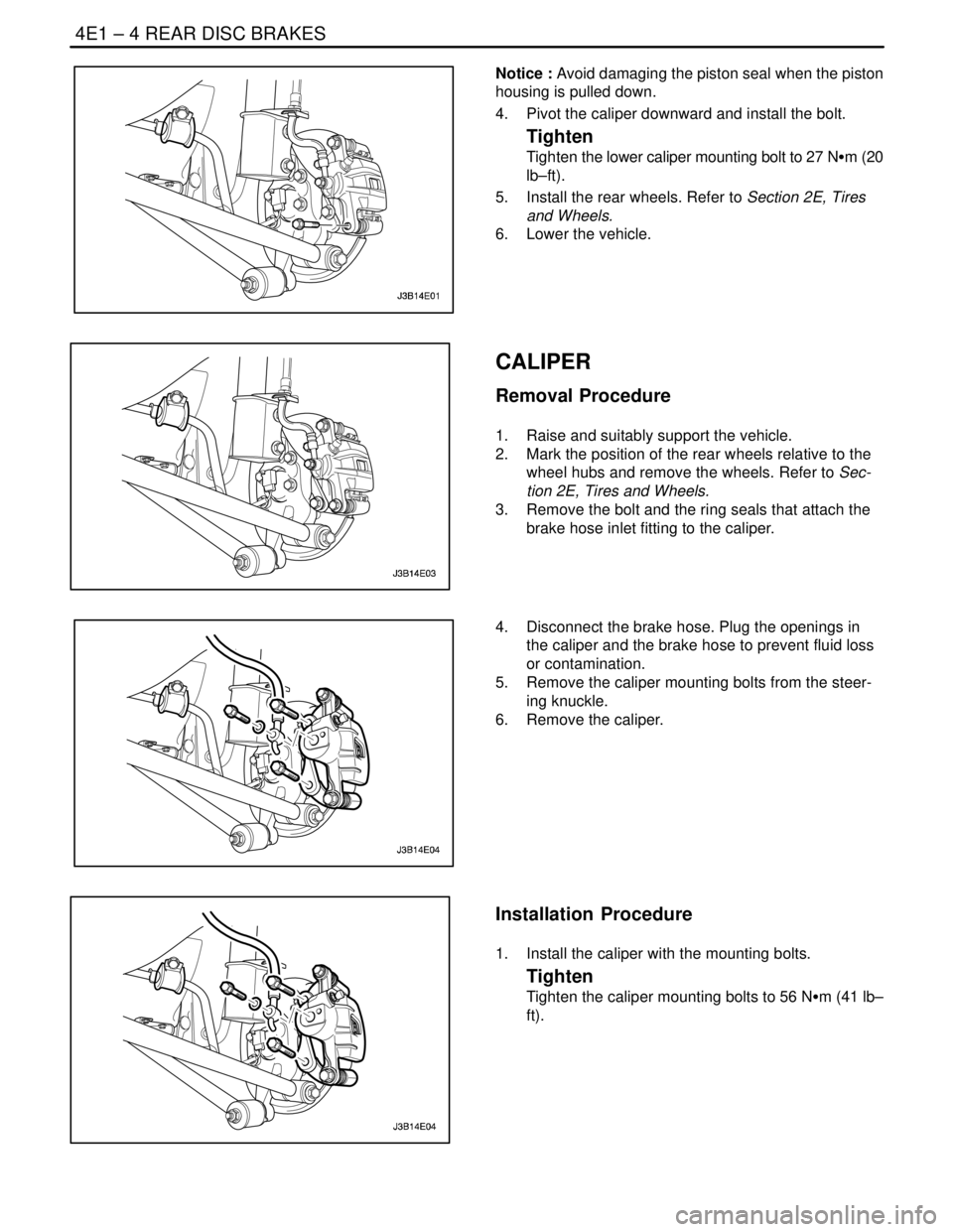
4E1 – 4IREAR DISC BRAKES
DAEWOO V–121 BL4
Notice : Avoid damaging the piston seal when the piston
housing is pulled down.
4. Pivot the caliper downward and install the bolt.
Tighten
Tighten the lower caliper mounting bolt to 27 NSm (20
lb–ft).
5. Install the rear wheels. Refer to Section 2E, Tires
and Wheels.
6. Lower the vehicle.
CALIPER
Removal Procedure
1. Raise and suitably support the vehicle.
2. Mark the position of the rear wheels relative to the
wheel hubs and remove the wheels. Refer to Sec-
tion 2E, Tires and Wheels.
3. Remove the bolt and the ring seals that attach the
brake hose inlet fitting to the caliper.
4. Disconnect the brake hose. Plug the openings in
the caliper and the brake hose to prevent fluid loss
or contamination.
5. Remove the caliper mounting bolts from the steer-
ing knuckle.
6. Remove the caliper.
Installation Procedure
1. Install the caliper with the mounting bolts.
Tighten
Tighten the caliper mounting bolts to 56 NSm (41 lb–
ft).
Page 1062 of 2643
REAR DISC BRAKES 4E1 – 5
DAEWOO V–121 BL4
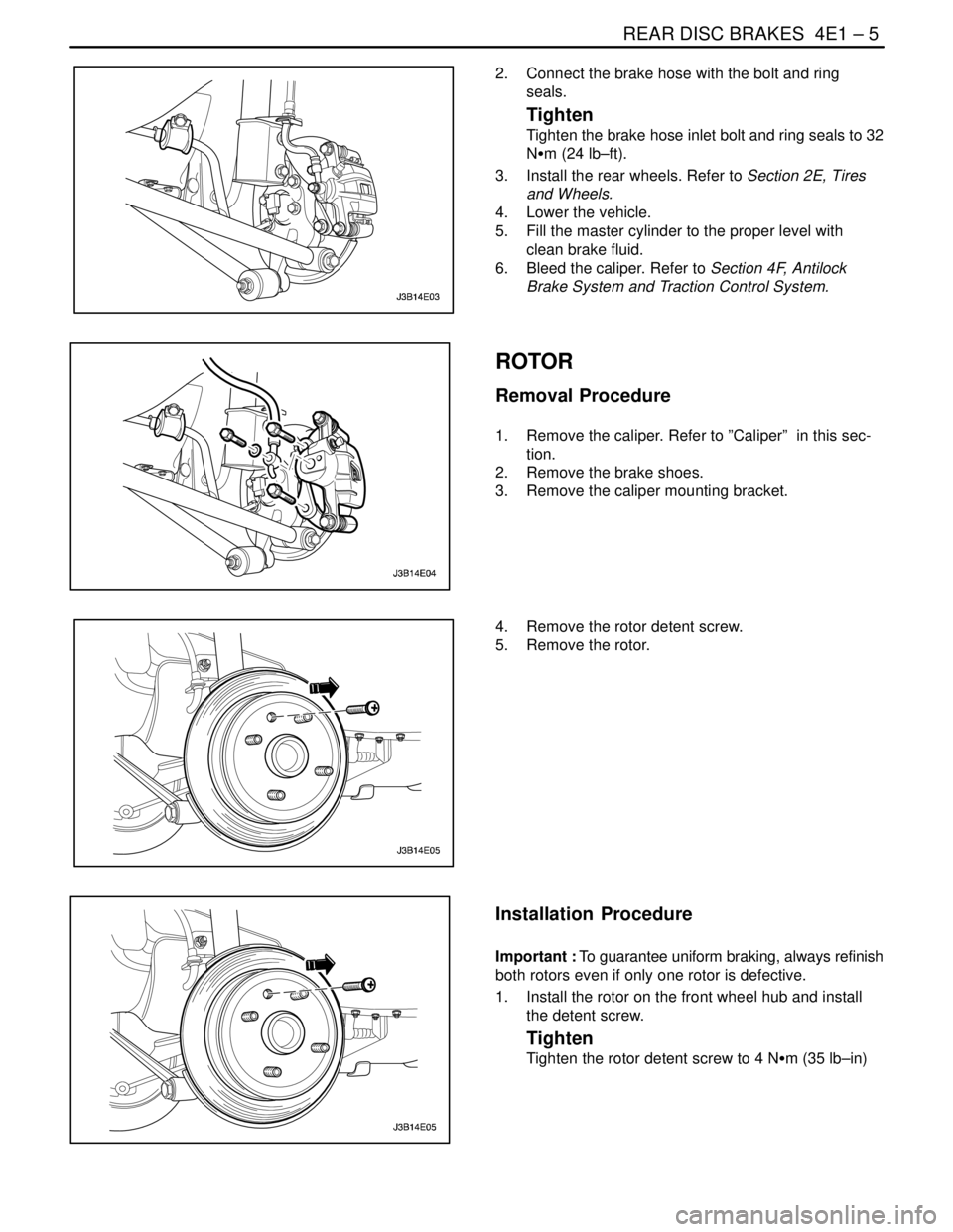
2. Connect the brake hose with the bolt and ring
seals.
Tighten
Tighten the brake hose inlet bolt and ring seals to 32
NSm (24 lb–ft).
3. Install the rear wheels. Refer to Section 2E, Tires
and Wheels.
4. Lower the vehicle.
5. Fill the master cylinder to the proper level with
clean brake fluid.
6. Bleed the caliper. Refer to Section 4F, Antilock
Brake System and Traction Control System.
ROTOR
Removal Procedure
1. Remove the caliper. Refer to ”Caliper” in this sec-
tion.
2. Remove the brake shoes.
3. Remove the caliper mounting bracket.
4. Remove the rotor detent screw.
5. Remove the rotor.
Installation Procedure
Important : To guarantee uniform braking, always refinish
both rotors even if only one rotor is defective.
1. Install the rotor on the front wheel hub and install
the detent screw.
Tighten
Tighten the rotor detent screw to 4 NSm (35 lb–in)
Page 1070 of 2643

SECTION : 4E2
REAR DRUM BRAKES
TABLE OF CONTENTS
SPECIFICATIONS4E2–1 . . . . . . . . . . . . . . . . . . . . . . . . .
Fastener Tightening Specifications 4E2–1. . . . . . . . .
DIAGNOSIS4E2–1 . . . . . . . . . . . . . . . . . . . . . . . . . . . . . . .
Lining Inspection 4E2–1. . . . . . . . . . . . . . . . . . . . . . . . .
Drums 4E2–1. . . . . . . . . . . . . . . . . . . . . . . . . . . . . . . . . .
MAINTENANCE AND REPAIR4E2–3 . . . . . . . . . . . . . .
ON–VEHICLE SERVICE 4E2–3. . . . . . . . . . . . . . . . . . . .
Brake Adjustment 4E2–3. . . . . . . . . . . . . . . . . . . . . . . . Shoe and Lining 4E2–4. . . . . . . . . . . . . . . . . . . . . . . . .
Wheel Cylinder Assembly 4E2–7. . . . . . . . . . . . . . . . .
Backing Plate 4E2–8. . . . . . . . . . . . . . . . . . . . . . . . . . . .
UNIT REPAIR 4E2–10. . . . . . . . . . . . . . . . . . . . . . . . . . . .
Wheel Cylinder 4E2–10. . . . . . . . . . . . . . . . . . . . . . . . .
GENERAL DESCRIPTION AND SYSTEM
OPERATION4E2–12 . . . . . . . . . . . . . . . . . . . . . . . . . . . .
Drum Brakes 4E2–12. . . . . . . . . . . . . . . . . . . . . . . . . . .
SPECIFICATIONS
FASTENER TIGHTENING SPECIFICATIONS
ApplicationNSmLb–FtLb–In
Brake Line1612–
Brake Wheel Hub/Backing Plate–to–Rear
Axle Nuts2821–
Wheel Cylinder–to–Backing Plate Bolt8–71
DIAGNOSIS
LINING INSPECTION
1. Raise and suitably support the vehicle.
2. Remove the wheel. Refer to Section 2E, Tires and
Wheels.
3. Release the parking brake.
4. Remove the drum. Refer to ” Drum” in this section.
5. Measure the lining thickness. The minimum lining
thickness is 0.5 mm (0.02 inch).
CAUTION : To avoid injury when servicing brake
parts, do not create dust by grinding or sanding the
brake linings or by cleaning the wheel brake parts
with a dry brush or with compressed air.
Important : Replace the shoe and lining assembly in axle
sets only.
6. Install the drum, if removed. Refer to ”One–Piece
Drum” or ”Two–Piece Drum” in this section.
7. Install the wheel, if removed. Refer to Section 2E,
Tires and Wheels.
8. Lower the vehicle.
DRUMS
Whenever brake drums are removed, they should be thor-
oughly cleaned and inspected to see if the drums are
cracked, scored, deeply grooved, or beyond the specified
out–of–round limit.
S A cracked drum is unsafe for further service and-
must be replaced. Do not attempt to weld a cracked
drum. Smooth out any slight scores.
S Heavy or extensive scoring will cause excessive
brake lining wear and may require refinishing the
drum braking surface.
S If the brake linings are slightly worn but are still re-
usable and the drum is grooved, polish the drum
with a fine emery cloth but do not refinish it. Elimi-
nating all grooves in the drum and smoothing the
ridges on the lining would remove too much metal
and lining. If left alone, the grooves and ridges
match, and satisfactory service can be obtained. If
the brake linings need to be replaced, refinish a
grooved drum. A grooved drum, used with a new