Reverse DAEWOO LACETTI 2004 Service Manual Online
[x] Cancel search | Manufacturer: DAEWOO, Model Year: 2004, Model line: LACETTI, Model: DAEWOO LACETTI 2004Pages: 2643, PDF Size: 80.54 MB
Page 2273 of 2643

LITHING SYSTEMS 9B – 47
DAEWOO V–121 BL4
BACKUP LAMPS
The backup lamps are located in the rear combination
lamps They will come on when the transaxle is shifted into
reverse. On a vehicle with an automatic transaxle, the
backup lamps are activated by the neutral safety backup
(NSBU) switch. On a vehicle with a manual transaxle, they
are activated by a reverse switch which is part of the trans-
axle.
Page 2428 of 2643

9P – 8IDOORS
DAEWOO V–121 BL4
StepNo Yes Value(s) Action
181. Remove the trim panel from a door which
has an inoperative power window.
2. Move a vehicle battery close enough to the
door so that the window motor can be pow-
ered directly from the battery with jumper
wires.
3. Disconnect the the two–pin window motor
connector in the door.
Important : To prevent the fuse in the jumper wire
from blowing, do not touch the jumper wires togeth-
er.
1. Attach a jumper wire between the battery
negative terminal and one of the terminals in
the two–pin window motor connector.
2. Attach a fused jumper wire between the bat-
tery positive terminal and the remaining ter-
minal in the two–pin window motor connec-
tor. Unless the motor is at the end of its trav-
el, the window should move with the jumpers
attached.
3. To move the window in the opposite direc-
tion, reverse the jumper wire connections at
the window motor connector.
Does the power window operate in both direc-
tions when the motor is operated directly from
a battery?–Go to
Step 20Go to
Step 19
19Replace the window motor.
Is the repair complete?–System
OK–
201. Before reconnecting the two–pin window mo-
tor connector, connect an ohmmeter between
the terminals to check the resistance of the
motor.
2. Record the ohmmeter reading for motor re-
sistance.
3. Reconnect the motor connector and reinstall
the door trim panel.
4. Disconnect the electrical connector from the
dual power window switch.
5. At the dual power window switch connector,
use an ohmmeter to check the resistance
between the terminals which lead to the mo-
tor that was tested in Step 15
Is the resistance at the switch connector
approximately equal to the resistance that
was previously measured at the motor con-
nector?–Go to
Step 22Go to
Step 21
21Repair the open circuit between the window
motor and the window switch.
Is the repair complete?–System
OK–
22Replace the power window switch.
Is the repair complete?–System
OK–
Page 2431 of 2643

DOORS 9P – 11
DAEWOO V–121 BL4
StepNo Yes Value(s) Action
181. Remove the trim panel from the front door
which has an inoperative power window.
2. Move a vehicle battery close enough to the
door so that the window motor can be pow-
ered directly from the battery with jumper
wires.
3. Disconnect the the two–pin window motor
connector in the door.
Important : To prevent the fuse in the jumper wire
from blowing, do not touch the jumper wires togeth-
er.
1. Attach a jumper wire between the battery
negative terminal and one of the terminals in
the two–pin window motor connector.
2. Attach a fused jumper wire between the bat-
tery positive terminal and the remaining ter-
minal in the two–pin window motor connec-
tor. Unless the motor is at the end of its trav-
el, the window should move with the jumpers
attached.
3. To move the window in the opposite direc-
tion, reverse the jumper wire connections at
the window motor connector.
Does the power window operate in both direc-
tions when the motor is operated directly from
a battery?–Go to
Step 20Go to
Step 19
19Replace the window motor.
Is the repair complete?–System
OK–
201. Before reconnecting the two–pin window mo-
tor connector, connect an ohmmeter between
the terminals to check the resistance of the
motor.
2. Record the ohmmeter reading for motor re-
sistance.
3. Reconnect the motor connector and reinstall
the door trim panel.
4. Disconnect the electrical connector from the
power window switch.
5. At the power window main switch connector,
use an ohmmeter to check the resistance
between the terminals which lead to the mo-
tor that was tested in Step 15.
Is the resistance at the main switch connector
approximately equal to the resistance that
was previously measured at the motor con-
nector?–Go to
Step 22Go to
Step 21
21Repair the open circuit between the window
motor and the window switch.
Is the repair complete?–System
OK–
22Replace the power window switch.
Is the repair complete?–System
OK–
Page 2434 of 2643

9P – 14IDOORS
DAEWOO V–121 BL4
StepNo Yes Value(s) Action
181. Remove the trim panel from the rear door
which has an inoperative power window.
2. Move a vehicle battery close enough to the
door so that the window motor can be pow-
ered directly from the battery with jumper
wires.
3. Disconnect the the two–pin window motor
connector in the door.
Important : To prevent the fuse in the jumper wire
from blowing, do not touch the jumper wires togeth-
er.
1. Attach a jumper wire between the negative
battery terminal and one of the terminals in
the two–pin window motor connector.
2. Attach a fused jumper wire between the posi-
tive battery terminal and the remaining termi-
nal in the two–pin power window motor con-
nector. Unless the motor is at the end of its
travel, the power window should move with
the jumpers attached.
3. To move the power window in the opposite
direction, reverse the jumper wire connec-
tions at the power window motor connector.
Does the power window operate in both direc-
tions when the motor is operated directly from
a battery?–Go to
Step 20Go to
Step 19
19Replace the power window motor.
Is the repair complete?–System
OK–
201. Make sure the window lock on the main
switch is off.
2. Turn the ignition ON.
3. At the rear power window switch connector,
check the voltage at terminal 1.
Is the voltage equal to the specified value?11–14vGo to
Step 21Go to
Step 29
211. At the power window motor two–pin connec-
tor, use an ohmmeter to measure the resist-
ance of the power window motor. Record the
resistance.
2. Re–connect the two–pin power window motor
connector.
3. Disconnect the rear power window switch
connector.
4. Use an ohmmeter to measure between termi-
nals 2 and 6 of the rear power window switch
connector.
Is the resistance measured at the rear power
window switch connector equal to the resist-
ance previously measured at the rear power
window motor connector?–Go to
Step 23Go to
Step 22
22Repair the open circuit between the rear pow-
er window switch and the rear power window
motor connector.
Is the repair complete?–System
OK–
Page 2539 of 2643

NUBIRA/LACETTIFRONT 4–5
S Aircon condenser and related parts.
S Head lamps and fenders.
S Hood, radiator grill, and bumper.
S Others
S Install in the reverse order in which they were removed.
Note : After install the all related parts, rub in grease to
the moving parts and replenish cooling liquid, break oil,
aircon gas and others.
14. Check and adjust
S Check clearances and level differences.
S Check the hood locking and unlocking condition.
S Adjust the head lamp aim.
S Check all operation.
S Check for gas, oil and liquid leaks.
Note : Use specified check sheet for operation check
properly.
Page 2543 of 2643
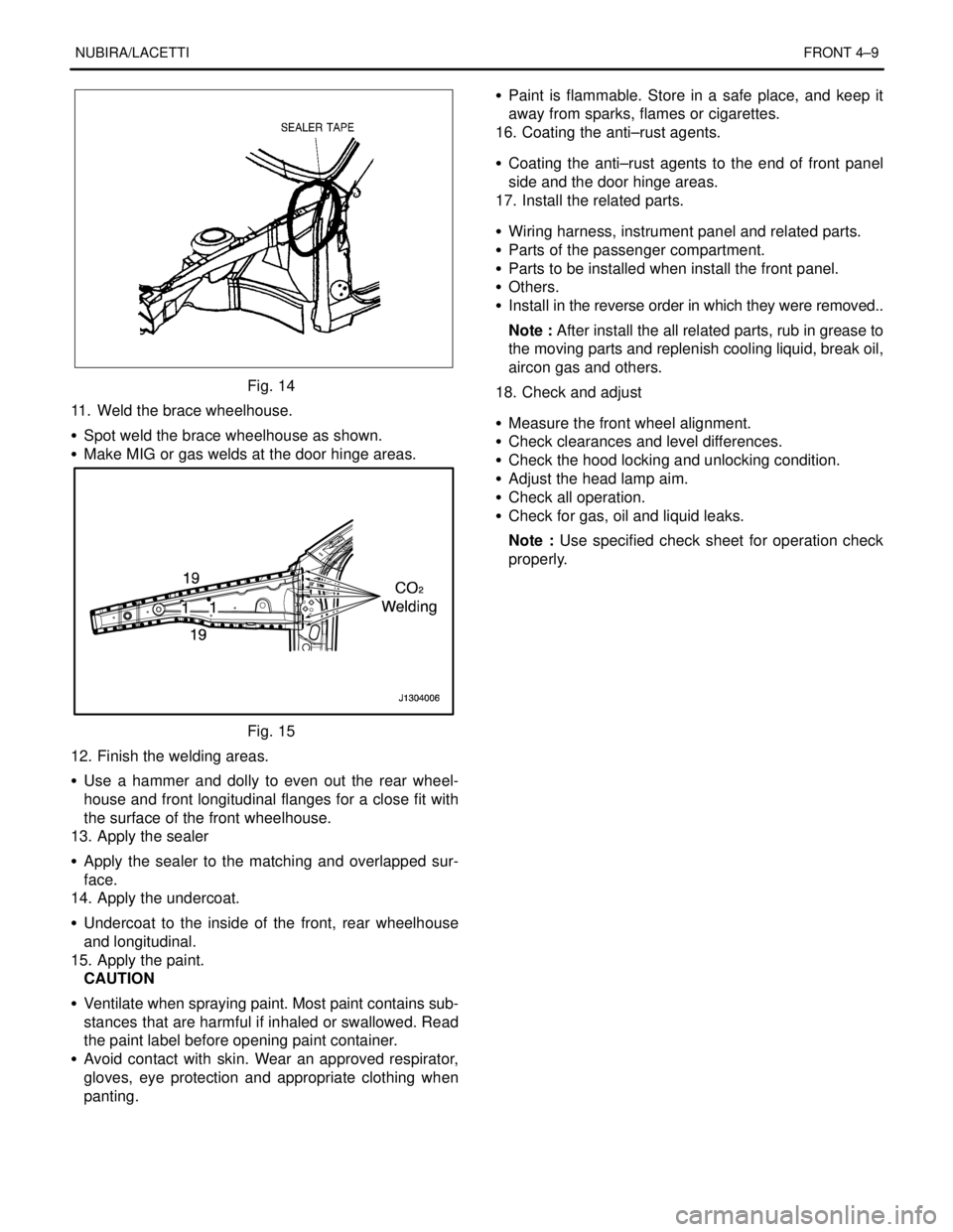
NUBIRA/LACETTIFRONT 4–9
Fig. 14
11. Weld the brace wheelhouse.
S Spot weld the brace wheelhouse as shown.
S Make MIG or gas welds at the door hinge areas.
Fig. 15
12. Finish the welding areas.
S Use a hammer and dolly to even out the rear wheel-
house and front longitudinal flanges for a close fit with
the surface of the front wheelhouse.
13. Apply the sealer
S Apply the sealer to the matching and overlapped sur-
face.
14. Apply the undercoat.
S Undercoat to the inside of the front, rear wheelhouse
and longitudinal.
15. Apply the paint.
CAUTION
S Ventilate when spraying paint. Most paint contains sub-
stances that are harmful if inhaled or swallowed. Read
the paint label before opening paint container.
S Avoid contact with skin. Wear an approved respirator,
gloves, eye protection and appropriate clothing when
panting.S Paint is flammable. Store in a safe place, and keep it
away from sparks, flames or cigarettes.
16. Coating the anti–rust agents.
S Coating the anti–rust agents to the end of front panel
side and the door hinge areas.
17. Install the related parts.
S Wiring harness, instrument panel and related parts.
S Parts of the passenger compartment.
S Parts to be installed when install the front panel.
S Others.
S Install in the reverse order in which they were removed..
Note : After install the all related parts, rub in grease to
the moving parts and replenish cooling liquid, break oil,
aircon gas and others.
18. Check and adjust
S Measure the front wheel alignment.
S Check clearances and level differences.
S Check the hood locking and unlocking condition.
S Adjust the head lamp aim.
S Check all operation.
S Check for gas, oil and liquid leaks.
Note : Use specified check sheet for operation check
properly.
Page 2546 of 2643

4–12 FRONTNUBIRA/LACETTI
Note : Use of jigs is recommended for correct positions
and check that the both front longitudinal and wheel-
house are parallel.
S Tack weld the clamped section for temporary installa-
tion.
7. Perform the main welding.
S Weld as much as possible with the jig still mounted.
S Make MIG or gas welds at the butt joints at the front lon-
gitudinal, carefully.
Fig. 19
S Spot weld the wheelhouse with the front longitudinal
flange areas and front panel.
CAUTION : To prevent eye injury and burns when
welding, wear an approved welding helmet, gloves
and safety shoes.
S Perform a trial welding first, and check the welding con-
dition.
S Increase the number of spot by 20% for areas to be spot
welded.
Fig. 20
S Level the weld beads at the longitudinal butt joints area
with disc sander.
S Make the stiffener(Thickness: 2.8 mm Min., Width: 80
mm) according to the form of longitudinal butt joint areasand weld the stiffener at the longitudinal butt joint areas
with MIG welder.
Fig. 21
8. Finish the welding areas.
S Level the gas or MIG welded areas with disc sander.
S Use a hammer and dolly to even out the wheelhouse and
longitudinal flanges for a close fit.
9. Apply the sealer.
S Apply the sealer to the joint areas of the dash panel lower
and floor panel areas.
10. Apply the undercoat.
S Undercoat to the joint and overlapped areas of the front
floor, longitudinal under side and the inside of front, rear
wheelhouse.
11. Apply the paint.
CAUTION
S Ventilate when spraying paint. Most paint contains sub-
stances that are harmful if inhaled or swallowed. Read
the paint label before opening paint container.
S Avoid contact with skin. Wear an approved respirator,
gloves, eye protection and appropriate clothing when
painting.
S Paint is flammable. Store in a safe place, and keep it
away from sparks, flames or cigarettes.
12. Coating the anti–rust agents.
S Coating the anti–rust agents to the end of front panel
side and the front door hinge areas.
13. Install the related parts.
S Clean the passenger compartment.
S Wiring harness, instrument panel and related parts.
S Parts of the passenger compartment.
S Chassis components.
S Engine, radiator and related parts.
S Aircon condenser and related parts.
S Head lamps and fenders.
S Heed, radiator grill, and bumper.
S Others.
S Install in the reverse order in which they were removed.
Page 2551 of 2643
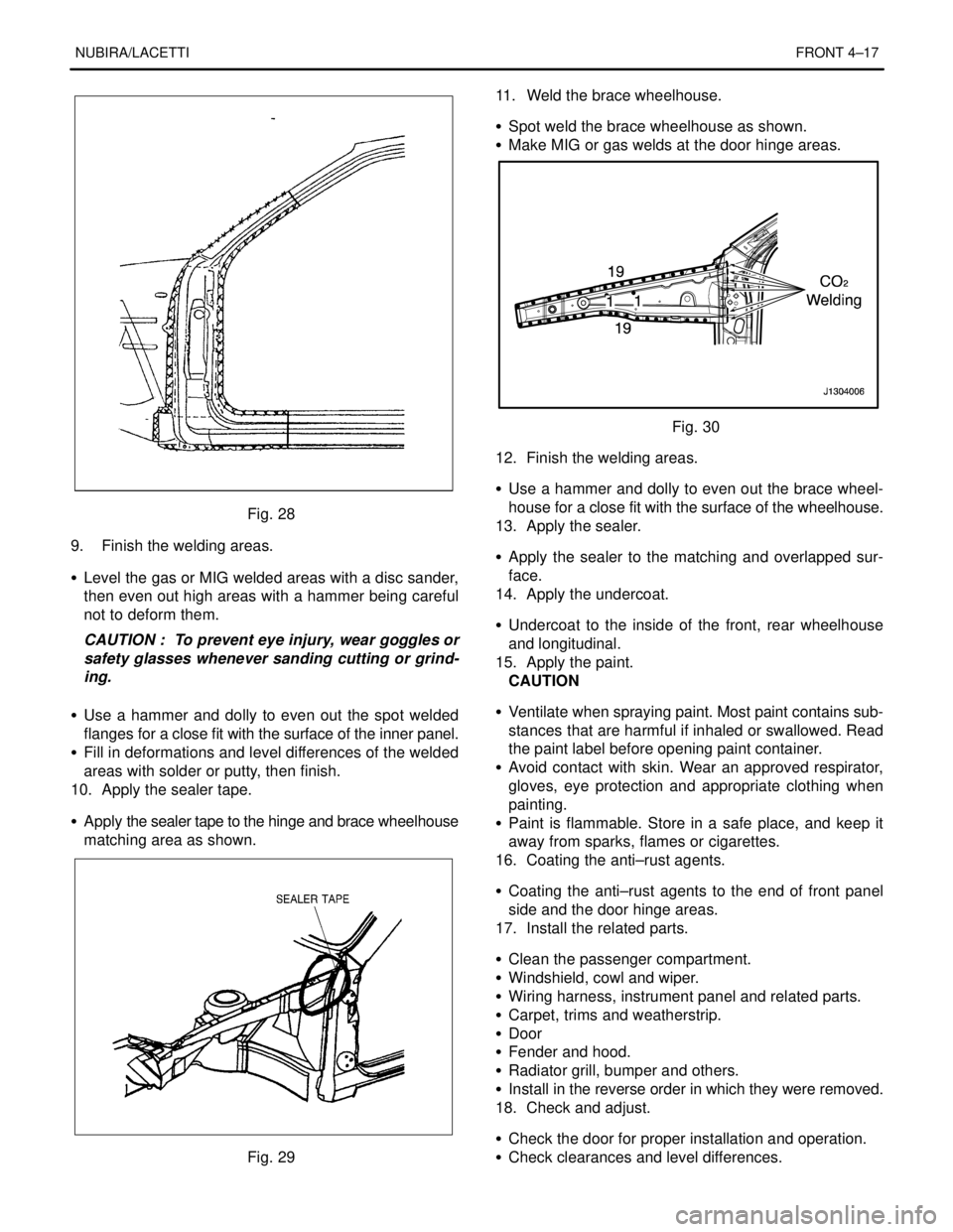
NUBIRA/LACETTIFRONT 4–17
Fig. 28
9. Finish the welding areas.
S Level the gas or MIG welded areas with a disc sander,
then even out high areas with a hammer being careful
not to deform them.
CAUTION : To prevent eye injury, wear goggles or
safety glasses whenever sanding cutting or grind-
ing.
S Use a hammer and dolly to even out the spot welded
flanges for a close fit with the surface of the inner panel.
S Fill in deformations and level differences of the welded
areas with solder or putty, then finish.
10. Apply the sealer tape.
S Apply the sealer tape to the hinge and brace wheelhouse
matching area as shown.
Fig. 2911. Weld the brace wheelhouse.
S Spot weld the brace wheelhouse as shown.
S Make MIG or gas welds at the door hinge areas.
Fig. 30
12. Finish the welding areas.
S Use a hammer and dolly to even out the brace wheel-
house for a close fit with the surface of the wheelhouse.
13. Apply the sealer.
S Apply the sealer to the matching and overlapped sur-
face.
14. Apply the undercoat.
S Undercoat to the inside of the front, rear wheelhouse
and longitudinal.
15. Apply the paint.
CAUTION
S Ventilate when spraying paint. Most paint contains sub-
stances that are harmful if inhaled or swallowed. Read
the paint label before opening paint container.
S Avoid contact with skin. Wear an approved respirator,
gloves, eye protection and appropriate clothing when
painting.
S Paint is flammable. Store in a safe place, and keep it
away from sparks, flames or cigarettes.
16. Coating the anti–rust agents.
S Coating the anti–rust agents to the end of front panel
side and the door hinge areas.
17. Install the related parts.
S Clean the passenger compartment.
S Windshield, cowl and wiper.
S Wiring harness, instrument panel and related parts.
S Carpet, trims and weatherstrip.
S Door
S Fender and hood.
S Radiator grill, bumper and others.
S Install in the reverse order in which they were removed.
18. Check and adjust.
S Check the door for proper installation and operation.
S Check clearances and level differences.
Page 2557 of 2643
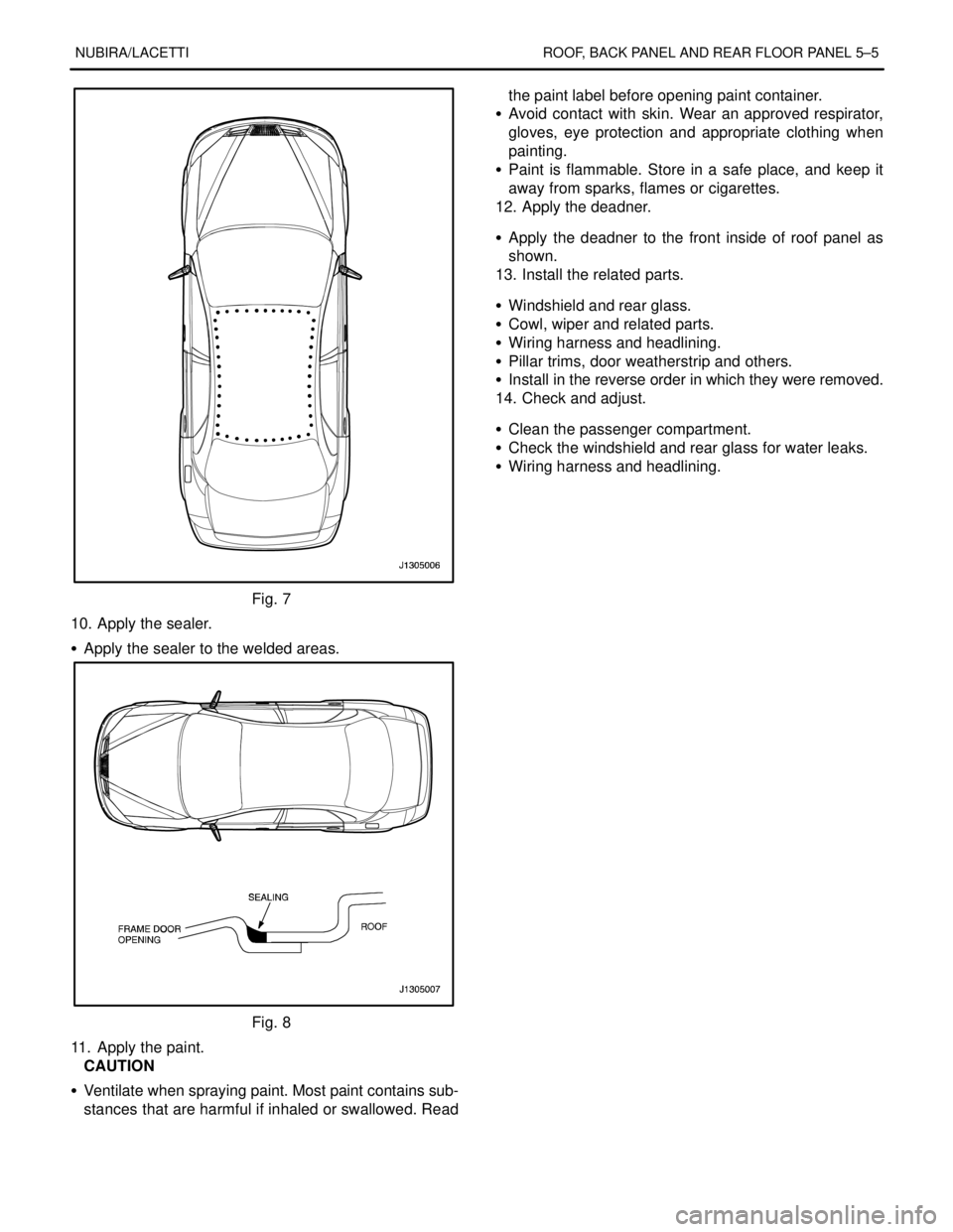
NUBIRA/LACETTI ROOF, BACK PANEL AND REAR FLOOR PANEL 5–5
Fig. 7
10. Apply the sealer.
S Apply the sealer to the welded areas.
Fig. 8
11. Apply the paint.
CAUTION
S Ventilate when spraying paint. Most paint contains sub-
stances that are harmful if inhaled or swallowed. Readthe paint label before opening paint container.
S Avoid contact with skin. Wear an approved respirator,
gloves, eye protection and appropriate clothing when
painting.
S Paint is flammable. Store in a safe place, and keep it
away from sparks, flames or cigarettes.
12. Apply the deadner.
S Apply the deadner to the front inside of roof panel as
shown.
13. Install the related parts.
S Windshield and rear glass.
S Cowl, wiper and related parts.
S Wiring harness and headlining.
S Pillar trims, door weatherstrip and others.
S Install in the reverse order in which they were removed.
14. Check and adjust.
S Clean the passenger compartment.
S Check the windshield and rear glass for water leaks.
S Wiring harness and headlining.
Page 2560 of 2643
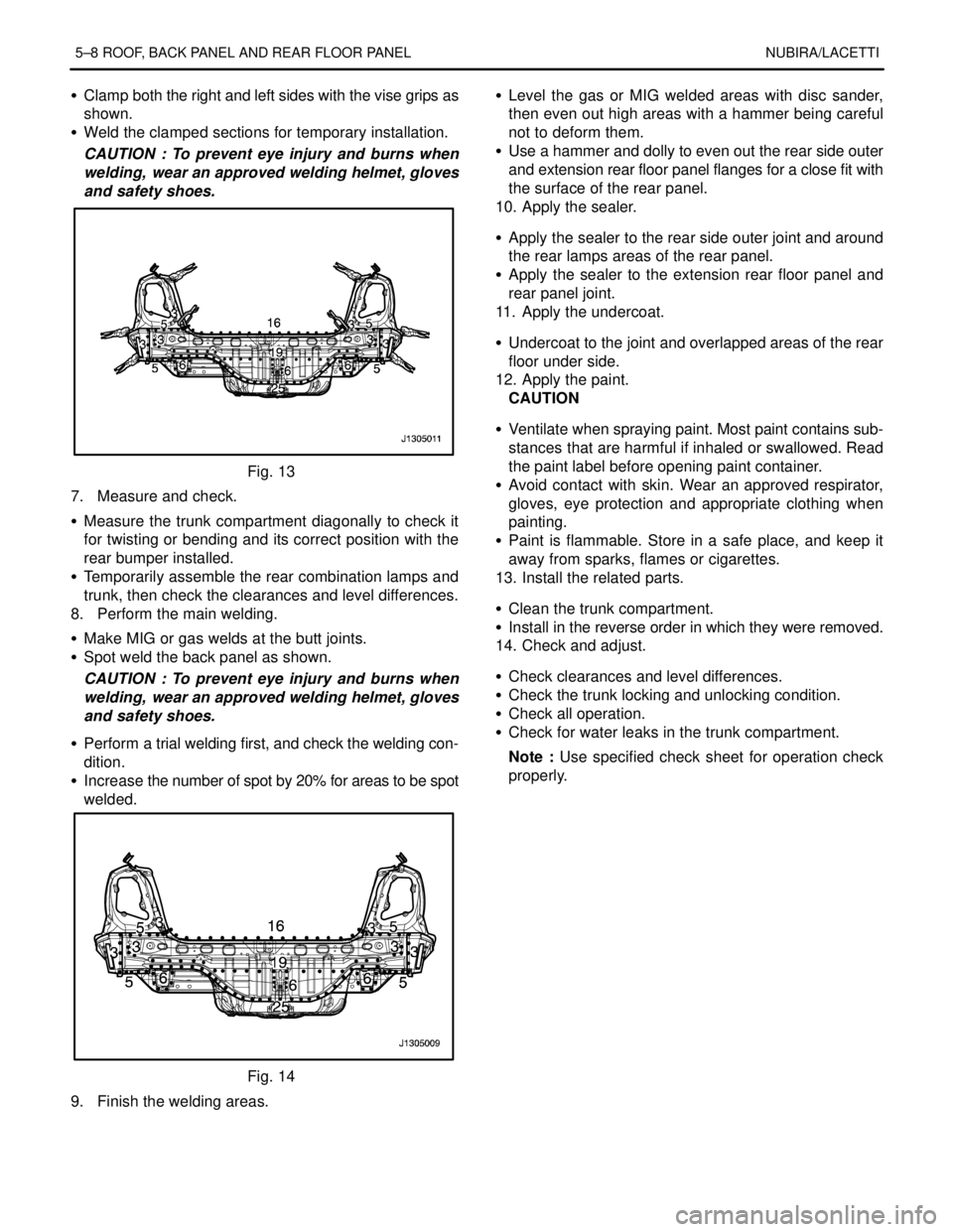
5–8 ROOF, BACK PANEL AND REAR FLOOR PANEL NUBIRA/LACETTI
S Clamp both the right and left sides with the vise grips as
shown.
S Weld the clamped sections for temporary installation.
CAUTION : To prevent eye injury and burns when
welding, wear an approved welding helmet, gloves
and safety shoes.
Fig. 13
7. Measure and check.
S Measure the trunk compartment diagonally to check it
for twisting or bending and its correct position with the
rear bumper installed.
S Temporarily assemble the rear combination lamps and
trunk, then check the clearances and level differences.
8. Perform the main welding.
S Make MIG or gas welds at the butt joints.
S Spot weld the back panel as shown.
CAUTION : To prevent eye injury and burns when
welding, wear an approved welding helmet, gloves
and safety shoes.
S Perform a trial welding first, and check the welding con-
dition.
S Increase the number of spot by 20% for areas to be spot
welded.
Fig. 14
9. Finish the welding areas.S Level the gas or MIG welded areas with disc sander,
then even out high areas with a hammer being careful
not to deform them.
S Use a hammer and dolly to even out the rear side outer
and extension rear floor panel flanges for a close fit with
the surface of the rear panel.
10. Apply the sealer.
S Apply the sealer to the rear side outer joint and around
the rear lamps areas of the rear panel.
S Apply the sealer to the extension rear floor panel and
rear panel joint.
11. Apply the undercoat.
S Undercoat to the joint and overlapped areas of the rear
floor under side.
12. Apply the paint.
CAUTION
S Ventilate when spraying paint. Most paint contains sub-
stances that are harmful if inhaled or swallowed. Read
the paint label before opening paint container.
S Avoid contact with skin. Wear an approved respirator,
gloves, eye protection and appropriate clothing when
painting.
S Paint is flammable. Store in a safe place, and keep it
away from sparks, flames or cigarettes.
13. Install the related parts.
S Clean the trunk compartment.
S Install in the reverse order in which they were removed.
14. Check and adjust.
S Check clearances and level differences.
S Check the trunk locking and unlocking condition.
S Check all operation.
S Check for water leaks in the trunk compartment.
Note : Use specified check sheet for operation check
properly.