egr DAEWOO LACETTI 2004 Service Manual Online
[x] Cancel search | Manufacturer: DAEWOO, Model Year: 2004, Model line: LACETTI, Model: DAEWOO LACETTI 2004Pages: 2643, PDF Size: 80.54 MB
Page 557 of 2643

ENGINE CONTROLS 1F – 311
DAEWOO V–121 BL4
Action Taken When the DTC Sets
S The Malfunction Indicator Lamp (MIL) will illuminate
after three consecutive trip with a fail.
S The ECM will record operating conditions at the
time the diagnostic fail. This information will be
stored in the Freeze Frame and Failure Records
buffers.
S A history DTC is stored.
Conditions for Clearing the MIL/DTC
S The MIL will turn off after four consecutive ignition
cycles in which the diagnostic runs without a fault.
S A history DTC will clear after 40 consecutive warm–
up cycles without a fault.S DTC(s) can be cleared by using the scan tool.
S Disconnecting the ECM battery feed for more than
10 seconds.
Diagnostic Aids
Due to moisture associated with exhaust systems, the
EGR valve may freeze and stick in cold weather at times.
After the vehicle is brought into a warm shop for repairs,
the valve warms and the problem disappears.
By watching the Actual EGR and desired EGR positions
on a cold vehicle with a scan tool, the fault can be easily
verified. Check the Freeze Frame data to determine if the
DTC set when the vehicle was cold by viewing the Engine
Coolant Temperature (ECT).
DTC P1403 – Exhaust Gas Recirculation Valve Failure
StepActionValue(s)YesNo
1Perform an Euro On–Board Diagnostic (EOBD)
System Check.
Is the system check complete?–Go to Step 2Go to
”On–Board
Diagnostic Sys-
tem Check”
21. Turn the ignition switch to with the engine OFF.
2. Install the scan tool.
3. Command the exhaust gas recirculation (EGR)
valve to the specified values.
Does the Actual EGR Position follow the desired
EGR position?25%, 50%
75%, 100%Go to Step 19Go to Step 3
31. Turn the ignition switch to ON.
2. Disconnect the EGR valve electrical connector.
3. With a test light connected to B+, probe the
ground circuit to the EGR valve.
Does the test light illuminate?–Go to Step 4Go to Step 5
41. Connect the test light to ground.
2. Probe the EGR control circuit at terminal 3 to
the EGR valve.
3. Command the EGR valve to the specified val-
ues using a scan tool.
After the command is raised, does the test light glow
brighter, flash or maintain a steady glow?25%, 50%
75%, 100%Go to Step 6Go to Step 7
5Repair the open or poor connection in the EGR
ground circuit.
Is the repair complete?–Go to Step 19–
6With a test light still connected to ground, probe the
signal circuit at terminal 3.
Does the test light illuminate?–Go to Step 8Go to Step 9
7With a test light still connected to ground, again
probe the signal circuit without commanding the
EGR valve with the scan tool.
Does the test light illuminate?–Go to Step 10Go to Step 11
8Check the signal circuit for a short to voltage and re-
pair as necessary.
Is a repair necessary?–Go to Step 19Go to Step 12
Page 558 of 2643

1F – 312IENGINE CONTROLS
DAEWOO V–121 BL4
StepNo Yes Value(s) Action
9With a digital voltmeter (DVM) connected to ground,
probe the 5V reference circuit at terminal 1.
Is the voltage measured near the specified value?5VGo to Step 13Go to Step 14
10Check the control circuit for a short to battery voltage
and repair as necessary.
Is a repair necessary?–Go to Step 19Go to Step 12
11Connect the test light to B+ and again probe the con-
trol circuit at terminal 4.
Does the test light illuminate?–Go to Step 15Go to Step 16
12Replace the engine control module (ECM).
Is the replacement complete?–Go to Step 19–
13Check the EGR ground circuit for a poor connection
or proper terminal tension at the ECM and repair as
necessary.
Is a repair necessary?–Go to Step 19Go to Step 17
14Check the 5V reference circuit for a shortage to bat-
tery voltage and repair as necessary.
Is a repair necessary?–Go to Step 19Go to Step 12
15Check the control circuit for a shortage to ground
and repair as necessary.
Is a repair necessary?–Go to Step 19Go to Step 12
16Check the control circuit for an open or poor connec-
tion at the EGR valve electrical connector and repair
as necessary.
Is a repair necessary?–Go to Step 19Go to Step 18
17Replace the EGR valve.
Is the replacement complete?–Go to Step 19–
18Check the ECM electrical connector for a poor con-
nection and repair as necessary.
Is a repair necessary?–Go to Step 19Go to Step 12
191. Using the scan tool, clear the Diagnostic
Trouble Codes (DTCs).
2. Start the engine and idle at normal operating
temperature.
3. Operate the vehicle within the conditions for
setting the DTC as specifiec in the supporting
text.
Does the scan tool indicate that this diagnostic ran
and passed?–Go to Step 20Go to Step 2
20Check if any additional DTCs are set.
Are any DTCs displayed that have not been diag-
nosed?–Go to
Applicable DTC
tableSystem OK
Page 559 of 2643
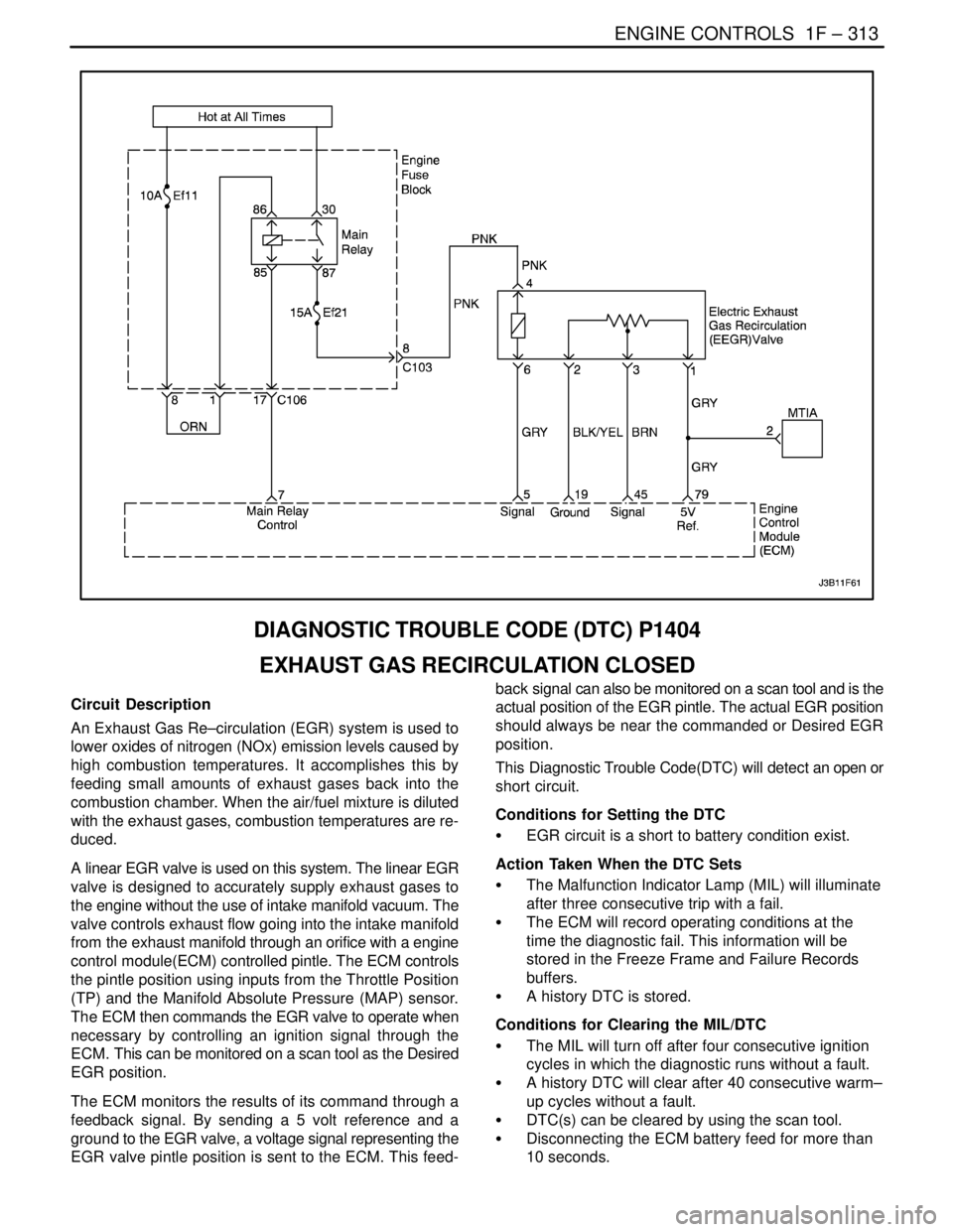
ENGINE CONTROLS 1F – 313
DAEWOO V–121 BL4
DIAGNOSTIC TROUBLE CODE (DTC) P1404
EXHAUST GAS RECIRCULATION CLOSED
Circuit Description
An Exhaust Gas Re–circulation (EGR) system is used to
lower oxides of nitrogen (NOx) emission levels caused by
high combustion temperatures. It accomplishes this by
feeding small amounts of exhaust gases back into the
combustion chamber. When the air/fuel mixture is diluted
with the exhaust gases, combustion temperatures are re-
duced.
A linear EGR valve is used on this system. The linear EGR
valve is designed to accurately supply exhaust gases to
the engine without the use of intake manifold vacuum. The
valve controls exhaust flow going into the intake manifold
from the exhaust manifold through an orifice with a engine
control module(ECM) controlled pintle. The ECM controls
the pintle position using inputs from the Throttle Position
(TP) and the Manifold Absolute Pressure (MAP) sensor.
The ECM then commands the EGR valve to operate when
necessary by controlling an ignition signal through the
ECM. This can be monitored on a scan tool as the Desired
EGR position.
The ECM monitors the results of its command through a
feedback signal. By sending a 5 volt reference and a
ground to the EGR valve, a voltage signal representing the
EGR valve pintle position is sent to the ECM. This feed-back signal can also be monitored on a scan tool and is the
actual position of the EGR pintle. The actual EGR position
should always be near the commanded or Desired EGR
position.
This Diagnostic Trouble Code(DTC) will detect an open or
short circuit.
Conditions for Setting the DTC
S EGR circuit is a short to battery condition exist.
Action Taken When the DTC Sets
S The Malfunction Indicator Lamp (MIL) will illuminate
after three consecutive trip with a fail.
S The ECM will record operating conditions at the
time the diagnostic fail. This information will be
stored in the Freeze Frame and Failure Records
buffers.
S A history DTC is stored.
Conditions for Clearing the MIL/DTC
S The MIL will turn off after four consecutive ignition
cycles in which the diagnostic runs without a fault.
S A history DTC will clear after 40 consecutive warm–
up cycles without a fault.
S DTC(s) can be cleared by using the scan tool.
S Disconnecting the ECM battery feed for more than
10 seconds.
Page 560 of 2643

1F – 314IENGINE CONTROLS
DAEWOO V–121 BL4
Diagnostic Aids
Due to moisture associated with exhaust systems, the
EGR valve may freeze and stick in cold weather at times.
After the vehicle is brought into a warm shop for repairs,
the valve warms and the problem disappears. By watchingthe Actual EGR and desired EGR positions on a cold ve-
hicle with a scan tool, the fault can be easily verified.
Check the Freeze Frame data to determine if the DTC set
when the vehicle was cold by viewing the Engine Coolant
Temperature (ECT).
DTC P1404 – Exhaust Gas Recirculation Closed
StepActionValue(s)YesNo
1Perform an Euro On–Board Diagnostic (EOBD)
System Check.
Is the system check complete?–Go to Step 2Go to
”On–Board
Diagnostic Sys-
tem Check”
21. Turn the ignition switch ON with the engine
OFF.
2. Install the scan tool.
3. Command the Exhaust Gas Recirculation
(EGR) valve to the specified values.
Does the Actual EGR Position follow the Desired
EGR Position?25%, 50%
75%, 100%Go to Step 13Go to Step 3
3Disconnect the EGR valve electrical connector.
Is the Actual EGR Position near the specified value?100%Go to Step 4Go to Step 5
4Check the signal circuit terminal 3 for a short to volt-
age and repair as necessary.
Is a repair necessary?–Go to Step 13Go to Step 6
5With a Digital Voltmeter (DVM) connected to ground,
probe the 5 volt reference circuit terminal 1 to the
EGR valve.
Does the DVM read near the specified valve?5VGo to Step 7Go to Step 8
61. Turn the ignition OFF.
2. Replace the Engine Control Module (ECM).
Is the repair complete?–Go to Step 13–
71. Connect a test light to ground.
2. Probe the EGR control circuit to the EGR
valve.
Does the test light illuminate?–Go to Step 9Go to Step 10
8Check the 5 volt reference circuit for a short to volt-
age and repair as necessary.
Is a repair necessary?–Go to Step 13Go to Step 6
9Check the control circuit for a short to voltage and re-
pair as necessary.
Is a repair necessary?–Go to Step 13Go to Step 6
10Check the EGR valve ground circuit for an open or
poor connection at the EGR valve electrical connec-
tor and repair as necessary.
Is a repair necessary?–Go to Step 13Go to Step 12
11Replace the EGR valve.
Is a action complete?–Go to Step 13–
12Check the EGR electrical connector for a poor con-
nection and repair as necessary.
Is a repair necessary?–Go to Step 13–
Page 582 of 2643

1F – 336IENGINE CONTROLS
DAEWOO V–121 BL4
DIAGNOSTIC TROUBLE CODE (DTC) P1628
IMMOBILIZER NO SUCCESSFUL COMMUNICATION
Circuit Description
When the ignition switch is turned to ON, the key tested
by immobilizer anti–theft system. While the key code is be-
ing read by immobilizer control unit or integrated anti–theft
control unit, the engine can start run with any key that will
turn the lock cylinder. the key code is read and compared
with key codes that have been stored in the memory of the
immobilizer control unit. If a valid key is detected, the im-
mobilizer control unit sends a serial data release message
to the Engine Control Module (ECM). Included in the re-
lease message is an identification (ID) code which as-
sures that neither the immobilizer control unit nor the ECM
have been substituted to defeat the system. If the ECM re-
ceives an invalid release message, the ECM performs the
following action:
S Disable the fuel injector circuit.
S Disable the fuel pump circuit.
S Disable the ignition coil.
S A Diagnostic Trouble Code (DTC) will stored if de-
tect communication link failure between the ECM
and immobilizer control unit.Conditions for Setting the DTC
S No safety security strategy allowed.
S Time–out delay has elapsed without successful
communication or a transmission key ON/OFF oc-
curred before a successful communication.
Action Taken When the DTC Sets
S The Malfunction Indicator Lamp (MIL) will not illumi-
nate.
S The ECM will store conditions which were present
when the DTC was set as Failure Records data
only.
S This information will not be stored in the Freeze
Frame data.
Conditions for Clearing the MIL/DTC
S A history DTC will clear after 40 consecutive warm–
up cycles without a fault.
S DTC(s) can be cleared by using the scan tool.
S Disconnecting the ECM battery feed for more than
10 seconds.
Page 584 of 2643

1F – 338IENGINE CONTROLS
DAEWOO V–121 BL4
DIAGNOSTIC TROUBLE CODE (DTC) P1629
IMMOBILIZER WRONG COMPUTATION
Circuit Description
When the ignition switch is turned to ON, the key tested
by immobilizer anti–theft system. While the key code is be-
ing read by immobilizer control unit or integrated anti–theft
control unit, the engine can start run with any key that will
turn the lock cylinder. the key code is read and compared
with key codes that have been stored in the memory of the
immobilizer control unit. If a valid key is detected, the im-
mobilizer control unit sends a serial data release message
to the Engine Control Module (ECM). Included in the re-
lease message is an identification (ID) code which as-
sures that neither the immobilizer control unit nor the ECM
have been substituted to defeat the system. If the ECM re-
ceives an invalid release message, the ECM performs the
following action:
S Disable the fuel injector circuit.
S Disable the fuel pump circuit.
S Disable the ignition coil.A Diagnostic Trouble Code (DTC) will stored if detect com-
munication link failure between the ECM and immobilizer
control unit.
Conditions for Setting the DTC
S Wrong coded value from ICU.
Action Taken When the DTC Sets
S The Malfunction Indicator Lamp (MIL) will not illumi-
nate.
S The ECM will store conditions which were present
when the DTC was set as Failure Records data
only.
S This information will not be stored in the Freeze
Frame data.
Conditions for Clearing the MIL/DTC
S A history DTC will clear after 40 consecutive warm–
up cycles without a fault.
S DTC(s) can be cleared by using the scan tool.
S Disconnecting the ECM battery feed for more than
10 seconds.
Page 593 of 2643

ENGINE CONTROLS 1F – 347
DAEWOO V–121 BL4
DIAGNOSTIC TROUBLE CODE (DTC) P0106
MANIFOLD ABSOLUTE PRESSURE RATIONALITY
Circuit Description
The Engine Control Module (ECM) uses the Manifold Ab-
solute Pressure (MAP) sensor to control the fuel delivery
and the ignition timing. The MAP sensor measures the
changes in the intake manifold pressure which results
from engine load (intake manifold vacuum) and the rpm
changes, and it converts these into voltage outputs. The
ECM can detect if the MAP sensor is not responding to the
Throttle Position (TP) changes by comparing the actual
MAP change to a predicted MAP change based on the
amount of TP change that occurs. If the ECM does not see
the expected MAP change or more, DTC P0106 will set.
Conditions for Setting the DTC
S Altitude compensated MAP reading is higher than
high threshold or lower than low threshold table
based on rpm and TP signal.
S DTCs P0107, P0108, P0117, P0118, P0122,
P0123, P0201, P0202, P0203, P0204, P0300,
P0351, P0352, P0402, P0404, P1404, P0405,
P0406, P0506, P0507 are not set.
S Engine running.
S Valid Barometric Pressure (BARO) update.
S Torque Converter Clutch (TCC) steady (A/T).
S A/C steady state.
S No TP sensor fail conditions present.
S No MAP fail conditions present.
S Change in Idle Air Control (IAC) is less than 5%.
S Coolant temperature is greater than –10°C (14°F).
S Change in rpm is less than 200.
S Change in TP sensor is less than 3%.
S Change in Exhaust Gas Recirculation (EGR) value
is less than 6%.
S The rpm is between 1300 and 4500.
S All of the above are stabilized for 1.5 seconds.
Action Taken When the DTC Sets
S The Malfunction Indicator Lamp (MIL) will illuminate
after three consecutive ignition cycle with a fail.
S The ECM will record operating conditions at the
time the diagnostic fails. This information will be
stored in the Freeze Frame and Failure Records
buffers.
S A history DTC is stored.
S The ECM will substitute a fixed MAP value and use
TP sensor to control the fuel delivery. (The scan
tool will not show defaulted value.)
Conditions for Clearing the MIL/DTC
S The MIL will turn off after four consecutive ignition
cycles in which the diagnostic runs without a fault.
S A history DTC will clear after 40 consecutive warm–
up cycles without a fault.
S DTC(s) can be cleared by using the scan tool.
S Disconnecting the ECM battery feed for more than
10 seconds.Diagnostic Aids
With the ignition ON and the engine stopped, the manifold
pressure is equal to atmospheric pressure and the signal
voltage will be high. This information is used by the ECM
as an indication of vehicle altitude. Comparison of this
reading with a known good vehicle with the same sensor
is a good way to check the accuracy of a suspect sensor.
Readings should be the same +0.4 volt.
The MAP sensor vacuum source should be thoroughly
checked for restrictions at the intake manifold.
Test Description
Numbers below refer to the step numbers on the Diagnos-
tic Table.
1. The On–Board Diagnostic (EOBD) System Check
prompts the technician to complete some basic
checks and store the freeze frame and failure re-
cords data on the scan tool if applicable. This
creates an electronic copy of the data taken when
the occurred. The information is then stored on the
scan tool for later reference.
2. A sensor that displays an ignition ON, engine OFF
BARO value that does not appear normal for the
altitude the vehicle is in should be considered to be
malfunctioning.
3. While starting the engine, the MAP sensor should
detect any changes in the manifold pressure. This
test is to determine if the sensor is stuck at a value.
4. A normal MAP sensor will react as quickly to the
throttle changes as they can be made. A sensor
should not appear to be lazy or catch up with the
throttle movements.
5. This step checks if the reason for no MAP change
was due to a faulty sensor or vacuum source to the
sensor.
6. The MAP sensor vacuum source should be thor-
oughly checked for restrictions. A drill bit can be
used to clean out any casting flash that may exist in
the vacuum port.
7. The MAP sensor vacuum source should be thor-
oughly checked for restrictions. A drill bit can be
used to clean out any casting flash that may exist in
the vacuum port.
9. The MAP Sensor System Performance diagnostic
may have to complete several tests before deter-
mining if the diagnostic has passed or failed the last
test. Operate the vehicle in the Conditions for Set-
ting the DTC several times to ensure that the diag-
nostic runs enough tests to pass or fail.
10. If no faults have been found at this point and no
additional DTCs were set, refer to ”Diagnostic
Aids”in this section for additional checks and infor-
mation.
Page 618 of 2643

1F – 372IENGINE CONTROLS
DAEWOO V–121 BL4
DIAGNOSTIC TROUBLE CODE (DTC) P0131
FRONT HEATED OXYGEN SENSOR (HO2S1) LOW
VOLTAGE
Circuit Description
The Engine Control Module (ECM) supplies a voltage of
about 0.45 volts between terminals M12 and M29 (if mea-
sured with a 10 megohm digital voltmeter, this may read
as low as 0.32 volts). The Front Heated Oxygen sensor 1
(HO2S1) varies the voltage within a range of about 1 volt
if the exhaust is rich, down through about 0.10 volts if the
exhaust is lean.
The sensor is like an open circuit and produces no voltage
when it is below 315°C(600°F). An open sensor circuit or
cold sensor causes Open Loop operation.
If the HO2S1 pigtail wiring, connector, or terminal is dam-
aged, the entire HO2S1 assembly must be replaced. Do
not attempt to repair the wiring, connector, or terminals. In
order for the sensor to function properly, it must have a
clean air reference provided to it. This clean air reference
is obtained by way of the HO2S1 wire(s). Any attempt to
repair the wires, connector or terminals could result in the
obstruction of the air reference and degrade the HO2S1
performance. Refer to ”Front Heated Oxygen Sensor” in
this section.Conditions for Setting the DTC
S HO2S1 voltage is less than 0.05 volts.
S Closed loop stoichiometry.
S Engine Coolant Temperature (ECT) is greater than
60°C(140°F).
S System voltage is greater than 10 volts.
S DTCs P0106, P0107, P0108, P0117, P0118,
P0122, P0123, P0171, P0172, P0201, P0202,
P0203, P0204, P0300, P0336, P0337, P0351,
P0352, P0402, P0404, P0405, P0406, P0506,
P0507, P1404, and P0443 are not set.
S 3 second delay after conditions are met.
Action Taken When the DTC Sets
S The Malfunction Indicator Lamp (MIL) will illumi-
nate.
S The ECM will record operating conditions at the
time the diagnostic fails. This information will be
stored in the Freeze Frame and Failure Records
buffers.
S A history DTC is stored.
S The vehicle will operate in Open Loop.
Page 621 of 2643

ENGINE CONTROLS 1F – 375
DAEWOO V–121 BL4
DIAGNOSTIC TROUBLE CODE (DTC) P0132
FRONT HEATED OXYGEN SENSOR (HO2S1) HIGH
VOLTAGE
Circuit Description
The Engine Control Module (ECM) supplies a voltage of
about 0.45 volts between terminals M12 and M29 (if mea-
sured with a 10 megohm digital voltmeter, this may read
as low as 0.32 volts). The Front Heated Oxygen Sensor
(HO2S1) varies the voltage within a range of about 1 volt
if the exhaust is rich, down through about 0.10 volts if the
exhaust is lean.
The sensor is like and open circuit and produces no volt-
age when it is below 315°C (600°F). An open sensor cir-
cuit or cold sensor causes Open Loop operation.
If the HO2S1 pigtail wiring, connector, or terminal is dam-
aged, the entire HO2S1 assembly must be replaced. Do
not attempt to repair the wiring, connector, or terminals. In
order for the sensor to function properly, it must have a
clean air reference provided to it. This clean air reference
is obtained by way of the HO2S1 wire(s). Any attempt to
repair the wires, connector or terminals could result in the
obstruction of the air reference and degrade the HO2S1
performance. Refer to”Front Heated Oxygen Sensor” in
this section.
Conditions for Setting the DTCS HO2S1 voltage is greater than 0.952 volts.
S Closed loop stoichiometry.
S Engine Coolant Temperature (ECT) is greater than
60°C(140°F).
S System voltage is greater than 10 volts.
S DTCs P0106, P0107, P0108, P0117, P0118,
P0122, P0123, P0171, P0172, P0201, P0202,
P0203, P0204, P0300, P0336, P0337, P0351,
P0352, P0402, P0404, P0405, P0406, P0506,
P0507, P1404, and P0443 are not set.
S 3 second delay after conditions are met.
Action Taken When the DTC Sets
S The Malfunction Indicator Lamp (MIL) will illumi-
nate.
S The ECM will record operating conditions at the
time the diagnostic fails. This information will be
stored in the Freeze Frame and Failure Records
buffers.
S A history DTC is stored.
S The vehicle will operate in Open Loop.
Conditions for Clearing the MIL/DTC
S The MIL will turn off after four consecutive ignition
cycles in which the diagnostic runs without a fault.
Page 624 of 2643

1F – 378IENGINE CONTROLS
DAEWOO V–121 BL4
DIAGNOSTIC TROUBLE CODE (DTC) P0133
FRONT HEATED OXYGEN SENSOR (HO2S1) SLOW
RESPONSE
Circuit Description
The Engine Control Module (ECM) continuously monitors
the Front Heated Oxygen Sensor (HO2S1) activity for 100
seconds. During the monitor period, the ECM counts the
number of times that the HO2S1 switches from rich to lean
and from lean to rich and adds the amount of time it took
to complete all switches. With this information, an average
time for all switches can be determined. If the average time
to switch is too out of specification, a DTC P0133 will set.
If the HO2S1 pigtail wiring, connector, or terminal is dam-
aged, the entire HO2S1 assembly must be replaced. Do
not attempt to repair the wiring, connector, or terminals. In
order for the sensor to function properly, it must have a
clean air reference provided to it. This clean air reference
is obtained by way of the HO2S1 wire(s). Any attempt to
repair the wires, connector, or terminals could result in the
obstruction of the air reference and degrade HO2S1 per-
formance.
Conditions for Setting the DTCS HO2S1 average transition time between 0.3–0.6
volts, lean to rich is greater than 156 millisec-
onds(A/T) or rich to lean is greater than 140 milli-
seconds (M/T).
S Closed loop stoichiometry.
S Engine Coolant Temperature (ECT) is greater than
70°C (158°F).
S System voltage is greater than 10 volts.
S Engine run time is greater than 60 seconds.
S Purge Duty Cycle (DC) is less than 20%.
S The rpm is between 1600 and 4300.
S Airflow is between 9 and 40 g/sec.
S DTCs P0106, P0107, P0108, P0117, P0118,
P0122, P0123, P0131, P0132, P0134, P0135,
P1167, P0171, P1171, P0172, P0201, P0202,
P0203, P0204, P0300, P0336, P0337, P0351,
P0352, P0402, P0404, P0405, P0406, P0506,
P0507, P1404, and P0443 are not set.
S 2 second delay after conditions are met.
Action Taken When the DTC Sets
S The Malfunction Indicator Lamp (MIL) will illuminate
after three consecutive ignition cycle with a fail.