pressure valve DAEWOO LACETTI 2004 Service Repair Manual
[x] Cancel search | Manufacturer: DAEWOO, Model Year: 2004, Model line: LACETTI, Model: DAEWOO LACETTI 2004Pages: 2643, PDF Size: 80.54 MB
Page 20 of 2643

GENERAL INFORMATION 0B – 13
DAEWOO V–121 BL4
EACH TIME THE OIL IS CHANGED
Automatic Transaxle Fluid
Refer to fluid level service procedure of Section 5A, ZF
4HP16 Automatic Transaxle.
Manual Transaxle
Check the fluid level and add fluid as required. Refer to
Section 5B, Five–Speed Manual Transaxle.
Brake System Inspection
This inspection should be done when the wheels are re-
moved for rotation. Inspect the lines and the hoses for
proper hookup, binding, leaks, cracks, chafing, etc. In-
spect the disc brake pads for wear. Inspect the rotors for
surface condition. Also inspect the drum brake linings for
wear and cracks. Inspect other brake parts, including the
drums, the wheels cylinders, the parking brake, etc., at the
same time. Check the parking brake adjustment. Inspect
the brakes more often if habit or conditions result in fre-
quent braking.
Steering, Suspension and Front Drive Axle
Boot And Seal Inspection
Inspect the front and rear suspension and the steering
system for damaged, loose or missing parts, signs of wear
or lack of lubrication. Inspect the power steering lines and
the hoses for proper hookup, binding, leaks, cracks, chaf-
ing, etc. Clean and inspect the drive axle boot and seals
for damage, tears or leakage. Replace the seals if neces-
sary.
Exhaust System Inspection
Inspect the complete system (including the catalytic con-
verter if equipped). Inspect the body near the exhaust sys-
tem. Look for broken, damaged, missing, or out–of–posi-
tion parts as well as open seams, holes, loose
connections, or other conditions which could cause heat
buildup in the floor pan or could let exhaust fumes seep
into the trunk or passenger compartment.
Throttle Linkage Inspection
Inspect the throttle linkage for interference or binding,
damaged, or missing parts. Lubricate all linkage joints and
throttle cable joints, the intermediate throttle shaft bearing,
the return spring at throttle valve assembly, and the accel-
erator pedal sliding face with suitable grease. Check the
throttle cable for free movements.
Engine Drive Belts
Inspect all belts for cracks, fraying, wear and proper ten-
sion. Adjust or replace the belts as needed.
Hood Latch Operation
When opening the hood, note the operation of the secon-
dary latch. It should keep the hood from opening all the
way when the primary latch is released. The hood must
close firmly.
AT LEAST ANNUALLY
Lap and Shoulder Belts Condition and
Operation
Inspect the belt system including: the webbing, the
buckles, the latch plates, the retractor, the guide loops and
the anchors.
Movable Head Restraint Operation
On vehicles with movable head restraints, the restraints
must stay in the desired position.
Spare Tire and Jack Storage
Be alert to rattles in the rear of the vehicle. The spare tire,
all the jacking equipment, and the tools must be securely
stowed at all times. Oil the jack ratchet or the screw mech-
anism after each use.
Key Lock Service
Lubricate the key lock cylinder.
Body Lubrication Service
Lubricate all the body door hinges including the hood, the
fuel door, the rear compartment hinges and the latches,
the glove box and the console doors, and any folding seat
hardware.
Transaxle Neutral Switch Operation on
Automatic Transaxle
CAUTION : Take the following precautions because
the vehicle could move without warning and possibly
cause personal injury or property damage:
S Firmly apply the parking brake and the regular
brakes.
S Do not use the accelerator pedal.
S Be ready to promptly turn off the ignition if the ve-
hicle starts.
On automatic transaxle vehicles, try to start the engine in
each gear. The starter should crank only in P (Park) or N
(Neutral).
Parking Brake and Transaxle P (Park)
Mechanism Operation
CAUTION : In order to reduce the risk of personal in-
jury or property damage, be prepared to apply the reg-
ular brakes promptly if the vehicle begins to move.
Park on a fairly steep hill with enough room for movement
in the downhill direction. To check the parking brake, with
the engine running and the transaxle in N (Neutral), slowly
remove foot pressure from the regular brake pedal (until
only the parking brake is holding the vehicle).
To check the automatic transaxle P (Park) mechanism’s
holding ability, release all brakes after shifting the trans-
axle to P (Park).
Underbody Flushing
Flushing the underbody will remove any corrosive materi-
als used for ice and snow removal and dust control. At
least every spring clean the underbody. First, loosen the
sediment packed in closed areas of the vehicle. Then flush
the underbody with plain water.
Page 33 of 2643

SECTION : 1A
GENERAL ENGINE INFORMATION
TABLE OF CONTENTS
DIAGNOSIS1A–1 . . . . . . . . . . . . . . . . . . . . . . . . . . . . . . . .
Compression Test 1A–1. . . . . . . . . . . . . . . . . . . . . . . . .
Oil Pressure Test 1A–2. . . . . . . . . . . . . . . . . . . . . . . . . .
Oil Leak Diagnosis 1A–3. . . . . . . . . . . . . . . . . . . . . . . .
Knock Diagnosis 1A–4. . . . . . . . . . . . . . . . . . . . . . . . . . Noise Diagnosis 1A–8. . . . . . . . . . . . . . . . . . . . . . . . . .
GENERAL INFORMATION1A–11 . . . . . . . . . . . . . . . . . .
Cleanliness and Care 1A–11. . . . . . . . . . . . . . . . . . . . .
On–Engine Service 1A–11. . . . . . . . . . . . . . . . . . . . . . .
DIAGNOSIS
COMPRESSION TEST
Important : Disconnect the Crankshaft Position (CKP)
Sensor connector to disable the fuel and the ignition sys-
tems.
Test the compression pressure for each cylinder. Low
compression pressure may be the fault of the valves or the
pistons. The following conditions should be considered
when you check the cylinder compression:
S The engine should be at normal operating tempera-
ture.
S The throttle must be wide open.
S All the spark plugs should be removed.
S The battery must be at or near full charge.
1. Place approximately three squirts of oil from a
plunger– type oiler into each spark plug port.
2. Insert the engine compression gauge into each
spark plug port.
3. Crank test each cylinder with four to five compres-
sion strokes using the starter motor.4. The lowest reading should not be less than 70% of
the highest reading. The compression gauge read-
ing should not be less than 689 kPa (100 psi) for
any of the cylinders.
5. Examine the gauge readings obtained after the four
”puffs” per cylinder are obtained from cranking the
starter motor. The readings are explained in the
following descriptions:
S Normal Condition – Compression builds up quickly
and evenly to the specified compression on each
cylinder.
S Piston Rings Faulty – Compression is low on the
first stroke and tends to build up on following
strokes, but the compression pressure does not
reach normal. The compression pressure improves
considerably with the addition of oil into the cylin-
der.
S Valves Faulty – Low compression pressure on the
first stroke. The compression pressure does not
tend to build up on the following strokes. The com-
pression pressure does not improve much with the
addition of oil into the cylinder.
Page 38 of 2643

1A – 6IGENERAL ENGINE INFORMATION
DAEWOO V–121 BL4
Light Knock Hot
StepActionValue(s)YesNo
1Is there a light knock when the engine is hot?–Go to Step 2System OK
2Is detonation or spark knock evident?–Go to Step 3Go to Step 4
3Check the engine timing and the fuel quality.
Was the problem found?–Go to Step 1–
4Inspect the torque converter bolts.
Are the bolts tightened to the specified value?45 NSm
(33 lb–ft)Go to Step 5Go to Step 6
5Tighten the torque converter bolts.
Is the repair complete?–Go to Step 1–
6Inspect the manifold.
Is there an exhaust leak at the manifold?–Go to Step 7Go to Step 8
7Tighten the bolts or replace the gasket.
Is the repair complete?–Go to Step 1–
8Check the rod bearing clearance.
Is the clearance within the specified value?0.019 ~
0.070 mm
(0.0007 ~
0.0028 in.)Go to Step 9System OK
9Replace the rod bearings, as necessary.
Is the repair complete?–Go to Step 1–
Knocks During Initial Start–Up But Last Only a Few Seconds
StepActionValue(s)YesNo
1Does the engine knock during initial start–up but last
only a few seconds?–Go to Step 2System OK
2Check the engine oil.
Is the proper viscosity oil used in the crankcase?–Go to Step 4Go to Step 3
3Install oil of the proper viscosity for the expected
seasonal temperatures.
Is the repair complete?–Go to Step 1–
4Inspect the hydraulic lifters.
Is there evidence of hydraulic lifter bleed–down?–Go to Step 5Go to Step 6
5Clean, test and replace the lifters, as necessary.
Is the repair complete?*–Go to Step 1–
6Inspect the crankshaft end clearance.
Is the clearance more than specified value?0.1 mm
(0.0039 in.)Go to Step 7Go to Step 8
7Replace the crankshaft thrust bearing.
Is the repair complete?–Go to Step 1–
8Inspect the front main bearing clearance.
Is the clearance more than the specified value?0.026~0.046
mm (0.0010~
0.0018 in.)Go to Step 9System OK
9Replace the worn parts of the front main bearing.
Is the repair complete?–Go to Step 1–
* When the engine is stopped, some valves will be open. Spring pressure against the lifters will tend to bleed lifter down.
Attempts to repair this should be made only if the problem is consistent.
An engine that is only operated for short periods between start–ups may have lifter noise that lasts for a few minutes. This
is a normal condition.
Page 48 of 2643

1.4L/1.6L DOHC ENGINE MECHANICAL 1C1 – 5
DAEWOO V–121 BL4
FASTENER TIGHTENING SPECIFCATIONS
ApplicationNSmLb–FtLb–In
Air Cleaner Housing Bolts10–89
Camshaft Cap Bolts1612–
Camshaft Cover Nuts10–89
Connecting Rod Bearing Cap Bolts25
+ 30° + 15°18
+ 30° + 15°–
Coolant Temperature Sensor2015–
Crankshaft Bearing Cap Bolts50
+ 45° + 15°37
+ 45°+ 15°–
Crankshaft Cover Nuts5~8–44~71
Crankshaft Pulley Bolt95 NSm
+ 30° + 15°––
Cylinder Head Bolts (Cylinder Head Mounting Bolts)25 + 70°
+ 70° + 50°18 + 70°
+ 70° + 50°–
Direct Ignition System Coil Mounting Bolts10–89
Direct Ignition System Coil Mounting Bracket Bolts10–89
Engine Mount Attaching Bolts3022–
Engine Mount Bracket Attaching Bolts/Nuts5037–
Exhaust Camshaft Gear Bolt67.549–
Exhaust Flex Pipe–to–Catalytic Converter or Connecting Pipe
Retaining Nut3526–
Exhaust Flex Pipe–to–Exhaust Manifold Retaining Nuts3526–
Exhaust Gas Recirculation Valve Adapter Bolts2518–
Exhaust Manifold Heat Shield Bolts1511–
Exhaust Manifold Retaining Nuts2518–
Flexible Plate Bolts6044–
Flexible Plate Inspection Cover Bolts10–89
Flywheel Bolts35
+ 30° + 15°25
+ 30° + 15°–
Flywheel Inspection Cover Bolts12–106
Front Timing Belt Cover Bolts (Upper and Lower)10–89
Fuel Rail Assembly Retaining Bolts2518–
Fuel Rail Retaining Bolts2518–
Generator Upper Retaining Bolt2015–
Intake Camshaft Gear Bolt67.549–
Intake Manifold Retaining Bolts/Nuts2518–
Intake Manifold Support Bracket Lower Bolt2518–
Intake Manifold Support Bracket Upper Bolts2518–
Lower Front Timing Belt Cover Bolts10–89
Oil Pan Flange Bolts7555–
Oil Pan Retaining Bolts10–89
Oil Pan Drain Plug3526–
OIl Pressure Switch4030–
Page 51 of 2643
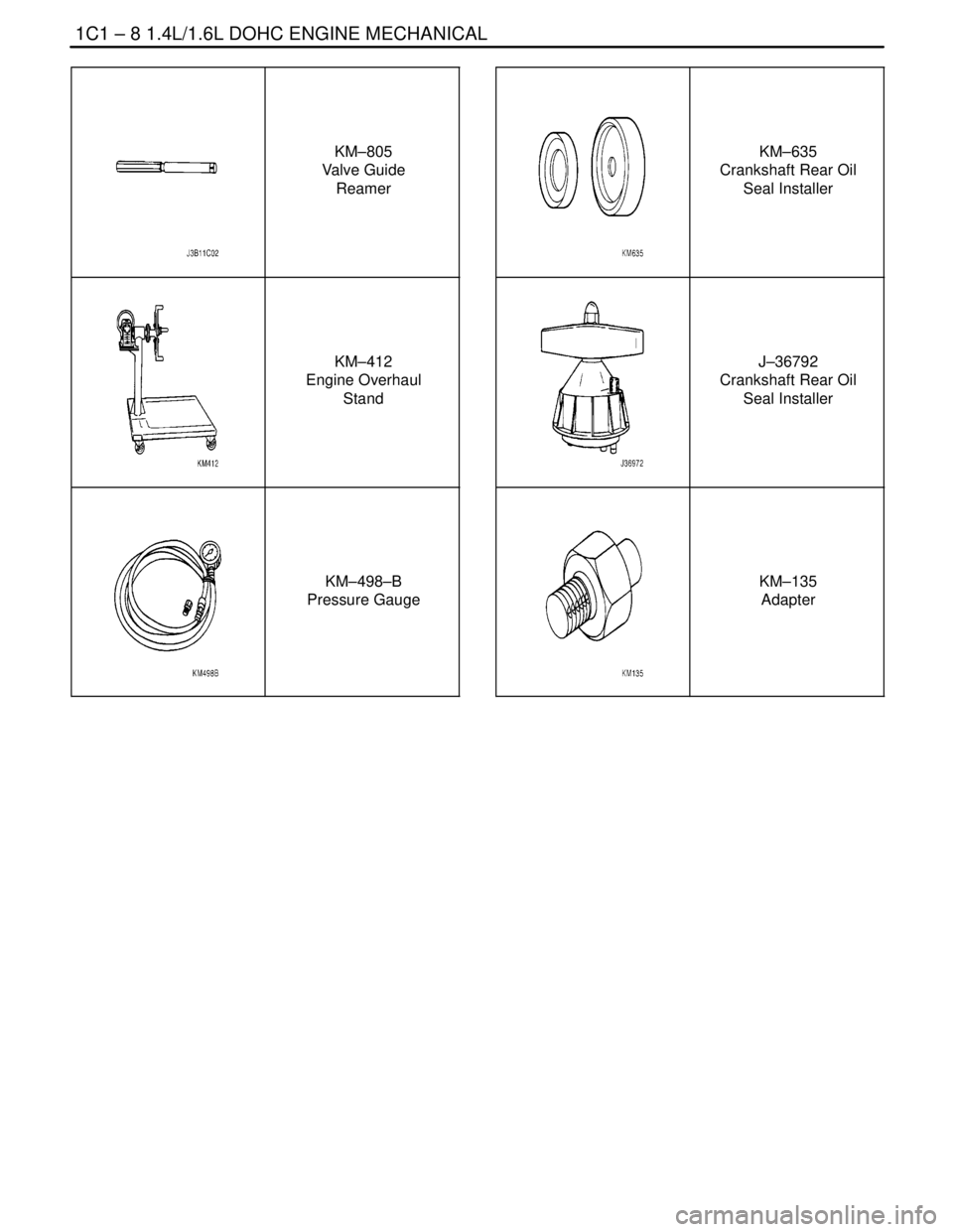
1C1 – 8I1.4L/1.6L DOHC ENGINE MECHANICAL
DAEWOO V–121 BL4
KM–805
Valve Guide
Reamer
KM–412
Engine Overhaul
Stand
KM–498–B
Pressure Gauge
KM–635
Crankshaft Rear Oil
Seal Installer
J–36792
Crankshaft Rear Oil
Seal Installer
KM–135
Adapter
Page 54 of 2643

1.4L/1.6L DOHC ENGINE MECHANICAL 1C1 – 11
DAEWOO V–121 BL4
1. Piston Ring Set
2. Piston
3. Piston Pin
4. Connecting Rod
5. Connecting Rod Bearing Set
6. Oil Level Gauge Stick
7. Gauge Stic Tube
8. Sleeve
9. Clutch Housing Sleeve
10. Cylinder Block
11. Plug
12. Gap
13. Bypass Valve
14. Connecting Piece
15. Oil Filter
16. Oil Pump Body Gasket
17. Water Inlet Neck
18. Knock Sensor
19. Fly Wheel (M/T)
20. Flexible Plate (A/T)
21. Shaft Seal Ring
22. Crank Shaft Upper Bearing Set
23. Crank Shaft24. Crank Shaft Lower Bearing Set
25. Transmitter Disc
26. Crankshaft Bearing Cap
27. Oil Pan
28. Threaded Ring
29. Washer
30. Oil Pan Drain Plug
31. Oil Pump
32. Oil Pump Cover
33. Oil Pump Inner Rotor
34. Oil Pump Outer Rotor
35. Oil Pump Plug
36. Shaft Sealing
37. Pressure Relief Valve Plunger
38. Relief Valve Spring
39. Sealing
40. Relief Valve
41. Oil Pressure Switch
42. Sleeve
43. Oil Suction Pipe Bracket
44. Oil Suction Pipe
45. Sealing
Page 120 of 2643

1.4L/1.6L DOHC ENGINE MECHANICAL 1C1 – 77
DAEWOO V–121 BL4
GENERAL DESCRIPTION
AND SYSTEM OPERATION
CYLINDER HEAD AND GASKET
The cylinder head is made of an aluminum alloy. The cylin-
der head uses cross–flow intake and exhaust ports. A
spark plug is located in the center of each combustion
chamber. The cylinder head houses the dual camshafts.
CRANKSHAFT
The crankshaft has eight integral weights which are cast
with it for balancing. Oil holes run through the center of the
crankshaft to supply oil to the connecting rods, the bear-
ings, the pistons, and the other components. The end
thrust load is taken by the thrust washers installed at the
center journal.
TIMING BELT
The timing belt coordinates the crankshaft and the dual
overhead camshafts and keeps them synchronized. The
timing belt also turns the water pump. The timing belt and
the pulleys are toothed so that there is no slippage be-
tween them. There are two idler pulleys. An automatic ten-
sioner pulley maintains the timing belt’s correct tension.
The timing belt is made of a tough reinforced rubber similar
to that used on the serpentine accessory drive belt. The
timing belt requires no lubrication.
OIL PUMP
The oil pump draws engine oil from the oil pan and feeds
it under pressure to the various parts of the engine. An oil
strainer is mounted before the inlet of the oil pump to re-
move impurities which could clog or damage the oil pump
or other engine components. When the drive gear rotates,
the driven gear rotates. This causes the space between
the gears to constantly open and narrow, pulling oil in from
the oil pan when the space opens and pumping the oil out
to the engine as it narrows.
At high engine speeds, the oil pump supplies a much high-
er amount of oil than is required for lubrication of the en-
gine. The oil pressure regulator prevents too much oil from
entering the engine lubrication passages. During normal
oil supply, a coil spring and valve keep the bypass closed,
directing all of the oil pumped to the engine. When the
amount of oil being pumped increases, the pressure be-
comes high enough to overcome the force of the spring.This opens the valve of the oil pressure regulator, allowing
the excess oil to flow through the valve and drain back to
the oil pan.
OIL PAN
The engine oil pan is mounted to the bottom of the cylinder
block. The engine oil pan houses the crankcase and is
made of cast metal.
Engine oil is pumped from the oil pan by the oil pump. After
it passes through the oil filter, it is fed through two paths
to lubricate the cylinder block and the cylinder head. In one
path, the oil is pumped through the oil passages in the
crankshaft to the connecting rods, then to the pistons and
the cylinders. It then drains back to the oil pan. In the sec-
ond path, the oil is pumped through the oil passages to the
camshaft. The oil passes through the internal passage-
ways in the camshafts to lubricate the valve assemblies
before draining back to the oil pan.
EXHAUST MANIFOLD
A single four–port, rear–takedown manifold is used with
this engine. The manifold is designed to direct escaping
exhaust gases out of the combustion chambers with a
minimum of back pressure. The oxygen sensor is
mounted to the exhaust manifold.
INTAKE MANIFOLD
The intake manifold has four independent long ports and
uses inertial supercharging to improve engine torque at
low and moderate speeds. The plenum is attached to the
intake manifold.
CAMSHAFTS
This engine is a dual overhead camshaft (DOHC) type,
which means there are two camshafts. One camshaft op-
erates the intake valves, and the other camshaft operates
the exhaust valves. The camshafts sit in journals on the
top of the engine in the cylinder head and are held in place
by camshaft caps. The camshaft journals of the cylinder
head are drilled to create oil passages. Engine oil travels
to the camshafts under pressure where it lubricates each
camshaft journal. The oil returns to the oil pan through
drain holes in the cylinder head. The camshaft lobes are
machined into the solid camshaft to open and close the in-
take and the exhaust valves precisely the correct amount
at the correct time. The camshaft lobes are oiled by splash
action from pressurized oil escaping from the camshaft
journals.
Page 125 of 2643

1.8L DOHC ENGINE MECHANICAL 1C2 – 5
DAEWOO V–121 BL4
Application Lb–InLb–Ft NSm
Oil Pan Retaining Bolts10–89
Oil Pressure Switch4030–
Oil Suction Pipe Bolts8–71
Oil Suction Pipe Support Bracket Bolts16–53
Oil Pump Rear Cover Bolts6–53
Oil Pump Retaining Bolts10–89
Pulse Pickup Sensor Disc1310–
Rear Timing Belt Cover Bolts7–62
Safety Relief Valve Bolt3022–
Spark Plug Cover Bolts8–71
Spark Plugs2015–
Thermostat Housing Mounting Bolts1511–
Throttle Cable Bracket Bolts8–71
Timing Belt Automatic Tensioner Bolts2518–
Timing Belt Idler Pulley Bolt2518–
Timing Belt Idler Pulley Nut2518–
Transaxle Bell Housing Bolts7555–
Transaxle Torque Converter Bolts6044–
Page 131 of 2643

1.8L DOHC ENGINE MECHANICAL 1C2 – 11
DAEWOO V–121 BL4
1. Connecting Rod
2. Bearing Set
3. Connecting Rod Bolt
4. Piston Ring Set
5. Piston Pin
6. Piston
7. Engine Block
8. Sleeve
9. Water Jacket Cap
10. Bolt (Manual Transaxle)
11. Flywheel (Manual Transaxle)
12. Flexible Plate (Automatic Transaxle)
13. Bolt (Automatic Transaxle)
14. Clamp
15. Hose
16. Clamp
17. Engine Ventilation Pipe
18. Bolt
19. Gasket
20. Needle Sleeve
21. Crankshaft Rear Seal
22. Crankshaft
23. Transmitter Disk
24. Bolt
25. Oil Pan Scraper
26. Oil Pan
27. Drain Plug
28. Washer
29. Bolt
30. Sleeve
31. Gasket
32. Bolt
33. Oil Pump Cover
34. Ring Gear
35. Gear
36. Oil Pressure Switch
37. Washer
38. Washer
39. Oil Duct Outlet Plug
40. Connecting Piece
41. Seal Ring
42. Oil Filter43. Bypass Valve
44. Pressure Relief Valve Plunger
45. Pressure Relief Valve Spring
46. Seal Ring
47. Pressure Relief Valve Plug
48. Seal Ring
49. Bolt
50. Oil Suction Pipe
51. Bolt
52. Rear Timing Belt Cover
53. Bolt
54. Special Bolt
55. Idler Pulley
56. Stud
57. Nut
58. Bolt
59. Tensioner
60. Bolt
61. Thrust Inner Washer
62. Woodruff Key
63. Crankshaft Gear
64. Thrust Outer Washer
65. Bolt
66. Camshaft Drive Belt
67. Gasket
68. Front Timing Belt Cover
69. Bolt
70. Bushing Plug
71. Bushing
72. Oil Gallery Plug
73. Bolt
74. Water Pump
75. Seal Ring
76. Crankshaft Position Sensor
77. Bolt
78. Knock Sensor*
79. Bolt
80. Bolt
81. Crankshaft Bearing Bridge
* : 2.0L DOHC Engine
Page 159 of 2643
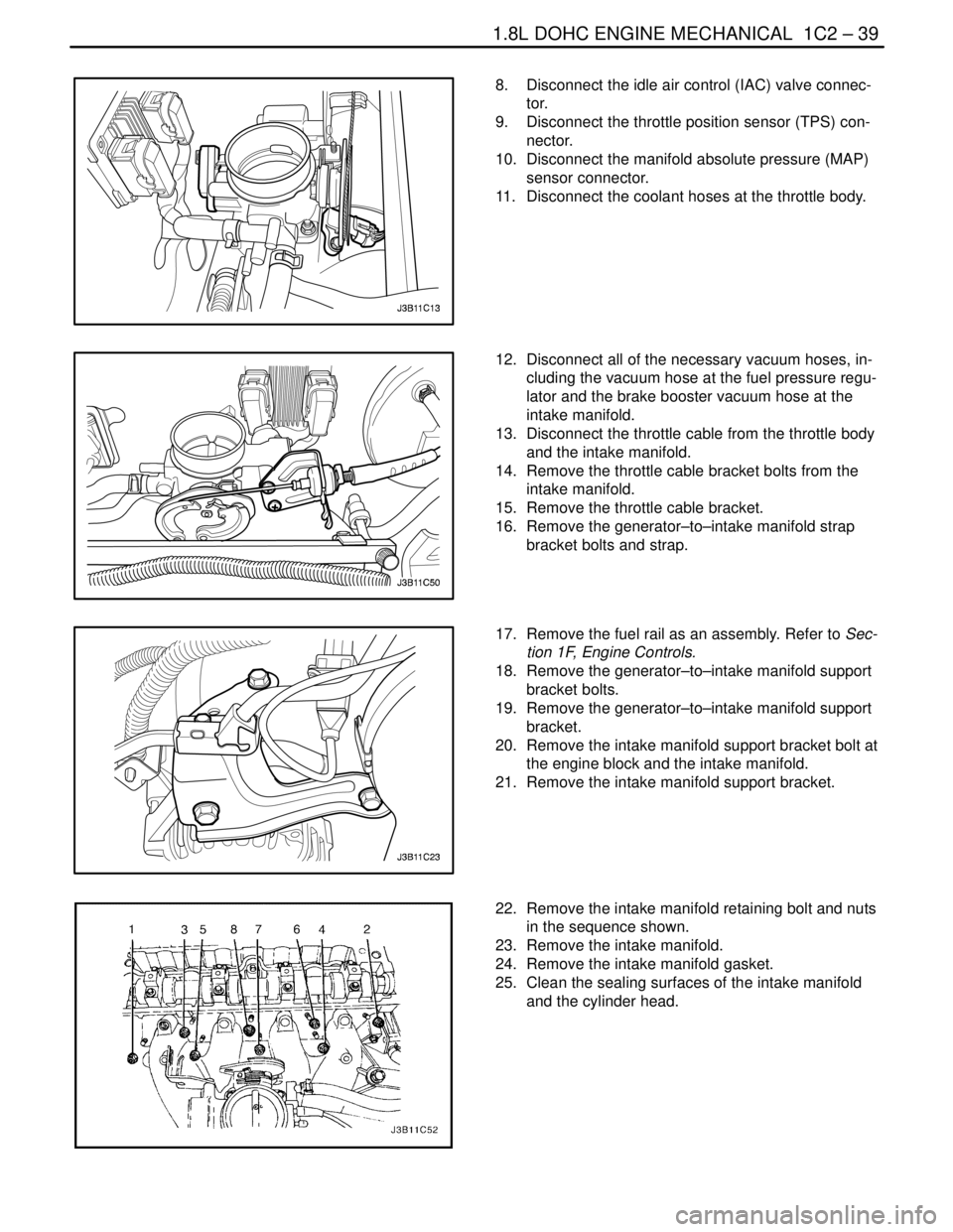
1.8L DOHC ENGINE MECHANICAL 1C2 – 39
DAEWOO V–121 BL4
8. Disconnect the idle air control (IAC) valve connec-
tor.
9. Disconnect the throttle position sensor (TPS) con-
nector.
10. Disconnect the manifold absolute pressure (MAP)
sensor connector.
11. Disconnect the coolant hoses at the throttle body.
12. Disconnect all of the necessary vacuum hoses, in-
cluding the vacuum hose at the fuel pressure regu-
lator and the brake booster vacuum hose at the
intake manifold.
13. Disconnect the throttle cable from the throttle body
and the intake manifold.
14. Remove the throttle cable bracket bolts from the
intake manifold.
15. Remove the throttle cable bracket.
16. Remove the generator–to–intake manifold strap
bracket bolts and strap.
17. Remove the fuel rail as an assembly. Refer to Sec-
tion 1F, Engine Controls.
18. Remove the generator–to–intake manifold support
bracket bolts.
19. Remove the generator–to–intake manifold support
bracket.
20. Remove the intake manifold support bracket bolt at
the engine block and the intake manifold.
21. Remove the intake manifold support bracket.
22. Remove the intake manifold retaining bolt and nuts
in the sequence shown.
23. Remove the intake manifold.
24. Remove the intake manifold gasket.
25. Clean the sealing surfaces of the intake manifold
and the cylinder head.