ABS DAEWOO NUBIRA 2004 Service Repair Manual
[x] Cancel search | Manufacturer: DAEWOO, Model Year: 2004, Model line: NUBIRA, Model: DAEWOO NUBIRA 2004Pages: 2643, PDF Size: 80.54 MB
Page 1022 of 2643

4A – 6IHYDRAULIC BRAKES
DAEWOO V–121 BL4
STOP LAMP WARNING CIRCUIT DIAGNOSIS
J3B14A03
10A30
F4
32
A19
A13 A14 A1 A2B15 C201
31C201IP/Fuse
Block C201
C202
C110C108 S301 WHT
BRN
BRN
Parking
Brake
SwitchBrake
Fluid
Switch
BLKBRN LT GRN
DK
GRN
DK
GRN LT GRN/
BLK
LT GRN/
BLKPPL/
WHT
PPL/
WHT
PPL/
WHTPPL/
WHT PPL/
WHT
PPL/
WHT ABS
Warning
Lamp TCS
Active
Warning
Lamp Parking
Brake
Warning
Lamp Charging
Warning
Hot in Run and Start
PNK
Cluster PNK
EBCM”L” Ter.
Generator 1 12
2
20 2222 16 41 13
3
4
11 1 215
8
21
G303
Test Description
The number(s) below refer to step(s) on the diagnostic
table.
1. When the ignition is turned ON, the brake warning
lamp should initially illuminate and then dim for ABS
equipped vehicles. This is done as a bulb check.
On vehicles that are not equipped with ABS, the
brake warning lamp should only illuminate when
either the brake fluid reservoir is low or the parking
brake is applied.
7. The brake fluid level switch is a normally open
switch. If the brake warning lamp is off after discon-
necting the switch, the brake fluid level switch is
stuck closed.9. If the brake warning lamp is still on after discon-
necting the parking brake switch, there is a short to
ground in the wire to the parking brake switch.
12. If the other checks have been properly performed
and the brake warning lamp is off after disconnect-
ing the electronic brake control module (EBCM) J1
connector, the EBCM is faulty.
19. If the brake warning lamp does not operate while
performing any of the functions, the fault should be
in the ignition feed to the circuit.
24. This step determines if the problem is in the ignition
feed to the circuit or in the instrument cluster.
30. The brake warning lamp should illuminate when
jumpering the parking brake connector to ground.
32. If the brake warning lamp is on after jumpering the
brake fluid level switch terminals, the switch is
faulty.
Page 1023 of 2643

HYDRAULIC BRAKES 4A – 7
DAEWOO V–121 BL4
Stop Lamp Warning Circuit Diagnosis
StepActionValue(s)YesNo
1Turn the ignition ON.
Is the brake warning lamp always on?–Go to Step 2Go to Step 18
2Check the ABS warning lamp.
Is the ABS warning lamp also on?–Go to Step 3Go to Step 4
3Use a scan tool to check for diagnostic trouble codes
(DTCs) and follow the procedures for any DTCs
found.
Is the lamp still on?–Go to Step 4System OK
4Release the parking brake fully.
Is the lamp off?–System OKGo to Step 5
5Check the brake fluid level.
Is the fluid level OK?–Go to Step 7Go to Step 6
61. Fill the brake fluid reservoir with clean DOT 3
equivalent hydraulic fluid.
2. Replace the cap on the fluid reservoir.
Is the lamp on?– Go to Step 7System OK
7Disconnect the harness connector from the brake
fluid level switch.
Is the lamp on?–Go to Step 9Go to Step 8
8Replace the brake fluid level switch.
Is the repair complete?–System OK–
91. Connect the brake fluid level switch.
2. Disconnect the parking brake switch.
Is the lamp on?–Go to Step 11Go to Step 10
10Replace the parking brake switch.
Is the repair complete?–System OK–
11Connect the parking brake switch.
Is the vehicle equipped with ABS?–Go to Step 12Go to Step 14
121. Turn the ignition OFF.
2. Disconnect the electronic brake control module
(EBCM) connector.
3. Turn the ignition ON.
Is the lamp on?–Go to Step 14Go to Step 13
13Replace the electronic brake control module
(EBCM).
Is the repair complete?–System OK–
141. Turn the ignition OFF.
2. Connect the EBCM connector.
3. Check for a short to ground in the wiring be-
tween the instrument cluster terminal A19(B15)
and the brake fluid level switch.
Is the problem found?–Go to Step 17Go to Step 15
15Check for a short to ground in the wiring between the
instrument cluster terminal A19(B15) and the park-
ing brake switch.
Is the problem found?–Go to Step 17Go to Step 16
Page 1024 of 2643

4A – 8IHYDRAULIC BRAKES
DAEWOO V–121 BL4
StepNo Yes Value(s) Action
16Check for a short to ground in the wiring between the
instrument cluster terminal A19(B15) and the EBCM
connector terminal 21.
Is the problem found?–Go to Step 17Go to Step 18
17Repair the wiring as needed.
Is the repair complete?–System OK–
18Check the brake lamp after doing each of the follow-
ing functions:
S Apply the parking brake.
S Remove the cap from the brake fluid reservoir.
S On vehicles equipped with ABS, command the
lamp on using a scan tool.
Does the brake warning lamp operate for all of these
conditions?–System OKGo to Step 19
19When the operations listed in step 18 were per-
formed, the brake warning lamp did not function.
Did the brake warning lamp fail to light for all of the
operations listed in step 18?–Go to Step 20Go to Step 27
201. Turn the ignition OFF.
2. Inspect the kick panel fuse F4.
Is the fuse OK?–Go to Step 22Go to Step 21
21Replace the fuse.
Is the repair complete?–System OK–
22Inspect the brake warning lamp bulb.
Is the bulb OK?–Go to Step 24Go to Step 23
23Replace the bulb.
Is the repair complete?–System OK–
241. Disconnect the instrument cluster connector.
2. Turn the ignition ON.
3. Measure the voltage at the instrument cluster
connector terminal A19(B15).
Does the voltage measure within the value speci-
fied?11–14 vGo to Step 25Go to Step 26
251. Turn the ignition OFF.
2. Repair the open in the instrument cluster.
Is the repair complete?–System OK–
261. Turn the ignition OFF.
2. Repair the open in the wiring between the in-
strument cluster connector terminal A19(B15)
and the ignition switch.
Is the repair complete?–System OK–
27Apply the parking brake again.
Does the parking brake warning lamp operate with
the parking brake applied?–Go to Step 28Go to Step 30
28Remove the brake fluid reservoir cap.
Does the parking brake warning lamp operate with
the cap from the brake fluid reservoir removed?–Go to Step 29Go to Step 32
29Check for an open between the instrument cluster
connector terminal A1 and the EBCM connector ter-
minal 21.
Is the problem found?–Go to Step 17Go to Step 13
Page 1027 of 2643
HYDRAULIC BRAKES 4A – 11
DAEWOO V–121 BL4
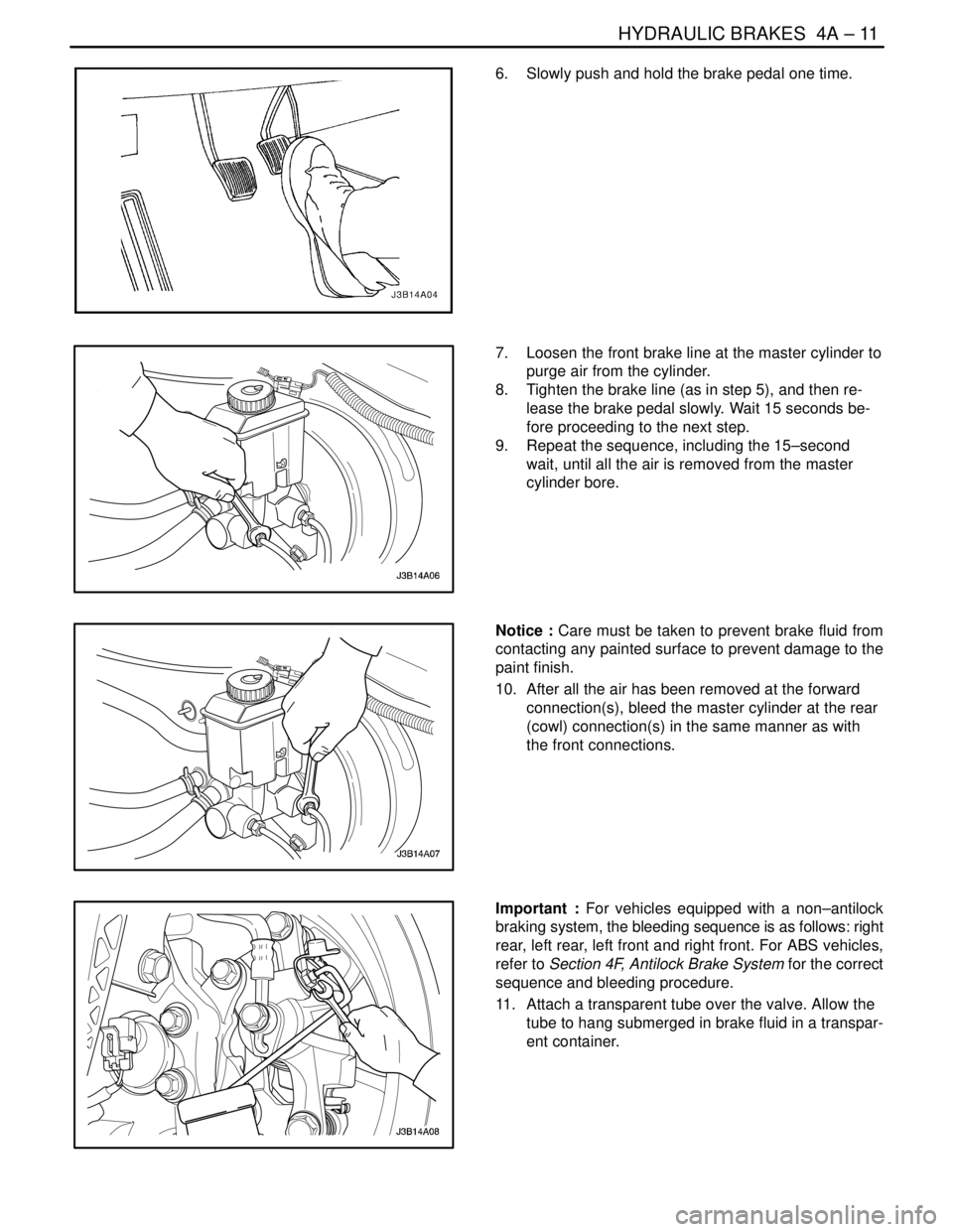
6. Slowly push and hold the brake pedal one time.
7. Loosen the front brake line at the master cylinder to
purge air from the cylinder.
8. Tighten the brake line (as in step 5), and then re-
lease the brake pedal slowly. Wait 15 seconds be-
fore proceeding to the next step.
9. Repeat the sequence, including the 15–second
wait, until all the air is removed from the master
cylinder bore.
Notice : Care must be taken to prevent brake fluid from
contacting any painted surface to prevent damage to the
paint finish.
10. After all the air has been removed at the forward
connection(s), bleed the master cylinder at the rear
(cowl) connection(s) in the same manner as with
the front connections.
Important : For vehicles equipped with a non–antilock
braking system, the bleeding sequence is as follows: right
rear, left rear, left front and right front. For ABS vehicles,
refer to Section 4F, Antilock Brake System for the correct
sequence and bleeding procedure.
11. Attach a transparent tube over the valve. Allow the
tube to hang submerged in brake fluid in a transpar-
ent container.
Page 1028 of 2643
4A – 12IHYDRAULIC BRAKES
DAEWOO V–121 BL4
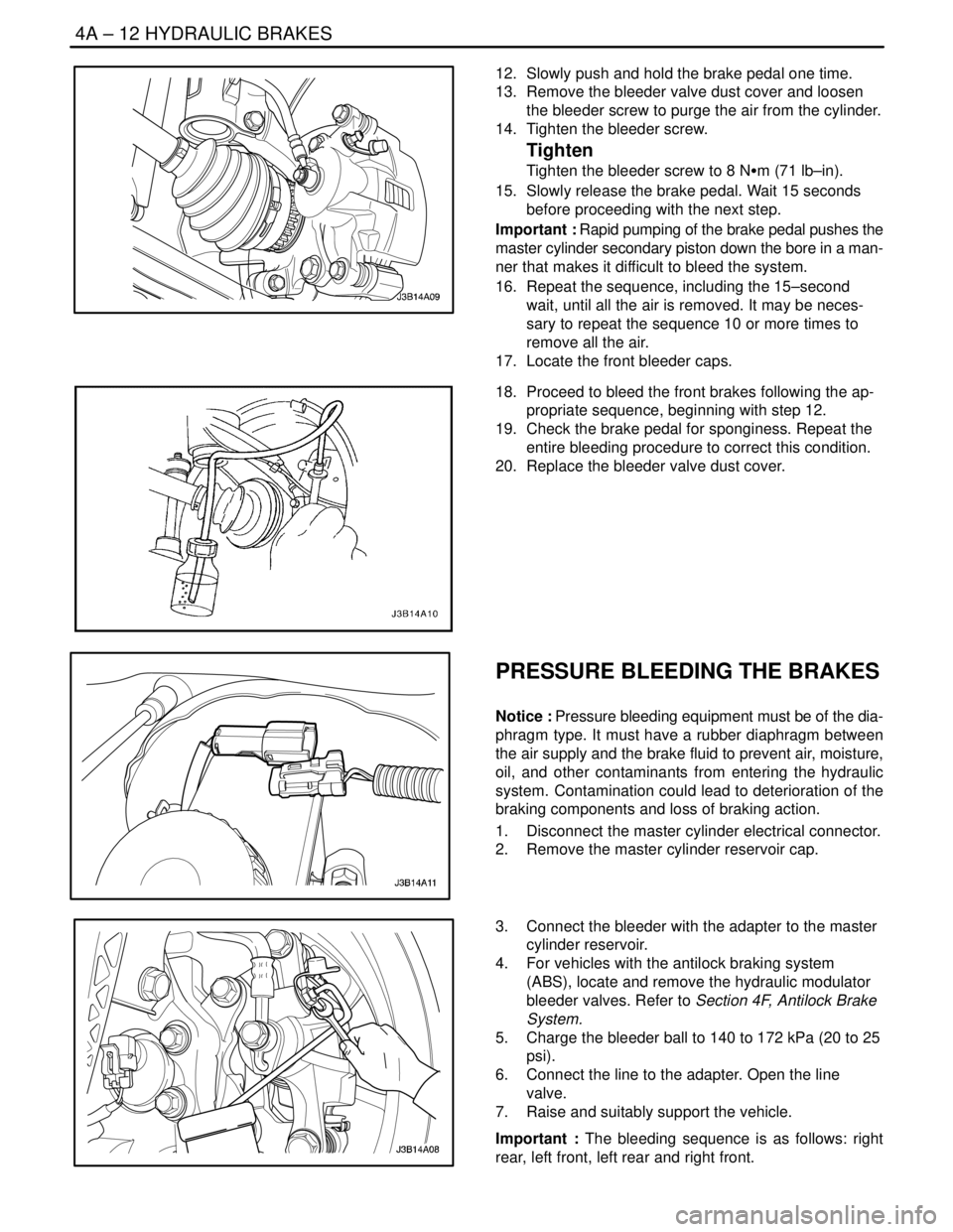
12. Slowly push and hold the brake pedal one time.
13. Remove the bleeder valve dust cover and loosen
the bleeder screw to purge the air from the cylinder.
14. Tighten the bleeder screw.
Tighten
Tighten the bleeder screw to 8 NSm (71 lb–in).
15. Slowly release the brake pedal. Wait 15 seconds
before proceeding with the next step.
Important : Rapid pumping of the brake pedal pushes the
master cylinder secondary piston down the bore in a man-
ner that makes it difficult to bleed the system.
16. Repeat the sequence, including the 15–second
wait, until all the air is removed. It may be neces-
sary to repeat the sequence 10 or more times to
remove all the air.
17. Locate the front bleeder caps.
18. Proceed to bleed the front brakes following the ap-
propriate sequence, beginning with step 12.
19. Check the brake pedal for sponginess. Repeat the
entire bleeding procedure to correct this condition.
20. Replace the bleeder valve dust cover.
PRESSURE BLEEDING THE BRAKES
Notice : Pressure bleeding equipment must be of the dia-
phragm type. It must have a rubber diaphragm between
the air supply and the brake fluid to prevent air, moisture,
oil, and other contaminants from entering the hydraulic
system. Contamination could lead to deterioration of the
braking components and loss of braking action.
1. Disconnect the master cylinder electrical connector.
2. Remove the master cylinder reservoir cap.
3. Connect the bleeder with the adapter to the master
cylinder reservoir.
4. For vehicles with the antilock braking system
(ABS), locate and remove the hydraulic modulator
bleeder valves. Refer to Section 4F, Antilock Brake
System.
5. Charge the bleeder ball to 140 to 172 kPa (20 to 25
psi).
6. Connect the line to the adapter. Open the line
valve.
7. Raise and suitably support the vehicle.
Important : The bleeding sequence is as follows: right
rear, left front, left rear and right front.
Page 1035 of 2643

4B – 2IMASTER CYLINDER
DAEWOO V–121 BL4
DIAGNOSIS
CHECKING BRAKE
PROPORTIONING VALVE
Use two brake pressure gauges to check the brake pro-
portioning valves that are attached to the master cylinder
on non–ABS braking systems. These valves limit the out-
let pressure to the rear brakes after a predetermined mas-
ter cylinder pressure has been reached. (On ABS braking
systems, the hydraulic modulator/motor pack assembly
controls the hydraulic pressure to both the rear wheel cyl-
inders or rear calipers, and the front calipers.)
When checking the brake proportioning valves, be sure
that the hydraulic line pressure is measured simulta-
neously and diagonally on the front and the rear axles.To measure the pressure, use the following steps.
1. Remove the bleeder valve and install a pressure
gauge to one of the rear brake cylinders.
2. Install another bleeder valve and install another
pressure gauge to the diagonally opposite front
brake.
3. Build pressure by pressing firmly on the brake ped-
al several times. (The pressure indicated on the
gauge is not regulated and represents the actual
brake system hydraulic pressure.)
4. Build pressure until the test values in the following
proportioning valve test chart are achieved.
Model
Reference Number for
Gradient and Switching
Pressure on the Valve
HousingInput Pressure Read on
the Manometer at the
Front Axle in kPa (psi)Output Pressure Read
on the Manometer at the
Front Axle in kPa (psi)
500 (73)500 (73)
N/B, H/B0.3/304 500 (653) 3 450 ± 200(500 ± 29)
10 000 (1,450)5 100 ± 300(740 ± 44)
500 (73)500 (73)
WAGON0.3/405 500 (798)4 450 ± 200(645 ± 29)
10 000 (1,450)5 800 ± 300(841 ± 44)
Important : If the pressure exceeds 10 000 kPa (1,450
psi), the pressure reading on the rear gauge will not be ac-
curate.5. Remove the gauges from the tested brake circuit
and repeat the test on the remaining circuit.
Page 1036 of 2643
MASTER CYLINDER 4B – 3
DAEWOO V–121 BL4
MAINTENANCE AND REPAIR
ON–VEHICLE SERVICE
MASTER CYLINDER ASSEMBLY
(Left–Hand Drive Shown, Right–Hand Drive
Similar)
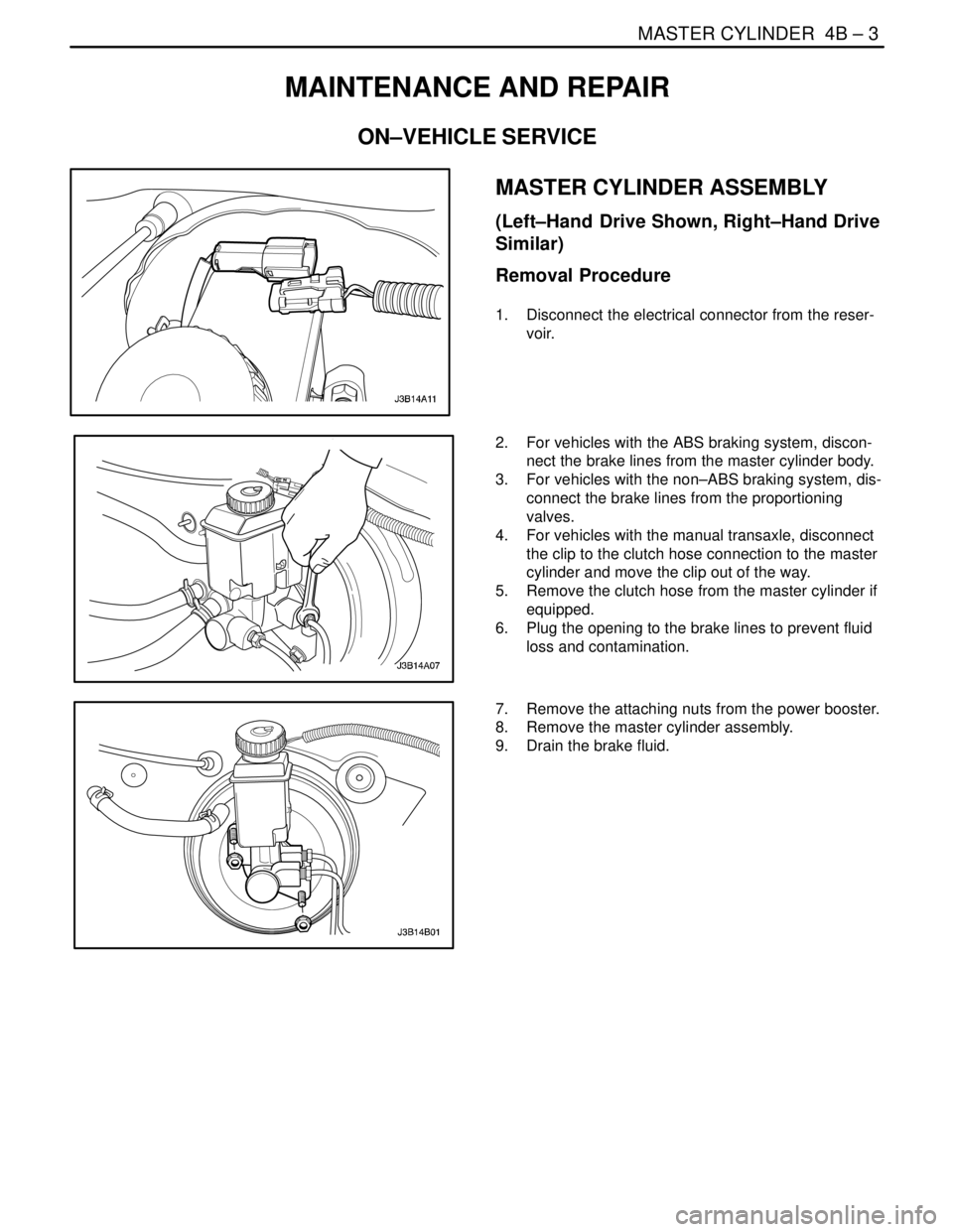
Removal Procedure
1. Disconnect the electrical connector from the reser-
voir.
2. For vehicles with the ABS braking system, discon-
nect the brake lines from the master cylinder body.
3. For vehicles with the non–ABS braking system, dis-
connect the brake lines from the proportioning
valves.
4. For vehicles with the manual transaxle, disconnect
the clip to the clutch hose connection to the master
cylinder and move the clip out of the way.
5. Remove the clutch hose from the master cylinder if
equipped.
6. Plug the opening to the brake lines to prevent fluid
loss and contamination.
7. Remove the attaching nuts from the power booster.
8. Remove the master cylinder assembly.
9. Drain the brake fluid.
Page 1037 of 2643
4B – 4IMASTER CYLINDER
DAEWOO V–121 BL4
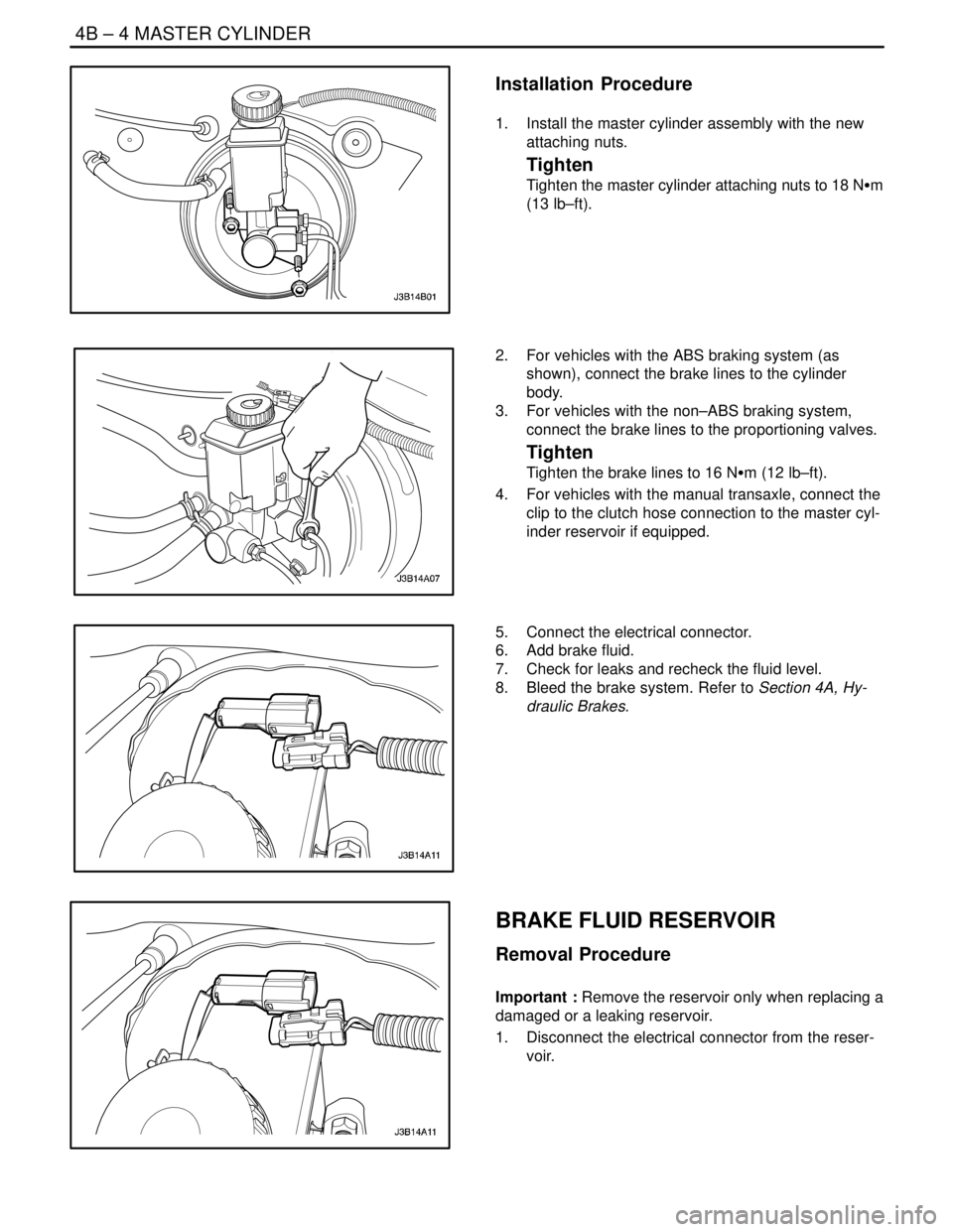
Installation Procedure
1. Install the master cylinder assembly with the new
attaching nuts.
Tighten
Tighten the master cylinder attaching nuts to 18 NSm
(13 lb–ft).
2. For vehicles with the ABS braking system (as
shown), connect the brake lines to the cylinder
body.
3. For vehicles with the non–ABS braking system,
connect the brake lines to the proportioning valves.
Tighten
Tighten the brake lines to 16 NSm (12 lb–ft).
4. For vehicles with the manual transaxle, connect the
clip to the clutch hose connection to the master cyl-
inder reservoir if equipped.
5. Connect the electrical connector.
6. Add brake fluid.
7. Check for leaks and recheck the fluid level.
8. Bleed the brake system. Refer to Section 4A, Hy-
draulic Brakes.
BRAKE FLUID RESERVOIR
Removal Procedure
Important : Remove the reservoir only when replacing a
damaged or a leaking reservoir.
1. Disconnect the electrical connector from the reser-
voir.
Page 1040 of 2643
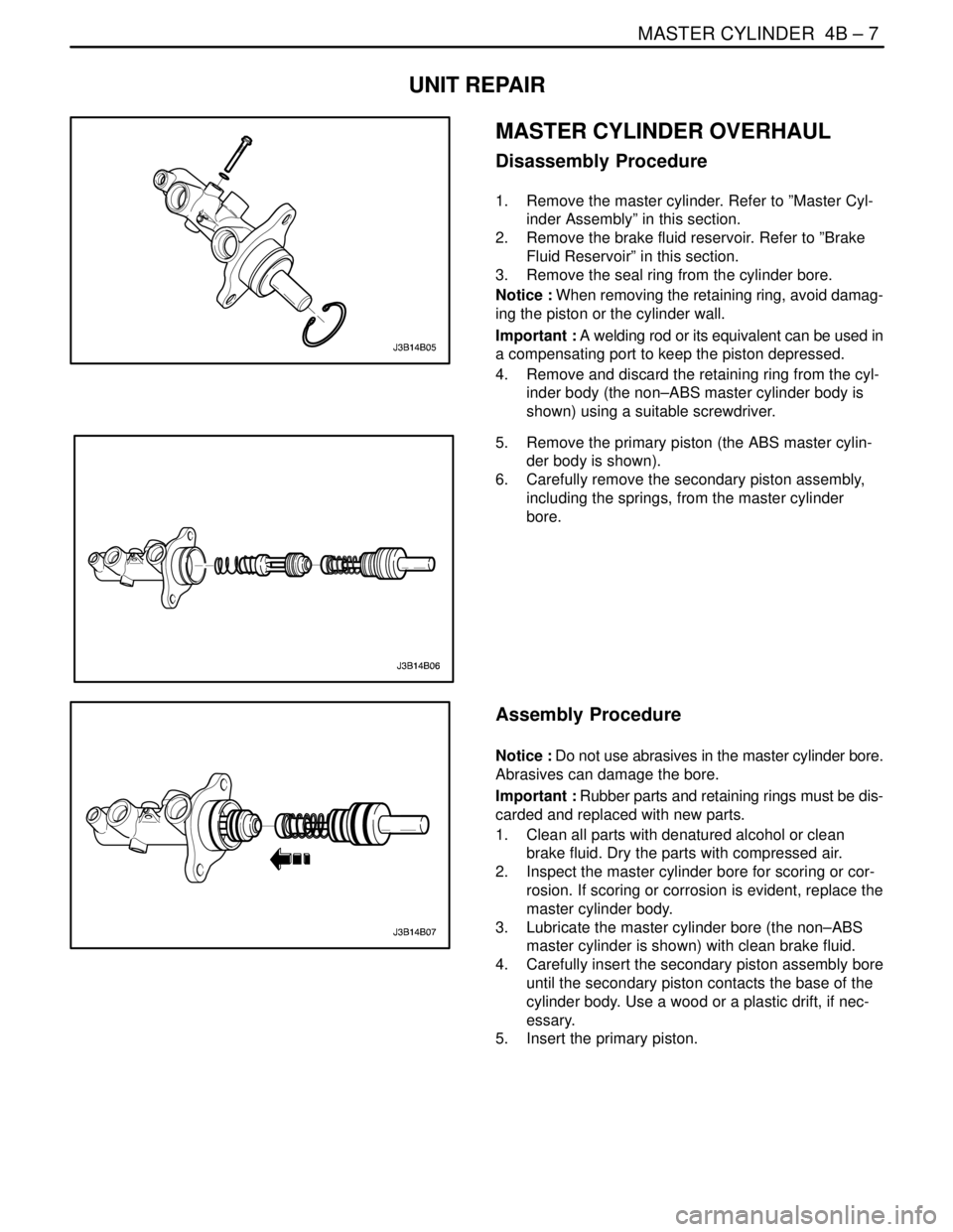
MASTER CYLINDER 4B – 7
DAEWOO V–121 BL4
UNIT REPAIR
MASTER CYLINDER OVERHAUL
Disassembly Procedure
1. Remove the master cylinder. Refer to ”Master Cyl-
inder Assembly” in this section.
2. Remove the brake fluid reservoir. Refer to ”Brake
Fluid Reservoir” in this section.
3. Remove the seal ring from the cylinder bore.
Notice : When removing the retaining ring, avoid damag-
ing the piston or the cylinder wall.
Important : A welding rod or its equivalent can be used in
a compensating port to keep the piston depressed.
4. Remove and discard the retaining ring from the cyl-
inder body (the non–ABS master cylinder body is
shown) using a suitable screwdriver.
5. Remove the primary piston (the ABS master cylin-
der body is shown).
6. Carefully remove the secondary piston assembly,
including the springs, from the master cylinder
bore.
Assembly Procedure
Notice : Do not use abrasives in the master cylinder bore.
Abrasives can damage the bore.
Important : Rubber parts and retaining rings must be dis-
carded and replaced with new parts.
1. Clean all parts with denatured alcohol or clean
brake fluid. Dry the parts with compressed air.
2. Inspect the master cylinder bore for scoring or cor-
rosion. If scoring or corrosion is evident, replace the
master cylinder body.
3. Lubricate the master cylinder bore (the non–ABS
master cylinder is shown) with clean brake fluid.
4. Carefully insert the secondary piston assembly bore
until the secondary piston contacts the base of the
cylinder body. Use a wood or a plastic drift, if nec-
essary.
5. Insert the primary piston.
Page 1041 of 2643

4B – 8IMASTER CYLINDER
DAEWOO V–121 BL4
6. Press the pistons into the cylinder bore using a
wooden or a plastic drift.
Notice : When installing the new retaining ring, take care
not to damage the cylinder bore.
7. Insert the new retaining ring into the groove in the
cylinder bore (the non–ABS cylinder body is
shown). Remove the welding rod.
8. Move the pistons backward and forward after instal-
lation to check for free movement.
9. Lubricate the seal ring and insert the seal into the
cylinder bore. The open side must face outward
until the seal rests on the piston.
10. Install the brake fluid reservoir to the master cylin-
der. Refer to ”Brake Fluid Reservoir” in this section.
11. Install the master cylinder assembly. Refer to Mas-
ter Cylinder Assembly in this section
12. Raise and suitably support the vehicle.
13. Bleed the braking system. Refer to Section 4A, Hy-
draulic Brakes orSection 4F, Antilock Brake Sys-
tem.
14. Lower the vehicle.