brakes DAEWOO NUBIRA 2004 Service Repair Manual
[x] Cancel search | Manufacturer: DAEWOO, Model Year: 2004, Model line: NUBIRA, Model: DAEWOO NUBIRA 2004Pages: 2643, PDF Size: 80.54 MB
Page 1527 of 2643
5A1 – 178IZF 4 HP 16 AUTOMATIC TRANSAXLE
DAEWOO V–121 BL4
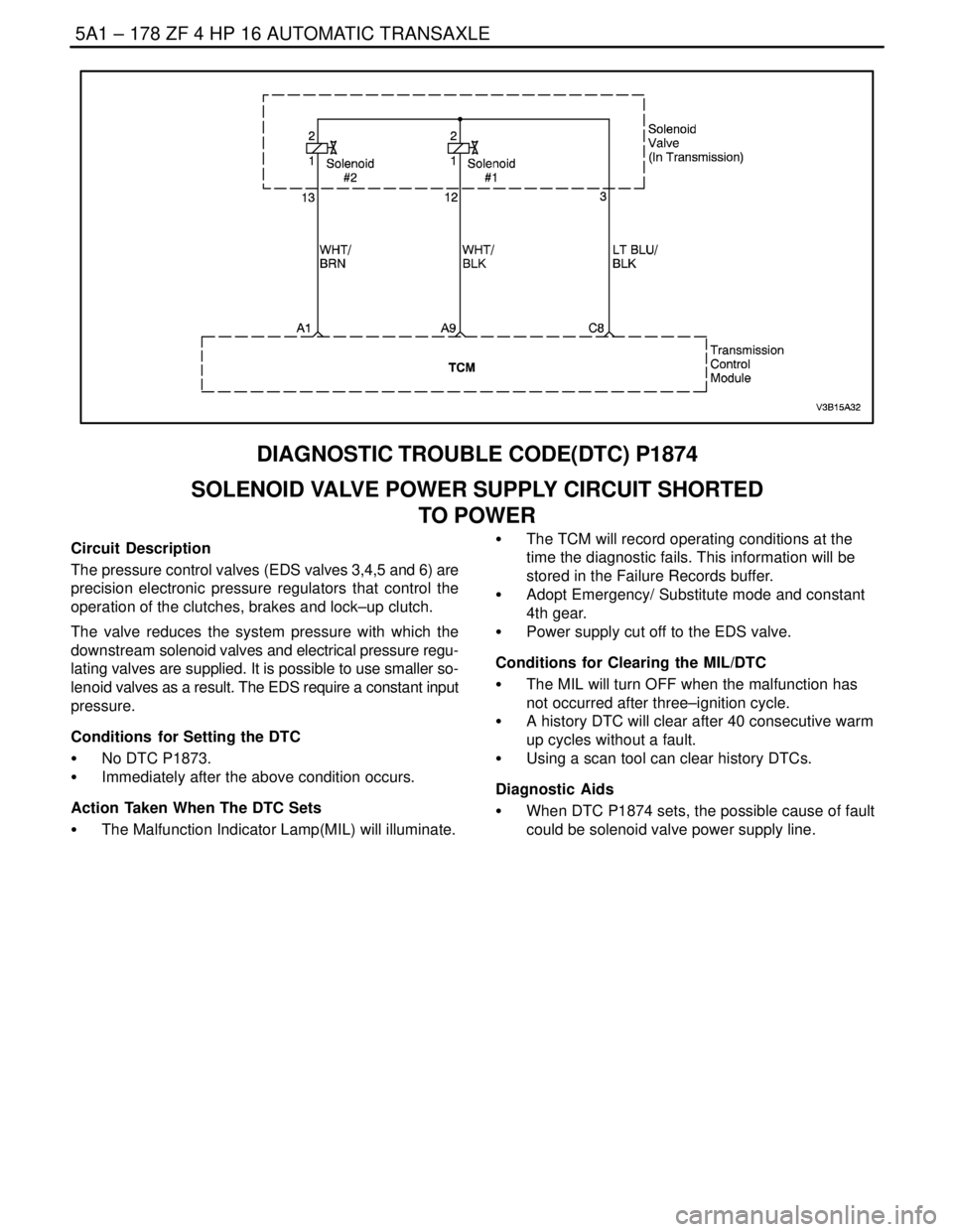
DIAGNOSTIC TROUBLE CODE(DTC) P1874
SOLENOID VALVE POWER SUPPLY CIRCUIT SHORTED
TO POWER
Circuit Description
The pressure control valves (EDS valves 3,4,5 and 6) are
precision electronic pressure regulators that control the
operation of the clutches, brakes and lock–up clutch.
The valve reduces the system pressure with which the
downstream solenoid valves and electrical pressure regu-
lating valves are supplied. It is possible to use smaller so-
lenoid valves as a result. The EDS require a constant input
pressure.
Conditions for Setting the DTC
S No DTC P1873.
S Immediately after the above condition occurs.
Action Taken When The DTC Sets
S The Malfunction Indicator Lamp(MIL) will illuminate.S The TCM will record operating conditions at the
time the diagnostic fails. This information will be
stored in the Failure Records buffer.
S Adopt Emergency/ Substitute mode and constant
4th gear.
S Power supply cut off to the EDS valve.
Conditions for Clearing the MIL/DTC
S The MIL will turn OFF when the malfunction has
not occurred after three–ignition cycle.
S A history DTC will clear after 40 consecutive warm
up cycles without a fault.
S Using a scan tool can clear history DTCs.
Diagnostic Aids
S When DTC P1874 sets, the possible cause of fault
could be solenoid valve power supply line.
Page 1582 of 2643
ZF 4 HP 16 AUTOMATIC TRANSAXLE 5A1 – 233
DAEWOO V–121 BL4
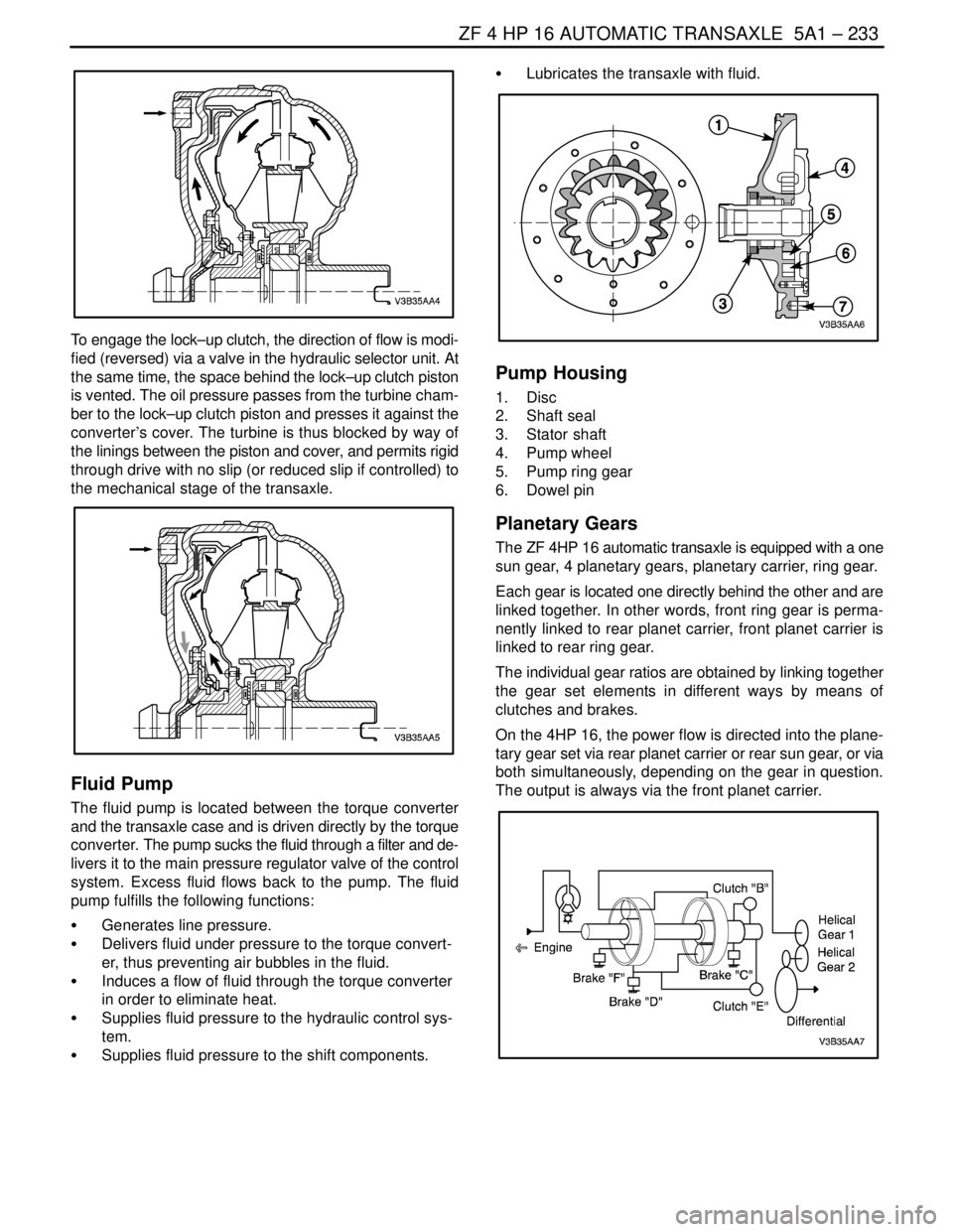
To engage the lock–up clutch, the direction of flow is modi-
fied (reversed) via a valve in the hydraulic selector unit. At
the same time, the space behind the lock–up clutch piston
is vented. The oil pressure passes from the turbine cham-
ber to the lock–up clutch piston and presses it against the
converter’s cover. The turbine is thus blocked by way of
the linings between the piston and cover, and permits rigid
through drive with no slip (or reduced slip if controlled) to
the mechanical stage of the transaxle.
Fluid Pump
The fluid pump is located between the torque converter
and the transaxle case and is driven directly by the torque
converter. The pump sucks the fluid through a filter and de-
livers it to the main pressure regulator valve of the control
system. Excess fluid flows back to the pump. The fluid
pump fulfills the following functions:
S Generates line pressure.
S Delivers fluid under pressure to the torque convert-
er, thus preventing air bubbles in the fluid.
S Induces a flow of fluid through the torque converter
in order to eliminate heat.
S Supplies fluid pressure to the hydraulic control sys-
tem.
S Supplies fluid pressure to the shift components.S Lubricates the transaxle with fluid.
Pump Housing
1. Disc
2. Shaft seal
3. Stator shaft
4. Pump wheel
5. Pump ring gear
6. Dowel pin
Planetary Gears
The ZF 4HP 16 automatic transaxle is equipped with a one
sun gear, 4 planetary gears, planetary carrier, ring gear.
Each gear is located one directly behind the other and are
linked together. In other words, front ring gear is perma-
nently linked to rear planet carrier, front planet carrier is
linked to rear ring gear.
The individual gear ratios are obtained by linking together
the gear set elements in different ways by means of
clutches and brakes.
On the 4HP 16, the power flow is directed into the plane-
tary gear set via rear planet carrier or rear sun gear, or via
both simultaneously, depending on the gear in question.
The output is always via the front planet carrier.
Page 1583 of 2643
5A1 – 234IZF 4 HP 16 AUTOMATIC TRANSAXLE
DAEWOO V–121 BL4
Shift Elements: Multi–disc Clutches and
Brakes
The purpose of the shift elements is to perform shifts un-
der load without the tractive flow being interrupted.
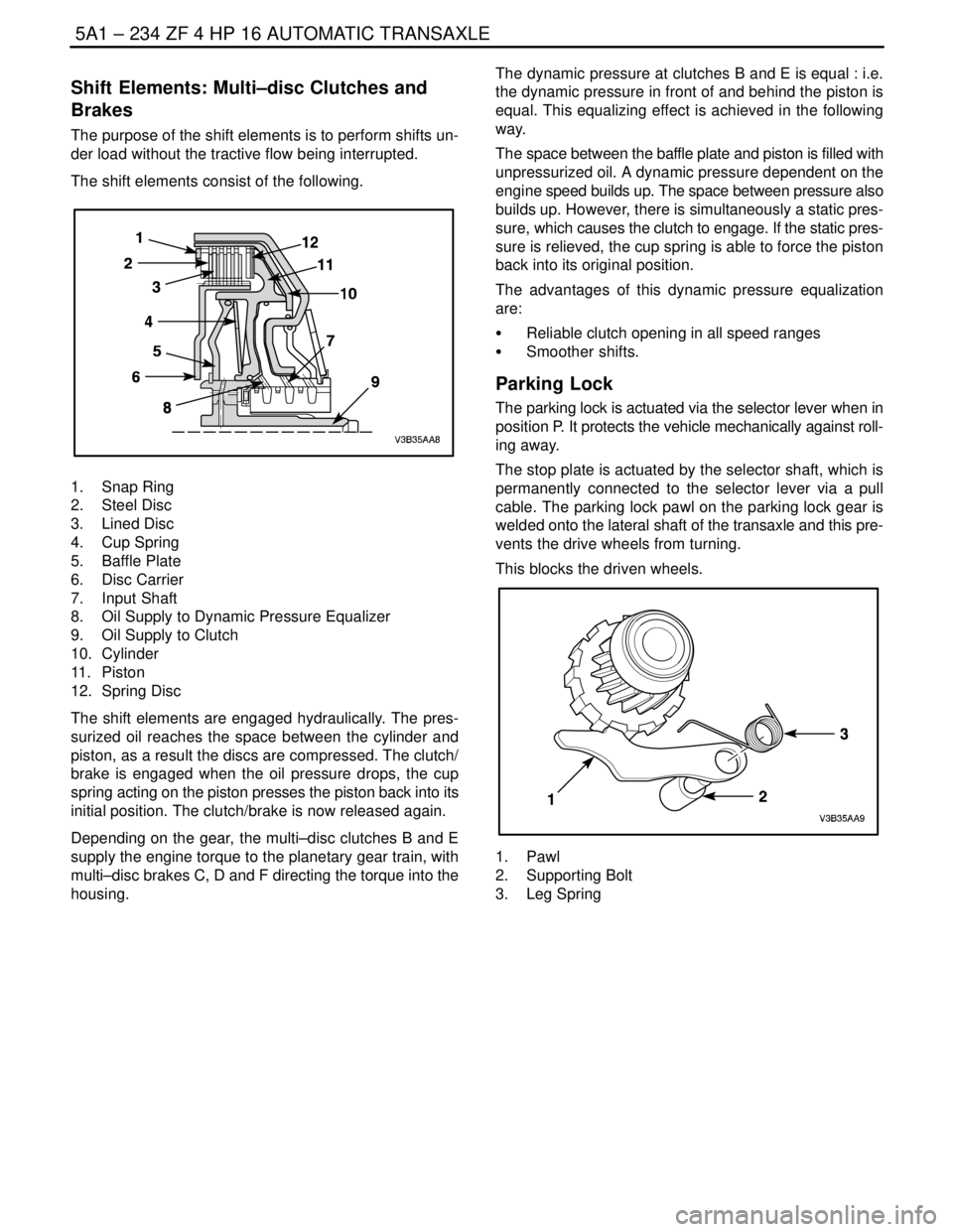
The shift elements consist of the following.
1. Snap Ring
2. Steel Disc
3. Lined Disc
4. Cup Spring
5. Baffle Plate
6. Disc Carrier
7. Input Shaft
8. Oil Supply to Dynamic Pressure Equalizer
9. Oil Supply to Clutch
10. Cylinder
11. Piston
12. Spring Disc
The shift elements are engaged hydraulically. The pres-
surized oil reaches the space between the cylinder and
piston, as a result the discs are compressed. The clutch/
brake is engaged when the oil pressure drops, the cup
spring acting on the piston presses the piston back into its
initial position. The clutch/brake is now released again.
Depending on the gear, the multi–disc clutches B and E
supply the engine torque to the planetary gear train, with
multi–disc brakes C, D and F directing the torque into the
housing.The dynamic pressure at clutches B and E is equal : i.e.
the dynamic pressure in front of and behind the piston is
equal. This equalizing effect is achieved in the following
way.
The space between the baffle plate and piston is filled with
unpressurized oil. A dynamic pressure dependent on the
engine speed builds up. The space between pressure also
builds up. However, there is simultaneously a static pres-
sure, which causes the clutch to engage. If the static pres-
sure is relieved, the cup spring is able to force the piston
back into its original position.
The advantages of this dynamic pressure equalization
are:
S Reliable clutch opening in all speed ranges
S Smoother shifts.
Parking Lock
The parking lock is actuated via the selector lever when in
position P. It protects the vehicle mechanically against roll-
ing away.
The stop plate is actuated by the selector shaft, which is
permanently connected to the selector lever via a pull
cable. The parking lock pawl on the parking lock gear is
welded onto the lateral shaft of the transaxle and this pre-
vents the drive wheels from turning.
This blocks the driven wheels.
1. Pawl
2. Supporting Bolt
3. Leg Spring
Page 1586 of 2643
ZF 4 HP 16 AUTOMATIC TRANSAXLE 5A1 – 237
DAEWOO V–121 BL4
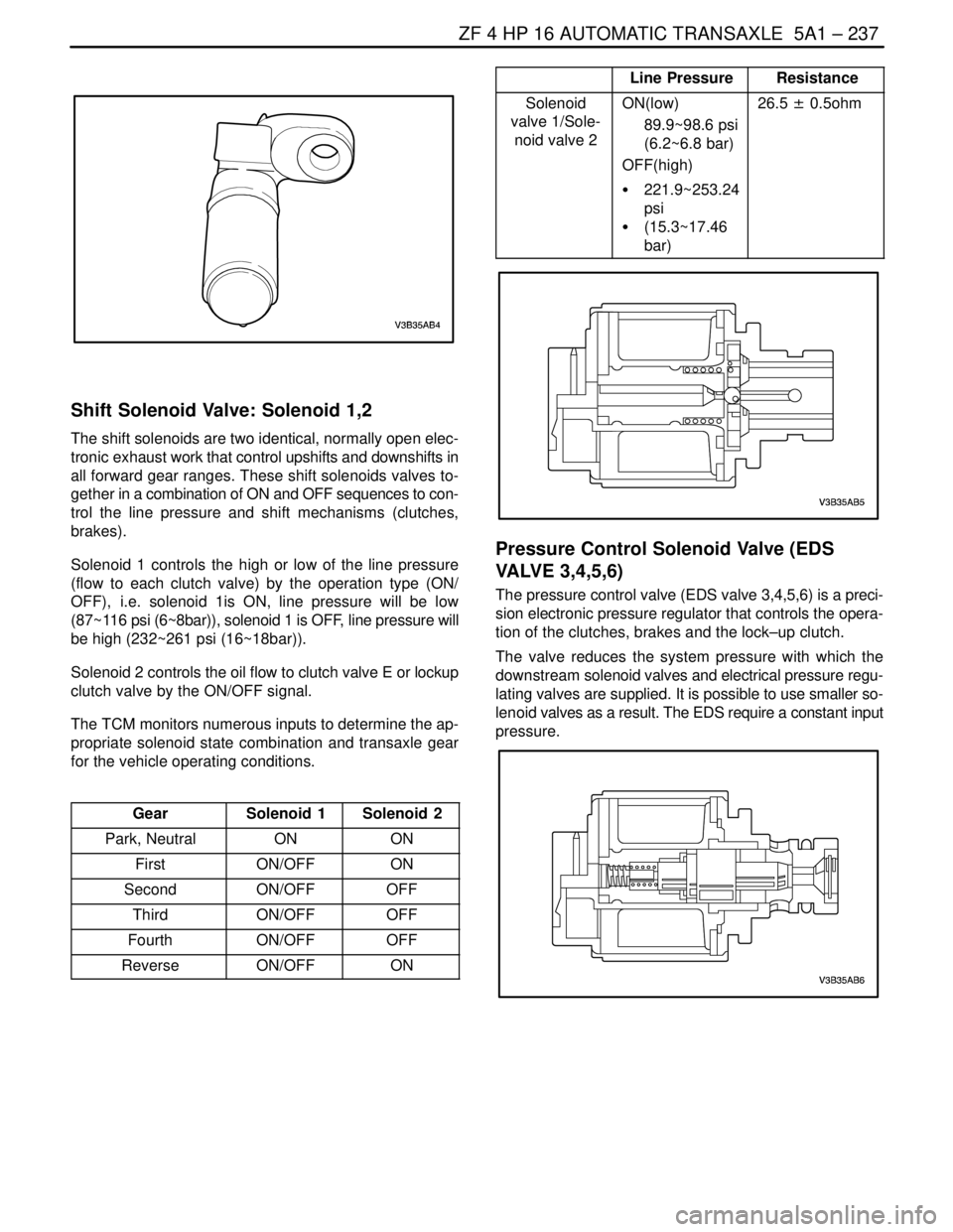
Shift Solenoid Valve: Solenoid 1,2
The shift solenoids are two identical, normally open elec-
tronic exhaust work that control upshifts and downshifts in
all forward gear ranges. These shift solenoids valves to-
gether in a combination of ON and OFF sequences to con-
trol the line pressure and shift mechanisms (clutches,
brakes).
Solenoid 1 controls the high or low of the line pressure
(flow to each clutch valve) by the operation type (ON/
OFF), i.e. solenoid 1is ON, line pressure will be low
(87~116 psi (6~8bar)), solenoid 1 is OFF, line pressure will
be high (232~261 psi (16~18bar)).
Solenoid 2 controls the oil flow to clutch valve E or lockup
clutch valve by the ON/OFF signal.
The TCM monitors numerous inputs to determine the ap-
propriate solenoid state combination and transaxle gear
for the vehicle operating conditions.
Gear
Solenoid 1Solenoid 2
Park, NeutralONON
FirstON/OFFON
SecondON/OFFOFF
ThirdON/OFFOFF
FourthON/OFFOFF
ReverseON/OFFON
Line PressureResistance
Solenoid
valve 1/Sole-
noid valve 2ON(low)
89.9~98.6 psi
(6.2~6.8 bar)
OFF(high)
S 221.9~253.24
psi
S (15.3~17.46
bar)26.5 ± 0.5ohm
Pressure Control Solenoid Valve (EDS
VALVE 3,4,5,6)
The pressure control valve (EDS valve 3,4,5,6) is a preci-
sion electronic pressure regulator that controls the opera-
tion of the clutches, brakes and the lock–up clutch.
The valve reduces the system pressure with which the
downstream solenoid valves and electrical pressure regu-
lating valves are supplied. It is possible to use smaller so-
lenoid valves as a result. The EDS require a constant input
pressure.
Page 1811 of 2643
AISIN AUTOMATIC TRANSAXLE 5A2 – 221
DAEWOO V–121 BL4
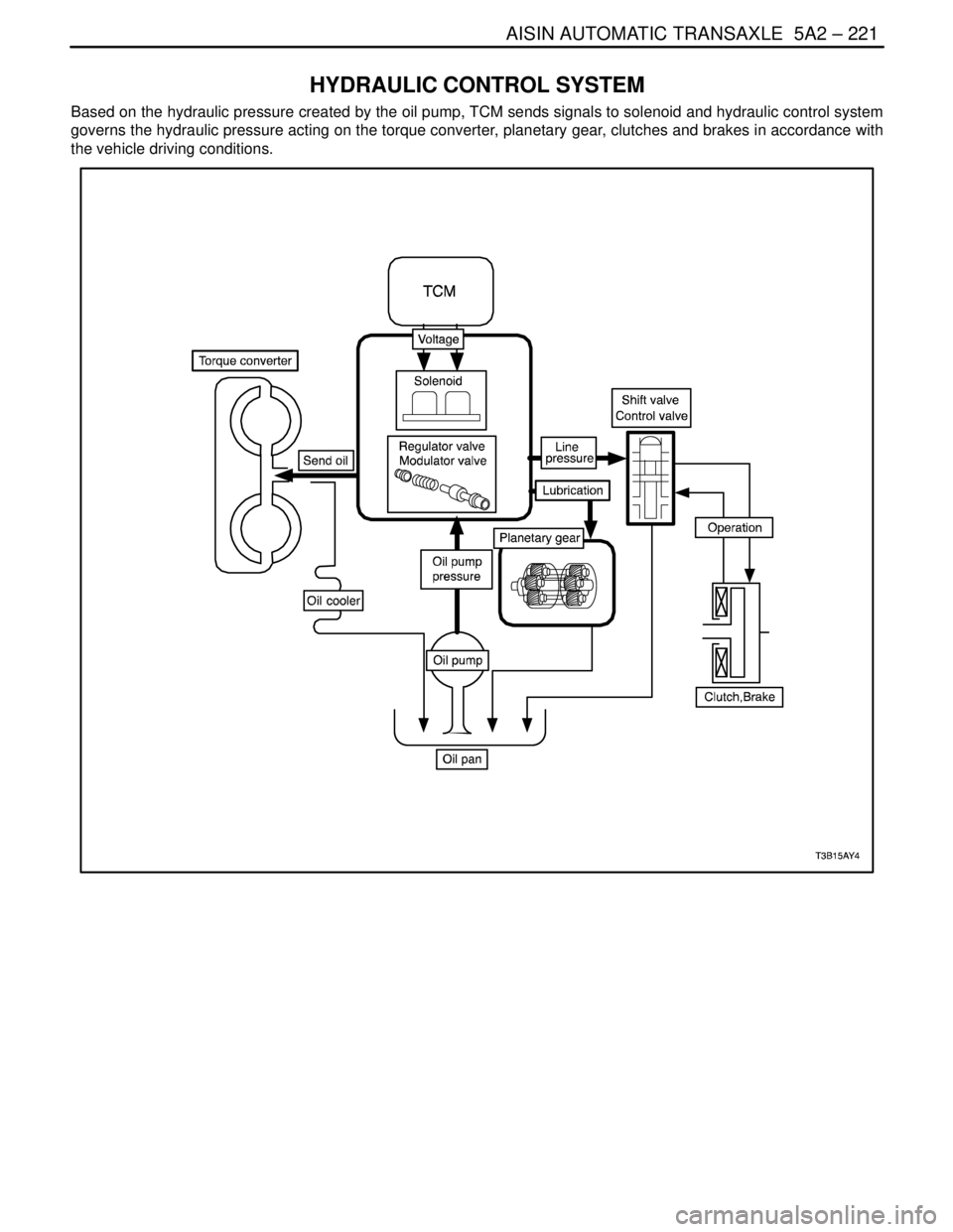
HYDRAULIC CONTROL SYSTEM
Based on the hydraulic pressure created by the oil pump, TCM sends signals to solenoid and hydraulic control system
governs the hydraulic pressure acting on the torque converter, planetary gear, clutches and brakes in accordance with
the vehicle driving conditions.
Page 1813 of 2643
AISIN AUTOMATIC TRANSAXLE 5A2 – 223
DAEWOO V–121 BL4
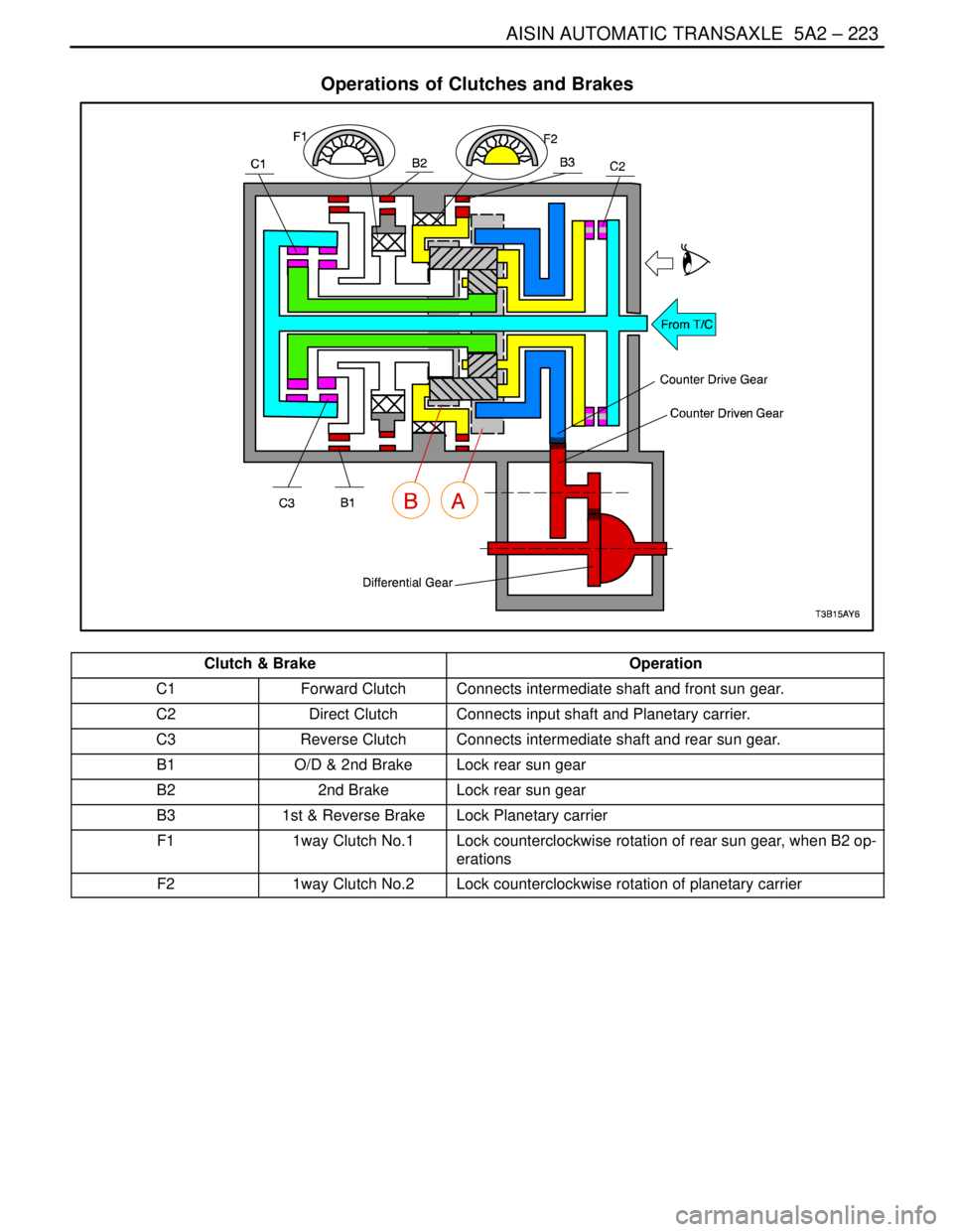
Operations of Clutches and Brakes
Clutch & BrakeOperation
C1Forward ClutchConnects intermediate shaft and front sun gear.
C2Direct ClutchConnects input shaft and Planetary carrier.
C3Reverse ClutchConnects intermediate shaft and rear sun gear.
B1O/D & 2nd BrakeLock rear sun gear
B22nd BrakeLock rear sun gear
B31st & Reverse BrakeLock Planetary carrier
F11way Clutch No.1Lock counterclockwise rotation of rear sun gear, when B2 op-
erations
F21way Clutch No.2Lock counterclockwise rotation of planetary carrier
Page 2524 of 2643

2–4 PREPARATIONS OF BODYWORK NUBIRA/LACETTI
2. CHECKPOINTS
S Accurate Inspection of Damaged Parts(Visual)
.
Seat Belts
Always replace the seat belt if :
1. The belt material is cut, punctured, burned or in any
way damaged.
2. The buckle or retractor does not work properly.
3. They were being worn at the time of a collision(also
check for damage at the seat belt anchor points).
4. Their condition is questionable.
.
Front Section :
1. Is there any bending, splitting, denting or other dam-
age to the suspension and its related parts?
2. Is there any deformation of the front panel or radiator
crossmember? Have any of the connected sections
come apart?
3. Are there any creases or distortion in the front wheel-
house or side frame? Have any of the connected sec-
tions come apart?
4. Is there any bending or twisting of the whole front
area?
5. Is there any deformation like creases, bulges, or dents
in the front pillar, dash panel, floor, etc.?
6. Is there any vertical twisting or misaligned clearance
in the door?
7. Is the windshield seal broken?
8. Is there any deformation in the vicinity of the top part
of the roof panel’s center pillar?
9. Is there any damage inside the automobile(is there
any twisting of the dash panel, or anything irregular with
the clearances or sheet–mounting parts)?
10. Is there any damage to the steering wheel? Is there
any deformation in the column and the column–mounted
parts?
11. Is there any oil or water leakage and damage to the en-
gine, transmission or brakes?
12. Is there any irregular noise in the gear changing opera-
tion, engine and transmission rotation?
13. Are there any traces of contact between the engine
block and the center crossmember ?
14. Is there any damage to brake or fuel lines, or wire har-
nesses?Rear Section :
1. Is there any twisting, bulging or denting of the rear floor
any rear bolsters? Have any of the connected sections
come apart?
2. Is there any irregular bulging or denting in the rear
fender?
3. Is there any distortion in the rear inner panel? Is there
any bending and denting in the vicinity of the rear pillar?
4. Is there any distortion or creasing is the rear wheel-
house and arch sections? Have any of the connected
sections come apart?
5. Is there anything irregular in the rear glass seal clear-
ance?
6. Is there any twisting or misalignment of the clearance
of the trunk lid opening section?
7. Is there any bending, splitting, denting or other dam-
age to the suspension and its related parts?
8. Is there any deformation of the rear floor crossmem-
ber, trunk floor panel and back panel? Have any of the
connected sections come apart?
.
Impact Beam :
Always replace the door assembly if :
1. The external force makes the impact beam of door in-
ner deform.
Always replace impact beam if :
2. The external force makes the impact beam of front
bumper and rear bumper deform.