nut DAEWOO NUBIRA 2004 Service Repair Manual
[x] Cancel search | Manufacturer: DAEWOO, Model Year: 2004, Model line: NUBIRA, Model: DAEWOO NUBIRA 2004Pages: 2643, PDF Size: 80.54 MB
Page 1036 of 2643
MASTER CYLINDER 4B – 3
DAEWOO V–121 BL4
MAINTENANCE AND REPAIR
ON–VEHICLE SERVICE
MASTER CYLINDER ASSEMBLY
(Left–Hand Drive Shown, Right–Hand Drive
Similar)
Removal Procedure
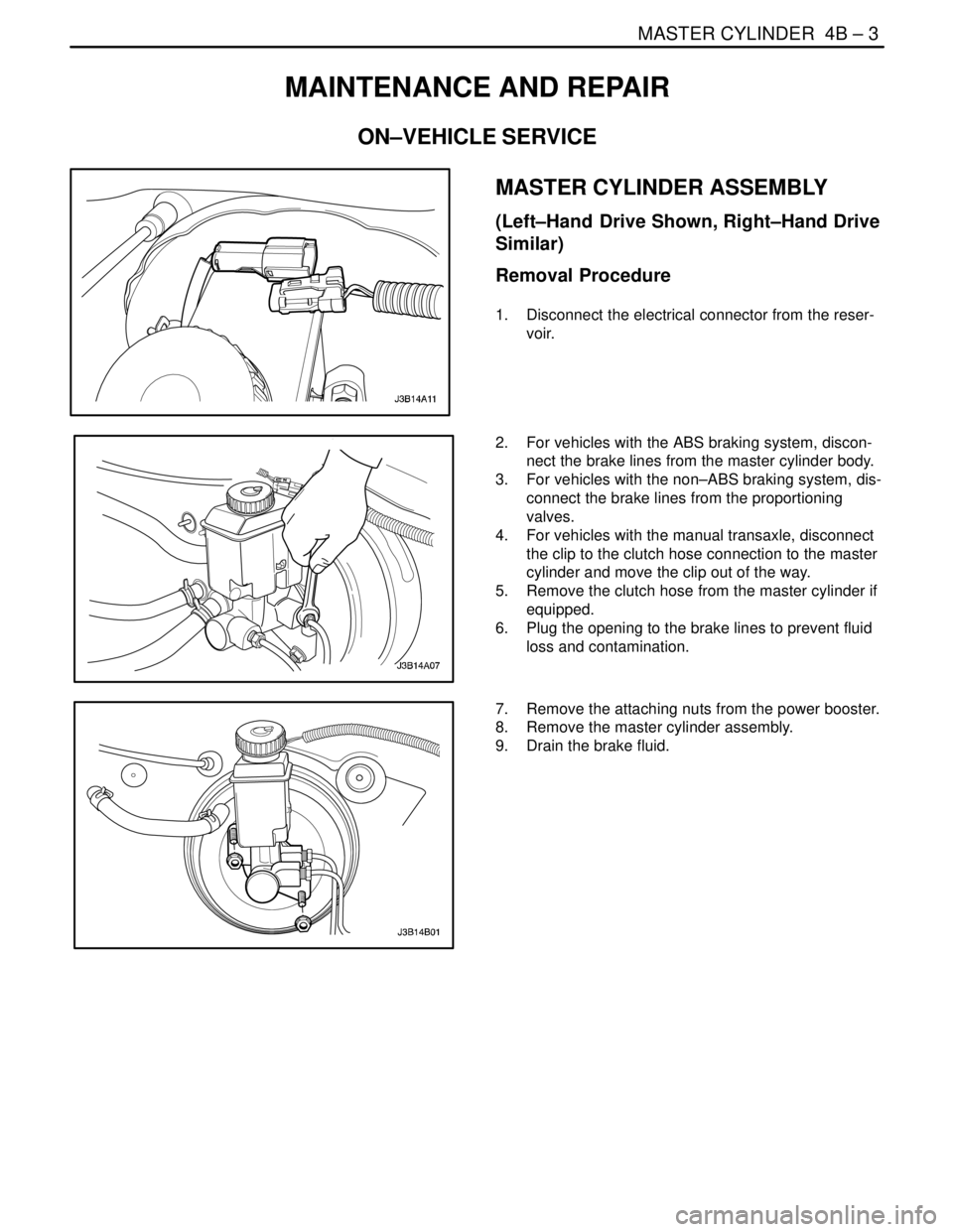
1. Disconnect the electrical connector from the reser-
voir.
2. For vehicles with the ABS braking system, discon-
nect the brake lines from the master cylinder body.
3. For vehicles with the non–ABS braking system, dis-
connect the brake lines from the proportioning
valves.
4. For vehicles with the manual transaxle, disconnect
the clip to the clutch hose connection to the master
cylinder and move the clip out of the way.
5. Remove the clutch hose from the master cylinder if
equipped.
6. Plug the opening to the brake lines to prevent fluid
loss and contamination.
7. Remove the attaching nuts from the power booster.
8. Remove the master cylinder assembly.
9. Drain the brake fluid.
Page 1037 of 2643
4B – 4IMASTER CYLINDER
DAEWOO V–121 BL4
Installation Procedure
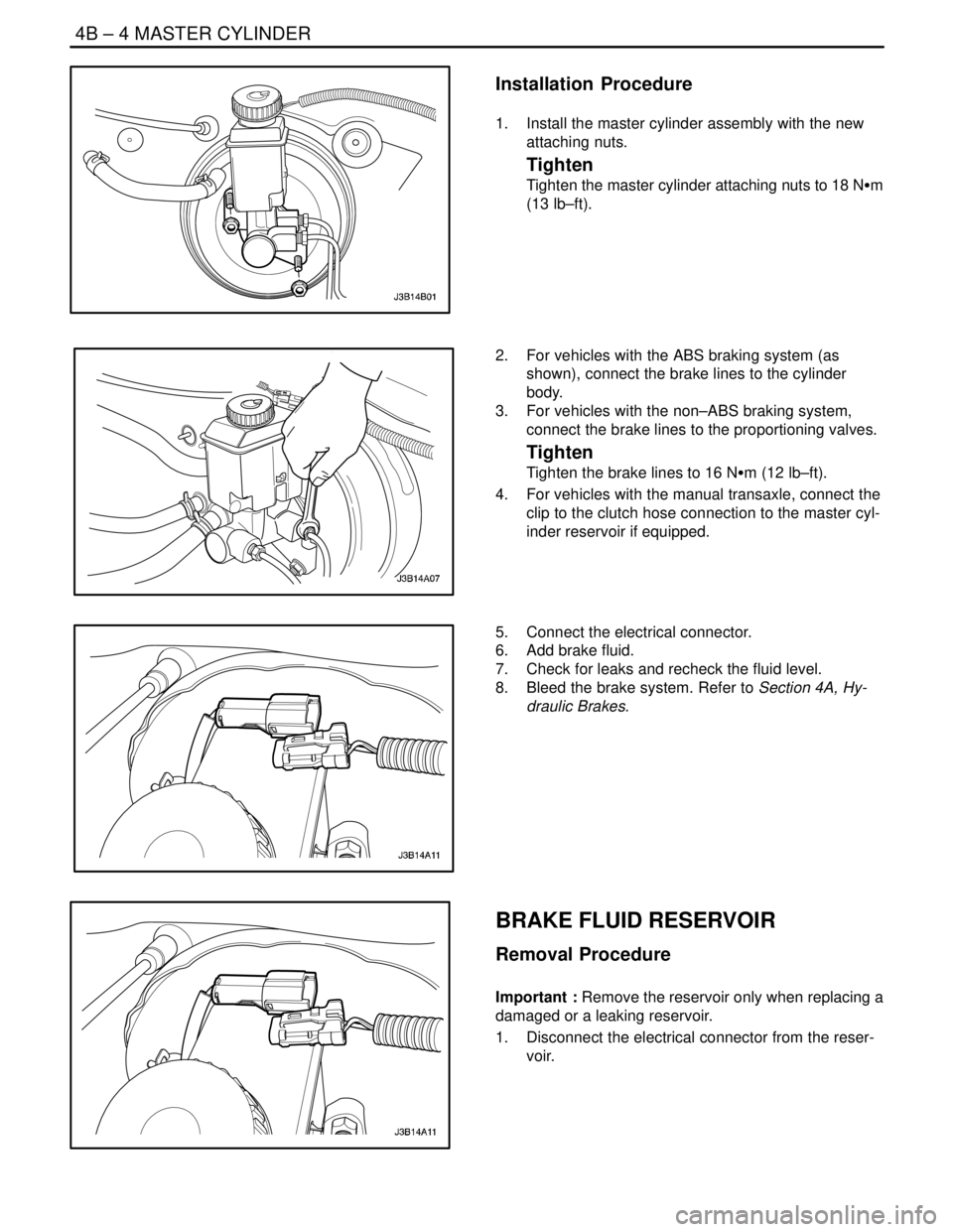
1. Install the master cylinder assembly with the new
attaching nuts.
Tighten
Tighten the master cylinder attaching nuts to 18 NSm
(13 lb–ft).
2. For vehicles with the ABS braking system (as
shown), connect the brake lines to the cylinder
body.
3. For vehicles with the non–ABS braking system,
connect the brake lines to the proportioning valves.
Tighten
Tighten the brake lines to 16 NSm (12 lb–ft).
4. For vehicles with the manual transaxle, connect the
clip to the clutch hose connection to the master cyl-
inder reservoir if equipped.
5. Connect the electrical connector.
6. Add brake fluid.
7. Check for leaks and recheck the fluid level.
8. Bleed the brake system. Refer to Section 4A, Hy-
draulic Brakes.
BRAKE FLUID RESERVOIR
Removal Procedure
Important : Remove the reservoir only when replacing a
damaged or a leaking reservoir.
1. Disconnect the electrical connector from the reser-
voir.
Page 1043 of 2643

SECTION : 4C
POWER BOOSTER
TABLE OF CONTENTS
SPECIFICATIONS4C–1 . . . . . . . . . . . . . . . . . . . . . . . . . .
Fasrener Tightening Specifications 4C–1. . . . . . . . . .
DIAGNOSIS4C–1 . . . . . . . . . . . . . . . . . . . . . . . . . . . . . . . .
Power Booster Functional Check 4C–1. . . . . . . . . . . .
MAINTENANCE AND REPAIR4C–2 . . . . . . . . . . . . . . . ON–VEHICLE SERVICE 4C–2. . . . . . . . . . . . . . . . . . . . .
Vacuum Hose 4C–2. . . . . . . . . . . . . . . . . . . . . . . . . . . .
Power Booster Assembly 4C–2. . . . . . . . . . . . . . . . . . .
GENERAL DESCRIPTION AND SYSTEM
OPERATION4C–6 . . . . . . . . . . . . . . . . . . . . . . . . . . . . . .
Power Booster 4C–6. . . . . . . . . . . . . . . . . . . . . . . . . . . .
SPECIFICATIONS
FASRENER TIGHTENING SPECIFICATIONS
ApplicationNSmLb–FtLb–In
Booster–to–Bracket Nuts (Right–Hand Drive)2216–
Booster–to–Dash Panel Nut (Left–Hand
Drive)2216–
Booster Hex Nut and Pushrod Clevis1813–
Brake Line Fittings1612–
DIAGNOSIS
POWER BOOSTER FUNCTIONAL
CHECK
1. With the engine stopped, eliminate vacuum in the
booster by pumping the brake pedal several times.
2. Push the pedal down and hold in this position.
3. Start the engine.4. The booster is OK if the pedal drops further be-
cause of extra force produced.
If the brake pedal does not drop, the vacuum system (vac-
uum hoses, check valve, etc.) is probably defective and
should be checked.
If no defect is revealed by checking the vacuum system,
the defect is in the booster itself.
Page 1044 of 2643
4C – 2IPOWER BOOSTER
DAEWOO V–121 BL4
MAINTENANCE AND REPAIR
ON–VEHICLE SERVICE
VACUUM HOSE
Removal Procedure
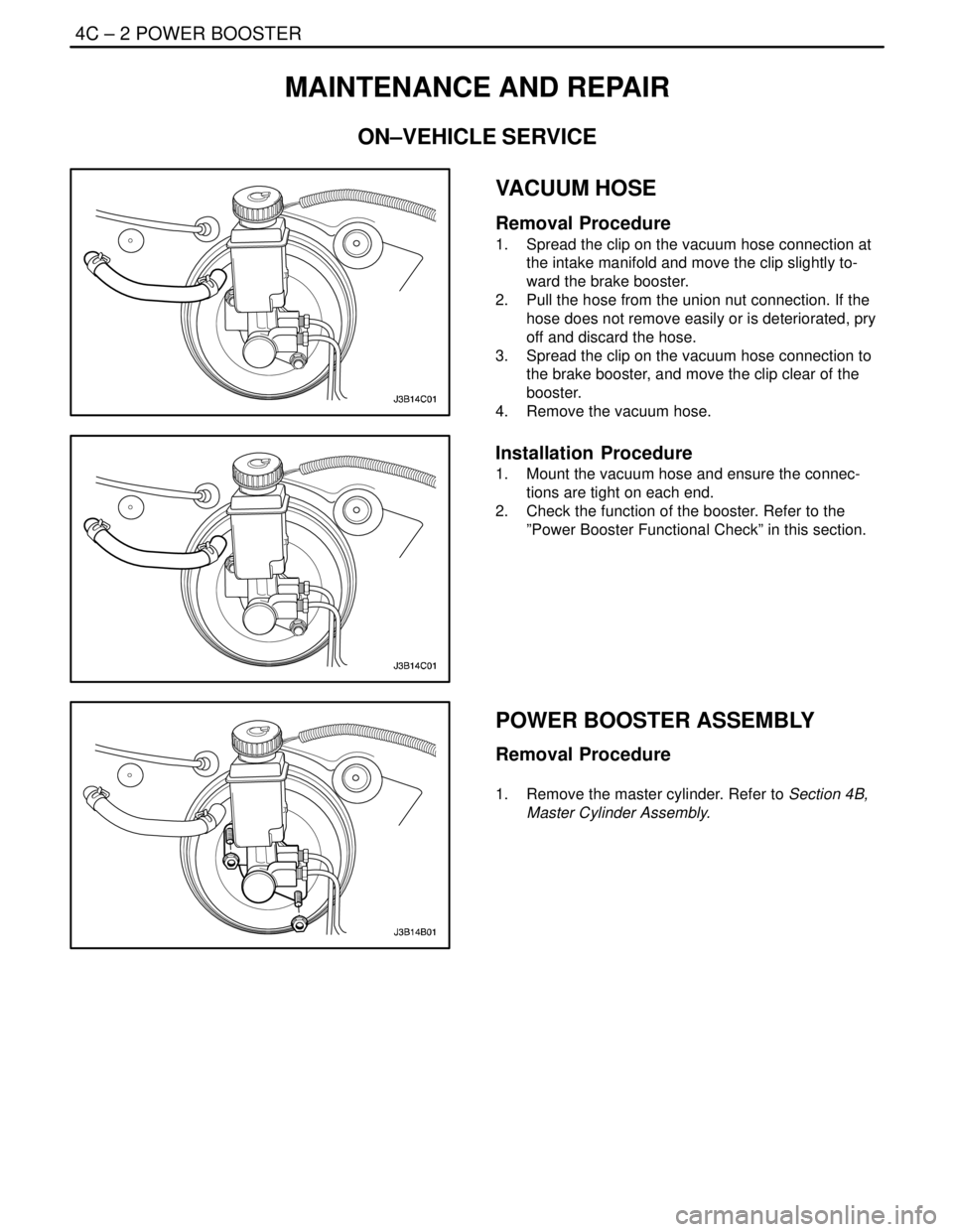
1. Spread the clip on the vacuum hose connection at
the intake manifold and move the clip slightly to-
ward the brake booster.
2. Pull the hose from the union nut connection. If the
hose does not remove easily or is deteriorated, pry
off and discard the hose.
3. Spread the clip on the vacuum hose connection to
the brake booster, and move the clip clear of the
booster.
4. Remove the vacuum hose.
Installation Procedure
1. Mount the vacuum hose and ensure the connec-
tions are tight on each end.
2. Check the function of the booster. Refer to the
”Power Booster Functional Check” in this section.
POWER BOOSTER ASSEMBLY
Removal Procedure
1. Remove the master cylinder. Refer to Section 4B,
Master Cylinder Assembly.
Page 1045 of 2643
POWER BOOSTER 4C – 3
DAEWOO V–121 BL4
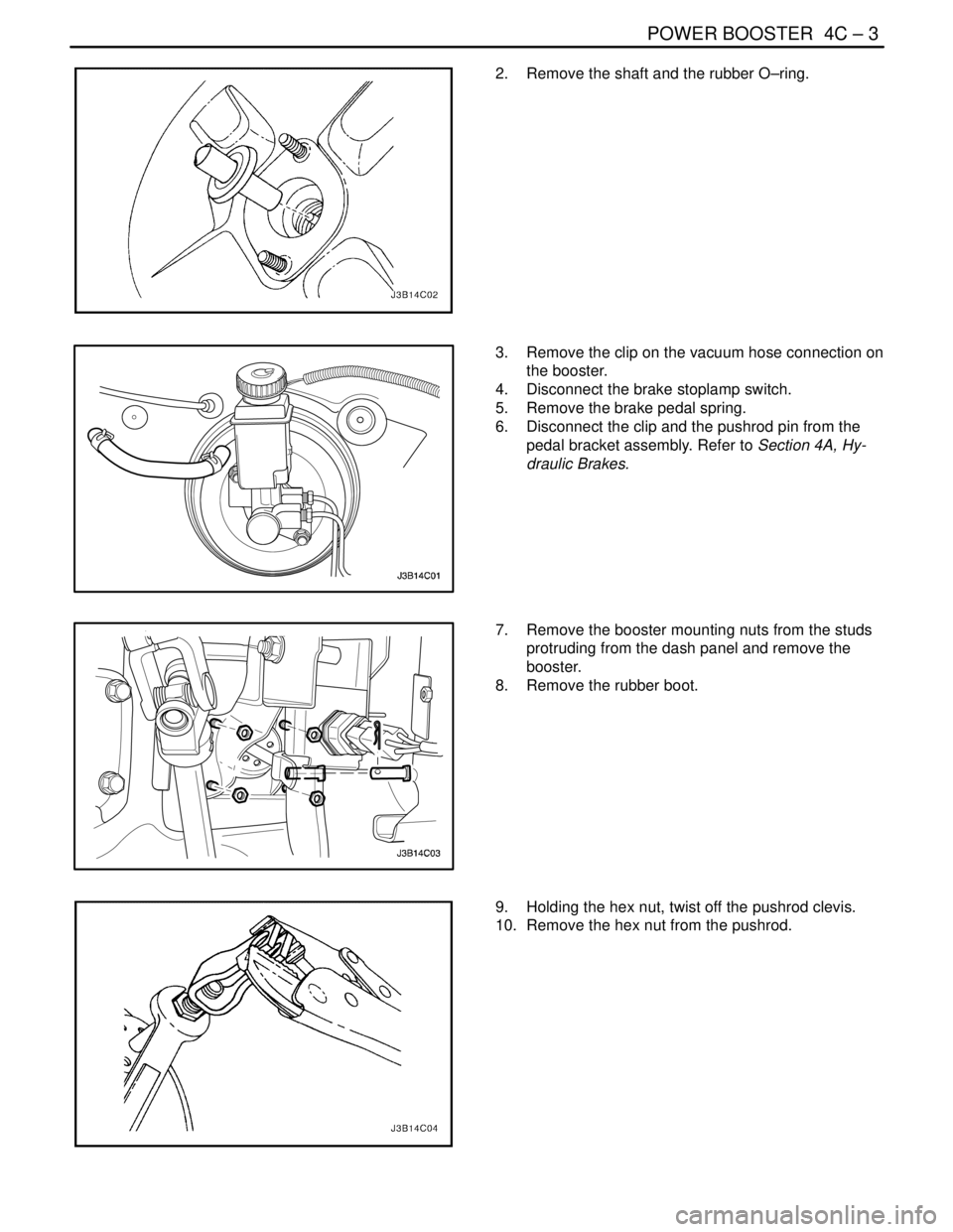
2. Remove the shaft and the rubber O–ring.
3. Remove the clip on the vacuum hose connection on
the booster.
4. Disconnect the brake stoplamp switch.
5. Remove the brake pedal spring.
6. Disconnect the clip and the pushrod pin from the
pedal bracket assembly. Refer to Section 4A, Hy-
draulic Brakes.
7. Remove the booster mounting nuts from the studs
protruding from the dash panel and remove the
booster.
8. Remove the rubber boot.
9. Holding the hex nut, twist off the pushrod clevis.
10. Remove the hex nut from the pushrod.
Page 1046 of 2643
4C – 4IPOWER BOOSTER
DAEWOO V–121 BL4
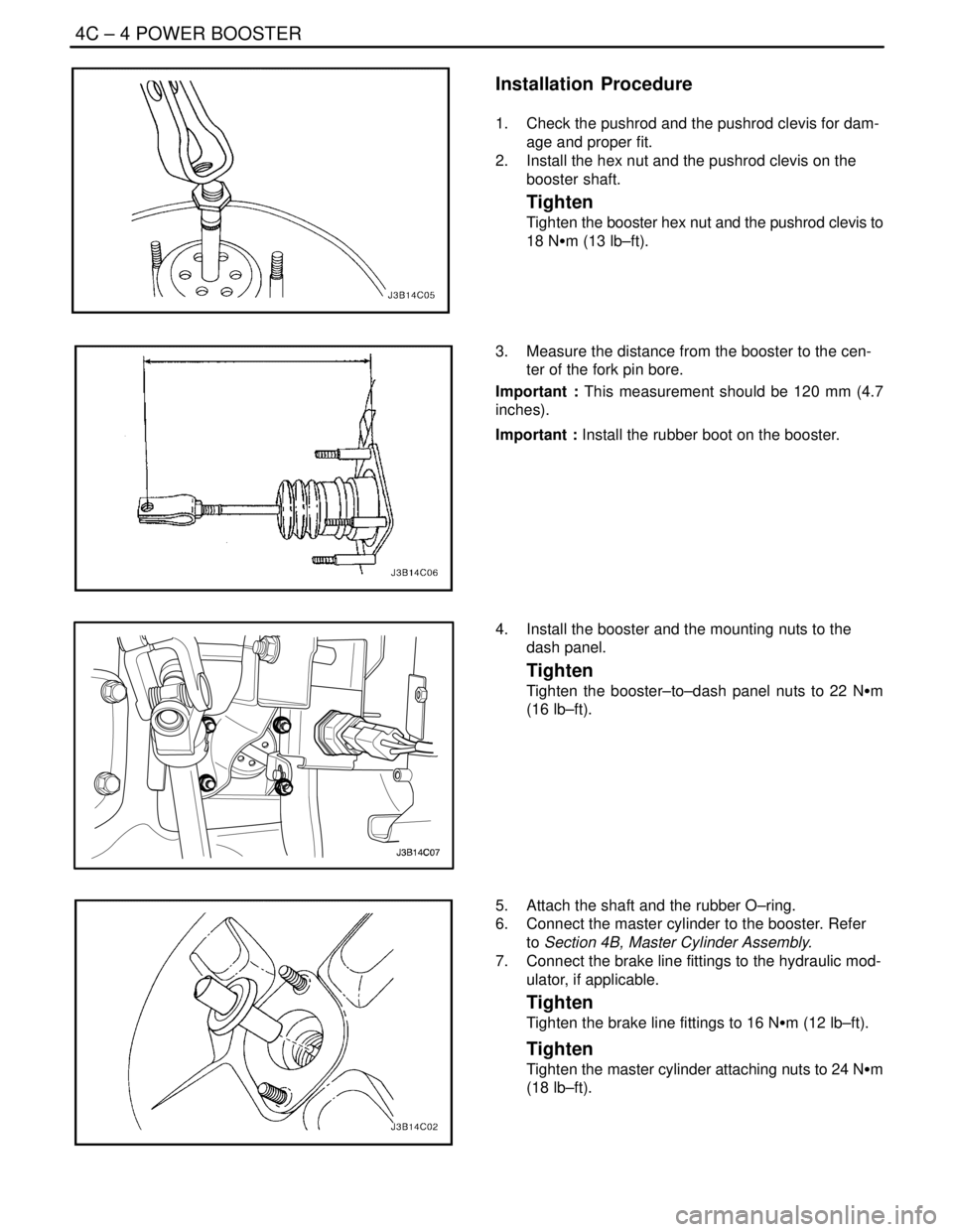
Installation Procedure
1. Check the pushrod and the pushrod clevis for dam-
age and proper fit.
2. Install the hex nut and the pushrod clevis on the
booster shaft.
Tighten
Tighten the booster hex nut and the pushrod clevis to
18 NSm (13 lb–ft).
3. Measure the distance from the booster to the cen-
ter of the fork pin bore.
Important : This measurement should be 120 mm (4.7
inches).
Important : Install the rubber boot on the booster.
4. Install the booster and the mounting nuts to the
dash panel.
Tighten
Tighten the booster–to–dash panel nuts to 22 NSm
(16 lb–ft).
5. Attach the shaft and the rubber O–ring.
6. Connect the master cylinder to the booster. Refer
to Section 4B, Master Cylinder Assembly.
7. Connect the brake line fittings to the hydraulic mod-
ulator, if applicable.
Tighten
Tighten the brake line fittings to 16 NSm (12 lb–ft).
Tighten
Tighten the master cylinder attaching nuts to 24 NSm
(18 lb–ft).
Page 1059 of 2643
4E1 – 2IREAR DISC BRAKES
DAEWOO V–121 BL4
pulsation and/or front end vibration during braking. Thick-
ness can be measured with a commercially available mi-
crometer and should be 10 mm(0.39 inch) or over.
Light scoring of the rotor surfaces is acceptable if it does
not exceed 0.40 mm (0.016 inch) in depth. Scoring mea-
surements can be made with a commercially available
brake micrometer.
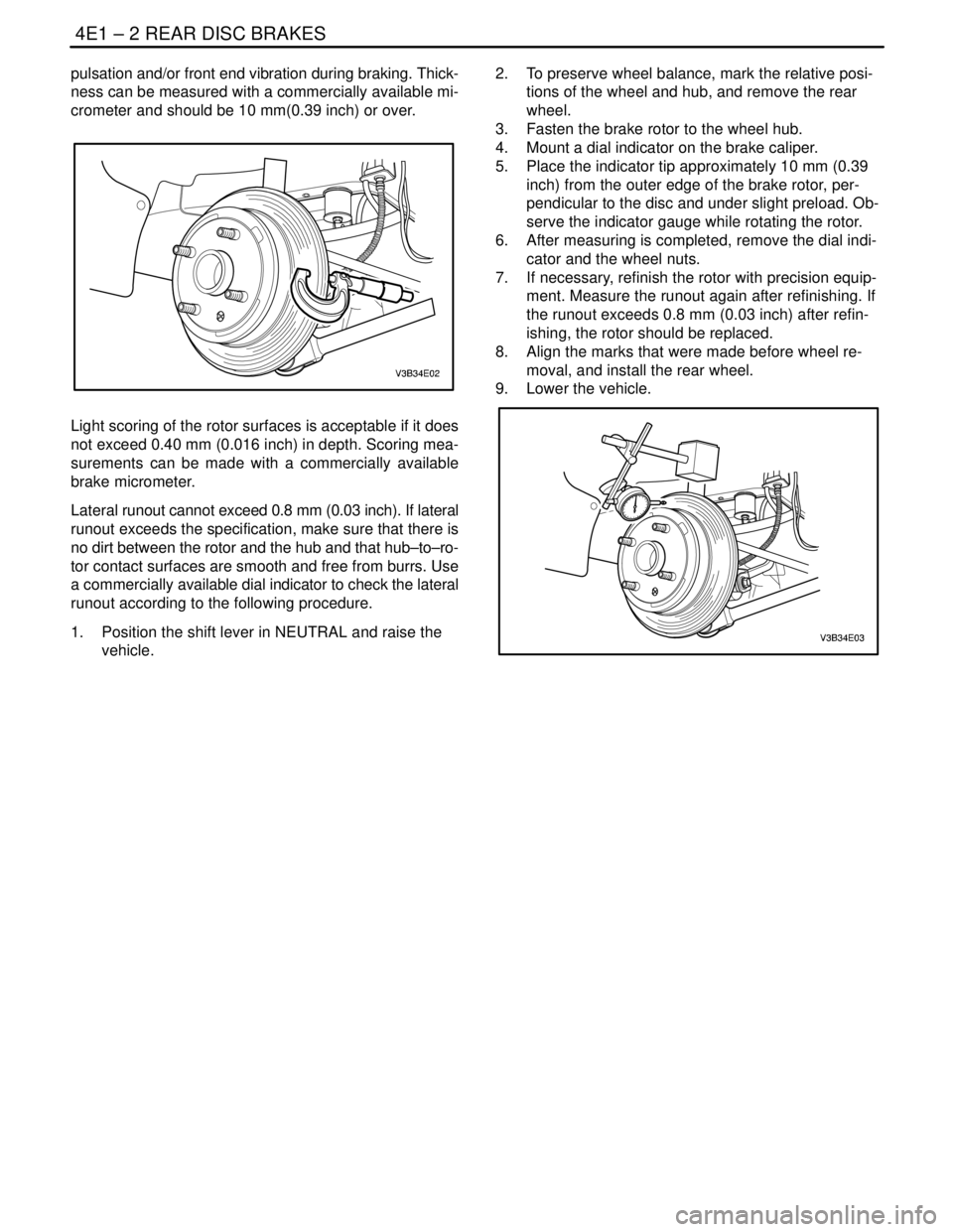
Lateral runout cannot exceed 0.8 mm (0.03 inch). If lateral
runout exceeds the specification, make sure that there is
no dirt between the rotor and the hub and that hub–to–ro-
tor contact surfaces are smooth and free from burrs. Use
a commercially available dial indicator to check the lateral
runout according to the following procedure.
1. Position the shift lever in NEUTRAL and raise the
vehicle.2. To preserve wheel balance, mark the relative posi-
tions of the wheel and hub, and remove the rear
wheel.
3. Fasten the brake rotor to the wheel hub.
4. Mount a dial indicator on the brake caliper.
5. Place the indicator tip approximately 10 mm (0.39
inch) from the outer edge of the brake rotor, per-
pendicular to the disc and under slight preload. Ob-
serve the indicator gauge while rotating the rotor.
6. After measuring is completed, remove the dial indi-
cator and the wheel nuts.
7. If necessary, refinish the rotor with precision equip-
ment. Measure the runout again after refinishing. If
the runout exceeds 0.8 mm (0.03 inch) after refin-
ishing, the rotor should be replaced.
8. Align the marks that were made before wheel re-
moval, and install the rear wheel.
9. Lower the vehicle.
Page 1070 of 2643

SECTION : 4E2
REAR DRUM BRAKES
TABLE OF CONTENTS
SPECIFICATIONS4E2–1 . . . . . . . . . . . . . . . . . . . . . . . . .
Fastener Tightening Specifications 4E2–1. . . . . . . . .
DIAGNOSIS4E2–1 . . . . . . . . . . . . . . . . . . . . . . . . . . . . . . .
Lining Inspection 4E2–1. . . . . . . . . . . . . . . . . . . . . . . . .
Drums 4E2–1. . . . . . . . . . . . . . . . . . . . . . . . . . . . . . . . . .
MAINTENANCE AND REPAIR4E2–3 . . . . . . . . . . . . . .
ON–VEHICLE SERVICE 4E2–3. . . . . . . . . . . . . . . . . . . .
Brake Adjustment 4E2–3. . . . . . . . . . . . . . . . . . . . . . . . Shoe and Lining 4E2–4. . . . . . . . . . . . . . . . . . . . . . . . .
Wheel Cylinder Assembly 4E2–7. . . . . . . . . . . . . . . . .
Backing Plate 4E2–8. . . . . . . . . . . . . . . . . . . . . . . . . . . .
UNIT REPAIR 4E2–10. . . . . . . . . . . . . . . . . . . . . . . . . . . .
Wheel Cylinder 4E2–10. . . . . . . . . . . . . . . . . . . . . . . . .
GENERAL DESCRIPTION AND SYSTEM
OPERATION4E2–12 . . . . . . . . . . . . . . . . . . . . . . . . . . . .
Drum Brakes 4E2–12. . . . . . . . . . . . . . . . . . . . . . . . . . .
SPECIFICATIONS
FASTENER TIGHTENING SPECIFICATIONS
ApplicationNSmLb–FtLb–In
Brake Line1612–
Brake Wheel Hub/Backing Plate–to–Rear
Axle Nuts2821–
Wheel Cylinder–to–Backing Plate Bolt8–71
DIAGNOSIS
LINING INSPECTION
1. Raise and suitably support the vehicle.
2. Remove the wheel. Refer to Section 2E, Tires and
Wheels.
3. Release the parking brake.
4. Remove the drum. Refer to ” Drum” in this section.
5. Measure the lining thickness. The minimum lining
thickness is 0.5 mm (0.02 inch).
CAUTION : To avoid injury when servicing brake
parts, do not create dust by grinding or sanding the
brake linings or by cleaning the wheel brake parts
with a dry brush or with compressed air.
Important : Replace the shoe and lining assembly in axle
sets only.
6. Install the drum, if removed. Refer to ”One–Piece
Drum” or ”Two–Piece Drum” in this section.
7. Install the wheel, if removed. Refer to Section 2E,
Tires and Wheels.
8. Lower the vehicle.
DRUMS
Whenever brake drums are removed, they should be thor-
oughly cleaned and inspected to see if the drums are
cracked, scored, deeply grooved, or beyond the specified
out–of–round limit.
S A cracked drum is unsafe for further service and-
must be replaced. Do not attempt to weld a cracked
drum. Smooth out any slight scores.
S Heavy or extensive scoring will cause excessive
brake lining wear and may require refinishing the
drum braking surface.
S If the brake linings are slightly worn but are still re-
usable and the drum is grooved, polish the drum
with a fine emery cloth but do not refinish it. Elimi-
nating all grooves in the drum and smoothing the
ridges on the lining would remove too much metal
and lining. If left alone, the grooves and ridges
match, and satisfactory service can be obtained. If
the brake linings need to be replaced, refinish a
grooved drum. A grooved drum, used with a new
Page 1072 of 2643
REAR DRUM BRAKES 4E2 – 3
DAEWOO V–121 BL4
MAINTENANCE AND REPAIR
ON–VEHICLE SERVICE
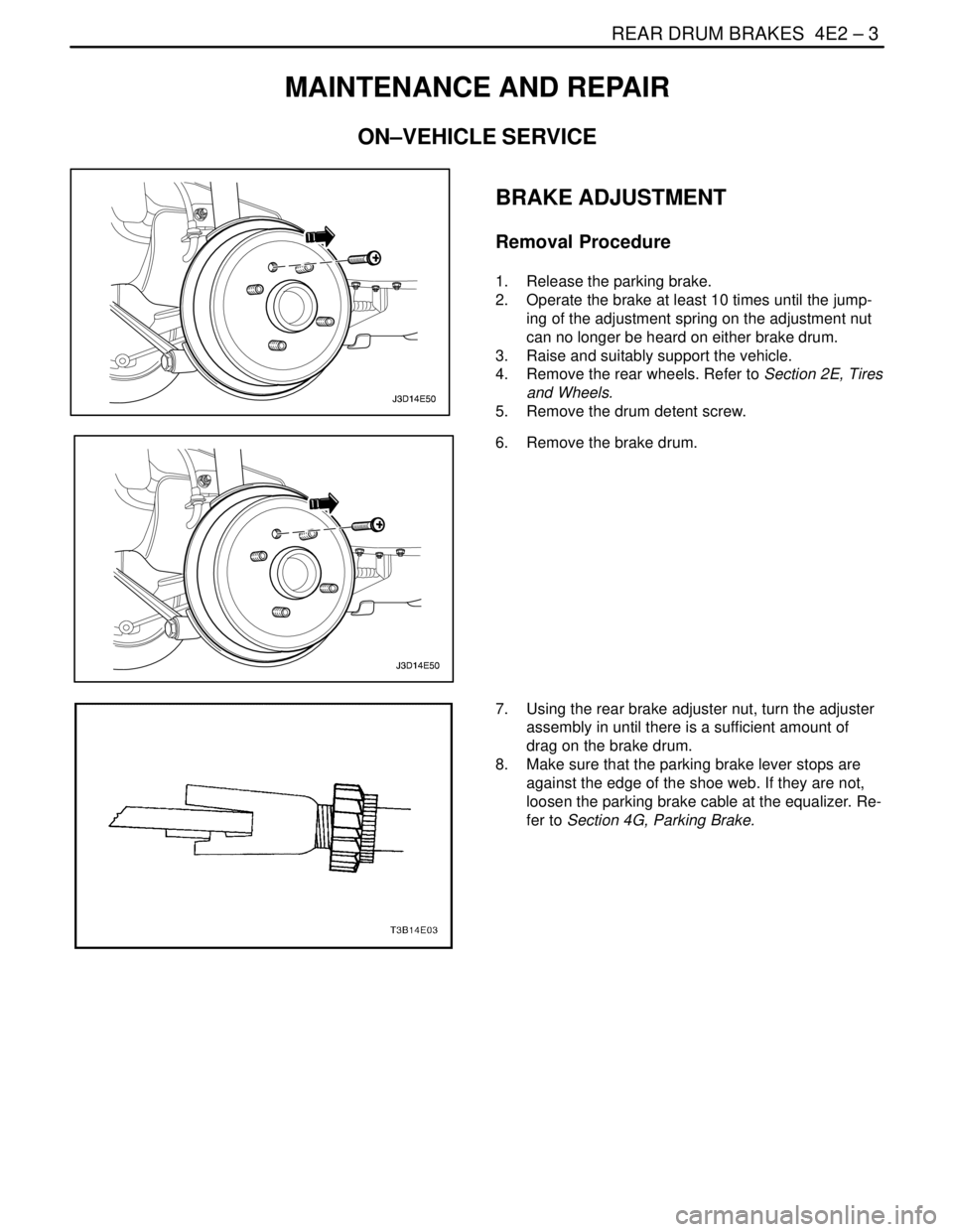
BRAKE ADJUSTMENT
Removal Procedure
1. Release the parking brake.
2. Operate the brake at least 10 times until the jump-
ing of the adjustment spring on the adjustment nut
can no longer be heard on either brake drum.
3. Raise and suitably support the vehicle.
4. Remove the rear wheels. Refer to Section 2E, Tires
and Wheels.
5. Remove the drum detent screw.
6. Remove the brake drum.
7. Using the rear brake adjuster nut, turn the adjuster
assembly in until there is a sufficient amount of
drag on the brake drum.
8. Make sure that the parking brake lever stops are
against the edge of the shoe web. If they are not,
loosen the parking brake cable at the equalizer. Re-
fer to Section 4G, Parking Brake.
Page 1075 of 2643
4E2 – 6IREAR DRUM BRAKES
DAEWOO V–121 BL4
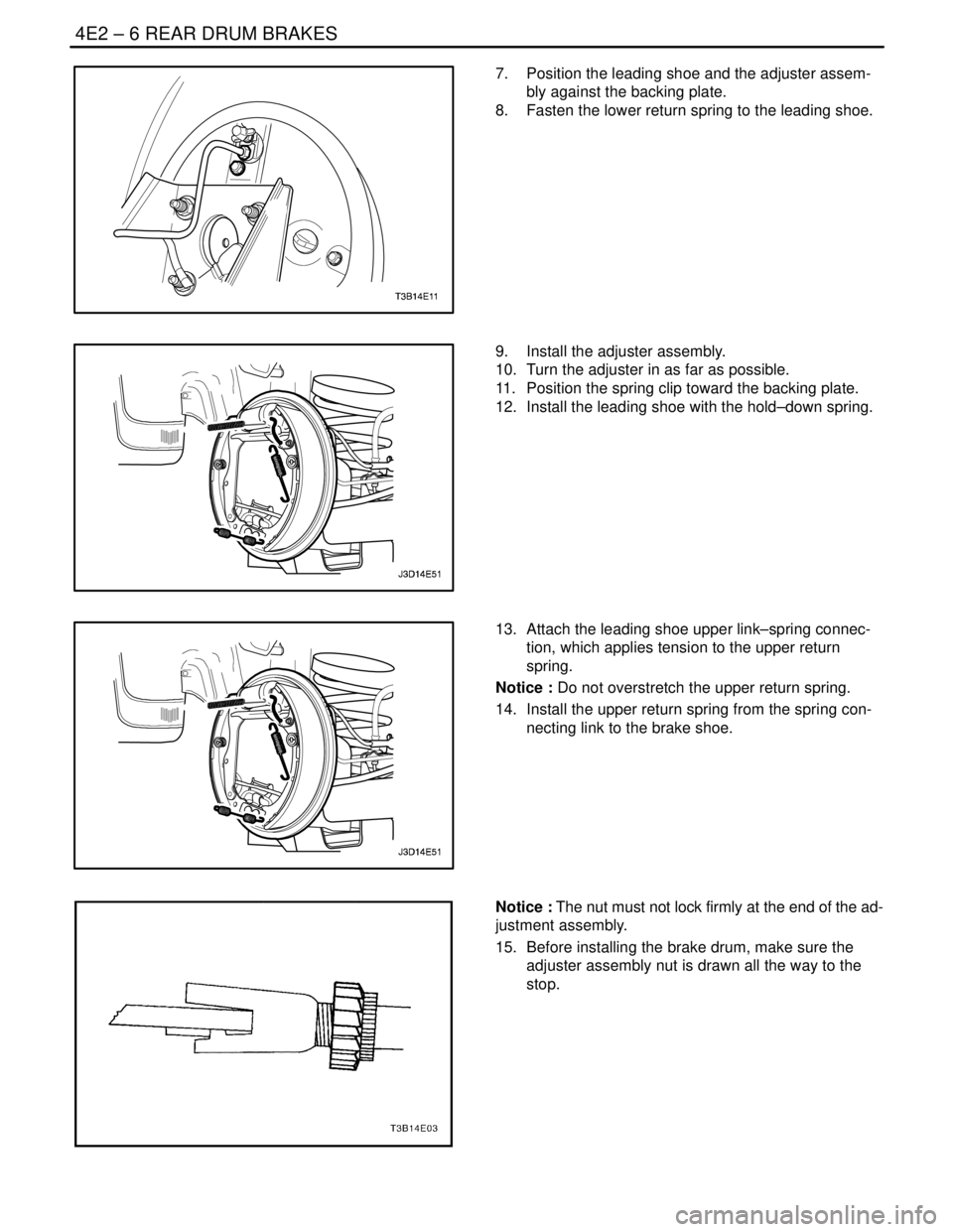
7. Position the leading shoe and the adjuster assem-
bly against the backing plate.
8. Fasten the lower return spring to the leading shoe.
9. Install the adjuster assembly.
10. Turn the adjuster in as far as possible.
11. Position the spring clip toward the backing plate.
12. Install the leading shoe with the hold–down spring.
13. Attach the leading shoe upper link–spring connec-
tion, which applies tension to the upper return
spring.
Notice : Do not overstretch the upper return spring.
14. Install the upper return spring from the spring con-
necting link to the brake shoe.
Notice : The nut must not lock firmly at the end of the ad-
justment assembly.
15. Before installing the brake drum, make sure the
adjuster assembly nut is drawn all the way to the
stop.