DTC P0342 DAEWOO NUBIRA 2004 Service Owner's Manual
[x] Cancel search | Manufacturer: DAEWOO, Model Year: 2004, Model line: NUBIRA, Model: DAEWOO NUBIRA 2004Pages: 2643, PDF Size: 80.54 MB
Page 677 of 2643

ENGINE CONTROLS 1F – 431
DAEWOO V–121 BL4
DIAGNOSTIC TROUBLE CODE (DTC) P0302
CYLINDER 2 MISFIRE
System Description
The Engine Control Module (ECM) monitors the crank-
shaft and camshaft positions to detect if the engine is mis-
firing. The ECM looks for a quick drop in crankshaft speed.
This test is executed in blocks of 100 engine revolution
tests. It may take between one to several tests to store a
Diagnostic Trouble Code (DTC) and illuminate the Mal-
function Indicator Lamp (MIL). Under light misfire condi-
tions, it may also take more than one trip to set a DTC. Se-
vere misfire will flash the MIL, indicating that catalyst
damage is possible.
Conditions for Setting the DTC
S Emission threshold is 3%.
S 20 engine cycles have occurred since cranking has
started.
S A/C compressor clutch has not just engaged or dis-
engaged.
S Engine load and engine speed is in a detectable
region and is at or above zero torque.
S Camshaft Position (CMP) sensor is in synchroniza-
tion.
S Exhaust Gas Recirculation (EGR) flow diagnostic is
not in progress.
S Fuel level is greater than 12% of rated tank capac-
ity.
S Decel Fuel Cutoff (DFCO) not active.
S Throttle position change is less than 3% per 125
ms.
S Vehicle has not encountered an abusive engine
speed of 7000 rpm.
S Crankshaft speed patters are normal.
S Throttle position is less than 3% when vehicle
speed is greater than 10 km/h (6 mph).
S Vehicle voltage is between 11 and 16 volts.
S Engine Coolant Temperature (ECT) is between
–7°C (19°F) and 120°C (248°F).
S There is the correct ratio between Crankshaft Posi-
tion (CKP) sensor pulses and CMP sensor pulses.
S DTCs P0106, P0107, P0108, P0117, P0118,
P0122, P0123, P0336, P0337, P0341, P0342 and
P0502 are not set.
Action Taken When the DTC Sets
S The MIL will illuminate after two consecutive ignition
cycles in which the diagnostic runs with the fault
active.
Or
S The MIL will illuminate immediately and flash if mis-
fire is present.
S The ECM will record operating conditions at the
time the diagnostic fails. This information will be
stored in the Freeze Frame and Failure Records
buffers.S A history DTC is stored.
Conditions for Clearing the MIL/DTC
S The MIL will turn off after four consecutive ignition
cycles in which the diagnostic runs without a fault
within the freeze frame conditions that the DTC
failed.
S A history DTC will clear after 40 consecutive warm–
up cycles without a fault.
S The DTC(s) can be cleared by using the scan tool.
S Disconnecting the ECM battery feed for more than
10 seconds.
Diagnostic Aids
An intermittent can also be the result of a defective reluctor
wheel. Remove the CKP sensor and inspect the reluctor
wheel through the sensor mount hole. Check for porosity
and the condition of wheel. If the DTC is intermittent refer
to”Symptoms Diagnosis” in this section.
Test Description
Number(s) below refer to the step number(s) on the Diag-
nostic Table.
1. The On–Board Diagnostic (EOBD) System Check
prompts the technician to complete some basic
checks and store the freeze frame and failure re-
cords data on the scan tool if applicable. This
creates an electronic copy of the data taken when
the malfunction occurred. The information is then
stored on the scan tool for later reference.
3. A visual/physical inspection should include check-
ing the following components:
S The wiring for proper connections, pinches or
cuts.
S The ECM grounds for being clean and tight.
S The vacuum hoses for splits, kinks, and proper
connections as shown on the Vehicle Emission
Information label. Check thoroughly for any type
of leak or restriction.
S For air leaks at the throttle body mounting area
and intake manifold sealing surfaces.
5. When all the accumulators are relatively equal, then
the misfire is being caused by something that af-
fects the entire engine. When they are not then the
misfire is being caused by something that is specif-
ic to two or more cylinders.
6. Whenever the misfire is not present operating the
vehicle may be necessary to duplicate the condi-
tions in the Freeze Frame Data in order to detect
misfire. Depending on the engine load, the condi-
tions may have to be maintained for up to 20 sec-
onds. Whenever the misfire accumulators start to
increment, then misfire is present. A history misfire
counter will store the number of misfires that have
occurred until the DTC is cleared.
Page 682 of 2643

1F – 436IENGINE CONTROLS
DAEWOO V–121 BL4
DIAGNOSTIC TROUBLE CODE (DTC) P0303
CYLINDER 3 MISFIRE
System Description
The Engine Control Module (ECM) monitors the crank-
shaft and camshaft positions to detect if the engine is mis-
firing. The ECM looks for a quick drop in crankshaft speed.
This test is executed in blocks of 100 engine revolution
tests. It may take between one to several tests to store a
Diagnostic Trouble Code (DTC) and illuminate the Mal-
function Indicator Lamp (MIL). Under light misfire condi-
tions, it may also take more than one trip to set a DTC. Se-
vere misfire will flash the MIL, indicating that catalyst
damage is possible.
Conditions for Setting the DTC
S Emission threshold is 3%.
S 20 engine cycles have occurred since cranking has
started.
S A/C compressor clutch has not just engaged or dis-
engaged.
S Engine load and engine speed is in a detectable
region and is at or above zero torque.
S Camshaft Position (CMP) sensor is in synchroniza-
tion.
S Exhaust Gas Recirculation (EGR) flow diagnostic is
not in progress.
S Fuel level is greater than 12% of rated tank capac-
ity.
S Decel Fuel Cutoff (DFCO) not active.
S Throttle position change is less than 3% per 125
ms.
S Vehicle has not encountered an abusive engine
speed of 7000 rpm.
S Crankshaft speed patters are normal.
S Throttle position is less than 3% when vehicle
speed is greater than 10 km/h (6 mph).
S Vehicle voltage is between 11 and 16 volts.
S Engine Coolant Temperature (ECT) is between
–7°C (19°F) and 120°C (248°F).
S There is the correct ratio between Crankshaft Posi-
tion (CKP) sensor pulses and CMP sensor pulses.
S DTCs P0106, P0107, P0108, P0117, P0118,
P0122, P0123, P0336, P0337, P0341, P0342 and
P0502 are not set.
Action Taken When the DTC Sets
S The MIL will illuminate after two consecutive ignition
cycles in which the diagnostic runs with the fault
active.
Or
S The MIL will illuminate immediately and flash if mis-
fire is present.
S The ECM will record operating conditions at the
time the diagnostic fails. This information will be
stored in the Freeze Frame and Failure Records
buffers.S A history DTC is stored.
Conditions for Clearing the MIL/DTC
S The MIL will turn off after four consecutive ignition
cycles in which the diagnostic runs without a fault
within the freeze frame conditions that the DTC
failed.
S A history DTC will clear after 40 consecutive warm–
up cycles without a fault.
S The DTC(s) can be cleared by using the scan tool.
S Disconnecting the ECM battery feed for more than
10 seconds.
Diagnostic Aids
An intermittent can also be the result of a defective reluctor
wheel. Remove the CKP sensor and inspect the reluctor
wheel through the sensor mount hole. Check for porosity
and the condition of wheel. If the DTC is intermittent refer
to”Symptoms Diagnosis” in this section.
Test Description
Number(s) below refer to the step number(s) on the Diag-
nostic Table.
1. The On–Board Diagnostic (EOBD) System Check
prompts the technician to complete some basic
checks and store the freeze frame and failure re-
cords data on the scan tool if applicable. This
creates an electronic copy of the data taken when
the malfunction occurred. The information is then
stored on the scan tool for later reference.
3. A visual/physical inspection should include check-
ing the following components:
S The wiring for proper connections, pinches or
cuts.
S The ECM grounds for being clean and tight.
S The vacuum hoses for splits, kinks, and proper
connections as shown on the Vehicle Emission
Information label. Check thoroughly for any type
of leak or restriction.
S For air leaks at the throttle body mounting area
and intake manifold sealing surfaces.
5. When all the accumulators are relatively equal, then
the misfire is being caused by something that af-
fects the entire engine. When they are not then the
misfire is being caused by something that is specif-
ic to two or more cylinders.
6. Whenever the misfire is not present operating the
vehicle may be necessary to duplicate the condi-
tions in the Freeze Frame Data in order to detect
misfire. Depending on the engine load, the condi-
tions may have to be maintained for up to 20 sec-
onds. Whenever the misfire accumulators start to
increment, then misfire is present. A history misfire
counter will store the number of misfires that have
occurred until the DTC is cleared.
Page 687 of 2643

ENGINE CONTROLS 1F – 441
DAEWOO V–121 BL4
DIAGNOSTIC TROUBLE CODE (DTC) P0304
CYLINDER 4 MISFIRE
System Description
The Engine Control Module (ECM) monitors the crank-
shaft and camshaft positions to detect if the engine is mis-
firing. The ECM looks for a quick drop in crankshaft speed.
This test is executed in blocks of 100 engine revolution
tests. It may take between one to several tests to store a
Diagnostic Trouble Code (DTC) and illuminate the Mal-
function Indicator Lamp (MIL). Under light misfire condi-
tions, it may also take more than one trip to set a DTC. Se-
vere misfire will flash the MIL, indicating that catalyst
damage is possible.
Conditions for Setting the DTC
S Emission threshold is 3%.
S 20 engine cycles have occurred since cranking has
started.
S A/C compressor clutch has not just engaged or dis-
engaged.
S Engine load and engine speed is in a detectable
region and is at or above zero torque.
S Camshaft Position (CMP) sensor is in synchroniza-
tion.
S Exhaust Gas Recirculation (EGR) flow diagnostic is
not in progress.
S Fuel level is greater than 12% of rated tank capac-
ity.
S Decel Fuel Cutoff (DFCO) not active.
S Throttle position change is less than 3% per 125
ms.
S Vehicle has not encountered an abusive engine
speed of 7000 rpm.
S Crankshaft speed patters are normal.
S Throttle position is less than 3% when vehicle
speed is greater than 10 km/h (6 mph).
S Vehicle voltage is between 11 and 16 volts.
S Engine Coolant Temperature (ECT) is between
–7°C (19°F) and 120°C (248°F).
S There is the correct ratio between Crankshaft Posi-
tion (CKP) sensor pulses and CMP sensor pulses.
S DTCs P0106, P0107, P0108, P0117, P0118,
P0122, P0123, P0336, P0337, P0341, P0342 and
P0502 are not set.
Action Taken When the DTC Sets
S The MIL will illuminate after two consecutive ignition
cycles in which the diagnostic runs with the fault
active.
Or
S The MIL will illuminate immediately and flash if mis-
fire is present.
S The ECM will record operating conditions at the
time the diagnostic fails. This information will be
stored in the Freeze Frame and Failure Records
buffers.S A history DTC is stored.
Conditions for Clearing the MIL/DTC
S The MIL will turn off after four consecutive ignition
cycles in which the diagnostic runs without a fault
within the freeze frame conditions that the DTC
failed.
S A history DTC will clear after 40 consecutive warm–
up cycles without a fault.
S The DTC(s) can be cleared by using the scan tool.
S Disconnecting the ECM battery feed for more than
10 seconds.
Diagnostic Aids
An intermittent can also be the result of a defective reluctor
wheel. Remove the CKP sensor and inspect the reluctor
wheel through the sensor mount hole. Check for porosity
and the condition of wheel. If the DTC is intermittent refer
to”Symptoms Diagnosis” in this section.
Test Description
Number(s) below refer to the step number(s) on the Diag-
nostic Table.
1. The On–Board Diagnostic (EOBD) System Check
prompts the technician to complete some basic
checks and store the freeze frame and failure re-
cords data on the scan tool if applicable. This
creates an electronic copy of the data taken when
the malfunction occurred. The information is then
stored on the scan tool for later reference.
3. A visual/physical inspection should include check-
ing the following components:
S The wiring for proper connections, pinches or
cuts.
S The ECM grounds for being clean and tight.
S The vacuum hoses for splits, kinks, and proper
connections as shown on the Vehicle Emission
Information label. Check thoroughly for any type
of leak or restriction.
S For air leaks at the throttle body mounting area
and intake manifold sealing surfaces.
5. When all the accumulators are relatively equal, then
the misfire is being caused by something that af-
fects the entire engine. When they are not then the
misfire is being caused by something that is specif-
ic to two or more cylinders.
6. Whenever the misfire is not present operating the
vehicle may be necessary to duplicate the condi-
tions in the Freeze Frame Data in order to detect
misfire. Depending on the engine load, the condi-
tions may have to be maintained for up to 20 sec-
onds. Whenever the misfire accumulators start to
increment, then misfire is present. A history misfire
counter will store the number of misfires that have
occurred until the DTC is cleared.
Page 701 of 2643

ENGINE CONTROLS 1F – 455
DAEWOO V–121 BL4
DIAGNOSTIC TROUBLE CODE (DTC) P0337
58X CRANK POSITION SENSOR NO SIGNAL
Circuit Description
The 58X reference signal is produced by the Crankshaft
Position (CKP) sensor. During one crankshaft revolution,
58 crankshaft pulses will be produced. The Engine Control
Module (ECM) uses the 58X reference signal to calculate
engine rpm and CKP. The ECM constantly monitors the
number of pulses on the 58X reference circuit and
compares them to the number of Camshaft Position
(CMP) signal pulses being received. If the ECM does not
receive any 58X reference pulses on the 58X reference
circuit while cranking, Diagnostic Trouble Code (DTC)
P0337 will set.
Conditions for Setting the DTC
S 58X reference pulse not seen during cranking.
S DTCs P0341 and P0342 are not set.
S Change in voltage drop is greater than 0.5 volts and
change in Manifold Absolute Pressure (MAP) is
greater than 0.05kPa (0.07 psi).
S 58X reference pulse not seen for 0.078 seconds.
Action Taken When the DTC Sets
S The Malfunction Indicator Lamp (MIL) will illumi-
nate.
S The ECM will record operating conditions at the
time the diagnostic fails. This information will be
stored in the Freeze Frame and Failure Records
buffer.
S A history DTC is stored.
Conditions for Clearing the MIL/DTCS The MIL will turn OFF after four consecutive igni-
tion cycles in which the diagnostic runs without a
fault.
S A history DTC will clear after 40 consecutive warm–
up cycles have occurred without a fault.
S The DTC(s) can be cleared using the scan tool.
S Disconnecting the ECM battery feed for more than
10 seconds.
Diagnostic Aids
An intermittent may be caused by a poor connection,
rubbed–through wire insulation or a wire broken inside the
insulation. Check for:
S Poor connection – Inspect the ECM harness and
connectors for improper mating, broken locks, im-
properly formed or damaged terminals, and poor
terminal–towire connections.
S Damaged harness – Inspect the wiring harness for
damage. If the harness appears to be OK, discon-
nect the ECM, turn the ignition ON and observe a
voltmeter connected to the 58X reference circuit at
the ECM harness connector while moving the con-
nectors and the wiring harnesses related to the
ECM. A change in voltage will indicate the location
of the fault.
S Reviewing the Failure Records vehicle mileage
since the diagnostic test last failed may help deter-
mine how often the condition that caused the DTC
to be set occurs. This may assist in diagnosing the
condition.
Page 705 of 2643

ENGINE CONTROLS 1F – 459
DAEWOO V–121 BL4
Test Description
Number(s) below refer to the step number(s) on the Diag-
nostic Table.
1. The On–Board Diagnostic (EOBD) System Check
prompts the technician to complete some basic
checks and store the freeze frame and failure re-
cords data on the scan tool if applicable. This
creates an electronic copy of the data taken when
the malfunction occurred. The information is then
stored on the scan tool for later reference.
2. This step determines if DTC P0341 is the result of
a hard failure or an intermittent condition.
3. The counter should stop incrementing with the sen-sor electrical connector disconnected and set a
DTC P0342 with the sensor disconnected. If it still
increments the ECM is malfunctioning.
4. By moving the CMP sensor electrical connector, the
connections at the sensor are checked. Make sure
the electrical connector remains securely fastened.
5. A poor connection in any of the circuits at the CMP
will cause the CMP Resync Counter to increment.
Anytime a poor connection is present, the CMP
Reference Activity counter will stop incrementing
and the CMP Resync Counter will increment.
8. The replacement ECM must be reprogrammed.
Refer to the latest Techline procedure for ECM re-
programming.
DTC P0341 – Camshaft Position Sensor Rationality
StepActionValue(s)YesNo
1Perform an On–Board Diagnostic (EOBD) System
Check.
Was the check performed?–Go to Step 2Go to
”On–Board
Diagnostic Sys-
tem Check”
21. Turn the ignition OFF.
2. Install a scan tool to the Data Link Connector
(DLC).
3. Start the engine and operate the vehicle within
the Freeze Frame Conditions and Conditions
for Setting the DTC as noted.
Is Diagnostic Trouble Code (DTC) P0341 set?–Go to Step 3Go to
”Diagnostic
Aids”
31. Turn the ignition OFF.
2. Disconnect the Camshaft Position (CMP) sen-
sor connector.
3. Turn the ignition ON.
4. Using a voltmeter, check the voltage between
the CMP sensor harness connector (Engine
Control Module [ECM] side) terminal 3 and
ground.
Does the voltage near the specified value?5 VGo to Step 4Go to Step 5
4Using a voltmeter, check the voltage between the
CMP sensor wiring harness connector terminal 1
and ground.
Is the voltage over the specified value?10 voltsGo to Step 6Go to Step 10
5With a test light connected to ground, probe the
CMP harness connector terminal 3.
Does the test light illuminate?–Go to Step 8Go to Step 9
6With a test light connected to B+, probe the CMP
sensor harness connector terminal 2.
Does the test light illuminate?–Go to Step 7Go to Step 11
7Check for poor connections at the CMP sensor elec-
trical connectors and repair as needed.
Is the repair complete?–Go to Step 15Go to Step 13
Page 707 of 2643
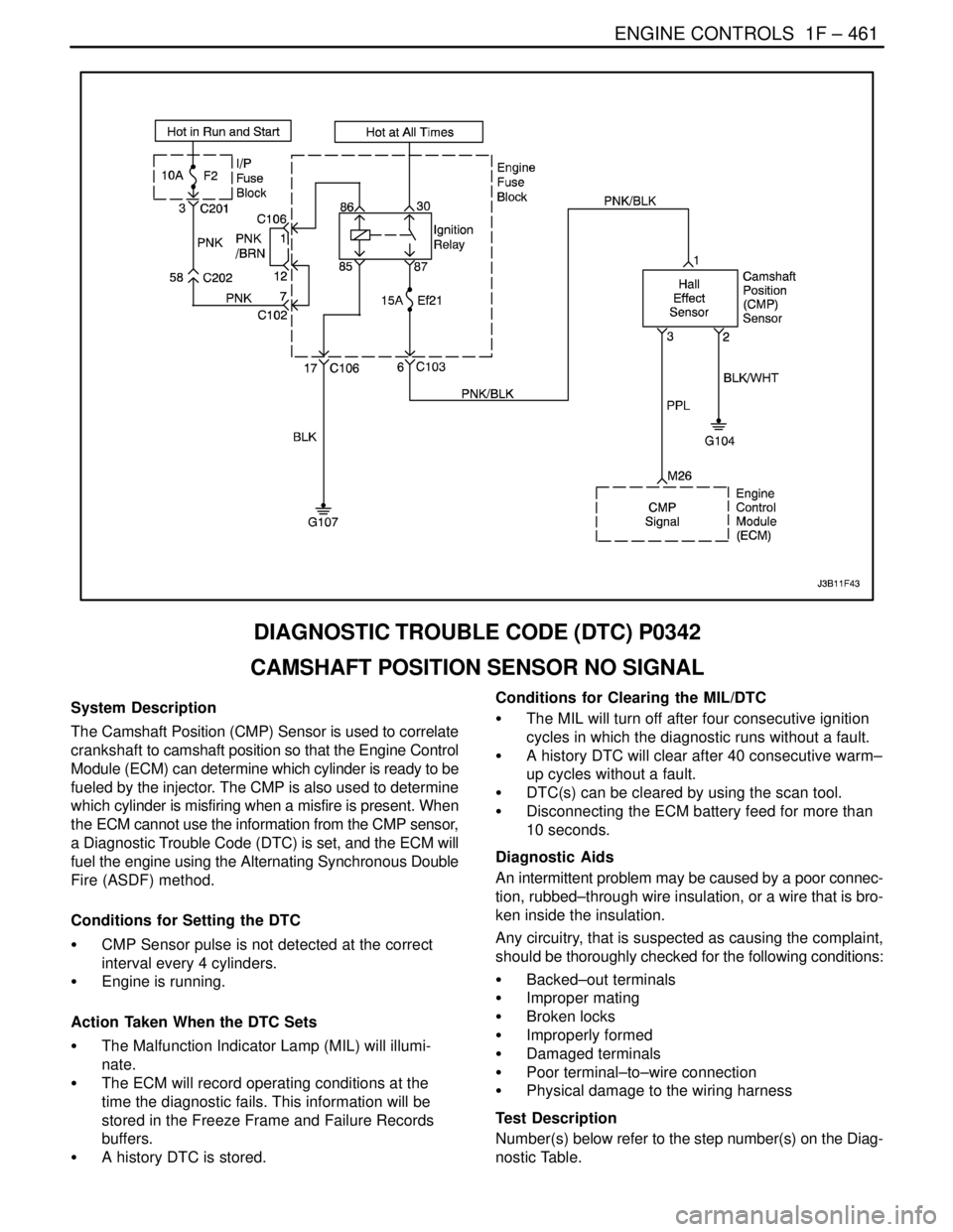
ENGINE CONTROLS 1F – 461
DAEWOO V–121 BL4
DIAGNOSTIC TROUBLE CODE (DTC) P0342
CAMSHAFT POSITION SENSOR NO SIGNAL
System Description
The Camshaft Position (CMP) Sensor is used to correlate
crankshaft to camshaft position so that the Engine Control
Module (ECM) can determine which cylinder is ready to be
fueled by the injector. The CMP is also used to determine
which cylinder is misfiring when a misfire is present. When
the ECM cannot use the information from the CMP sensor,
a Diagnostic Trouble Code (DTC) is set, and the ECM will
fuel the engine using the Alternating Synchronous Double
Fire (ASDF) method.
Conditions for Setting the DTC
S CMP Sensor pulse is not detected at the correct
interval every 4 cylinders.
S Engine is running.
Action Taken When the DTC Sets
S The Malfunction Indicator Lamp (MIL) will illumi-
nate.
S The ECM will record operating conditions at the
time the diagnostic fails. This information will be
stored in the Freeze Frame and Failure Records
buffers.
S A history DTC is stored.Conditions for Clearing the MIL/DTC
S The MIL will turn off after four consecutive ignition
cycles in which the diagnostic runs without a fault.
S A history DTC will clear after 40 consecutive warm–
up cycles without a fault.
S DTC(s) can be cleared by using the scan tool.
S Disconnecting the ECM battery feed for more than
10 seconds.
Diagnostic Aids
An intermittent problem may be caused by a poor connec-
tion, rubbed–through wire insulation, or a wire that is bro-
ken inside the insulation.
Any circuitry, that is suspected as causing the complaint,
should be thoroughly checked for the following conditions:
S Backed–out terminals
S Improper mating
S Broken locks
S Improperly formed
S Damaged terminals
S Poor terminal–to–wire connection
S Physical damage to the wiring harness
Test Description
Number(s) below refer to the step number(s) on the Diag-
nostic Table.
Page 708 of 2643

1F – 462IENGINE CONTROLS
DAEWOO V–121 BL4
1. The On–Board Diagnostic (EOBD) System Check
prompts the technician to complete some basic
checks and to store the freeze frame and failure
records data on the scan tool if applicable. This
creates an electronic copy of the data taken when
the malfunction occurred. The information is then
stored on the scan tool for later reference.
2. This step determines if DTC P0342 is the result ofa hard failure or an intermittent condition.
4. Determines if voltage is available to the CMP.
7. This step checks for a voltage supplied by the ECM
to the CMP.
12. The replacement ECM must be reprogrammed.
Refer to the latest Techline procedure for ECM re-
programming.
DTC P0342 – Camshaft Position Sensor No Signal
StepActionValue(s)YesNo
1Perform an On–Board Diagnostic (EOBD) System
Check.
Was the check performed?–Go to Step 2Go to
”On–Board
Diagnostic Sys-
tem Check”
21. Turn the ignition OFF.
2. Install a scan tool to the Data Link Connector
(DLC).
3. Idle the engine.
Is the Camshaft Position (CMP) Active Count incre-
menting?–Go to Step 3Go to Step 4
31. Turn the ignition ON.
2. Review the Freeze Frame data and note the
parameters.
3. Start the engine and operate the vehicle within
the Freeze Frame Conditions and Conditions
for Setting the DTC as noted.
Is the CMP Active Counter incrementing?–Go to Step 13Go to Step 4
41. Turn the ignition OFF.
2. Disconnect the CMP sensor connector.
3. Turn the ignition ON.
4. With a test light connected to ground, probe
the CMP sensor harness connector, terminal 1.
Does the test light illuminate?–Go to Step 5Go to Step 6
5With a test light connected to B+, probe the CMP
sensor harness connector, terminal 2.
Does the test light illuminate?–Go to Step 7Go to Step 8
6Check for a poor connection or open in the CMP sen-
sor B+ feed circuit and repair as necessary.
Is the repair complete?–Go to Step 13Go to
”Diagnostic
Aids”
7Using a Digital Voltmeter (DVM), check the voltage
between the CMP sensor harness connector, termi-
nal 3 and ground.
Does the DVM display near the specified values?5 VGo to Step 11Go to Step 9
8Check for a poor connection or open in the CMP sen-
sor ground circuit and repair as necessary.
Is the repair complete?–Go to Step 13–
91. Turn the ignition OFF.
2. Disconnect the engine Control Module (ECM)
connector.
3. Check for the CMP signal circuit for an open or
short to round or short to B+, and repair as
needed.
Is the repair complete?–Go to Step 13Go to Step 10
Page 730 of 2643

1F – 484IENGINE CONTROLS
DAEWOO V–121 BL4
DIAGNOSTIC TROUBLE CODE (DTC) P0420
CATALYST OXYGEN SENSOR LOW EFFICIENCY
Circuit Description
In order to control exhaust emissions of Hydrocarbons
(HC), Carbon Monoxide (CO) and Nitrogen Oxide (NOx),
a Three–Way Catalytic Converter (TWC) is used. The cat-
alyst within the converter promotes a chemical reaction
which oxidizes the HC and CO present in the exhaust gas,
converting them into harmless water vapor and carbon
dioxide, it also reduces NOx, converting it into nitrogen.
The catalytic converter also has the ability to store oxygen.
The Engine Control Module (ECM) has the capability to
monitor this process using a Heated
Rear Heated Oxygen Sensor (HO2S2) located in the ex-
haust stream past the TWC. The HO2S2 produces an out-
put signal which indicates the oxygen storage capacity of
the catalyst; this in turn indicates the catalyst’s ability to
convert exhaust emissions effectively. The ECM monitors
the catalyst efficiency by first allowing the catalyst to heat
up, waiting for a stabilization period while the engine is id-
ling, and then adding and removing fuel while monitoring
the reaction of the HO2S2. When the catalyst is function-
ing properly, the HO2S2 response to the extra fuel is slow
compared to the Front Heated Oxygen Sensor (HO2S1).
When the HO2S2 response is close to that of the HO2S1,
the Oxygen storage capability or efficiency of the catalyst
is considered to be bad, and the Malfunction Indicator
Lamp (MIL) will illuminate.
Conditions for Setting the DTC
S Oxygen storage capacity index time is less than 0.3
seconds.
S Before idle test, the vehicle needs to be driven for
at least:
S 15 seconds at airflow is greater than 9.2 g/sec.
for manual transaxle.
S 11 seconds at airflow is greater than 12 g/sec
for automatic transaxle.
S Oxygen Sensor Capacity test condition:
S Closed loop stoichiometry.
S Purge concentration learned.
S Engine is running more than 330 seconds.
S Airflow is between 2.5 and 7.25 g/sec.
S Throttle Position (TP) sensor is less than 1.5%.
S Intake Air Temperature (IAT) is between –7°C
(19.4°F) and 105°C (221°F).
S Barometric pressure (BARO) is greater than 72 kPa
(10.4 psi).
S Catalyst temperature is between 500°C (932°F)
and 850°C (1562°F) for automatic transaxle.
S Catalyst temperature is between 450°C (842°F)
and 850°C (1562°F) for automatic transaxle.
S Closed Loop integrator change is less than 0.03.
S Idle time is less than 1 minute.
S Vehicle speed is less than 3 km/h (1.9 mph).S Block Learn Mode is learned.
S Above condition is stabilized for 5 seconds.
Note : Test is aborted for this idle if:
S Change in engine speed is greater than 80 rpm.
S A/C status changed.
S Cooling fan status changed.
S Insufficient air/fuel shift.
S DTC(s) P0106, P0107, P0108, P0117, P0118,
P0122, P0123, P0131, P0132, P0133, P1133,
P0134, P0135, P0137, P0138, P0140, P0141,
P1167, P1171, P0171, P0172, P0201, P0202,
P0203, P0204, P0300, P0336, P0337, P0341,
P0342, P0351, P0352, P0402, P0404, P1404,
P0405, P0406, P0443, P0502, P0506, P0507, and
P0562 are not set.
Action Taken When the DTC Sets
S The Malfunction Indicator Lamp (MIL) will illumi-
nate.
S The ECM will record operating conditions at the
time the diagnostic fails. This information will be
stored in the Freeze Frame and Failure Records
buffers.
S A history DTC is stored.
Conditions for Clearing the MIL/DTC
S The MIL will turn off after four consecutive ignition
cycles in which the diagnostic runs without a fault.
S A history DTC will clear after 40 consecutive warm–
up cycles without a fault.
S DTC(s) can be cleared by using the scan tool.
S Disconnecting the ECM battery feed for more than
10 seconds.
Diagnostic Aids
The catalyst test may abort due to a change in the engine
load. Do not change the engine load (i.e. A/C, coolant fan,
heater motor) while a catalyst test is in progress.
An intermittent problem may be caused by a poor connec-
tion, rubbed–through wire insulation, or a wire that is bro-
ken inside the insulation.
Any circuitry, that is suspected as causing the intermittent
complaint, should be thoroughly checked for the following
conditions:
S Backed–out terminals
S Improper mating
S Broken locks
S Improperly formed
S Damaged terminals
S Poor terminal–to–wire connection
Test Description
Number(s) below refer to the step number(s) on the Diag-
nostic Table.
Page 747 of 2643

ENGINE CONTROLS 1F – 501
DAEWOO V–121 BL4
DIAGNOSTIC TROUBLE CODE (DTC) P0506
IDLE SPEED RPM LOWER THAN DESIRED IDLE SPEED
Circuit Description
The Engine Control Module (ECM) controls the air enter-
ing into the engine with an Idle Air Control (IAC) Valve. To
increase the idle rpm, the ECM commands the pintle in-
side the IAC valve away from the throttle body seat. This
allows more air to bypass through the throttle blade. To de-
crease the rpm the ECM commands the pintle towards the
throttle body seat. This reduces the amount of air bypass-
ing the throttle blade. A scan tool will read the IAC valve
pintle position in counts. The higher the counts, the more
air that is allowed to bypass the throttle blade. This Diag-
nostic Trouble Code (DTC) determines if a low idle condi-
tion exists as defined as 100 rpm below the desired idle
rpm.
Conditions for Setting the DTC
S No intrusive tests are active.
S DTC(s) P0106, P0107, P0108, P0112, P0113,
P0117, P0118, P0122, P0123, P0131, P0132,
P0133, P0135, P0141, P1133, P1134, P0171,
P01167, P1171, P0172, P0201, P0202, P0203,
P0204, P0300, P0336, P0337, P0341, P0342,
P0351, P0352, P0402, P0404, P1404, P0405,
P0406, P0443, and P0502 are not set.
S Engine is running more than 60 seconds.
S Barometric Pressure (BARO) is greater than 72
kPa (10.4 psi).
S Engine Coolant Temperature (ECT) is greater than
60°C (140°F).
S Ignition voltage is between 11 and 16 volts.
S Manifold Absolute Pressure is less than 60 kPa (8.7
psi).
S IAC valve is controlled fully opened.
S All of the above must be met for greater than 5 sec-
onds.Action Taken When the DTC Sets
S The Malfunction Indicator Lamp (MIL) will illuminate
after three consecutive ignition cycle with a fail.
S The ECM will record operating conditions at the
time the diagnostic fails. This information will be
stored in the Freeze Frame and Failure Records
buffers.
S A history DTC is stored.
Conditions for Clearing the MIL/DTC
S The MIL will turn off after four consecutive ignition
cycles in which the diagnostic runs without a fault.
S A history DTC will clear after 40 consecutive warm–
up cycles without a fault.
S DTC(s) can be cleared by using the scan tool.
S Disconnecting the ECM battery feed for more than
10 seconds.
Diagnostic Aids
Inspect the IAC valve electrical connection for proper mat-
ing.
Inspect the wiring harness for damage.
Inspect the throttle stop screw for signs of tampering.
Inspect the throttle linkage for signs of binding or exces-
sive wear.
A slow or unstable idle may be caused by one of the follow-
ing conditions:
S Fuel system too rich or too lean.
S Foreign material in the throttle body bore or in the
air induction system.
S A leaking or restricted intake manifold.
S Excessive engine overloading. Check for seized
pulleys, pumps, or motors on the accessory drive.
S Overweight engine oil.
Page 750 of 2643

1F – 504IENGINE CONTROLS
DAEWOO V–121 BL4
DIAGNOSTIC TROUBLE CODE (DTC) P0507
IDLE SPEED RPM HIGHER THAN DESIRED IDLE SPEED
Circuit Description
The Engine Control Module (ECM) controls the air enter-
ing into the engine with an Idle Air Control (IAC) Valve. To
increase the idle rpm, the ECM commands the pintle in-
side the IAC valve away from the throttle body seat. This
allows more air to bypass through the throttle blade. To de-
crease the rpm the ECM commands the pintle towards the
throttle body seat. This reduces the amount of air bypass-
ing the throttle blade. A scan tool will read the IAC valve
pintle position in counts. The higher the counts, the more
air that is allowed to bypass the throttle blade. This Diag-
nostic Trouble Code (DTC) determines if a high idle condi-
tion exists as defined as 200 rpm above the desired idle
rpm.
Conditions for Setting the DTC
S No intrusive tests are active.
S DTC(s) P0106, P0107, P0108, P0112, P0113,
P0117, P0118, P0122, P0123, P0131, P0132,
P0133, P0135, P0141, P1133, P1134, P0171,
P1167, P1171, P0172, P0201, P0202, P0203,
P0204, P0300, P0336, P0337, P0341, P0342,
P0351, P0352, P0402, P0404, P1404, P0405,
P0406, P0441, P0443, and P0502 are not set.
S Engine is running more than 60 seconds.
S Barometric Pressure (BARO) is greater than 72
kPa (10.4 psi).
S Engine Coolant Temperature (ECT) is greater than
60°C (140°F).
S Ignition voltage is between 11 and 16 volts.
S The Intake Air Temperature (IAT) is greater than
–20°C (–4°F).
S IAC valve is controlled fully closed.S All of the above must be met for greater than 5 sec-
onds.
S Idle engine speed error is greater than 200 rpm for
10 seconds.
Action Taken When the DTC Sets
S The Malfunction Indicator Lamp (MIL) will illuminate
after three consecutive ignition cycle with a fail.
S The ECM will record operating conditions at the
time the diagnostic fails. This information will be
stored in the Freeze Frame and Failure Records
buffers.
S A history DTC is stored.
Conditions for Clearing the MIL/DTC
S The MIL will turn off after four consecutive ignition
cycles in which the diagnostic runs without a fault.
S A history DTC will clear after 40 consecutive warm–
up cycles without a fault.
S DTC(s) can be cleared by using the scan tool.
S Disconnecting the ECM battery feed for more than
10 seconds.
Diagnostic Aids
Inspect the IAC valve electrical connection for proper mat-
ing.
Inspect the wiring harness for damage.
Inspect the throttle stop screw for signs of tampering.
Inspect the throttle linkage for signs of binding or exces-
sive wear.
Inspect the positive crankcase ventilation (PCV) valve and
PCV hose.
A slow or unstable idle may be caused by one of the follow-
ing conditions: