Lamp fuse DAEWOO NUBIRA 2004 Service Owner's Manual
[x] Cancel search | Manufacturer: DAEWOO, Model Year: 2004, Model line: NUBIRA, Model: DAEWOO NUBIRA 2004Pages: 2643, PDF Size: 80.54 MB
Page 1016 of 2643

4–4WUSAGE AND CAPACITY OF FUSES IN FUSE BLOCK
3. POSITION OF CONTROL UNIT, RELAY AND PART NUMBER
1) ENGINE FUSE BLOCK
Part Name
Part No.Remarks
Front Fog Relay96190187
ILLUM. Relay96190187
Cooling Fan Low Relay96190189
Cooling Fan HI Relay96190189
A/C Comp. Relay96190187
Horn Relay96190187
Defog Relay96190189
Fuel Relay96190189
Main/Ignition Relay96190189
Power Window Relay96190189
Head Lamp Relay96190189
2) BEHIND DRIVER LEG ROOM CONNECTOR HOLDER
Part Name
Part No.Remarks
Rear Fog Relay96344573
PNP Relay96190189
Blink Unit96312545
Blower Relay96190189
3) DRIVER LEG ROOM
Part Name
Part No.Remarks
Chime Bell96459510
TCM (MR–140/HV–240)96342619
TCM (SIRIUS D4)96497032
4) BEHIND LEFT HEAD LAMP
Part Name
Part No.Remarks
Cooling Fan Control Relay96251271
5) UNDER LEFT PASSENGER LEG ROOM
Part Name
Part No.Remarks
Central Door Lock Unit96552824
6) FLOOR PANEL BELOW CONSOLE
Part Name
Part No.Remarks
Anti Theft Control Unit96407681Wes t Euro
96404668General
SDM96406712
7) BESIDE ENGINE FUSE BLOCK
Part Name
Part No.Remarks
EBCM96549742
Page 1022 of 2643
4A – 6IHYDRAULIC BRAKES
DAEWOO V–121 BL4
STOP LAMP WARNING CIRCUIT DIAGNOSIS
J3B14A03
10A30
F4
32
A19
A13 A14 A1 A2B15 C201
31C201IP/Fuse
Block C201
C202
C110C108 S301 WHT
BRN
BRN
Parking
Brake
SwitchBrake
Fluid
Switch
BLKBRN LT GRN
DK
GRN
DK
GRN LT GRN/
BLK
LT GRN/
BLKPPL/
WHT
PPL/
WHT
PPL/
WHTPPL/
WHT PPL/
WHT
PPL/
WHT ABS
Warning
Lamp TCS
Active
Warning
Lamp Parking
Brake
Warning
Lamp Charging
Warning
Hot in Run and Start
PNK
Cluster PNK
EBCM”L” Ter.
Generator 1 12
2
20 2222 16 41 13
3
4
11 1 215
8
21
G303
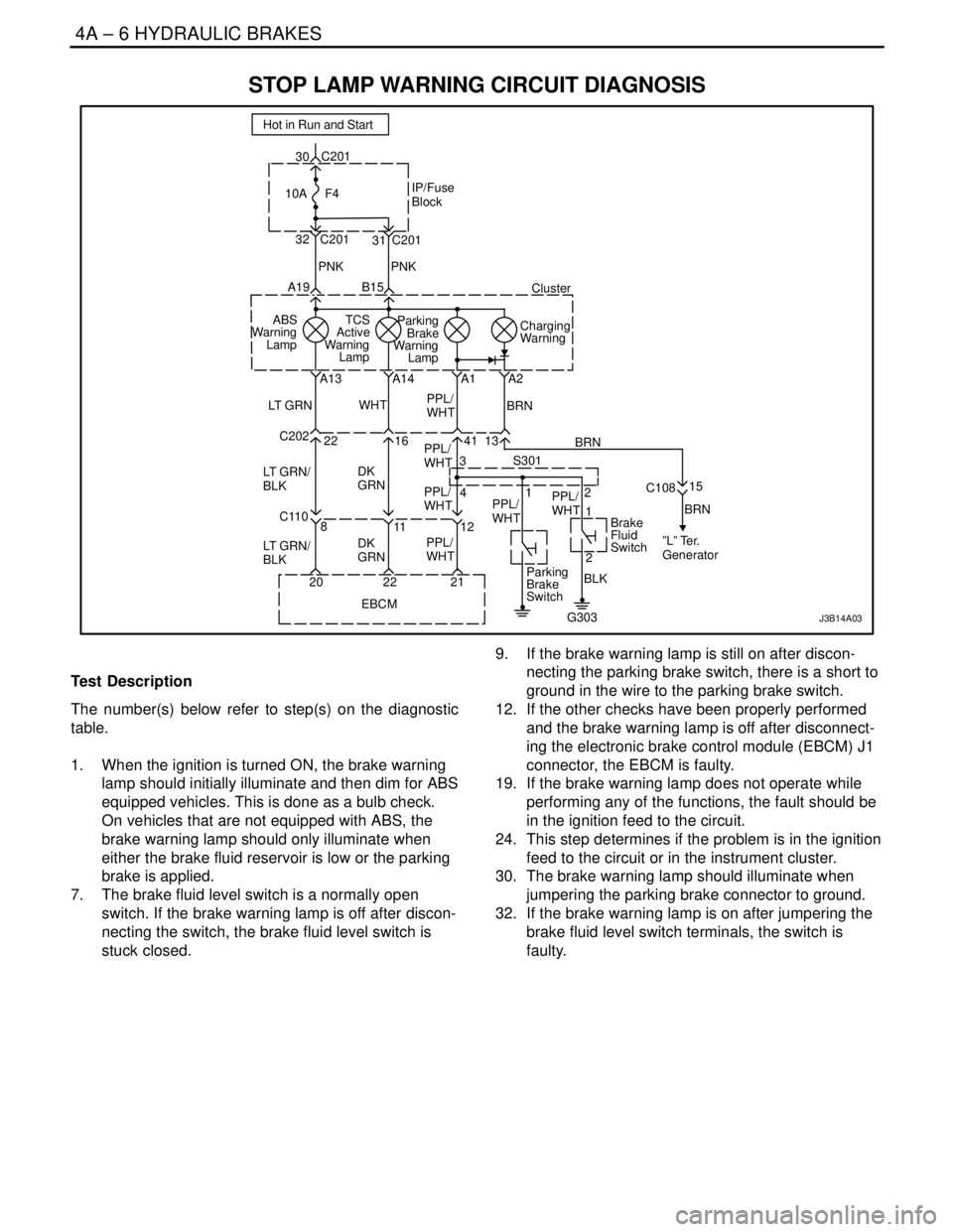
Test Description
The number(s) below refer to step(s) on the diagnostic
table.
1. When the ignition is turned ON, the brake warning
lamp should initially illuminate and then dim for ABS
equipped vehicles. This is done as a bulb check.
On vehicles that are not equipped with ABS, the
brake warning lamp should only illuminate when
either the brake fluid reservoir is low or the parking
brake is applied.
7. The brake fluid level switch is a normally open
switch. If the brake warning lamp is off after discon-
necting the switch, the brake fluid level switch is
stuck closed.9. If the brake warning lamp is still on after discon-
necting the parking brake switch, there is a short to
ground in the wire to the parking brake switch.
12. If the other checks have been properly performed
and the brake warning lamp is off after disconnect-
ing the electronic brake control module (EBCM) J1
connector, the EBCM is faulty.
19. If the brake warning lamp does not operate while
performing any of the functions, the fault should be
in the ignition feed to the circuit.
24. This step determines if the problem is in the ignition
feed to the circuit or in the instrument cluster.
30. The brake warning lamp should illuminate when
jumpering the parking brake connector to ground.
32. If the brake warning lamp is on after jumpering the
brake fluid level switch terminals, the switch is
faulty.
Page 1024 of 2643

4A – 8IHYDRAULIC BRAKES
DAEWOO V–121 BL4
StepNo Yes Value(s) Action
16Check for a short to ground in the wiring between the
instrument cluster terminal A19(B15) and the EBCM
connector terminal 21.
Is the problem found?–Go to Step 17Go to Step 18
17Repair the wiring as needed.
Is the repair complete?–System OK–
18Check the brake lamp after doing each of the follow-
ing functions:
S Apply the parking brake.
S Remove the cap from the brake fluid reservoir.
S On vehicles equipped with ABS, command the
lamp on using a scan tool.
Does the brake warning lamp operate for all of these
conditions?–System OKGo to Step 19
19When the operations listed in step 18 were per-
formed, the brake warning lamp did not function.
Did the brake warning lamp fail to light for all of the
operations listed in step 18?–Go to Step 20Go to Step 27
201. Turn the ignition OFF.
2. Inspect the kick panel fuse F4.
Is the fuse OK?–Go to Step 22Go to Step 21
21Replace the fuse.
Is the repair complete?–System OK–
22Inspect the brake warning lamp bulb.
Is the bulb OK?–Go to Step 24Go to Step 23
23Replace the bulb.
Is the repair complete?–System OK–
241. Disconnect the instrument cluster connector.
2. Turn the ignition ON.
3. Measure the voltage at the instrument cluster
connector terminal A19(B15).
Does the voltage measure within the value speci-
fied?11–14 vGo to Step 25Go to Step 26
251. Turn the ignition OFF.
2. Repair the open in the instrument cluster.
Is the repair complete?–System OK–
261. Turn the ignition OFF.
2. Repair the open in the wiring between the in-
strument cluster connector terminal A19(B15)
and the ignition switch.
Is the repair complete?–System OK–
27Apply the parking brake again.
Does the parking brake warning lamp operate with
the parking brake applied?–Go to Step 28Go to Step 30
28Remove the brake fluid reservoir cap.
Does the parking brake warning lamp operate with
the cap from the brake fluid reservoir removed?–Go to Step 29Go to Step 32
29Check for an open between the instrument cluster
connector terminal A1 and the EBCM connector ter-
minal 21.
Is the problem found?–Go to Step 17Go to Step 13
Page 1085 of 2643
4F – 4IANTILOCK BRAKE SYSTEM
DAEWOO V–121 BL4
ABS SYSTEM CIRCUIT (II)
60A
REDEf2
2
C107
J3B14F02
Oil feeding
Connector
BLK/WHT
G106
10A30
F4
32 43
A19
A13 A14
S301A1 C201 C201
31C201 C201 C201
C202
C110
C110
C101
C106C202 WHT
BRN BRN BRN
DLC
(Data Link
Connector) LT GRN
DK
GRN
DK
GRN LT GRN/
BLK
LT GRN/
BLK
LT GRN
LT GRN LT GRN
LT GRN LT GRN
DK BLU
DK BLUDK BLUDK BLU
DK BLU
DK BLU
ECM
”53” Ter.
(Sirius D4)ECM
”K7” Ter.
(MR–140)PPL/
WHT
PPL/
WHT
WHT/
YELPPL/WHTPPL/WHT
PPL/WHT PPL/WHT ABS
Warning
LampTCS
Warning
LampParking
Brake
Warning
Lamp
Hot in Run and Start
Hot at all times
PNK
Cluster I/P
Fuse
Block
PNK
EBCMBrake Fluid
Switch
”1” Ter.
Parking Brake
Switch 8
88 9
92 20 2222 16
41
3
42
1
11
12
19
12 432
1
21
25 23 11
6C110
C202
10A30
F11
62B15
15 15
Page 1090 of 2643
ANTILOCK BRAKE SYSTEM 4F – 9
DAEWOO V–121 BL4
J3B14F04
60A Ef230A Ef5
2
42
C107 C105
2
C110
G106
A19
A13 A1 A14
C110 C202
C202WHT LT GRN
DK
GRN LT GRN/
BLK
BLK
DK BLUDK BLU
PPL/WHT
PPL/WHT ABS
TCS Parking
Brake
Hot at all times
RED REDRED/WHT
Ignition
Switch
RED
RED
I/P Cluster
EBCM8
20
22 2216 41
1211
18 1621
1
C107
10A F410AF11
32 31
43
6 62 C201
C201 C201C201
C110 C202
Hot in Run and Start
30
4
1711
C202
15
B15
DLC
(Data Link
Connector)12
G106
BLK/WHTOil Feeding
Connector
”2” Ter.
BRNBRN BRN
BRN PNK PNK PNK
19J1
59B1
ONStart Lock
Acc
IG1
19
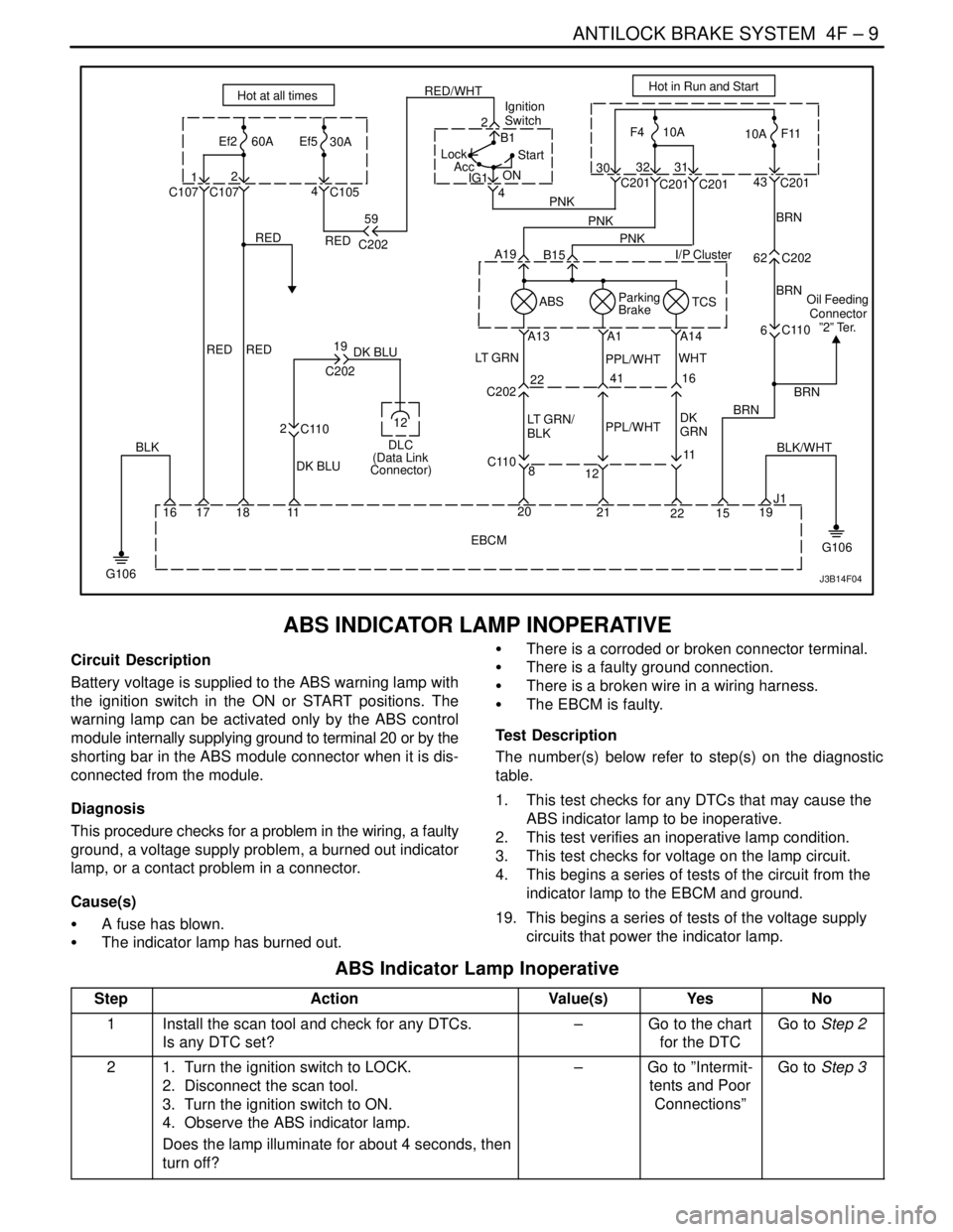
ABS INDICATOR LAMP INOPERATIVE
Circuit Description
Battery voltage is supplied to the ABS warning lamp with
the ignition switch in the ON or START positions. The
warning lamp can be activated only by the ABS control
module internally supplying ground to terminal 20 or by the
shorting bar in the ABS module connector when it is dis-
connected from the module.
Diagnosis
This procedure checks for a problem in the wiring, a faulty
ground, a voltage supply problem, a burned out indicator
lamp, or a contact problem in a connector.
Cause(s)
S A fuse has blown.
S The indicator lamp has burned out.S There is a corroded or broken connector terminal.
S There is a faulty ground connection.
S There is a broken wire in a wiring harness.
S The EBCM is faulty.
Test Description
The number(s) below refer to step(s) on the diagnostic
table.
1. This test checks for any DTCs that may cause the
ABS indicator lamp to be inoperative.
2. This test verifies an inoperative lamp condition.
3. This test checks for voltage on the lamp circuit.
4. This begins a series of tests of the circuit from the
indicator lamp to the EBCM and ground.
19. This begins a series of tests of the voltage supply
circuits that power the indicator lamp.
ABS Indicator Lamp Inoperative
StepActionValue(s)YesNo
1Install the scan tool and check for any DTCs.
Is any DTC set?–Go to the chart
for the DTCGo to Step 2
21. Turn the ignition switch to LOCK.
2. Disconnect the scan tool.
3. Turn the ignition switch to ON.
4. Observe the ABS indicator lamp.
Does the lamp illuminate for about 4 seconds, then
turn off?–Go to ”Intermit-
tents and Poor
Connections”Go to Step 3
Page 1099 of 2643
4F – 18IANTILOCK BRAKE SYSTEM
DAEWOO V–121 BL4
J3B14F04
60A Ef230A Ef5
2
42
C107 C105
2
C110
G106
A19
A13 A1 A14
C110 C202
C202WHT LT GRN
DK
GRN LT GRN/
BLK
BLK
DK BLUDK BLU
PPL/WHT
PPL/WHT ABS
TCS Parking
Brake
Hot at all times
RED REDRED/WHT
Ignition
Switch
RED
RED
I/P Cluster
EBCM8
20
22 2216 41
1211
18 1621
1
C107
10A F410AF11
32 31
43
6 62 C201
C201 C201C201
C110 C202
Hot in Run and Start
30
4
1711
C202
15
B15
DLC
(Data Link
Connector)12
G106
BLK/WHTOil Feeding
Connector
”2” Ter.
BRNBRN BRN
BRN PNK PNK PNK
19J1
59B1
ONStart Lock
Acc
IG1
19
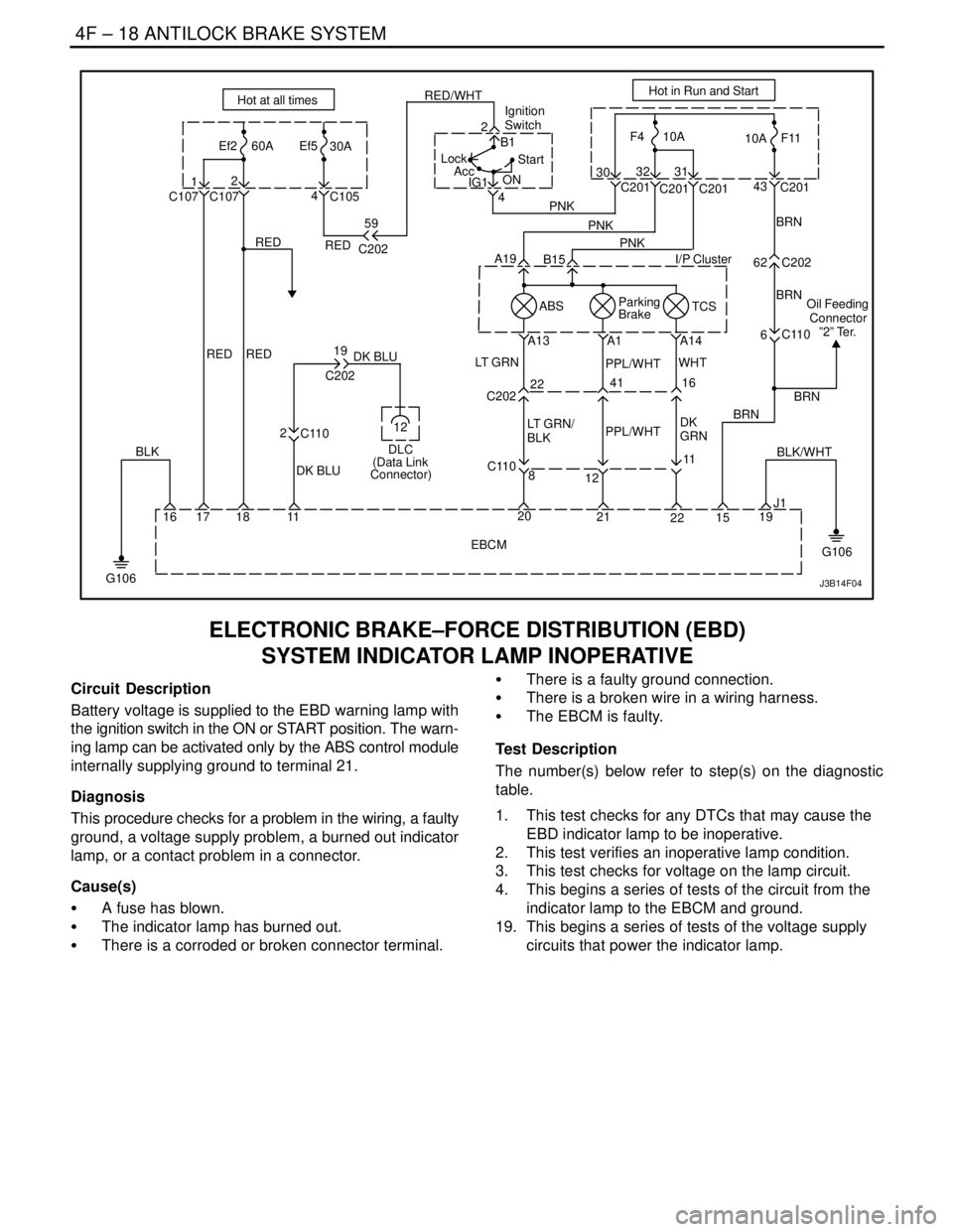
ELECTRONIC BRAKE–FORCE DISTRIBUTION (EBD)
SYSTEM INDICATOR LAMP INOPERATIVE
Circuit Description
Battery voltage is supplied to the EBD warning lamp with
the ignition switch in the ON or START position. The warn-
ing lamp can be activated only by the ABS control module
internally supplying ground to terminal 21.
Diagnosis
This procedure checks for a problem in the wiring, a faulty
ground, a voltage supply problem, a burned out indicator
lamp, or a contact problem in a connector.
Cause(s)
S A fuse has blown.
S The indicator lamp has burned out.
S There is a corroded or broken connector terminal.S There is a faulty ground connection.
S There is a broken wire in a wiring harness.
S The EBCM is faulty.
Test Description
The number(s) below refer to step(s) on the diagnostic
table.
1. This test checks for any DTCs that may cause the
EBD indicator lamp to be inoperative.
2. This test verifies an inoperative lamp condition.
3. This test checks for voltage on the lamp circuit.
4. This begins a series of tests of the circuit from the
indicator lamp to the EBCM and ground.
19. This begins a series of tests of the voltage supply
circuits that power the indicator lamp.
Page 1128 of 2643

ANTILOCK BRAKE SYSTEM 4F – 47
DAEWOO V–121 BL4
J3B14F10
EBCM
ORN/
BLK
LT BLULT B L U
BLK/ WHT
C201 C202
141
40
19
61
G1062
4
15A Ef13
6
C10211
S30114
C201C110
76
C202 11
DIAGNOSTIC TROUBLE CODE (DTC) C0161
ABS BRAKE SWITCH CIRCUIT MALFUNCTION
Circuit Description
When the brake pedal is depressed, the contacts on the
brake light switch close to illuminate the brake lights. Bat-
tery voltage is also applied to terminal 14 of the electronic
brake control module (EBCM), which signals the ABS con-
troller that the brakes are applied and ABS may be need-
ed. Without this, signals from a wheel speed sensor that
may indicate need for ABS intervention are questionable.
When the brake pedal is not depressed, the EBCM termi-
nal 14 is grounded through the brake lights.
Diagnosis
This procedure will check whether there is no output or
constant output from the brake light switch and will deter-
mine the cause as a faulty switch or a problem in the cir-
cuitry.
Cause(s)
S The ground connection or the positive connection at
the EBCM has failed.
S There is an open, short to ground, or short to posi-
tive in the vehicle wiring.S The brake light switch has failed.
Fail Action
The system records a DTC C0161. ABS and EBD opera-
tion is enabled and ABS / EBD warning lamp don’t turn on.
Test Description
The number(s) below refer to step(s) on the diagnostic
table.
1. This simple test will isolate the problem to the fuse–
brake light switch–splice 301 area or the splice
301–EBCM area.
3. This is the first step in identifying an open, a short
to ground, a short to voltage, or a faulty brake light
switch.
11. This step begins the process of finding an open, a
defective connector, or a faulty EBCM.
Diagnostic Aids
Inspect wiring and connectors carefully and thoroughly.
Failure to do so could result in misdiagnosis, causing part
replacement with reappearance of the malfunction.
Page 1129 of 2643

4F – 48IANTILOCK BRAKE SYSTEM
DAEWOO V–121 BL4
DTC C0161 – ABS Brake Switch Circuit Malfunction
StepActionValue(s)YesNo
1Step on the brake pedal.
Do the brake lights come on at all?–Go to Step 3Go to Step 2
2Remove your foot from the brake pedal.
Do the lights stay on continuously?–Go to Step 8Go to Step 11
3Check fuse EF13 in the engine compartment fuse
block.
Is fuse EF13 blown?–Go to Step 4Go to Step 6
41. Replace fuse EF13.
2. Check the new fuse.
Does the new fuse blow?–Go to Step 5Go to Step 7
51. Repair the short to ground in the brake light
circuitry.
2. Install a new fuse EF13.
Is the repair complete?–System OK–
6Repair the open in the brake light switch circuit ORN/
BLK from terminal 6 of connector C102 at the engine
fuse block to the brake light switch and circuit LT
BLU from terminal 11 of splice S301.
Is the repair complete?–System OK–
7Check for functioning of the brake lights and the ABS
system.
Is the repair complete?–System OK–
8Check the brake light switch on the brake pedal.
Is the switch faulty?–Go to Step 9Go to Step 10
9Repair the brake light switch.
Is the repair complete?–System OK–
10Repair the short to positive in the circuit YEL be-
tween the brake light switch, splice S301, the brake
lights, the center high–mounted stoplamp, and the
ABS wiring harness connector at the EBCM terminal
14.
Is the repair complete?–System OK–
111. Disconnect the EBCM connector.
2. Use a digital voltmeter (DVM) to measure volt-
age between pins 14 and 19 of the ABS har-
ness connector at the EBCM.
3. Have an assistant step on the brake pedal.
Does the DVM indicate the specified value?11–14 vGo to Step 13Go to Step 12
Page 1137 of 2643
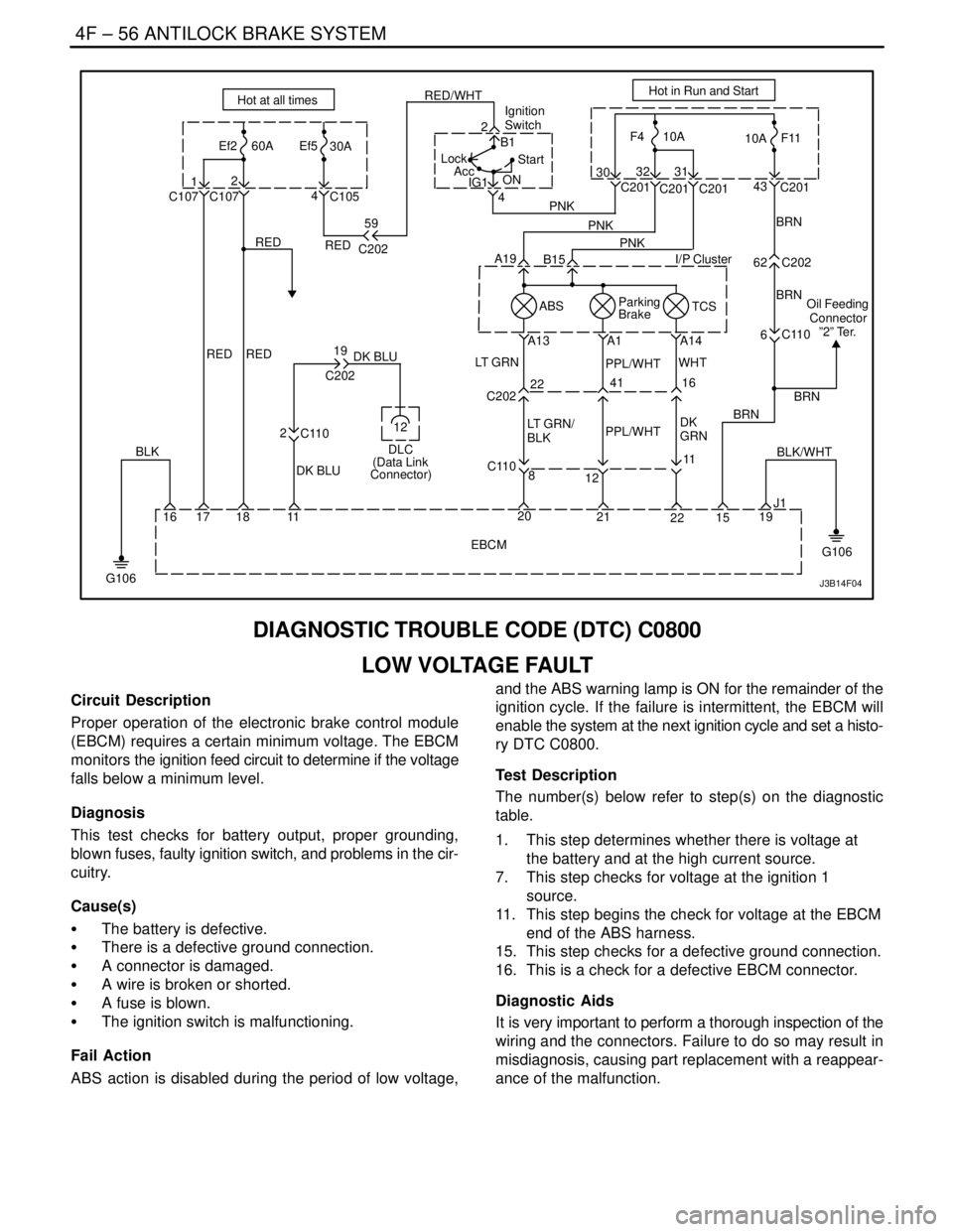
4F – 56IANTILOCK BRAKE SYSTEM
DAEWOO V–121 BL4
J3B14F04
60A Ef230A Ef5
2
42
C107 C105
2
C110
G106
A19
A13 A1 A14
C110 C202
C202WHT LT GRN
DK
GRN LT GRN/
BLK
BLK
DK BLUDK BLU
PPL/WHT
PPL/WHT ABS
TCS Parking
Brake
Hot at all times
RED REDRED/WHT
Ignition
Switch
RED
RED
I/P Cluster
EBCM8
20
22 2216 41
1211
18 1621
1
C107
10A F410AF11
32 31
43
6 62 C201
C201 C201C201
C110 C202
Hot in Run and Start
30
4
1711
C202
15
B15
DLC
(Data Link
Connector)12
G106
BLK/WHTOil Feeding
Connector
”2” Ter.
BRNBRN BRN
BRN PNK PNK PNK
19J1
59B1
ONStart Lock
Acc
IG1
19
DIAGNOSTIC TROUBLE CODE (DTC) C0800
LOW VOLTAGE FAULT
Circuit Description
Proper operation of the electronic brake control module
(EBCM) requires a certain minimum voltage. The EBCM
monitors the ignition feed circuit to determine if the voltage
falls below a minimum level.
Diagnosis
This test checks for battery output, proper grounding,
blown fuses, faulty ignition switch, and problems in the cir-
cuitry.
Cause(s)
S The battery is defective.
S There is a defective ground connection.
S A connector is damaged.
S A wire is broken or shorted.
S A fuse is blown.
S The ignition switch is malfunctioning.
Fail Action
ABS action is disabled during the period of low voltage,and the ABS warning lamp is ON for the remainder of the
ignition cycle. If the failure is intermittent, the EBCM will
enable the system at the next ignition cycle and set a histo-
ry DTC C0800.
Test Description
The number(s) below refer to step(s) on the diagnostic
table.
1. This step determines whether there is voltage at
the battery and at the high current source.
7. This step checks for voltage at the ignition 1
source.
11. This step begins the check for voltage at the EBCM
end of the ABS harness.
15. This step checks for a defective ground connection.
16. This is a check for a defective EBCM connector.
Diagnostic Aids
It is very important to perform a thorough inspection of the
wiring and the connectors. Failure to do so may result in
misdiagnosis, causing part replacement with a reappear-
ance of the malfunction.
Page 1146 of 2643

ANTILOCK BRAKE SYSTEM 4F – 65
DAEWOO V–121 BL4
GENERAL DESCRIPTION AND SYSTEM
OPERATION
BASIC KNOWLEDGE REQUIRED
Before using this section, it is important that you have a ba-
sic knowledge of the following items. Without this knowl-
edge, it will be difficult to use the diagnostic procedures
contained in this section.
S Basic Electrical Circuits : You should understand
the basic theory of electricity and know the mean-
ing of voltage, current (amps), and resistance
(ohms). You should understand what happens in a
circuit with an open or shorted wire. You should be
able to read and understand a wiring diagram.
S Use of Circuit Testing Tools : You should know how
to use a test light and how to bypass components
to test circuits using fused jumper wires. You should
be familiar with a digital multimeter. You should be
able to measure voltage, resistance, and current,
and be familiar with the controls and how to use
them correctly.
ABS SYSTEM COMPONENTS
The ABS 5.3 Antilock Braking System (ABS) consists of
a conventional hydraulic brake system plus antilock com-
ponents. The conventional brake system includes a vacu-
um booster, master cylinder, front disc brakes, rear lead-
ing/trailing drum brakes, interconnecting hydraulic brake
pipes and hoses, brake fluid level sensor and the BRAKE
indicator.
The ABS components include a hydraulic unit, an elec-
tronic brake control module (EBCM), two system fuses,
four wheel speed sensors (one at each wheel), intercon-
necting wiring, the ABS indicator, the EBD indicator (which
is connected to the parking lamp) and the rear disk brakes.
See “ABS Component Locator” in this section for the gen-
eral layout of this system.
The hydraulic unit with the attached EBCM is located be-
tween the surge tank and the fire wall on the left side of the
vehicle.
The basic hydraulic unit configuration consists of hydraulic
check valves, two solenoid valves for each wheel, a hy-
draulic pump, two accumulators, and two damper. The hy-
draulic unit controls hydraulic pressure to the front calipers
and rear wheel cylinders by modulating hydraulic pressure
to prevent wheel lockup.
Nothing in the hydraulic unit or the EBCM is serviceable.
In the event of any failure, the entire ABS unit with at-
tached EBCM must be replaced. For more information, re-
fer to ”Base Braking Mode” and ”Antilock Braking Mode”
in this section.
BASE BRAKING MODE
The baseline braking mode of the ABS 5.3 system used
in this vehicle is a diagonal split system. In this system,
one master cylinder circuit supplies pressure to the right
front and the left rear brakes; the other circuit supplies
pressure to the left front and the right rear brakes. All
valves in the hydraulic modulator are in their normal, non–
energized positions as shown in the drawings found in
”ABS System Components” in this section.