parking brake DAEWOO NUBIRA 2004 Service Owner's Manual
[x] Cancel search | Manufacturer: DAEWOO, Model Year: 2004, Model line: NUBIRA, Model: DAEWOO NUBIRA 2004Pages: 2643, PDF Size: 80.54 MB
Page 1024 of 2643

4A – 8IHYDRAULIC BRAKES
DAEWOO V–121 BL4
StepNo Yes Value(s) Action
16Check for a short to ground in the wiring between the
instrument cluster terminal A19(B15) and the EBCM
connector terminal 21.
Is the problem found?–Go to Step 17Go to Step 18
17Repair the wiring as needed.
Is the repair complete?–System OK–
18Check the brake lamp after doing each of the follow-
ing functions:
S Apply the parking brake.
S Remove the cap from the brake fluid reservoir.
S On vehicles equipped with ABS, command the
lamp on using a scan tool.
Does the brake warning lamp operate for all of these
conditions?–System OKGo to Step 19
19When the operations listed in step 18 were per-
formed, the brake warning lamp did not function.
Did the brake warning lamp fail to light for all of the
operations listed in step 18?–Go to Step 20Go to Step 27
201. Turn the ignition OFF.
2. Inspect the kick panel fuse F4.
Is the fuse OK?–Go to Step 22Go to Step 21
21Replace the fuse.
Is the repair complete?–System OK–
22Inspect the brake warning lamp bulb.
Is the bulb OK?–Go to Step 24Go to Step 23
23Replace the bulb.
Is the repair complete?–System OK–
241. Disconnect the instrument cluster connector.
2. Turn the ignition ON.
3. Measure the voltage at the instrument cluster
connector terminal A19(B15).
Does the voltage measure within the value speci-
fied?11–14 vGo to Step 25Go to Step 26
251. Turn the ignition OFF.
2. Repair the open in the instrument cluster.
Is the repair complete?–System OK–
261. Turn the ignition OFF.
2. Repair the open in the wiring between the in-
strument cluster connector terminal A19(B15)
and the ignition switch.
Is the repair complete?–System OK–
27Apply the parking brake again.
Does the parking brake warning lamp operate with
the parking brake applied?–Go to Step 28Go to Step 30
28Remove the brake fluid reservoir cap.
Does the parking brake warning lamp operate with
the cap from the brake fluid reservoir removed?–Go to Step 29Go to Step 32
29Check for an open between the instrument cluster
connector terminal A1 and the EBCM connector ter-
minal 21.
Is the problem found?–Go to Step 17Go to Step 13
Page 1025 of 2643

HYDRAULIC BRAKES 4A – 9
DAEWOO V–121 BL4
StepNo Yes Value(s) Action
301. Turn the ignition ON.
2. Disconnect the parking brake switch.
3. Jumper the parking brake switch connector
terminal to ground.
Is the lamp on?–Go to Step 10Go to Step 31
311. Turn the ignition OFF.
2. Repair the open in the wire between the instru-
ment cluster connector terminal A1 and the
parking brake switch connector terminal.
3. Is the repair complete?
Is the repair complete?–System OK–
321. Disconnect the brake fluid level switch.
2. Turn the ignition ON.
3. Jumper the brake fluid level switch connector
terminals.
Is the lamp on?–Go to Step 8Go to Step 33
331. Turn the ignition OFF.
2. Connect a test light between battery positive
and the BRN/WHT wire terminal of the brake
fluid level switch.
Is the test light on?–Go to Step 34Go to Step 35
34Repair the open in the wiring between ground and
the brake fluid level switch.
Is the repair complete?–System OK–
35Repair the open in the wiring between the instrument
cluster connector terminal A1 and the brake fluid lev-
el switch.
Is the repair complete?–System OK–
Page 1033 of 2643

HYDRAULIC BRAKES 4A – 17
DAEWOO V–121 BL4
GENERAL DESCRIPTION
AND SYSTEM OPERATION
WARNING LAMP OPERATION
This brake system uses a BRAKE warning lamp located
in the instrument panel cluster. When the ignition switch
is in the START position, the BRAKE warning lamp should
illuminate. It should go off when the ignition switch returns
to the ON position.The following conditions will activate the BRAKE warning
lamp:
S The lamp should be on whenever the parking brake
is applied and the ignition switch is in the ON posi-
tion.
S A low fluid level in the master cylinder will turn the
BRAKE lamp on.
Page 1058 of 2643

SECTION : 4E1
REAR DISC BRAKES
TABLE OF CONTENTS
SPECIFICATIONS4E1–1 . . . . . . . . . . . . . . . . . . . . . . . . .
Fastener Tightening Specifications 4E1–1. . . . . . . . . .
DIAGNOSIS4E1–1 . . . . . . . . . . . . . . . . . . . . . . . . . . . . . . .
Lining Inspection 4E1–1. . . . . . . . . . . . . . . . . . . . . . . . .
Rotor Inspection 4E1–1. . . . . . . . . . . . . . . . . . . . . . . . . .
MAINTENANCE AND REPAIR4E1–3 . . . . . . . . . . . . . .
ON–VEHICLE SERVICE 4E1–3. . . . . . . . . . . . . . . . . . . .
Shoe and Lining 4E1–3. . . . . . . . . . . . . . . . . . . . . . . . . . Caliper 4E1–4. . . . . . . . . . . . . . . . . . . . . . . . . . . . . . . . . .
Rotor 4E1–5. . . . . . . . . . . . . . . . . . . . . . . . . . . . . . . . . . .
Hub and Parking Brake Shoe/Backplate 4E1–6. . . . .
UNIT REPAIR 4E1–10. . . . . . . . . . . . . . . . . . . . . . . . . . . .
Caliper Overhaul 4E1–10. . . . . . . . . . . . . . . . . . . . . . . .
GENERAL DESCRIPTION AND SYSTEM
OPERATION4E1–12 . . . . . . . . . . . . . . . . . . . . . . . . . . . .
Disc Brake Caliper Assembly 4E1–12. . . . . . . . . . . . . .
SPECIFICATIONS
FASTENER TIGHTENING SPECIFICATIONS
ApplicationNSmLb–FtLb–In
Brake Hose Inlet Bolt and Ring Seals3224–
Caliper Mounting Bolts5641–
Lower Caliper Mounting Bolt2720–
Parking Brake Shoe Hold–Down Spring As-
sembly Screw4–35
Rotor Detent Screw4–35
Hub Bolts6548–
DIAGNOSIS
LINING INSPECTION
1. Raise and suitably support the vehicle.
2. Remove the rear wheels. Refer to Section 2E, Tires
and Wheels.
3. Visually check the brake shoe linings for minimum
thickness and wear.
4. Measure the thickness.
Important : The minimum discard thickness of the brake
shoe lining is 2 mm (0.08 inch).
5. Install the shoes in axle sets only.
6. Install the rear wheels. Refer to Section 2E, Tires
and Wheels.
7. Lower the vehicle.
ROTOR INSPECTION
Brake rotors are manufactured with close tolerances for
thickness variation, flatness, and lateral runout, but pits
and grooves are created in rotors during usage. Lack of
uniformity of the braking surfaces of the rotor can cause
inadequate braking and a pulsating pedal during braking.
The surface finish of the rotor is also important because
an unsuitable surface finish can cause pulling and rapid
wear of the brake shoe lining. If a rotor does not meet the
specification, it should be refinished to specification or re-
placed. Refinishing of the rotor should only be done with
precision equipment.
Thickness variation can be checked by measuring the
thickness of the rotor at four or more points around the cir-
cumference of the rotor. All measurements must be made
at the same distance from the edge of the rotor. A rotor that
varies by more than. 1.0 mm (0.04 inch) can cause pedal
Page 1063 of 2643
4E1 – 6IREAR DISC BRAKES
DAEWOO V–121 BL4
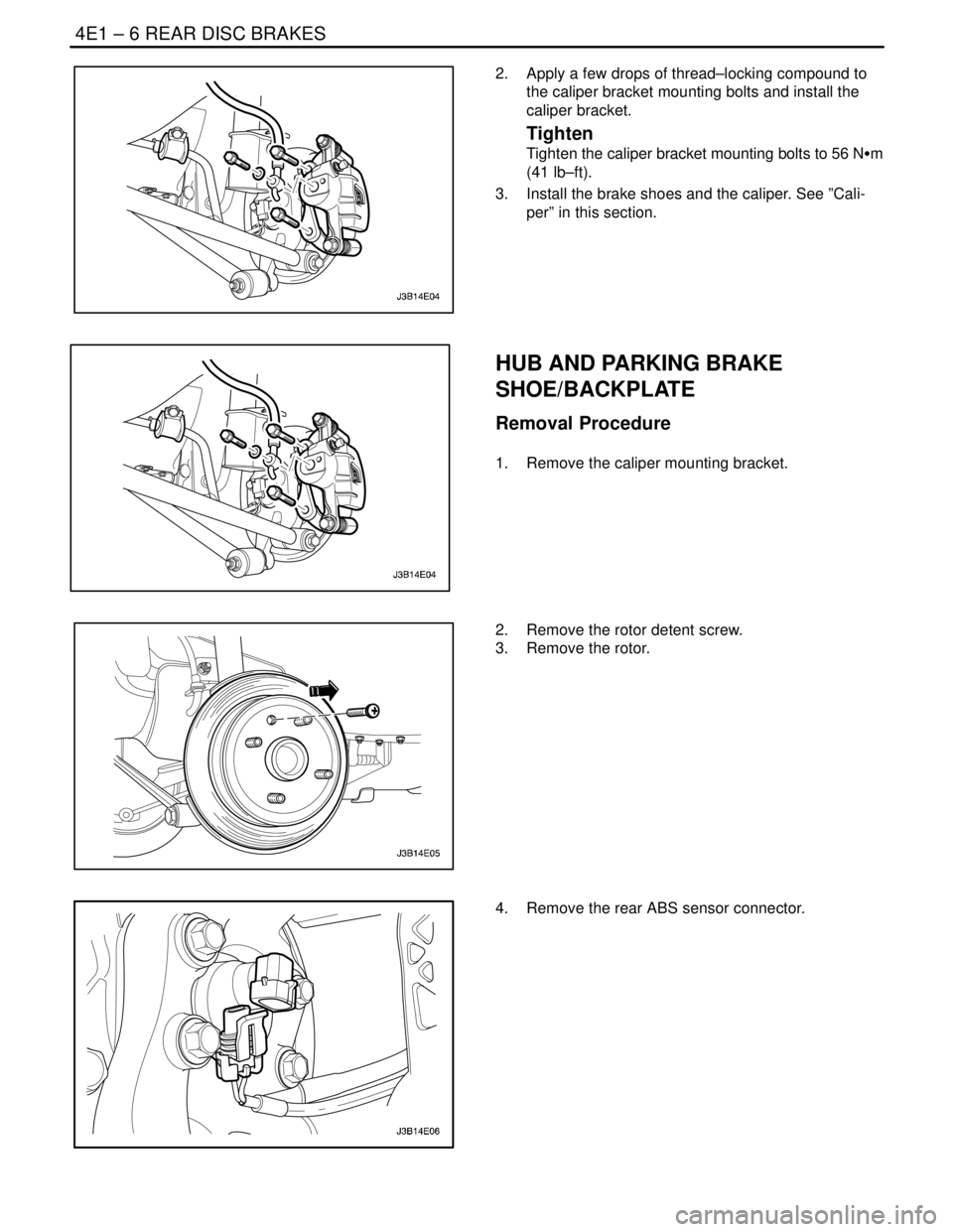
2. Apply a few drops of thread–locking compound to
the caliper bracket mounting bolts and install the
caliper bracket.
Tighten
Tighten the caliper bracket mounting bolts to 56 NSm
(41 lb–ft).
3. Install the brake shoes and the caliper. See ”Cali-
per” in this section.
HUB AND PARKING BRAKE
SHOE/BACKPLATE
Removal Procedure
1. Remove the caliper mounting bracket.
2. Remove the rotor detent screw.
3. Remove the rotor.
4. Remove the rear ABS sensor connector.
Page 1064 of 2643
REAR DISC BRAKES 4E1 – 7
DAEWOO V–121 BL4
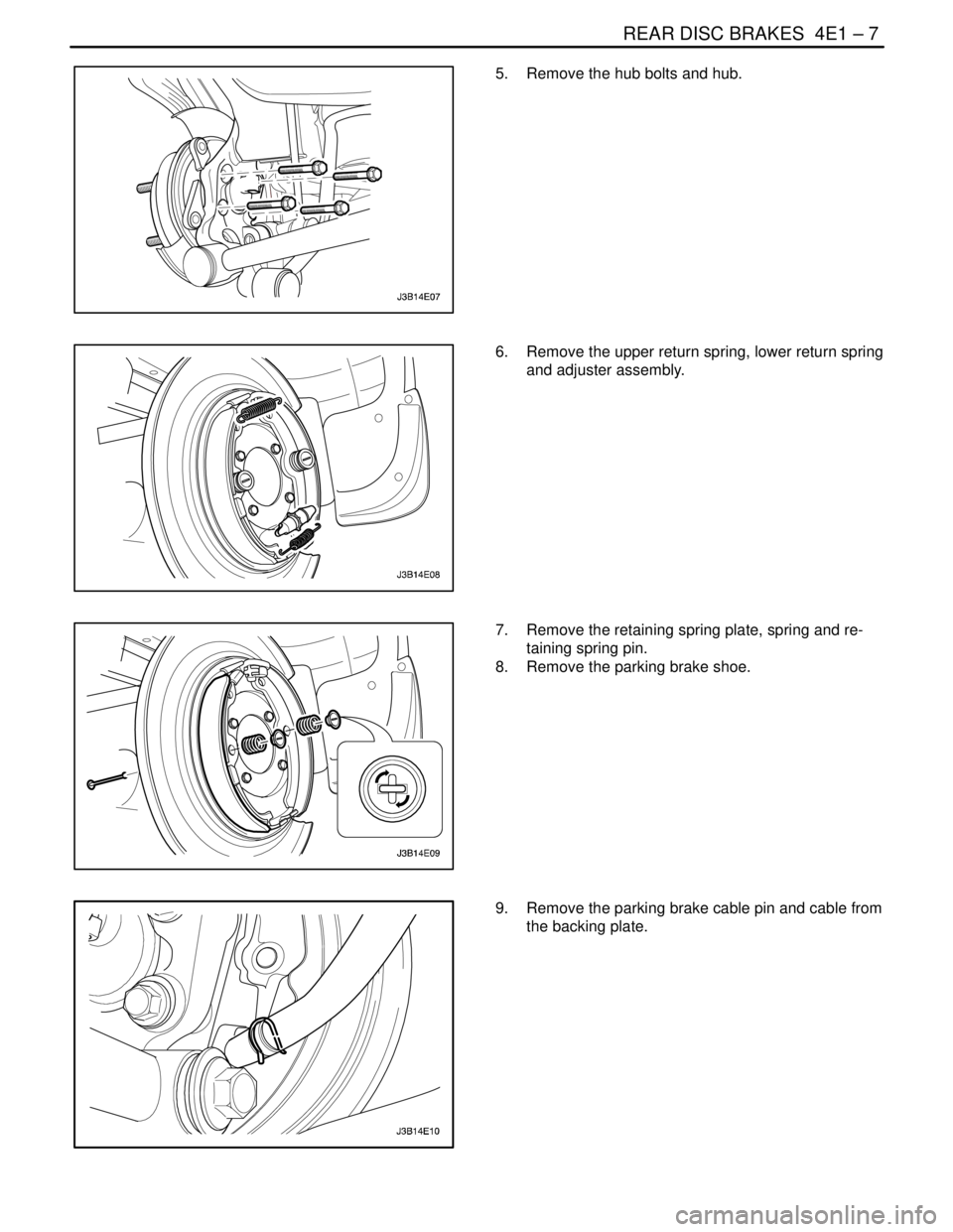
5. Remove the hub bolts and hub.
6. Remove the upper return spring, lower return spring
and adjuster assembly.
7. Remove the retaining spring plate, spring and re-
taining spring pin.
8. Remove the parking brake shoe.
9. Remove the parking brake cable pin and cable from
the backing plate.
Page 1065 of 2643
4E1 – 8IREAR DISC BRAKES
DAEWOO V–121 BL4
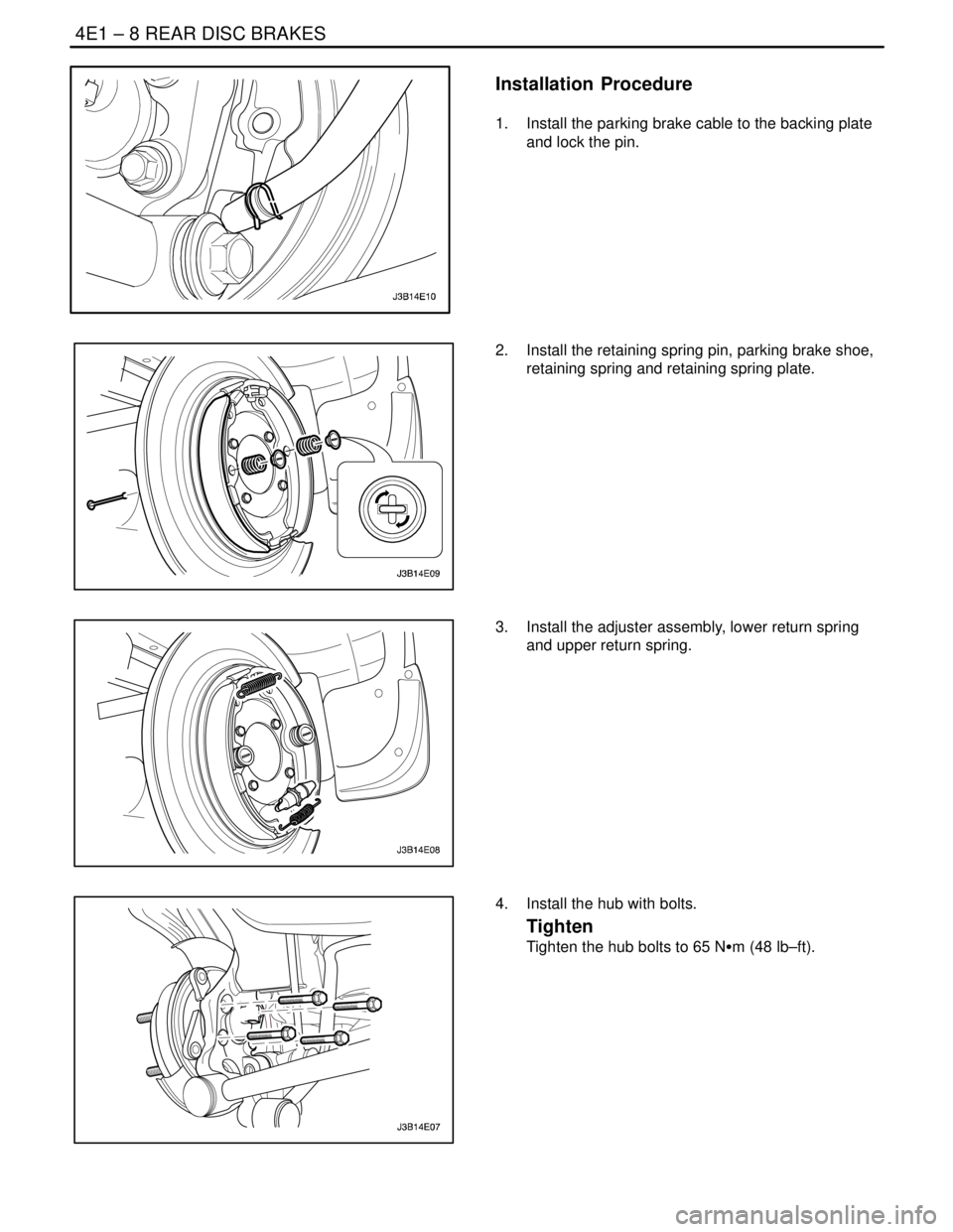
Installation Procedure
1. Install the parking brake cable to the backing plate
and lock the pin.
2. Install the retaining spring pin, parking brake shoe,
retaining spring and retaining spring plate.
3. Install the adjuster assembly, lower return spring
and upper return spring.
4. Install the hub with bolts.
Tighten
Tighten the hub bolts to 65 NSm (48 lb–ft).
Page 1070 of 2643

SECTION : 4E2
REAR DRUM BRAKES
TABLE OF CONTENTS
SPECIFICATIONS4E2–1 . . . . . . . . . . . . . . . . . . . . . . . . .
Fastener Tightening Specifications 4E2–1. . . . . . . . .
DIAGNOSIS4E2–1 . . . . . . . . . . . . . . . . . . . . . . . . . . . . . . .
Lining Inspection 4E2–1. . . . . . . . . . . . . . . . . . . . . . . . .
Drums 4E2–1. . . . . . . . . . . . . . . . . . . . . . . . . . . . . . . . . .
MAINTENANCE AND REPAIR4E2–3 . . . . . . . . . . . . . .
ON–VEHICLE SERVICE 4E2–3. . . . . . . . . . . . . . . . . . . .
Brake Adjustment 4E2–3. . . . . . . . . . . . . . . . . . . . . . . . Shoe and Lining 4E2–4. . . . . . . . . . . . . . . . . . . . . . . . .
Wheel Cylinder Assembly 4E2–7. . . . . . . . . . . . . . . . .
Backing Plate 4E2–8. . . . . . . . . . . . . . . . . . . . . . . . . . . .
UNIT REPAIR 4E2–10. . . . . . . . . . . . . . . . . . . . . . . . . . . .
Wheel Cylinder 4E2–10. . . . . . . . . . . . . . . . . . . . . . . . .
GENERAL DESCRIPTION AND SYSTEM
OPERATION4E2–12 . . . . . . . . . . . . . . . . . . . . . . . . . . . .
Drum Brakes 4E2–12. . . . . . . . . . . . . . . . . . . . . . . . . . .
SPECIFICATIONS
FASTENER TIGHTENING SPECIFICATIONS
ApplicationNSmLb–FtLb–In
Brake Line1612–
Brake Wheel Hub/Backing Plate–to–Rear
Axle Nuts2821–
Wheel Cylinder–to–Backing Plate Bolt8–71
DIAGNOSIS
LINING INSPECTION
1. Raise and suitably support the vehicle.
2. Remove the wheel. Refer to Section 2E, Tires and
Wheels.
3. Release the parking brake.
4. Remove the drum. Refer to ” Drum” in this section.
5. Measure the lining thickness. The minimum lining
thickness is 0.5 mm (0.02 inch).
CAUTION : To avoid injury when servicing brake
parts, do not create dust by grinding or sanding the
brake linings or by cleaning the wheel brake parts
with a dry brush or with compressed air.
Important : Replace the shoe and lining assembly in axle
sets only.
6. Install the drum, if removed. Refer to ”One–Piece
Drum” or ”Two–Piece Drum” in this section.
7. Install the wheel, if removed. Refer to Section 2E,
Tires and Wheels.
8. Lower the vehicle.
DRUMS
Whenever brake drums are removed, they should be thor-
oughly cleaned and inspected to see if the drums are
cracked, scored, deeply grooved, or beyond the specified
out–of–round limit.
S A cracked drum is unsafe for further service and-
must be replaced. Do not attempt to weld a cracked
drum. Smooth out any slight scores.
S Heavy or extensive scoring will cause excessive
brake lining wear and may require refinishing the
drum braking surface.
S If the brake linings are slightly worn but are still re-
usable and the drum is grooved, polish the drum
with a fine emery cloth but do not refinish it. Elimi-
nating all grooves in the drum and smoothing the
ridges on the lining would remove too much metal
and lining. If left alone, the grooves and ridges
match, and satisfactory service can be obtained. If
the brake linings need to be replaced, refinish a
grooved drum. A grooved drum, used with a new
Page 1072 of 2643
REAR DRUM BRAKES 4E2 – 3
DAEWOO V–121 BL4
MAINTENANCE AND REPAIR
ON–VEHICLE SERVICE
BRAKE ADJUSTMENT
Removal Procedure
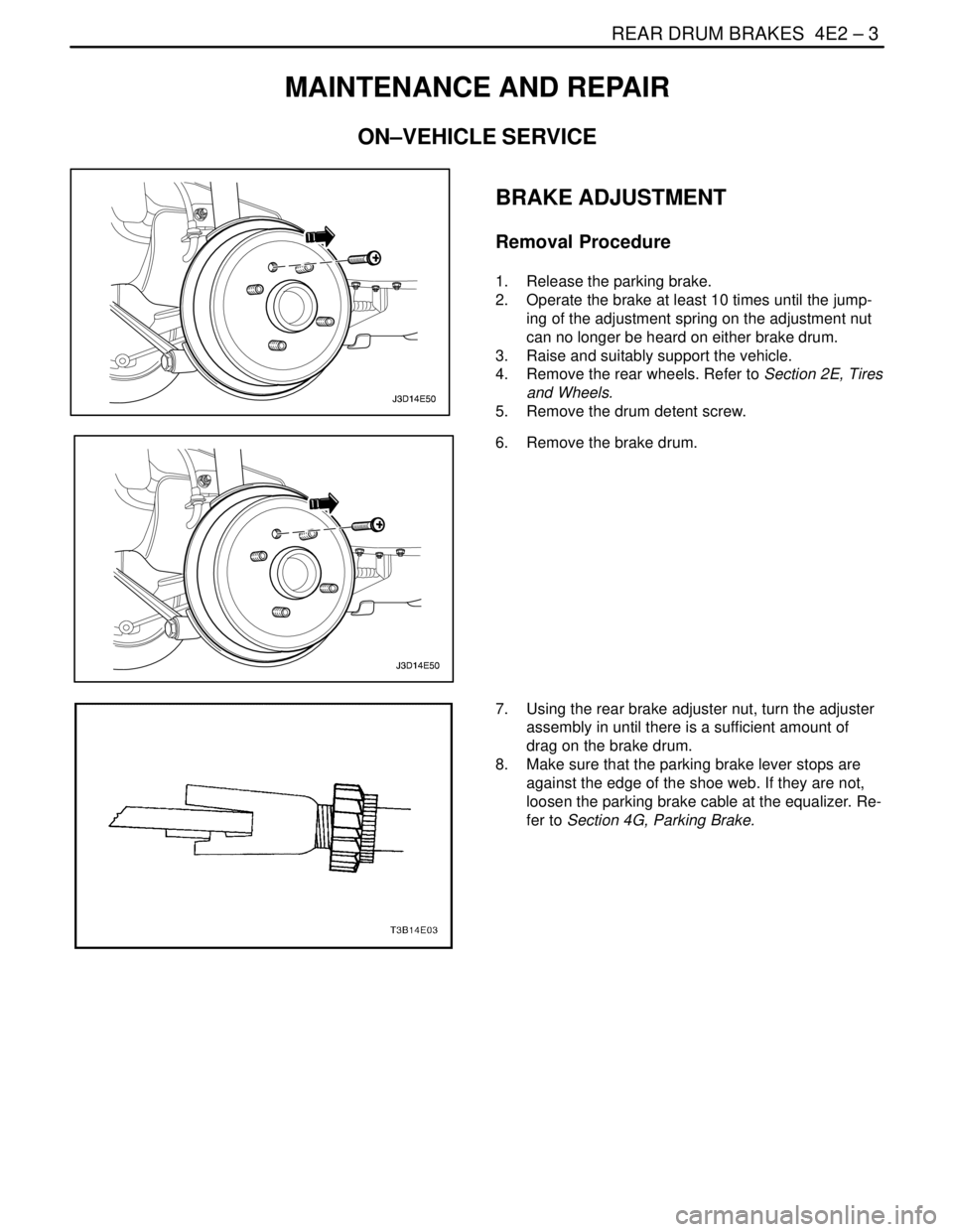
1. Release the parking brake.
2. Operate the brake at least 10 times until the jump-
ing of the adjustment spring on the adjustment nut
can no longer be heard on either brake drum.
3. Raise and suitably support the vehicle.
4. Remove the rear wheels. Refer to Section 2E, Tires
and Wheels.
5. Remove the drum detent screw.
6. Remove the brake drum.
7. Using the rear brake adjuster nut, turn the adjuster
assembly in until there is a sufficient amount of
drag on the brake drum.
8. Make sure that the parking brake lever stops are
against the edge of the shoe web. If they are not,
loosen the parking brake cable at the equalizer. Re-
fer to Section 4G, Parking Brake.
Page 1073 of 2643
4E2 – 4IREAR DRUM BRAKES
DAEWOO V–121 BL4
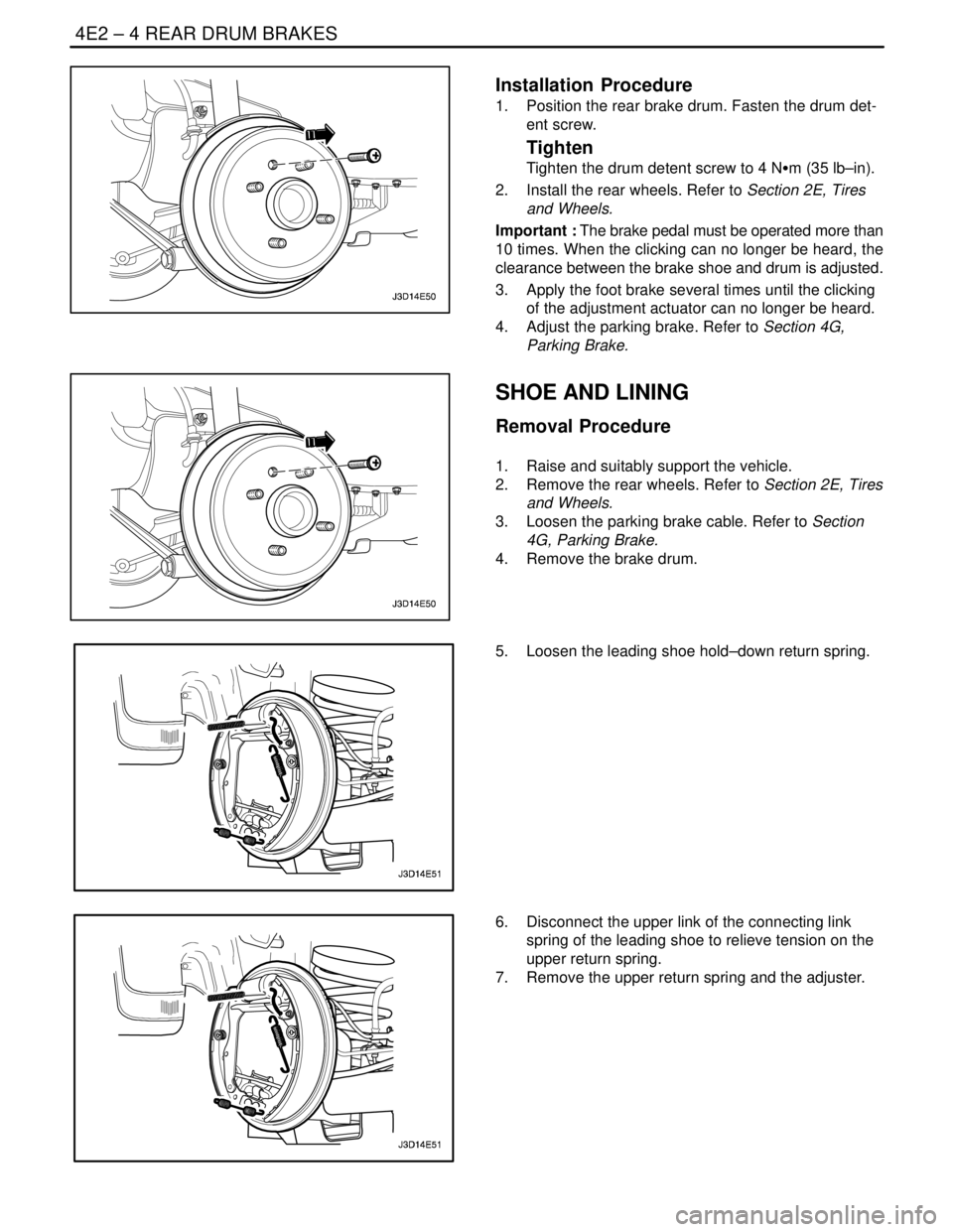
Installation Procedure
1. Position the rear brake drum. Fasten the drum det-
ent screw.
Tighten
Tighten the drum detent screw to 4 NSm (35 lb–in).
2. Install the rear wheels. Refer to Section 2E, Tires
and Wheels.
Important : The brake pedal must be operated more than
10 times. When the clicking can no longer be heard, the
clearance between the brake shoe and drum is adjusted.
3. Apply the foot brake several times until the clicking
of the adjustment actuator can no longer be heard.
4. Adjust the parking brake. Refer to Section 4G,
Parking Brake.
SHOE AND LINING
Removal Procedure
1. Raise and suitably support the vehicle.
2. Remove the rear wheels. Refer to Section 2E, Tires
and Wheels.
3. Loosen the parking brake cable. Refer to Section
4G, Parking Brake.
4. Remove the brake drum.
5. Loosen the leading shoe hold–down return spring.
6. Disconnect the upper link of the connecting link
spring of the leading shoe to relieve tension on the
upper return spring.
7. Remove the upper return spring and the adjuster.