wheel alignment DAEWOO NUBIRA 2004 Service Owner's Manual
[x] Cancel search | Manufacturer: DAEWOO, Model Year: 2004, Model line: NUBIRA, Model: DAEWOO NUBIRA 2004Pages: 2643, PDF Size: 80.54 MB
Page 917 of 2643

2B – 10IWHEEL ALIGNMENT
DAEWOO V–121 BL4
GENERAL DESCRIPTION
AND SYSTEM OPERATION
FOUR WHEEL ALIGNMENT
The first responsibility of engineering is to design safe
steering and suspension systems. Each component must
be strong enough to withstand and absorb extreme pun-
ishment. Both the steering system and the front and the
rear suspension must function geometrically with the body
mass.
The steering and the suspension systems require that the
front wheels self–return and that the tire rolling effort and
the road friction be held to a negligible force in order to al-
low the customer to direct the vehicle with the least effort
and the most comfort.
A complete wheel alignment check should include mea-
surements of the rear toe and camber.
Four–wheel alignment assures that all four wheels will be
running in precisely the same direction.
When the vehicle is geometrically aligned, fuel economy
and tire life are at their peak, and steering and perfor-
mance are maximized.
TOE
Toe–in is the turning in of the tires, while toe–out is the
turning out of the tires from the geometric centerline or
thrust line. The toe ensures parallel rolling of the wheels.
The toe serves to offset the small deflections of the wheel
support system which occur when the vehicle is rolling for-
ward. The specified toe angle is the setting which achieves
0 degrees of toe when the vehicle is moving.
Incorrect toe–in or toe–out will cause tire wear and re-
duced fuel economy. As the individual steering and sus-
pension components wear from vehicle mileage, addition-
al toe will be needed to compensate for the wear.
Always correct the toe dimension last.
CASTER
Caster is the tilting of the uppermost point of the steering
axis either forward or backward from the vertical when
viewed from the side of the vehicle. A backward tilt is posi-
tive, and a forward tilt is negative. Caster influences direc-
tional control of the steering but does not affect tire wear.
Weak springs or overloading a vehicle will affect caster.
One wheel with more positive caster will pull toward the
center of the car. This condition will cause the car to move
or lean toward the side with the least amount of positive
caster. Caster is measured in degrees and is not adjust-
able.
CAMBER
Camber is the tilting of the top of the tire from the vertical
when viewed from the front of the vehicle. When the tires
tilt outward, the camber is positive. When the tires tilt in-
ward, the camber is negative. The camber angle is mea-
sured in degrees from the vertical. Camber influences
both directional control and tire wear.
If the vehicle has too much positive camber, the outside
shoulder of the tire will wear. If the vehicle has too much
negative camber, the inside shoulder of the tire will wear.
Camber is not adjustable.
STEERING AXIS INCLINATION
Steering Axis Inclination (SAI) is the tilt at the top of the
steering knuckle from the vertical. Measure the SAI angle
from the true vertical to a line through the center of the strut
and the lower ball joint as viewed from the front of the ve-
hicle.
SAI helps the vehicle track straight down the road and as-
sists the wheel back into the straight ahead position. SAI
on front wheel drive vehicles should be negative.
INCLUDED ANGLE
The included angle is the angle measured from the cam-
ber angle to the line through the center of the strut and the
lower ball joint as viewed from the front of the vehicle.
The included angle is calculated in degrees. Most align-
ment racks will not measure the included angle directly. To
determine the included angle, subtract the negative or add
the positive camber readings to the Steering Axis Inclina-
tion (SAI).
SCRUB RADIUS
The scrub radius is the distance between true vertical and
the line through the center of the strut and lower ball joint
to the road surface. Scrub radius is built into the design of
the vehicle. Scrub radius is not adjustable.
SETBACK
The setback is the distance in which one front hub and
bearing assembly may be rearward of the other front hub
and bearing assembly. Setback is primarily caused by a
road hazard or vehicle collision.
TURNING ANGLE
The turning angle is the angle of each front wheel to the
vertical when the vehicle is making a turn.
Page 954 of 2643
2D – 12IREAR SUSPENSION
DAEWOO V–121 BL4
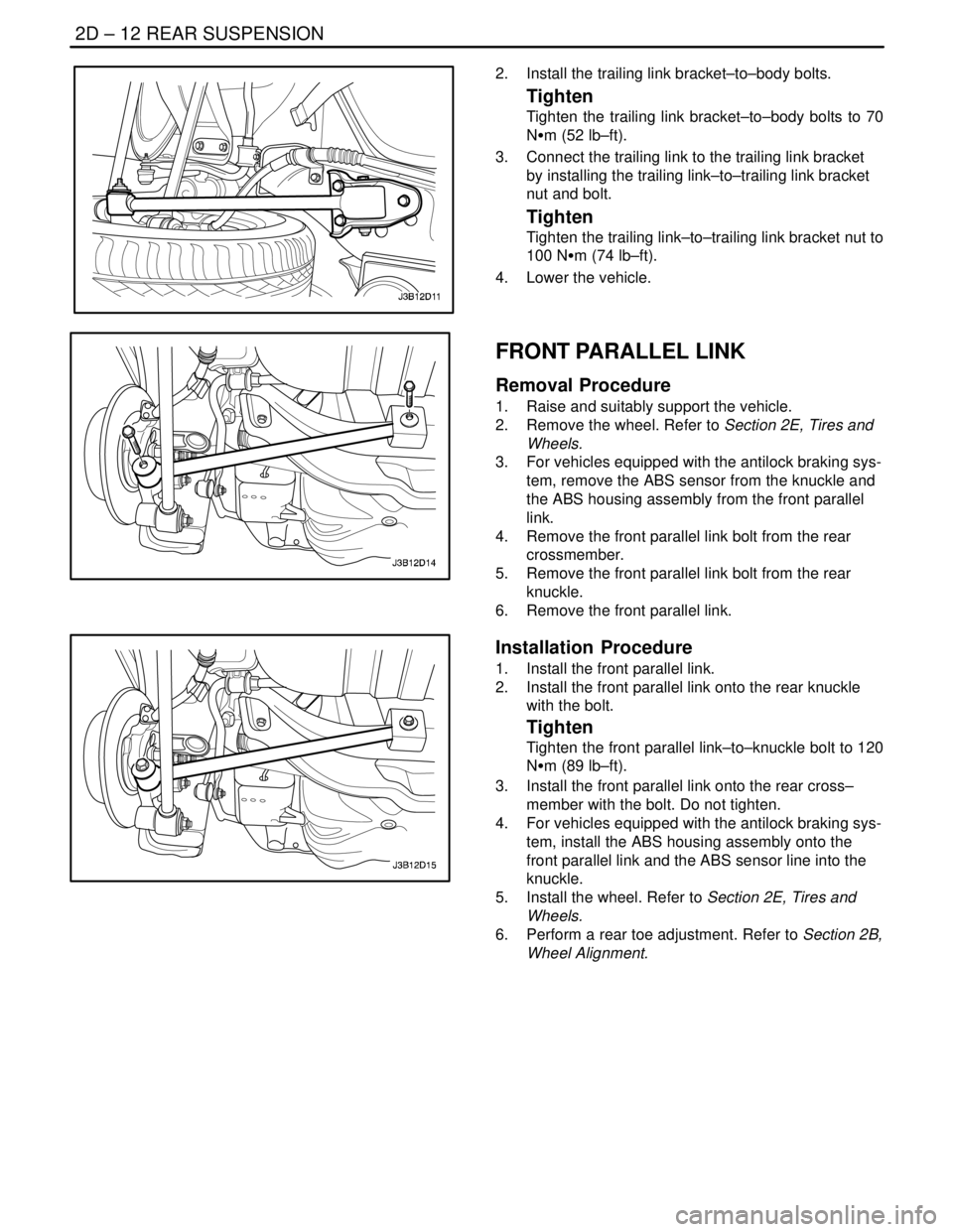
2. Install the trailing link bracket–to–body bolts.
Tighten
Tighten the trailing link bracket–to–body bolts to 70
NSm (52 lb–ft).
3. Connect the trailing link to the trailing link bracket
by installing the trailing link–to–trailing link bracket
nut and bolt.
Tighten
Tighten the trailing link–to–trailing link bracket nut to
100 NSm (74 lb–ft).
4. Lower the vehicle.
FRONT PARALLEL LINK
Removal Procedure
1. Raise and suitably support the vehicle.
2. Remove the wheel. Refer to Section 2E, Tires and
Wheels.
3. For vehicles equipped with the antilock braking sys-
tem, remove the ABS sensor from the knuckle and
the ABS housing assembly from the front parallel
link.
4. Remove the front parallel link bolt from the rear
crossmember.
5. Remove the front parallel link bolt from the rear
knuckle.
6. Remove the front parallel link.
Installation Procedure
1. Install the front parallel link.
2. Install the front parallel link onto the rear knuckle
with the bolt.
Tighten
Tighten the front parallel link–to–knuckle bolt to 120
NSm (89 lb–ft).
3. Install the front parallel link onto the rear cross–
member with the bolt. Do not tighten.
4. For vehicles equipped with the antilock braking sys-
tem, install the ABS housing assembly onto the
front parallel link and the ABS sensor line into the
knuckle.
5. Install the wheel. Refer to Section 2E, Tires and
Wheels.
6. Perform a rear toe adjustment. Refer to Section 2B,
Wheel Alignment.
Page 1021 of 2643

HYDRAULIC BRAKES 4A – 5
DAEWOO V–121 BL4
DIAGNOSIS
BRAKE SYSTEM TESTING
Brakes should be tested on a dry, clean, reasonably
smooth and level roadway. A true test of brake perfor-
mance cannot be made if the roadway is wet, greasy, or
covered with loose dirt whereby all tires do not grip the
road equally. Testing will also be adversely affected if the
roadway is crowned so as to throw the weight so roughly
that the wheels tend to bounce.
Test the brakes at different vehicle speeds with both light
and heavy pedal pressure; however, avoid locking the
brakes and sliding the tires. Locked brakes and sliding
tires do not indicate brake efficiency since heavily braked,
but turning, wheels will stop the vehicle in less distance
than locked brakes. More tire–to–road friction is present
with a heavily–braked, turning tire than with a sliding tire.
Because of the high deceleration capability, a firmer pedal
may be felt at higher deceleration levels.
There are three major external conditions that affect brake
performance:
S Tires having unequal contact and grip of the road
will cause unequal braking. Tires must be equally
inflated, and the tread pattern of the right and the
left tires must be approximately equal.
S Unequal loading of the vehicle can affect the brake
performance since the most heavily loaded wheels
require more braking power, and thus more braking
effort, than the others.
S Misalignment of the wheels, particularly conditions
of excessive camber and caster, will cause the
brakes to pull to one side.
To check for brake fluid leaks, hold constant foot pressure
on the pedal with the engine running at idle and the shift
lever in NEUTRAL. If the pedal gradually falls away with
the constant pressure, the hydraulic system may be leak-
ing. Perform a visual check to confirm any suspected
leaks.
Check the master cylinder fluid level. While a slight drop
in the reservoir level results from normal lining wear, an ab-
normally low level indicates a leak in the system. The hy-
draulic system may be leaking either internally or external-
ly. Refer to the procedure below to check the master
cylinder. Also, the system may appear to pass this test
while still having a slight leak. If the fluid level is normal,
check the vacuum booster pushrod length. If an incorrect
pushrod length is found, adjust or replace the rod.
Check the master cylinder using the following procedure:
S Check for a cracked master cylinder casting or
brake fluid leaking around the master cylinder.
Leaks are indicated only if there is at least one drop
of fluid. A damp condition is not abnormal.S Check for a binding pedal linkage and for an incor-
rect pushrod length. If both of these parts are in
satisfactory condition, disassemble the master cyl-
inder and check for an elongated or swollen primary
cylinder or piston seals. If swollen seals are found,
substandard or contaminated brake fluid should be
suspected. If contaminated brake fluid is found, all
the components should be disassembled and
cleaned, and all the rubber components should be
replaced. All of the pipes must also be flushed.
Improper brake fluid, or mineral oil or water in the fluid,
may cause the brake fluid to boil or cause deterioration of
the rubber components. If the primary piston cups in the
master cylinder are swollen, then the rubber parts have
deteriorated. This deterioration may also be evidenced by
swollen wheel cylinder piston seals on the drum brake
wheels.
If deterioration of rubber is evident, disassemble all the hy-
draulic parts and wash the parts with alcohol. Dry these
parts with compressed air before reassembly to keep alco-
hol out of the system. Replace all the rubber parts in the
system, including the hoses. Also, when working on the
brake mechanisms, check for fluid on the linings. If exces-
sive fluid is found, replace the linings.
If the master cylinder piston seals are in satisfactory condi-
tion, check for leaks or excessive heat conditions. If these
conditions are not found, drain the fluid, flush the master
cylinder with brake fluid, refill the master cylinder, and
bleed the system. Refer to ”Manual Bleeding the Brakes”
or”Pressure Bleeding the Brakes” in this section.
BRAKE HOSE INSPECTION
The hydraulic brake hoses should be inspected at least
twice a year. The brake hose assembly should be checked
for road hazard damage, cracks, chafing of the outer cov-
er, and for leaks or blisters. Inspect the hoses for proper
routing and mounting. A brake hose that rubs on a suspen-
sion component will wear and eventually fail. A light and
a mirror may be needed for an adequate inspection. If any
of the above conditions are observed on the brake hose,
adjust or replace the hose as necessary.
WARNING LAMP OPERATION
This brake system uses a BRAKE warning lamp located
in the instrument panel cluster. When the ignition switch
is in the START position, the BRAKE warning lamp should
glow and go OFF when the ignition switch returns to the
RUN position.
The following conditions will activate the BRAKE lamp:
S Parking brake applied. The light should be ON
whenever the parking brake is applied and the igni-
tion switch is ON.
S Low fluid level. A low fluid level in the master cylin-
der will turn the BRAKE lamp ON.
S EBD system is disabled. The light should be ON
when the EBD system is malfunctioning.
Page 1829 of 2643

FIVE–SPEED MANUAL TRANSAXLE 5B – 5
DAEWOO V–121 BL4
DIAGNOSIS
ISOLATE NOISE
Identify the cause of any noise before attempting to repair
the clutch, the transaxle, or their related link–ages.
Symptoms of trouble with the clutch or the manual trans-
axle include:
S A great effort required to shift gears.
S The sound of gears clashing and grinding.
S Gear blockout.
Any of these conditions requires a careful analysis. Make
the following checks before disassembling the clutch or
the transaxle for repairs.
Road Travel Noise
Many noises that appear to come from the transaxle may
actually originate with other sources such as the:
S Tires.
S Road surfaces.
S Wheel bearings.
S Engine.
S Exhaust system.
These noises may vary according to the:
S Size of the vehicle.
S Type of the vehicle.
S Amount of insulation used in the body of the ve-
hicle.
Transaxle Noise
Transaxle gears, like any mechanical device, are not ab-
solutely quiet and will make some noise during normal op-
eration.
To verify suspected transaxle noises:
1. Select a smooth, level asphalt road to reduce tire
and resonant body noise.
2. Drive the vehicle far enough to warm up all the lu-
bricants thoroughly.
3. Record the speed and the gear range of the trans-
axle when the noise occurs.
4. Check for noises with the vehicle stopped, but with
the engine running.
5. Determine if the noise occurs while the vehicle op-
erates in:
S Drive – under a light acceleration or a heavy
pull.
S Float – maintaining a constant speed with a light
throttle on a level road.
S Coast – with the transaxle in gear and the
throttle partly or fully closed.
S All of the above.
Bearing Noise
Differential Side Bearing Noise
Differential side bearing noise and wheel bearing noise
can be confused easily. Since side bearings are pre–
loaded, a differential side bearing noise should not dimin-
ish much when the differential/transaxle is run with the
wheels off the ground.
Wheel Bearing Noise
Wheel bearings produce a rough growl or grating sound
that will continue when the vehicle is coasting and the
transaxle is in NEUTRAL. Since wheel bearings are not
pre–loaded, a wheel bearing noise should diminish con-
siderably when the wheels are off the ground.
Other Noise
Brinelling
A brinelled bearing causes a ”knock” or ”click” approxi-
mately every second revolution of the wheel because the
bearing rollers do not travel at the same speed as the
wheel. In operation, the effect is characterized by a low–
pitched noise.
A brinelled bearing is caused by excessive thrust which
pushes the balls up on the pathway and creates a triangu-
lar–shaped spot in the bearing race. A brinelled bearing
can also be caused from pressing one race into position
by applying pressure on the other race.
A false indication of a brinelled bearing occurs as a result
of vibration near the area where the bearing is mounted.
Brinelling is identified by slight indentations, resulting in a
washboard effect in the bearing race.
Lapping
Lapped bearing noise occurs when fine particles of abra-
sive materials such as scale, sand, or emery circulate
through the oil in the vehicle, causing the surfaces of the
roller and the race to wear away. Bearings that wear loose
but remain smooth, without spalling or pitting, are the re-
sult of dirty oil.
Locking
Large particles of foreign material wedged between the
roller and the race usually causes one of the races to turn,
creating noise from a locked bearing. Pre–loading regular
taper roller bearings to a value higher than that specified
also can result in locked bearings
Pitting
Pitting on the rolling surface comes from normal wear and
the introduction of foreign materials.
Spalling
Spalled bearings have flaked or pitted rollers or races
caused by an overload or an incorrect assembly that re-
sults in a misalignment, a cocking of bearings, or adjust-
ments that are too tight.
After completing these checks, refer to the ”Diagnosis
Chart” in this section.
Page 1920 of 2643

POWER STEERING GEAR 6C – 3
DAEWOO V–121 BL4
DIAGNOSIS
POWER RACK AND PINION STEERING GEAR
Hissing Noise
ChecksAction
Check the intermediate shaft joints for looseness.Tighten the intermediate shaft joints.
Check the power steering hose for contact with other com-
ponents.Be sure the power steering hose is correctly fitted into the
hose clips.
Rattling Noise in Steering Gear
ChecksAction
Check the power steering hose for contact with the body.Be sure the power steering hose is correctly fitted into the
hose clips.
Check the steering gear for insufficient lubrication.Lubricate the steering gear.
Check the steering gear mounting for improper installa-
tion.Tighten the steering gear mounting bracket nuts and bolts.
Check the outer tie rods for improper installation.Tighten the outer tie rod joints. Replace the outer tie rods.
Poor Return of Steering Wheel to Center
ChecksAction
Check the steering wheel for contact with the turn signal
housing.Adjust the turn signal housing.
Check the intermediate shaft joints for binding or loose-
ness.Replace the intermediate shaft.
Check the power steering pump flow control valve for
sticking and improper alignment.Replace the power steering pump.
Check the wheel alignment.Align the wheels.
Check the wheel bearings for wear or damage.Replace the wheel bearings.
Check the intermediate shaft joints for improper installa-
tion.Adjust the intermediate shaft between the steering gear
and the steering column.
Replace the intermediate shaft.
Check the outer tie rods and the ball joints for binding or
looseness.Tighten the tie rods and the ball joints. Replace the tie rods
and the ball joints.
Check the steering gear adjustments.Perform a straight–ahead check.
Check the steering column shaft seal for rubbing on the
shaft.Replace the dash seal.
Check the steering shaft bearings for binding.Replace the stub shaft bearings.
Momentary Increase in Effort When Turning the Wheel Quickly
ChecksAction
Check the power steering pump for internal leaks.Replace the power steering pump.
Check the hoses for damage or restricted flow.Replace the power steering hoses and/or pipes.
Check the power steering fluid level.Fill the power steering fluid reservoir.
Check the power steering pump flow control valve for
sticking and improper operation.Replace the power steering pump.
Page 1931 of 2643
6C – 14IPOWER STEERING GEAR
DAEWOO V–121 BL4
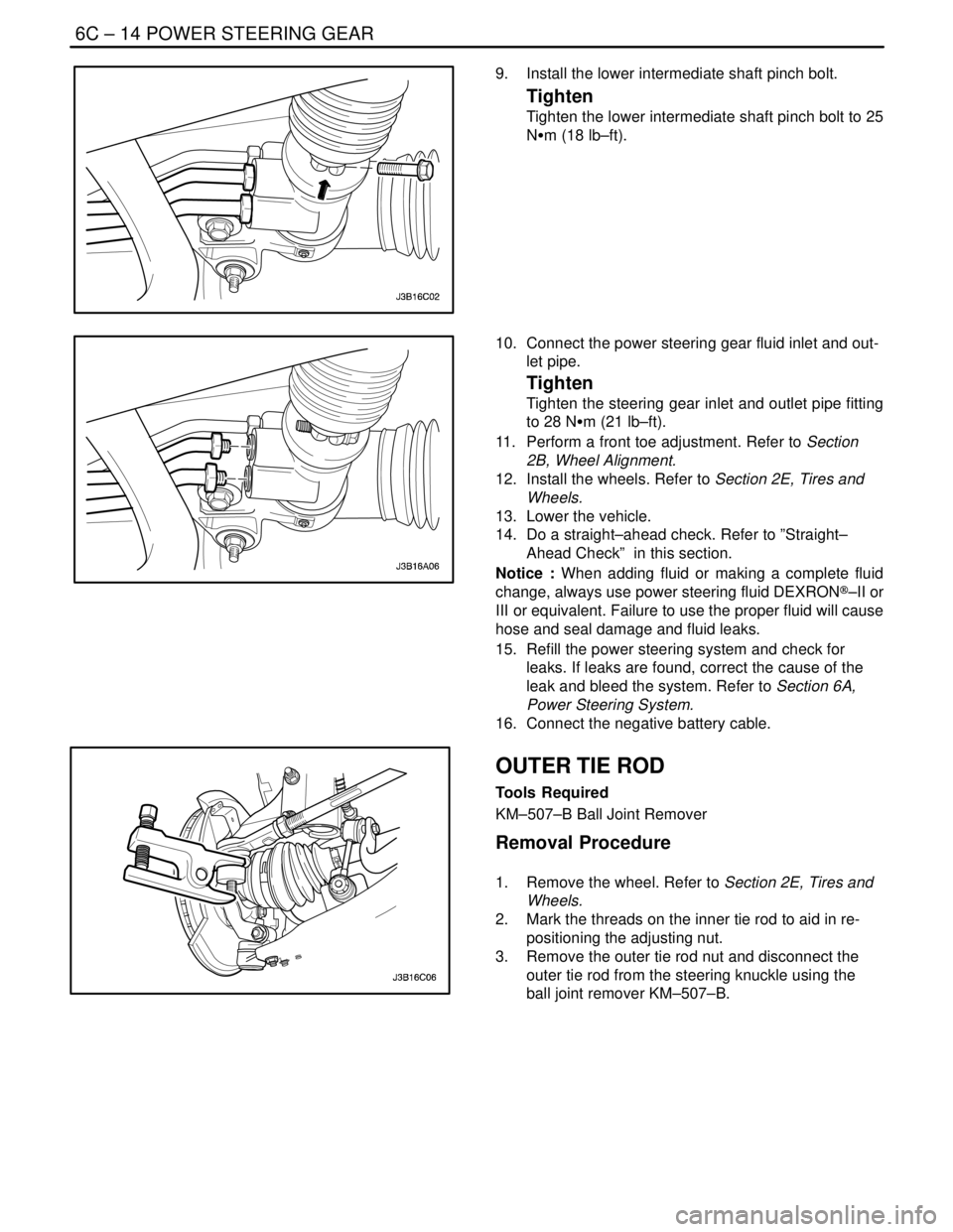
9. Install the lower intermediate shaft pinch bolt.
Tighten
Tighten the lower intermediate shaft pinch bolt to 25
NSm (18 lb–ft).
10. Connect the power steering gear fluid inlet and out-
let pipe.
Tighten
Tighten the steering gear inlet and outlet pipe fitting
to 28 NSm (21 lb–ft).
11. Perform a front toe adjustment. Refer to Section
2B, Wheel Alignment.
12. Install the wheels. Refer to Section 2E, Tires and
Wheels.
13. Lower the vehicle.
14. Do a straight–ahead check. Refer to ”Straight–
Ahead Check” in this section.
Notice : When adding fluid or making a complete fluid
change, always use power steering fluid DEXRON®–II or
III or equivalent. Failure to use the proper fluid will cause
hose and seal damage and fluid leaks.
15. Refill the power steering system and check for
leaks. If leaks are found, correct the cause of the
leak and bleed the system. Refer to Section 6A,
Power Steering System.
16. Connect the negative battery cable.
OUTER TIE ROD
Tools Required
KM–507–B Ball Joint Remover
Removal Procedure
1. Remove the wheel. Refer to Section 2E, Tires and
Wheels.
2. Mark the threads on the inner tie rod to aid in re-
positioning the adjusting nut.
3. Remove the outer tie rod nut and disconnect the
outer tie rod from the steering knuckle using the
ball joint remover KM–507–B.
Page 1932 of 2643
POWER STEERING GEAR 6C – 15
DAEWOO V–121 BL4
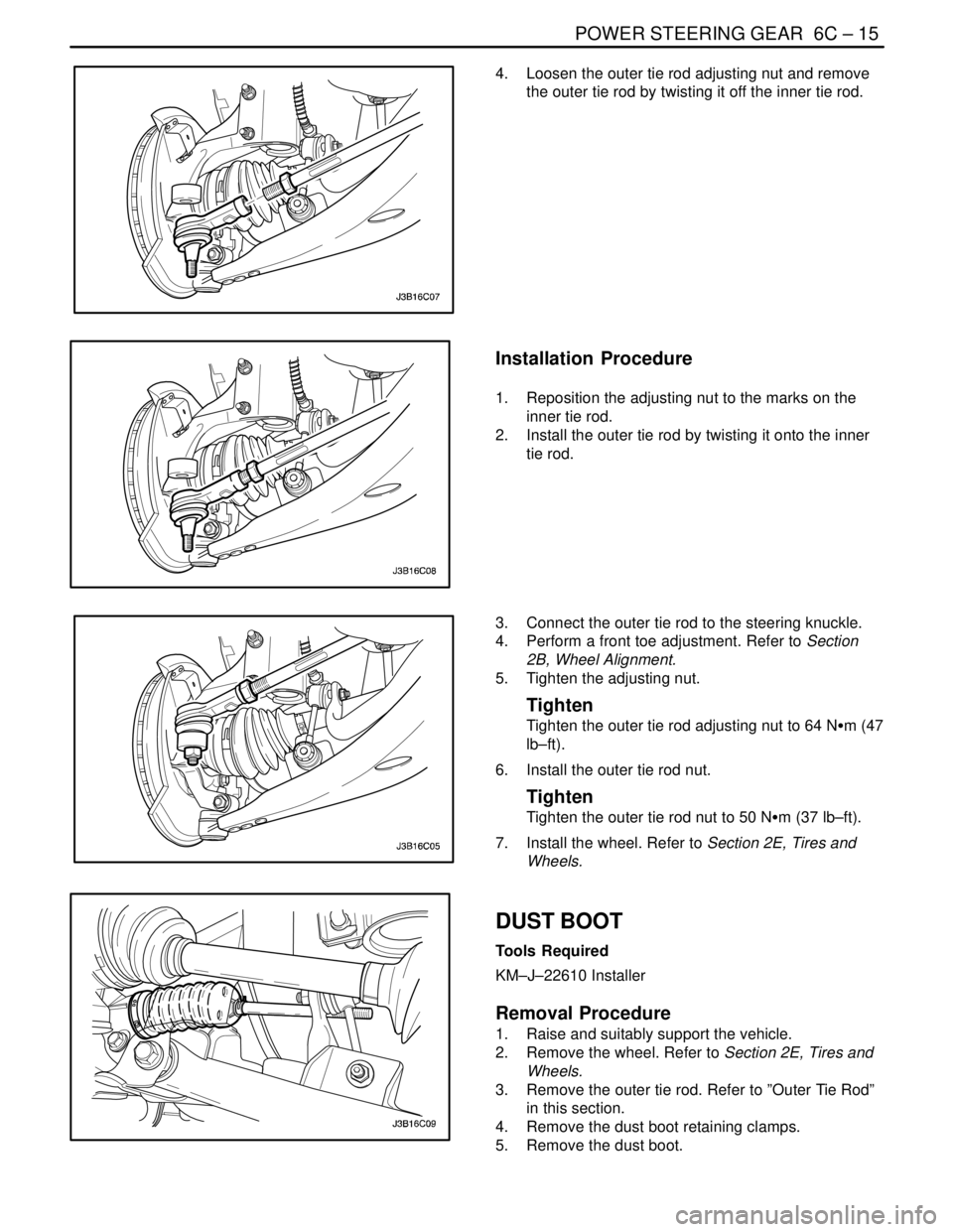
4. Loosen the outer tie rod adjusting nut and remove
the outer tie rod by twisting it off the inner tie rod.
Installation Procedure
1. Reposition the adjusting nut to the marks on the
inner tie rod.
2. Install the outer tie rod by twisting it onto the inner
tie rod.
3. Connect the outer tie rod to the steering knuckle.
4. Perform a front toe adjustment. Refer to Section
2B, Wheel Alignment.
5. Tighten the adjusting nut.
Tighten
Tighten the outer tie rod adjusting nut to 64 NSm (47
lb–ft).
6. Install the outer tie rod nut.
Tighten
Tighten the outer tie rod nut to 50 NSm (37 lb–ft).
7. Install the wheel. Refer to Section 2E, Tires and
Wheels.
DUST BOOT
Tools Required
KM–J–22610 Installer
Removal Procedure
1. Raise and suitably support the vehicle.
2. Remove the wheel. Refer to Section 2E, Tires and
Wheels.
3. Remove the outer tie rod. Refer to ”Outer Tie Rod”
in this section.
4. Remove the dust boot retaining clamps.
5. Remove the dust boot.
Page 1934 of 2643
POWER STEERING GEAR 6C – 17
DAEWOO V–121 BL4
Straight–Ahead Check Table
StepActionValue(s)YesNo
1Place the steering wheel in the straight–
ahead position.
Is the wheel in the correct position?–Go to
Step 2–
2Is the lower intermediate shaft pinch bolt lying
parallel to the steering gear?–Go to
Step 3Go to
Step 4
3Is the steering wheel off center by more than
5 degrees?–Go to
Step 5Go to
Step 6
4The pinion is displaced on the rack. The steer-
ing pinion position must be corrected.
Is the repair complete?–Go to
Step 2–
5Remove steering wheel and center on the
spindle splines.
Is the repair complete?–Go to
Step 3–
6Turn the steering wheel all the way to the
right. Measure the inner and the outer angles
of the tire centerline compared to the straight–
ahead centerline. Are the angles within speci-
fications?Inner
angle:
37.5°
Outer
angle: 31°System
OKGo to
Step 7
7The rack assembly was not assembled cor-
rectly.
Repair as needed.
Is the repair complete?–Go to
Step 6–
INTERMEDIATE SHAFT AND DASH
SEAL
(Left–Hand Drive Shown, Right–Hand
Drive Similar)
Removal Procedure
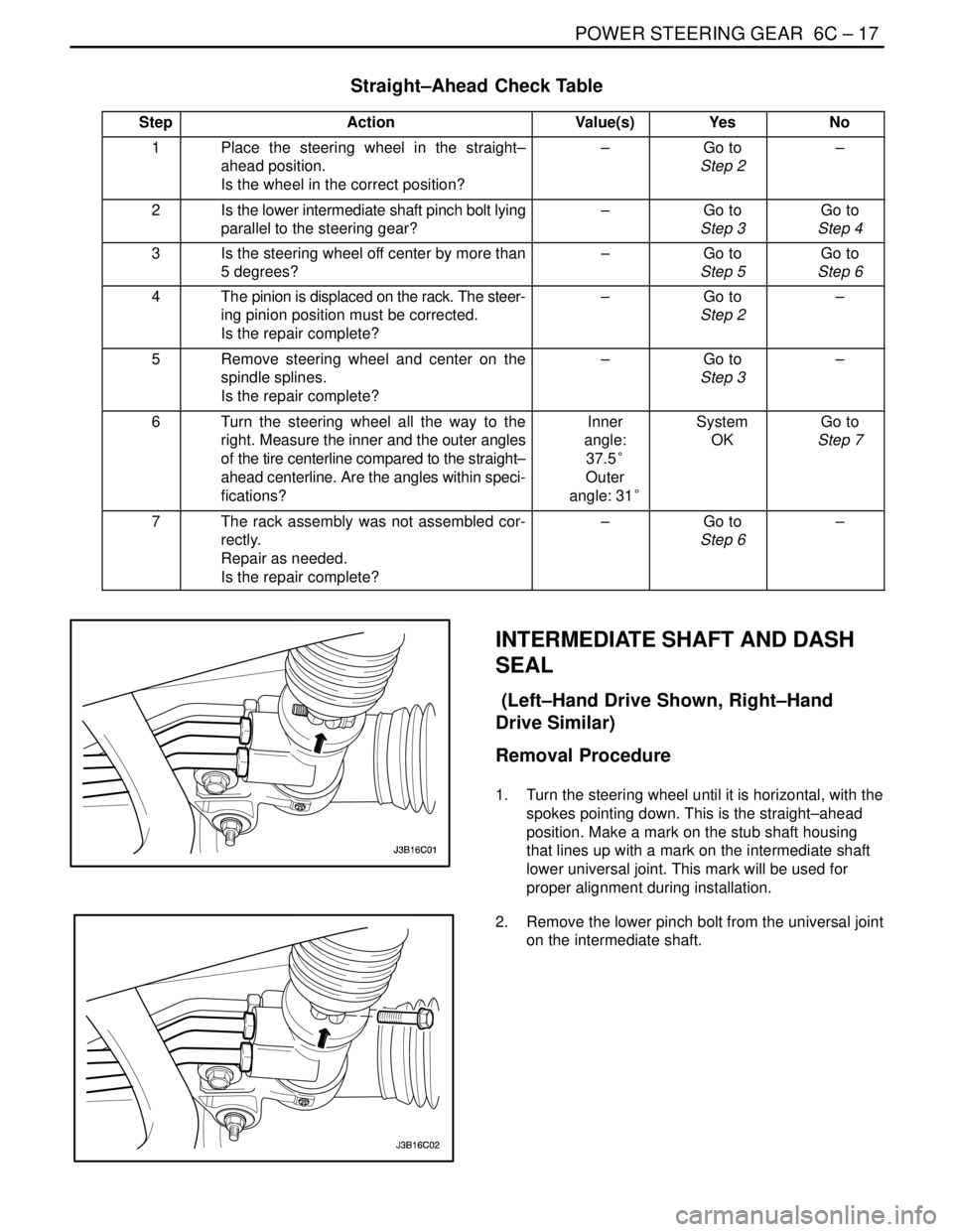
1. Turn the steering wheel until it is horizontal, with the
spokes pointing down. This is the straight–ahead
position. Make a mark on the stub shaft housing
that lines up with a mark on the intermediate shaft
lower universal joint. This mark will be used for
proper alignment during installation.
2. Remove the lower pinch bolt from the universal joint
on the intermediate shaft.
Page 1942 of 2643
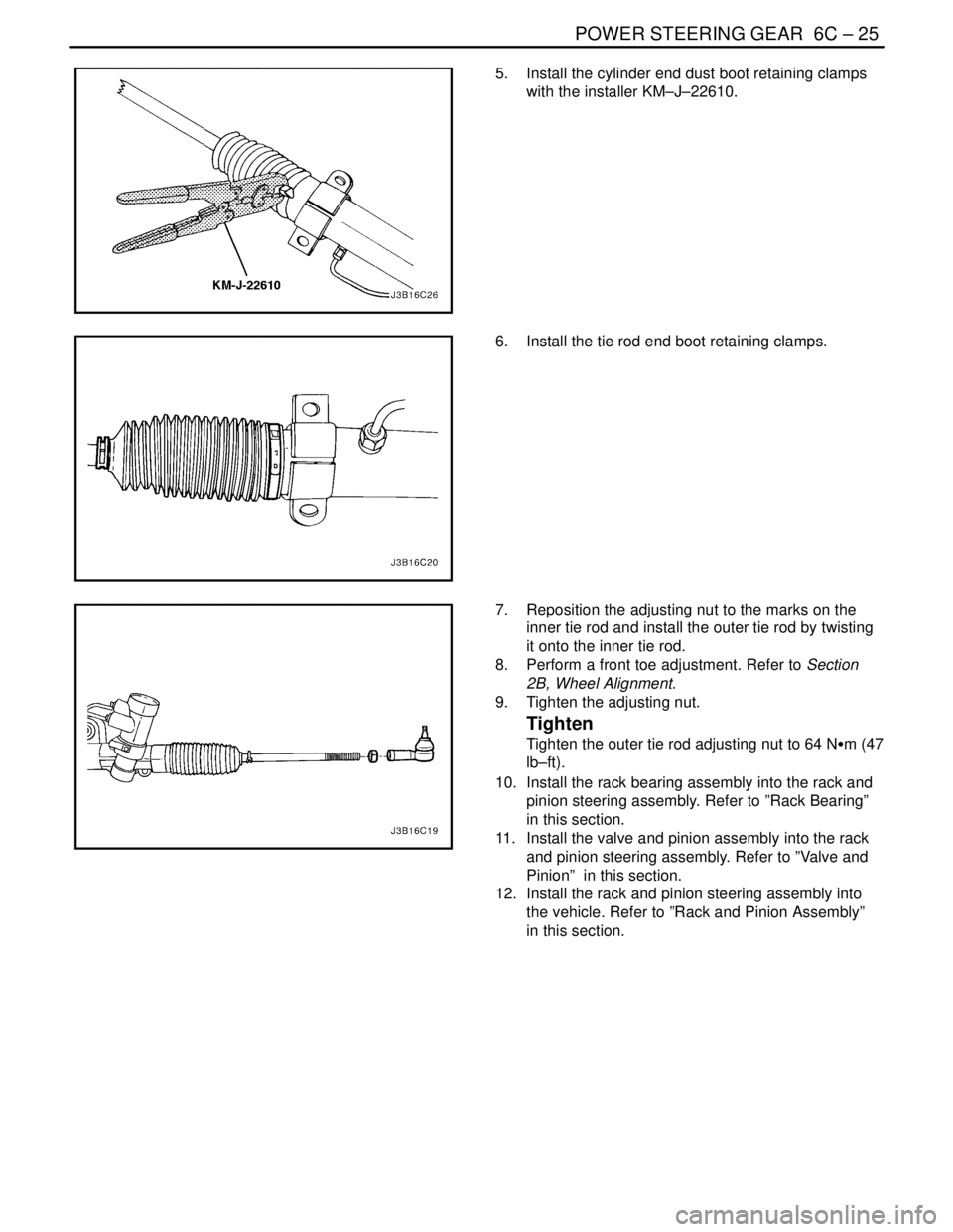
POWER STEERING GEAR 6C – 25
DAEWOO V–121 BL4
5. Install the cylinder end dust boot retaining clamps
with the installer KM–J–22610.
6. Install the tie rod end boot retaining clamps.
7. Reposition the adjusting nut to the marks on the
inner tie rod and install the outer tie rod by twisting
it onto the inner tie rod.
8. Perform a front toe adjustment. Refer to Section
2B, Wheel Alignment.
9. Tighten the adjusting nut.
Tighten
Tighten the outer tie rod adjusting nut to 64 NSm (47
lb–ft).
10. Install the rack bearing assembly into the rack and
pinion steering assembly. Refer to ”Rack Bearing”
in this section.
11. Install the valve and pinion assembly into the rack
and pinion steering assembly. Refer to ”Valve and
Pinion” in this section.
12. Install the rack and pinion steering assembly into
the vehicle. Refer to ”Rack and Pinion Assembly”
in this section.
Page 1957 of 2643

STEERING WHEEL AND COLUMN 6E – 3
DAEWOO V–121 BL4
High Lock Effort
ChecksAction
Check the lock cylinder for damage.Replace the lock cylinder.
Check the ignition switch for lack of free movement.Lubricate the ignition switch.
Check for extreme misalignment of the housing to the cov-
er.Realign the cover on the housing. Replace the cover as
needed.
Check for a bent ignition switch mounting bracket.Replace the ignition switch mounting bracket.
Key Cannot Be Removed in the LOCK Position
ChecksAction
Check to see that the ignition switch is set correctly.Reset the ignition switch.
Check the lock cylinder for damage.Replace the lock cylinder.
Check the fuse F17 from the I/P fuse block.Replace the fuse F17
Check for an open or short in the circuit between terminal
2 of key interlock solenoid and the I/P fuse block.Replace the fuse F17
Select the gear shift lever to ”P” position.
Check the resistance between the terminal 2 and 1 of the
”P” position switch.Replace the ”P” position switch.
Check for an open or short in the circuit between the
ground G202 and terminal 1 of the key interlock unit.Replace the open or short from the circuit.
Turn the ignition ON.
Select the gear shift lever to ”P” position.
Check the resistance between the terminal 1 and 2 of the
key interlock solenoid.Replace the key interlock solenoid.