ABS DAEWOO NUBIRA 2004 Service Owner's Guide
[x] Cancel search | Manufacturer: DAEWOO, Model Year: 2004, Model line: NUBIRA, Model: DAEWOO NUBIRA 2004Pages: 2643, PDF Size: 80.54 MB
Page 408 of 2643

1F – 162IENGINE CONTROLS
DAEWOO V–121 BL4
DIAGNOSTIC TROUBLE CODE (DTC) P0172
FUEL TRIM SYSTEM TOO RICH
System Description
If the adaptation value threshold is permanently exceed-
ed, the deviation of the adaptive terms enables to detect
a slow default coming out. Two time counters (one for the
rich side and another one for the lean side) are increased
while the lambda controller exceeds the adaptation
thresholds. As soon as one of the time counters reaches
its maximum value, the error is detected.The aim of this
test is to simulate a failure that would result in exceeding
the adaptive terms. Two kinds of failure must be created.
S A lean side deviation: P0171
S A rich side deviation : P0172
It is thus necessary to determine, for each kind of failure,
the limit good and the limit bad. For a given failure, mea-
sure the emission threshold until the legal emission
thresholds are exceeded.Note that the problem is due to
the emission thresholds required, it is not simple to disturb
the system so that the emission thresholds will be exceed-
ed. The tuning has been made thanks to a dedicated cal-
ibration but, as such a procedure is not permitted by the
regulation, it is necessary to create some material mal-
function (fuel pressure regulator, fuel injector, air leak-
age...).
Conditions for Setting the DTC
S DTCs P0107, P0108, P0112, P0113, P0117,
P0118, P0122, P0123, P0131, P0132, P0337,
P0338, P0341, P0342, P0400, P1319, P1402,
P1404, P1405, P1671 and P1672 are not set.
S Coolant temperature is greater than 20°C (68°F).
(1.4L DOHC)
S Coolant temperature is greater than 80°C (176°F).
(1.6L DOHC)
S Manifold Absolute Pressure (MAP) is greater than
70 kPa (10.2 psi).
S System is in closed loop.
Action Taken When the DTC SetsS The Malfunction Indicator Lamp (MIL) will illuminate
after three consecutive trip with a fail.
S The ECM will record operating conditions at the
time the diagnostic fail. This information will be
stored in the Freeze Frame and Failure Records
buffers.
S A history DTC is stored.
Conditions for Clearing the MIL/DTC
S The MIL will turn off after four consecutive ignition
cycles in which the diagnostic runs without a fault.
S A history DTC will clear after 40 consecutive warm
up cycles without a fault.
S DTC(s) can be cleared by using the scan tool.
S Disconnecting the ECM battery feed for 10 sec-
onds.
Diagnostic Aids
Important : After repairs, use the scan tool Fuel Trim Re-
set function to reset the long–term fuel trim to 128 (0%).
Check for poor connection at the ECM. Inspect the har-
ness connectors for the following conditions:
S Backed–out terminals.
S Improper mating.
S Broken locks.
S Improperly formed.
S Damaged terminals.
S Poor terminal–to–wire connection.
Inspect the wiring harness for damage. If the harness ap-
pears to be OK, observe the O2S display on the scan tool
while moving the connectors and the wiring harness re-
lated to the engine harness. A change in the display will
indicate the location of the fault.
If a DTC P1404 is also set, check the 5 volt reference cir-
cuits for a short to voltage.
Check for a restricted exhaust system.
A shorted 5 volt reference circuit may cause a DTC P0172
to set. Check the 5 volt reference sensors for abnormal
readings.
DTC P0172 – Fuel Trim System Too Rich
StepActionValue(s)YesNo
1Perform an Euro On–Board Diagnostic (EOBD)
System Check.
Is the system check complete?–Go to Step 2Go to
”On–Board
Diagnostic Sys-
tem Check”
21. Install the scan tool to the Data Link Connector
(DLC).
2. Turn the ignition ON.
Are any component related Diagnostic Trouble
Codes (DTCs) set?–Go to
applicable DTC
tableGo to Step 3
Page 409 of 2643

ENGINE CONTROLS 1F – 163
DAEWOO V–121 BL4
StepNo Yes Value(s) Action
3With the engine running, operate the vehicle until the
LOOP STATUS indicates closed.
Is the Long Term Fuel Trim value above the specified
value?–30%Go to Step 4Go to Step 5
41. Turn the ignition switch ON, with the engine
OFF.
2. Review the Freeze Frame data and note the
parameters.
3. Operate the vehicle within the Freeze Frame
conditions and Conditions for Setting The DTC
as noted.
Does the Long Term Fuel Trim value above the spe-
cified value while operating under the specified con-
ditions?–30%Go to Step 21Go to Step 5
5Visually/physically check the air cleaner filter for ex-
cessive dirt or being plugged and repair as needed.
Is the repair complete?–Go to Step 21Go to Step 6
6Visually/physically check the air intake system for
collapsed or restricted and repair as needed.
Is the repair complete?–Go to Step 21Go to Step 7
7Inspect the throttle body inlet for damaged or foreign
objects which may partially block the airflow and re-
pair as needed.
Is the repair complete?–Go to Step 21Go to Step 8
81. Turn the ignition OFF.
2. Inspect the throttle bore, throttle plate and Idle
Air Control (IAC) passages for clocking and
foreign objects and repair as needed.
Is the repair complete?–Go to Step 21Go to Step 9
9Start the engine with the vehicle in park or neutral
and A/C off and note the idle quality.
Is a low or unsteady idle being experienced?–Go to Step 10Go to Step 12
10Idle the engine.
Are the IAC counts below the specified value?100Go to Step 12Go to Step 11
111. Turn the ignition OFF.
2. Disconnect the Manifold Absolute Pressure
(MAP) sensor electrical connector.
3. Start the engine.
4. Operate the vehicle in Closed Loop while moni-
toring the Long Term Fuel Trim value.
Does the Long Term Fuel Trim value increase above
the specified value?–30%Go to Step 20Go to Step 12
12Check the IAC valve performance. Refer to ”DTC
P0506 Idle Speed RPM Lower Than Desired Idle
Speed” or ”DTC P0507 Idle Speed RPM Higher
Than Desired Idle Speed” in this section and repair
as necessary.
Is the repair complete?–Go to Step 21Go to Step 13
Page 464 of 2643
1F – 218IENGINE CONTROLS
DAEWOO V–121 BL4
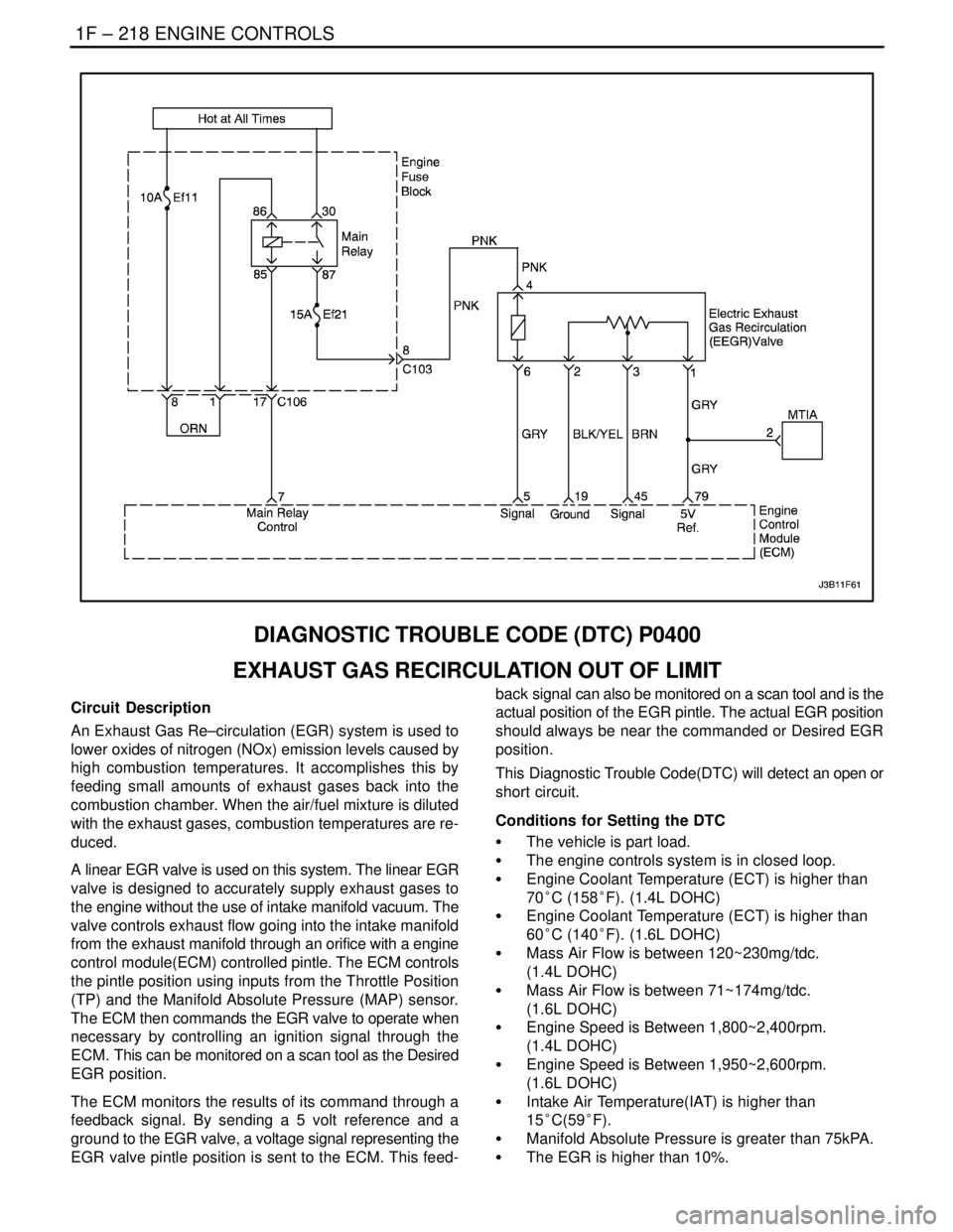
DIAGNOSTIC TROUBLE CODE (DTC) P0400
EXHAUST GAS RECIRCULATION OUT OF LIMIT
Circuit Description
An Exhaust Gas Re–circulation (EGR) system is used to
lower oxides of nitrogen (NOx) emission levels caused by
high combustion temperatures. It accomplishes this by
feeding small amounts of exhaust gases back into the
combustion chamber. When the air/fuel mixture is diluted
with the exhaust gases, combustion temperatures are re-
duced.
A linear EGR valve is used on this system. The linear EGR
valve is designed to accurately supply exhaust gases to
the engine without the use of intake manifold vacuum. The
valve controls exhaust flow going into the intake manifold
from the exhaust manifold through an orifice with a engine
control module(ECM) controlled pintle. The ECM controls
the pintle position using inputs from the Throttle Position
(TP) and the Manifold Absolute Pressure (MAP) sensor.
The ECM then commands the EGR valve to operate when
necessary by controlling an ignition signal through the
ECM. This can be monitored on a scan tool as the Desired
EGR position.
The ECM monitors the results of its command through a
feedback signal. By sending a 5 volt reference and a
ground to the EGR valve, a voltage signal representing the
EGR valve pintle position is sent to the ECM. This feed-back signal can also be monitored on a scan tool and is the
actual position of the EGR pintle. The actual EGR position
should always be near the commanded or Desired EGR
position.
This Diagnostic Trouble Code(DTC) will detect an open or
short circuit.
Conditions for Setting the DTC
S The vehicle is part load.
S The engine controls system is in closed loop.
S Engine Coolant Temperature (ECT) is higher than
70°C (158°F). (1.4L DOHC)
S Engine Coolant Temperature (ECT) is higher than
60°C (140°F). (1.6L DOHC)
S Mass Air Flow is between 120~230mg/tdc.
(1.4L DOHC)
S Mass Air Flow is between 71~174mg/tdc.
(1.6L DOHC)
S Engine Speed is Between 1,800~2,400rpm.
(1.4L DOHC)
S Engine Speed is Between 1,950~2,600rpm.
(1.6L DOHC)
S Intake Air Temperature(IAT) is higher than
15°C(59°F).
S Manifold Absolute Pressure is greater than 75kPA.
S The EGR is higher than 10%.
Page 467 of 2643
ENGINE CONTROLS 1F – 221
DAEWOO V–121 BL4
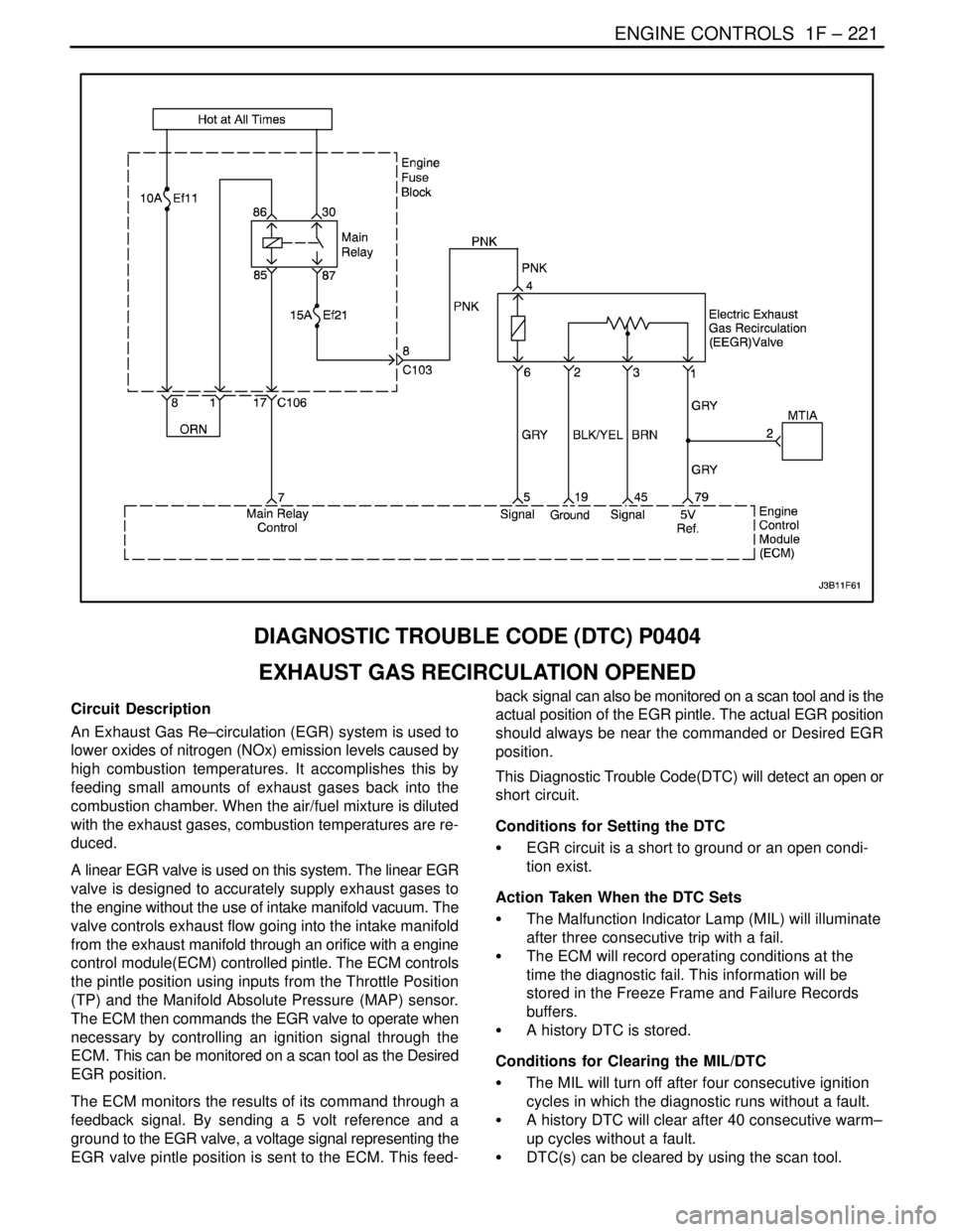
DIAGNOSTIC TROUBLE CODE (DTC) P0404
EXHAUST GAS RECIRCULATION OPENED
Circuit Description
An Exhaust Gas Re–circulation (EGR) system is used to
lower oxides of nitrogen (NOx) emission levels caused by
high combustion temperatures. It accomplishes this by
feeding small amounts of exhaust gases back into the
combustion chamber. When the air/fuel mixture is diluted
with the exhaust gases, combustion temperatures are re-
duced.
A linear EGR valve is used on this system. The linear EGR
valve is designed to accurately supply exhaust gases to
the engine without the use of intake manifold vacuum. The
valve controls exhaust flow going into the intake manifold
from the exhaust manifold through an orifice with a engine
control module(ECM) controlled pintle. The ECM controls
the pintle position using inputs from the Throttle Position
(TP) and the Manifold Absolute Pressure (MAP) sensor.
The ECM then commands the EGR valve to operate when
necessary by controlling an ignition signal through the
ECM. This can be monitored on a scan tool as the Desired
EGR position.
The ECM monitors the results of its command through a
feedback signal. By sending a 5 volt reference and a
ground to the EGR valve, a voltage signal representing the
EGR valve pintle position is sent to the ECM. This feed-back signal can also be monitored on a scan tool and is the
actual position of the EGR pintle. The actual EGR position
should always be near the commanded or Desired EGR
position.
This Diagnostic Trouble Code(DTC) will detect an open or
short circuit.
Conditions for Setting the DTC
S EGR circuit is a short to ground or an open condi-
tion exist.
Action Taken When the DTC Sets
S The Malfunction Indicator Lamp (MIL) will illuminate
after three consecutive trip with a fail.
S The ECM will record operating conditions at the
time the diagnostic fail. This information will be
stored in the Freeze Frame and Failure Records
buffers.
S A history DTC is stored.
Conditions for Clearing the MIL/DTC
S The MIL will turn off after four consecutive ignition
cycles in which the diagnostic runs without a fault.
S A history DTC will clear after 40 consecutive warm–
up cycles without a fault.
S DTC(s) can be cleared by using the scan tool.
Page 470 of 2643
1F – 224IENGINE CONTROLS
DAEWOO V–121 BL4
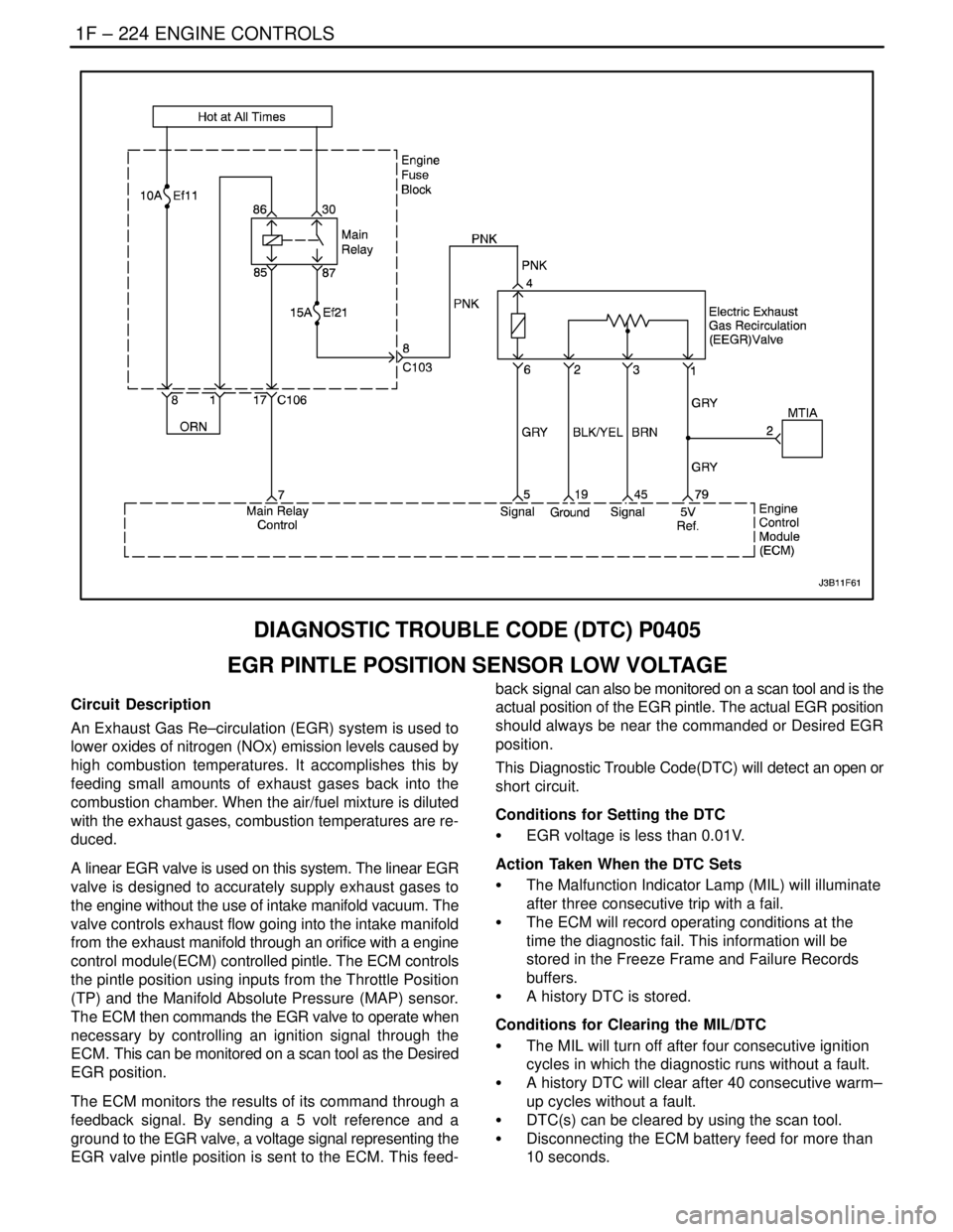
DIAGNOSTIC TROUBLE CODE (DTC) P0405
EGR PINTLE POSITION SENSOR LOW VOLTAGE
Circuit Description
An Exhaust Gas Re–circulation (EGR) system is used to
lower oxides of nitrogen (NOx) emission levels caused by
high combustion temperatures. It accomplishes this by
feeding small amounts of exhaust gases back into the
combustion chamber. When the air/fuel mixture is diluted
with the exhaust gases, combustion temperatures are re-
duced.
A linear EGR valve is used on this system. The linear EGR
valve is designed to accurately supply exhaust gases to
the engine without the use of intake manifold vacuum. The
valve controls exhaust flow going into the intake manifold
from the exhaust manifold through an orifice with a engine
control module(ECM) controlled pintle. The ECM controls
the pintle position using inputs from the Throttle Position
(TP) and the Manifold Absolute Pressure (MAP) sensor.
The ECM then commands the EGR valve to operate when
necessary by controlling an ignition signal through the
ECM. This can be monitored on a scan tool as the Desired
EGR position.
The ECM monitors the results of its command through a
feedback signal. By sending a 5 volt reference and a
ground to the EGR valve, a voltage signal representing the
EGR valve pintle position is sent to the ECM. This feed-back signal can also be monitored on a scan tool and is the
actual position of the EGR pintle. The actual EGR position
should always be near the commanded or Desired EGR
position.
This Diagnostic Trouble Code(DTC) will detect an open or
short circuit.
Conditions for Setting the DTC
S EGR voltage is less than 0.01V.
Action Taken When the DTC Sets
S The Malfunction Indicator Lamp (MIL) will illuminate
after three consecutive trip with a fail.
S The ECM will record operating conditions at the
time the diagnostic fail. This information will be
stored in the Freeze Frame and Failure Records
buffers.
S A history DTC is stored.
Conditions for Clearing the MIL/DTC
S The MIL will turn off after four consecutive ignition
cycles in which the diagnostic runs without a fault.
S A history DTC will clear after 40 consecutive warm–
up cycles without a fault.
S DTC(s) can be cleared by using the scan tool.
S Disconnecting the ECM battery feed for more than
10 seconds.
Page 473 of 2643

ENGINE CONTROLS 1F – 227
DAEWOO V–121 BL4
DIAGNOSTIC TROUBLE CODE (DTC) P0406
EGR PINTLE POSITION SENSOR HIGH VOLTAGE
Circuit Description
An Exhaust Gas Re–circulation (EGR) system is used to
lower oxides of nitrogen (NOx) emission levels caused by
high combustion temperatures. It accomplishes this by
feeding small amounts of exhaust gases back into the
combustion chamber. When the air/fuel mixture is diluted
with the exhaust gases, combustion temperatures are re-
duced.
A linear EGR valve is used on this system. The linear EGR
valve is designed to accurately supply exhaust gases to
the engine without the use of intake manifold vacuum. The
valve controls exhaust flow going into the intake manifold
from the exhaust manifold through an orifice with a engine
control module(ECM) controlled pintle. The ECM controls
the pintle position using inputs from the Throttle Position
(TP) and the Manifold Absolute Pressure (MAP) sensor.
The ECM then commands the EGR valve to operate when
necessary by controlling an ignition signal through the
ECM. This can be monitored on a scan tool as the Desired
EGR position.
The ECM monitors the results of its command through a
feedback signal. By sending a 5 volt reference and a
ground to the EGR valve, a voltage signal representing the
EGR valve pintle position is sent to the ECM. This feed-back signal can also be monitored on a scan tool and is the
actual position of the EGR pintle. The actual EGR position
should always be near the commanded or Desired EGR
position.
This Diagnostic Trouble Code(DTC) will detect an open or
short circuit.
Conditions for Setting the DTC
S EGR voltage is higher than 4.99V.
Action Taken When the DTC Sets
S The Malfunction Indicator Lamp (MIL) will illuminate
after three consecutive trip with a fail.
S The ECM will record operating conditions at the
time the diagnostic fail. This information will be
stored in the Freeze Frame and Failure Records
buffers.
S A history DTC is stored.
Conditions for Clearing the MIL/DTC
S The MIL will turn off after four consecutive ignition
cycles in which the diagnostic runs without a fault.
S A history DTC will clear after 40 consecutive warm–
up cycles without a fault.
S DTC(s) can be cleared by using the scan tool.
S Disconnecting the ECM battery feed for more than
10 seconds.
Page 476 of 2643

1F – 230IENGINE CONTROLS
DAEWOO V–121 BL4
DIAGNOSTIC TROUBLE CODE (DTC) P0420
CATALYST LOW EFFICIENCY
Circuit Description
In order to control exhaust emissions of Hydrocarbons
(HC), Carbon Monoxide (CO) and Nitrogen Oxide (NOx),
a Three–Way Catalytic Converter (TWC) is used. The cat-
alyst within the converter promotes a chemical reaction
which oxidizes the HC and CO present in the exhaust gas,
converting them into harmless water vapor and carbon
dioxide, it also reduces NOx, converting it into nitrogen.
The catalytic converter also has the ability to store oxygen.
The Engine Control Module (ECM) has the capability to
monitor this process using a Heated Oxygen Sensor
(HO2S) located in the exhaust stream past the TWC. The
HO2S produces an output signal which indicates the oxy-
gen storage capacity of the catalyst; this in turn indicates
the catalyst’s ability to convert exhaust emissions effec-
tively. The ECM monitors the catalyst efficiency by first al-
lowing the catalyst to heat up, waiting for a stabilization pe-
riod while the engine is idling, and then adding and
removing fuel while monitoring the reaction of the HO2S.
When the catalyst is functioning properly, the HO2S re-
sponse to the extra fuel is slow compared to the Oxygen
Sensor (O2S). When the HO2S response is close to that
of the O2S, the Oxygen storage capability or efficiency of
the catalyst is considered to be bad, and the Malfunction
Indicator Lamp (MIL) will illuminate.
Conditions for Setting the DTC
S Closed loop stoichiometry.
S Engine Coolant Temperature (ECT) is more than
75°C (167°F) . (1.4L DOHC)
S Engine Coolant Temperature (ECT) is more than
70°C (158°F) . (1.6L DOHC)
S Engine speed between 1,766rpm and 2,368rpm.
(1.4L DOHC)
S Engine speed between 1,760rpm and 2,530rpm.
(1.6L DOHC)
S Vehicle speed is between 47km/h (29.2mph) and
80km/h (49.7mph). (1.4L DOHC)
S Vehicle speed is between 60km/h (37.3mph) and
76km/h (47.2mph). (1.6L DOHC)
S The manifold absolute pressure is greater than 70
kpa. (1.4L DOHC)S The manifold absolute pressure is greater than 76
kpa. (1.6L DOHC)
S Activity of the heated oxygen sensor excited by
lambda controller stimuli higher than a threshold.
S DTC(s) P0107, P0108, P0117, P0118, P0122,
P0123, P0131, P0132, P0133, P0137, P0138,
P0140, P0141, P0171, P0172, P0300, P0336,
P0337, P0341, P0342, P0351, P0352, P0404,
P0405, P0405 and P0562 are not sets.
Action Taken When the DTC Sets
S The Malfunction Indicator Lamp (MIL) will illuminate
after three consecutive trip with a fail.
S The ECM will record operating conditions at the
time the diagnostic fail. This information will be
stored in the Freeze Frame and Failure Records
buffers.
S A history DTC is stored.
Conditions for Clearing the MIL/DTC
S The MIL will turn off after four consecutive ignition
cycles in which the diagnostic runs without a fault.
S A history DTC will clear after 40 consecutive warm–
up cycles without a fault.
S DTC(s) can be cleared by using the scan tool.
S Disconnecting the ECM battery feed for more than
10 seconds.
Diagnostic Aids
The catalyst test may abort due to a change in the engine
load. Do not change the engine load (i.e. A/C, coolant fan,
heater motor) while a catalyst test is in progress.
An intermittent problem may be caused by a poor connec-
tion, rubbed–through wire insulation, or a wire that is bro-
ken inside the insulation.
Any circuitry, that is suspected as causing the intermittent
complaint, should be thoroughly checked for the following
conditions:
S Backed–out terminals
S Improper mating
S Broken locks
S Improperly formed
S Damaged terminals
S Poor terminal–to–wire connection.
Page 545 of 2643

ENGINE CONTROLS 1F – 299
DAEWOO V–121 BL4
DIAGNOSTIC TROUBLE CODE (DTC) P1382
ROUGH ROAD DATA INVALID (NON ABS)
Circuit Description
The VR sensor is used to detecting the road situation.
By sensing difference of wheel rotation duration caused by
bumps or potholes in the road, the Engine Control Module
(ECM) can determine if the changes in crankshaft speed
are due to engine misfire or are driveline induced. If the VR
sensor detects a rough road condition, the ECM misfire
detection diagnostic will be de–activated.
Conditions for Setting the DTC
S Vehicle speed is higher than 5km/h(3.1mph).
S No Vehicle Speed Sensor error not set.
S VR sensor output signal is higher than 0.26.
S VR sensor output signal is not change for 30sec-
onds.Action Taken When the DTC Sets
S The Malfunction Indicator Lamp (MIL) will not illumi-
nate.
S The ECM will store conditions which were present
when the DTC was set as Failure Records data
only.
S This information will not be stored in the Freeze
Frame data.
Conditions for Clearing the MIL/DTC
S A history DTC will clear after 40 consecutive warm–
up cycles without a fault.
S DTC(s) can be cleared by using the scan tool.
S Disconnecting the ECM battery feed for more than
10 seconds.
Page 546 of 2643

1F – 300IENGINE CONTROLS
DAEWOO V–121 BL4
DTC P1382 – Rough Road Data Invalid (NON ABS)
StepActionValue(s)YesNo
1Perform an Euro On–Board Diagnostic (EOBD)
System Check.
Was the check performed?–Go to Step 2Go to
”On–Board
Diagnostic Sys-
tem Check”
21. Turn the ignition ON, with engine OFF.
2. Install a scan tool to the Data Link Connector
(DLC).
3. Review and record the scan tool Failure Re-
cords data.
4. Operate the vehicle within Failure Records
conditions as noted.
5. Using the scan tool, monitor specific Diagnostic
Trouble Code (DTC) info for DTC P1382.
Does the scan tool indicate that DTC P1382 failed?–Go to Step 4Go to Step 3
31. Check for the following conditions and repair as
needed:
2. VR sensor seal missing or damaged.
3. VR sensor mounting flanges cracked, missing,
or incorrectly installed.
Is the repair complete?–Go to Step 14Go to
”Diagnostic
Aids”
41. Turn the ignition OFF.
2. Disconnect the VR sensor electrical connector.
3. Turn the ignition ON, with the engine OFF.
4. Observe the VR sensor value displayed on the
scan tool.
Is the VR sensor value near the specified value?0VGo to Step 5Go to Step 12
51. Jumper the 5 volt reference circuit, terminal 2
and the VR sensor signal circuit, terminal 1 to-
gether at the VR sensor harness connector.
2. Observe the VR sensor value displayed on the
scan tool.
Is the VR sensor value near the specified value?4.95VGo to Step 14Go to Step 10
61. Turn the ignition OFF.
2. Disconnect the Engine Control Module (ECM)
and check the sensor ground circuit for high
resistance, an open between the ECM and the
VR sensor, or for a poor connection at the ter-
minal 53 of the ECM and repair as needed.
Is the repair complete?–Go to Step 14Go to Step 10
7Check the 5 volt reference circuit for high resistance,
an open between the ECM and the VR sensor, or a
poor connection at the terminal 84 of the ECM and
repair as needed.
Is the repair complete?–Go to Step 14Go to Step 8
81. Turn the ignition OFF.
2. Disconnect the ECM and check the VR sensor
signal circuit for high resistance, an open, a low
voltage, or a short to the sensor ground circuit
and repair as needed.
Is the repair complete?–Go to Step 14Go to Step 9
Page 548 of 2643

1F – 302IENGINE CONTROLS
DAEWOO V–121 BL4
DIAGNOSTIC TROUBLE CODE (DTC) P1382
ROUGH ROAD DATA INVALID (ABS)
Circuit Description
The wheel speed sensor is used to detecting the road situ-
ation.
As the wheel is rotated, the wheel speed sensor produces
an AC voltage that increase with wheel speed. The EBCM
uses the frequency of the AC signal to calculate wheel
speed. The wheel speed sensor is connected to EBCM by
a ”twisted pair” of wires. Twisting reduces noise suscepti-
bility than may cause a DTC to set. If the wheel speed sen-
sor detects a rough road condition, the ECM misfire detec-
tion diagnostic will be de–activated.
Conditions for Setting the DTC
S Vehicle speed is higher than 5km/h(3.1mph).
S No Vehicle Speed Sensor error not set.
S VR sensor output signal is higher than 0.26.S VR sensor output signal is not change for 30sec-
onds.
Action Taken When the DTC Sets
S The Malfunction Indicator Lamp (MIL) will not illumi-
nate.
S The ECM will store conditions which were present
when the DTC was set as Failure Records data
only.
S This information will not be stored in the Freeze
Frame data.
Conditions for Clearing the MIL/DTC
S A history DTC will clear after 40 consecutive warm–
up cycles without a fault.
S DTC(s) can be cleared by using the scan tool.
S Disconnecting the ECM battery feed for more than
10 seconds.