oil pressure DAEWOO NUBIRA 2004 Service Owner's Guide
[x] Cancel search | Manufacturer: DAEWOO, Model Year: 2004, Model line: NUBIRA, Model: DAEWOO NUBIRA 2004Pages: 2643, PDF Size: 80.54 MB
Page 248 of 2643

1F – 2IENGINE CONTROLS
DAEWOO V–121 BL4
TROUBLE CODE DIAGNOSIS
(1.4L/1.6L DOHC) 1F–111. . . . . . . . . . . . . . . . . . . . . . . .
Clearing Trouble Codes 1F–111. . . . . . . . . . . . . . . . . . . .
Diagnostic Trouble Codes (1.4L/1.6L DOHC) 1F–111.
DTC P0107 Manifold Absolute Pressure Sensor
Low Voltage 1F–114. . . . . . . . . . . . . . . . . . . . . . . . . . .
DTC P0108 Manifold Absolute Pressure Sensor
High Voltage 1F–117. . . . . . . . . . . . . . . . . . . . . . . . . .
DTC P0112 Intake Air Temperature Sensor Low
Voltage 1F–120. . . . . . . . . . . . . . . . . . . . . . . . . . . . . . .
DTC P0113 Intake Air Temperature Sensor High
Voltage 1F–122. . . . . . . . . . . . . . . . . . . . . . . . . . . . . . .
DTC P0117 Engine Coolant Temperature
Sensor Low Voltage 1F–125. . . . . . . . . . . . . . . . . . . .
DTC P0118 Engine Coolant Temperature
Sensor High Voltage 1F–128. . . . . . . . . . . . . . . . . . . .
DTC P0122 Throttle Position Sensor Low
Voltage 1F–131. . . . . . . . . . . . . . . . . . . . . . . . . . . . . . .
DTC P0123 Throttle Position Sensor High
Voltage 1F–134. . . . . . . . . . . . . . . . . . . . . . . . . . . . . . .
DTC P0131 Front Heated Oxygen Sensor Low
Voltage 1F–137. . . . . . . . . . . . . . . . . . . . . . . . . . . . . . .
DTC P0132 Front Heated Oxygen Sensor High
Voltage 1F–140. . . . . . . . . . . . . . . . . . . . . . . . . . . . . . .
DTC P0133 Front Heated Oxygen Sensor No
Activity 1F–142. . . . . . . . . . . . . . . . . . . . . . . . . . . . . . .
DTC P0135 Front Heated Oxygen Sensor Heater
Circuit Not Functioning 1F–145. . . . . . . . . . . . . . . . . .
DTC P0137 Rear Heated Oxygen Sensor Low
Voltage 1F–148. . . . . . . . . . . . . . . . . . . . . . . . . . . . . . .
DTC P0138 Rear Heated Oxygen Sensor High
Voltage 1F–151. . . . . . . . . . . . . . . . . . . . . . . . . . . . . . .
DTC P0140 Rear Heated Oxygen Sensor No
Activity 1F–153. . . . . . . . . . . . . . . . . . . . . . . . . . . . . . .
DTC P0141 Rear Heated Oxygen Sensor Heater
Malfunction 1F–156. . . . . . . . . . . . . . . . . . . . . . . . . . .
DTC P0171 Fuel Trim System Too Lean 1F–158. . . .
DTC P0172 Fuel Trim System Too Rich 1F–162. . . . .
DTC P0222 Main Throttle Idle Actuator (MTIA)
Low Voltage 1F–165. . . . . . . . . . . . . . . . . . . . . . . . . . .
DTC P0223 Main Throttle Idle Actuator (MTIA)
High Voltage 1F–168. . . . . . . . . . . . . . . . . . . . . . . . . .
DTC P0261 Injector 1 Low Voltage 1F–171. . . . . . . . .
DTC P0262 Injector 1 High Voltage 1F–173. . . . . . . .
DTC P0264 Injector 2 Low Voltage 1F–175. . . . . . . . .
DTC P0265 Injector 2 High Voltage 1F–177. . . . . . . .
DTC P0267 Injector 3 Low Voltage 1F–179. . . . . . . . .
DTC P0268 Injector 3 High Voltage 1F–181. . . . . . . .
DTC P0270 Injector 4 Low Voltage 1F–183. . . . . . . . .
DTC P0271 Injector 4 High Voltage 1F–185. . . . . . . . DTC P0300 Multiple Cylinder Misfire(Catalyst
Damage) 1F–188. . . . . . . . . . . . . . . . . . . . . . . . . . . . .
DTC P0300 Multiple Cylinder Misfire(Increase
Emission) 1F–192. . . . . . . . . . . . . . . . . . . . . . . . . . . . .
DTC P0327 Knock Sensor Circuit Fault
(1.4L DOHC) 1F–195. . . . . . . . . . . . . . . . . . . . . . . . . .
DTC P0327 Knock Sensor Circuit Fault
(1.6L DOHC) 1F–198. . . . . . . . . . . . . . . . . . . . . . . . . .
DTC P0335 Magnetic Crankshaft Position
Sensor Electrical Error 1F–201. . . . . . . . . . . . . . . . . .
DTC P0336 58X Crankshaft Position Sensor
No Plausible Signal 1F–204. . . . . . . . . . . . . . . . . . . .
DTC P0337 58X Crankshaft Position Sensor
No Signal 1F–207. . . . . . . . . . . . . . . . . . . . . . . . . . . . .
DTC P0341 Camshaft Position Sensor
Rationality 1F–210. . . . . . . . . . . . . . . . . . . . . . . . . . . .
DTC P0342 Camshaft Position Sensor Signal 1F–212
DTC P0351 Ignition Signal Coil A Fault 1F–214. . . . .
DTC P0352 Ignition Signal Coil B Fault 1F–216. . . . .
DTC P0400 Exhaust Gas Recirculation Out
Of Limit 1F–218. . . . . . . . . . . . . . . . . . . . . . . . . . . . . . .
DTC P0404 Exhaust Gas Recirculation
Opened 1F–221. . . . . . . . . . . . . . . . . . . . . . . . . . . . . . .
DTC P0405 EGR Pintle Position Sensor Low
Voltage 1F–224. . . . . . . . . . . . . . . . . . . . . . . . . . . . . . .
DTC P0406 EGR Pintle Position Sensor High
Voltage 1F–227. . . . . . . . . . . . . . . . . . . . . . . . . . . . . . .
DTC P0420 Catalyst Low Efficiency 1F–230. . . . . . . .
DTC P0444 EVAP Purge Control Circuit No
Signal 1F–232. . . . . . . . . . . . . . . . . . . . . . . . . . . . . . . .
DTC P0445 EVAP Purge Control Circuit Fault 1F–235
DTC P0462 Fuel Level Sensor Low Voltage
(1.6L DOHC Only) 1F–238. . . . . . . . . . . . . . . . . . . . .
DTC P0463 Fuel Level Sensor High Voltage
(1.6L DOHC Only) 1F–241. . . . . . . . . . . . . . . . . . . . .
DTC P0480 Low Speed Cooling Fan Relay
Circuit Fault (1.4L DOHC) 1F–245. . . . . . . . . . . . . . .
DTC P0480 Low Speed Cooling Fan Relay
Circuit Fault (1.6L DOHC) 1F–248. . . . . . . . . . . . . . .
DTC P0481 High Speed Cooling Fan Relay
Circuit Fault (1.4L DOHC) 1F–251. . . . . . . . . . . . . . .
DTC P0481 High Speed Cooling Fan Relay
Circuit Fault (1.6L DOHC) 1F–254. . . . . . . . . . . . . . .
DTC P0501 Vehicle Speed No Signal
(M/T Only) 1F–257. . . . . . . . . . . . . . . . . . . . . . . . . . . .
DTC P0510 Throttle Position Switch Circuit Fault
(1.4L DOHC) 1F–260. . . . . . . . . . . . . . . . . . . . . . . . . .
DTC P0510 Throttle Position Switch Circuit
Fault (1.6L DOHC) 1F–262. . . . . . . . . . . . . . . . . . . . .
DTC P0532 A/C Pressure Sensor Low Voltage 1F–264
DTC P0533 A/C Pressure Sensor High
Voltage 1F–267. . . . . . . . . . . . . . . . . . . . . . . . . . . . . . .
Page 251 of 2643

ENGINE CONTROLS 1F – 5
DAEWOO V–121 BL4
SYMPTOM DIAGNOSIS1F–574 . . . . . . . . . . . . . . . . . . .
Important Preliminary Checks 1F–574. . . . . . . . . . . . .
Intermittents 1F–574. . . . . . . . . . . . . . . . . . . . . . . . . . . .
Hard Start 1F–576. . . . . . . . . . . . . . . . . . . . . . . . . . . . . .
Surges or Chuggles 1F–579. . . . . . . . . . . . . . . . . . . . . .
Lack of Power, Sluggishness, or Sponginess 1F–581
Hesitation, Sag, Stumble 1F–583. . . . . . . . . . . . . . . . .
Cuts Out, Misses 1F–584. . . . . . . . . . . . . . . . . . . . . . . .
Poor Fuel Economy 1F–587. . . . . . . . . . . . . . . . . . . . . .
Rough, Unstable, or Incorrect Idle, Stalling 1F–588. .
Excessive Exhaust Emissions or Odors 1F–591. . . . .
Dieseling, Run–On 1F–592. . . . . . . . . . . . . . . . . . . . . . .
Backfire 1F–593. . . . . . . . . . . . . . . . . . . . . . . . . . . . . . . .
MAINTENANCE AND REPAIR1F–594 . . . . . . . . . . . . .
ON–VEHICLE SERVICE 1F–594. . . . . . . . . . . . . . . . . . .
Fuel System Pressure Relief 1F–594. . . . . . . . . . . . . .
Fuel Tank 1F–594. . . . . . . . . . . . . . . . . . . . . . . . . . . . . . .
Fuel Pump 1F–596. . . . . . . . . . . . . . . . . . . . . . . . . . . . . .
Fuel Filter 1F–597. . . . . . . . . . . . . . . . . . . . . . . . . . . . . .
Fuel Rail and Injectors (1.4L/1.6L DOHC) 1F–598. . .
Fuel Rail and Injectors (1.8L DOHC) 1F–600. . . . . . .
Engine Coolant Temperature Sensor
(1.4L/1.6L DOHC) 1F–602. . . . . . . . . . . . . . . . . . . . . .
Engine Coolant Temperature Sensor
(1.8L DOHC) 1F–602. . . . . . . . . . . . . . . . . . . . . . . . . .
Throttle Position Sensor (1.8L DOHC) 1F–603. . . . . .
Throttle Body (1.4L/1.6L DOHC) 1F–603. . . . . . . . . . .
Throttle Body (1.8L DOHC) 1F–604. . . . . . . . . . . . . . .
Front Heated Oxygen Sensor (HO2S 1)
(1.4L/1.6L DOHC) 1F–606. . . . . . . . . . . . . . . . . . . . . .
Front Heated Oxygen Sensor (HO2S 1)
(1.8L DOHC) 1F–607. . . . . . . . . . . . . . . . . . . . . . . . . .
Rear Heated Oxygen Sensor (HO2S 2) 1F–607. . . . .
Intake Air Temperature Sensor
(1.4L/1.6L DOHC) 1F–608. . . . . . . . . . . . . . . . . . . . . .
Intake Air Temperature Sensor (1.8L DOHC) 1F–609
Idle Air Control Valve (1.8L DOHC) 1F–609. . . . . . . . .
Manifold Absolute Pressure Sensor
(1.4L/1.6L DOHC) 1F–610. . . . . . . . . . . . . . . . . . . . . .
Manifold Absolute Pressure Sensor
(1.8L DOHC) 1F–611. . . . . . . . . . . . . . . . . . . . . . . . . .
Exhaust Gas Recirculation Valve
(1.4L/1.6L DOHC) 1F–611. . . . . . . . . . . . . . . . . . . . . .
Exhaust Gas Recirculation Valve (1.8L DOHC) 1F–612
Knock Sensor (1.4L/1.6L DOHC) 1F–612. . . . . . . . . .
Knock Sensor (1.8L DOHC) 1F–613. . . . . . . . . . . . . . .
Evaporative Emission Canister 1F–614. . . . . . . . . . . . Evaporative Emission Canister Purge Solenoid Valve 1
F–615
Crankshaft Position (CKP) Sensor
(1.4L/1.6L DOHC) 1F–615. . . . . . . . . . . . . . . . . . . . . .
Crankshaft Position (CKP) Sensor
(1.8L DOHC) 1F–616. . . . . . . . . . . . . . . . . . . . . . . . . .
Camshaft Position Sensor (1.4L/1.6L DOHC) 1F–618
Camshaft Position Sensor (1.8L DOHC) 1F–619. . . .
Engine Control Module (1.4L/1.6L DOHC) 1F–620. . .
Engine Control Module (1.8L DOHC) 1F–621. . . . . . .
Electronic Ignition System Ignition Coil
(1.4L/1.6L DOHC) 1F–621. . . . . . . . . . . . . . . . . . . . . .
Electronic Ignition System Ignition Coil
(1.8L DOHC) 1F–622. . . . . . . . . . . . . . . . . . . . . . . . . .
GENERAL DESCRIPTION AND SYSTEM
OPERATION1F–623 . . . . . . . . . . . . . . . . . . . . . . . . . . . .
Ignition System Operation 1F–623. . . . . . . . . . . . . . . .
Electronic Ignition System Ignition Coil 1F–623. . . . . .
Crankshaft Position Sensor 1F–623. . . . . . . . . . . . . . .
Camshaft Position Sensor 1F–623. . . . . . . . . . . . . . . .
Idle Air System Operation 1F–623. . . . . . . . . . . . . . . . .
Fuel Control System Operation 1F–623. . . . . . . . . . . .
Evaporative Emission Control System
Operation 1F–624. . . . . . . . . . . . . . . . . . . . . . . . . . . . .
Evaporative Emission Canister 1F–625. . . . . . . . . . . .
Positive Crankcase Ventilation System
Operation 1F–625. . . . . . . . . . . . . . . . . . . . . . . . . . . . .
Engine Coolant Temperature Sensor 1F–625. . . . . . .
Throttle Position Sensor 1F–625. . . . . . . . . . . . . . . . . .
Catalyst Monitor Oxygen Sensors 1F–625. . . . . . . . . .
Exhaust Gas Recirculation Valve 1F–626. . . . . . . . . . .
Intake Air Temperature Sensor 1F–626. . . . . . . . . . . .
Idle Air Control Valve 1F–626. . . . . . . . . . . . . . . . . . . . .
Manifold Absolute Pressure Sensor 1F–626. . . . . . . .
Engine Control Module 1F–627. . . . . . . . . . . . . . . . . . .
Fuel Injector 1F–627. . . . . . . . . . . . . . . . . . . . . . . . . . . .
Knock Sensor 1F–627. . . . . . . . . . . . . . . . . . . . . . . . . . .
Rough Road Sensor 1F–627. . . . . . . . . . . . . . . . . . . . .
Strategy–Based Diagnostics 1F–628. . . . . . . . . . . . . .
EOBD Serviceability Issues 1F–628. . . . . . . . . . . . . . .
Serial Data Communications 1F–629. . . . . . . . . . . . . .
On–Board Diagnostic (EOBD) 1F–629. . . . . . . . . . . . .
Comprehensive Component Monitor Diagnostic
Operation 1F–630. . . . . . . . . . . . . . . . . . . . . . . . . . . . .
Common EOBD Terms 1F–630. . . . . . . . . . . . . . . . . . .
Reading Diagnostic Trouble Codes 1F–632. . . . . . . . .
Primary System–Based Diagnostics 1F–633. . . . . . . .
Page 256 of 2643

1F – 10IENGINE CONTROLS
DAEWOO V–121 BL4
FASTENER TIGHTENING SPECIFICATIONS
ApplicationNSmLb–FtLb–In
Camshaft Position Sensor Bolts (1.4L/1.6L DOHC)7–62
Camshaft Position Sensor Bolts (1.8 DOHC)8–71
Crankshaft Position Sensor Retaining Bolt (1.4L/1.6L DOHC)6.5–58
Crankshaft Position Sensor Retaining Bolt (1.8 DOHC)8–71
Electronic Ignition System Ignition Coil Retaining Bolts10–89
Exhaust Gas Recirculation Valve Retaining Bolts3022–
Engine Control Module Bolts12–106
Engine Coolant Temperature Sensor Bolt (1.4L/1.6L DOHC)17.513–
Engine Coolant Temperature Sensor Bolt (1.8 DOHC)2015–
Evaporative Emission Canister Flange Bolt4–35
Evaporative Emission Canister Purge Solenoid Bracket Bolt5–44
Fuel Filter Mounting Bracket Assembly Bolt4–35
Fuel Tank Retaining Bolts2015–
Fuel Rail Retaining Bolts2518–
Idle Air Control Valve Retaining Bolts (1.8 DOHC)3–27
Intake Air Temperature Sensor2216–
Knock Sensor Bolt2015–
Manifold Absolute Pressure Sensor Bolts (1.4L/1.6L DOHC)8–71
Manifold Absolute Pressure Sensor Bolts (1.8 DOHC)4–35
Oxygen Sensor Bolt4231–
Throttle Body Retaining Nuts (1.4L/1.6L DOHC)1511–
Throttle Body Retaining Nuts (1.8 DOHC)10–89
Throttle Position Sensor Retaining Bolts (1.8 DOHC)2–18
Page 274 of 2643
1F – 28IENGINE CONTROLS
DAEWOO V–121 BL4
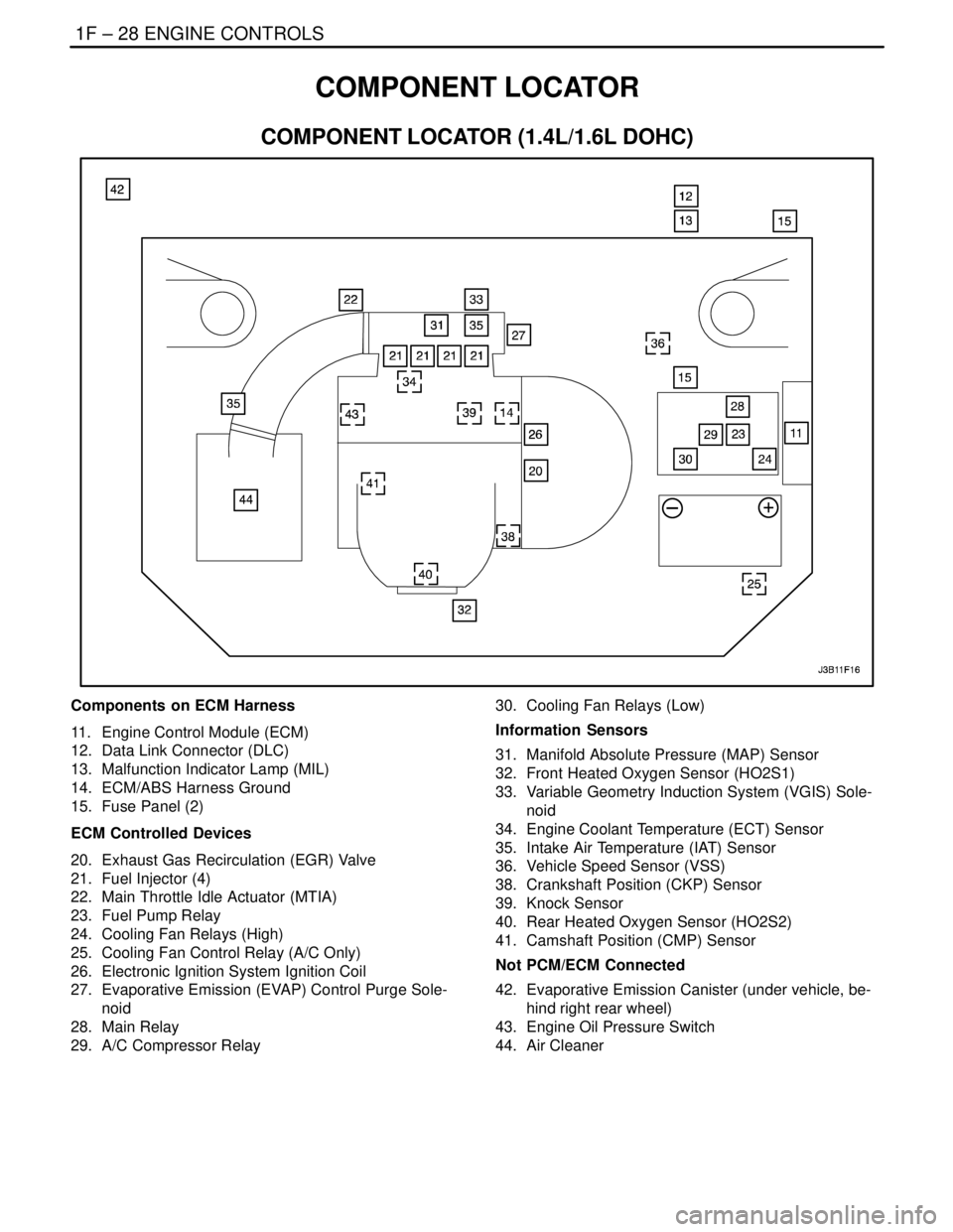
COMPONENT LOCATOR
COMPONENT LOCATOR (1.4L/1.6L DOHC)
Components on ECM Harness
11. Engine Control Module (ECM)
12. Data Link Connector (DLC)
13. Malfunction Indicator Lamp (MIL)
14. ECM/ABS Harness Ground
15. Fuse Panel (2)
ECM Controlled Devices
20. Exhaust Gas Recirculation (EGR) Valve
21. Fuel Injector (4)
22. Main Throttle Idle Actuator (MTIA)
23. Fuel Pump Relay
24. Cooling Fan Relays (High)
25. Cooling Fan Control Relay (A/C Only)
26. Electronic Ignition System Ignition Coil
27. Evaporative Emission (EVAP) Control Purge Sole-
noid
28. Main Relay
29. A/C Compressor Relay30. Cooling Fan Relays (Low)
Information Sensors
31. Manifold Absolute Pressure (MAP) Sensor
32. Front Heated Oxygen Sensor (HO2S1)
33. Variable Geometry Induction System (VGIS) Sole-
noid
34. Engine Coolant Temperature (ECT) Sensor
35. Intake Air Temperature (IAT) Sensor
36. Vehicle Speed Sensor (VSS)
38. Crankshaft Position (CKP) Sensor
39. Knock Sensor
40. Rear Heated Oxygen Sensor (HO2S2)
41. Camshaft Position (CMP) Sensor
Not PCM/ECM Connected
42. Evaporative Emission Canister (under vehicle, be-
hind right rear wheel)
43. Engine Oil Pressure Switch
44. Air Cleaner
Page 275 of 2643
ENGINE CONTROLS 1F – 29
DAEWOO V–121 BL4
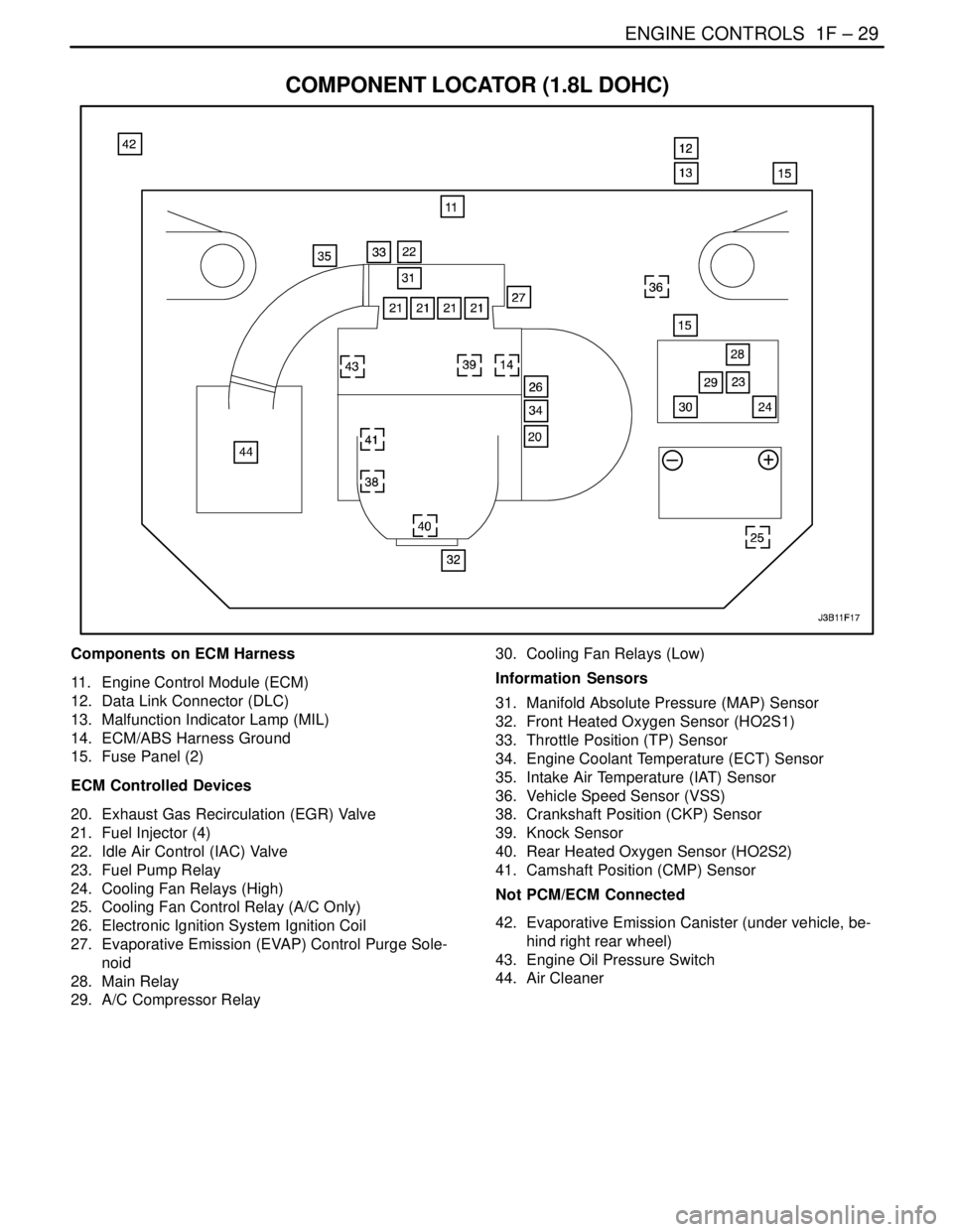
COMPONENT LOCATOR (1.8L DOHC)
Components on ECM Harness
11. Engine Control Module (ECM)
12. Data Link Connector (DLC)
13. Malfunction Indicator Lamp (MIL)
14. ECM/ABS Harness Ground
15. Fuse Panel (2)
ECM Controlled Devices
20. Exhaust Gas Recirculation (EGR) Valve
21. Fuel Injector (4)
22. Idle Air Control (IAC) Valve
23. Fuel Pump Relay
24. Cooling Fan Relays (High)
25. Cooling Fan Control Relay (A/C Only)
26. Electronic Ignition System Ignition Coil
27. Evaporative Emission (EVAP) Control Purge Sole-
noid
28. Main Relay
29. A/C Compressor Relay30. Cooling Fan Relays (Low)
Information Sensors
31. Manifold Absolute Pressure (MAP) Sensor
32. Front Heated Oxygen Sensor (HO2S1)
33. Throttle Position (TP) Sensor
34. Engine Coolant Temperature (ECT) Sensor
35. Intake Air Temperature (IAT) Sensor
36. Vehicle Speed Sensor (VSS)
38. Crankshaft Position (CKP) Sensor
39. Knock Sensor
40. Rear Heated Oxygen Sensor (HO2S2)
41. Camshaft Position (CMP) Sensor
Not PCM/ECM Connected
42. Evaporative Emission Canister (under vehicle, be-
hind right rear wheel)
43. Engine Oil Pressure Switch
44. Air Cleaner
Page 288 of 2643

1F – 42IENGINE CONTROLS
DAEWOO V–121 BL4
StepNo Yes Value(s) Action
191. Measure the resistance between following ter-
minals:
S Terminal 1 and 2 of ignition coil.
S Terminal 2 and 1 of ignition coil.
Are the resistance within the value specified.
1. Remove the high tension cable.
2. Measure the resistance between second coil.
S Between 1 and 4
S Between 2 and 3
Are the resistance within the value specified.0.9 W
5.3 kWGo to Step 21Go to Step 20
20Replace the EI system ignition coil.
Is the repair complete?–Go to Step 2–
211. Check for any damages or poor connection in
ignition wires and repair as needed.
2. Connect the EI system ignition coil connector
and ECM connector.
3. Check for the presence of spark from all of the
ignition wires.
Is the spark present from all of the ignition wires?–Go to Step 2Go to Step 22
22Replace ECM.
Is the repair complete?–Go to Step 2–
231. Turn the ignition OFF.
2. Connect a fuel pressure gauge.
3. Crank the engine.
Is any fuel pressure present?–Go to Step 26Go to Step 24
241. Turn the ignition OFF.
2. Disconnect the electrical connector at the fuel
pump.
3. Connect a test light between the fuel pump ter-
minals 2 and 3.
4. Turn the ignition ON.
5. With the ignition ON, the test light should light
for the time specified.
Is the test light on?2 sec.Go to Step 25Go to 34
25Replace the fuel pump.
Is the repair complete?–Go to Step 2–
26Is the fuel pressure within the value specified?283–324 kPa
(41–47 psi)Go to Step 27Go to Step 29
27Check the fuel for contamination.
Is the fuel contaminated?–Go to Step 28Go to Step 41
281. Remove the contaminated fuel from the fuel
tank.
2. Clean the fuel tank as needed.
Is the repair complete?–Go to Step 2–
291. Check the fuel filter for restriction.
2. Inspect the fuel lines for kinks and restrictions.
3. Repair or replace as needed.
4. Measure the fuel pressure.
Is the fuel pressure within the value specified?283–324 kPa
(41–47 psi)Go to Step 2Go to Step 30
Page 296 of 2643

1F – 50IENGINE CONTROLS
DAEWOO V–121 BL4
StepNo Yes Value(s) Action
35While cranking the engine, measure the voltage at
the EI system ignition coil connector terminal 3 .
Does the voltage fluctuate within the values speci-
fied?0.2–2.0 vGo to Step 39Go to Step 37
36Check for an open in the wire from the EI system
ignition coil connector terminal 1 to the ECM connec-
tor terminal M51.
Is the problem found?–Go to Step 38Go to Step 40
37Check for an open in the wire from the EI system
ignition coil connector terminal 3 to the ECM connec-
tor terminal M1.
Is the problem found?–Go to Step 38Go to Step 40
381. Repair the wiring as needed.
2. Connect the EI system ignition coil connector.
3. Check for the presence of spark from all of the
ignition wires.
Is spark present from all of the ignition wires?–Go to Step 3Go to Step 39
39Replace the EI system ignition coil.
Is the repair complete?–Go to Step 3–
401. Turn the ignition OFF.
2. Replace the ECM.
Is the repair complete?–Go to Step 3–
411. Turn the ignition OFF.
2. Connect a fuel pressure gauge.
3. Crank the engine.
Is any fuel pressure present?–Go to Step 44Go to Step 42
421. Turn the ignition OFF.
2. Disconnect the electrical connector at the fuel
pump.
3. Connect a test light between the fuel pump
connector terminals 3 and 2.
4. Turn the ignition ON.
5. With the ignition ON, the test light should light
for the time specified.
Is the test light on?2 secGo to Step 43Go to Step 53
43Replace the fuel pump.
Is the repair complete?–Go to Step 3–
44Is the fuel pressure within the value specified?283–324 kPa
(41–47 psi)Go to Step 48Go to Step 45
451. Check the fuel filter for a restriction.
2. Inspect the fuel lines for kinks and restrictions.
Is the problem found?–Go to Step 46Go to Step 47
461. Disconnect the vacuum line from the fuel pres-
sure regulator.
2. Inspect the vacuum line for the presence of
fuel.
3. Inspect the fuel pressure regulator vacuum port
for the presence of fuel.
Is any fuel present?283–324 kPa
(41–47 psi)Go to Step 3Go to Step 47
Page 339 of 2643

ENGINE CONTROLS 1F – 93
DAEWOO V–121 BL4
ENGINE COOLING FAN CIRCUIT CHECK – DUAL FAN
(1.4L/1.6L DOHC)
Circuit Description
The engine cooling fan circuit operates the main cooling
fan and the auxiliary cooling fan. The cooling fans are con-
trolled by the engine control module (ECM) based on in-
puts from the Engine Coolant Temperature (ECT) sensor
and the Air Conditioning Pressure (ACP) sensor. The
ECM controls the low speed cooling fan operation by inter-
nally grounding the ECM connector terminal 10. This ener-
gizes the low speed cooling fan relay and operates the
main cooling fan and the auxiliary cooling fan at low speed
as the cooling fans are connected in a series circuit. The
ECM controls the high speed cooling fan operation by in-
ternally grounding the ECM connector terminal 10 and the
ECM connector terminal 9 at the same time. This ener-
gizes the low speed cooling fan relay, the high speed cool-
ing fan relay, and the series/parallel cooling fan relay re-
sulting in high speed fan operation as the cooling fans are
now connected in a parallel circuit.
Diagnostic Aids
S If the owner complained of an overheating problem,
it must be determined if the complaint was due to
an actual boil over, or the engine coolant tempera-
ture gauge indicated overheating. If the engine is
overheating and the cooling fans are on, the cooling
system should be checked.
S If the engine fuse block fuses Ef11 become open
(blown) immediately after installation, inspect for a
short to ground in the wiring of the appropriate cir-
cuit. If the fuses become open (blown) when the
cooling fans are to be turned on by the ECM, sus-
pect a faulty cooling fan motor.
S The ECM will turn the cooling fans on at low speed
when the coolant temperature is 97°C (207°F). The
ECM will turn the cooling fans off when the coolant
temperature is 94°C(201°F).
S The ECM will turn the cooling fans on at high speed
when the coolant temperature is 101°C (214°F).
The ECM will change the cooling fans from high
speed to low speed when the coolant temperature
is 98°C (208°F).S The ECM will turn the cooling fans on at low speed
when the A/C system is on. The ECM will change
the cooling fans from low speed to high speed
when the high side A/C pressure is 1882 kPa (273
psi) then return to low speed when the high side
A/C pressure is 1448 kPa (210 psi). When the A/C
system is on, the ECM will change the cooling fans
from low to high speed when the coolant tempera-
ture reaches 117°C (244°F) then return to low
speed when the coolant temperature reaches
11 4°C (237°F).
S The cooling fan circuit can be checked quickly by
disconnecting the ECM connector 2 and grounding
the connector terminal 10. This should create low
speed cooling fan operation with the ignition ON. By
grounding the ECM connector terminals 10 and 9
and turning the ignition ON, high speed cooling fan
operation should be achieved.
Test Description
The number(s) below refer to step(s) on the diagnostic
table.
4. This step, along with step 5, checks for the ability of
the ECM to operate the cooling fans.
8. This step, along with step 9, checks for the ability of
the ECM to operate the cooling fans in response to
A/C pressure readings.
16. After confirming battery voltage and the ECM sup-
plying a ground to the coil side of the cooling fan
relay A, by jumpering connector terminals 30 and
87 it will be determined if the relay is at fault or a
wiring problem is present.
31. This step checks for the presence of battery volt-
age to the main cooling fan when the A/C is on. If
battery voltage is present and the cooling fans are
not operating, the problem is in the ground side of
the cooling fan circuit.
37. By directly grounding the ECM connector terminals
10 and 9, the main and auxiliary cooling fans
should run at high speed.
Engine Cooling Fan Circuit Check – Dual Fan (1.4L/1.6L DOHC)
StepActionValue(s)YesNo
1Perform an On–Board Diagnostic (EOBD) system
check.
Is the check completed?–Go to Step 2Go to
”On–Board
Diagnostic Sys-
tem Check”
21. Check the engine fuse block fuse Ef11.
2. Replace the fuse as needed.
Is the fuse OK?–Go to Step 3Go to
”Diagnostic
Aids”
Page 346 of 2643

1F – 100IENGINE CONTROLS
DAEWOO V–121 BL4
ENGINE COOLING FAN CIRCUIT CHECK – DUAL FAN
(1.8L DOHC)
Circuit Description
The engine cooling fan circuit operates the main cooling
fan and the auxiliary cooling fan. The cooling fans are con-
trolled by the engine control module (ECM) based on in-
puts from the Engine Coolant Temperature (ECT) sensor
and the Air Conditioning Pressure (ACP) sensor. The
ECM controls the low speed cooling fan operation by inter-
nally grounding the ECM connector terminal K28. This en-
ergizes the low speed cooling fan relay and operates the
main cooling fan and the auxiliary cooling fan at low speed
as the cooling fans are connected in a series circuit. The
ECM controls the high speed cooling fan operation by in-
ternally grounding the ECM connector terminal K28 and
the ECM connector terminal K12 at the same time. This
energizes the low speed cooling fan relay, the high speed
cooling fan relay, and the series/parallel cooling fan relay
resulting in high speed fan operation as the cooling fans
are now connected in a parallel circuit.
Diagnostic Aids
S If the owner complained of an overheating problem,
it must be determined if the complaint was due to
an actual boil over, or the engine coolant tempera-
ture gauge indicated overheating. If the engine is
overheating and the cooling fans are on, the cooling
system should be checked.
S If the engine fuse block fuses Ef21, Ef6, Ef8 be-
come open (blown) immediately after installation,
inspect for a short to ground in the wiring of the ap-
propriate circuit. If the fuses become open (blown)
when the cooling fans are to be turned on by the
ECM, suspect a faulty cooling fan motor.
S The ECM will turn the cooling fans on at low speed
when the coolant temperature is 97°C (207°F). The
ECM will turn the cooling fans off when the coolant
temperature is 94°C(201°F).
S The ECM will turn the cooling fans on at high speed
when the coolant temperature is 101°C (214°F).
The ECM will change the cooling fans from high
speed to low speed when the coolant temperature
is 98°C (208°F).S The ECM will turn the cooling fans on at low speed
when the A/C system is on. The ECM will change
the cooling fans from low speed to high speed
when the high side A/C pressure is 1882 kPa (273
psi) then return to low speed when the high side
A/C pressure is 1448 kPa (210 psi). When the A/C
system is on, the ECM will change the cooling fans
from low to high speed when the coolant tempera-
ture reaches 117°C (244°F) then return to low
speed when the coolant temperature reaches
11 4°C (237°F).
S The cooling fan circuit can be checked quickly by
disconnecting the ECM connector 2 and grounding
the connector terminal K28. This should create low
speed cooling fan operation with the ignition ON. By
grounding the ECM connector terminals K28 and
K12 and turning the ignition ON, high speed cooling
fan operation should be achieved.
Test Description
The number(s) below refer to step(s) on the diagnostic
table.
4. This step, along with step 5, checks for the ability of
the ECM to operate the cooling fans.
8. This step, along with step 9, checks for the ability of
the ECM to operate the cooling fans in response to
A/C pressure readings.
16. After confirming battery voltage and the ECM sup-
plying a ground to the coil side of the cooling fan
relay A, by jumpering connector terminals 30 and
87 it will be determined if the relay is at fault or a
wiring problem is present.
31. This step checks for the presence of battery volt-
age to the main cooling fan when the A/C is on. If
battery voltage is present and the cooling fans are
not operating, the problem is in the ground side of
the cooling fan circuit.
37. By directly grounding the ECM connector terminals
K28 and K12, the main and auxiliary cooling fans
should run at high speed.
Engine Cooling Fan Circuit Check – Dual Fan (1.8L DOHC)
StepActionValue(s)YesNo
1Perform an On–Board Diagnostic (EOBD) system
check.
Is the check completed?–Go to Step 2Go to
”On–Board
Diagnostic Sys-
tem Check”
21. Check the I/P fuse block fuse F2.
2. Replace the fuse as needed.
Is the fuse OK?–Go to Step 3Go to
”Diagnostic
Aids”
Page 356 of 2643

1F – 110IENGINE CONTROLS
DAEWOO V–121 BL4
FUEL INJECTOR BALANCE TEST
A fuel injector tester is used to energize the injector for a
precise amount of time, thus spraying a measured amount
of fuel into the intake manifold. This causes a drop in the
fuel rail pressure that can be recorded and used tocompare each of the fuel injectors. All of the fuel injectors
should have the same pressure drop.
Fuel Injector Balance Test Example
Cylinder1234
First Reading296 kPa (43 psi)296 kPa (43 psi)296 kPa (43 psi)296 kPa (43 psi)
Second Reading131 kPa (19 psi)117 kPa (17 psi)124 kPa (18 psi)145 kPa (21 psi)
Amount Of Drop165 kPa (24 psi)179 kPa (26 psi)172 kPa (25 psi)151 kPa (22 psi)
Average Range:
156~176 kPa
(22.5~25.5 psi)Injector OKFaulty Injector – Too
Much Pressure DropInjector OKFaulty Injector – Too
Little Pressure Drop
CAUTION : The fuel system is under pressure. To
avoid fuel spillage and the risk of personal injury or
fire, it is necessary to relieve the fuel system pressure
before disconnecting the fuel lines.
CAUTION : Do not pinch or restrict nylon fuel lines.
Damage to the lines could cause a fuel leak, resulting
in possible fire or personal injury.
Notice : In order to prevent flooding of the engine, do not
perform the Injector Balance Test more than once (includ-
ing any retest on faulty fuel injectors) without running the
engine.
Test
1. Turn the ignition switch to ON in order to get the
fuel pressure to its maximum level.
2. Allow the fuel pressure to stabilize and then record
this initial pressure reading. Wait until there is no
movement of the needle on the fuel pressure
gauge.
3. Follow the manufacturer’s instructions for the use
of the adapter harness. Energize the fuel injector
tester once and note the fuel pressure drop at its
lowest point. Record this second reading. Subtract
it from the first reading to determine the amount of
the fuel pressure drop.
4. Disconnect the fuel injector tester from the fuel in-
jector.
5. After turning the ignition switch to ON, in order toobtain maximum pressure once again, make a con-
nection at the next fuel injector. Energize the fuel
injector tester and record the fuel pressure reading.
Repeat this procedure for all the injectors.
6. Retest any of the fuel injectors that the pressure
drop exceeds the 10 kPa (1.5 psi) of the average
pressure drop value.
7. Replace any of the fuel injectors that fail the retest.
8. If the pressure drop of all of the fuel injectors is
within 10 kPa (1.5 psi) of the average pressure
drop value, then the fuel injectors are flowing nor-
mally and no replacement should be necessary.
9. Reconnect the fuel injector harness and review the
symptom diagnostic tables.
10. An engine cool down period of 10 minutes is neces-
sary in order to avoid irregular readings due to hot
soak fuel boiling.
11. Connect the fuel pressure gauge carefully to avoid
any fuel spillage.
12. The fuel pump should run about 2 seconds after the
ignition is turned to the ON position.
13. Insert a clear tube attached to the vent valve of the
fuel pressure gauge into a suitable container.
14. Bleed the air from the fuel pressure gauge and
hose until all of the air is bled from the fuel pressure
gauge.
15. The ignition switch must be in the OFF position at
least 10 seconds in order to complete the Engine
Control Module (ECM) shutdown cycle.