MITA DAEWOO NUBIRA 2004 Service Repair Manual
[x] Cancel search | Manufacturer: DAEWOO, Model Year: 2004, Model line: NUBIRA, Model: DAEWOO NUBIRA 2004Pages: 2643, PDF Size: 80.54 MB
Page 16 of 2643
GENERAL INFORMATION 0B – 9
DAEWOO V–121 BL4
MAINTENANCE AND REPAIR
MAINTENANCE AND LUBRICATION
NORMAL VEHICLE USE
The maintenance instructions contained in the mainte-
nance schedule are based on the assumption that the ve-
hicle will be used for the following reasons:
S To carry passengers and cargo within the limitation
indicated on the tire placard located on the edge of
the driver’s door.
S To be driven on reasonable road surfaces and with-
in legal operating limits.
EXPLANATION OF SCHEDULED
MAINTENANCE SERVICES
The services listed in the maintenance schedule are fur-
ther explained below. When the following maintenance
services are performed, make sure all the parts are re-
placed and all the necessary repairs are done before driv-
ing the vehicle. Always use the proper fluid and lubricants.
Drive Belt Inspection
When a separate belt drives the power steering pump, the
air conditioning compressor and the generator, inspect it
for cracks, fraying, wear and proper tension. Adjust or re-
place the belt as needed.
Engine Oil and Oil Filter Change
API Classifications of Engine Oil
The International Lubricant Standardization and Approval
Committee (ILSAC) and American Petroleum Institute
classifies engine oils according to their performance quali-
ty. Always use oil rated API–SL (ILSAC GF–III) or better.
Engine Oil Viscosity
Engine oil viscosity (thickness) has an effect on fuel econ-
omy and cold weather operation. Lower viscosity engine
oils can provide better fuel economy and cold weather per-
formance; however, higher temperature weather condi-
tions require higher viscosity engine oils for satisfactory lu-
brication. Using oils of any viscosity other than those
viscosities recommended could result in engine damage.
Cooling System Service
Drain, flush and refill the system with new coolant. Refer
to ”Recommended Fluids And Lubricants” in this section.
Fuel Micro–Filter Replacement
Replace the engine fuel filter every 45,000 km (27,000
miles).
Air Cleaner Element Replacement
Replace the air cleaner element every 45,000 km (27,000
miles).Replace the air cleaner more often under dusty conditions.
Throttle Body Mounting Bolt Torque
Check the torque of the mounting bolts.
Tighten the throttle body mounting bolts to 15 NSm (11 lb–
ft) if necessary.
Spark Plug Replacement
Replace spark plugs with the same type.
Spark Plug Wire Replacement
Clean wires and inspect them for burns, cracks or other
damage. Check the wire boot fit at the DIS module and at
the spark plugs. Replace the wires as needed.
Brake System Service
Check the disc brake pads and the drum brake linings ev-
ery 15,000 km (9,000 miles) or 12 months. Check the pad
and the lining thickness carefully. If the pads or the linings
are not expected to last to the next scheduledmaintenance
service, replace the pads or the linings. Check the breath-
er hole in the brake fluid reservoir cap to be sure it is free
from dirt and the passage is open.
Transaxle Service
The manual transaxle fluid does not require changing. For
automatic transaxles, refer to ”Scheduled Maintenance
Charts” in this section.
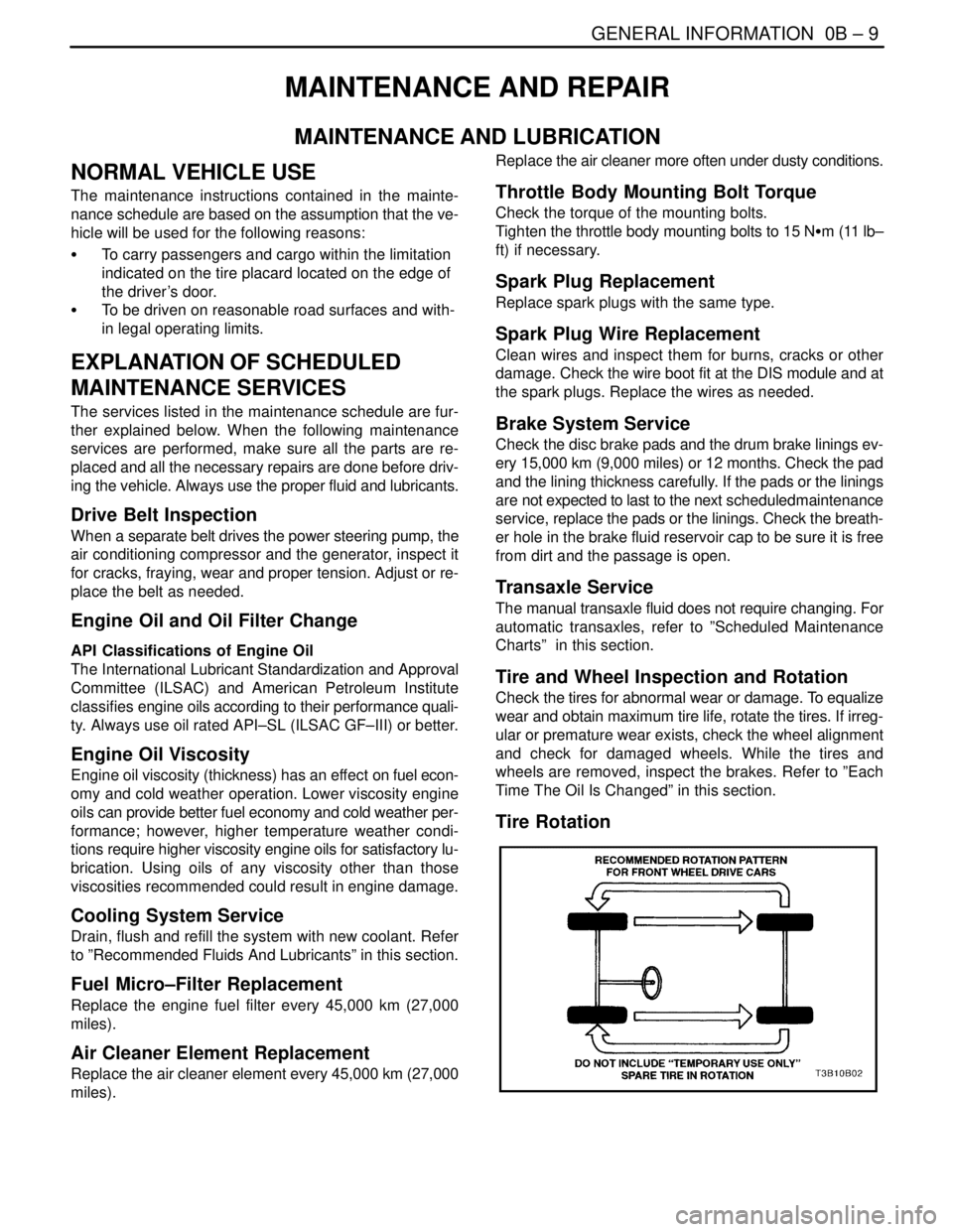
Tire and Wheel Inspection and Rotation
Check the tires for abnormal wear or damage. To equalize
wear and obtain maximum tire life, rotate the tires. If irreg-
ular or premature wear exists, check the wheel alignment
and check for damaged wheels. While the tires and
wheels are removed, inspect the brakes. Refer to ”Each
Time The Oil Is Changed” in this section.
Tire Rotation
Page 2023 of 2643

MANUAL CONTROL HEATING, VENTILATION AND AIR CONDITIONING SYSTEM 7B – 21
DAEWOO V–121 BL4
Refrigerant Recovery
Important : Use only a refrigerant tank that is designed for
the charging station in use. The unit’s overfill limitation
mechanism is calibrated specifically for use with this tank.
The tank’s valves are also manufactured specifically for
this unit.
1. Attach the high–side hose with the quick disconnect
coupler to the high–side fitting of the vehicle’s A/C
system.
2. Open the coupler valve.
3. Attach the low–side hose with the quick disconnect
coupler to the low–side fitting of the vehicle’s A/C
system.
4. Open the coupler valve.
5. Check the high–side and the low–side gauges on
the unit’s control panel in order to ensure that the
A/C system has pressure. If there is no pressure,
there is no refrigerant in the system to recover.
Important : If there is no refrigerant in the system, do not
continue with the recovery operation which would, under
this condition, draw air into the recovery tank.
6. Open both the high–side and the low–side valves.
7. Open the gas and the liquid valves on the tank.
8. Drain any oil that may be in the oil separator.
9. Close the oil drain valve.
10. Plug the unit into the proper voltage outlet.
11. Turn on the main power switch.
Notice : Never reuse refrigerant oil. Damage to the A/C
system may result from such reuse. Dispose of the refrig-
erant oil properly.
12. Begin the recovery process. Refer to the manufac-
turer ’s instructions for the charging station in use.
Important : Some A/C system polyalkaline glycol (PAG)
lubricating oil may be removed with the refrigerant during
recovery. The amount of oil removed varies. A charging
station separates the oil from the refrigerant and provides
a means of determining how much oil was removed. Re-
place the same amount of oil when recharging the system.
Refer to the manufacturer’s instructions for the charging
station in use.
13. Wait 5 minutes, then check the control panel low–
side gauge. If the A/C has maintained vacuum, the
recovery is complete.
14. If the low–side gauge pressure rises above zero,
there is more refrigerant in the system. Recover the
additional refrigerant. Repeat this step until the sys-
tem maintains vacuum for 2 minutes.
Important : If the control indicator shows that the refriger-
ant tank is full during the recovery process and the unit
shuts off, install an empty unit tank to store the refrigerant
needed for steps later in the procedure. Do not use any
other type of tank.
Evacuation
The unit tank must contain a sufficient amount of R–134a
refrigerant for charging. Check the amount of refrigerant
in the tank. If there is less than 3.6 kg (8 pounds) of refrig-
erant, add new refrigerant to the tank. Refer to the
manufacturer ’s instructions for adding refrigerant.
1. Verify that the high–side and the low–side hoses
are connected to the A/C system. Open both the
high–side and the low–side valves on the unit’s
control panel.
2. Open both the gas and the liquid valves on the
tank.
Important : Refer to the manufacturer’s instructions for
the charging station in use. It is necessary to evacuate the
system before recharging it with new or recycled refriger-
ant.
3. Start the vacuum pump and begin the evacuation
process. Non–condensable gases (mostly air) are
vented from the tank automatically during the re-
cycling process. You may hear the pressure being
released.
4. Check for leaks in the system. Refer to the
manufacturer ’s instructions for the charging station
in use.
Important : Change the vacuum pump oil frequently. Re-
fer to the manufacturer’s instructions for the charging sta-
tion in use.
A/C System Oil Charge Replenishing
Any oil removed from the A/C system during the recovery
process must be replenished at this time.
1. Use the correct graduated bottle of PAG oil for the
R–134a system.
Important:
S Keep the oil bottles tightly capped at all times to
protect the oil from moisture and contamination.
S You must have an A/C system vacuum for this op-
eration. Never open the oil injection valve while
there is positive pressure in the A/C system. This
will result in oil blowback through the bottle vent.
S Never let the oil level drop below the pickup tube
while charging or replenishing the system, as this
will allow air into the A/C system.
2. Refer to the manufacturer’s instructions for the
charging station in use. Add the proper amount of
PAG oil to the system.
3. Close the valve when the required oil charge has
been pulled into the system.
Charging
Important : Evacuate the A/C system before charging.
1. Close the low–side valve on the control panel.
2. Open the high–side valve on the control panel.
3. Refer to the manufacturer’s instructions for the
charging station in use.
4. Enter the amount of refrigerant needed to charge
the A/C, making sure to use the correct system of
measurement, i.e. kilogram (kg) or pound (lb).
5. Begin the charging process.