fuel cap DATSUN 210 1979 User Guide
[x] Cancel search | Manufacturer: DATSUN, Model Year: 1979, Model line: 210, Model: DATSUN 210 1979Pages: 548, PDF Size: 28.66 MB
Page 67 of 548

t
IGHTENING
TORQUE
Cylinder
head
bolt
Rocker
shaft
bracket
bolt
ain
bearing
cap
bolt
Flywheel
fixing
bolt
Drive
plate
fixing
bolt
Al4
AlS
Connecting
rod
cap
nut
Camshaft
sprocket
bolt
Locating
plate
bolt
Valve
rocker
adjusting
nut
Oil
strainer
bolt
Oil
pan
bolt
Oil
pan
drain
plug
Timing
chain
cover
bolt
Crank
pulley
bolt
Water
pump
bolt
Fuel
pump
bolt
Spark
plug
Engine
mounting
securing
bolt
Engine
Mechanical
Unit
kg
iii
ft
lb
7
0
to
7
5
51
to
54
2
0t02
5
14to
18
5
0
to
6
0
36
to
43
8
0
to
9
0
58
to
65
8
0
to
9
0
58
to
65
8
5
to
9
5
61
to
69
3
2
to
3
8
23
to
27
4
0
to
4
8
29
to
35
0
5
to
0
8
3
6
to
5
8
1
6
to
2
2
12to
16
0
9
to
I
4
6
5
to
10
1
0
4
to
0
6
2
9
to
4
3
2
0
to
3
0
14
to
22
0
5
to
0
7
3
6
to
5
1
15to
20
l08
to
145
0
9
to
I
4
6
5
to
1O
l
0
9
to
I
4
6
5
to
10
1
1
5
to
2
0
11
to
14
1
9
to
2
5
14to
18
EM
30
Page 92 of 548
5
The
pressure
gauge
indicates
static
fuel
pressure
in
the
line
The
gauge
reading
should
be
within
the
specified
value
Fuel
pump
pressure
0
21
to
0
27
kg
em2
3
0
to
3
8
pli
I
Note
If
the
fuel
in
the
carburetor
float
chamber
has
run
out
and
engine
has
stopped
remove
clip
and
pour
fuel
into
carburetor
Fasten
clip
securely
and
repeat
static
pres
sure
test
If
pressure
is
not
within
the
specifi
ed
limit
remove
pump
as
an
assembly
CAPACITY
TEST
The
capacity
test
is
conducted
only
when
static
pressure
is
within
the
specification
To
conduct
this
test
proceed
as
follows
1
Disconnect
pressure
gauge
from
T
connector
and
in
its
vacant
place
install
a
suitable
container
as
a
fuel
sump
2
Start
engine
and
run
at
1
000
pm
3
Pump
should
deliver
the
specified
amouni
of
fuel
If
little
or
no
fuel
flows
from
open
end
of
pipe
it
is
an
indication
that
fuel
line
is
clogged
or
pump
is
mal
functioning
Fuel
pump
capacity
450
cc
27
46
eu
inl
min
at
1
000
rpm
REMOVAL
AND
INSTALLATION
Note
When
disconnecting
fuel
lines
use
a
container
to
receive
fuel
remaining
in
fuel
hoses
I
Disconnect
inlet
and
outlet
fuel
hoses
from
fuel
pump
2
Remove
fuel
pump
3
To
install
reverse
the
order
of
removal
Engine
Fuel
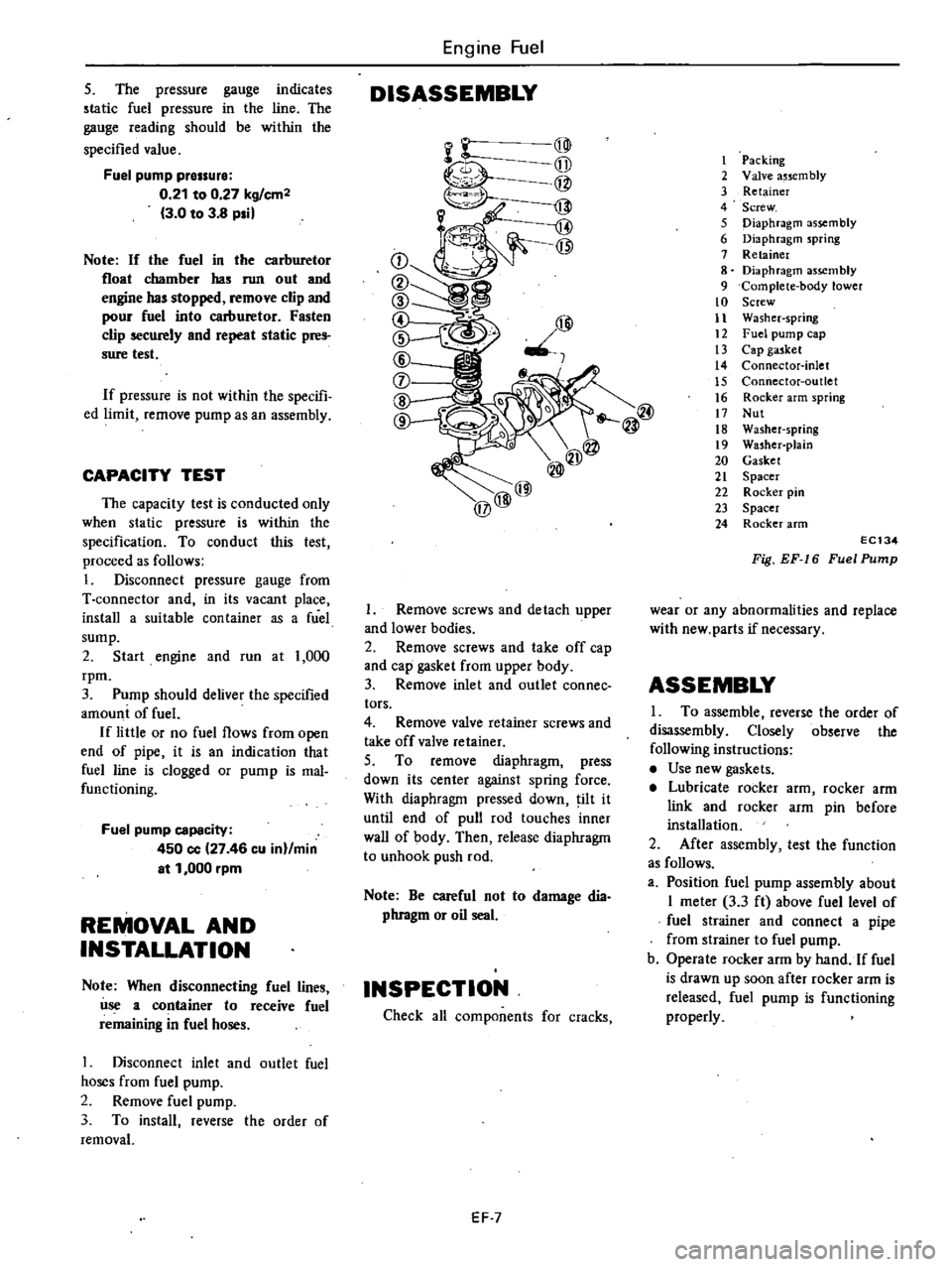
DISASSEMBLY
@@
@@
@
@@
1
Remove
screws
and
detach
upper
and
lower
bodies
2
Remove
screws
and
take
off
cap
and
cap
gasket
from
upper
body
3
Remove
inlet
and
outlet
connee
tors
4
Remove
valve
retainer
screws
and
take
off
valve
retainer
S
To
remove
diaphragm
press
down
its
center
against
spring
force
With
diaphragm
pressed
down
ilt
it
until
end
of
pull
rod
touches
inner
wall
of
body
Then
release
diaphragm
to
unhook
push
rod
Note
Be
careful
not
to
damage
dia
phragm
or
oil
seal
INSPECTION
Check
all
components
for
cracks
EF
7
I
Packing
2
Valve
a5scm
bly
3
Retainer
4
Screw
5
Diaphragm
assembly
6
Diaphragm
spring
7
Retainer
8
Diaphragm
assembly
9
Complete
body
lower
10
Screw
11
Washer
spring
12
Fuel
pump
cap
13
Cap
gasket
14
Connector
inlet
15
Connector
outlet
16
Rocker
arm
spring
17
Nut
18
Washer
spring
19
Washer
pJain
20
Gasket
21
Spacer
22
Rocker
pin
23
Spacer
24
Rocker
arm
EC134
Fig
EF
16
Fuel
Pump
wear
or
any
abnormalities
and
replace
with
new
parts
if
necessary
ASSEMBLY
I
To
assemble
reverse
the
order
of
disassembly
Closely
observe
the
following
instructions
Use
new
gaskets
Lubricate
rocker
arm
rocker
arm
link
and
rocker
arm
pin
before
installation
2
After
assembly
test
the
function
as
follows
a
Position
fuel
pump
assembly
about
I
meter
3
3
ft
above
fuel
level
of
fuel
strainer
and
connect
a
pipe
from
strainer
to
fuel
pump
b
Operate
rocker
arm
by
hand
If
fuel
is
drawn
up
soon
after
rocker
arm
is
released
fuel
pump
is
functioning
properly
Page 99 of 548
DASH
POT
SYSTEM
These
carburetors
are
equipped
with
a
dash
pot
interlocked
with
the
primary
thrott
Ie
valve
through
a
link
mechanism
The
dash
pot
prevents
the
throttle
valve
from
closing
abruptly
thereby
reducing
He
emissions
during
deceleia
tion
or
gear
shifting
In
automatic
transmissi9fi
models
it
also
prevents
engine
stall
resulting
from
quick
application
of
the
brake
or
from
quick
release
of
the
accelerator
pedal
after
it
s
been
tread
upon
slightly
INSPECTION
AND
ADJUSTMENT
CARBURETOR
IDLE
R
P
M
AND
MIXTURE
RATIO
CO
idle
adjustment
with
CO
meter
Refer
to
Carburetor
Idle
rpm
and
Mixture
Ratio
Section
ET
for
check
ing
and
a
justment
CO
idle
adjustment
without
CO
meter
Non
California
models
Refer
to
Carburetor
Idle
rpm
and
Mixture
Ratio
Section
ETl
fot
check
ing
and
adjustment
Idle
limiter
cap
Refer
to
Idle
Limiter
Cap
SeCtio
ET
for
checking
and
adjustment
FUEL
LEVEL
I
With
engine
idling
visually
check
fuel
level
through
sight
window
of
float
chamber
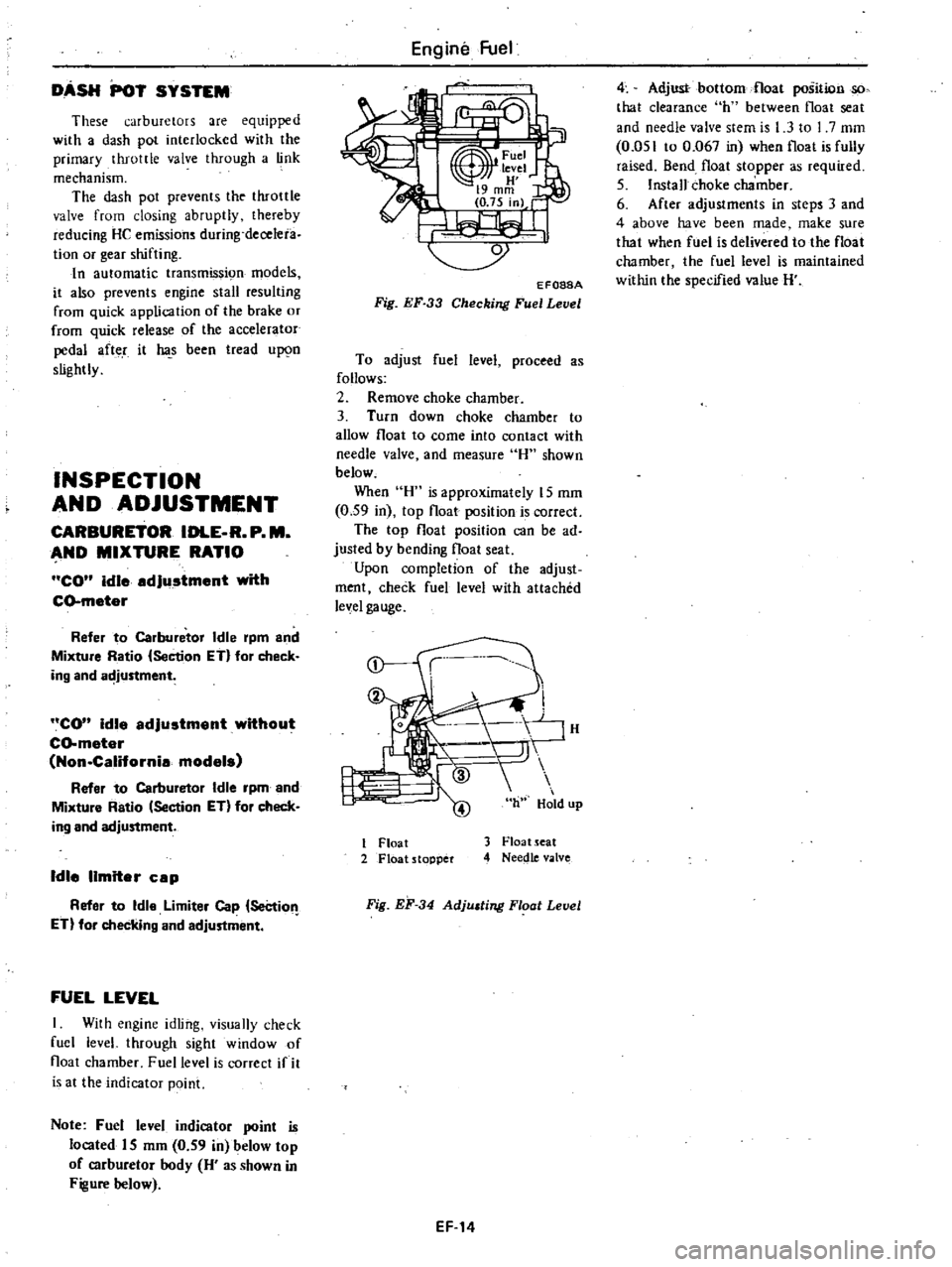
Fuel
level
is
correct
if
it
is
at
the
indicator
point
Note
Fuel
level
indicator
point
is
located
IS
mm
0
59
in
below
top
of
carburetor
body
H
as
shown
in
Figure
below
Engine
Fuel
EF088A
Fig
EF
33
Checking
Fuel
Level
To
adjust
fuel
level
proceed
as
follows
2
Remove
choke
chamber
3
Turn
down
choke
chamber
to
allow
float
to
come
into
contact
with
needle
valve
and
measure
H
shown
below
When
H
is
approximately
15
mm
0
59
in
top
float
position
is
correct
The
top
float
position
can
be
ad
justed
by
bending
float
seat
Upon
completion
of
the
adjust
ment
check
fuel
level
with
attached
level
gauge
nhH
J
1
Float
2
Float
stopper
3
Float
seat
4
Needle
valve
Fig
EF
34
Adjusting
Floot
Level
EF
14
4
Adjust
bottom
float
position
so
that
clearance
hl
between
float
seat
and
needle
valve
stem
is
1
3
to
I
7
mm
0
051
to
0
067
in
when
float
is
fully
raised
Bend
float
stopper
as
required
5
Install
choke
chamber
6
After
adjustments
in
steps
3
and
4
above
have
been
made
make
sure
that
when
fuel
is
delivered
to
the
float
chamber
the
fuel
level
is
maintained
within
the
specified
value
H
Page 109 of 548

En9ineFuel
DISASSEMBLY
AND
ASSEMBLY
Except
FU
model
A
JS
@fB
@
Choke
chamber
@
Center
body
@
Throttle
chamber
1
Servo
diaphragm
of
throttle
opener
2
Dash
pot
3
Automatic
choke
cover
4
Automatic
choke
I
ody
and
diaphragm
chamber
S
Accelerating
pump
lever
6
Auxiliary
valve
7
Venturi
stopper
screw
8
Primary
and
secondary
maU
venturi
9
Secondary
slow
jet
I
I
l
c
I
liO
JCJ
@
c
1
@
11
i
I
rJ
@
10
Power
valve
11
Secondary
main
air
bleed
12
Primary
main
air
bleed
13
Injector
weight
14
Primary
slow
air
bleed
15
Accelerating
pump
16
Plug
17
Primary
slow
jet
18
Needle
valve
19
Float
20
Anti
c1ieseling
solenoid
valve
21
Primary
main
jet
22
Secondary
main
jet
23
Idle
limiter
cap
24
Idle
adjust
screw
25
Spring
26
Throttle
adjust
screw
27
Spring
28
Primary
and
secondary
throttle
valves
29
Fast
idle
adjust
screw
30
Accelerating
pump
rod
31
Throttle
retum
spring
32
Stroke
limiter
Note
Do
nOt
remove
the
puts
marked
with
an
uterisk
EF420A
Fig
EF
60
c
rburetor
EF
24
Page 110 of 548

FU
model
Engine
Fuel
If
@
Choke
chamber
@
Ceo
ter
body
@
Throttle
chamber
1
Dash
pot
2
An
tomatic
choke
cover
3
Automatic
choke
body
and
diaphragm
chamber
4
Throttle
valve
switch
assembly
5
Throttle
valve
switch
adjust
screw
6
Fast
idle
adjust
screw
7
Secondary
slow
jet
EF567A
8
Secondary
small
venturi
9
Primary
small
venturi
10
Power
valve
11
Secondary
main
air
bleed
12
Plug
13
Primary
main
air
bleed
14
Plug
15
Injector
weight
16
Primary
slow
air
bleed
17
Accelerating
pump
18
Needle
valve
19
Plug
20
Primary
slow
jet
21
Float
22
Anti
dieseling
solenoid
valve
23
Secondary
main
jet
24
Primary
main
jet
25
Idle
limiter
cap
26
Idle
adjust
screw
27
Throttle
adjust
screw
28
Vaeuum
screw
29
Primary
and
secondary
throttle
valves
Note
Do
not
remove
the
parts
muked
with
an
utemk
Fig
EF
61
Carburetor
EF
25
Page 113 of 548

Engine
Fuel
Throttle
chamber
parts
Except
FU
model
1
1
4
@
EF087A
1
Throttle
return
spring
2
lluottlc
opencr
adjusuctew
3
Accelerating
pump
rod
4
Fa
t
idle
adjust
5CICW
5
Primary
and
secondary
throttle
valve
6
Sprin8
1
Idle
adjust
screw
8
Idle
limiter
cap
9
Spring
10
Throttle
adjust
rew
oG
I
l
I
r
Y
Note
Do
not
remove
the
puts
ked
with
an
uterisk
FU
model
on
TIlROTfLE
CHAMBER
PARTS
1
Throttle
valve
switch
adjust
screw
2
Fast
idle
adjust
screw
3
limiter
cap
4
Idle
adjust
screw
S
Throttle
adjust
screw
6
Vacuum
screw
7
Primary
and
secondary
throttle
valves
Note
Do
not
remove
the
putl
marked
with
an
uterist
EF864
Fig
EF
64
Throttle
Chamber
EF
28
Page 117 of 548

Engine
Fuel
SERVICE
DATA
AND
SPECIFICATIONS
GENERAL
SPECIFICATIONS
CARBURETOR
California
models
Non
caJ
ifornia
model
Manual
tranlDlWion
Automatic
transmission
Manual
transmission
FU
model
utomatic
transmission
Type
DCH306
6t
DCH306
63
DCH306
60E
DCH306
67
DCH306
68
3
DCH306
69
1
DCH306
60
2
DCH306
12
4
Primary
Secondary
Primary
Secondary
Primuy
Secondary
Primary
Secondary
Primary
Secondary
Outer
diameter
26
1
02
30
1
18
26
1
02
30
1
18
26
1
02
30
1
18
26
1
02
30
1
18
26
1
02
30
1
18
mm
in
Venturi
diameter
23
0
9t
27
1
06
23
0
91
27
1
06
23
0
91
27
1
06
22
0
87
27
1
06
23
0
91
27
1
06
mm
in
Main
jet
107
145
107
1145
106
145
1107
145
105
1145
104
2
t04
4
Main
air
bleed
95
180
95
180
1110
80
65
1M
195
80
Slow
jet
1145
150
145
150
145
150
146
150
45
150
Powerjet
143
43
140
148
2
48
138
140
4
1
With
A15
engine
2
4
For
Canada
models
3
Common
to
models
with
A14
and
AlS
engines
except
Canada
INSPECTION
AND
ADJUSTMENT
A
T
C
AIR
CLEANER
Air
con
trol
valve
partially
opens
Air
control
valve
fully
opens
Oc
OF
Oc
F
38
to
54
100
to
129
Above
55
131
IDLE
COMPENSATOR
Idle
compensator
partially
opens
Bi
metal
No
I
Bi
metal
No
2
Idle
compensator
fully
opens
Bi
metal
No
I
Bi
metal
No
2
Oc
OF
60
to
70
140
to
158
70
to
80
158
to
176
Oc
OF
Above
70
158
Above
80
176
FUEL
PUMP
Fuel
pressure
Fuel
pump
capacity
kgfcm2
psi
cc
cu
in
min
at
rpm
0
27
3
8
450
27
46
1
000
EF
32
Page 127 of 548
Emission
Control
System
EARLY
FUEL
EVAPORATIVE
E
FE
SYSTEM
DESCRIPTION
@
jl
D
W
o
0
0
UL
@
1
Intake
manifold
9
Screw
2
Stove
gasket
10
Thermostat
spring
3
Mar
fold
stove
11
Heat
control
valve
4
Heat
shield
plate
12
Control
valve
shaft
5
Snap
ring
13
Exhaust
manifold
6
Countczwcight
14
Cap
7
Key
15
Bushing
8
Stopper
pin
16
Coil
spring
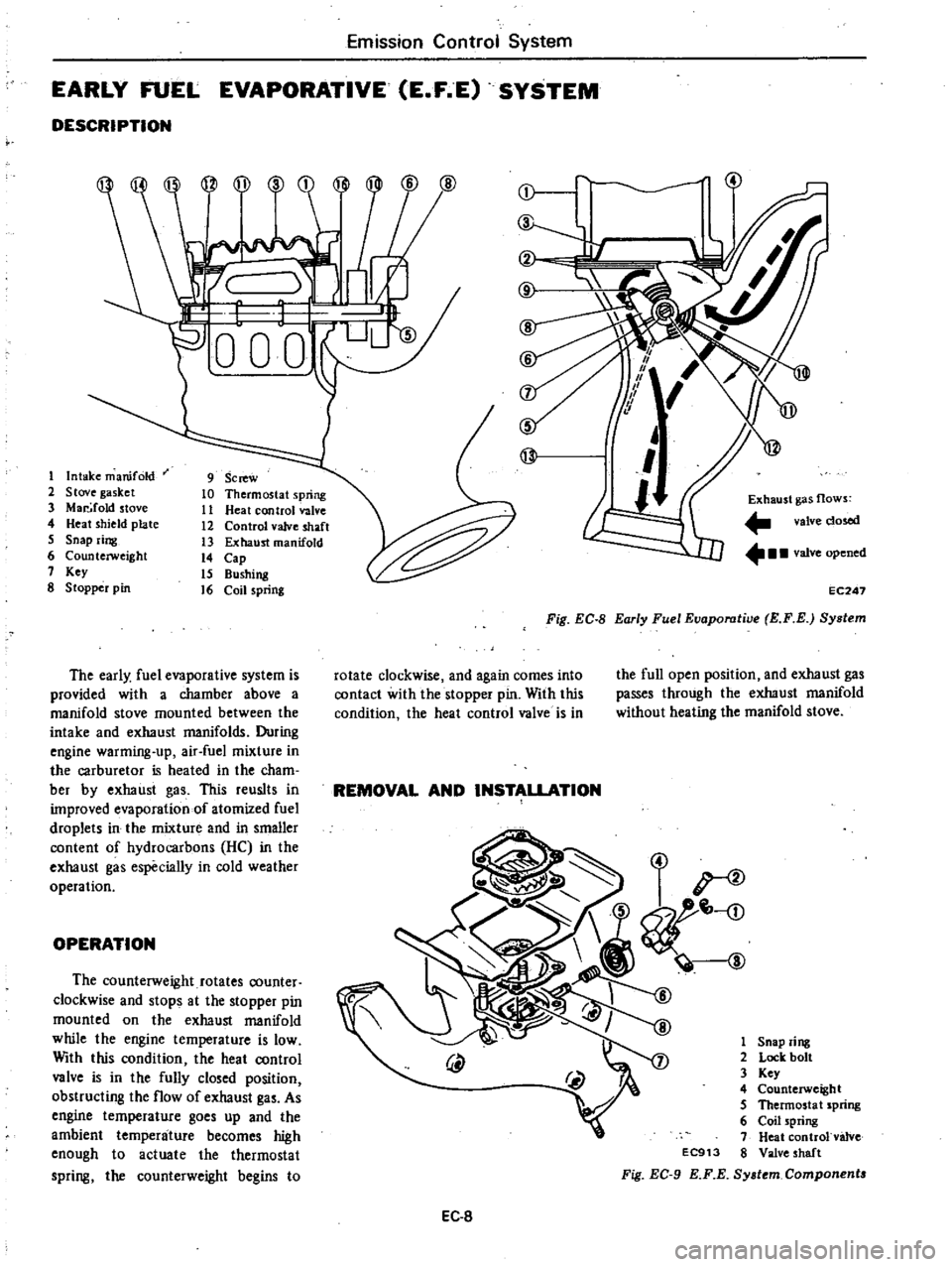
The
early
fuel
evaporative
system
is
provided
with
a
chamber
above
a
manifold
stove
mounted
between
the
intake
and
exhaust
manifolds
During
engine
warming
up
air
fuel
mixture
in
the
carburetor
is
heated
in
the
cham
ber
by
exhaust
gas
This
reuslts
in
improved
evaporation
of
atomized
fuel
droplets
in
the
mixture
and
in
smaller
content
of
hydrocarbons
HC
in
the
exhaust
gas
especially
in
cold
weather
operation
OPERATION
The
counterweight
rotates
counter
clockwise
and
stops
at
the
stopper
pin
mounted
on
the
exhaust
manifold
while
the
engine
temperature
is
low
With
this
condition
the
heat
control
valve
is
in
the
fully
closed
position
obstructing
the
flow
of
exhaust
gas
As
engine
temperature
goes
up
and
the
ambient
temperature
becomes
high
enough
to
actuate
the
thermostat
spring
the
counterweight
begins
to
j
@
l
7
1
1
5
If
@
I
Exhaust
gas
flows
valve
dosed
valve
opened
EC247
Fig
EC
8
Early
Fuel
Eaaporatiae
E
F
E
System
rotate
clockwise
and
again
comes
into
contact
with
the
stopper
pin
With
this
condition
the
heat
control
valve
is
in
the
full
open
position
and
exhaust
gas
passes
through
the
exhaust
manifold
without
heating
the
manifold
stove
REMOVAL
AND
INSTALLATION
1
Snap
ring
2
Lock
bolt
3
Key
4
Counterweight
5
Thermosta
t
spring
6
Coil
spring
7
Heat
controlvalve
EC913
8
Valve
shaft
Fig
EC
9
KF
E
Sy
tem
Component
EC
8
Page 154 of 548

Emission
Control
System
EvApORATIVE
EMISSION
CONTROL
SYSTEM
DESCRIPTION
carbons
is
accomplished
by
activated
charcoals
in
the
C
Ibon
canister
This
system
is
made
up
of
the
foUo
ing
I
I
Fuel
tank
with
positive
sealing
filler
cap
The
evaporative
emission
control
system
is
used
to
reduce
hydrocarbons
emitted
to
the
atmosphere
from
the
fuel
system
This
reduction
of
hydro
6
C
2
Fuel
check
valve
3
Vapor
vent
line
4
Carbon
canister
I
5
Vacuum
ignalline
6
Canister
purge
line
5
1
Fuel
tank
2
Fuel
filler
cap
with
vacuum
relief
valve
3
Fuel
check
valve
4
Vapor
vent
line
5
Canister
purge
line
6
Vacuum
signal
line
7
Carbon
canister
EC327
A
Fig
EC
104
Evaporative
Emission
Control
System
for
Sed
n
EC
35
t
Page 155 of 548

OPERATION
Fuel
vapors
from
the
sealed
fuel
tank
are
led
into
the
carbon
canister
The
canister
is
filled
with
activated
charcoals
to
absorb
the
fuel
vapors
when
the
engine
is
at
rest
or
at
idling
t
Fuel
tank
2
Fuel
filler
cap
with
vacuum
re1ief
va1ve
3
Fuel
check
vslve
4
Vapor
t
line
5
Vacuum
signal
line
6
Canister
purge
line
Emission
Control
System
As
the
throttle
Valve
opens
and
car
speed
increases
vacuum
pressure
in
the
vacuum
signajline
forces
the
purge
control
valve
to
open
and
admits
an
orifice
to
intake
manifold
and
fuel
vapor
is
then
drawn
into
the
intake
manifold
through
the
canister
purge
line
Fuel
vapor
7
Throttle
valve
IZ
Filter
8
Engine
13
Purge
control
valve
9
Carbon
cani5t
14
DiaphraP
spring
10
Activated
carbon
IS
Diaphngm
II
Screen
16
Fixed
orifice
EC785
Fig
EC
JOS
Evaporative
Emiuion
Control
System
Fuel
vapor
flow
when
ngine
is
at
rest
or
running
REMOVAL
AND
INSTALLAtiON
CARBON
CANISTER
FILTER
Check
for
a
contantinated
element
Elemenl
can
be
removed
at
the
bottom
of
canister
installed
on
car
body
EF201
Fig
EC
I06
Replacing
Carbon
Canilttr
Filter
CHECK
VALVE
The
check
valve
is
located
behind
the
luggage
compartment
board
on
the
fuel
tank
Remove
the
luggage
compartment
board
and
disconnect
the
vapor
tube
The
check
valve
can
then
be
taken
out
EC315A
Fig
EC
I07
Removing
Check
Volve
EC
36
INSPECTION
FUEL
TANK
AND
VAPOR
VENT
LINE
1
Check
all
hoses
and
fuel
tank
filler
cap
2
Disconnect
the
vapor
vent
line
connecting
carbon
canister
to
check
valve
3
Connect
a
3
w
y
connector
a
manometer
and
a
cock
or
an
equi
valent
3
way
charge
cock
to
the
end
of
the
vent
line
EC183A
Fig
EC
IOB
Vent
Line
4
Supply
fresh
air
into
the
vapor
vent
line
through
the
cock
little
by
little
until
pressure
becomes
368
mmHZO
14
5
inHZO
S
Shut
the
cock
completely
and
leave
it
unattended
6
After
2
5
minutes
measure
the
height
of
the
liquid
in
the
manometer
7
Variation
in
height
should
remain
with
25
mmHZO
0
98
inH20
8
When
filler
cap
does
not
close
completely
the
height
should
drop
to
zero
in
a
short
time
9
If
the
height
does
not
drop
to
zero
in
a
short
time
when
ruler
cap
is
d
it
is
the
cause
of
a
stuffy
hose
Note
In
case
the
vent
line
is
stuffy
the
breathing
in
fuel
tank
is
not
thoroughly
IIIIIde
thus
causing
in
sufficient
delivery
of
feul
to
engine
or
vapor
lock
It
must
therefore
be
repaired
or
replaced