wiring DATSUN 210 1979 User Guide
[x] Cancel search | Manufacturer: DATSUN, Model Year: 1979, Model line: 210, Model: DATSUN 210 1979Pages: 548, PDF Size: 28.66 MB
Page 185 of 548

Power
suppl
circuit
check
Make
sure
that
ignition
switch
is
in
OFF
position
2
Disconnect
Ie
ignition
unit
con
nector
from
unit
3
Turn
ignition
switch
to
ON
position
4
Measure
voltage
at
the
terminal
as
shown
in
Fig
EE
70
I
I
1
Fig
EE
70
EE734
Checking
Power
Supply
Circuit
5
Turn
ignition
switch
to
OFF
position
JUDGMENT
Battery
voltage
is
indicated
OK
In
this
case
check
Primary
Circuit
Battery
voltage
is
not
indicated
NG
In
case
of
NG
check
power
supply
wirings
fusible
link
ignition
switch
and
connecto
s
for
condition
and
con
tinuity
Primer
circuit
check
I
Make
sure
that
ignition
switch
is
in
0
FF
position
2
Disconnect
IC
ignition
unit
con
nector
from
unit
3
Turn
ignition
switch
to
ON
position
4
Measure
voltage
at
the
terminal
as
shown
in
Fig
EE
7I
1
I
r
1
EE735
Fig
EE
7I
Checking
Primary
Circuit
Engine
Electrical
System
5
Turn
ignition
switch
to
OFF
position
JUDGMENT
Battery
voltage
is
indicated
OK
In
this
case
proceed
to
the
step
for
IC
Ignition
Unit
and
Pick
up
Coil
Check
Battery
voltage
is
not
indicated
NG
If
NG
check
condition
and
con
tinuity
of
primary
circuit
wirings
and
connectors
If
results
of
these
inspec
tions
are
satisfactory
check
Ignition
Coil
Ignition
coil
check
I
Make
sure
that
ignition
switch
is
in
OFF
position
2
Disconnect
harness
connector
from
ignition
coil8terminal
3
Measure
resistance
between
and
8terminals
Resistance
1
range
C2J
j
EE567
Fig
EE
72
Checking
Ignition
Coil
Assem
bly
JUDGMENT
If
resistance
value
is
0
84
to
1
02n
OK
If
resistance
value
is
other
than
the
specified
value
NG
Ie
Ignition
unit
end
pick
up
coli
check
If
power
supply
circuit
primary
circuit
and
high
tension
cables
are
in
good
order
IC
ignition
unit
and
or
pick
up
coil
are
malfunctioning
I
Make
sure
that
ignition
switch
is
in
OFF
position
2
Remove
distributor
cap
and
ro
tor
EE
27
3
Measure
resistance
between
two
terminals
of
pick
up
coil
as
a
distribu
tor
assembly
with
a
circuit
tester
1
Tester
probes
2
Grommet
3
Ie
ignition
urnt
EE736
Fig
EE
73
Measuring
Pick
up
Coil
Resistance
4
Measure
resistance
by
reversing
polarity
of
circuit
tester
probes
JUDGMENT
Approx
400n
are
indicated
Pick
up
coil
OK
IC
ignition
unit
NG
In
this
case
replace
faulty
IC
igni
tion
unit
with
new
one
Approx
400n
are
not
indicated
Condition
cannot
be
judged
Thus
proceed
to
item
5
Note
If
resistance
is
approx
4OOn
no
further
inspection
is
required
replace
IC
ignition
unit
5
Make
sure
2
pin
IC
ignition
unit
connector
is
securely
connected
to
unit
6
Turn
ignition
switch
to
ON
position
7
Measure
voltage
at
ignition
coil
8
terminal
8
Turn
ignition
switch
to
OFF
position
CAUTION
Turn
ignition
switch
off
after
releasing
test
probe
of
circuit
tester
from
nega
tive
terminal
of
ignition
coil
Failure
to
do
this
could
result
in
damage
to
circuit
tester
Page 292 of 548
Place
the
vehicle
in
a
pit
and
by
sampling
the
lealeed
oil
deiermine
if
it
is
the
torque
converter
oil
The
torque
converter
oil
has
a
color
like
red
wine
so
it
is
easily
distinguished
from
engine
oil
or
gear
oil
Wipe
off
the
lealeing
oil
and
dust
and
detect
the
spot
of
ill
lell8e
nonflammable
organic
solvent
such
as
carbon
tetrachloride
for
wiping
Raise
the
oil
tcmperature
by
op
erating
the
engine
and
shift
the
lever
to
D
to
increase
the
oil
pressure
The
sp
Q
of
o
1
1I8
u
J1en
be
found
more
easily
Note
As
oil
leakage
from
the
breath
er
does
not
talee
place
except
when
running
at
high
peed
it
iSimpos
sible
to
ate
this
lealcage
with
vehicle
stationary
CHECKING
ENGINE
IDLING
REVOLunON
The
engine
idling
revolution
should
be
properly
adjusted
If
the
engine
revolution
is
too
low
the
e
gine
does
not
operate
smoothly
and
if
too
high
a
strong
shocle
or
creep
develops
when
changing
over
from
ON
to
Dn
or
R
CHECKING
AND
ADJUSTING
KICK
WN
SWITCH
AND
DOWNSH
FT
SOLENOID
When
the
Ieickdown
operation
is
not
made
properly
or
the
speed
chang
ingpoint
is
too
high
check
the
kick
down
switch
downshift
solenoid
and
wiring
between
them
When
the
igni
tion
Ieey
is
po
iti
ned
at
the
1st
stage
and
the
accelerator
pedal
is
depressed
deeply
the
switch
contact
hould
be
closed
and
the
solenoid
should
clicle
If
it
does
not
click
it
indicates
a
defect
Then
check
each
part
with
the
testing
inatrumen15
Auto
lT1atic
Transmissiqn
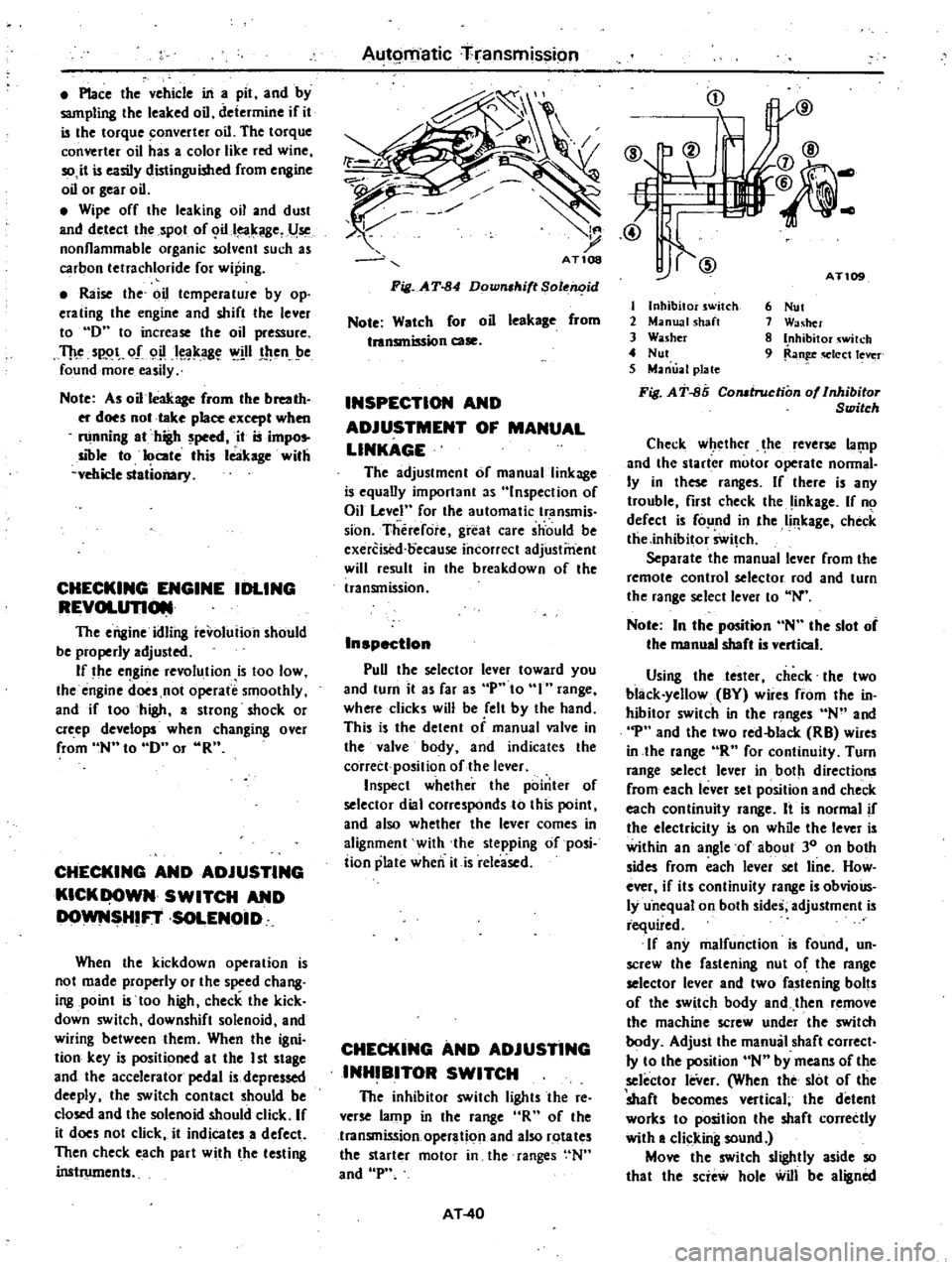
Fi
J
A
T
84
Down
ltift
Sole
id
Note
Watch
for
oil
leekage
from
tnnsmission
case
INSPECTION
AND
ADJUSTMENT
OF
MANUAL
LINKAGE
The
adjustmcnt
of
manual
linkage
i
equany
important
as
Inspection
of
Oil
Level
for
the
automatic
transmis
sion
Therefore
great
care
should
be
cxercised
oecause
incorrect
adjustment
will
result
in
the
breakdown
of
the
transmission
Inspection
pun
the
selector
lever
toward
you
and
turn
it
as
far
as
p
to
range
where
clicks
will
be
ell
by
the
hand
This
is
the
detent
of
manual
valve
in
the
valve
body
and
indicates
the
corrett
position
of
the
lever
Inspect
whether
the
pointer
of
selector
dial
corresponds
to
this
point
and
also
whether
the
lever
comes
in
alignment
with
the
stepping
of
posi
iion
plate
when
itis
released
CHECKING
AND
ADJUSTING
INHIBITOR
SWITCH
The
inhibitor
switch
lights
the
re
verse
lamp
in
the
range
R
of
the
transmission
operation
and
also
rotates
the
starter
motor
in
the
ranges
N
and
P
AT
40
i
j
tI
IlV
@
@
AT
I
Inhibitor
switch
2
Manual
shaft
3
Washer
4
Nut
5
Manual
plate
Fi
J
AT
85
Comtruction
of
Inhibitor
Switch
6
Nut
1
Washer
8
Inhibitor
wilch
9
Ran
q
Iect
lever
Check
w
ethcr
he
leverse
lal
1p
and
the
starter
motor
operate
nonnal
Iy
in
these
ranges
If
there
is
any
trouble
first
check
the
inkage
If
no
defect
is
fo
nd
in
the
Ii
leage
check
tlie
inhibitor
Swi
ch
Separate
the
manual
lever
from
the
remote
control
selector
rod
and
turn
the
range
select
lever
to
N
Note
In
the
position
N
the
slot
of
the
manual
shaft
is
vertical
Using
the
tester
check
the
two
black
yellow
BY
wire
from
the
in
hibitor
switch
in
the
ranges
N
and
p
and
the
two
red
blacle
RB
wires
in
the
lange
R
for
continuity
Turn
range
select
lever
in
both
directions
from
each
lever
set
position
and
check
each
continuity
range
It
is
normal
if
the
electricity
is
on
while
the
lever
is
within
an
angle
of
about
30
on
both
sides
from
each
lever
set
line
How
ever
if
its
continuity
range
is
obvioUs
ly
u
nequal
on
both
sides
adjustment
is
required
If
any
malfunction
is
found
un
screw
the
fastening
nut
o
the
range
selector
lever
and
two
fastening
bolts
of
the
switch
body
and
then
remove
the
machine
screw
under
the
switch
body
Adjust
the
manual
shaft
correct
Iy
to
the
position
N
by
means
of
the
selector
leVer
When
the
slot
of
the
shaft
becomes
vertical
the
detent
worles
to
position
the
shaft
correctly
with
a
clicking
sound
Move
the
switch
slightly
aside
so
that
the
scie
hole
will
be
aligned
Page 297 of 548

JUDGEMENT
IN
MEASURING
LINE
PRESSURE
Low
idling
line
pressure
in
the
ranges
D
2
R
and
P
This
can
be
attributed
to
trouble
in
the
pressure
supply
system
or
too
low
output
of
power
caused
by
I
A
worn
oil
pump
2
An
oil
pressure
leak
in
the
oil
pump
valve
body
or
case
3
A
sticking
regulator
valve
2
Low
idling
line
pressure
i
n
cer
tain
ranges
only
This
is
presumably
caused
by
an
oil
leak
in
the
devices
or
circuits
con
nected
to
the
relevant
ranges
I
When
there
is
an
oil
leaJi
in
the
rear
clutch
and
governor
the
line
pressure
in
on
2
and
I
are
low
but
the
pressure
i
nonnal
in
R
2
When
an
oil
leak
occurs
in
the
low
and
reverse
brake
circuit
the
line
pressure
in
oR
and
P
are
low
b
t
the
pressure
is
normal
in
0
2
and
I
3
High
idling
line
pressure
Thi
is
presumably
caused
by
an
increased
aC
1ulT
t
rott
e
pr
ssure
owing
to
a
leak
in
the
vacuum
tube
or
diaphragin
or
by
an
increased
line
Automatic
Transmission
pressure
due
to
a
sticking
regulator
valve
Vacuum
leakage
is
checked
by
directly
measuring
the
negative
pres
sure
after
removing
the
vacuum
pipe
A
puncture
of
the
vacuum
dia
phragm
can
be
easily
ascertained
because
the
torque
converter
oil
is
absorbed
into
the
engine
and
the
exhaust
pipe
emits
white
smoke
4
Item
to
be
checked
when
the
Ii
e
pressure
is
increasing
In
this
c
1eck
the
line
pressure
should
be
measured
with
vacuums
of
300
mmHg
Il
SI
inHg
and
0
mmHg
0
inHg
in
accordance
with
the
staIl
test
procedure
i
If
the
line
pressure
does
not
in
crease
despite
the
vacuum
decrease
check
whether
the
vacuum
rod
is
i
corporated
2
If
the
line
pressure
does
not
meet
tile
standard
iUs
caused
mostly
by
a
sticking
pressure
regulating
valve
pres
sure
regulating
valve
plug
or
amplifier
TROUBLE
SHOOTING
CHART
INSPECTING
ITEMS
I
Inspection
with
automatic
trans
mission
on
vehicle
AT
45
A
Oil
level
B
Range
select
linkage
C
Inhibitor
switch
and
wiring
D
Vacuum
diaphragm
and
piping
E
Downshift
solenoid
kickdown
switch
and
wiring
F
Engine
idling
rpm
G
Oil
pressure
throttle
H
Engine
stall
rpm
I
Rear
lubrication
J
Control
valve
manual
K
Governor
valve
L
Band
servo
M
Transmission
air
check
N
Oil
quality
o
Ignition
switch
and
starter
motor
P
Engine
adjustment
and
brake
in
spection
2
Inspection
after
inspecting
auto
matic
transmission
on
vehicle
m
Rear
clutch
n
Front
clutch
q
Band
brake
r
Low
and
reverse
brake
s
Oil
pump
t
Leakage
of
oil
passage
u
One
way
clutch
of
troque
converter
v
One
way
clutch
of
transmission
w
Front
clutch
check
ball
x
Parking
linkage
y
Planetary
gear
Page 357 of 548
REMOVAL
I
Disconnect
wiring
to
brake
fluid
level
gauge
2
Disconnect
front
and
rear
brake
tubes
from
master
cylinder
CAUTION
When
removing
brake
tubes
use
suitable
tube
wrench
Never
use
open
end
or
edjustllble
wrench
Note
When
disconnecting
brake
tubes
be
sure
to
use
a
container
to
receive
draining
brake
fluid
Use
of
raga
is
also
suggested
to
keep
adjacent
perts
and
area
clean
3
Remove
master
cylinder
securing
nut
Master
cylinder
can
then
be
taken
out
DISASSEMBLY
1
Remove
reservoir
caps
and
filtern
and
drain
out
brake
fluid
2
Pry
off
stopper
ring
using
a
screwdriver
3
Remove
stopper
screw
and
take
out
stopper
primary
piston
assembly
spring
and
secondary
piston
assembly
in
the
order
shown
Note
Discard
caps
if
they
are
reo
moved
from
piston
assemblies
and
use
new
ones
4
Unscrew
pluga
to
gain
access
to
check
valve
for
disassembling
Note
a
Never
detach
reservoir
tanks
If
they
are
removed
for
any
reason
discard
them
and
install
new
ones
b
Do
not
remove
or
disassemble
brake
fluid
level
gauge
INSPECTION
Thoroughly
clean
all
parts
in
a
suitable
solvent
and
check
them
for
wear
or
damage
Replace
any
part
that
is
faulty
Brake
System
CAUTION
Use
brake
fluid
to
clean
Never
use
mineral
oil
I
Check
cylinder
and
pistons
for
evidence
of
abnonnal
wear
or
damage
Replace
if
found
faulty
2
Check
piston
to
cylinder
clear
ance
If
it
exceeds
the
specified
value
replace
either
piston
or
cylinder
Piston
to
cylinder
clearance
less
than
0
15
mm
0
0059
in
3
Check
springs
for
weakness
fatigue
or
damage
Replace
if
neces
sary
4
When
master
cylinder
is
disas
sembled
be
sure
to
discard
caps
and
valves
Replace
any
other
parts
which
show
evidence
of
deformation
wear
or
other
damage
S
Replace
damaged
oil
reservoirs
and
caps
ASSEMBLY
Assemble
master
cylinder
following
the
reverse
procedure
of
disassembly
paying
particular
attention
to
the
fol
lowing
note
Note
a
Replace
gaskets
and
packing
with
new
ones
b
Apply
brake
fluid
or
rubber
grease
to
sliding
contact
surface
of
parts
to
facilitate
assembly
of
master
cylinder
c
The
brake
master
cylinder
is
avail
able
in
both
NABCO
make
and
TOKICO
make
There
is
no
inter
changeability
of
repair
kits
or
com
ponent
parts
between
NABCO
and
TOKlCO
makes
When
replacing
the
repair
kit
or
component
parts
ascertain
the
brand
of
the
brake
master
cylinder
body
Be
sure
to
use
parts
of
the
same
make
as
the
fonner
ones
INSTALLATION
Install
master
cylinder
following
the
reverse
procedure
of
removal
After
installation
bleed
brake
system
BR
5
CAUTION
When
installing
Flare
Nut
6694310000
brake
tubes
use
Torque
Wrench
CiJ
Tightening
torque
Brake
master
cylinder
securing
nut
0
8
to
t
1
kg
m
5
8
to
8
0
ft
lb
Brake
tube
flare
nut
1
5
to
1
8
kg
m
11
to
13
ft
b
BRAKE
FLUID
LEVEL
GAUGE
Inspection
I
Disengage
hand
brake
control
lever
2
Raise
cap
and
make
sure
that
hand
brake
warning
lamp
goes
on
when
float
comes
into
contact
with
stopper
BRAKE
LINE
REMOVAL
I
Remove
flare
nuts
on
both
ends
and
remove
retainers
and
clips
CAUTION
When
removing
brake
tubes
and
hoses
use
suitable
tube
wrench
Never
use
open
end
or
adjustable
wrench
2
To
remove
brake
hose
first
re
move
flare
nut
securing
brake
tube
to
brake
hose
and
withdraw
lock
spring
End
of
hose
can
then
be
removed
from
bracket
Next
remuve
brake
hose
Do
not
twist
brake
hose
INSPECTION
Check
brake
lines
tubes
and
hoses
for
evidence
of
cracks
deterioration
or
other
damage
Replace
any
faulty
parts
Page 446 of 548
DATSUN
210
Model
8310
Series
SECTIONBE
BODY
ELECTRICAL
SYSTEM
CONTENTS
BODY
ELECTRICAL
WIRING
DESCRIPTION
FUSE
AND
FUSIBLE
LINK
WIRING
WIRING
HARNESS
LOCATION
OF
ELECTRICAL
UNIT
ELECTRICAL
UNIT
OF
LIGHTING
SYSTEM
BULB
SPECIFICATIONS
REMOVAL
AND
INSTALLATION
For
lamp
IGNITION
SWITCH
COMBINATION
SWITCH
ILLUMINATION
CONTROL
UNIT
AIMING
ADJUSTMENT
ELECTRICAL
UNIT
OF
SIGNAL
SYSTEM
BE
12
TURN
SIGNAL
SWITCH
BE
12
HORN
RELAY
BE
12
HAZARD
SWITCH
BE
12
STOP
LAMP
SWITCH
BE
12
BACK
UP
LAMP
SWITCH
BE
12
DOOR
SWITCH
BE
12
METERS
AND
GAUGES
BE
13
COMBINATION
METER
BE
13
TACHOMETER
BE
14
FUEL
LEVEL
AND
WATER
TEMPERATURE
INDICATOR
SYSTEM
BE
14
WARNING
SYSTEM
BE
15
CHARGE
WARNING
SYSTEM
BE
15
BRAKE
WARNING
SYSTEM
BE
15
BE
2
BE
2
BE
2
BE
4
BE
5
BE
8
BE
9
BE
9
BE
10
BE
10
BE
10
BE
11
BE
11
OIL
PRESSURE
WARNING
SYSTEM
SEAT
BELT
WARNING
SYSTEM
ELECTRICAL
ACCESSORIES
WINDSHIELD
WIPER
AND
WASHER
REAR
WINDOW
WIPER
AND
WASHER
CIGARETTE
LIGHTER
RADIO
CLOCK
REAR
WINDOW
DEFOGGER
STARTING
SYSTEM
For
automatic
transmission
models
HEATER
DESCRIPTION
AIR
FLOW
REMOVAL
AND
INSTALLATION
ADJUSTING
HEATER
CONTROL
DISASSEMBLY
AND
ASSEMBLY
OF
HEATER
UNIT
INSPECTION
WIRING
DIAGRAMS
AND
TROUBLE
DIAGNOSES
ELECTRICAL
SYSTEM
BLOCK
DIAGRAM
FUSE
BLOCK
CIRCUIT
SUPPLY
ROUTING
LIGHTING
SYSTEM
SIGNAL
SYSTEM
METERS
AND
GAUGES
WARNING
SYSTEM
ELECTRICAL
ACCESSORY
SYSTEM
HEATER
BE
15
BE
15
BE
17
BE
17
BE
18
BE
20
BE
20
BE
21
BE
21
BE
23
BE
23
BE
23
BE
24
BE
26
BE
27
BE
27
BE
28
BE
29
BE
29
BE
30
BE
31
BE
36
BE
41
BE
44
BE
4B
BE
55
Page 447 of 548
DESCRI
PTI
ON
Cabl
are
covered
with
color
coded
vinyl
for
easy
identification
In
the
wiring
diagram
olors
are
indicated
by
one
or
two
alphabetical
letters
It
is
recommended
that
the
battery
be
disconnected
before
performing
any
electrical
service
other
than
bulb
or
fuse
replacement
In
addition
to
fuses
a
fusible
link
has
been
installed
to
protect
wiring
Circuit
system
Starting
and
ignition
system
Charging
system
Lighting
system
Signal
system
Instrument
system
Others
Grounding
system
The
main
cable
of
each
system
is
generally
coded
with
a
single
color
These
colors
are
represented
by
such
letters
as
G
W
or
Br
Minor
items
of
each
circuit
s
terminal
are
coded
with
a
two
tone
color
as
follows
BW
Black
with
white
stripe
LgR
Light
green
with
red
stripe
Body
ectrical
System
BODY
ELECTRICAL
WIRING
The
fusible
link
functions
almost
the
same
as
a
fuse
though
its
characteris
tics
are
slightly
different
than
normal
fuses
CABLE
COLORS
Cable
colors
are
generally
used
as
shown
in
the
following
table
Color
B
Black
W
White
R
Red
G
Green
y
Yellow
L
Br
Lg
Blue
Brown
Light
green
B
Black
INSPECTION
Inspect
all
electrical
circuits
Ie
Terring
to
wiring
or
circuit
diagrams
Circuits
should
be
tested
for
continui
ty
or
short
circuit
with
a
conventional
test
lamp
or
low
reading
voltmeter
Before
inspecting
circuit
ensure
that
I
Each
electrical
component
part
or
cable
is
securely
fastened
to
its
con
nector
or
tenninal
2
Each
connection
is
fIrmly
in
place
and
free
from
rust
and
dirt
BE
2
3
No
cable
covering
shows
any
evi
dence
of
cracks
deterioration
or
other
damage
4
Each
terminal
is
at
a
safe
distance
3
Vay
from
any
adjacent
metal
parts
5
Each
cable
is
fastened
to
its
proper
connector
or
terminal
6
Each
grounding
bolt
is
fumly
planted
7
Wiring
is
kept
away
from
any
adjacent
parts
with
sharp
edges
or
high
temperature
parts
such
as
exhaust
pipe
8
Wiring
is
kept
away
from
any
rotating
or
working
parts
fan
pulley
fan
belt
etc
9
Cables
between
fIXed
portions
and
moving
parts
are
long
enough
to
withstand
shocks
and
vibratory
forces
Note
a
Before
starting
to
inspect
and
repair
any
part
of
electrical
system
or
oth
parts
which
may
lead
to
a
short
circuit
disconnect
cables
at
battery
terminals
as
follows
Disconnect
cable
at
negative
terminal
and
then
disconnect
cable
at
positive
terminal
Before
connecting
cables
to
battery
terminal
be
s
1
to
clean
tenninals
with
a
rag
Fasten
cable
at
positive
t
minal
and
then
ground
cable
at
negative
tenninal
Apply
grease
to
top
of
these
terminals
to
prevent
rust
from
developing
on
them
b
Ne
use
a
screwdriver
or
service
tool
to
oonduct
a
oontinuity
test
Use
test
leads
Co
Nev
ground
an
open
circuit
or
circuits
under
no
lood
Use
a
test
lamp
I2V
3W
or
circuit
tester
as
a
lood
FUSE
AND
FUSIBLE
LINK
MAINTENANCE
INSTRUCTIONS
Fuse
The
fuse
block
is
installed
under
the
instrument
panel
on
driver
s
side
Page 448 of 548

When
for
one
reason
or
another
fuse
has
melted
use
systematic
proce
dure
to
check
and
eliminate
cause
of
problem
before
installing
new
fuse
Note
a
If
fuse
is
blown
be
sure
to
elimi
nate
cause
of
problem
before
in
stalling
new
fuse
b
Use
fuse
of
specified
rating
Never
use
fuse
of
more
than
specified
rating
c
Check
condition
of
fuse
holders
If
much
rust
or
dirt
is
found
thereon
clean
metal
parts
with
fine
grained
sandpaper
until
proper
metal
to
metal
contact
is
made
Poor
contact
in
any
fuse
holder
will
often
lead
to
voltage
drop
or
heat
ing
in
the
circuit
and
could
result
in
improper
circuit
operation
Body
Electrical
System
W
BE1100
Fig
BE
l
FU
e
Block
Fusible
link
Fusible
link
protects
starting
he
d
lamp
ignition
and
charge
circuits
and
wiring
between
fuse
and
fusible
link
BE1110
Fig
BE
2
Fusible
Link
BE
3
CAUTION
a
If
fusible
link
should
melt
it
is
possible
that
critical
circuit
power
supply
or
large
current
carrying
circuit
is
shorted
In
such
a
case
carefully
check
and
eliminate
cause
of
problem
b
Never
wrap
periphery
of
fusible
link
with
vinyl
tape
Extreme
care
should
be
taken
with
this
link
to
ensure
that
it
does
not
come
into
contact
with
any
other
wiring
har
ness
or
vinyl
or
rubber
parts
A
melted
fusible
link
can
be
detect
ed
either
by
visual
inspection
or
by
feeling
with
finger
tip
If
its
condition
is
questionable
use
circuit
tester
or
test
lamp
as
required
to
conduct
continuity
test
This
continuity
test
can
be
performed
in
the
same
manner
as
for
any
conventional
fuse
Page 449 of 548
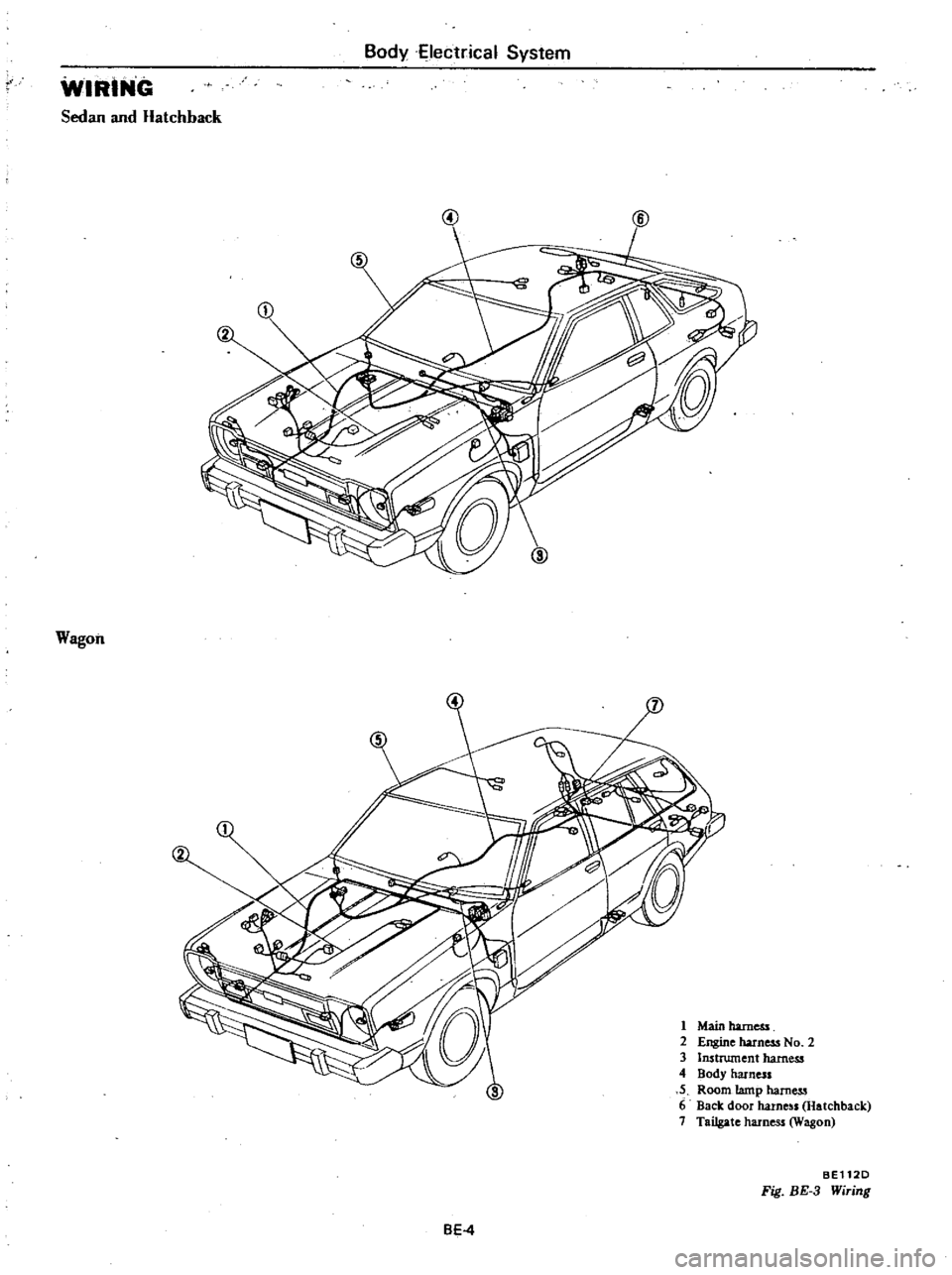
Body
Electrical
System
WIRING
Sedan
and
Hatchback
Wagon
2
1
Main
harness
2
Engine
harness
No
2
3
Instrument
harness
4
Body
harness
5
Room
tamp
harness
6
Back
door
harne
ls
Hatchback
7
Tailgate
harness
Wagon
BEl12D
Fig
BE
3
Wiring
BE4
Page 457 of 548
Body
Electrical
System
ELECTRICAL
UNIT
OF
SIGNAL
SYSTEM
CAUTION
Before
startill1l
to
work
on
any
part
of
electrical
system
disconnect
battery
ground
cable
TURN
SIGNAL
SWITCH
Refer
to
combination
switch
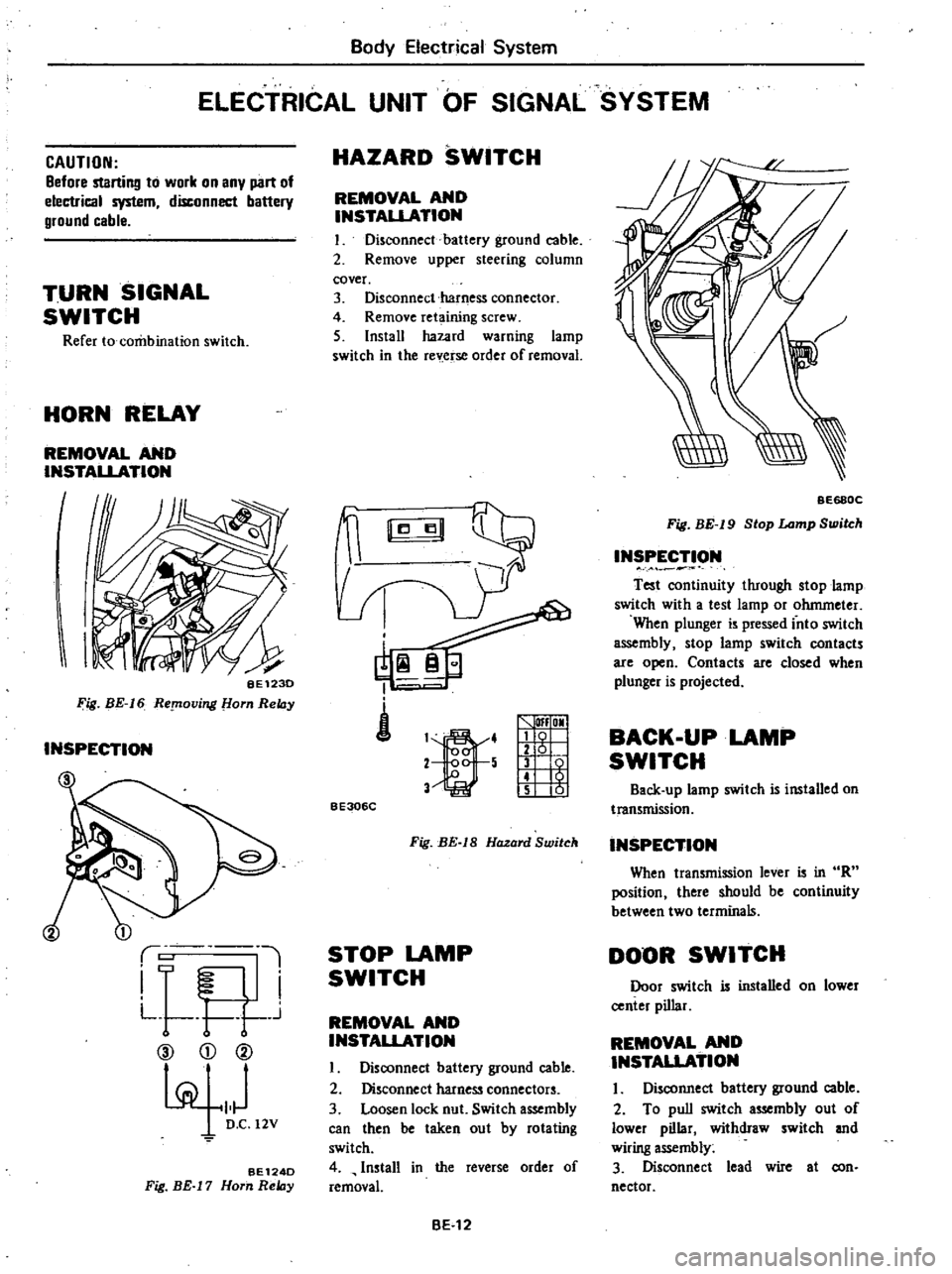
HORN
RELAY
REMOVAL
AND
INSTALLATION
I
I
BE123D
Fig
BE
16
ReplOving
om
ReIDy
INSPECTION
1
i
L
l
I
F
I
L
t
r
j
CV
CD
@
pi
101
D
C
12V
BE124D
Fig
BE
17
Horn
ReIDy
HAZARD
SWITCH
REMOVAL
AND
INSTAUATION
I
Disconnect
battery
ground
cable
2
Remove
upper
steering
column
cover
3
Disconnect
harness
connector
4
Remove
ret
ining
screw
5
Install
hazard
warning
lamp
switch
in
the
rev
erse
order
of
removal
i
1
4
2
5
V
lfI
OMI
g
1
t
5
01
BE306C
Fig
BE
IS
Hazard
Switch
STOP
LAMP
SWITCH
REMOVAL
AND
INSTALLATION
I
Disoonnect
battery
ground
cable
2
Disconnect
harness
connectors
3
Loosen
lock
nut
Switch
assembly
can
then
be
taken
out
by
rotating
switch
4
Install
in
the
reverse
order
of
removal
BE
12
BE68QC
Fig
BE
19
Stop
Lamp
Switch
INSPECTION
Test
oontinuity
through
stop
lamp
switch
with
a
test
lamp
or
ohmmeter
When
plunger
is
pressed
into
switch
assembly
stop
lamp
switch
contacts
are
open
Contacts
are
closed
when
plunger
is
projected
BACK
UP
LAMP
SWITCH
Back
up
lamp
switch
is
installed
on
transmission
INSPECTION
When
transmission
lever
is
in
R
position
there
should
be
continuity
between
two
terminals
DOOR
SWITCH
Door
switch
is
installed
on
lower
center
pillar
REMOVAL
AND
INSTAUATION
I
Disconnect
battery
ground
cable
2
To
pull
switch
assembly
out
of
lower
pillar
withdraw
switch
and
wiring
assembly
3
Disconnect
lead
wire
at
con
nector
Page 480 of 548
Head
lamp
Condition
Head
lamp
do
not
light
for
either
high
or
low
beam
High
beam
cannot
be
switched
to
low
beam
or
vice
versa
Head
lamps
dim
Head
lamp
lights
on
only
one
side
Body
Electrical
System
Probable
cause
Burnt
fusible
link
Loose
connection
or
open
circuit
Faulty
combination
switch
No
ground
Faulty
combination
switch
Partly
discharged
or
faulty
battery
Faulty
charging
system
Poor
ground
or
loose
connection
Burnt
fusible
link
Loose
head
lamp
connection
Faulty
headlamp
beam
Tail
clearance
aide
marker
and
license
plate
lampa
Condition
Neither
left
nor
right
lamp
lights
Lamp
on
only
one
side
does
not
light
Probable
cause
Burnt
fuse
Loose
connection
or
open
circuit
Faulty
lighting
switch
Lamps
light
when
@
and
@
terminals
of
harness
connector
to
combination
switch
are
connected
with
test
lead
iIlc1uding
15A
fuse
Burnt
bulb
LOose
bulb
Loose
connection
to
lamp
BE
35
Corrective
action
Corree
cause
and
rep1ace
Check
wiring
and
or
repair
connection
Conduct
continuity
test
and
replace
if
nee
essary
Clean
and
tighten
ground
terminal
Conduct
continuity
test
and
replace
if
nee
essary
Measure
specific
gravity
of
electrolyte
and
recharge
or
replace
battery
if
necessary
Measure
voltage
at
headlamp
terminals
If
it
is
less
than
12
8V
check
charging
system
for
proper
operation
Clean
and
or
tighten
Replace
Repair
Replace
Corrective
action
Correct
cause
and
replace
Check
wiring
and
or
repair
connection
Replace
if
necessary
Replace
Correct
Correct