brake DATSUN 210 1979 Workshop Manual
[x] Cancel search | Manufacturer: DATSUN, Model Year: 1979, Model line: 210, Model: DATSUN 210 1979Pages: 548, PDF Size: 28.66 MB
Page 340 of 548
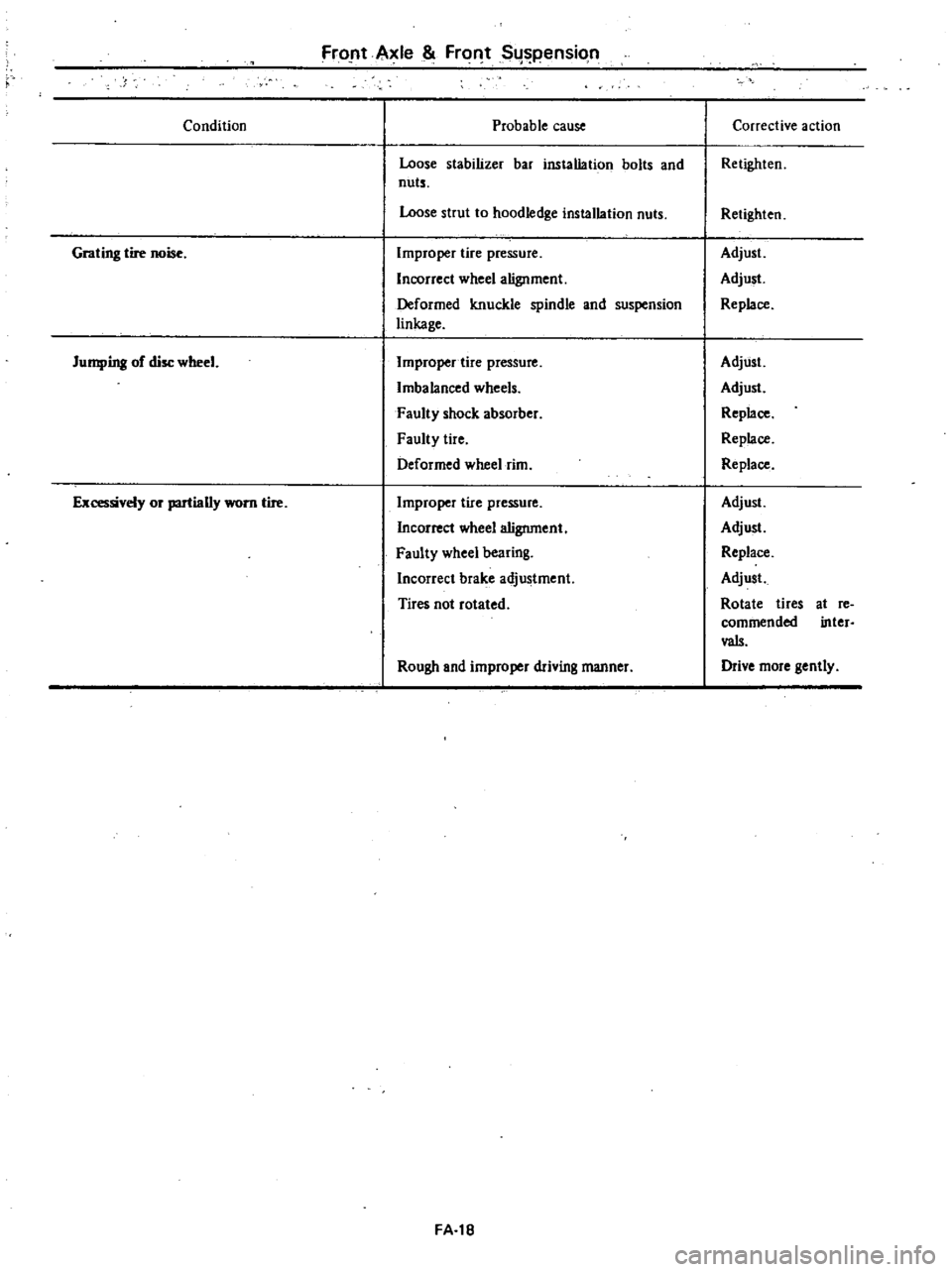
Front
Axle
Front
Suspension
Condition
Probable
cause
Loose
stabilizer
bar
installation
bolts
and
nuts
Loose
strut
to
hoodledge
installation
nuts
Grating
tire
noise
Improper
tire
pressure
Incorrect
wheel
alignment
Deformed
knuckle
spindle
and
suspension
linkage
Jumping
of
disc
wheel
Improper
tire
pressure
Imbalanced
wheels
Faulty
shock
absorber
Faulty
tire
Deformed
wheel
rim
Ex
t
J1
or
partially
worn
tire
Improper
tire
pressure
Incorrect
wheel
alignment
Faulty
wheel
bearing
Incorrect
brake
adjustment
Tires
not
rotated
Rough
and
improper
driving
manner
FA
18
Corrective
action
Retighten
Retighten
Adjust
Adjust
Replace
Adjust
Adjust
Replace
Replace
Replace
Adjust
Adjust
Replace
Adjust
Rotate
tires
commended
vaIs
Drive
more
gently
at
re
inter
Page 344 of 548

REAR
AXLE
REAR
AXLE
ASSEMBLY
Remove
L
Block
front
wheels
with
chocks
2
Raise
rear
of
car
high
enough
to
pennit
working
underneath
and
place
stands
solidly
under
body
member
on
both
sides
RA544
Fig
RA
2
Supporting
Point
3
Support
under
center
of
dif
ferential
carrier
with
a
garage
jack
4
Remove
rear
wheels
5
Disconnect
propeller
shaft
by
re
moving
bolts
CD
securing
propeller
shaft
flange
to
companion
flange
of
differential
carrier
6
Disconnect
brake
hose
from
brake
tube
at
body
@
and
rear
cable
adjuster
@
Fig
RA
3
Removing
Propeller
Shaft
and
Brohe
Hose
CAUTION
e
When
disconnecting
brake
tube
use
suitable
tube
wrench
Never
use
open
end
or
adjustable
wrench
b
Cover
brake
hose
end
pipe
open
ings
to
prevent
entrance
of
dirt
Rear
Axle
Rear
Suspension
7
Remove
bolts
securing
shock
absorber
lower
ends
on
each
side
RA485
Fig
RA
4
Removing
Bolt
Securing
Shock
Absorber
Lower
End
Note
When
removing
shock
absorber
lower
end
from
bracket
squeeze
shock
absorber
and
lift
it
out
right
above
to
accommodate
em
bossment
inside
bracket
C
AA486
Fig
RA
5
Shock
Absorber
Lower
End
8
Lower
jack
slowly
and
remove
cojI
springs
on
each
side
after
they
are
fully
extended
AA546
Fig
RA
6
Removing
Coil
Spring
9
Raise
jack
to
its
original
position
10
Remove
bolts
CD
and
@
se
curing
upper
and
lower
links
at
axle
case
side
RA
3
Fig
RA
7
Disconnecting
Upper
Link
and
Lower
Link
II
Release
garage
jack
slowly
and
pull
it
out
toward
rear
of
car
In
tenetlon
Install
rear
axle
in
the
reverse
order
of
removal
CAUTION
a
When
installing
brake
tubes
use
Flare
Nut
Torque
Wrench
GG94310000
b
Before
tightening
link
bushing
nuts
temporarily
attach
upper
and
lower
links
to
axle
case
Alter
jacking
up
center
of
differential
carrier
until
upper
Bnd
lower
links
are
almost
horizontal
securely
tighten
link
bushing
nuts
c
When
supporting
car
weight
at
Cl
nter
of
differential
carrier
do
not
put
a
load
in
car
j
Tightening
torque
Brake
tube
flare
nut
1
5
to
1
8
kg
m
11
to
13
ft
lb
Propeller
shaft
to
companion
flange
connecting
nut
2
4
to
3
3
kg
m
17
to
24
ft
Ibl
Shock
absorber
lower
end
nut
7
0
to
8
0
kg
m
51
to
58
ft
Ibl
lower
link
fixing
nut
7
0
to
8
0
kg
m
51
to
58
ft
Ib
Upper
link
fixing
nut
7
0
to
8
0
kg
m
51
to
58
ft
lb
Page 345 of 548

i
REAR
AXLE
SHAFT
AND
WHEn
BEARING
Removal
end
disassembly
1
mock
front
wheels
with
chocks
2
Raise
rear
of
car
and
support
under
axle
case
on
stands
3
Remove
rear
wheel
4
Pull
off
spring
CD
and
discon
nect
brake
cable
from
lever
by
re
moving
clevis
pin
@
5
Disconnect
brake
tube
at
rear
brake
disc
I
@
CD
RA547
Fig
RA
8
Removing
Broke
Port
CAUTION
e
Whim
disconnecting
brake
tube
use
suitBble
tube
wrench
Never
use
open
end
or
adjustabla
wrench
b
Cover
brake
hose
and
pipe
open
ings
to
prevent
entrance
of
dirt
6
Re
TIove
brake
drum
7
Remove
four
nuts
securing
brake
disc
back
plate
from
rear
axle
case
RA548
Fig
RA
9
Removing
Null
8
Draw
out
axle
shaft
assembly
together
with
brake
disc
using
Rear
Axle
Stand
KV
40
1
01000
and
Sliding
Hammer
ST36230000
Rear
Axle
Rea
Suspension
RA549
Fig
RA
lO
Removing
Re
Axle
Shaft
A
embly
9
Remove
oil
seal
if
necessary
and
install
new
one
10
Cut
collar
with
cold
chisel
Fig
RA
II
Cutting
Bearing
Collar
CAUTION
Take
care
not
to
damage
axle
shaft
with
cold
chisel
during
operation
II
Remove
wheel
bearing
and
col
lar
using
Rear
Axle
Shaft
Bearing
Puller
Hf72480000
Then
take
out
brake
disc
I
1
RA492
Fig
RA
12
Removing
Wheel
Bearing
Inspection
Inspect
the
following
parts
and
replace
as
required
RA
4
L
Check
axle
shaft
for
sttaightness
cracks
damage
wear
or
distortion
2
Check
the
lip
of
oil
seal
for
damage
deformation
or
wear
3
Check
bearing
for
wear
or
dam
age
Ass
mbl
end
Instelletl
n
Assemble
and
install
in
the
reverse
order
of
disassembly
and
removal
noting
the
following
points
I
Install
bearing
spacer
bearing
and
new
bearing
collar
onto
axle
shaft
and
press
bearing
collar
by
specified
load
3
to
5
tons
using
Rear
Axle
Shaft
Bear
ing
Collar
Press
Stand
S1
38210000
Note
e
New
collar
must
be
used
end
clean
collar
and
we
shaft
b
Insert
wbeel
bearing
with
seaI
side
facing
bnke
disc
I
8
RA157
Fig
RA
13
l1l1ta
ling
Wheel
Bearing
2
Install
oil
seal
using
Rear
Axle
Oil
Seal
Drift
KV40100300
3
Pack
cavity
between
sealing
lips
of
oil
seal
with
recommended
multi
purpose
grease
4
When
inserting
axle
shaft
into
axle
case
use
Rear
Axle
Shaft
Guide
ST37840000
not
to
damage
the
seal
ing
lips
of
oil
seal
To
insert
axle
shaft
into
axle
case
proceed
as
follows
I
Install
Rear
Axle
Shaft
Guide
ST37840000
on
we
case
2
Remove
guide
when
the
distance
A
between
axle
flange
and
bearing
is
70
to
90
mm
2
76
to
3
54
in
See
Fig
RA
14
Note
Apply
multi
purpose
grease
to
the
outer
periphery
of
the
rear
we
shaft
bearing
collar
Page 346 of 548
V
CD
l
t
177t
ID
@
A
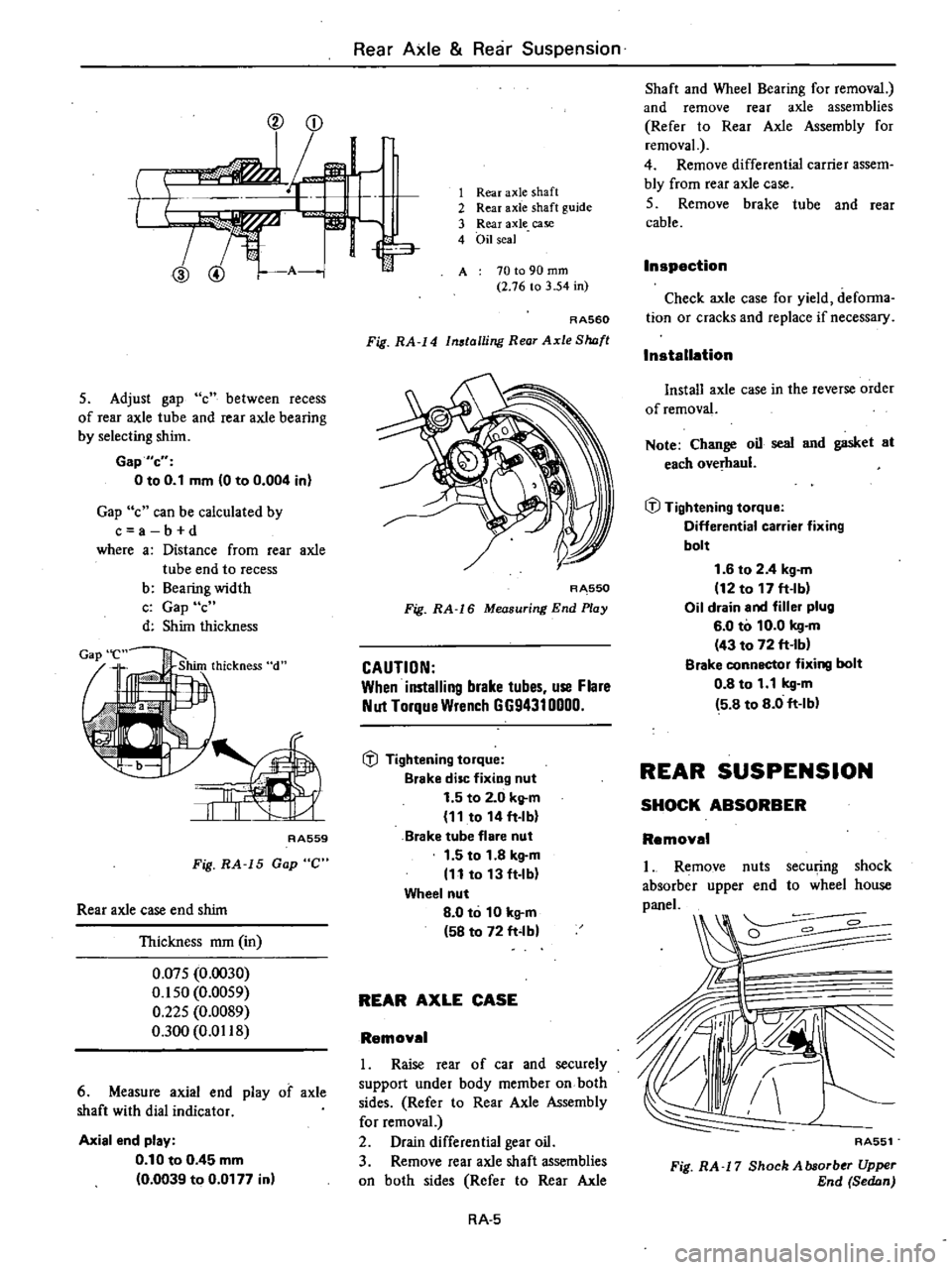
5
Adjust
gap
c
between
recess
of
rear
axle
tube
and
rear
axle
bearing
by
selecting
shinto
Gap
e
o
to
0
1
mm
0
to
0
004
in
Gap
c
can
be
calculated
by
c
a
b
d
where
a
Distance
from
rear
axle
tube
end
to
recess
b
Bearing
width
c
Gap
c
d
Shint
thickness
RA559
Fig
RA
15
Gap
C
Rear
axle
case
end
shim
Thickness
mm
in
om5
0
0030
0
1
50
0
0059
0
225
0
0089
0
300
0
0118
6
Measure
axial
end
play
of
axle
shaft
with
dial
indicator
Axial
end
plav
0
10
to
0
45
mm
0
0039
to
0
0177
in
Rear
Axle
Rear
Suspension
1
Rear
axle
shaft
2
Rear
axle
shaft
guide
3
Rear
axle
case
4
Oil
seal
I
ill
A
70
to
90
mm
2
76
to
3
54
in
A
A560
Fig
RA
14
Installing
Rear
Axle
Slwft
R
550
Fig
RA
16
Measuring
End
Play
CAUTION
When
installing
brake
1ubes
use
Flare
Nul
Torque
Wrench
GG94310000
ifl
Tightening
torque
Brake
disc
fixing
nut
1
5
to
2
0
kg
m
11
to
14
ft
lb
Brake
tube
flare
nut
1
5
to
1
8
kg
m
11
to
13
ft
lb
Wheel
nut
8
0
to
10
kg
m
58
to
72
ft
lb
REAR
AXLE
CASE
Remove
I
Raise
rear
of
car
and
securely
support
under
body
member
on
both
sides
Refer
to
Rear
Axle
Assembly
for
removal
2
Drain
differential
gear
oil
3
Remove
rear
axle
shaft
assemblies
on
both
sides
Refer
to
Rear
Axle
RA
5
Shaft
and
Wheel
Bearing
for
removal
and
remove
rear
axle
assemblies
Refer
to
Rear
Axle
Assembly
for
removal
4
Remove
differential
carrier
assem
bly
from
rear
axle
case
5
Remove
brake
tube
and
rear
cable
Inspection
Check
axle
case
for
yield
deforma
tion
or
cracks
and
replace
if
necessary
Installetion
Install
axle
case
in
the
reverse
order
of
removal
Note
Change
oil
seal
and
gasket
at
each
ove
haul
ifl
Tightening
tOlque
Differential
carrier
fixing
bolt
1
6
to
2
4
kg
m
12
to
17
ft
lbl
Oil
drain
and
filler
plug
6
0
to
10
0
kg
m
43
to
72
ft
lbl
Blake
connector
fixing
bolt
0
8
to
1
1
kg
m
5
8
to
8
0
ft
Ibl
REAR
SUSPENSION
SHOCK
ABSORBER
Removal
1
Remove
nuts
secu
ng
shock
absorber
upper
end
to
wheel
house
paneL
RA551
Fig
RA
17
Shock
Absorber
Upper
End
Sedan
Page 350 of 548

TIGHTENING
TORQUE
Brake
tube
connector
flare
nut
Brake
disc
fixing
nut
PropelJer
shaft
to
companion
flange
connecting
nut
Wheel
nut
Drain
and
filler
ptug
Differential
carrier
to
axle
case
bolt
Shock
absorber
upper
end
nut
Shock
absorber
lower
end
nut
Upper
link
fixing
bolt
Upper
link
fixing
nut
Lower
link
fixing
nut
Rear
Axle
Rear
Suspension
kg
m
ft
Ib
kg
m
ft
lb
kg
m
ft
tb
kg
m
ft
lb
kg
m
ft
Ib
kg
m
ft
lb
kg
m
ft
lb
kg
m
ft
lb
kg
m
ft
lb
kg
m
ft
lb
kg
m
ft
Ib
RA
9
1
5
to
1
8
II
to
13
1
5
to
2
0
II
to
14
2
4
to
3
3
17
to
24
8
0
to
10
0
58
to
72
6
0
to
10
0
43
to
72
1
6
to
2
4
12
to
17
1
5
to
2
0
II
to
14
7
0
to
8
0
51
to
58
7
0t08
0
51
to
58
7
0
to
8
0
51
to
58
7
0
to
8
0
51
to
58
Page 353 of 548
DATSUN
2
0
Model
83
0
Series
SECTIONBR
BRAKE
SYSTEM
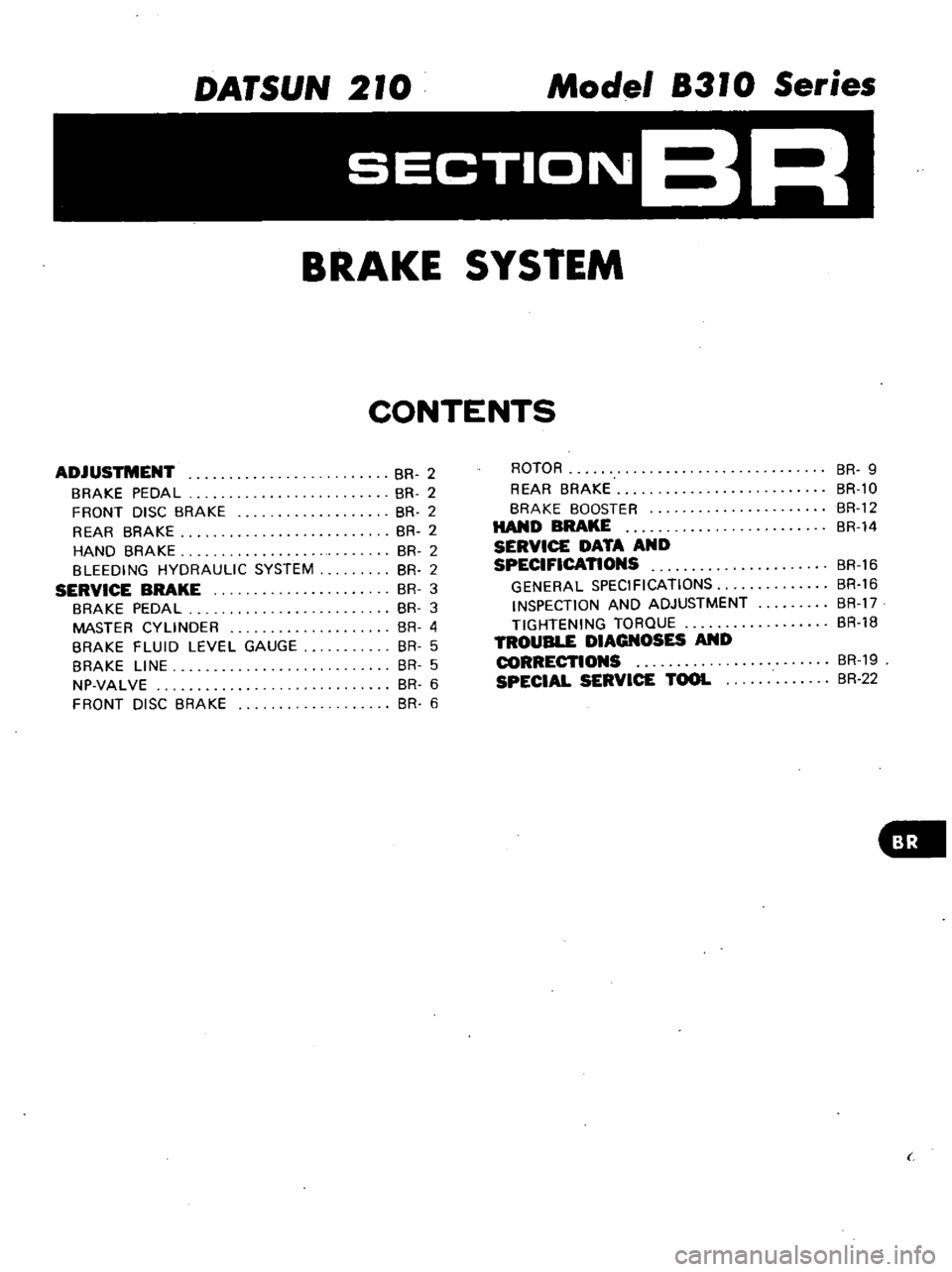
CONTENTS
ADJUSTMENT
BRAKE
PEDAL
FRONT
DISC
BRAKE
REAR
BRAKE
HAND
BRAKE
BLEEDING
HYDRAULIC
SYSTEM
SERVICE
BRAKE
BRAKE
PEDAL
MASTER
CYLINDER
BRAKE
FLUID
LEVEL
GAUGE
BRAKE
LINE
NP
VALVE
FRONT
DISC
BRAKE
BR
2
BR
2
BR
2
BR
2
BR
2
BR
2
BR
3
BR
3
BR
4
BR
5
BR
5
BR
6
BR
6
ROTOR
REAR
BRAKE
BRAKE
BOOSTER
HAND
BRAKE
SERVICE
DATA
AND
SPECIFICATIONS
GENERAL
SPECIFICATIONS
INSPECTION
AND
ADJUSTMENT
TIGHTENING
TORQUE
TROUBLE
DIAGNOSES
AND
CORRECTIONS
SPECIAL
SERVICE
TOOL
BR
9
BR
l0
BR
12
BR
14
BR
16
BR
16
BR
17
BR
18
8R
19
8R
22
Page 354 of 548
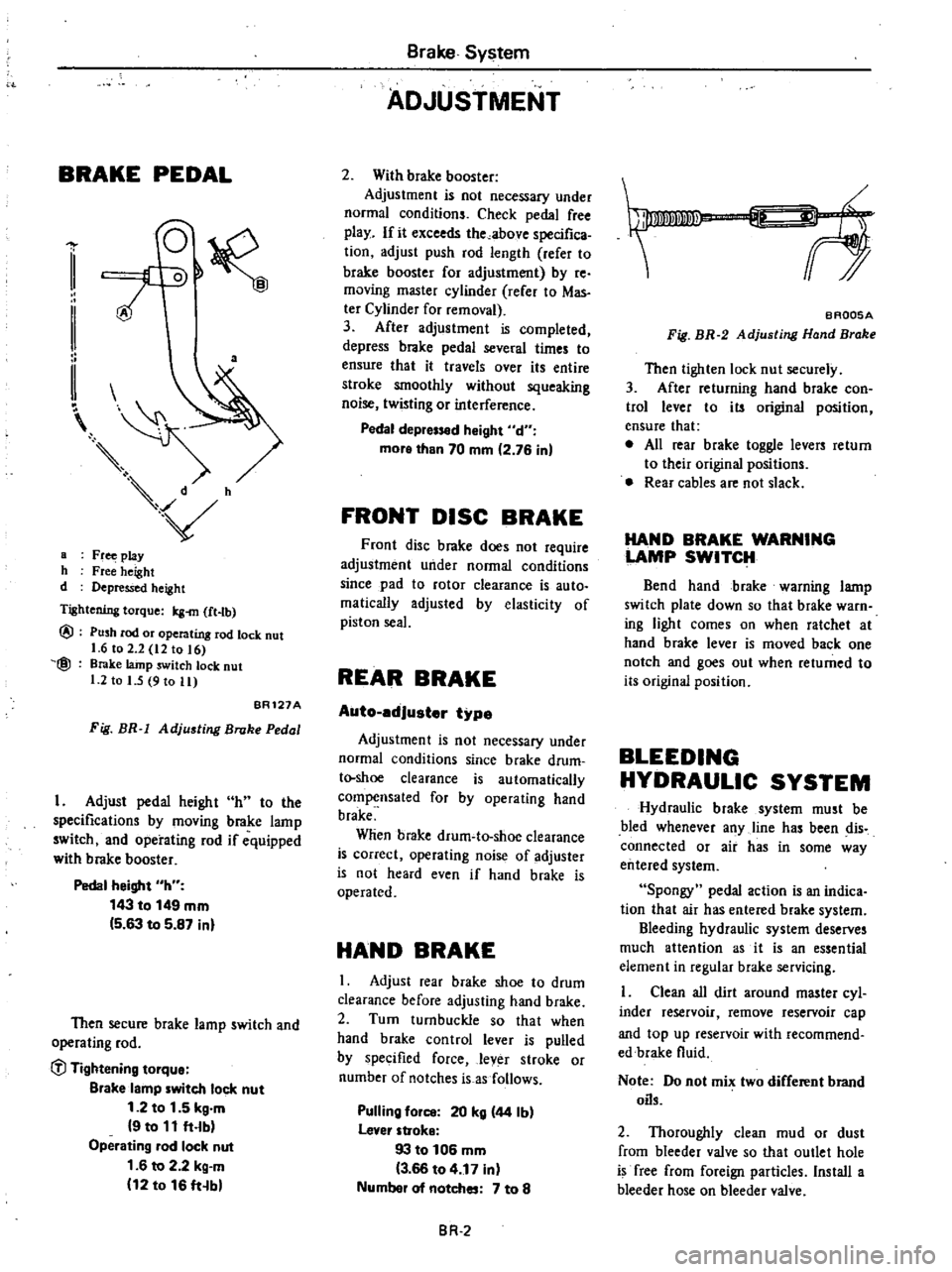
BRAKE
PEDAL
a
a
Fr
play
h
Free
height
d
Depressed
height
Tightening
torque
Icg
m
ft
tb
@
@
Push
rod
or
operating
rod
lock
nut
1
6
to
2
2
12
to
16
Brake
lainp
switch
lock
nut
1
2
to
I
5
9
to
11
BR121A
Fig
BR
1
Adjusting
Broke
Pedal
I
Adjust
pedal
height
h
to
the
specifications
by
moving
brake
lamp
switch
and
operating
rod
if
equipped
with
brake
booster
Pedal
height
h
143
to
149
mm
5
63
to
5
87
inl
Then
secure
brake
lamp
switch
and
operating
rod
C
l
Tightening
tOlque
Blake
lamp
witch
lock
nut
1
2
to
1
5
kg
m
9
to
11
ft
lb
Operating
lad
lock
nut
1
6
to
2
2
kg
m
12
to
16
ft
b
Brake
System
ADJUSTMENT
2
With
brake
booster
Adjustment
is
not
necessary
under
normal
conditions
Check
pedal
free
play
If
it
exceeds
the
above
specifica
tion
adjust
push
rod
length
refer
to
brake
booster
for
adjustment
by
re
moving
master
cylinder
rerer
to
Mas
ter
Cylinder
for
removal
3
After
adjustment
is
completed
depress
brake
pedal
several
times
to
ensure
that
it
travels
over
its
entire
stroke
smoothly
without
squeaking
noise
twisting
or
interference
Pedal
depr
d
Might
d
more
than
70
mm
2
76
in
FRONT
DISC
BRAKE
Front
disc
brake
does
not
require
adjustment
under
normal
conditions
since
pad
to
rotor
clearance
is
auto
malically
adjusted
by
elasticity
of
piston
seal
REAR
BRAKE
Auto
edJuster
type
Adjustment
is
not
necessary
under
normal
conditions
since
brake
drum
t
shoe
clearance
is
automatically
compensated
for
by
operating
hand
brake
Wlien
brake
drum
to
shoe
clearance
is
correct
operating
noise
of
adjuster
is
not
heard
even
if
hand
brake
is
operated
HAND
BRAKE
I
Adjust
rear
brake
shoe
to
drum
clearance
before
adjusting
hand
brake
2
Turn
turnbuckle
so
that
when
hand
brake
control
lever
is
pulled
by
specified
force
lever
stroke
or
number
of
notches
is
as
follows
Pulling
fOil
20
kg
44
Ib
lever
stroke
93
to
106
mm
3
66
to
4
17
in
Numbel
of
notches
7
to
8
BR
2
f
BAQ05A
Fig
BR
2
Adjusting
Hand
Brake
Then
tighten
lock
nut
securely
3
After
returning
hand
brake
con
trol
lever
to
its
original
position
ensure
that
e
All
rear
brake
toggle
levers
return
to
their
original
positions
Rear
cables
are
not
slack
HAND
BRAKE
WARNING
LAMP
SWITCH
Bend
hand
brake
warning
lamp
switch
plate
down
so
that
brake
warn
ing
light
comes
on
when
ratchet
at
hand
brake
lever
is
moved
back
one
notch
and
goes
out
when
returned
to
its
original
position
BLEEDING
HYDRAULIC
SYSTEM
Hydraulic
brake
system
must
be
bled
whenever
any
line
has
been
dis
connected
or
air
has
in
some
way
entered
system
Spongy
pedal
action
is
an
indica
tion
that
air
has
entered
brake
system
Bleeding
hydraulic
system
deserves
much
attention
as
it
is
an
essential
element
in
regular
brake
servicing
Clean
all
dirt
around
master
cyl
inder
reservoir
remove
reservoir
cap
and
top
up
reservoir
with
recommend
edbrake
fluid
Note
Do
not
mix
two
different
brand
oils
2
Thoroughly
clean
mud
or
dust
from
bleeder
valve
so
that
outlet
hole
is
free
from
foreign
particles
Install
a
bleeder
hose
on
bleeder
valve
Page 355 of 548
L
@
fl
JJ
l
f
m
ff
v
1
II
2
I
I
II
B
s1
r
Dip
other
end
of
hose
into
brake
fluid
bled
in
a
container
3
Pepress
brake
pedal
two
or
three
times
and
then
keep
pedal
fully
de
pressed
4
With
brake
pedal
fully
depressed
open
bleeder
valve
to
exhaust
air
Note
a
Carefully
monitor
brake
fluid
level
at
master
cylinder
during
bleeding
operation
BRAKE
PEDAL
REMOVAL
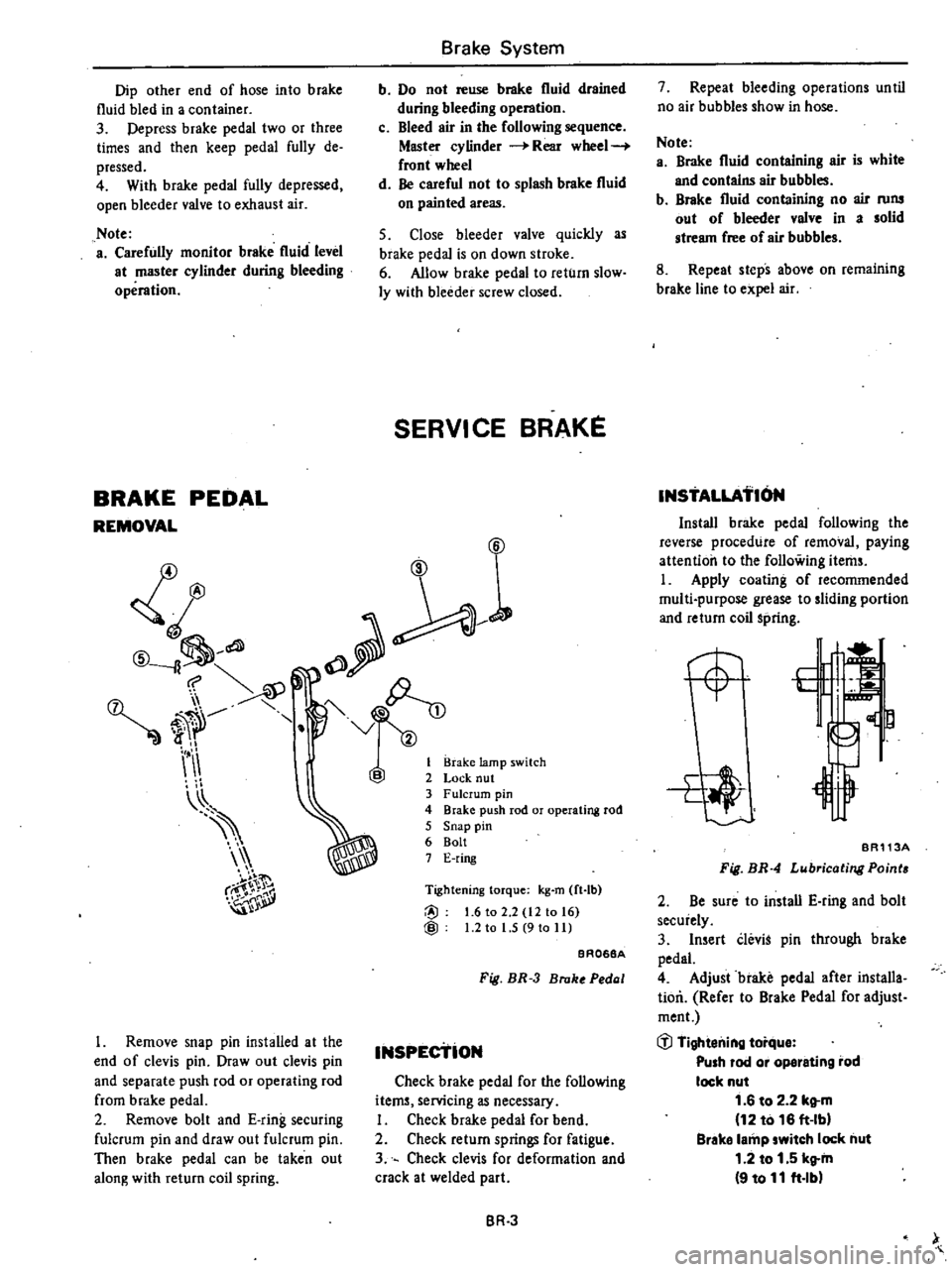
I
Remove
snap
pin
installed
at
the
end
of
clevis
pin
Draw
out
clevis
pin
and
separate
push
rod
or
operating
rod
from
brake
pedal
2
Remove
bolt
and
E
ring
securing
fulcrum
pin
and
draw
out
fulcrum
pin
Then
brake
pedal
can
be
taken
out
along
with
return
coil
spring
Brake
System
b
Do
not
reuse
brake
fluid
drained
during
bleeding
operation
c
Bleed
air
in
the
following
sequence
Master
cylinder
Rear
wheel
front
wheel
d
Be
careful
not
to
splash
brake
fluid
on
painted
areas
5
Close
bleeder
valve
quickly
as
brake
pedal
is
on
down
stroke
6
Allow
brake
pedal
to
return
slow
ly
with
bleeder
screw
closed
SERVI
CE
BRAKE
fJ
Brake
lamp
switch
Lock
nut
Fulcrum
pin
Brake
push
rod
or
operating
rod
Snap
pin
Bolt
E
ring
Tightening
torque
kg
m
ft
Ib
@
1
6
to
2
2
12
10
16
@
1
2
to
l
S
9
to
II
BROS8A
Fig
BR
3
Broke
Pedal
INSPEctioN
Check
brake
pedal
for
the
following
items
servicing
as
necessary
I
Check
brake
pedal
for
bend
2
Check
return
springs
for
fatigue
3
Check
clevis
for
deformation
and
crack
at
welded
part
BR
3
7
Repeat
bleeding
operations
until
no
air
bubbles
show
in
hose
Note
a
Brake
fluid
containing
air
is
white
and
contalns
air
bubbles
b
Brake
fluid
containing
no
air
rons
out
of
bleeder
valve
in
a
solid
stream
free
of
air
bubbles
8
Repeat
steps
above
on
remaining
brake
line
to
expel
air
INSTALLATION
Install
brake
pedal
following
the
reverse
procedure
of
removal
paying
attention
to
the
following
items
I
Apply
coating
of
recommended
multi
purpose
grease
to
sliding
portion
and
return
coil
spring
BA113A
Fit
BR
4
Lubricating
Point
2
Be
sure
to
install
E
ring
and
bolt
securely
3
Insert
CleviS
pin
through
brake
pedal
4
Adjust
brake
pedal
after
installa
tion
Refer
to
Blake
Pedal
for
adjust
ment
j
Tightening
torque
Push
rod
or
op8leting
rod
lock
nut
1
6
to
2
2
kltm
12
to
16
ft
Ibl
Brake
lamp
switch
lock
nut
1
2
to
1
5
kltin
9
to
11
ft
lb
Page 356 of 548
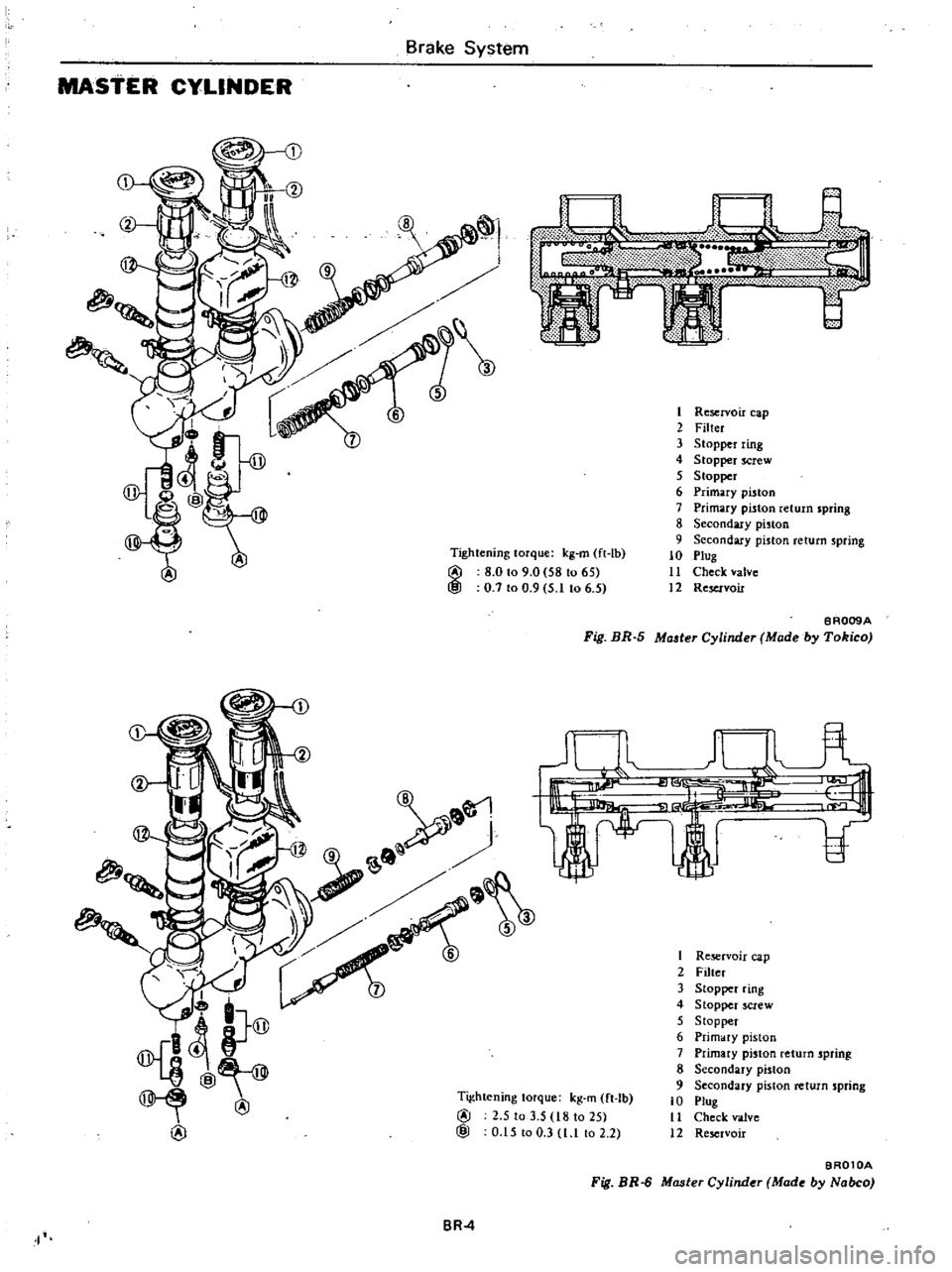
Tightening
torque
kg
m
ft
Ib
@
8
0
to
9
0
581065
@
0
7
to
0
9
5
1
to
6
5
I
Brake
System
MAstER
CYLINDER
I
Reservoir
cap
2
Filter
3
Stopper
ring
4
Stopper
Crew
5
Stopper
6
Primary
piston
7
Primary
piston
return
spring
8
Secondary
piston
9
Secondary
piston
return
spring
10
Plug
11
Check
valve
12
Reservoir
BR009A
Fig
BR
5
Ma
ler
Cylinder
Made
by
Tokico
1
Re
rvoir
cap
2
Filter
3
Stopper
ring
4
Stopper
screw
5
Stopper
6
Primary
piston
7
Primary
pinon
return
spring
8
Secondary
piston
9
Secondary
piston
return
spring
10
Plug
11
Check
valve
12
Reservoir
Tightening
torque
kg
m
ft
Ib
@
2
5
to
3
5
18
10
25
@
0
15
00
3
l
l
o
2
2
BR
4
I
BA010A
Fill
BR
6
Master
Cylinder
Made
by
Nabco
Page 357 of 548
REMOVAL
I
Disconnect
wiring
to
brake
fluid
level
gauge
2
Disconnect
front
and
rear
brake
tubes
from
master
cylinder
CAUTION
When
removing
brake
tubes
use
suitable
tube
wrench
Never
use
open
end
or
edjustllble
wrench
Note
When
disconnecting
brake
tubes
be
sure
to
use
a
container
to
receive
draining
brake
fluid
Use
of
raga
is
also
suggested
to
keep
adjacent
perts
and
area
clean
3
Remove
master
cylinder
securing
nut
Master
cylinder
can
then
be
taken
out
DISASSEMBLY
1
Remove
reservoir
caps
and
filtern
and
drain
out
brake
fluid
2
Pry
off
stopper
ring
using
a
screwdriver
3
Remove
stopper
screw
and
take
out
stopper
primary
piston
assembly
spring
and
secondary
piston
assembly
in
the
order
shown
Note
Discard
caps
if
they
are
reo
moved
from
piston
assemblies
and
use
new
ones
4
Unscrew
pluga
to
gain
access
to
check
valve
for
disassembling
Note
a
Never
detach
reservoir
tanks
If
they
are
removed
for
any
reason
discard
them
and
install
new
ones
b
Do
not
remove
or
disassemble
brake
fluid
level
gauge
INSPECTION
Thoroughly
clean
all
parts
in
a
suitable
solvent
and
check
them
for
wear
or
damage
Replace
any
part
that
is
faulty
Brake
System
CAUTION
Use
brake
fluid
to
clean
Never
use
mineral
oil
I
Check
cylinder
and
pistons
for
evidence
of
abnonnal
wear
or
damage
Replace
if
found
faulty
2
Check
piston
to
cylinder
clear
ance
If
it
exceeds
the
specified
value
replace
either
piston
or
cylinder
Piston
to
cylinder
clearance
less
than
0
15
mm
0
0059
in
3
Check
springs
for
weakness
fatigue
or
damage
Replace
if
neces
sary
4
When
master
cylinder
is
disas
sembled
be
sure
to
discard
caps
and
valves
Replace
any
other
parts
which
show
evidence
of
deformation
wear
or
other
damage
S
Replace
damaged
oil
reservoirs
and
caps
ASSEMBLY
Assemble
master
cylinder
following
the
reverse
procedure
of
disassembly
paying
particular
attention
to
the
fol
lowing
note
Note
a
Replace
gaskets
and
packing
with
new
ones
b
Apply
brake
fluid
or
rubber
grease
to
sliding
contact
surface
of
parts
to
facilitate
assembly
of
master
cylinder
c
The
brake
master
cylinder
is
avail
able
in
both
NABCO
make
and
TOKICO
make
There
is
no
inter
changeability
of
repair
kits
or
com
ponent
parts
between
NABCO
and
TOKlCO
makes
When
replacing
the
repair
kit
or
component
parts
ascertain
the
brand
of
the
brake
master
cylinder
body
Be
sure
to
use
parts
of
the
same
make
as
the
fonner
ones
INSTALLATION
Install
master
cylinder
following
the
reverse
procedure
of
removal
After
installation
bleed
brake
system
BR
5
CAUTION
When
installing
Flare
Nut
6694310000
brake
tubes
use
Torque
Wrench
CiJ
Tightening
torque
Brake
master
cylinder
securing
nut
0
8
to
t
1
kg
m
5
8
to
8
0
ft
lb
Brake
tube
flare
nut
1
5
to
1
8
kg
m
11
to
13
ft
b
BRAKE
FLUID
LEVEL
GAUGE
Inspection
I
Disengage
hand
brake
control
lever
2
Raise
cap
and
make
sure
that
hand
brake
warning
lamp
goes
on
when
float
comes
into
contact
with
stopper
BRAKE
LINE
REMOVAL
I
Remove
flare
nuts
on
both
ends
and
remove
retainers
and
clips
CAUTION
When
removing
brake
tubes
and
hoses
use
suitable
tube
wrench
Never
use
open
end
or
adjustable
wrench
2
To
remove
brake
hose
first
re
move
flare
nut
securing
brake
tube
to
brake
hose
and
withdraw
lock
spring
End
of
hose
can
then
be
removed
from
bracket
Next
remuve
brake
hose
Do
not
twist
brake
hose
INSPECTION
Check
brake
lines
tubes
and
hoses
for
evidence
of
cracks
deterioration
or
other
damage
Replace
any
faulty
parts