fuel pump DATSUN 610 1969 User Guide
[x] Cancel search | Manufacturer: DATSUN, Model Year: 1969, Model line: 610, Model: DATSUN 610 1969Pages: 171, PDF Size: 10.63 MB
Page 126 of 171
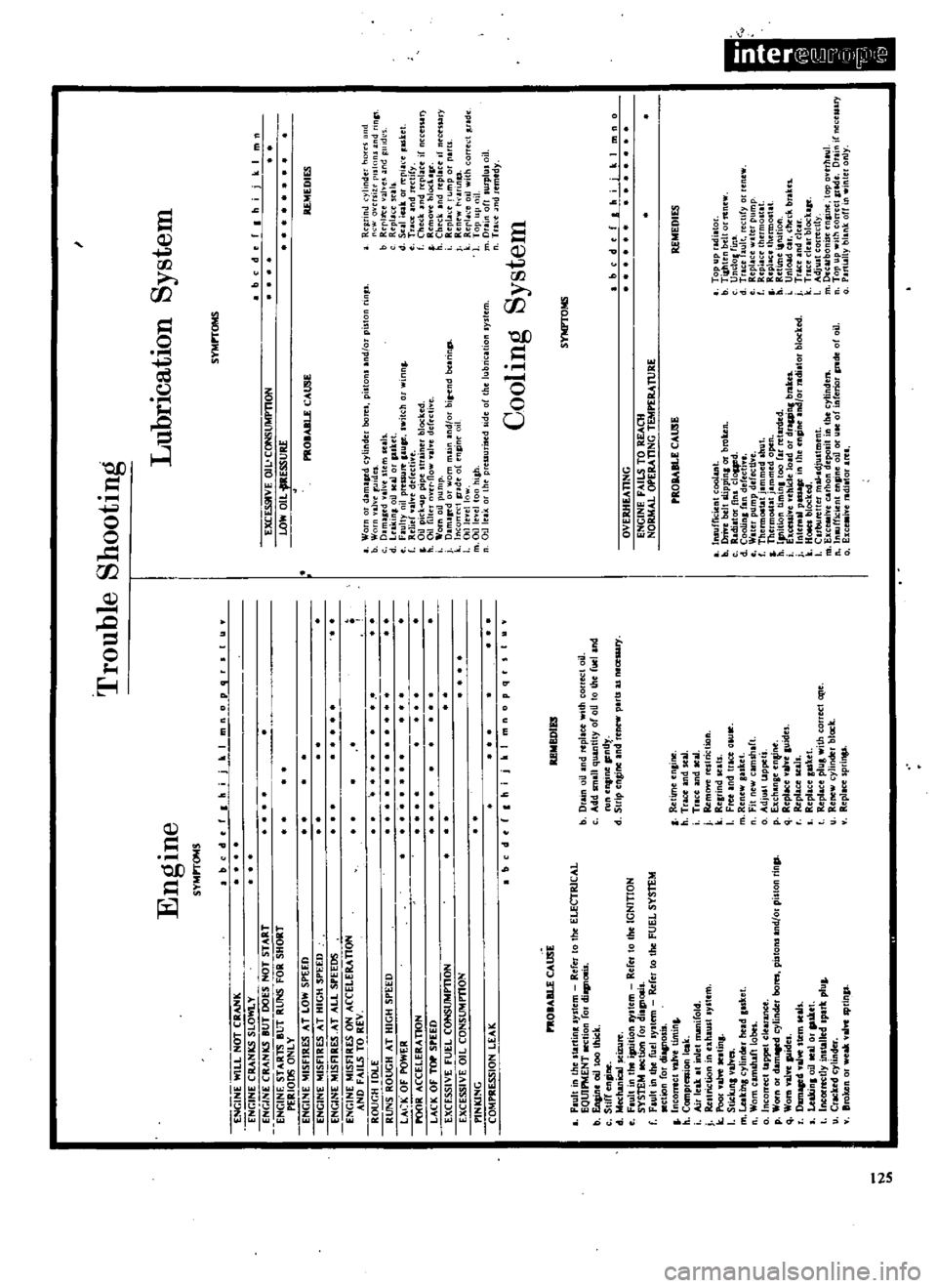
N
Engme
SYMPTOMS
I
Trouble
Shooting
Lubrication
System
SYMPTOMS
bed
t
f
I
h
i
1m
0
p
q
r
I
I
II
bed
t
f
I
h
Ii
I
m
n
ENGINE
WILL
NOT
CRANK
ENGINE
CRANKS
SLOWLY
ENGINE
CRANkS
BUT
OOES
NOT
START
ENGINE
STARTS
BUT
RUNS
FOR
SHORT
PERIODS
aNL
Y
ENGINE
I
tISFIRES
AT
LOW
SPEED
ENGINE
MISFIRES
AT
HIGH
SPEED
ENGINE
MISFIRES
AT
ALL
SPEEDS
ENGINE
MISFIRES
ON
ACCELERATION
AND
FAILS
TO
REV
ROUGH
IDLE
RUNS
ROUGH
AT
HIGH
SPEED
lACK
OF
POWER
POOR
CCElERA
nON
LACK
OF
TOP
SPEED
EXCESSIVE
FUEL
CONSUMmON
EXCESSIVE
OIL
CONSUMmON
PINKING
COMPRESSION
LEAK
PROIABLE
CAUSE
Faull
In
th
e
ltartinll
IYltem
Refer
to
the
ELECTRICAL
EQUIPMENT
leetion
fOI
dilllflOlIll
b
Eft
ineoiltoothick
Stiffenpne
d
Mechanieal
scimre
Flult
In
lhe
IpUlion
I
ltem
Refer
to
the
IGNITION
SYSTEM
IeCtion
for
di
I
f
Flult
the
fuellYlltm
Refer
to
the
FUEL
SYSTEM
Clion
or
di
l
OIII
Incomcl
tllvetlmln
h
ComprellllllIU
IClk
Air
leak
IRlel
JIlIIni
old
j
Reltriction
nhlu5t5ylltm
Ie
Poor
alYe
WIIIIIJ
I
Stick
tnlvall
n
m
Lclklnl
cylinder
held
Illke
Womcamlhlft
lobel
IncolTe
ttappetclurance
p
Worn
dlm
ed
cylinder
born
pUlon5
Ind
or
pll
f1np
q
Wom
nl
fC
paides
Damaced
a1wlttmseal
LeWnloilwaI
pu
e
Incorrectly
installed
apark
plu
CrICked
cylinder
Broken
weakv
w
sprinp
EXCES9lVE
OIL
CONSUMPTION
WW
OIL
ilRESSURE
PROIABLE
CAUSE
REMEDIES
I
Worn
dlmalJl
dcyhnderbon
P
v
lnd
orpulu
nnr
s
b
WorJl
valve
r
uides
C
D
m
led
valve
lIemluls
d
Lnlunr
oil
ul
pillet
e
Flulty
nil
P
uu
IluP
Iwnch
wmn
f
Relief
valve
defecuve
011
pick
up
pipellfline
blocked
h
011
filler
nver
flow
yaJYe
dcffe
WO
n
oil
pump
J
Dlmllfd
om
maUl
Ind
or
bl
nd
b
lnnll
l
lncorreCllndeofentpneoil
l
Oil
level
10
m
Oillevel
tnnhllh
Oillelk
the
preuunled
Ilde
of
the
lubn
IYSfem
p
Tldc
Rel1
f1nd
yllOde1
ne
OVCntZl
nd
nnJ
b
Rcpltte
v
lve
and
Iltd
c
Repl
cc
5c
l
d
Sullu
rt
pl
cp
aI
kCl
e
Trice
Ind
rtClify
f
heel
lod
replace
if
nccess
T
RemoYcblQChJC
h
Chcck
Ind
repllcclfncct
i
ry
i
Repll
e
rump
J
Renew
nnp
k
Rerl
ec
OIl
with
l
Top
up
oil
m
DTllnofllurpIUloil
Tn
ndremedy
Coolmg
System
b
r
h
j
I
m
p
q
d
REMEDIES
SYMI
IOMS
b
Drlm
oiJ
nd
rcpl
ce
with
ot
Add
smlll
quanllty
n
oil
to
the
fuel
Ind
rune
lmeFnd
d
SlfIpenJine
Ind
renew
p
ru
asn
celllry
I
bed
t
f
I
h
I
i
k
I
mn
0
OVERHEATING
ENGINE
FAILS
TO
REAOI
NORMAL
OPERATING
TEMPERAt
lRE
PROIAILE
CAUSE
REMEDIES
I
RetUne
enJine
h
Trace
ndseal
Tr
Ind
seal
j
RemO
f
t
rellnction
k
Relnnd
sel
I
Freelnd
trice
C
UIe
m
Renewguke
Fit
new
clmlhlrt
AdJult
t
appeti
p
bch
ngeenfin
q
Replacevalnluldes
Rtplace
seall
Repllccgukel
Repllcc
plulwlth
correct
Cl
Ie
Renew
cyhndcrblock
Repllce
5prLnp
I
IlIIIIfficien
coolant
b
DriYebellllippinIOfbrobn
c
RldiatOf
fUll
cloq
ed
d
Coo
inlflndefeclln
e
Wit
pl1mpdtfectlve
f
ThelTllOllatj
mmed
Ihul
Thermost
j
mmed
open
r
t
eti
I
kt
r
re
a
q
brake
j
lntel1laJp
se
lheenpne
ndforradi
torbloeked
11
HOItI
blocked
I
Carburetterm
djullmem
m
Excellive
arbon
depolit
in
thecylinden
In
ffici
enpneoil
uae
of
inferior
p1Ide
of
oil
Exce
inrldi
lorlrea
I
Topupradil
v
b
Ti
htenbdtorftnc
I
t
rmify
e
Repl
cwaterpump
f
Rcpll
e
thermoltll
I
Replleclhermolt
t
h
RetimeiaTUlion
i
Unload
ear
check
brl
ktt
j
Trace
ndclu
k
TfI
cdUrblockaae
L
AdjUllcorrc
cth
m
Decarbonise
fO
tne
top
overh
uJ
Top
up
wlth
correct
rade
Dr
inifneceUlry
PUIl
lly
blink
off
in
winter
only
Page 127 of 171
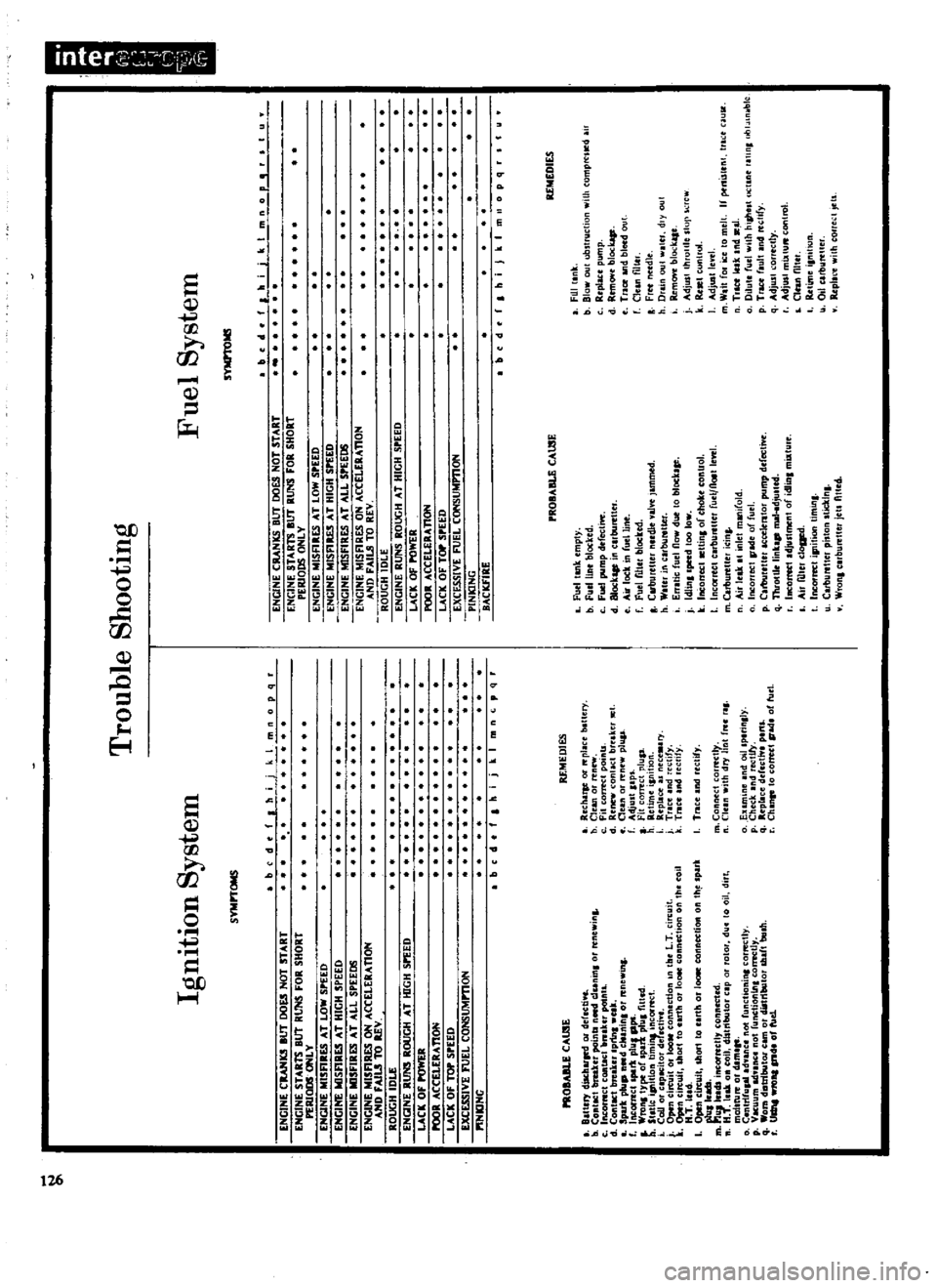
Trouble
Shooting
Ignition
System
SYMnONS
be
d
t
f
I
h
ENGINE
CRANKS
IUT
DOES
NOT
nART
ENGINE
STARTS
BUT
RUNS
FOR
SHORT
PERIODS
ONLY
ENGINE
MISfiRES
AT
LOW
SPEED
ENCINE
WlSflRES
AT
HIGH
SPEED
ENGINE
MISFIRES
AT
ALL
SPEEDS
ENCINE
MISfiRES
ON
ACCELERATION
AND
FAI
TO
REV
ROUGH
IDLE
ENGINE
RUNS
ROUCH
AT
toGH
SPEED
UCK
OF
POWER
POOR
ACCELERAnON
LACK
OF
TOP
SPEED
EXCESSIVE
FUEL
CONSUMmON
PlNKlNC
PROBABLE
CAU5E
t
Bani
dilcharFd
01
defective
b
COJlIllCl
nabr
poinb
nCiCCl
c1Unlftl
renewlna
c
Incorrect
cantlel
ltn
ktr
potftu
d
ConllCt
maker
Iprtn
wuk
Spark
plup
n
d
ch
ntnl
nnewlJIl
r
Jncorrec
llpulpl1llPpI
WronllypeoCap
rtpllllflttad
h
Slltlc
I
lllon
limina
Incorrect
I
Coli
c
plCilor
defC
tl
t
g
o
o
c
o
c
t1o
t
n
h
CllIl
the
toil
H
T
lud
I
Open
cimail
lIlort
nnh
1
conneclion
Ih
spart
m
l
1ulludslnCClfRcllyc
oIIJlCC
tcd
H
T
Ink
coil
dbtribulor
elp
due
oil
din
mol
t
I
o
d
ml
C
ntrlfuplld
anee
not
unetionln
eOll
lctly
p
VKuum
Id
e
not
funclionill
cOIYKtly
q
om
datrlbutw
elm
Or
4iltributor
dldt
bluh
I
UllntWJlOlllpldl
off
ld
L
i
k
I
m
no
p
q
I
b
m
q
f
h
i
j
REMEDIES
I
aceh
tJe
oc
pllce
blHery
b
Clean
01
n
c
Fi
wrrecl
poin
d
Renew
blnker
ll
t
Clea
l
l
ne
plllll
f
Adjull
pt
Fit
cor
c
plu
l
h
aetUne
i
mtlon
I
a
plaCf
I
nece
r
j
Trice
Ind
recury
k
True
ndlecfity
Tnee
nd
leclity
m
Con
c
cOI
ct1r
Clca
wIth
dry
hn
fne
rl
EllImlne
and
Oillpllln
ly
p
Cheek
Ind
rectlly
q
aepllccddectkol
plnl
r
Chlnp
comct
Il
adl
of
fuel
Fuel
System
ENGINE
CRANKS
8lTf
DOES
NOT
START
ENGINE
STARTS
BUT
RUNS
FOR
SHORT
PERIODS
ONLY
ENGINE
MISARES
AT
LOW
SPEED
ENGINE
MISflRE5
AT
HIGH
SPEED
ENGINE
MISFIRES
AT
ALL
SPEEDS
ENGINE
MISAKES
ON
ACCELERA110N
AND
FAILS
TO
REV
ROUGH
IDLE
ENGINE
RUNS
ROUGH
AT
HIGH
SPEED
LACK
OF
POWER
POOR
ACCELERA110N
LACK
OF
TOP
SPEED
EXCESSIVE
flJEL
CONSUMmON
PINKING
BACKFIRE
PROBABLE
CAU5E
Fuel
tank
empty
b
Fu
llinc
blocked
Fuel
pumpd
fectiYe
d
Block
in
cllburene
Air
lock
in
fuel
line
f
Fuel
rut
r
blocked
I
Cuburetter
needle
nlve
jammed
h
Wile
CI
buRlt
r
Errltic
fllel
now
due
blocka
j
IdlinJlpeed
too
low
k
InConectlCtllnlofcttoke
conllol
1
lncorrectcarbuntterfuel
nOltlewl
m
C
muretler
Itlna
Ail
leak
It
Inlet
mlrurold
Incorrect
pade
offuet
p
Carburetter
accelerator
pumpdefect
e
q
Throlll
lintl
rrlIIl
djUlled
IncofftCl
Idjullmenl
of
IdlmJ
mutU
e
Aif
nltef
elogcd
Incorm
t
lpiitiOlluminJ
Clrburellel
Pll
un
lIitkln
Wron
cllburenerjetl
Atled
YMPtO
I
bell
f
1
h
I
j
k
I
m
nOli
I
I
I
0
b
f
h
i
J
k
I
m
REMEDIES
q
FLllllnk
b
Blow
ObSIf1rCllUll
ilh
compl
t
lIed
R
pll
pump
d
RemO
l
e
blockaJe
Trace
Uld
bleed
QUI
r
CIUl1fi1tef
K
Fretne
dle
h
Drlln
d
yout
Removeblockq
J
Adju
throlllelfOl
k
Reset
conllol
1
AdjUSlle
e
m
Wlit
fOI
melt
If
pt
nLS
n
nu
Tlact
lelklndse
a1
Dllu
e
fuel
with
hlah
I
rllln
ubl
ln
blc
p
Trace
fault
and
reeufy
q
AdjuII
correelly
Adju
mutufWconlrol
Clnnnlttr
Retjme
Ilftn
OdClrbulelle
Repllce
Wllh
Je
Page 134 of 171
GIS
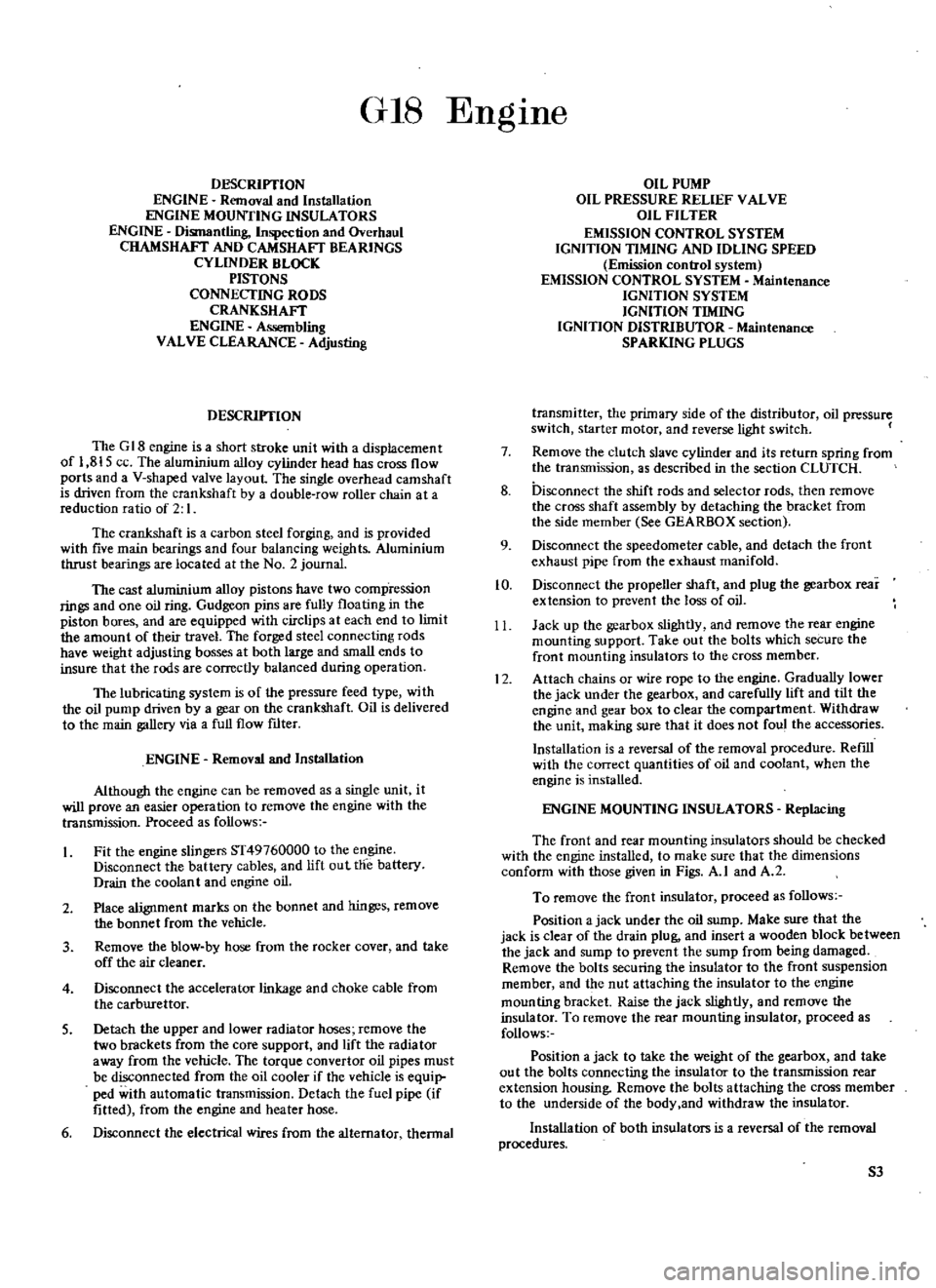
DESCRIYfION
ENGINE
Removal
and
Installation
ENGINE
MOUNTING
INSULATORS
ENGINE
Dismantling
Inspection
and
Overhaul
CHAMSHAFT
AND
CAMSHAFT
BEARINGS
CYLINDER
BLOCK
PISTONS
CONNECTING
RODS
CRANKSHAFT
ENGINE
Assembling
VALVE
CLEARANCE
Adjusting
DESCRIYfION
The
G
18
engine
is
a
short
stroke
unit
with
a
displacement
of
1
815
ce
The
aluminium
alloy
cylinder
head
has
cross
flow
ports
and
a
V
shaped
valve
layout
The
single
overhead
camshaft
is
driven
from
the
crankshaft
by
a
double
row
roller
chain
at
a
reduction
ratio
of
2
I
The
crankshaft
is
a
carbon
steel
forging
and
is
provided
with
five
main
bearings
and
four
balancing
weights
Aluminium
thrust
bearings
are
located
at
the
No
2
journal
The
cast
aluminium
alloy
pistons
have
two
comp
ression
rings
and
one
oil
ring
Gudgeon
pins
are
fully
floating
in
the
piston
bores
and
are
equipped
with
circlips
at
each
end
to
limit
the
amount
of
their
travel
The
forged
steel
connecting
rods
have
weight
adjusting
bosses
at
both
large
and
small
ends
to
insure
that
the
rods
are
correctly
balanced
during
operation
The
lubricating
system
is
of
the
pressure
feed
type
with
the
oil
pump
driven
by
a
gear
on
the
crankshaft
Oil
is
delivered
to
the
main
gallery
via
a
full
flow
ftlter
ENGINE
Removal
and
Installation
Although
the
engine
can
be
removed
as
a
single
unit
it
will
prove
an
easier
operation
to
remove
the
engine
with
the
transmission
Proceed
as
follows
Fit
the
engine
slingers
ST49760000
to
the
engine
Disconnect
the
battery
cables
and
lift
out
the
battery
Drain
the
coolant
and
engine
oil
2
Place
alignment
marks
on
the
bonnet
and
hinges
remove
the
bonnet
from
the
vehicle
3
Remove
the
blow
by
hose
from
the
rocker
cover
and
take
off
the
air
cleaner
4
Disconnect
the
accelerator
linkage
and
choke
cable
from
the
carburettor
S
Detach
the
upper
and
lower
radiator
hoses
remove
the
two
brackets
from
the
core
support
and
lift
the
radia
tor
away
from
the
vehicle
The
torque
convertor
oil
pipes
must
be
disconnected
from
the
oil
cooler
if
the
vehicle
is
equip
ped
with
automatic
transmission
Detach
the
fuel
pipe
if
fitted
from
the
engine
and
heater
hose
6
Disconnect
the
electrical
wires
from
the
alternator
thennal
EngIne
OIL
PUMP
OIL
PRESSURE
RELIEF
VALVE
OIL
FILTER
EMISSION
CONTROL
SYSTEM
IGNITION
TIMING
AND
IDLING
SPEED
Emission
control
system
EMISSION
CONTROL
SYSTEM
Maintenance
IGNITION
SYSTEM
IGNITION
TIMING
IGNITION
DISTRIBUTOR
Maintenance
SPARKING
PLUGS
transmitter
the
primary
side
of
the
distributor
oil
pressure
switch
starter
motor
and
reverse
light
switch
7
Remove
the
clutch
slave
cylinder
and
its
return
spring
from
the
transmission
as
described
in
the
section
CLUTCH
8
Disconnect
the
shift
rods
and
selector
rods
then
remove
the
cross
shaft
assembly
by
detaching
the
bracket
from
the
side
member
See
GEARBOX
section
9
Disconnect
the
speedometer
cable
and
detach
the
front
exhaust
pipe
from
the
exhaust
manifold
10
Disconnect
the
propeller
shaft
and
plug
the
gearbox
rear
extension
to
prevent
the
loss
of
oil
11
Jack
up
the
gearbox
slightly
and
remove
the
rear
engine
mounting
support
Take
out
the
bolts
which
secure
the
front
mounting
insulators
to
the
cross
member
12
Attach
chains
or
wire
rope
to
the
engine
Gradually
lower
the
jack
under
the
gearbox
and
carefully
lift
and
tilt
the
engine
and
gear
box
to
clear
the
compartment
Withdraw
the
unit
making
sure
that
it
does
not
foul
the
accessories
Installation
is
a
reversal
of
the
removal
procedure
RefIll
with
the
correct
quantities
of
oil
and
coolant
when
the
engine
is
installed
ENGINE
MOUNTING
INSULATORS
Replacing
The
front
and
rear
mounting
insulators
should
be
checked
with
the
engine
installed
to
make
sure
that
the
dimensions
conform
with
those
given
in
Figs
A
I
and
A
2
To
remove
the
front
insulator
proceed
as
follows
Position
a
jack
under
the
oil
sump
Make
sure
that
the
jack
is
clear
of
the
drain
plug
and
insert
a
wooden
block
between
the
jack
and
sump
to
prevent
the
sump
from
being
damaged
Remove
the
bolts
securing
the
insulator
to
the
front
suspension
member
and
the
nut
attaching
the
insulator
to
the
engine
mounting
bracket
Raise
the
jack
slightly
and
remove
the
insulator
To
remove
the
rear
mounting
insulator
proceed
as
follows
Position
a
jack
to
take
the
weight
of
the
gearbox
and
take
out
the
bolts
connecting
the
insulator
to
the
transmission
rear
extension
housing
Remove
the
bolts
attaching
the
cross
member
to
the
underside
of
the
body
and
withdraw
the
insulator
Installation
of
both
insulators
is
a
reversal
of
the
removal
procedures
S3
Page 144 of 171

carrying
out
extensive
tests
with
the
necessary
equipment
The
hoses
and
connectors
can
of
course
be
checked
for
signs
of
leakage
and
corrected
as
necessary
Also
the
tension
of
the
air
pump
belt
IGNITION
TIMING
AND
IDLING
SPEED
Emission
control
system
The
ignition
timing
should
be
set
and
the
idling
speed
mixture
adjusted
in
the
folloWing
manner
Run
the
engine
until
it
reaches
its
normal
operating
tem
perature
Connect
an
ignition
tachometer
and
timing
light
observ
ing
the
manufacturers
instructions
NOTE
If
the
vehicle
is
equipped
with
automatic
transmission
make
sure
that
the
dashpot
does
not
prevent
the
throttle
from
closing
Turn
the
throttle
shaft
arm
adjusting
screw
anti
clock
wise
so
that
the
tip
of
the
screw
is
clear
of
the
throttle
shaft
arm
see
Fig
A
26
Turn
the
throttle
adjusting
screw
to
set
the
idling
speed
to
700
r
p
m
650
rpm
for
automatic
transmission
Adjust
the
ignition
timing
to
5
A
T
D
C
Refererence
should
be
made
to
the
instructions
given
in
the
section
IGNITION
SYSTEM
for
the
L14
L16
and
LI8
engines
for
ignition
timing
details
Turn
the
idling
adjustment
screw
and
throttle
adjusting
screw
until
the
engine
runs
smoothly
a
t
the
correct
idling
speed
Turn
the
idling
adjustment
screw
clockwise
until
the
engine
speed
starts
to
drop
as
a
weaker
mix
ture
is
obtained
Now
turn
the
idling
adjustment
screw
anti
clockwise
by
one
turn
one
and
a
half
turns
for
automatic
transmission
to
obtain
a
richer
mix
ture
Adjust
the
idling
speed
to
700
rpm
650
rpm
for
automatic
transmission
by
turning
the
throttle
adjusting
screw
Make
sure
that
the
ignition
timing
remains
at
50
A
T
D
C
Turn
the
throttle
shaft
ann
adjusting
screw
clockwise
until
the
tip
of
the
screw
just
contacts
the
throttle
shaft
ann
The
screw
must
not
exert
pressure
on
the
throttle
shaft
arm
EMISSION
CONTROL
SYSTEM
Maintenance
The
system
should
be
inspected
and
serviced
every
I
2
months
or
20
000
km
12
000
miles
whichever
comes
fIrst
to
make
sure
that
the
exhaust
emissions
are
maintained
at
the
minimum
level
Check
the
carburettor
choke
setting
and
adjust
as
described
in
the
section
FUEL
SYSTEM
Check
the
carburettor
idling
speed
mixture
and
adjust
if
necessary
as
described
under
the
heading
IGNITION
TIMING
AND
IDLING
SPEED
in
this
section
2
Check
the
distributor
earn
dwell
angle
and
also
the
condi
tion
of
the
contact
breaker
points
Check
the
ignition
timing
and
adjust
if
necessary
The
distributor
dwell
angle
should
be
adjusted
to
49
55
degrees
and
the
points
gap
to
0
45
0
55
mm
0
0177
0
0217
in
3
Remove
and
clean
the
sparking
plugs
Renew
any
plug
with
badly
worn
electrodes
Set
the
plug
gaps
to
0
80
0
90
mm
0
0315
0
0355
in
by
adjusting
the
earth
electrode
IGNITION
SYSTEM
The
maintenance
and
servicing
procedures
for
the
compo
nents
of
the
ignition
system
on
vehicles
fitted
with
the
GIS
engine
are
basically
similar
to
the
instructions
previously
given
for
the
Ll4
LI6
and
LIS
engines
The
distributor
is
however
of
a
different
type
Either
an
Hitachi
0416
57
distributor
being
fitted
or
an
Hitachi
0423
53
if
the
vehicle
is
equipped
with
an
emission
control
system
The
distributors
have
different
advance
curve
characteristics
as
shown
in
Technical
Data
IGNITION
TIMING
Check
the
ignition
timing
with
a
timing
light
as
previously
described
for
the
LI4
L16
and
L
8
engines
Disconnect
the
distributor
vacuum
line
and
run
engine
at
idling
speed
or
slightly
below
The
timing
should
be
set
at
8
BTDCj600
rpm
for
the
D416
57
distributor
or
at
5
ATDCj600
rpm
for
the
D423
53
distributor
fItted
to
engines
with
emission
control
systems
IGNITION
DISTRIBUTOR
Maintenance
Maintenance
instructions
are
similar
to
those
given
for
the
L14
LI6
and
L18
engines
Set
the
contact
breaker
points
gap
to
0
45
0
55
mm
0
0177
0
0217
in
as
previously
described
SPARKING
PLUGS
The
sparking
plugs
should
be
inspected
and
cleaned
at
regular
intervals
and
renewed
at
approximately
20
000
kIn
12
000
miles
Clean
the
plugs
thoroughly
and
make
sure
they
are
of
the
same
type
and
heat
range
File
the
centre
electrode
nat
before
adjusting
the
gap
Set
the
gap
to
0
8
0
9mm
0
031
0
035
in
if
the
engine
is
fItted
with
emission
control
system
or
to
0
7
0
8
mm
0
028
0
031
in
if
emission
control
is
not
fitted
Adjustment
must
always
be
made
by
bending
the
earth
electrode
TechnIcal
Data
GENERAL
SPECIFICATION
GI8
Engine
Cylinders
Bore
and
stroke
Displacemen
t
Valve
arrangemen
t
Firing
order
Engine
idler
speed
Compression
ratio
Oil
pressure
at
3000
r
p
m
4
in
line
85x80
mm
3
346x3
150
in
1
815
cc
110
8
cu
in
OHC
134
2
600
r
p
m
STD
8
3
I
4
7
to
5
5
kgjsq
cm
66
8
to
78
2
Ibjsq
in
LIQUID
PACKING
APPLICATION
Cylinder
block
2
Cylinder
head
Oil
gallery
blind
plug
Expansion
plug
Gas
breather
guide
Rear
bearing
cap
fitting
surface
Rear
bearing
cap
side
seal
both
ends
Expansion
plug
Rubber
plug
Rea
Manifold
heat
pipe
3
Chain
cover
gasket
both
sides
S13
Page 148 of 171

Fan
coupling
Pulley
ratio
fan
and
water
pump
Tuning
data
Basic
timing
Idling
speed
Distributor
dwell
angle
Spark
plug
gap
Choke
setting
CO
percent
setting
Fan
rpm
water
pump
rpm
3
300
4
000
120
103
Ll71
50
A
T
D
C
700
rpm
650
rpm
automatic
490
550
at
0
02
in
breaker
gap
0
8IJ
0
90
mm
0
03
I
5
0
0355
in
Manual
6
0
I
0
5
air
supply
hose
disconnected
Air
pump
drive
belt
tensioning
Permissible
slackness
of
8
0
12
0
mm
0
3
15
0
4
72
in
under
a
load
of7
1O
kg
1
54
2
20
lb
IGNITION
SYSTEM
DISTRIBUTOR
Type
Firing
order
Rotation
Igntion
timing
Without
emission
control
With
emission
control
Dwell
angle
Condenser
capacity
Advance
characteristics
D416
57
distributor
Hitachi
D416
57
Hitachi
D423
53
with
emission
control
system
134
2
Anti
clockwise
80
B
T
D
C
at
600
rpm
50
A
T
D
C
at
600
r
p
m
49
to
55
degreos
0
20
0
24
1
F
Centrifugal
Start
Maximum
degree
r
p
m
Vacuum
Start
Maximum
degree
r
p
m
Advance
characteristics
D423
53
distributor
Centrifugal
Start
Maximum
degree
r
p
m
Vacuum
Start
Maximum
degree
r
p
m
IGNITION
COIL
Type
Primary
voltage
Spark
gap
Primary
resistance
Secondary
resistance
SPARKING
PLUGS
Type
Gap
Fuel
Systenl
DESCRIPTION
FUEL
PUMP
Testing
FUEL
PUMP
Removing
and
Dismantling
CARBURETTOR
Idling
adjustment
FUEL
LEVEL
Adjusting
STARTING
INTERLOCK
VALVE
OPENING
THROTTLE
VALVE
INTERLOCK
OPENING
CARBURETIOR
Removing
and
Dismantling
DESCRIPTION
A
dual
barrel
down
draught
type
carburettor
is
fitted
to
vehicles
with
the
G
18
engine
A
Stromberg
type
D3034C
carburet
tor
is
installed
on
engines
with
exhaust
emission
controL
and
a
Solex
type
DAK340
carburettor
on
engines
not
equipped
with
this
type
of
system
Both
types
of
carburettors
incorporate
a
550
r
p
m
01
50
at
I
400
16
50
at
2
800
80
mmHg
6
50
at
200
r
p
m
475
r
p
m
01
50
at
1
000
23
50
at
2
600
80
mm
Hg
30
at
120
r
p
m
go
at
400
r
p
m
Hanshin
HM
12F
or
HP5
I
OE
with
emission
control
system
12
volts
more
than
6
mm
0
2362
in
3
8
ohms
at
200C
I
1
2
I
6
8
ohms
at
200
C
NGK
BP
6E
0
7
0
8
mm
0
028
0
031
in
or
0
80
9
mm
0
031
0
035
in
with
emission
control
system
primary
system
for
normal
running
and
a
secondary
system
for
full
load
running
a
float
assembly
which
supplies
fuel
to
both
primary
and
secondary
systems
a
starting
mechanism
and
accelerator
pump
which
provides
a
richer
mixture
on
accelera
tion
SI7
Page 149 of 171

1
D
1
1
I
i
l
I
1
j
j
w
n
I
UJ
1
j
e
tOll
i
j25z
t2JZ2
21
1
S
Mizin
nozzk
2
S
SmtzJJ
v
nturi
3
S
Main
air
bleed
4
S
Slow
jet
5
S
Slow
air
bleed
6
Needle
WIlve
7
Float
8
S
Emulsion
tube
9
S
Mainjd
10
S
Jly
paD
hol
11
S
Throttle
alve
12
Chob
I1tzhe
13
P
Main
air
bleed
14
P
Afuin
nozzle
15
Economizer
bleed
16
P
Slow
jet
17
Slow
onomiur
18
P
Slow
air
bleed
19
Airl
e
nt
20
Lnel
gauge
21
PMainjel
22
Idle
limitler
23
1dl
24
P
Jly
pa
hol
2S
P
Throttle
vahe
Fig
B
l
Sectional
view
of
the
DAK340
carburettor
Coil
Piiton
Strainer
v
cero
Fig
S
3
Electrical
fuel
pump
SI8
A
It
I
IL
o
l
Cfd
rj
1
l
o
j
11
111
r
J
l
l
b
I
1
1
F700
t
vahle
2
Vacuum
piJton
3
P
Slow
air
bleed
4
Slow
jtt
5
Slow
onomUt
T
6
P
Slow
air
bleM
7
Air
Fent
8
P
Main
air
bl
d
9
P
MiJin
nozzle
10
P
SmaU
venturi
1
J
Ozokt
valPe
12
Pumpnozzk
13
Pump
wd6h1
14
Discharft
check
valve
15
S
SnwU
venturi
17
S
Main
air
bleed
18
Step
air
bleed
19
Pump
arm
Fig
B
2
Sectional
view
of
the
D3034C
carburet
tor
fitted
to
engines
with
emiss
ion
control
5Y5tem
20
Step
jet
21
Pump
plunger
22
Inlet
c1r
k
l
aIve
23
S
Mizin
jet
24
lRtzp
uaun
25
lRtzplrragm
26
Step
port
27
Idle
port
28
P
T1vottk
valve
29
Idk
port
30
S
Dw
port
31
Idkadjust
screw
32
P
MiIin
jet
33
Po
NU
jet
34
Float
I
Ul
l
2
1
Fibre
mat
Nvlon
6
Fig
B
4
Fuel
strainer
Fig
Ii
s
Removing
the
fuel
pump
cover
1
Page 150 of 171
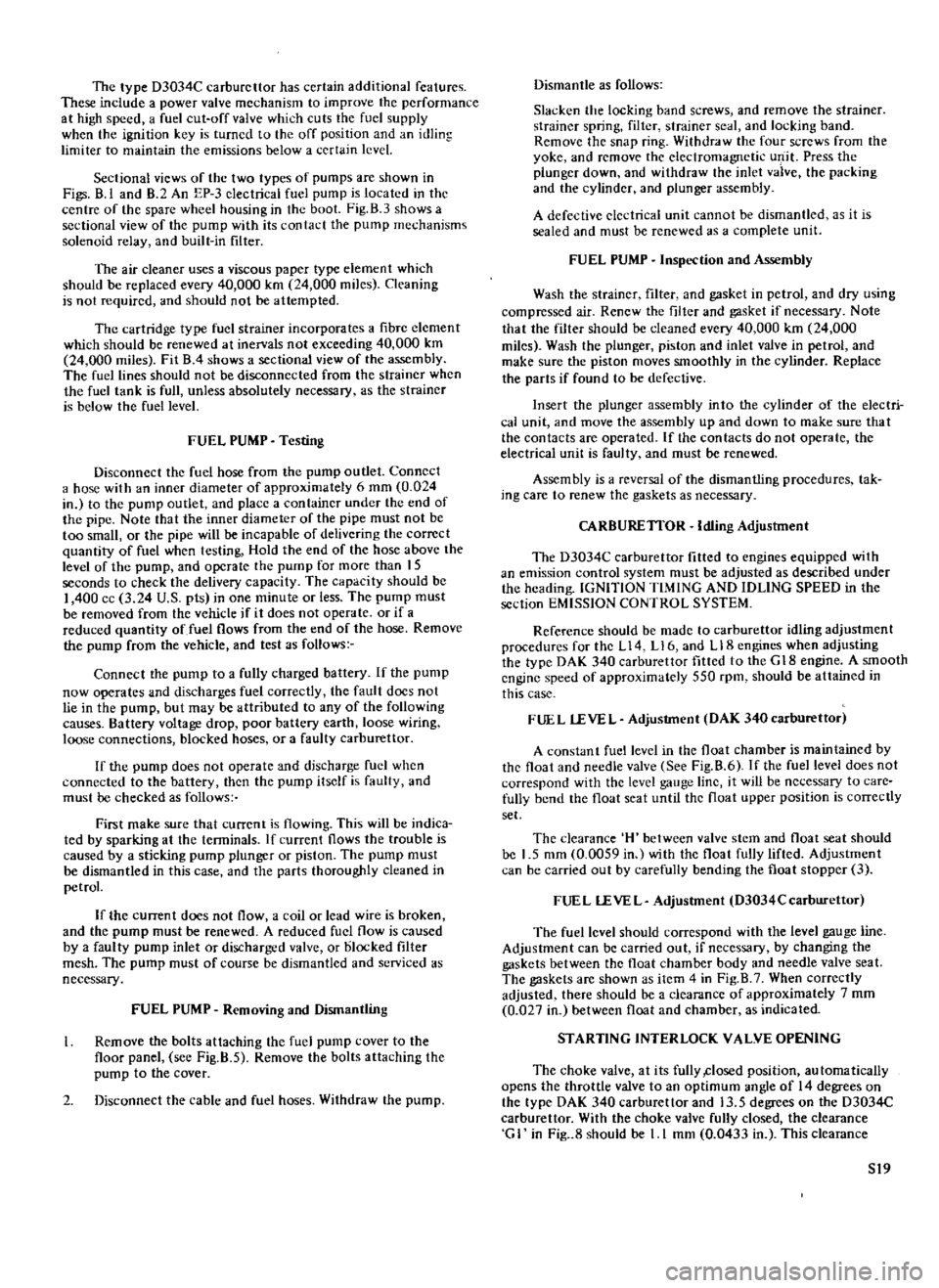
The
type
D3034C
carburettor
has
certain
additional
features
These
include
a
power
valve
mechanism
to
improve
the
performance
at
high
speed
a
fuel
cut
off
valve
which
cuts
the
fuel
supply
when
the
ignition
key
is
turned
to
the
off
position
and
an
idling
limiter
to
maintain
the
emissions
below
a
certain
level
Sectional
views
of
the
two
types
of
pumps
are
shown
in
Figs
8
1
and
B
2
An
EP
3
electrical
fuel
pump
is
located
in
the
centre
of
the
spare
wheel
housing
in
the
boot
Fig
B
3
shows
a
sectional
view
of
the
pump
with
its
contact
the
pump
mechanisms
solenoid
relay
and
built
in
filter
The
air
cleaner
uses
a
viscous
paper
type
element
which
should
be
replaced
every
40
000
km
24
000
miles
Cleaning
is
not
required
and
should
not
be
attempted
The
cartridge
type
fuel
strainer
incorporates
a
fibre
clement
which
should
be
renewed
at
inervals
not
exceeding
40
000
km
24
000
miles
Fit
B
4
shows
a
sectional
view
of
the
assembly
The
fuel
lines
should
not
be
disconnected
from
the
strainer
when
the
fuel
tank
is
full
unless
absolutely
necessary
as
the
strainer
is
below
the
fuel
level
FUEL
PUMP
Testing
Disconnect
the
fuel
hose
from
the
pump
outlet
Connect
a
hose
with
an
inner
diameter
of
approximately
6
mm
0
024
in
to
the
pump
outlet
and
place
a
container
under
the
end
of
the
pipe
Note
that
the
inner
diameter
of
the
pipe
must
not
be
too
small
or
the
pipe
will
be
incapable
of
delivering
the
correct
quantity
of
fuel
when
testing
Hold
the
end
of
the
hose
above
the
level
of
the
pump
and
operate
the
pump
for
more
than
IS
seconds
to
check
the
delivery
capacity
The
capacity
should
be
I
400
cc
3
24
U
S
pts
in
one
minute
or
less
The
pump
must
be
removed
from
the
vehicle
if
it
does
not
operate
or
if
a
reduced
quantity
of
fuel
flows
from
the
end
of
the
hose
Remove
the
pump
from
the
vehicle
and
test
as
follows
Connect
the
pump
to
a
fully
charged
battery
If
the
pump
now
operates
and
discharges
fuel
correctly
the
fault
does
not
lie
in
the
pump
but
may
be
attributed
to
any
of
the
following
causes
Battery
voltage
drop
poor
battery
earth
loose
wiring
loose
connections
blocked
hoses
or
a
faulty
carburettor
If
the
pump
does
not
operate
and
discharge
fuel
when
connected
to
the
battery
then
the
pump
itself
is
faulty
and
must
be
checked
as
follows
First
make
sure
that
current
is
flowing
This
will
be
indica
ted
by
sparking
at
the
tenninals
If
current
flows
the
trouble
is
caused
by
a
sticking
pump
plunger
or
piston
The
pump
must
be
dismantled
in
this
case
and
the
parts
thoroughly
cleaned
in
petrol
If
the
current
does
not
flow
a
coil
or
lead
wire
is
broken
and
the
pump
must
be
renewed
A
reduced
fuel
flow
is
caused
by
a
faulty
pump
inlet
or
discharged
valve
or
blocked
filter
mesh
The
pump
must
of
course
be
dismantled
and
serviced
as
necessary
FUEL
PUMP
Removing
and
Dismantling
Remove
the
bolts
attaching
the
fuel
pump
cover
to
the
floor
panel
see
Fig
B
S
Remove
the
bolts
attaching
the
pump
to
the
cover
2
Disconnect
the
cable
and
fuel
hoses
Withdraw
the
pump
Dismantle
as
follows
Slacken
the
locking
band
screws
and
remove
the
strainer
strainer
spring
filter
strainer
seal
and
locking
band
Remove
the
snap
ring
Withdraw
the
four
screws
from
the
yoke
and
remove
the
electromagnetic
ulJ
it
Press
the
plunger
down
and
withdraw
the
inlet
vaive
the
packing
and
the
cylinder
and
plunger
assembly
A
defective
eledrical
unit
cannot
be
dismantled
as
it
is
sealed
and
must
be
renewed
as
a
complete
unit
FUEL
PUMP
Inspection
and
Assembly
Wash
the
strainer
filter
and
gasket
in
petrol
and
dry
using
compressed
air
Renew
the
filter
and
gasket
if
necessary
Note
that
the
filter
should
be
cleaned
every
40
000
km
24
000
miles
Wash
the
plunger
piston
and
inlet
valve
in
petrol
and
make
sure
the
piston
moves
smoothly
in
the
cylinder
Replace
the
parts
if
found
to
be
defective
Insert
the
plunger
assembly
into
the
cylinder
of
the
electri
cal
unit
and
move
the
assembly
up
and
down
to
make
sure
tha
t
the
contacts
are
operated
If
the
contacts
do
not
operate
the
electrical
unit
is
faulty
and
must
be
renewed
Assembly
is
a
reversal
of
the
dismantling
procedures
tak
ing
care
to
renew
the
gaskets
as
necessary
CARBURETIOR
Idling
Adjustment
The
D3034C
carburettor
fitted
to
engines
equipped
with
an
emission
control
system
must
be
adjusted
as
described
under
the
heading
IGNITION
TIMING
AND
IDLING
SPEED
in
the
section
EMISSION
CONTROL
SYSTEM
Reference
should
be
made
to
carburettor
idling
adjustment
procedures
for
the
L14
L16
and
LI8
engines
when
adjusting
the
type
DAK
340
carburettor
fitted
to
the
G
18
engine
A
smooth
engine
speed
of
approximately
550
rpm
should
be
attained
in
this
case
FUEL
lEVEL
Adjustment
DAK
340earburettor
A
constant
fuellevcl
in
the
float
chamber
is
maintained
by
the
float
and
needle
valve
See
Fig
8
6
If
the
fuel
level
does
not
correspond
with
the
level
gauge
line
it
will
be
necessary
to
care
fully
bend
the
float
seat
until
the
float
upper
position
is
correctly
set
The
clearance
H
between
valve
stem
and
float
seat
should
be
I
5
mm
0
0059
in
with
the
float
fully
lifted
Adjustment
can
be
carried
out
by
carefully
bending
the
float
stopper
3
FUEL
lEVEL
Adjustment
D3034Ccarburettnr
The
fuel
level
should
correspond
with
the
level
gauge
line
Adjustment
can
be
carried
out
if
necessary
by
changing
the
gaskets
between
the
float
chamber
body
and
needle
valve
seat
The
gaskets
are
shown
as
item
4
in
Fig
B
7
When
correctly
adjusted
there
should
be
a
clearance
of
approximately
7
mm
0
027
in
between
float
and
chamber
as
indicated
STARTING
INTERLOCK
VALVE
OPENING
The
choke
valve
at
its
fully
closed
position
automatically
opens
the
throttle
valve
to
an
optimum
angle
of
14
degrees
on
the
type
DAK
340
carburettor
and
13
5
degrees
on
the
D3034C
carburettor
With
the
choke
valve
fully
closed
the
clearance
G
I
in
Fig
8
should
be
1
I
mm
0
0433
in
This
clearance
S19
Page 152 of 171
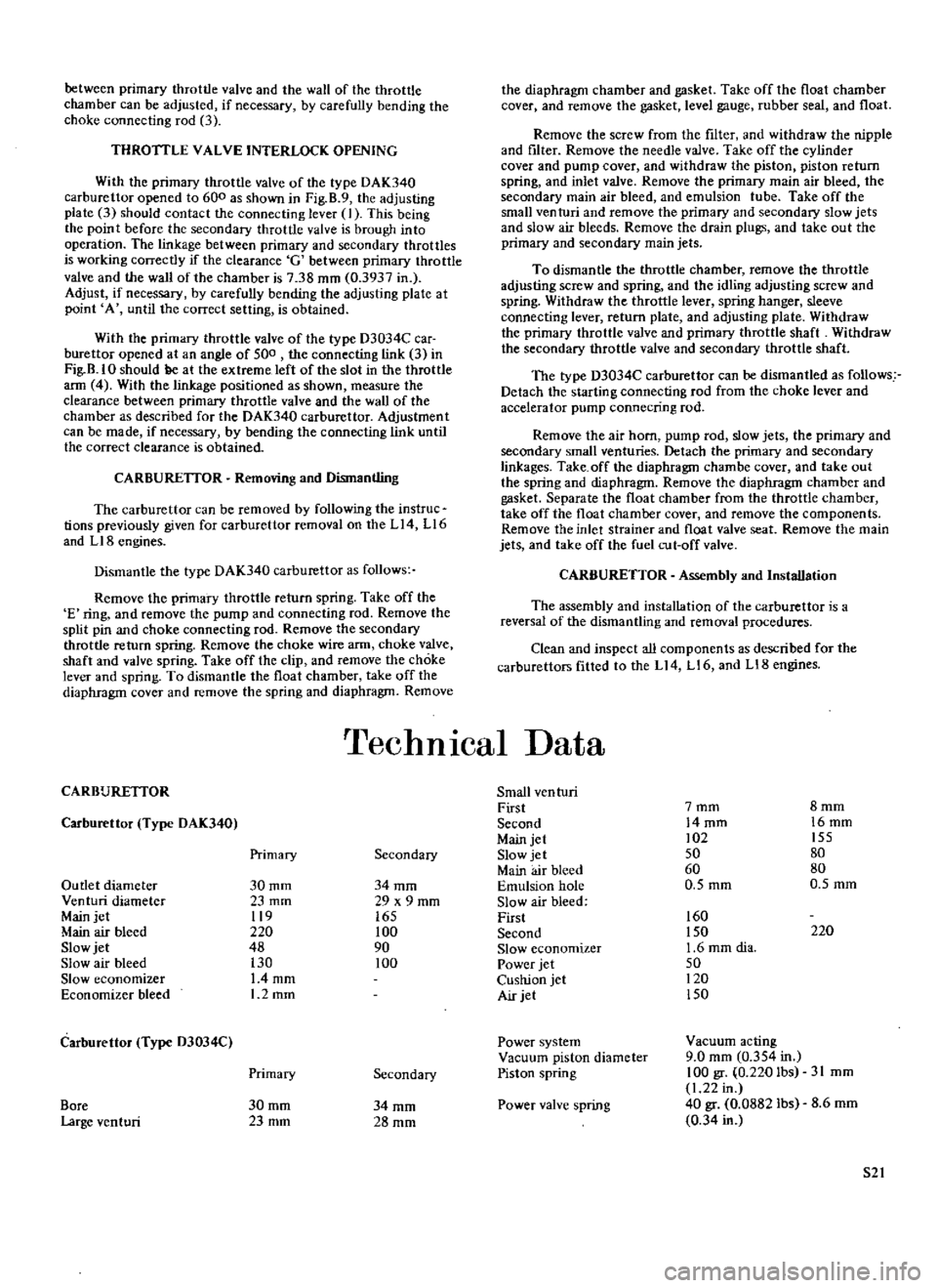
between
primary
throttle
valve
and
the
wall
of
the
throttle
chamber
can
be
adjusted
if
necessary
by
carefully
bending
the
choke
connecting
rod
3
THROTILE
VALVE
INTERLOCK
OPENING
With
the
primary
throttle
valve
of
the
type
DAK340
carburettor
opened
to
600
as
shown
in
Fig
B
9
the
adjusting
plate
3
should
contact
the
connecting
lever
J
This
being
the
point
before
the
secondary
throttle
valve
is
brough
into
operation
The
linkage
between
primary
and
secondary
throttles
is
working
correctly
if
the
clearance
G
between
primary
throttle
valve
and
the
wall
of
the
chamber
is
738
mm
0
3937
in
Adjust
if
necessary
by
carefully
bending
the
adjusting
plate
at
point
A
until
the
correct
setting
is
obtained
With
the
primary
throttle
valve
of
the
type
D3034C
car
burettor
opened
at
an
angle
of
500
the
connecting
link
3
in
Fig
B
IO
should
ge
at
the
extreme
left
of
the
slot
in
the
throttle
ann
4
With
the
linkage
positioned
as
shown
measure
the
clearance
between
primary
throttle
valve
and
the
wall
of
the
chamber
as
described
for
the
DAK340
carburettor
Adjustment
can
be
made
if
necessary
by
bending
the
connecting
link
until
the
correct
clearance
is
obtained
CARBURElTOR
Removing
and
Dismantling
The
carburettor
can
be
removed
by
following
the
instruc
tions
previously
given
for
carburettor
removal
on
the
Ll4
L16
and
LIB
engines
Dismantle
the
type
DAK340
carburettor
as
follows
Remove
the
primary
throttle
return
spring
Take
off
the
E
ring
and
remove
the
pump
and
connecting
rod
Remove
the
split
pin
and
choke
connecting
rod
Remove
the
secondary
throttle
return
spring
Remove
the
choke
wire
arm
choke
valve
shaft
and
valve
spring
Take
off
the
clip
and
remove
the
choke
lever
and
spring
To
dismantle
the
float
chamber
take
off
the
diaphragm
cover
and
remove
the
spring
and
diaphragm
Remove
the
diaphragm
chamber
and
gasket
Take
off
the
float
chamber
cover
and
remove
the
gasket
level
gauge
rubber
seal
and
float
Remove
the
screw
from
the
filter
and
withdraw
the
nipple
and
filter
Remove
the
needle
valve
Take
off
the
cylinder
cover
and
pump
cover
and
withdraw
the
piston
piston
return
spring
and
inlet
valve
Remove
the
primary
main
air
bleed
the
secondary
main
air
bleed
and
emulsion
tube
Take
off
the
small
venturi
and
remove
the
primary
and
secondary
slow
jets
and
slow
air
bleeds
Remove
the
drain
plugs
and
take
out
the
primary
and
secondary
main
jets
To
dismantle
the
throttle
chamber
remove
the
throttle
adjusting
screw
and
spring
and
the
idling
adjusting
screw
and
spring
Withdraw
the
throttle
lever
spring
hanger
sleeve
connecting
lever
return
plate
and
adjusting
plate
Withdraw
the
primary
throttle
valve
and
primary
throttle
shaft
Withdraw
the
secondary
throttle
valve
and
secondary
throttle
shaft
The
type
D3034C
carburettor
can
be
dismantled
as
follows
Detach
the
starting
connecting
rod
from
the
choke
lever
and
accelerator
pump
connecting
rod
Remove
the
air
horn
pump
rod
slow
jets
the
primary
and
secondary
small
venturies
Detach
the
primary
and
secondary
linkages
Take
off
the
diaphragm
chambe
cover
and
take
out
the
spring
and
diaphragm
Remove
the
diaphragm
chamber
and
gasket
Separate
the
float
chamber
from
the
throttle
chamber
take
off
the
float
chamber
cover
and
remove
the
components
Remove
the
inlet
strainer
and
float
valve
seat
Remove
the
main
jets
and
take
off
the
fuel
cut
off
valve
CARBURETTOR
Assembly
and
Installation
The
assembly
and
installation
of
the
carburettor
is
a
reversal
of
the
dismantling
and
removal
procedures
Clean
and
inspect
all
components
as
described
for
the
carburettors
fitted
to
the
Ll4
Ll6
and
LI8
engines
TechnIcal
Data
CARBURETIOR
Small
ven
turi
First
7mm
8mm
Carburettor
Type
DAK340
Second
14mm
16mm
Main
jet
02
155
Primary
Secondary
Slow
jet
50
80
Main
air
bleed
60
80
Outlet
diameter
30mm
34mm
Emulsion
hole
0
5
mm
O
5mm
Venturi
diameter
23
mm
29
x
9
mm
Slow
air
bleed
Main
jet
119
165
First
160
Main
air
bleed
220
100
Second
150
220
Slow
jet
48
90
Slow
economizer
1
6
mm
dia
Slow
air
bleed
130
100
Power
jet
50
Slow
economizer
L4mm
Cushion
jet
120
Economizer
bleed
1
2mm
Air
jet
150
Carburettor
Type
D3034C
Power
system
Vacllum
acting
Vacuum
piston
diameter
9
0
mm
0
354
in
Primary
Secondary
Piston
spring
100
gr
0
220
Ibs
31
mm
1
22
in
Bore
30mm
34mm
Power
valve
spring
40
gr
0
0882
lbs
8
6mm
Large
venturi
23mm
28mm
0
34
in
52
Page 154 of 171
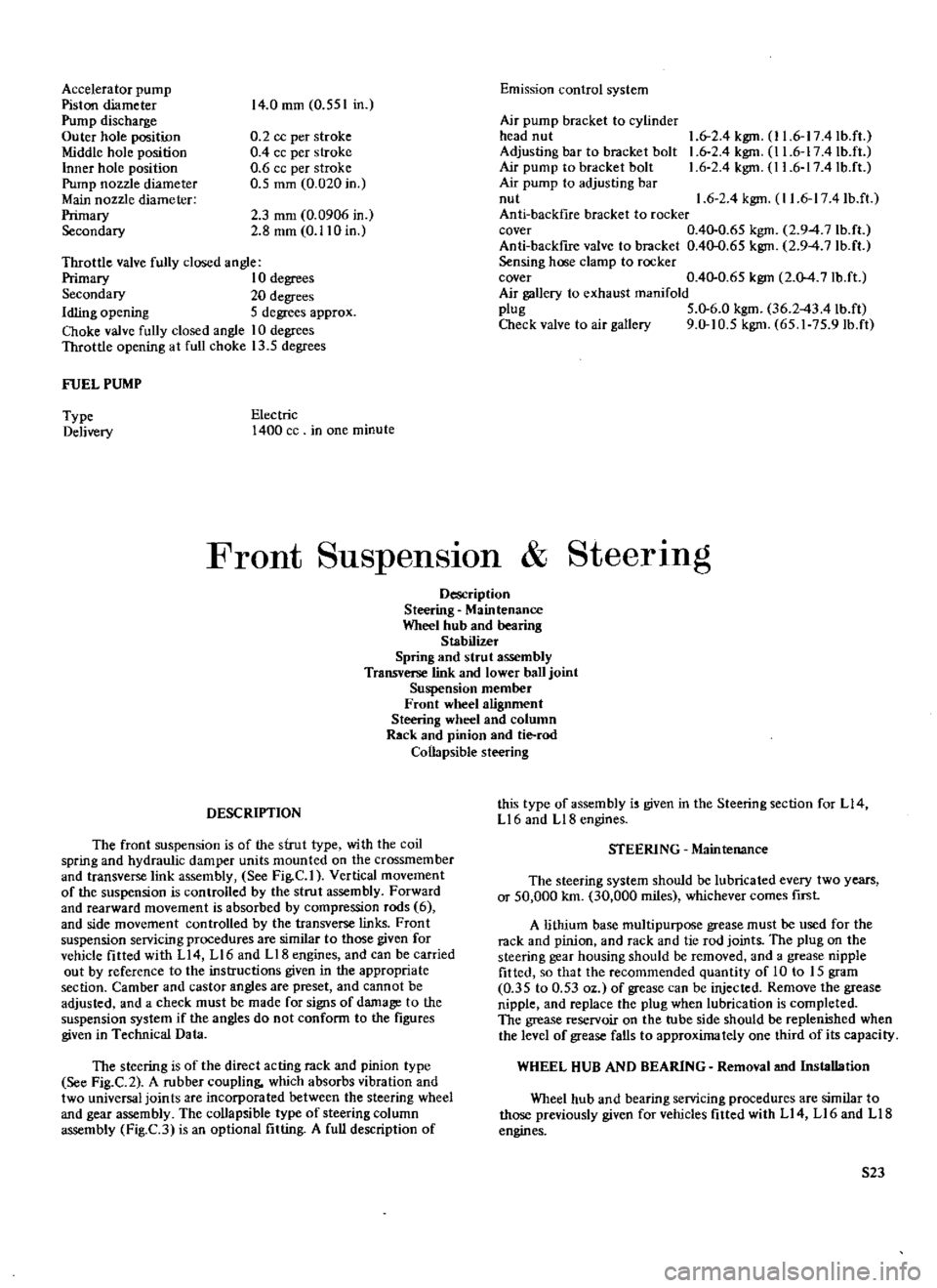
Accelerator
pump
Piston
diameter
Pump
discharge
Outer
hole
position
Middle
hole
position
Inner
hole
position
Pump
nozzle
diameter
Main
nozzle
diameter
Primary
Secondary
14
0
mm
0
551
in
0
2
cc
per
stroke
0
4
cc
per
stroke
0
6
cc
per
stroke
0
5
mm
0
020
in
2
3
mm
0
0906
in
2
8
mm
0
110
in
Throttle
valve
fully
closed
angle
Primary
10
degrees
Secondary
20
degrees
Idling
opening
5
degrees
approx
Choke
valve
fully
closed
angle
10
degrees
Throttle
opening
at
full
choke
13
5
degrees
FUEL
PUMP
Type
Delivery
Electric
1400
cc
in
one
minute
Emission
control
system
Air
pump
bracket
to
cylinder
head
nut
Adjusting
bar
to
bracket
bolt
Air
pump
to
bracket
bolt
Air
pump
to
adjusting
bar
nut
Anti
backfrre
bracket
to
rocker
cover
0
4Q
0
65
kgm
2
94
7
lb
ft
Anti
backfire
valve
to
bracket
0
4Q
O
65
kgm
2
94
7
lb
ft
Sensing
hose
clamp
to
rocker
cover
0
4Q
0
65
kgm
2
M
7
Ib
ft
Air
gallery
to
exhaust
manifold
plug
5
Q
6
0
kgm
36
243
4lb
ft
Check
valve
to
air
gallery
9
0
10
5
kgm
65
1
75
9Ib
ft
1
6
2
4
kgm
I
1
6
17
4Ib
ft
1
6
2
4
kgm
I
1
6
17
4Ib
ft
1
6
2
4
kgm
I
1
6
17
4
lb
ft
1
6
2
4
kgm
11
6
17
4Ib
ft
Front
SuspensIon
SteerIng
Description
Steering
Maintenance
Wheel
hub
and
bearing
Stabilizer
Spring
and
strut
assembly
Transverse
link
and
lower
ball
joint
Suspension
member
Front
wheel
alignment
Steering
wheel
and
column
Rack
and
pinion
and
tie
rod
Collapsible
steering
DESCRIPTION
The
front
suspension
is
of
the
strut
type
with
the
coil
spring
and
hydraulic
damper
units
mounted
on
the
crossmember
and
transverse
link
assembly
See
Fig
C
I
Vertical
movement
of
the
suspension
is
controlled
by
the
strut
assembly
Forward
and
rearward
movement
is
absorbed
by
compression
rods
6
and
side
movement
controlled
by
the
transverse
links
Front
suspension
servicing
procedures
are
similar
to
those
given
for
vehicle
fitted
with
L14
Ll6
and
LIB
engines
and
can
be
carried
out
by
reference
to
the
instructions
given
in
the
appropriate
section
Camber
and
castor
angles
are
preset
and
cannot
be
adjusted
and
a
check
must
be
made
for
signs
of
damage
to
the
suspension
system
if
the
angles
do
not
confonn
to
the
figures
given
in
Technical
Data
The
steering
is
of
the
direct
acting
rack
and
pinion
type
See
Fig
C
2
A
rubber
coupling
which
absorbs
vibration
and
two
universal
join
ts
are
incorpora
ted
between
the
steering
wheel
and
gear
assembly
The
collapsible
type
of
steering
column
assembly
Fig
C3
is
an
optional
fitting
A
full
description
of
this
type
of
assembly
i
given
in
the
Steering
section
for
L14
L16
and
L18
engines
STEERING
Maintenance
The
steering
system
should
be
lubricated
every
two
years
or
50
000
km
30
000
miles
whichever
comes
fIrst
A
lithium
base
multipurpose
grease
must
be
used
for
the
rack
and
pinion
and
rack
and
tie
rod
joints
The
plug
on
the
steering
gear
housing
should
be
removed
and
a
grease
nipple
fitted
so
that
the
recommended
quantity
of
10
to
15
gram
0
35
to
0
53
oz
of
grease
can
be
injected
Remove
the
grease
nipple
and
replace
the
plug
when
lubrication
is
completed
The
grease
reservoir
on
the
tube
side
should
be
replenished
when
the
level
of
grease
falls
to
approximately
one
third
ofits
capacity
WHEEL
HUB
AND
BEARING
Removal
and
Installation
Wheel
hub
and
bearing
servicing
procedures
are
similar
to
those
previously
given
for
vehicles
fitted
with
L14
LI6
and
LIB
engines
S23
Page 168 of 171
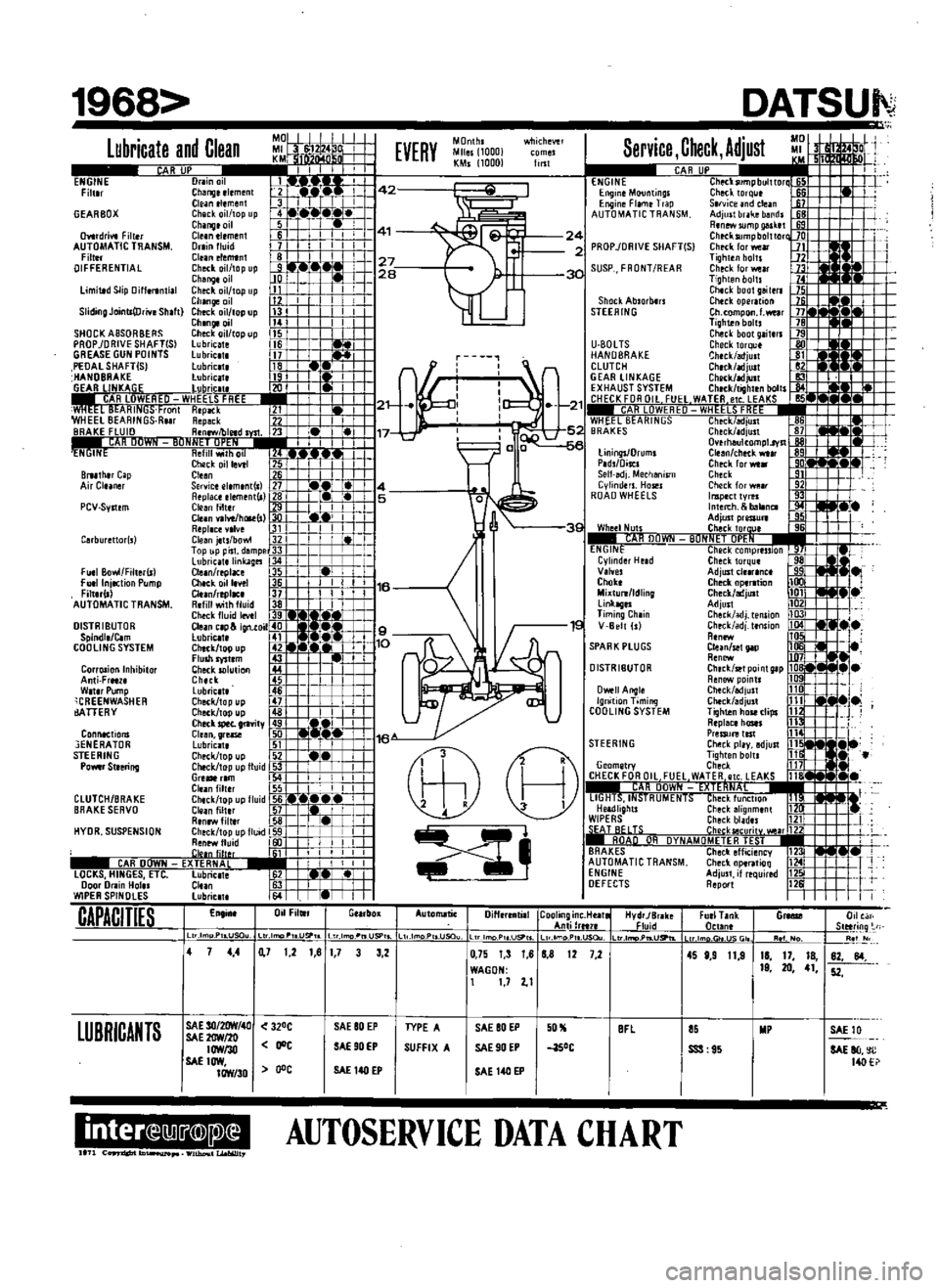
MO
MI
1224
D
I
KM
f
fMn
n
r
A
A
JP
I
I
T
I
I
I
Drain
ill
Changeelemenl
I
42
Cleantlement
3
I
II
r
I
Check
il
topup
4
I
Chinnloil
511
1
11
41
Gle
nelern
n
Ii
I
Orainlluid
7
I
I
I
I
Clunertmtn
81
1
I
I
I
I
I
27
Check
ailltop
up
Jf71
r
I
JIO
WI
28
Change
il
I
ill
limittdSlip
DiHlranti
1
Clleck
ilftopup
1J
I
I
I
Changelil
11
i
ill
ShdmgJolntt
Df
YlShlft
Check
11IIOpup
n
II
I
I
ChangeDl1
1
I
I
I
I
SHOCKASSORBERS
Check
Il
topup
5
PROP
DRIVESHAFTISI
lubncate
Hi
1
GREASE
GUN
POINTS
lubnCIl
it
PEOAlSHAFT
Sj
Lubrlc
te
18
HANDBHAKE
lubnc
1t
I
I
r
1
t
R
IINKAl
iF
luhncll
2u
I
I
i
I
ARlUWIORED
WHEELS
FREE
1m
I
I
i
1121
wHEE
L
tll
AHINli
ronl
HepitCk
211
t
f
WHEEl
BEARINGS
Rur
Repack
77
U
I
BRAKE
FLUID
R
nfWfbletd
1
I
lf
13
117
I
t
I
AH
UUWI
f
t1UN
11Itl
ih1tl
1
i
lcl
Check
oillevtl
B
l
r1i
BI1I1I1
r
Cap
Cleen
1ifj
j
I
Air
Cluner
Service
el
m
nt
l
J7
4
Replace
element
l
l
B
L
5
Cteenfilter
1
C
l
I
I
I
4
Clun
va
vellllR
I
I1
I
I
I
Repl
cH
lve
1
I
I
I
I
Cleen
jets
bOM
R
t
I
Top
liP
pisl
dempe
l
I
r
L
LlIbncatelinkages
I
I
L
Ctean
replace
5
j
I
Ch
ckoill
ve1
Ei
l
j
16
Clun
replac
n
11
R
fill
witll
fluid
38
I
Check
fluid
levll
IlL
t
I
CI
ign
toil
t
i
I
t
1
l
9
CheCk
top
u
p
10
Flulhryst
m
y
Cllecksolullon
44
Chltk
45
Lubrlc
tt
46
i
Clleck
top
up
L
L
Check
topup
4
aJdM
Cllltkspet
gl1vity
i
CI
en
gr
1S
liD
116
Lubriclt
1il
If
I
II
Clleck
topup
52
1
i
Chtck
topuplluid
3
I
I
Gre
rlm
4
I
1
I
I
I
Clunfiltlr
55
L
I
I
I
Chick
top
up
fluid
I6
w
W
e
I
ofi
Ldtir
1
Renewfiltlr
58
I
Check
topupflu
d
i91
i
I
i
Renrwfluid
I
I
I
I
I
ilinlil1r
11
I
I
I
I
I
I
CAR
DOWN
E
TERNAL
j
II
1
I
1
lOCKS
HINGES
Ell
Lubrictt
S21
r
1
el
L
Door
Dram
Hol
l
Clun
f
J
I
I
WIPER
SPINDLES
lubrictt
64
W
I
I
En
in
Dil
Filwr
GttrbOK
1968
Lubricate
and
Clean
ENGINE
Filt
r
GEARBOX
Dvttdrivt
Filt
r
AUTOMATIC
TRANSM
Filt
r
DIFFERENTIAL
PCV
Syllem
rburettor
s
FUll
Bowl
Filter
S1
Fu
llnjectionPump
Fittll
ll
AUTOMATIC
TRANSM
DISTRIBUTOR
Spindl
Ctm
COOLING
SYSTEM
CorrDlionlnllibitor
Anti
Frltl
W
t
rPump
CREENWASHER
ArrERY
Connections
3ENERATOR
STEERING
POMrStlering
CLUTCH
BRAKE
BRAKE
SERVO
HYDR
SUSPENSION
CAPACITIES
LUBRICANTS
Il
D
P
LUSClu
Service
Check
Adjust
CAR
UP
I
l
lletksumpbulttortM
1
Clled
rque
i6
ServiceJndclean
J1
Adjult
brake
bandl
tB
RtnMsumpgal
tt
fiS
Check
llJmpbnlttort
PROP
lOAIVE
SHAFT
S
Check
lor
wear
JJ
Tiglltenbolu
Jl
Check
tor
wear
n
Tiglltenboltl
Clllckbootgeiltrl
Clleckoperltion
Ch
CQmpon
l
welr
Tighten
bolts
Clleclbootgaiterl
Checktorqu
Gheck
edjult
Clllck
ljust
CIIRCk
adjult
Clleck
tighltnbolts
W
M
KSI
1
t
heCklMliiili
86
Check
ldjust
81
Overllllulcompl
rvll
Cleen
chltkwtlr
R9
Check
for
wear
0
Check
9
Checkforwp
lr
192
Il1Ipecttyrel
1IJ
Illte
II
blIl1nCl
Adjultpres
lure
Cllecktorul
liON
ET
OPE
l
heckcompression
Checktorqul
AdjUltclttr
nc
CheckoptTltion
Check
lIljLllt
AdjUlI
Clleck
alIj
tension
adj
t
nsion
I
Clun
selpp
jt1
Renew
Chetk
tPoint
tp
Renew
pointl
Check
6djult
110
J
Check
edjult
ill
i
ii
j
Tiglltenhoseclips
112
R
plece
lIastl
ill
PreSSIJ
test
114
1
STEERING
Clleek
play
adjust
ill
j
i
itl
e
Ti9htenboltl
ill
ii
Geometry
Check
U1L
H
CHECK
FOR
Oil
FUEL
WATER
etc
LEAKS
1181
I
I
R
DOWN
FXIE
HNA
11
1
1
lIGHTS
If
isfHUMt
NTS
Check
flll
C
lOn
f
3
Headlights
Checkllhgnmlnt
112Cr
WIPERS
Checkbladu
11111
J
TS
r
h
kIl
CII
I
Jrl7
iI
An
UH
OVNAUOMFTER
I
ST
I
BRAKES
CheCkemCienCY
1
I
AUTOMATIC
TRANSM
Clleek
op
rttioQ
T
ENGINE
Adjust
if
required
12
DEFECTS
Report
12
EVERY
MOnthl
Miles
1000
KMs
1000
lIBt
wtJichewl
ENGINE
EngmlMountings
Engine
Film
Trap
AUTOMATIC
TRANSM
24
2
30
SUSP
FRONT
REAR
Shock
Ablorb
rs
STEERING
1
21
5
1
c
e
U
80lTS
HANDBRAKE
CLUTCH
GEAR
LINKAGE
EXHAUST
SYSTEM
f
HFf
K
FOR
Oil
FllE
1
CAH
LUWI
RI
If
WHEEL
BEARINGS
BRAKES
UningsJDruml
Plds
Discl
Selhdj
Meclleni5l11
Cylinders
Hosel
ROAD
WHEELS
3S
Whe
1
Nun
AHllIIWN
ENGINE
Cyllnd
r
Held
Vllyes
Clloke
MiKtulli
ldling
linkagel
Timing
Ch
in
16
V
Belt
Is
SPARK
PLUGS
OISTRIBUTOR
Owell
Angle
Ignition
Timing
COOLING
SYSTEM
8
X
Automatic
Diffrrrntill
ICoolinginc
Ht
lltel
AntilrH1f
Ltr
lmoP
Ugo
IL
dmo
PII
U
Ou
HydrJBrak
Fluid
4
7
1
21
81
7
ULlma
II
USP
ULlmD
USP
L
L
tmoP
USQu
127
2
4
4
SAE
3O
2OW
411
SAE
lfrN
2fJ
IOWI3O
SAE1OW
IOW
30
320C
JOe
o
e
SAE80
EP
SAE90EP
SAE
140
EP
mmDIIIII
Ifn
c
ID
WIthDv
1
LI
obWt7
3
LtrJ
PtLUSPtL
3
2
0
75
T
3
1
8
B
8
WAGON
1
1
72
1
TYPE
A
SUFFIX
A
SAE80
EP
SAE90EP
SAE
140EP
0
aSoC
BFl
AUTOSERVICE
DATA
CHART
DATSUI
D
FurlT
nk
n
tln
G
0
Slltring
Re
I
lm
r
JSGI
11
1
No
4S
8
9
11
9
11
17
18
19
20
41
82
84
52
SSS
95
SAElll
SAE
80
c
14O