oil level DATSUN 610 1969 User Guide
[x] Cancel search | Manufacturer: DATSUN, Model Year: 1969, Model line: 610, Model: DATSUN 610 1969Pages: 171, PDF Size: 10.63 MB
Page 99 of 171
inter
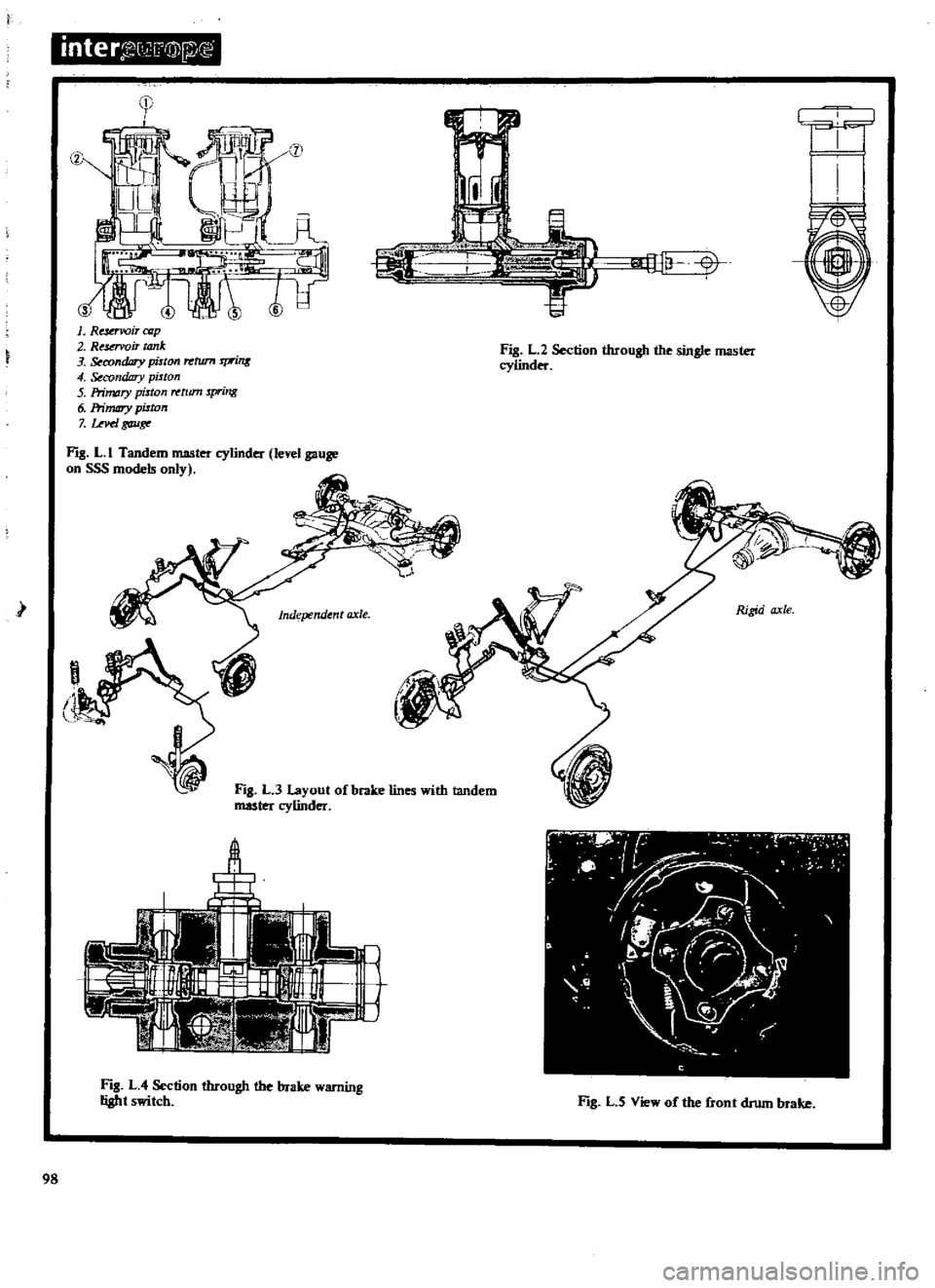
G
@lfi
r
OIl
ll
V
V
1
Re
rvoir
azp
2
Resovoir
tank
3
condDry
piston
rrtrun
rprins
4
Secondary
pitton
5
Primary
piston
tum
spring
6
Primary
piston
7
uvd
gau
Fl
L
I
Tandem
master
cylinder
level
gauge
on
SSS
models
only
Fig
L
2
Section
through
the
single
master
cylinder
I
Independent
axle
Rigid
axle
Fig
L
3
Layout
of
brake
lines
with
tandem
master
cylinder
A
Ji
I
I
f
tf
A1
r
Fig
L
4
Section
through
the
brake
warning
light
switch
Fl
L
5
View
of
the
front
drum
brake
98
Page 104 of 171
brake
shoe
is
in
contact
with
the
drum
The
adjuster
must
be
turned
from
the
rear
of
the
backplate
and
the
drum
turned
by
hand
When
the
shoe
contacts
the
drum
turn
the
adjuster
in
the
opposite
direction
until
the
shoe
is
just
clear
and
the
drum
can
be
rotated
freely
by
hand
Depress
the
brake
pedal
and
make
sure
that
the
brakes
operate
correctly
The
adjusters
must
be
released
slightly
if
the
brake
shoe
binds
FRONT
DISC
BRAKE
Friction
pads
Fig
L
14
The
disc
brakes
are
self
adjusting
but
the
friction
pads
should
be
checked
for
wear
every
5
000
km
3
000
miles
and
replaced
if
the
thickness
of
the
friction
lining
on
any
pad
is
less
than
1
0mm
0
004
in
In
effect
this
means
that
renewal
is
necessary
when
the
total
thickness
of
pad
and
lining
is
less
than
8
4mm
0
24
in
To
replace
the
friction
pads
proceed
as
follows
Siphon
out
some
of
the
fluid
in
the
master
cylinder
reservoir
Jack
up
the
front
of
the
vehicle
and
remove
the
road
wheel
Remove
the
anti
rattle
clip
from
the
calliper
plate
Fig
L
lS
Unhook
the
hanger
spring
and
withdraw
the
brake
pads
and
shims
Fig
L
17
It
should
be
noted
that
the
friction
pads
must
be
replaced
as
a
set
and
renewed
at
both
sides
of
the
vehicle
otherwise
the
braking
action
will
be
uneven
Oean
the
calliper
and
pad
at
their
installation
positions
Press
the
pistons
into
the
calliper
bores
so
that
the
new
friction
Pads
can
be
installed
The
pistons
can
be
installed
by
applying
light
pressure
as
shown
in
Fig
L
16
but
care
must
be
taken
to
avoid
pushing
them
too
far
or
the
groove
of
the
piston
will
damage
the
seal
If
the
pistons
are
pushed
down
excessively
it
will
be
necessary
to
dismantle
the
calliper
as
described
under
the
appropriate
heading
Assemble
the
anti
squeal
shims
to
the
friction
pads
with
the
arrow
mark
on
the
shims
pointing
in
the
direction
of
forward
disc
rotation
Refit
the
pads
and
retaining
pins
and
assemble
the
coil
spring
to
the
retaining
pin
furthest
away
from
the
air
bleed
screw
After
installing
the
new
pads
and
shims
depress
the
brake
pedal
several
times
to
reposition
the
pistons
in
the
calliper
O1eck
the
fluid
level
in
the
master
cylinder
reservoir
and
refill
to
the
correct
level
FRONT
DISC
BRAKE
Removal
and
Dismantling
1
Jack
up
the
front
of
the
vehicle
remove
the
road
wheel
and
take
out
the
friction
pads
2
Disconnect
the
brake
hose
from
the
brake
tube
and
plug
the
opened
end
to
prevent
the
loss
of
fluid
3
Remove
the
bolts
securing
the
brake
calliper
to
the
knuckle
flange
and
remove
the
calliper
assembly
Fig
L
IS
4
Remove
the
hub
nut
and
withdraw
the
hub
and
disc
To
dismantle
the
calliper
remove
the
anti
rattle
clip
and
withdraw
the
brake
pads
Remove
the
tension
springs
and
pull
the
cylinder
out
of
the
calliper
Blow
out
the
piston
with
com
pressed
air
applied
at
the
brake
hose
connection
Oean
the
components
in
brake
fluid
and
examine
them
for
signs
of
wear
or
damage
The
cylinder
walls
can
be
carefully
polished
with
fine
emery
cloth
if
they
are
rusted
or
contaminated
If
the
parts
are
excessively
corroded
they
should
be
renewed
Replace
the
pistons
if
they
are
unevenly
worn
damaged
or
rusted
The
sliding
surface
of
the
piston
is
plated
and
no
attempt
should
be
made
to
use
emery
cloth
or
similar
abrasives
for
cleaning
purposes
Check
the
thickness
of
the
friction
pads
as
previously
described
and
replace
them
if
necessary
Renew
the
piston
seals
and
the
dust
covers
O1eck
the
brake
disc
for
scoring
and
out
of
round
The
standard
disc
thickness
is
10
Omm
0
0394
in
and
must
not
be
reground
below
8
4mm
0
3307
in
Check
the
disc
run
out
with
a
dial
gauge
as
shown
in
Fig
L
19
Position
the
gauge
near
the
outer
diameter
and
check
that
the
run
out
does
not
exceed
0
06mm
0
0024
in
FRONT
BRAKE
DISC
Assembly
and
Installation
Rinse
the
cylinder
bore
with
brake
fluid
and
fit
the
piston
seal
into
the
cylinder
groove
Fig
L
20
Fit
the
wiper
seal
and
lightly
grease
the
bore
of
the
cylinder
Clean
the
brake
disc
and
fit
it
to
the
hub
Install
the
hub
to
the
knuckle
spindle
Carefully
insert
the
piston
into
the
cylinder
until
the
face
of
the
piston
is
almost
flush
with
the
wiper
seal
retainer
The
relieved
part
of
the
piston
should
face
the
piston
pin
Fit
the
cylinder
to
the
calliper
plate
and
secure
in
position
with
the
two
torsion
springs
Assemble
the
hold
down
pin
the
spring
washer
and
the
nut
to
the
support
bracket
Secure
the
nut
with
a
cotter
pin
Assemble
the
calliper
to
the
mounting
bracket
using
the
pivot
pin
washer
spring
washer
and
nut
Tighten
the
nut
and
secure
with
a
cotter
pin
Hook
the
hold
down
bracket
to
the
top
of
the
mounting
bracket
and
turn
the
calliper
plate
to
make
sure
that
it
can
slide
smoothly
Fit
the
calliper
assembly
to
the
knuckle
flange
Fit
a
shim
to
the
inner
pad
and
insert
the
pad
Draw
the
calliper
towards
the
chassis
and
insert
the
lower
cuts
on
the
pad
into
the
mounting
bracket
and
push
the
pad
in
until
it
contacts
the
piston
Move
the
calliper
away
from
the
chassis
and
insert
the
upper
cuts
Centre
the
indentation
of
the
outer
pad
in
the
calliper
plate
Fit
the
anti
rattle
clip
Fig
L
14
103
Page 109 of 171
interQ
8
j
@W
2
m
tV
r
ReJld
cop
level
th
elk
FIg
M
I
llIecking
the
specific
gra
ity
of
the
battery
electrolyte
I
Thermal
u
e
Hydrometer
f
j
0
l
Q
I
iJ
Qy@
I
@
@
@
ti
II
@
@
Fig
M
3
Brush
cover
removed
j
i
Fill
M
2
Starter
motor
components
1
L
u
uJIner
pin
2
Drive
mil
Nack
t
3
Dult
COPD
4
E
mmtle
r
5
Aut
mzl
6
Solmoid
mlch
7
Arm
zturr
8
Thnut
9
IJriv
mil
blllck
t
bush
10
17uust
WdSMr
11
Stop
washer
12
CiTc
ip
13
PirUon
srap
collar
14
Pinion
IS
IWfni1l6
clutch
16
Field
coil
17
Yok
18
Politive
brwh
19
N
J1iP
bnuh
20
Bnuh
rprinK
21
Brullr
holder
22
Bearing
bwh
23
Rmr
COJIU
24
Through
botrr
@
FIg
M
5
Yoke
assembly
removed
Fill
M
4
Solenoid
switch
1
108
Fig
M
6
Annatore
assembly
and
engagemenr
lever
removed
Page 110 of 171
ElectrIcal
EquIpment
DESCRIPTION
BATTERY
Maintenance
STARTER
MOTOR
Removal
and
Dismantling
STARTER
MOTOR
Testing
STARTER
MOTOR
Assembly
and
Installation
ALTERNATOR
Removal
Dismantling
and
Inspection
DESCRIPTION
A
12
volt
negative
earth
electrical
system
is
used
in
which
the
battery
is
charged
by
an
alternator
In
the
alternator
a
magnetic
field
is
produced
by
the
rotor
which
consists
of
the
alternator
shaft
field
coil
p
le
pieces
and
slip
rings
Output
current
is
generated
in
the
armature
coils
located
in
the
stator
Six
silicon
diodes
are
incorporated
in
the
alternator
caSing
to
rectify
the
alternating
current
supply
A
voltage
regulator
and
pilot
lamp
relay
are
built
in
the
regulator
box
which
nonnally
does
not
give
trouble
or
require
attention
The
starter
motor
is
a
brush
type
series
wound
motor
in
which
positive
meshing
of
the
pinion
and
ring
gear
teeth
are
secured
by
means
of
an
overrunning
clutch
BATTERY
Maintenance
The
battery
should
be
maintained
in
a
clean
and
dry
condition
at
all
times
or
a
current
leakage
may
occur
between
the
terminals
If
frequent
topping
up
is
required
it
is
an
indication
of
overcharging
or
deterioration
of
the
battery
When
refitting
the
cables
clean
them
thoroughly
and
coat
their
terminals
and
the
terminal
posts
with
petroleum
jelly
Check
the
level
of
the
electrolyte
in
the
battery
at
frequent
intervals
and
top
up
if
necessary
to
the
level
mark
on
the
battery
case
with
distilled
water
A
hydrometer
test
should
be
carried
out
to
determine
the
state
of
charge
of
the
battery
by
measuring
the
specific
gravity
of
the
electrolyte
It
should
be
pointed
out
that
the
addition
of
sulphuric
acid
will
not
normally
be
necessary
and
should
only
be
carried
out
by
an
expert
when
required
The
specific
gravity
of
the
electrolyte
should
be
ascertained
with
the
battery
fully
charged
at
an
electrolyte
temperature
of
200C
680F
The
specific
gravity
of
the
electrolyte
decreases
or
increases
by
0
0007
when
its
temperature
rises
or
falls
by
10C
1
80F
respectively
The
temperature
referred
to
is
that
of
the
electrolyte
and
not
the
ambient
temperature
to
correct
a
reading
for
an
air
temperature
it
will
be
necessary
to
add
0
0035
to
the
reading
for
every
50C
above
200C
Conversely
0
0035
must
be
deducted
for
every
SOC
below
200C
Test
each
cell
separately
and
draw
the
liquid
into
the
hydrometer
several
times
if
a
built
in
thermometer
type
is
used
The
correct
specific
gravity
readings
should
be
as
follows
ALTERNATOR
Assembly
and
Installation
HEAD
LAMPS
Replacing
HORN
INSTRUMENT
PANEL
Removal
WINDSCREEN
WIPERS
WINDSCREEN
WASHERS
IGNITION
SWITCH
AND
STEERING
LOCK
Cold
climates
Temperature
climates
Tropical
climates
Permissible
value
Over
1
22
Over
1
20
Over
1
18
Fully
charged
at
200C
680F
1
28
1
26
1
23
The
battery
should
be
recharged
if
a
low
specific
gravity
reading
is
indicated
Always
disconnect
both
terminals
of
the
battery
when
charging
and
clean
the
terminal
posts
with
a
soda
solution
Remove
the
vent
plugs
and
keep
the
electrolyte
temperature
below
450C
l130F
during
charging
Check
the
specific
gravity
after
charging
and
if
it
is
above
1
260
at
200C
680C
add
distilled
water
STARTER
MOTOR
Removal
and
Dismantling
As
previously
stated
the
starter
motor
is
brush
type
series
wound
motor
in
which
the
positive
meshing
of
the
pinion
and
ring
gear
teeth
are
secured
by
an
overrunning
clutch
The
over
running
clutch
employs
a
shift
lever
to
slide
the
pinion
into
mesh
with
the
flywheel
ring
gear
teeth
when
the
starter
is
operated
When
the
engine
starts
the
pL
lion
is
permitted
to
overrun
the
clutch
and
armature
but
is
held
in
mesh
until
the
shift
lever
is
released
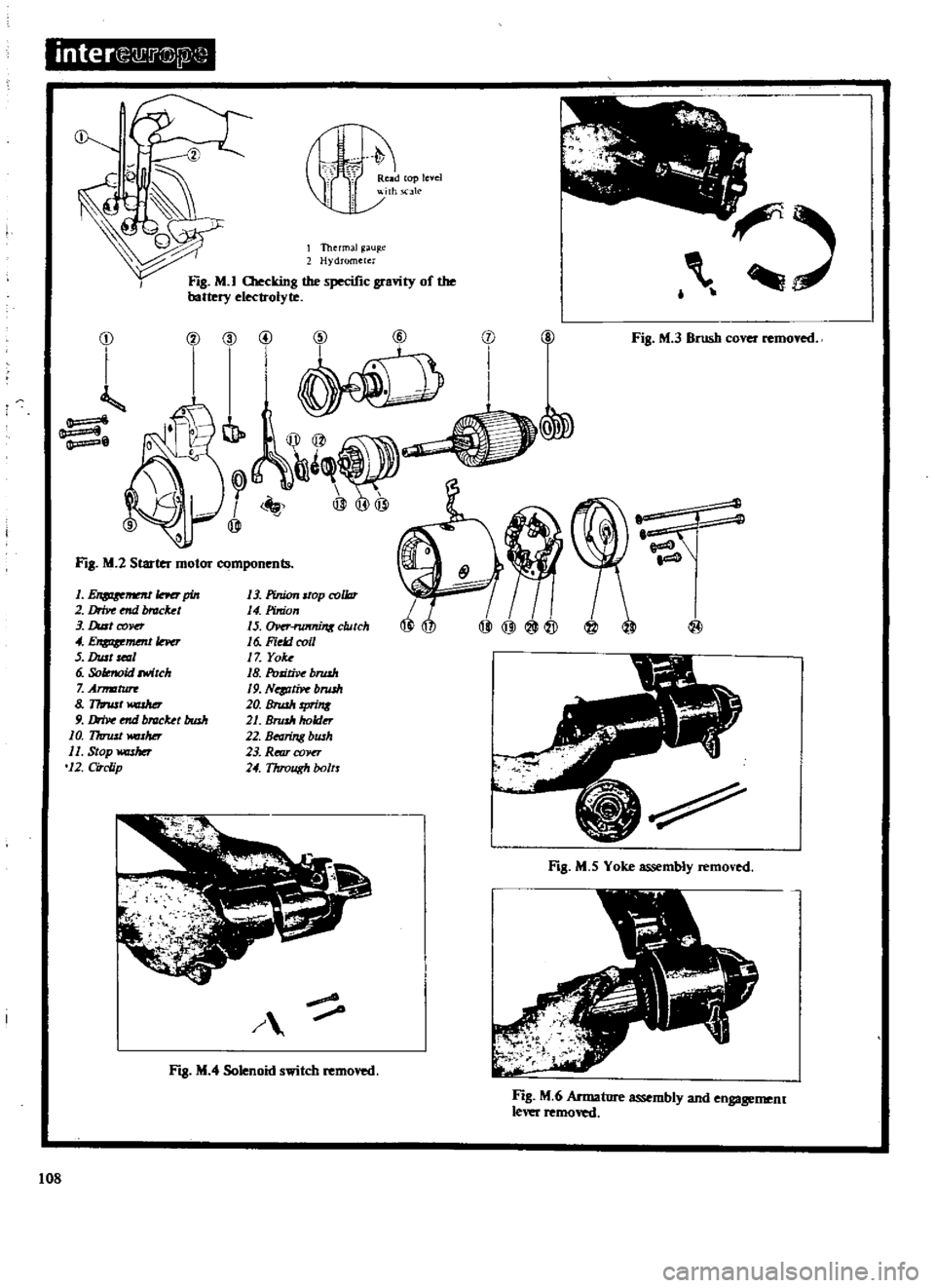
An
exploded
view
of
the
starter
is
shown
in
Fig
M
2
To
remove
the
starter
motor
proceed
as
follows
Disconnect
the
battery
earth
cable
2
Disconnect
the
black
and
yellow
wire
from
the
solenoid
terminal
and
the
black
cable
from
the
battery
terminal
3
Remove
the
two
bolts
securing
the
starter
motor
to
the
clutch
housing
Pull
the
starter
motor
assembly
forwards
and
withdraw
it
from
the
v
hicle
To
dismantle
the
starter
motor
ftrst
remove
the
brush
cover
and
lift
out
the
brushes
as
shown
in
Fig
M
3
Loosen
the
nut
securing
the
connecting
plate
to
the
solenoid
M
terminal
Remove
the
solenoid
retaining
screws
take
out
the
cotter
pin
and
withdraw
the
shift
lever
pin
Remove
the
solenoid
assembly
as
shown
in
Fig
M
4
Remove
the
two
through
bolts
and
rear
cover
assembly
then
remove
the
yoke
assembly
by
lightly
tapping
it
with
a
wooden
mallet
Fig
M
S
Withdraw
the
armature
and
shift
lever
Fig
M
6
Remove
the
pinion
stopper
from
the
armature
shaft
by
removing
the
stopper
washer
pushing
the
109
Page 126 of 171
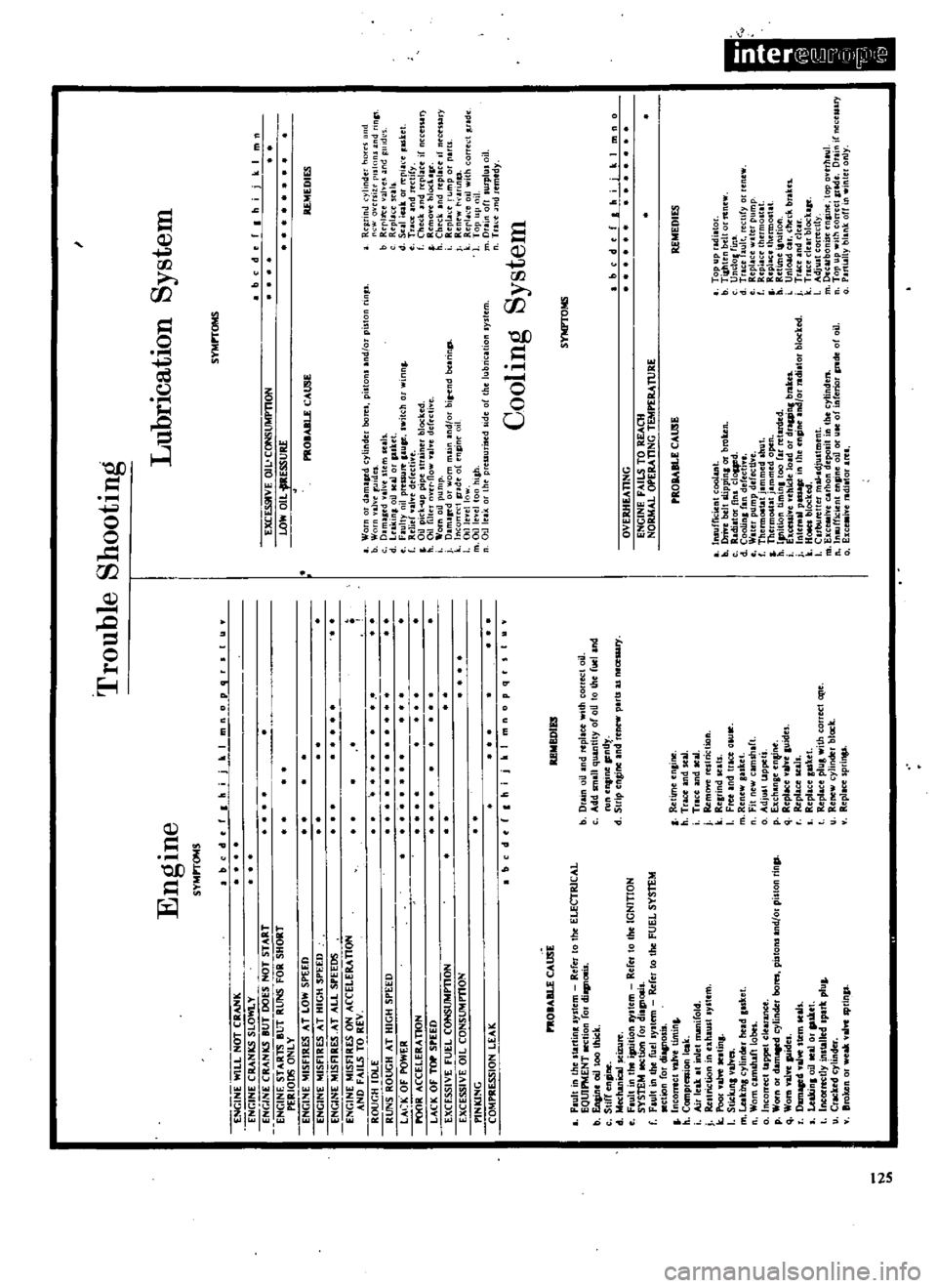
N
Engme
SYMPTOMS
I
Trouble
Shooting
Lubrication
System
SYMPTOMS
bed
t
f
I
h
i
1m
0
p
q
r
I
I
II
bed
t
f
I
h
Ii
I
m
n
ENGINE
WILL
NOT
CRANK
ENGINE
CRANKS
SLOWLY
ENGINE
CRANkS
BUT
OOES
NOT
START
ENGINE
STARTS
BUT
RUNS
FOR
SHORT
PERIODS
aNL
Y
ENGINE
I
tISFIRES
AT
LOW
SPEED
ENGINE
MISFIRES
AT
HIGH
SPEED
ENGINE
MISFIRES
AT
ALL
SPEEDS
ENGINE
MISFIRES
ON
ACCELERATION
AND
FAILS
TO
REV
ROUGH
IDLE
RUNS
ROUGH
AT
HIGH
SPEED
lACK
OF
POWER
POOR
CCElERA
nON
LACK
OF
TOP
SPEED
EXCESSIVE
FUEL
CONSUMmON
EXCESSIVE
OIL
CONSUMmON
PINKING
COMPRESSION
LEAK
PROIABLE
CAUSE
Faull
In
th
e
ltartinll
IYltem
Refer
to
the
ELECTRICAL
EQUIPMENT
leetion
fOI
dilllflOlIll
b
Eft
ineoiltoothick
Stiffenpne
d
Mechanieal
scimre
Flult
In
lhe
IpUlion
I
ltem
Refer
to
the
IGNITION
SYSTEM
IeCtion
for
di
I
f
Flult
the
fuellYlltm
Refer
to
the
FUEL
SYSTEM
Clion
or
di
l
OIII
Incomcl
tllvetlmln
h
ComprellllllIU
IClk
Air
leak
IRlel
JIlIIni
old
j
Reltriction
nhlu5t5ylltm
Ie
Poor
alYe
WIIIIIJ
I
Stick
tnlvall
n
m
Lclklnl
cylinder
held
Illke
Womcamlhlft
lobel
IncolTe
ttappetclurance
p
Worn
dlm
ed
cylinder
born
pUlon5
Ind
or
pll
f1np
q
Wom
nl
fC
paides
Damaced
a1wlttmseal
LeWnloilwaI
pu
e
Incorrectly
installed
apark
plu
CrICked
cylinder
Broken
weakv
w
sprinp
EXCES9lVE
OIL
CONSUMPTION
WW
OIL
ilRESSURE
PROIABLE
CAUSE
REMEDIES
I
Worn
dlmalJl
dcyhnderbon
P
v
lnd
orpulu
nnr
s
b
WorJl
valve
r
uides
C
D
m
led
valve
lIemluls
d
Lnlunr
oil
ul
pillet
e
Flulty
nil
P
uu
IluP
Iwnch
wmn
f
Relief
valve
defecuve
011
pick
up
pipellfline
blocked
h
011
filler
nver
flow
yaJYe
dcffe
WO
n
oil
pump
J
Dlmllfd
om
maUl
Ind
or
bl
nd
b
lnnll
l
lncorreCllndeofentpneoil
l
Oil
level
10
m
Oillevel
tnnhllh
Oillelk
the
preuunled
Ilde
of
the
lubn
IYSfem
p
Tldc
Rel1
f1nd
yllOde1
ne
OVCntZl
nd
nnJ
b
Rcpltte
v
lve
and
Iltd
c
Repl
cc
5c
l
d
Sullu
rt
pl
cp
aI
kCl
e
Trice
Ind
rtClify
f
heel
lod
replace
if
nccess
T
RemoYcblQChJC
h
Chcck
Ind
repllcclfncct
i
ry
i
Repll
e
rump
J
Renew
nnp
k
Rerl
ec
OIl
with
l
Top
up
oil
m
DTllnofllurpIUloil
Tn
ndremedy
Coolmg
System
b
r
h
j
I
m
p
q
d
REMEDIES
SYMI
IOMS
b
Drlm
oiJ
nd
rcpl
ce
with
ot
Add
smlll
quanllty
n
oil
to
the
fuel
Ind
rune
lmeFnd
d
SlfIpenJine
Ind
renew
p
ru
asn
celllry
I
bed
t
f
I
h
I
i
k
I
mn
0
OVERHEATING
ENGINE
FAILS
TO
REAOI
NORMAL
OPERATING
TEMPERAt
lRE
PROIAILE
CAUSE
REMEDIES
I
RetUne
enJine
h
Trace
ndseal
Tr
Ind
seal
j
RemO
f
t
rellnction
k
Relnnd
sel
I
Freelnd
trice
C
UIe
m
Renewguke
Fit
new
clmlhlrt
AdJult
t
appeti
p
bch
ngeenfin
q
Replacevalnluldes
Rtplace
seall
Repllccgukel
Repllcc
plulwlth
correct
Cl
Ie
Renew
cyhndcrblock
Repllce
5prLnp
I
IlIIIIfficien
coolant
b
DriYebellllippinIOfbrobn
c
RldiatOf
fUll
cloq
ed
d
Coo
inlflndefeclln
e
Wit
pl1mpdtfectlve
f
ThelTllOllatj
mmed
Ihul
Thermost
j
mmed
open
r
t
eti
I
kt
r
re
a
q
brake
j
lntel1laJp
se
lheenpne
ndforradi
torbloeked
11
HOItI
blocked
I
Carburetterm
djullmem
m
Excellive
arbon
depolit
in
thecylinden
In
ffici
enpneoil
uae
of
inferior
p1Ide
of
oil
Exce
inrldi
lorlrea
I
Topupradil
v
b
Ti
htenbdtorftnc
I
t
rmify
e
Repl
cwaterpump
f
Rcpll
e
thermoltll
I
Replleclhermolt
t
h
RetimeiaTUlion
i
Unload
ear
check
brl
ktt
j
Trace
ndclu
k
TfI
cdUrblockaae
L
AdjUllcorrc
cth
m
Decarbonise
fO
tne
top
overh
uJ
Top
up
wlth
correct
rade
Dr
inifneceUlry
PUIl
lly
blink
off
in
winter
only
Page 142 of 171
pulley
should
be
aligned
with
the
T
mark
on
the
chain
cover
Install
the
cylinder
head
assembly
Coat
the
cylinder
block
side
of
the
head
gasket
with
sealing
agent
Three
Bond
No
4
or
equivalent
but
take
care
that
the
scaling
agent
does
not
enter
the
cylinders
Tighten
the
head
bolts
in
several
stages
to
a
torque
reading
of
8
0
to
9
0
kgrn
58
to
65
lb
ft
Tighten
the
bolts
to
the
sequence
shown
in
Fig
A
IB
Pull
the
timing
chain
out
of
the
chain
cover
and
set
it
on
the
camshaft
sprocket
so
that
the
timing
marks
are
aligned
then
place
the
sprocket
and
chain
on
the
camshaft
Install
the
distributor
drive
gear
on
the
camshaft
and
tighten
the
bolt
to
a
torque
reading
of
4
5
to
5
5
kgrn
32
6
to
39
8
lb
ft
Note
that
the
camshaft
bolt
has
a
left
hand
thread
Adjust
the
valve
clearances
as
described
under
the
appro
priate
heading
Fit
the
rubber
plugs
at
the
front
and
rear
of
the
cylinder
head
taking
care
to
apply
sealing
agent
to
the
rear
plug
Install
the
chain
adjusting
screw
and
adjust
the
tension
of
the
chain
in
the
following
manner
Rotate
the
crankshaft
clockwise
to
establish
the
correct
chain
tension
screw
the
adjusting
screw
fully
home
then
back
it
off
by
half
a
turn
and
secure
with
the
locknut
Install
the
valve
rocker
cover
and
fit
the
water
pump
Note
that
one
of
the
water
pump
mounting
bolts
also
secures
the
generator
adjusting
arm
Install
the
bracket
and
alternator
water
pump
pulley
fan
blades
and
fan
belt
Tighten
the
fan
bolts
and
lock
each
pair
of
bolts
together
using
wire
inserted
through
the
holes
provided
in
the
bolts
Install
the
oil
filter
and
fit
the
rocker
cover
hose
Install
the
distributor
so
that
the
vacuum
control
unit
and
rotor
arc
positioned
as
shown
in
Fig
A
19
Oil
the
distributor
driven
gear
Fit
the
breather
assembly
the
clamp
of
the
pipe
is
tightened
together
with
the
exhaust
manifold
Install
the
spark
plugs
and
connect
the
high
tension
leads
Install
the
exhaust
manifold
Fit
the
head
shield
plate
and
engine
slinger
and
tighten
them
together
Note
that
the
exhaust
manifold
gasket
must
be
fitted
with
the
steel
plate
facing
the
manifold
Install
the
clutch
as
described
in
the
section
CLUTCH
Remove
the
engine
from
the
mounting
stand
and
install
the
gearbox
intake
manifold
and
carburettor
stater
motor
engine
mounting
oil
pressure
warning
switch
etc
Fill
the
engine
and
gearbox
to
the
correct
levels
with
recommended
oils
and
refill
the
cooling
system
Adjust
the
ignition
timing
and
carburettor
as
described
in
the
appropriate
sections
VALVE
CLEARANCES
Adjusting
The
valves
clearances
can
be
adjusted
in
a
similar
manner
to
the
instructions
given
for
the
L14
LI6
L18
engines
Initially
adjust
the
clearances
with
the
engine
switched
off
and
cold
to
0
2
mm
0
0079
in
for
both
intake
and
exhaust
valves
Set
the
final
clearances
to
0
28
mm
0
011
in
for
both
intake
and
exhaust
valves
with
the
engine
warmed
up
to
its
normal
operating
temperature
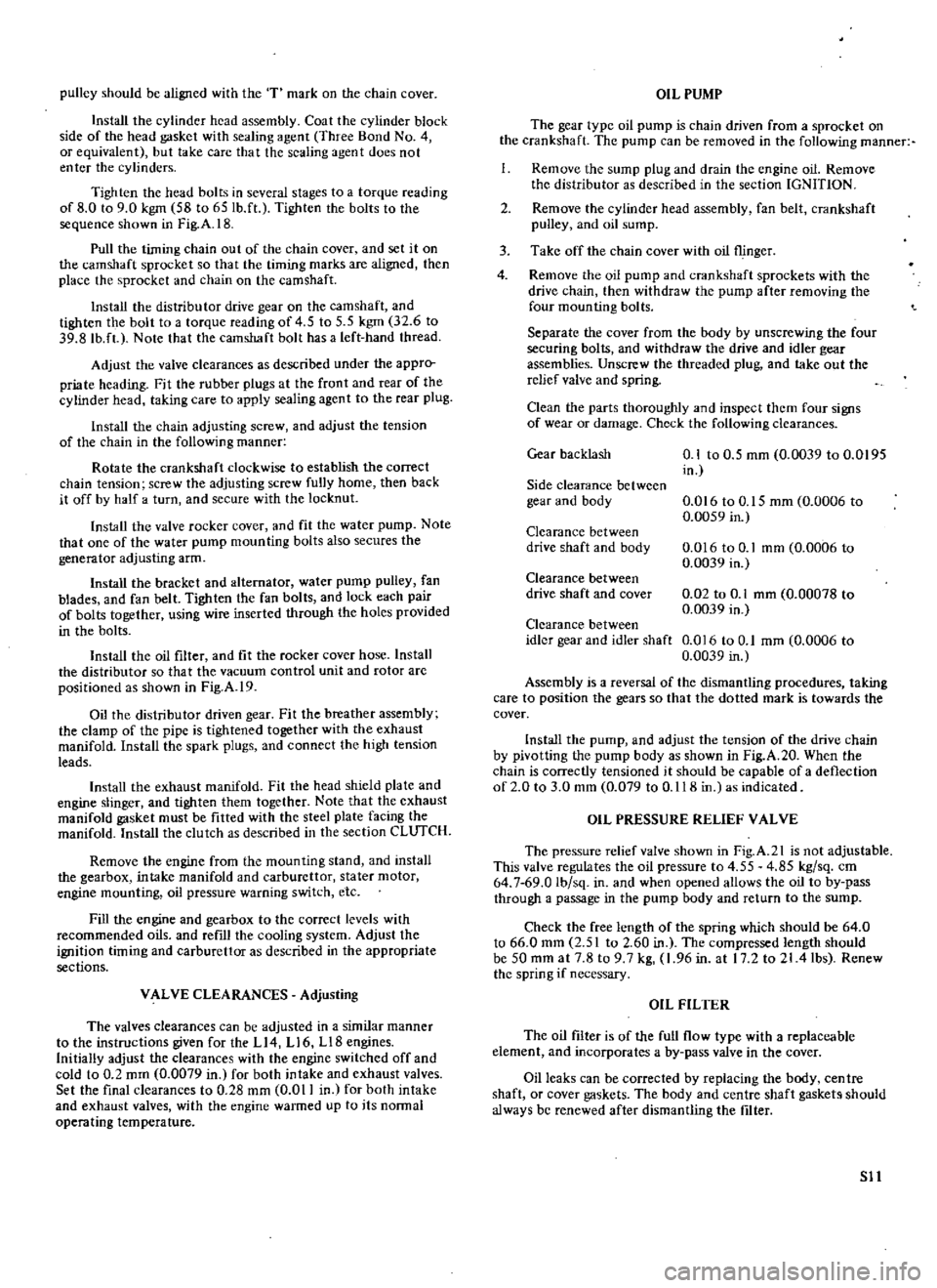
OIL
PUMP
The
gear
type
oil
pump
is
chain
driven
from
a
sprocket
on
the
crankshaft
The
pump
can
be
removed
in
the
following
manner
1
Remove
the
sump
plug
and
drain
the
engine
oil
Remove
the
distributor
as
described
in
the
section
IGNITION
2
Remove
the
cylinder
head
assembly
fan
belt
crankshaft
pulley
and
oil
sump
3
Take
off
the
chain
cover
with
oil
fl
inger
4
Remove
the
oil
pump
and
crankshaft
sprockets
with
the
drive
chain
then
withdraw
the
pump
after
removing
the
four
mounting
bolts
Separate
the
cover
from
the
body
by
unscrewing
the
four
securing
bolts
and
withdraw
the
drive
and
idler
gear
assemblies
Unscrew
the
threaded
plug
and
take
out
the
relief
valve
and
spring
Clean
the
parts
thoroughly
and
inspect
them
four
signs
of
wear
or
damage
Check
the
following
clearances
Gear
backlash
0
1
to
0
5
mm
0
0039
to
0
0195
in
Side
clearance
between
gear
and
body
0
016
to
0
15
mm
0
0006
to
0
0059
in
Clearance
between
drive
shaft
and
body
0
016
to
0
1
mm
0
0006
to
0
0039
in
Clearance
between
drive
shaft
and
cover
0
02
to
0
1
mm
0
00078
to
0
0039
in
Clearance
between
idler
gear
and
idler
shaft
0
016
to
0
1
mm
0
0006
to
0
0039
in
Assembly
is
a
reversal
of
the
dismantling
procedures
taking
care
to
position
the
gears
so
that
the
dotted
mark
is
towards
the
cover
Install
the
pump
and
adjust
the
tension
of
the
drive
chain
by
ph
otting
the
pump
body
as
shown
in
Fig
A
20
When
the
chain
is
correctly
tensioned
it
should
be
capable
of
a
deflection
of
2
0
to
3
0
mm
0
079
to
0
118
in
as
indicated
OIL
PRESSURE
RELIEF
VALVE
The
pressure
relief
valve
shown
in
Fig
A
21
is
not
adjustable
This
valve
regulates
the
oil
pressure
to
4
55
4
85
kg
sq
cm
64
7
69
0
lb
sq
in
and
when
opened
allows
the
oil
to
by
pass
through
a
passage
in
the
pump
body
and
return
to
the
sump
Check
the
free
length
of
the
spring
which
should
be
64
0
to
66
0
mm
2
51
to
2
60
in
The
compressed
length
should
be
50
mm
at
7
8
to
9
7
kg
1
96
in
at
17
2
to
21
4Ibs
Renew
the
spring
if
necessary
OIL
FILTER
The
oil
filter
is
of
the
full
flow
type
with
a
replaceable
element
and
incorporates
a
by
pass
valve
in
the
cover
Oil
leaks
can
be
corrected
by
replacing
the
body
centre
shaft
or
cover
gaskets
The
body
and
centre
shaft
gaskets
should
always
be
renewed
after
dismantling
the
filter
S
1
Page 144 of 171

carrying
out
extensive
tests
with
the
necessary
equipment
The
hoses
and
connectors
can
of
course
be
checked
for
signs
of
leakage
and
corrected
as
necessary
Also
the
tension
of
the
air
pump
belt
IGNITION
TIMING
AND
IDLING
SPEED
Emission
control
system
The
ignition
timing
should
be
set
and
the
idling
speed
mixture
adjusted
in
the
folloWing
manner
Run
the
engine
until
it
reaches
its
normal
operating
tem
perature
Connect
an
ignition
tachometer
and
timing
light
observ
ing
the
manufacturers
instructions
NOTE
If
the
vehicle
is
equipped
with
automatic
transmission
make
sure
that
the
dashpot
does
not
prevent
the
throttle
from
closing
Turn
the
throttle
shaft
arm
adjusting
screw
anti
clock
wise
so
that
the
tip
of
the
screw
is
clear
of
the
throttle
shaft
arm
see
Fig
A
26
Turn
the
throttle
adjusting
screw
to
set
the
idling
speed
to
700
r
p
m
650
rpm
for
automatic
transmission
Adjust
the
ignition
timing
to
5
A
T
D
C
Refererence
should
be
made
to
the
instructions
given
in
the
section
IGNITION
SYSTEM
for
the
L14
L16
and
LI8
engines
for
ignition
timing
details
Turn
the
idling
adjustment
screw
and
throttle
adjusting
screw
until
the
engine
runs
smoothly
a
t
the
correct
idling
speed
Turn
the
idling
adjustment
screw
clockwise
until
the
engine
speed
starts
to
drop
as
a
weaker
mix
ture
is
obtained
Now
turn
the
idling
adjustment
screw
anti
clockwise
by
one
turn
one
and
a
half
turns
for
automatic
transmission
to
obtain
a
richer
mix
ture
Adjust
the
idling
speed
to
700
rpm
650
rpm
for
automatic
transmission
by
turning
the
throttle
adjusting
screw
Make
sure
that
the
ignition
timing
remains
at
50
A
T
D
C
Turn
the
throttle
shaft
ann
adjusting
screw
clockwise
until
the
tip
of
the
screw
just
contacts
the
throttle
shaft
ann
The
screw
must
not
exert
pressure
on
the
throttle
shaft
arm
EMISSION
CONTROL
SYSTEM
Maintenance
The
system
should
be
inspected
and
serviced
every
I
2
months
or
20
000
km
12
000
miles
whichever
comes
fIrst
to
make
sure
that
the
exhaust
emissions
are
maintained
at
the
minimum
level
Check
the
carburettor
choke
setting
and
adjust
as
described
in
the
section
FUEL
SYSTEM
Check
the
carburettor
idling
speed
mixture
and
adjust
if
necessary
as
described
under
the
heading
IGNITION
TIMING
AND
IDLING
SPEED
in
this
section
2
Check
the
distributor
earn
dwell
angle
and
also
the
condi
tion
of
the
contact
breaker
points
Check
the
ignition
timing
and
adjust
if
necessary
The
distributor
dwell
angle
should
be
adjusted
to
49
55
degrees
and
the
points
gap
to
0
45
0
55
mm
0
0177
0
0217
in
3
Remove
and
clean
the
sparking
plugs
Renew
any
plug
with
badly
worn
electrodes
Set
the
plug
gaps
to
0
80
0
90
mm
0
0315
0
0355
in
by
adjusting
the
earth
electrode
IGNITION
SYSTEM
The
maintenance
and
servicing
procedures
for
the
compo
nents
of
the
ignition
system
on
vehicles
fitted
with
the
GIS
engine
are
basically
similar
to
the
instructions
previously
given
for
the
Ll4
LI6
and
LIS
engines
The
distributor
is
however
of
a
different
type
Either
an
Hitachi
0416
57
distributor
being
fitted
or
an
Hitachi
0423
53
if
the
vehicle
is
equipped
with
an
emission
control
system
The
distributors
have
different
advance
curve
characteristics
as
shown
in
Technical
Data
IGNITION
TIMING
Check
the
ignition
timing
with
a
timing
light
as
previously
described
for
the
LI4
L16
and
L
8
engines
Disconnect
the
distributor
vacuum
line
and
run
engine
at
idling
speed
or
slightly
below
The
timing
should
be
set
at
8
BTDCj600
rpm
for
the
D416
57
distributor
or
at
5
ATDCj600
rpm
for
the
D423
53
distributor
fItted
to
engines
with
emission
control
systems
IGNITION
DISTRIBUTOR
Maintenance
Maintenance
instructions
are
similar
to
those
given
for
the
L14
LI6
and
L18
engines
Set
the
contact
breaker
points
gap
to
0
45
0
55
mm
0
0177
0
0217
in
as
previously
described
SPARKING
PLUGS
The
sparking
plugs
should
be
inspected
and
cleaned
at
regular
intervals
and
renewed
at
approximately
20
000
kIn
12
000
miles
Clean
the
plugs
thoroughly
and
make
sure
they
are
of
the
same
type
and
heat
range
File
the
centre
electrode
nat
before
adjusting
the
gap
Set
the
gap
to
0
8
0
9mm
0
031
0
035
in
if
the
engine
is
fItted
with
emission
control
system
or
to
0
7
0
8
mm
0
028
0
031
in
if
emission
control
is
not
fitted
Adjustment
must
always
be
made
by
bending
the
earth
electrode
TechnIcal
Data
GENERAL
SPECIFICATION
GI8
Engine
Cylinders
Bore
and
stroke
Displacemen
t
Valve
arrangemen
t
Firing
order
Engine
idler
speed
Compression
ratio
Oil
pressure
at
3000
r
p
m
4
in
line
85x80
mm
3
346x3
150
in
1
815
cc
110
8
cu
in
OHC
134
2
600
r
p
m
STD
8
3
I
4
7
to
5
5
kgjsq
cm
66
8
to
78
2
Ibjsq
in
LIQUID
PACKING
APPLICATION
Cylinder
block
2
Cylinder
head
Oil
gallery
blind
plug
Expansion
plug
Gas
breather
guide
Rear
bearing
cap
fitting
surface
Rear
bearing
cap
side
seal
both
ends
Expansion
plug
Rubber
plug
Rea
Manifold
heat
pipe
3
Chain
cover
gasket
both
sides
S13
Page 148 of 171

Fan
coupling
Pulley
ratio
fan
and
water
pump
Tuning
data
Basic
timing
Idling
speed
Distributor
dwell
angle
Spark
plug
gap
Choke
setting
CO
percent
setting
Fan
rpm
water
pump
rpm
3
300
4
000
120
103
Ll71
50
A
T
D
C
700
rpm
650
rpm
automatic
490
550
at
0
02
in
breaker
gap
0
8IJ
0
90
mm
0
03
I
5
0
0355
in
Manual
6
0
I
0
5
air
supply
hose
disconnected
Air
pump
drive
belt
tensioning
Permissible
slackness
of
8
0
12
0
mm
0
3
15
0
4
72
in
under
a
load
of7
1O
kg
1
54
2
20
lb
IGNITION
SYSTEM
DISTRIBUTOR
Type
Firing
order
Rotation
Igntion
timing
Without
emission
control
With
emission
control
Dwell
angle
Condenser
capacity
Advance
characteristics
D416
57
distributor
Hitachi
D416
57
Hitachi
D423
53
with
emission
control
system
134
2
Anti
clockwise
80
B
T
D
C
at
600
rpm
50
A
T
D
C
at
600
r
p
m
49
to
55
degreos
0
20
0
24
1
F
Centrifugal
Start
Maximum
degree
r
p
m
Vacuum
Start
Maximum
degree
r
p
m
Advance
characteristics
D423
53
distributor
Centrifugal
Start
Maximum
degree
r
p
m
Vacuum
Start
Maximum
degree
r
p
m
IGNITION
COIL
Type
Primary
voltage
Spark
gap
Primary
resistance
Secondary
resistance
SPARKING
PLUGS
Type
Gap
Fuel
Systenl
DESCRIPTION
FUEL
PUMP
Testing
FUEL
PUMP
Removing
and
Dismantling
CARBURETTOR
Idling
adjustment
FUEL
LEVEL
Adjusting
STARTING
INTERLOCK
VALVE
OPENING
THROTTLE
VALVE
INTERLOCK
OPENING
CARBURETIOR
Removing
and
Dismantling
DESCRIPTION
A
dual
barrel
down
draught
type
carburettor
is
fitted
to
vehicles
with
the
G
18
engine
A
Stromberg
type
D3034C
carburet
tor
is
installed
on
engines
with
exhaust
emission
controL
and
a
Solex
type
DAK340
carburettor
on
engines
not
equipped
with
this
type
of
system
Both
types
of
carburettors
incorporate
a
550
r
p
m
01
50
at
I
400
16
50
at
2
800
80
mmHg
6
50
at
200
r
p
m
475
r
p
m
01
50
at
1
000
23
50
at
2
600
80
mm
Hg
30
at
120
r
p
m
go
at
400
r
p
m
Hanshin
HM
12F
or
HP5
I
OE
with
emission
control
system
12
volts
more
than
6
mm
0
2362
in
3
8
ohms
at
200C
I
1
2
I
6
8
ohms
at
200
C
NGK
BP
6E
0
7
0
8
mm
0
028
0
031
in
or
0
80
9
mm
0
031
0
035
in
with
emission
control
system
primary
system
for
normal
running
and
a
secondary
system
for
full
load
running
a
float
assembly
which
supplies
fuel
to
both
primary
and
secondary
systems
a
starting
mechanism
and
accelerator
pump
which
provides
a
richer
mixture
on
accelera
tion
SI7
Page 150 of 171
The
type
D3034C
carburettor
has
certain
additional
features
These
include
a
power
valve
mechanism
to
improve
the
performance
at
high
speed
a
fuel
cut
off
valve
which
cuts
the
fuel
supply
when
the
ignition
key
is
turned
to
the
off
position
and
an
idling
limiter
to
maintain
the
emissions
below
a
certain
level
Sectional
views
of
the
two
types
of
pumps
are
shown
in
Figs
8
1
and
B
2
An
EP
3
electrical
fuel
pump
is
located
in
the
centre
of
the
spare
wheel
housing
in
the
boot
Fig
B
3
shows
a
sectional
view
of
the
pump
with
its
contact
the
pump
mechanisms
solenoid
relay
and
built
in
filter
The
air
cleaner
uses
a
viscous
paper
type
element
which
should
be
replaced
every
40
000
km
24
000
miles
Cleaning
is
not
required
and
should
not
be
attempted
The
cartridge
type
fuel
strainer
incorporates
a
fibre
clement
which
should
be
renewed
at
inervals
not
exceeding
40
000
km
24
000
miles
Fit
B
4
shows
a
sectional
view
of
the
assembly
The
fuel
lines
should
not
be
disconnected
from
the
strainer
when
the
fuel
tank
is
full
unless
absolutely
necessary
as
the
strainer
is
below
the
fuel
level
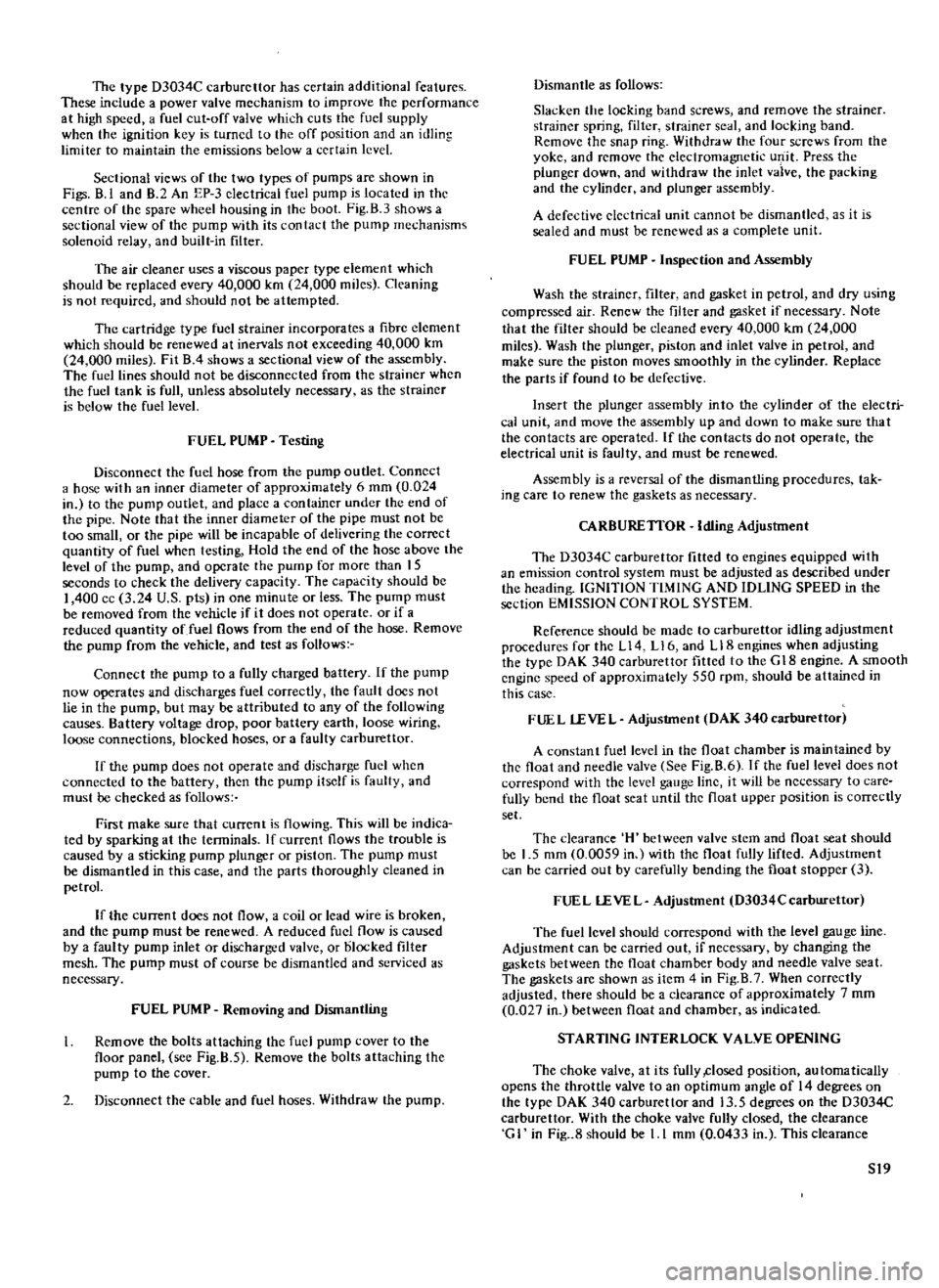
FUEL
PUMP
Testing
Disconnect
the
fuel
hose
from
the
pump
outlet
Connect
a
hose
with
an
inner
diameter
of
approximately
6
mm
0
024
in
to
the
pump
outlet
and
place
a
container
under
the
end
of
the
pipe
Note
that
the
inner
diameter
of
the
pipe
must
not
be
too
small
or
the
pipe
will
be
incapable
of
delivering
the
correct
quantity
of
fuel
when
testing
Hold
the
end
of
the
hose
above
the
level
of
the
pump
and
operate
the
pump
for
more
than
IS
seconds
to
check
the
delivery
capacity
The
capacity
should
be
I
400
cc
3
24
U
S
pts
in
one
minute
or
less
The
pump
must
be
removed
from
the
vehicle
if
it
does
not
operate
or
if
a
reduced
quantity
of
fuel
flows
from
the
end
of
the
hose
Remove
the
pump
from
the
vehicle
and
test
as
follows
Connect
the
pump
to
a
fully
charged
battery
If
the
pump
now
operates
and
discharges
fuel
correctly
the
fault
does
not
lie
in
the
pump
but
may
be
attributed
to
any
of
the
following
causes
Battery
voltage
drop
poor
battery
earth
loose
wiring
loose
connections
blocked
hoses
or
a
faulty
carburettor
If
the
pump
does
not
operate
and
discharge
fuel
when
connected
to
the
battery
then
the
pump
itself
is
faulty
and
must
be
checked
as
follows
First
make
sure
that
current
is
flowing
This
will
be
indica
ted
by
sparking
at
the
tenninals
If
current
flows
the
trouble
is
caused
by
a
sticking
pump
plunger
or
piston
The
pump
must
be
dismantled
in
this
case
and
the
parts
thoroughly
cleaned
in
petrol
If
the
current
does
not
flow
a
coil
or
lead
wire
is
broken
and
the
pump
must
be
renewed
A
reduced
fuel
flow
is
caused
by
a
faulty
pump
inlet
or
discharged
valve
or
blocked
filter
mesh
The
pump
must
of
course
be
dismantled
and
serviced
as
necessary
FUEL
PUMP
Removing
and
Dismantling
Remove
the
bolts
attaching
the
fuel
pump
cover
to
the
floor
panel
see
Fig
B
S
Remove
the
bolts
attaching
the
pump
to
the
cover
2
Disconnect
the
cable
and
fuel
hoses
Withdraw
the
pump
Dismantle
as
follows
Slacken
the
locking
band
screws
and
remove
the
strainer
strainer
spring
filter
strainer
seal
and
locking
band
Remove
the
snap
ring
Withdraw
the
four
screws
from
the
yoke
and
remove
the
electromagnetic
ulJ
it
Press
the
plunger
down
and
withdraw
the
inlet
vaive
the
packing
and
the
cylinder
and
plunger
assembly
A
defective
eledrical
unit
cannot
be
dismantled
as
it
is
sealed
and
must
be
renewed
as
a
complete
unit
FUEL
PUMP
Inspection
and
Assembly
Wash
the
strainer
filter
and
gasket
in
petrol
and
dry
using
compressed
air
Renew
the
filter
and
gasket
if
necessary
Note
that
the
filter
should
be
cleaned
every
40
000
km
24
000
miles
Wash
the
plunger
piston
and
inlet
valve
in
petrol
and
make
sure
the
piston
moves
smoothly
in
the
cylinder
Replace
the
parts
if
found
to
be
defective
Insert
the
plunger
assembly
into
the
cylinder
of
the
electri
cal
unit
and
move
the
assembly
up
and
down
to
make
sure
tha
t
the
contacts
are
operated
If
the
contacts
do
not
operate
the
electrical
unit
is
faulty
and
must
be
renewed
Assembly
is
a
reversal
of
the
dismantling
procedures
tak
ing
care
to
renew
the
gaskets
as
necessary
CARBURETIOR
Idling
Adjustment
The
D3034C
carburettor
fitted
to
engines
equipped
with
an
emission
control
system
must
be
adjusted
as
described
under
the
heading
IGNITION
TIMING
AND
IDLING
SPEED
in
the
section
EMISSION
CONTROL
SYSTEM
Reference
should
be
made
to
carburettor
idling
adjustment
procedures
for
the
L14
L16
and
LI8
engines
when
adjusting
the
type
DAK
340
carburettor
fitted
to
the
G
18
engine
A
smooth
engine
speed
of
approximately
550
rpm
should
be
attained
in
this
case
FUEL
lEVEL
Adjustment
DAK
340earburettor
A
constant
fuellevcl
in
the
float
chamber
is
maintained
by
the
float
and
needle
valve
See
Fig
8
6
If
the
fuel
level
does
not
correspond
with
the
level
gauge
line
it
will
be
necessary
to
care
fully
bend
the
float
seat
until
the
float
upper
position
is
correctly
set
The
clearance
H
between
valve
stem
and
float
seat
should
be
I
5
mm
0
0059
in
with
the
float
fully
lifted
Adjustment
can
be
carried
out
by
carefully
bending
the
float
stopper
3
FUEL
lEVEL
Adjustment
D3034Ccarburettnr
The
fuel
level
should
correspond
with
the
level
gauge
line
Adjustment
can
be
carried
out
if
necessary
by
changing
the
gaskets
between
the
float
chamber
body
and
needle
valve
seat
The
gaskets
are
shown
as
item
4
in
Fig
B
7
When
correctly
adjusted
there
should
be
a
clearance
of
approximately
7
mm
0
027
in
between
float
and
chamber
as
indicated
STARTING
INTERLOCK
VALVE
OPENING
The
choke
valve
at
its
fully
closed
position
automatically
opens
the
throttle
valve
to
an
optimum
angle
of
14
degrees
on
the
type
DAK
340
carburettor
and
13
5
degrees
on
the
D3034C
carburettor
With
the
choke
valve
fully
closed
the
clearance
G
I
in
Fig
8
should
be
1
I
mm
0
0433
in
This
clearance
S19
Page 154 of 171
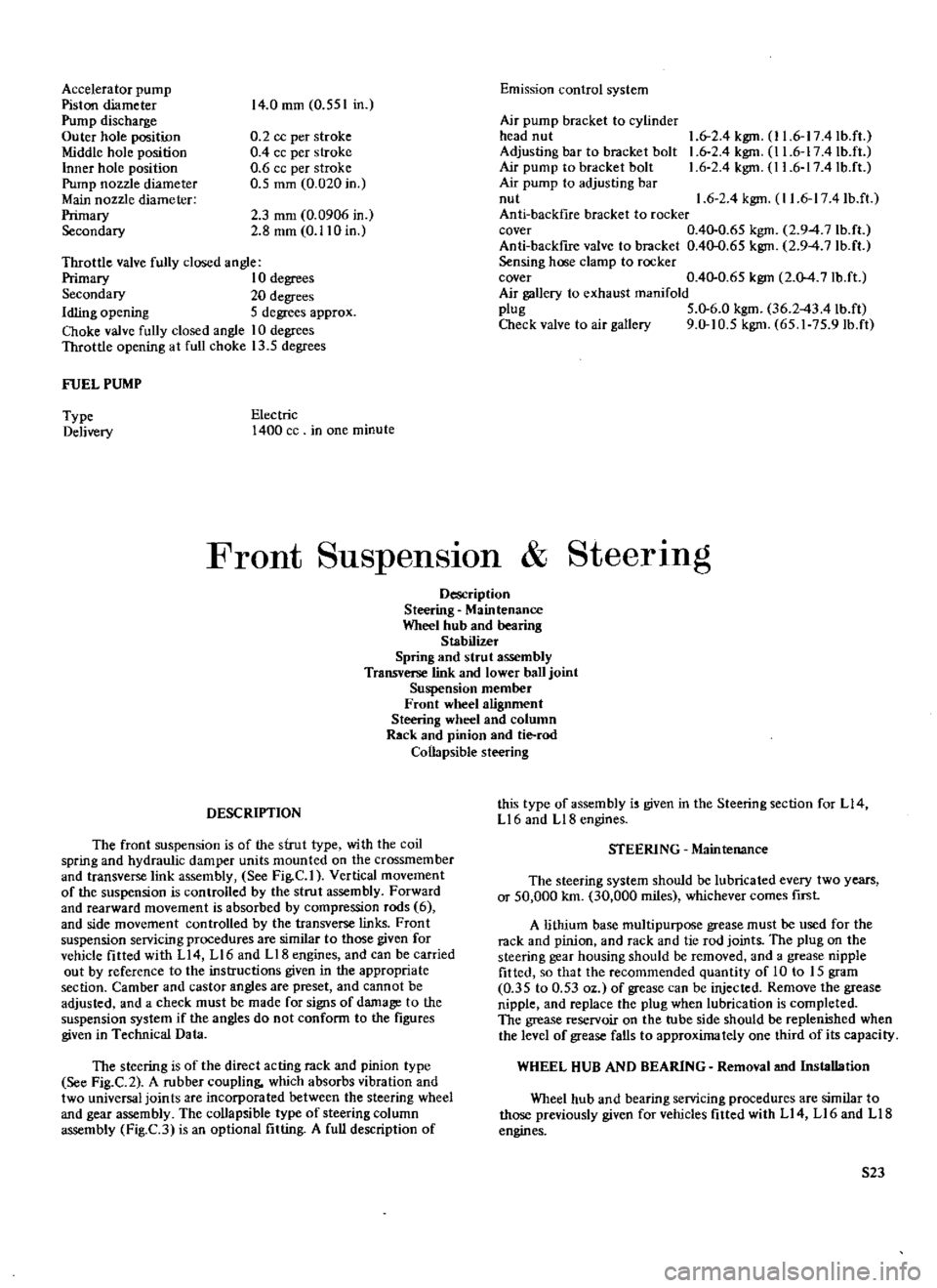
Accelerator
pump
Piston
diameter
Pump
discharge
Outer
hole
position
Middle
hole
position
Inner
hole
position
Pump
nozzle
diameter
Main
nozzle
diameter
Primary
Secondary
14
0
mm
0
551
in
0
2
cc
per
stroke
0
4
cc
per
stroke
0
6
cc
per
stroke
0
5
mm
0
020
in
2
3
mm
0
0906
in
2
8
mm
0
110
in
Throttle
valve
fully
closed
angle
Primary
10
degrees
Secondary
20
degrees
Idling
opening
5
degrees
approx
Choke
valve
fully
closed
angle
10
degrees
Throttle
opening
at
full
choke
13
5
degrees
FUEL
PUMP
Type
Delivery
Electric
1400
cc
in
one
minute
Emission
control
system
Air
pump
bracket
to
cylinder
head
nut
Adjusting
bar
to
bracket
bolt
Air
pump
to
bracket
bolt
Air
pump
to
adjusting
bar
nut
Anti
backfrre
bracket
to
rocker
cover
0
4Q
0
65
kgm
2
94
7
lb
ft
Anti
backfire
valve
to
bracket
0
4Q
O
65
kgm
2
94
7
lb
ft
Sensing
hose
clamp
to
rocker
cover
0
4Q
0
65
kgm
2
M
7
Ib
ft
Air
gallery
to
exhaust
manifold
plug
5
Q
6
0
kgm
36
243
4lb
ft
Check
valve
to
air
gallery
9
0
10
5
kgm
65
1
75
9Ib
ft
1
6
2
4
kgm
I
1
6
17
4Ib
ft
1
6
2
4
kgm
I
1
6
17
4Ib
ft
1
6
2
4
kgm
I
1
6
17
4
lb
ft
1
6
2
4
kgm
11
6
17
4Ib
ft
Front
SuspensIon
SteerIng
Description
Steering
Maintenance
Wheel
hub
and
bearing
Stabilizer
Spring
and
strut
assembly
Transverse
link
and
lower
ball
joint
Suspension
member
Front
wheel
alignment
Steering
wheel
and
column
Rack
and
pinion
and
tie
rod
Collapsible
steering
DESCRIPTION
The
front
suspension
is
of
the
strut
type
with
the
coil
spring
and
hydraulic
damper
units
mounted
on
the
crossmember
and
transverse
link
assembly
See
Fig
C
I
Vertical
movement
of
the
suspension
is
controlled
by
the
strut
assembly
Forward
and
rearward
movement
is
absorbed
by
compression
rods
6
and
side
movement
controlled
by
the
transverse
links
Front
suspension
servicing
procedures
are
similar
to
those
given
for
vehicle
fitted
with
L14
Ll6
and
LIB
engines
and
can
be
carried
out
by
reference
to
the
instructions
given
in
the
appropriate
section
Camber
and
castor
angles
are
preset
and
cannot
be
adjusted
and
a
check
must
be
made
for
signs
of
damage
to
the
suspension
system
if
the
angles
do
not
confonn
to
the
figures
given
in
Technical
Data
The
steering
is
of
the
direct
acting
rack
and
pinion
type
See
Fig
C
2
A
rubber
coupling
which
absorbs
vibration
and
two
universal
join
ts
are
incorpora
ted
between
the
steering
wheel
and
gear
assembly
The
collapsible
type
of
steering
column
assembly
Fig
C3
is
an
optional
fitting
A
full
description
of
this
type
of
assembly
i
given
in
the
Steering
section
for
L14
L16
and
L18
engines
STEERING
Maintenance
The
steering
system
should
be
lubricated
every
two
years
or
50
000
km
30
000
miles
whichever
comes
fIrst
A
lithium
base
multipurpose
grease
must
be
used
for
the
rack
and
pinion
and
rack
and
tie
rod
joints
The
plug
on
the
steering
gear
housing
should
be
removed
and
a
grease
nipple
fitted
so
that
the
recommended
quantity
of
10
to
15
gram
0
35
to
0
53
oz
of
grease
can
be
injected
Remove
the
grease
nipple
and
replace
the
plug
when
lubrication
is
completed
The
grease
reservoir
on
the
tube
side
should
be
replenished
when
the
level
of
grease
falls
to
approximately
one
third
ofits
capacity
WHEEL
HUB
AND
BEARING
Removal
and
Installation
Wheel
hub
and
bearing
servicing
procedures
are
similar
to
those
previously
given
for
vehicles
fitted
with
L14
LI6
and
LIB
engines
S23