transmission DATSUN 610 1969 User Guide
[x] Cancel search | Manufacturer: DATSUN, Model Year: 1969, Model line: 610, Model: DATSUN 610 1969Pages: 171, PDF Size: 10.63 MB
Page 108 of 171
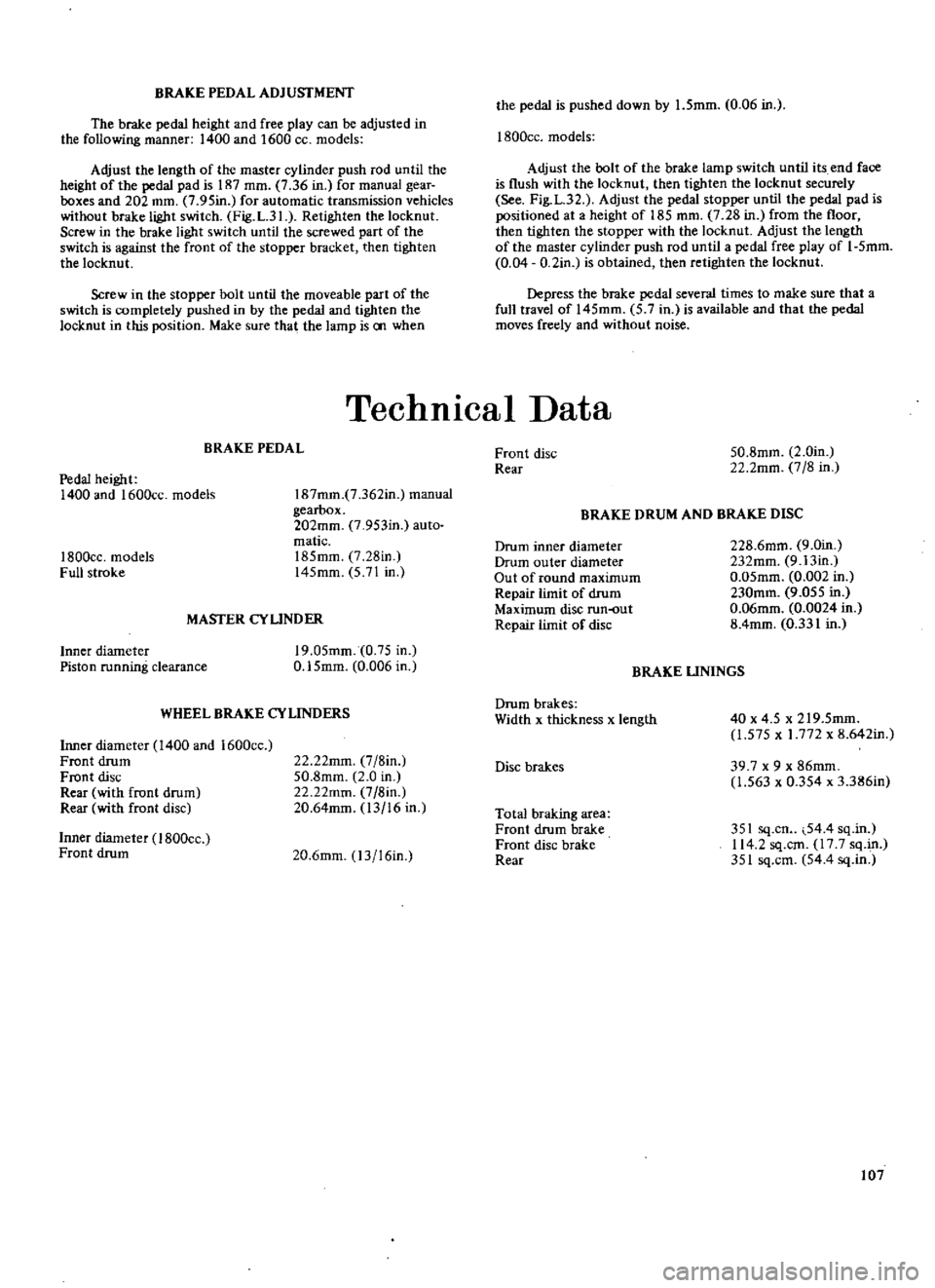
BRAKE
PEDAL
ADJUSTMENT
The
brake
pedal
height
and
free
play
can
be
adjusted
in
the
following
manner
1400
and
1600
CC
models
Adjust
the
length
of
the
master
cylinder
push
rod
until
the
height
of
the
pedal
pad
is
187
mm
7
36
in
for
manual
gear
boxes
and
202
mm
7
95in
for
automatic
transmission
vehicles
without
brake
light
switch
Fig
L
31
Retighten
the
locknut
Screw
in
the
brake
light
switch
until
the
screwed
part
of
the
switch
is
against
the
front
of
the
stopper
bracket
then
tighten
the
locknut
Screw
in
the
stopper
bolt
until
the
moveable
part
of
the
switch
is
completely
pushed
in
by
the
pedal
and
tighten
the
locknut
in
this
position
Make
sure
that
the
lamp
is
00
when
the
pedal
is
pushed
down
by
1
5mm
0
06
in
1800cc
models
Adjust
the
bolt
of
the
brake
lamp
switch
until
its
end
face
is
flush
with
the
locknut
then
tighten
the
locknut
securely
See
Fig
L
32
Adjust
the
pedal
stopper
until
the
pedal
pad
is
positioned
at
a
height
of
185
mrn
7
28
in
from
the
floor
then
tighten
the
stopper
with
the
locknut
Adjust
the
length
of
the
master
cylinder
push
rod
until
a
pedal
free
play
of
I
5mm
0
04
D
2in
is
obtained
then
retighten
the
locknut
Depress
the
brake
pedal
several
times
to
make
sure
that
a
full
travel
of
145mm
5
7
in
is
available
and
that
the
pedal
moves
freely
and
without
noise
Technical
Data
BRAKE
PEDAL
Pedal
height
1400
and
1600cc
models
I
87mm
7
362in
manual
gearbox
202mm
7
953in
auto
matic
185mm
7
28in
145mm
5
71
in
1800cc
models
Full
stroke
MASTER
CYUNDER
Inner
diameter
Piston
running
clearance
19
05mm
0
75
in
0
15mm
0
006
in
WHEEL
BRAKE
CYLINDERS
Inner
diameter
1400
and
1600cc
Front
drum
Front
disc
Rear
with
front
drum
Rear
with
front
disc
22
22mm
7
8in
50
8mm
2
0
in
22
22mm
7
8in
20
64mm
13
16
in
Inner
diameter
I
BOOcc
Front
drum
20
6mm
13
16in
Front
disc
Rear
50
8mm
2
0in
22
2mm
7
8
in
BRAKE
DRUM
AND
BRAKE
DISC
Drum
inner
diameter
Drum
outer
diameter
Out
of
round
maximum
Repair
limit
of
drum
Maximum
disc
run
out
Repair
limit
of
disc
228
6mm
9
0in
232mm
9
13in
0
05mm
0
002
in
230mm
9
055
in
0
06mm
0
0024
in
8
4mm
0
331
in
BRAKE
UNINGS
Drum
brakes
Width
x
thickness
x
length
40
x
4
5
x
219
5mm
1
575
x
1
772
x
8
642in
Disc
brakes
39
7
x
9
x
86mm
1
563
x
0
354
x
3
386in
Total
braking
area
Front
drum
brake
Front
disc
brake
Rear
351
sq
cn
54
4
sq
in
114
2
sq
cm
17
7
sq
in
351
sq
cm
54
4
sq
in
107
Page 134 of 171
GIS
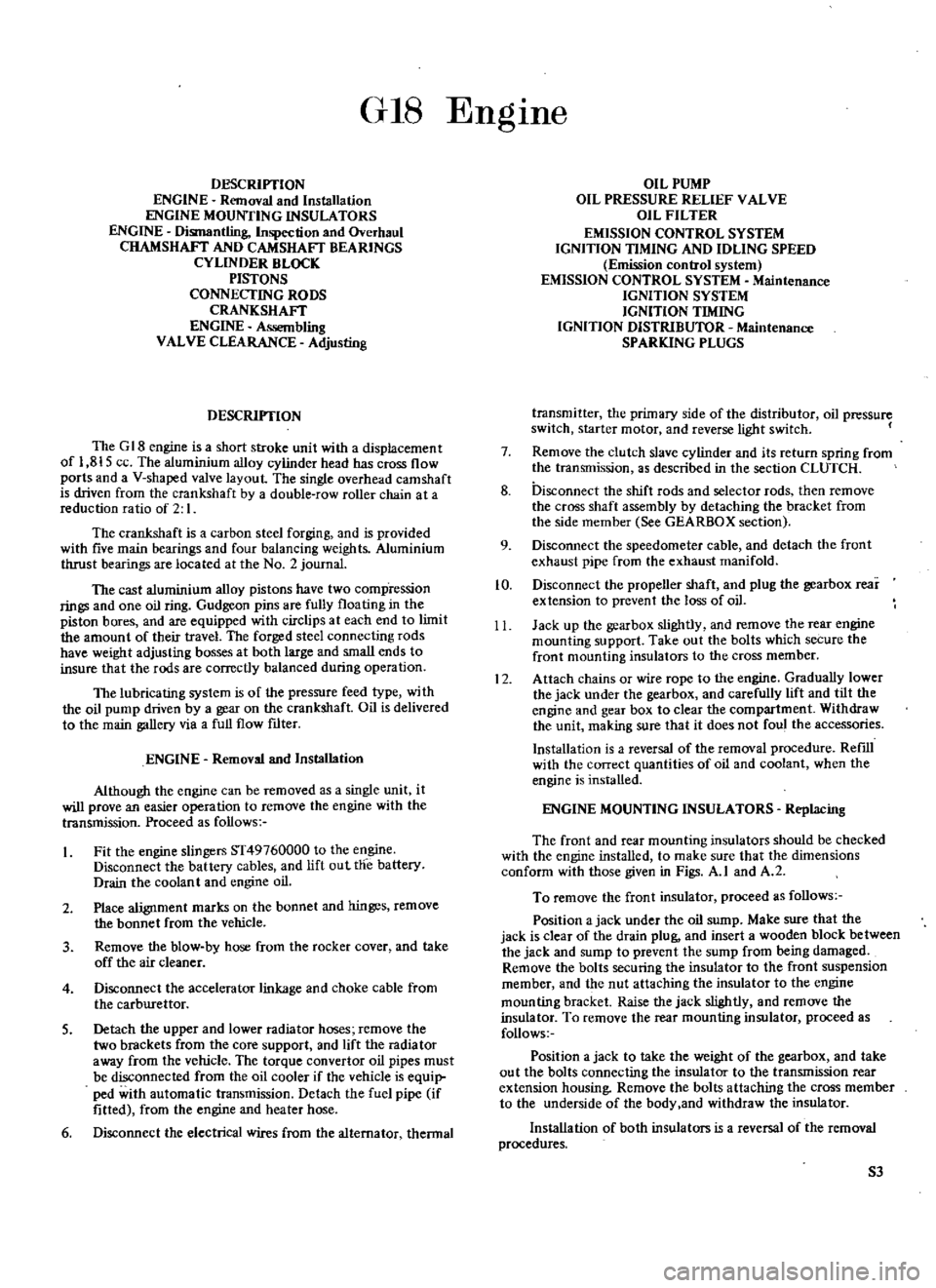
DESCRIYfION
ENGINE
Removal
and
Installation
ENGINE
MOUNTING
INSULATORS
ENGINE
Dismantling
Inspection
and
Overhaul
CHAMSHAFT
AND
CAMSHAFT
BEARINGS
CYLINDER
BLOCK
PISTONS
CONNECTING
RODS
CRANKSHAFT
ENGINE
Assembling
VALVE
CLEARANCE
Adjusting
DESCRIYfION
The
G
18
engine
is
a
short
stroke
unit
with
a
displacement
of
1
815
ce
The
aluminium
alloy
cylinder
head
has
cross
flow
ports
and
a
V
shaped
valve
layout
The
single
overhead
camshaft
is
driven
from
the
crankshaft
by
a
double
row
roller
chain
at
a
reduction
ratio
of
2
I
The
crankshaft
is
a
carbon
steel
forging
and
is
provided
with
five
main
bearings
and
four
balancing
weights
Aluminium
thrust
bearings
are
located
at
the
No
2
journal
The
cast
aluminium
alloy
pistons
have
two
comp
ression
rings
and
one
oil
ring
Gudgeon
pins
are
fully
floating
in
the
piston
bores
and
are
equipped
with
circlips
at
each
end
to
limit
the
amount
of
their
travel
The
forged
steel
connecting
rods
have
weight
adjusting
bosses
at
both
large
and
small
ends
to
insure
that
the
rods
are
correctly
balanced
during
operation
The
lubricating
system
is
of
the
pressure
feed
type
with
the
oil
pump
driven
by
a
gear
on
the
crankshaft
Oil
is
delivered
to
the
main
gallery
via
a
full
flow
ftlter
ENGINE
Removal
and
Installation
Although
the
engine
can
be
removed
as
a
single
unit
it
will
prove
an
easier
operation
to
remove
the
engine
with
the
transmission
Proceed
as
follows
Fit
the
engine
slingers
ST49760000
to
the
engine
Disconnect
the
battery
cables
and
lift
out
the
battery
Drain
the
coolant
and
engine
oil
2
Place
alignment
marks
on
the
bonnet
and
hinges
remove
the
bonnet
from
the
vehicle
3
Remove
the
blow
by
hose
from
the
rocker
cover
and
take
off
the
air
cleaner
4
Disconnect
the
accelerator
linkage
and
choke
cable
from
the
carburettor
S
Detach
the
upper
and
lower
radiator
hoses
remove
the
two
brackets
from
the
core
support
and
lift
the
radia
tor
away
from
the
vehicle
The
torque
convertor
oil
pipes
must
be
disconnected
from
the
oil
cooler
if
the
vehicle
is
equip
ped
with
automatic
transmission
Detach
the
fuel
pipe
if
fitted
from
the
engine
and
heater
hose
6
Disconnect
the
electrical
wires
from
the
alternator
thennal
EngIne
OIL
PUMP
OIL
PRESSURE
RELIEF
VALVE
OIL
FILTER
EMISSION
CONTROL
SYSTEM
IGNITION
TIMING
AND
IDLING
SPEED
Emission
control
system
EMISSION
CONTROL
SYSTEM
Maintenance
IGNITION
SYSTEM
IGNITION
TIMING
IGNITION
DISTRIBUTOR
Maintenance
SPARKING
PLUGS
transmitter
the
primary
side
of
the
distributor
oil
pressure
switch
starter
motor
and
reverse
light
switch
7
Remove
the
clutch
slave
cylinder
and
its
return
spring
from
the
transmission
as
described
in
the
section
CLUTCH
8
Disconnect
the
shift
rods
and
selector
rods
then
remove
the
cross
shaft
assembly
by
detaching
the
bracket
from
the
side
member
See
GEARBOX
section
9
Disconnect
the
speedometer
cable
and
detach
the
front
exhaust
pipe
from
the
exhaust
manifold
10
Disconnect
the
propeller
shaft
and
plug
the
gearbox
rear
extension
to
prevent
the
loss
of
oil
11
Jack
up
the
gearbox
slightly
and
remove
the
rear
engine
mounting
support
Take
out
the
bolts
which
secure
the
front
mounting
insulators
to
the
cross
member
12
Attach
chains
or
wire
rope
to
the
engine
Gradually
lower
the
jack
under
the
gearbox
and
carefully
lift
and
tilt
the
engine
and
gear
box
to
clear
the
compartment
Withdraw
the
unit
making
sure
that
it
does
not
foul
the
accessories
Installation
is
a
reversal
of
the
removal
procedure
RefIll
with
the
correct
quantities
of
oil
and
coolant
when
the
engine
is
installed
ENGINE
MOUNTING
INSULATORS
Replacing
The
front
and
rear
mounting
insulators
should
be
checked
with
the
engine
installed
to
make
sure
that
the
dimensions
conform
with
those
given
in
Figs
A
I
and
A
2
To
remove
the
front
insulator
proceed
as
follows
Position
a
jack
under
the
oil
sump
Make
sure
that
the
jack
is
clear
of
the
drain
plug
and
insert
a
wooden
block
between
the
jack
and
sump
to
prevent
the
sump
from
being
damaged
Remove
the
bolts
securing
the
insulator
to
the
front
suspension
member
and
the
nut
attaching
the
insulator
to
the
engine
mounting
bracket
Raise
the
jack
slightly
and
remove
the
insulator
To
remove
the
rear
mounting
insulator
proceed
as
follows
Position
a
jack
to
take
the
weight
of
the
gearbox
and
take
out
the
bolts
connecting
the
insulator
to
the
transmission
rear
extension
housing
Remove
the
bolts
attaching
the
cross
member
to
the
underside
of
the
body
and
withdraw
the
insulator
Installation
of
both
insulators
is
a
reversal
of
the
removal
procedures
S3
Page 136 of 171

ENGINE
Dismantling
Remove
the
engine
from
the
vehicle
as
previously
described
and
carefully
clean
the
exterior
surfaces
The
alternator
distribu
tor
and
starter
motor
should
be
removed
before
washing
Plug
the
carhurettor
air
horn
to
prevent
the
ingress
of
foreign
matter
Place
the
engine
and
transmission
on
the
engine
carrier
ST4797
0000
if
available
and
dismantle
as
follows
Remove
the
gearbox
from
the
engine
Disconnect
the
intake
manifold
water
hose
the
vacuum
hose
and
the
intake
manifold
to
oil
separator
hose
Remove
the
intake
manifold
with
the
carburettor
Fit
the
engine
attachment
ST3720OG18
to
the
cylin
der
block
and
place
tre
engine
on
the
stand
ST371
00000
Remove
the
clutch
@
Ssembly
as
described
in
the
section
CLUTCH
Remove
the
exhaust
manifold
and
heat
baffle
plate
Take
off
the
fan
blades
and
remove
the
water
pump
pulley
and
fan
belt
Remove
the
rocker
cover
hose
manifold
heat
hose
and
by
pass
hoses
Remove
the
generator
bracket
and
the
oil
fIlter
Extract
the
engine
breather
assembly
from
above
Note
that
the
breather
is
fitted
to
the
guide
and
is
installed
with
a
O
ring
which
is
pressed
into
the
cylinder
block
Flatten
the
10ckwasher
and
unscrew
the
crankshaft
pulley
nut
Withdraw
the
pulley
with
the
puller
ST44820000
if
available
but
do
not
hook
it
in
the
V
groove
of
the
pulley
Remove
the
rocker
cover
and
take
off
the
rubber
plug
located
on
the
front
of
the
cylinder
head
Straighten
the
lock
ing
washer
and
remove
the
bolt
securing
the
distributor
drive
gear
and
camshaft
sprocket
to
the
camshaft
Remove
the
drive
gear
and
take
off
the
sprocket
See
Fig
A
3
Remove
the
cylinder
head
bolts
in
reverse
order
to
the
tightening
sequence
sOOwn
in
Fig
A
18
and
lift
off
the
cylinder
head
as
an
assembly
See
Fig
A
4
Note
that
in
addition
to
the
ten
cylinder
head
bolts
there
are
also
two
bolts
securing
the
chain
cover
to
the
head
Invert
the
engine
and
remove
the
oil
sump
Remove
the
chain
cover
and
oil
flinger
Take
off
the
nut
securing
the
oil
pump
sprocket
and
withdraw
the
sprocket
with
the
chain
in
position
as
shown
in
Fig
A5
Remove
the
oil
pump
and
stramer
Note
that
two
of
the
pump
mounting
bolts
are
pipe
guides
Remove
the
timing
chain
crankshaft
sprocket
chain
ten
sioner
and
chain
stop
Remove
the
connecting
rod
caps
and
push
the
piston
and
connecting
rod
assemblies
through
the
tops
of
the
bores
Keep
all
parts
in
order
so
they
can
be
assembled
in
their
original
posi
tions
Take
out
the
flywheel
retaining
bolts
and
withdraw
the
flywheel
Remove
the
main
bearing
caps
but
take
care
not
to
damage
the
pipe
guides
Lift
out
the
crankshaft
and
main
bear
ings
noting
that
the
bearings
must
be
reassembled
in
their
original
positions
Remove
the
piston
rings
with
a
suitable
expander
and
take
off
the
gudgeon
pin
clips
The
piston
should
be
heated
to
a
temperature
of
50
to
600
122
to
1400F
before
extracting
the
gudgeon
pin
Keep
the
dismantled
parts
in
order
so
they
can
be
reassembled
in
their
original
positions
Remove
the
camshaft
rocker
ann
shaft
and
rocker
ann
assemblies
from
the
head
by
taking
off
the
cam
bracket
clamp
ing
nuts
It
is
advisable
to
insert
disused
bolts
in
the
No
1
and
No
5
bracket
holes
as
the
cam
bracket
will
fall
from
the
rocker
ann
shaft
when
it
is
removed
Remove
the
valve
cotters
using
the
special
tool
ST47450000
and
dismantle
the
valve
assemblies
Keep
the
parts
together
so
they
can
be
installed
in
their
original
order
ENGINE
Inspection
and
Overhaul
Cylinder
head
and
valves
Inspection
and
overhaul
procedures
can
be
carried
out
by
following
the
instructions
previously
given
for
the
L14
LI6
and
LIB
engines
noting
the
following
points
Measure
the
joint
face
of
the
cylinder
head
using
a
straight
edge
and
feeler
gauge
The
permissible
amount
of
distortion
is
0
03
mm
0
0012
in
or
less
The
surface
of
the
head
must
be
reground
if
the
maximum
limit
of
0
1
mm
0
0039
in
is
exceeded
Oean
each
valve
by
washing
in
petrol
then
carefully
examine
the
stems
and
heads
Discard
any
valves
with
worn
or
damaged
stems
Use
a
micrometer
to
check
the
diameter
of
the
stems
which
should
be
8
0
mm
0
315
in
for
both
intake
and
exhaust
valves
If
the
seating
face
of
the
valve
is
excessively
burned
damaged
or
distorted
the
valve
must
be
discarded
The
valve
seating
face
and
valve
tip
can
be
refaced
if
necessary
but
only
the
minimum
amount
of
metal
should
be
removed
Check
the
free
length
and
tension
of
each
valve
spring
and
compare
the
figures
obtained
with
those
given
in
Technical
Data
at
the
end
of
this
section
Use
a
square
to
check
the
springs
for
deformation
and
replace
any
spring
with
a
deflection
of
1
6
mm
0
0630
in
or
more
Valve
guides
Measure
the
clearance
between
the
valve
guide
and
valve
stern
The
stem
to
guide
clearance
should
be
0
025
0
055
mm
0
0010
0
0022
in
for
the
intake
valves
and
0
04
0
077
mm
0
0016
0
0030
in
for
the
exhaust
valves
The
maximum
clear
ance
limit
is
0
1
mm
0
0039
in
The
valve
guides
are
held
in
position
with
an
interference
fit
of
0
040
0
069
mm
0
0016
0
0027
in
and
can
be
removed
using
a
press
and
valve
guide
replacer
set
ST49730000
under
2
ton
pressure
This
operation
can
be
carried
out
at
room
temperature
but
will
be
more
effec
tively
performed
at
a
higher
temperature
Valve
guides
are
available
with
oversize
diameters
of
0
2
mm
0
0079
in
The
cylinder
head
guide
bore
must
be
reamed
out
at
normal
room
temperature
and
the
new
guides
pressed
in
after
heating
the
cylinder
head
to
a
temperature
of
approximately
800
C
1760F
The
standard
valve
guide
requires
a
bore
of
14
0
14
018
mm
0
551
0
552
in
and
the
oversize
valve
guide
a
bore
of
14
2
14
218
mm
0
559
0
560
in
Ream
out
the
bore
of
the
guides
to
obtain
the
desired
finish
and
clearance
Use
the
reamer
set
ST49710000
to
ream
the
bore
to
8
000
8
015
mm
0
3150
0
3156
in
The
valve
seat
surface
must
be
concentric
with
the
guide
bore
and
must
be
corrected
if
necessary
using
the
new
valve
guide
as
axis
Valve
seat
inserts
Check
the
valve
seat
inserts
for
signs
of
pitting
The
inserts
cannot
be
replaced
but
may
be
corrected
if
necessary
using
a
valve
seat
cutter
ST49720000
Scrape
the
seat
with
the
450
cutter
then
reduce
the
width
of
the
contacting
faces
using
the
150
and
600
cutters
for
the
intake
valve
inserts
and
150
cutter
for
the
exhaust
valve
inserts
Seat
correction
dimensions
are
shown
in
millimeters
in
Fig
A
6
Lap
each
valve
into
its
seat
after
correcting
the
seat
inserts
Place
a
small
quantity
of
fme
grinding
paste
on
the
seating
face
of
the
valve
and
lap
in
as
previously
described
for
the
Ll4
LI6
and
L
18
engines
S5
Page 144 of 171

carrying
out
extensive
tests
with
the
necessary
equipment
The
hoses
and
connectors
can
of
course
be
checked
for
signs
of
leakage
and
corrected
as
necessary
Also
the
tension
of
the
air
pump
belt
IGNITION
TIMING
AND
IDLING
SPEED
Emission
control
system
The
ignition
timing
should
be
set
and
the
idling
speed
mixture
adjusted
in
the
folloWing
manner
Run
the
engine
until
it
reaches
its
normal
operating
tem
perature
Connect
an
ignition
tachometer
and
timing
light
observ
ing
the
manufacturers
instructions
NOTE
If
the
vehicle
is
equipped
with
automatic
transmission
make
sure
that
the
dashpot
does
not
prevent
the
throttle
from
closing
Turn
the
throttle
shaft
arm
adjusting
screw
anti
clock
wise
so
that
the
tip
of
the
screw
is
clear
of
the
throttle
shaft
arm
see
Fig
A
26
Turn
the
throttle
adjusting
screw
to
set
the
idling
speed
to
700
r
p
m
650
rpm
for
automatic
transmission
Adjust
the
ignition
timing
to
5
A
T
D
C
Refererence
should
be
made
to
the
instructions
given
in
the
section
IGNITION
SYSTEM
for
the
L14
L16
and
LI8
engines
for
ignition
timing
details
Turn
the
idling
adjustment
screw
and
throttle
adjusting
screw
until
the
engine
runs
smoothly
a
t
the
correct
idling
speed
Turn
the
idling
adjustment
screw
clockwise
until
the
engine
speed
starts
to
drop
as
a
weaker
mix
ture
is
obtained
Now
turn
the
idling
adjustment
screw
anti
clockwise
by
one
turn
one
and
a
half
turns
for
automatic
transmission
to
obtain
a
richer
mix
ture
Adjust
the
idling
speed
to
700
rpm
650
rpm
for
automatic
transmission
by
turning
the
throttle
adjusting
screw
Make
sure
that
the
ignition
timing
remains
at
50
A
T
D
C
Turn
the
throttle
shaft
ann
adjusting
screw
clockwise
until
the
tip
of
the
screw
just
contacts
the
throttle
shaft
ann
The
screw
must
not
exert
pressure
on
the
throttle
shaft
arm
EMISSION
CONTROL
SYSTEM
Maintenance
The
system
should
be
inspected
and
serviced
every
I
2
months
or
20
000
km
12
000
miles
whichever
comes
fIrst
to
make
sure
that
the
exhaust
emissions
are
maintained
at
the
minimum
level
Check
the
carburettor
choke
setting
and
adjust
as
described
in
the
section
FUEL
SYSTEM
Check
the
carburettor
idling
speed
mixture
and
adjust
if
necessary
as
described
under
the
heading
IGNITION
TIMING
AND
IDLING
SPEED
in
this
section
2
Check
the
distributor
earn
dwell
angle
and
also
the
condi
tion
of
the
contact
breaker
points
Check
the
ignition
timing
and
adjust
if
necessary
The
distributor
dwell
angle
should
be
adjusted
to
49
55
degrees
and
the
points
gap
to
0
45
0
55
mm
0
0177
0
0217
in
3
Remove
and
clean
the
sparking
plugs
Renew
any
plug
with
badly
worn
electrodes
Set
the
plug
gaps
to
0
80
0
90
mm
0
0315
0
0355
in
by
adjusting
the
earth
electrode
IGNITION
SYSTEM
The
maintenance
and
servicing
procedures
for
the
compo
nents
of
the
ignition
system
on
vehicles
fitted
with
the
GIS
engine
are
basically
similar
to
the
instructions
previously
given
for
the
Ll4
LI6
and
LIS
engines
The
distributor
is
however
of
a
different
type
Either
an
Hitachi
0416
57
distributor
being
fitted
or
an
Hitachi
0423
53
if
the
vehicle
is
equipped
with
an
emission
control
system
The
distributors
have
different
advance
curve
characteristics
as
shown
in
Technical
Data
IGNITION
TIMING
Check
the
ignition
timing
with
a
timing
light
as
previously
described
for
the
LI4
L16
and
L
8
engines
Disconnect
the
distributor
vacuum
line
and
run
engine
at
idling
speed
or
slightly
below
The
timing
should
be
set
at
8
BTDCj600
rpm
for
the
D416
57
distributor
or
at
5
ATDCj600
rpm
for
the
D423
53
distributor
fItted
to
engines
with
emission
control
systems
IGNITION
DISTRIBUTOR
Maintenance
Maintenance
instructions
are
similar
to
those
given
for
the
L14
LI6
and
L18
engines
Set
the
contact
breaker
points
gap
to
0
45
0
55
mm
0
0177
0
0217
in
as
previously
described
SPARKING
PLUGS
The
sparking
plugs
should
be
inspected
and
cleaned
at
regular
intervals
and
renewed
at
approximately
20
000
kIn
12
000
miles
Clean
the
plugs
thoroughly
and
make
sure
they
are
of
the
same
type
and
heat
range
File
the
centre
electrode
nat
before
adjusting
the
gap
Set
the
gap
to
0
8
0
9mm
0
031
0
035
in
if
the
engine
is
fItted
with
emission
control
system
or
to
0
7
0
8
mm
0
028
0
031
in
if
emission
control
is
not
fitted
Adjustment
must
always
be
made
by
bending
the
earth
electrode
TechnIcal
Data
GENERAL
SPECIFICATION
GI8
Engine
Cylinders
Bore
and
stroke
Displacemen
t
Valve
arrangemen
t
Firing
order
Engine
idler
speed
Compression
ratio
Oil
pressure
at
3000
r
p
m
4
in
line
85x80
mm
3
346x3
150
in
1
815
cc
110
8
cu
in
OHC
134
2
600
r
p
m
STD
8
3
I
4
7
to
5
5
kgjsq
cm
66
8
to
78
2
Ibjsq
in
LIQUID
PACKING
APPLICATION
Cylinder
block
2
Cylinder
head
Oil
gallery
blind
plug
Expansion
plug
Gas
breather
guide
Rear
bearing
cap
fitting
surface
Rear
bearing
cap
side
seal
both
ends
Expansion
plug
Rubber
plug
Rea
Manifold
heat
pipe
3
Chain
cover
gasket
both
sides
S13
Page 160 of 171
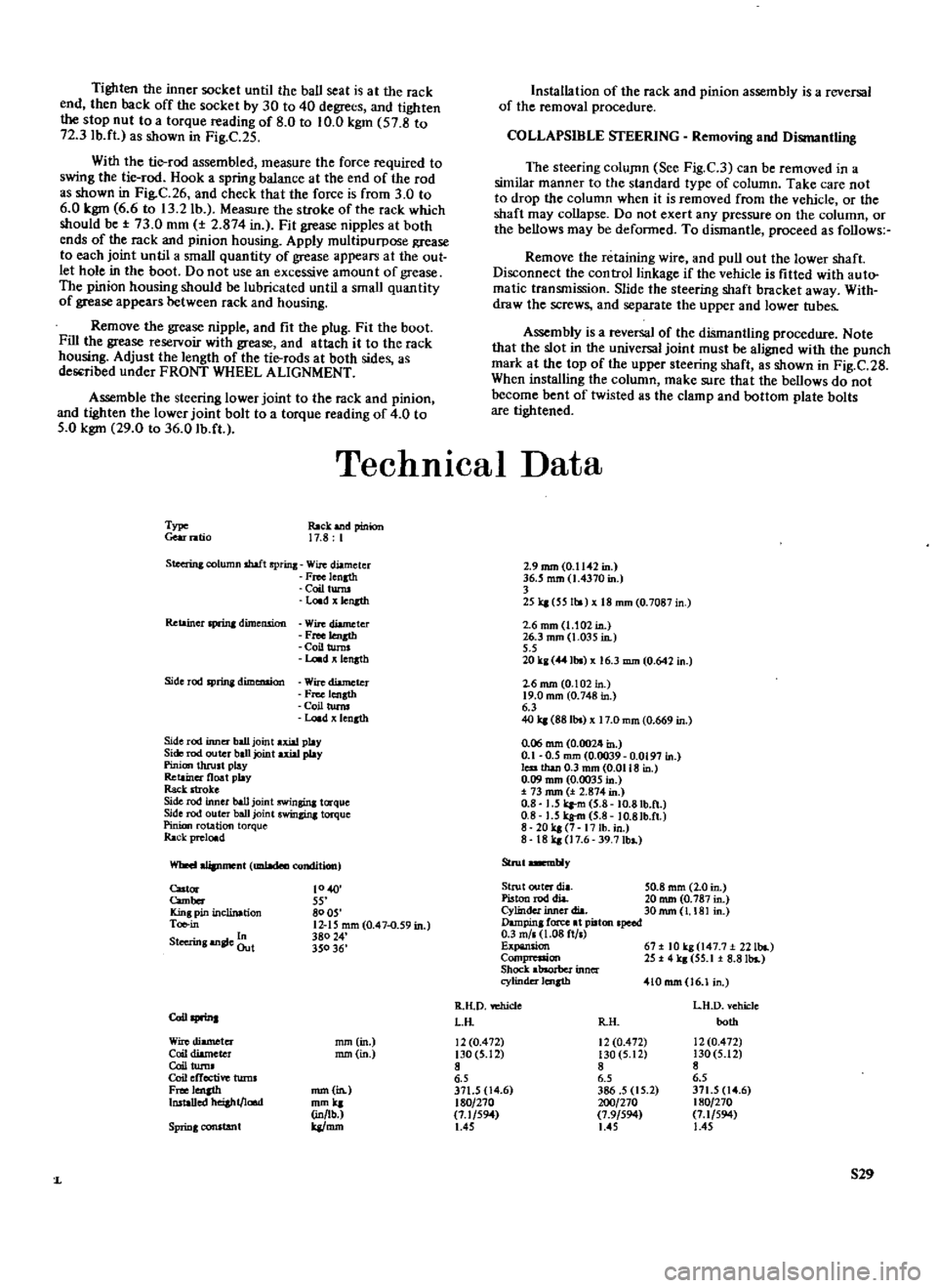
Tighten
the
inner
socket
until
the
ball
seat
is
at
the
rack
end
then
back
off
the
socket
by
30
to
40
degrees
and
tighten
the
stop
nut
to
a
torque
reading
of
8
0
to
10
0
kgm
57
8
to
72
3
Ib
ft
as
shown
in
Fig
C
25
With
the
tie
rod
assembled
measure
the
force
required
to
swing
the
tie
rod
Hook
a
spring
balance
at
the
end
of
the
rod
as
shown
in
Fig
C
26
and
check
that
the
force
is
from
3
0
to
6
0
kgm
6
6
to
13
2
lb
Measure
the
stroke
of
the
rack
which
should
be
73
0
mm
2
874
in
Fit
grease
nipples
at
both
ends
of
the
rack
and
pinion
housing
Apply
multipurpose
ase
to
each
joint
until
a
small
quantity
of
grease
appears
at
the
out
let
hole
in
the
boot
Do
not
use
an
excessive
amount
of
grease
The
pinion
housing
should
be
lubricated
until
a
small
quantity
of
grease
appears
between
rack
and
housing
Remove
the
grease
nipple
and
fit
the
plug
Fit
the
boot
Fill
the
grease
reseIVoir
with
grease
and
attach
it
to
the
rack
housing
Adjust
the
length
of
the
tie
rods
at
both
sides
as
des
ribed
under
FRONT
WHEEL
ALIGNMENT
Assemble
the
steering
lower
joint
to
the
rack
and
pinion
and
tighten
the
lower
joint
bolt
to
a
torque
reading
of
4
0
to
5
0
kgm
29
0
to
36
0
Ib
ft
Installation
of
the
rack
and
pinion
assembly
is
a
reversal
of
the
removal
procedure
COLLAPSIBLE
STEERING
Removi
8
and
Dismantti
8
The
steering
coluJllfl
See
Fig
C
3
can
be
removed
in
a
similar
manner
to
the
standard
type
of
column
Take
care
not
to
drop
the
column
when
it
is
removed
from
the
vehicle
or
the
shaft
may
collapse
Do
not
exert
any
pressure
on
the
column
or
the
bellows
may
be
defonned
To
dismantle
proceed
as
follows
Remove
the
retaining
wire
and
pull
out
the
lower
shaft
Disconnect
the
control
linkage
if
the
vehicle
is
fitted
with
auto
matic
transmission
Slide
the
steering
shaft
bracket
away
With
draw
the
screws
and
separate
the
upper
and
lower
tubes
Assembly
is
a
reversal
of
the
dismantling
procedure
Note
that
the
slot
in
the
universal
joint
must
be
aligned
with
the
punch
mark
at
the
top
of
the
upper
steering
shaft
as
shown
in
Fig
C
28
When
installing
the
column
make
sure
that
the
bellows
do
not
become
bent
of
twisted
as
the
clamp
and
bottom
plate
bolts
are
tightened
TechnICal
Data
TYP
Gear
I1ltio
Rack
and
pinion
17
8
I
Steerin
column
shaft
spring
Wire
diameter
Freelenath
CoiltW
llJ
Load
length
Retainer
sprinJ
dimension
Wire
diameter
F
CoilturnJ
l
oadxlensth
Side
rod
SPrina
dimeruion
Wire
diameter
Fn
elenath
Coil
turns
Load
x
lensth
Side
rod
inner
ball
joint
ax
ia
I
play
Side
rod
outer
ball
joint
uiaJ
play
Pinion
thrultplay
Retainer
float
play
Rack
moke
Side
rod
inner
ball
joint
swinsinl
torque
Side
rod
uter
ball
joint
swingina
torque
Pinion
oration
torque
Rack
pre1
d
Wheel
alipment
1IIl1a
a
ondition
Cut
c
m
Kinl
pin
inclination
Toe
in
S
In
teerinlan
eOut
10
40
8005
12
15
mm
0
47
0
59
in
38024
35036
2
9
mm
0
11
2
in
36
5
mm
1
4370
in
3
25q
551
18mm
0
7087
2
6
mm
1
102in
26
3
mm
1
035
in
5
5
20
kl
lbs
16
3
mm
0
642
in
26
mm
0
102
in
19
0
mm
0
748
in
6
3
40
q
88Ibs
17
0
mm
0
669
in
0
06
mm
0
002
m
0
1
0
5
mm
0
0039
0
0197
in
less
than
0
3
mm
0
0118
in
0
09
mm
0
0035
in
73
mm
t
2
87
in
0
8
1
5
q
m
5
8
10
8Ib
n
0
8
J
S
kg
m
5
8
JO
8Ib
ft
8
20q
7
17
lb
in
8
18
q
l7
6
39
7Ibs
Strut
DlelDbly
Strut
outer
Ilia
50
8
mm
2
0
in
Piston
rod
di
a
20
mm
0
787
in
Cylinder
inner
dia
30mm
I
181
in
Dampinl
force
at
pistonlpeed
0
3
m
I
1
08
ft
I
Expansion
67
IOq
I47
7
221bs
Compression
25
4kl
55
1
8
81bs
Shock
absorber
inner
cylinderlcngth
IOmm
16
1
in
R
IlD
vchicle
LH
D
ehide
CoiIsprina
LIi
IlIi
OOIh
Wire
diameter
mm
in
12
0
472
12
0
472
12
0
472
Coil
diameter
mm
in
130
5
12
130
5
12
130
5
12
Coil
Ium
S
Coil
effective
turnl
6
5
6
5
6
5
Free
lenJth
mm
in
371
5
14
6
386
5
15
2
371
5
14
6
Installed
hei
ht
load
mmq
180
270
200
270
180
270
in
lb
7
1
594
7
9
594
7
1
594
SpriDgCOfl
ltant
ka
mm
1
45
US
1
45
529
1
Page 170 of 171
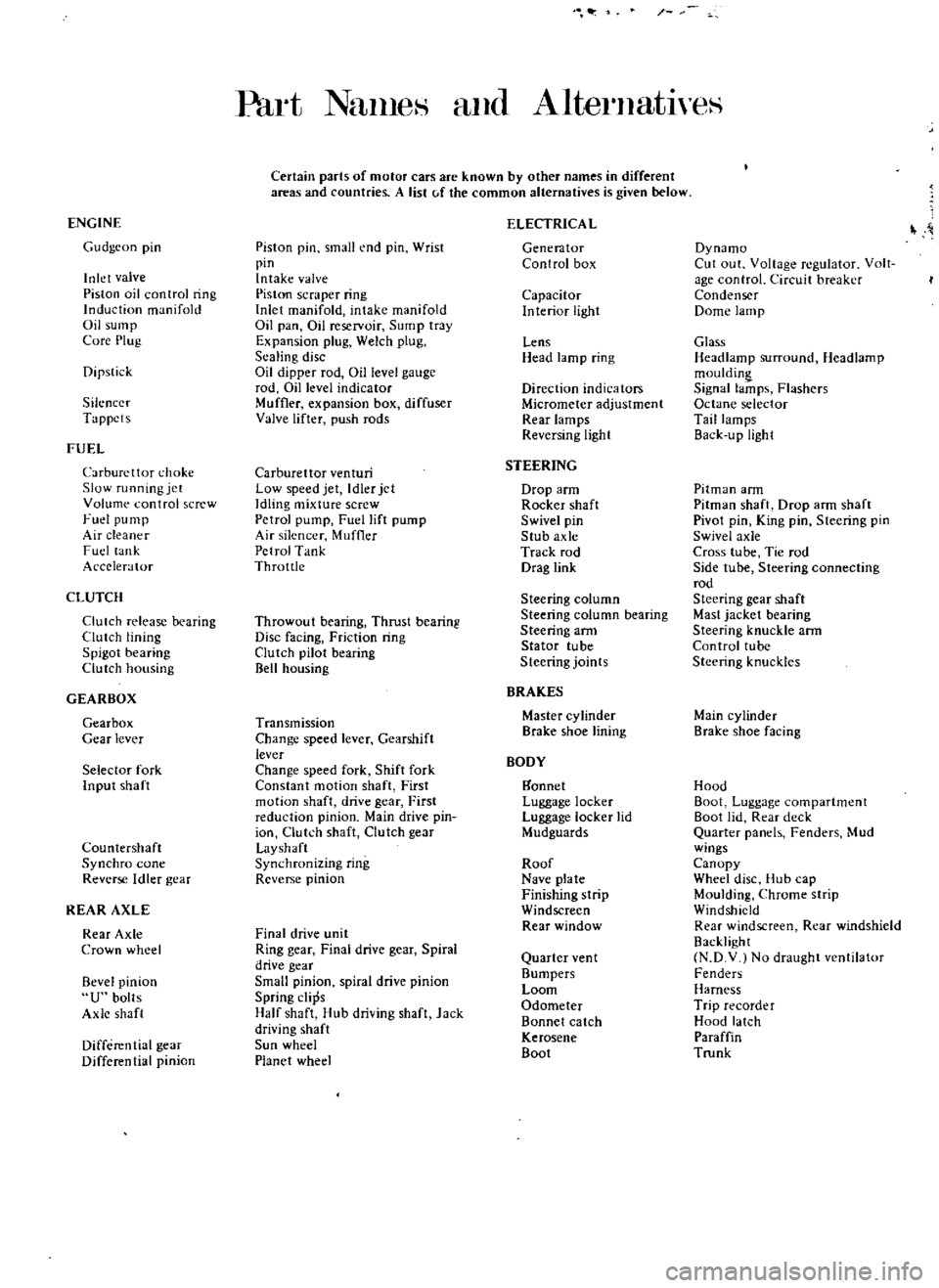
Part
NanleH
and
AlternatlyeS
Certain
parts
of
motor
cars
are
known
by
other
names
in
different
areas
and
countries
A
list
c
f
the
common
alternatives
is
given
below
ENGINE
ELECTRICA
L
Gudgeon
pin
Piston
pin
small
end
pin
Wrist
Generator
Dynamo
pin
Control
box
Cut
out
Voltage
regulator
Volt
Inlet
valve
Intake
valve
age
control
Circuit
breaker
Piston
oil
control
ring
Piston
scraper
ring
Capacitor
Condenser
Induction
manifold
Inlet
manifold
intake
manifold
Interior
light
Dome
lamp
Oil
sump
Oil
pan
Oil
reservoir
Sump
tray
Core
Plug
Expansion
plug
Welch
plug
Lens
Glass
Sealing
disc
Head
lamp
ring
Headlamp
surround
Headlamp
Dipstick
Oil
dipper
rod
Oil
level
gauge
mouldin
rod
Dillevel
indicator
Direction
indicators
Signal
lamps
Flashers
Silencer
Muffler
expansion
box
diffuser
Micrometer
adjustment
Octane
selector
Tappets
Valve
lifter
push
rods
Rear
lamps
Tail
lamps
Reversing
light
Back
u
pUgh
t
FUEL
Carburettor
choke
Carburettor
venturi
STEERING
Slow
running
jet
Low
speed
jet
Idler
jet
Drop
arm
Pitman
ann
Volume
control
screw
Idling
mixture
screw
Rocker
shaft
Pitman
shaft
Drop
ann
shaft
Fuel
pump
Petrol
pump
Fuel
lift
pump
Swivel
pin
Pivot
pin
King
pin
Steering
pin
Air
cleaner
Air
silencer
Muffler
Stub
axle
Swivel
axle
Fuel
lank
Petrol
Tank
Track
rod
Cross
tube
Tie
rod
Accelerator
Throttle
Drag
link
Side
tube
Steering
connecting
rod
CLUTCH
Steering
column
Steering
gear
shaft
Clutch
release
bearing
Throwout
bearing
Thrust
bearing
Steering
column
bearing
Mast
jacket
bearing
Clutch
lining
Disc
facing
Friction
ring
Steering
arm
Steering
knuckle
ann
Spigot
bearing
Clutch
pilot
bearing
Stator
tube
Control
tube
Clutch
housing
Bell
housing
Steering
joints
Steering
knuckles
GEARBOX
BRAKES
Gearbox
Transmission
Master
cylinder
Main
cylinder
Gear
lever
Change
speed
lever
Gearshift
Brake
shoe
lining
Brake
shoe
facing
lever
BODY
Selector
fork
Change
speed
fork
Shift
fork
Input
shaft
Constant
motion
shaft
First
gannet
Hood
motion
shaft
drive
gear
First
Luggage
locker
Boot
Luggage
compartment
reduction
pinion
Main
drive
pin
Luggage
locker
lid
Boot
lid
Rear
deck
ion
Clutch
shaft
Clutch
gear
Mudguards
Quarter
panels
Fenders
Mud
Countershaft
Layshaft
wings
Synchro
cone
Synchronizing
ring
Roof
Canopy
Reverse
Idler
gear
Reverse
pinion
Nave
plate
Wheel
disc
Hub
cap
Finishing
strip
Moulding
Chrome
strip
REAR
AXLE
Windscreen
Windshield
Rear
Axle
Final
drive
unit
Rear
window
Rear
windscreen
Rear
windshield
Crown
wheel
Ring
gear
Final
drive
gear
Spiral
Backlight
drive
gear
Quarter
ven
t
N
D
V
No
draught
ventilator
Bevel
pinion
Small
pinion
spiral
drive
pinion
Bumpers
Fenders
Loom
Harness
U
bolts
Spring
clips
Odometer
Trip
recorder
Axle
shaft
Half
shaft
Hub
driving
shaft
Jack
Bonnet
catch
Hood
latch
driving
shaft
Kerosene
Paraffin
Differential
gear
Sun
wheel
Boot
Trunk
Differential
pinion
Planet
wheel