lock DATSUN B110 1969 Service Owner's Manual
[x] Cancel search | Manufacturer: DATSUN, Model Year: 1969, Model line: B110, Model: DATSUN B110 1969Pages: 136, PDF Size: 5.64 MB
Page 71 of 136
Brakes
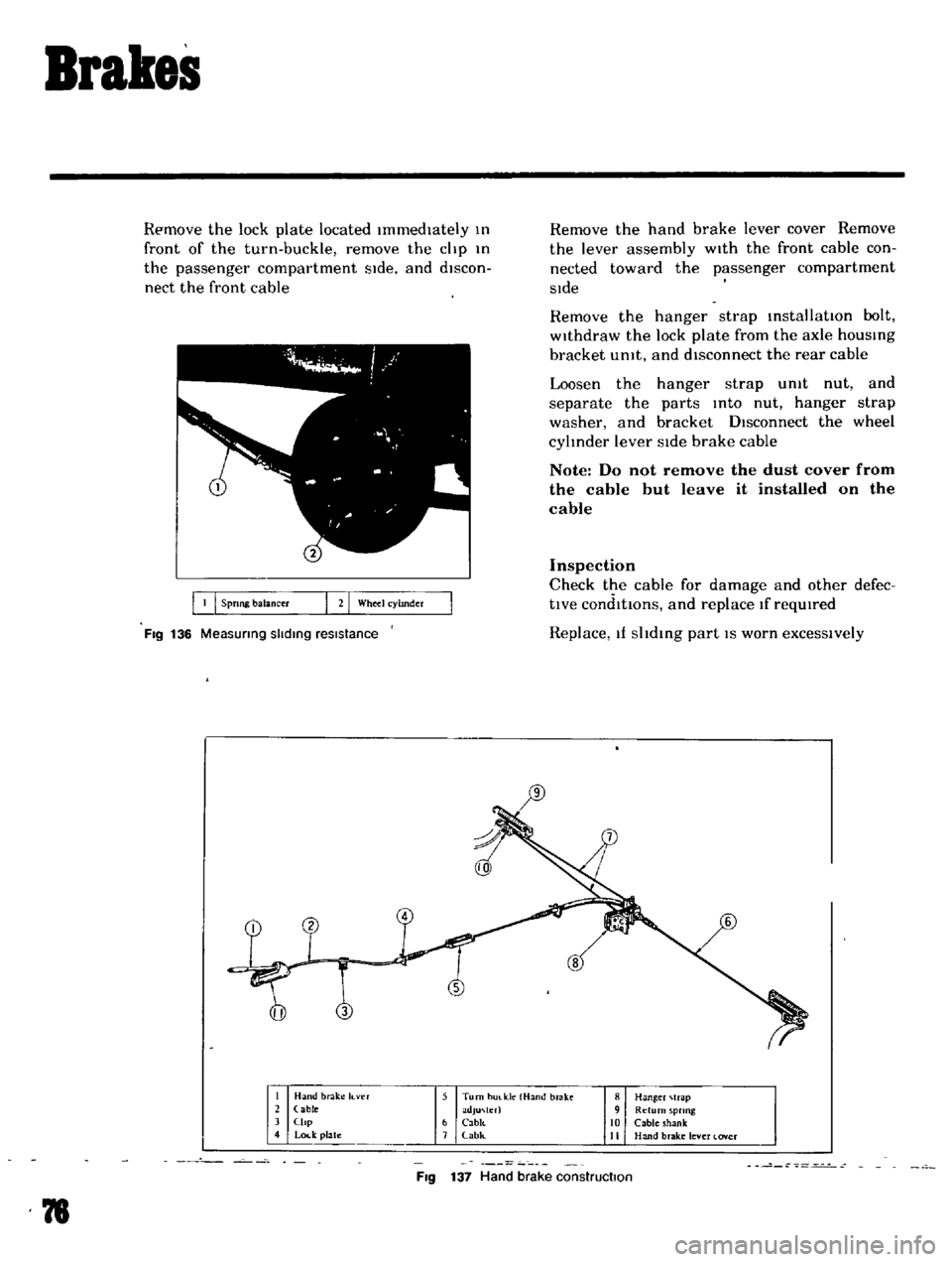
Remove
the
lock
plate
located
Immediately
III
front
of
the
turn
buckle
remove
the
clip
III
the
passenger
compartment
SIde
and
discon
nect
the
front
cable
I
Spong
balancer
G
Wheel
cyhnder
FIg
136
Measunng
slidIng
resistance
Remove
the
hand
brake
lever
cover
Remove
the
lever
assembly
wIth
the
front
cable
con
nected
toward
the
passenger
compartment
SIde
Remove
the
hanger
strap
installatIOn
bolt
withdraw
the
lock
plate
from
the
axle
hOUSIng
bracket
umt
and
disconnect
the
rear
cable
Loosen
the
hanger
strap
umt
nut
and
separate
the
parts
Into
nut
hanger
strap
washer
and
bracket
DIsconnect
the
wheel
cylinder
lever
SIde
brake
cable
Note
Do
not
remove
the
dust
cover
from
the
cable
but
leave
it
installed
on
the
cable
Inspection
Check
the
cable
for
damage
and
other
defec
tlve
condlttons
and
replace
If
reqUIred
Replace
If
shdIng
part
IS
worn
excessively
1
Hand
brake
It
ver
2
able
J
Clip
4
Lock
plate
5
Turn
hUlkle
Hand
brake
adJU
h
r
6
CabJc
7
abk
8
Han
er
trap
9
Return
sprmg
10
Cable
shank
II
Hand
brake
lever
lover
FIg
137
Hand
brake
construction
78
Page 72 of 136
Brakes
Make
sure
that
the
hand
brake
lever
can
be
operated
smoothly
and
that
the
ratchet
pawl
and
teeth
are
not
worn
unusually
or
damaged
With
the
hand
brake
lever
pulled
depress
the
push
button
and
make
sure
that
the
pawl
disengages
the
teeth
when
the
push
button
IS
depressed
0
1969
to
0
2362
In
completely
Make
sure
that
the
cable
dust
cover
1S
not
damaged
or
warped
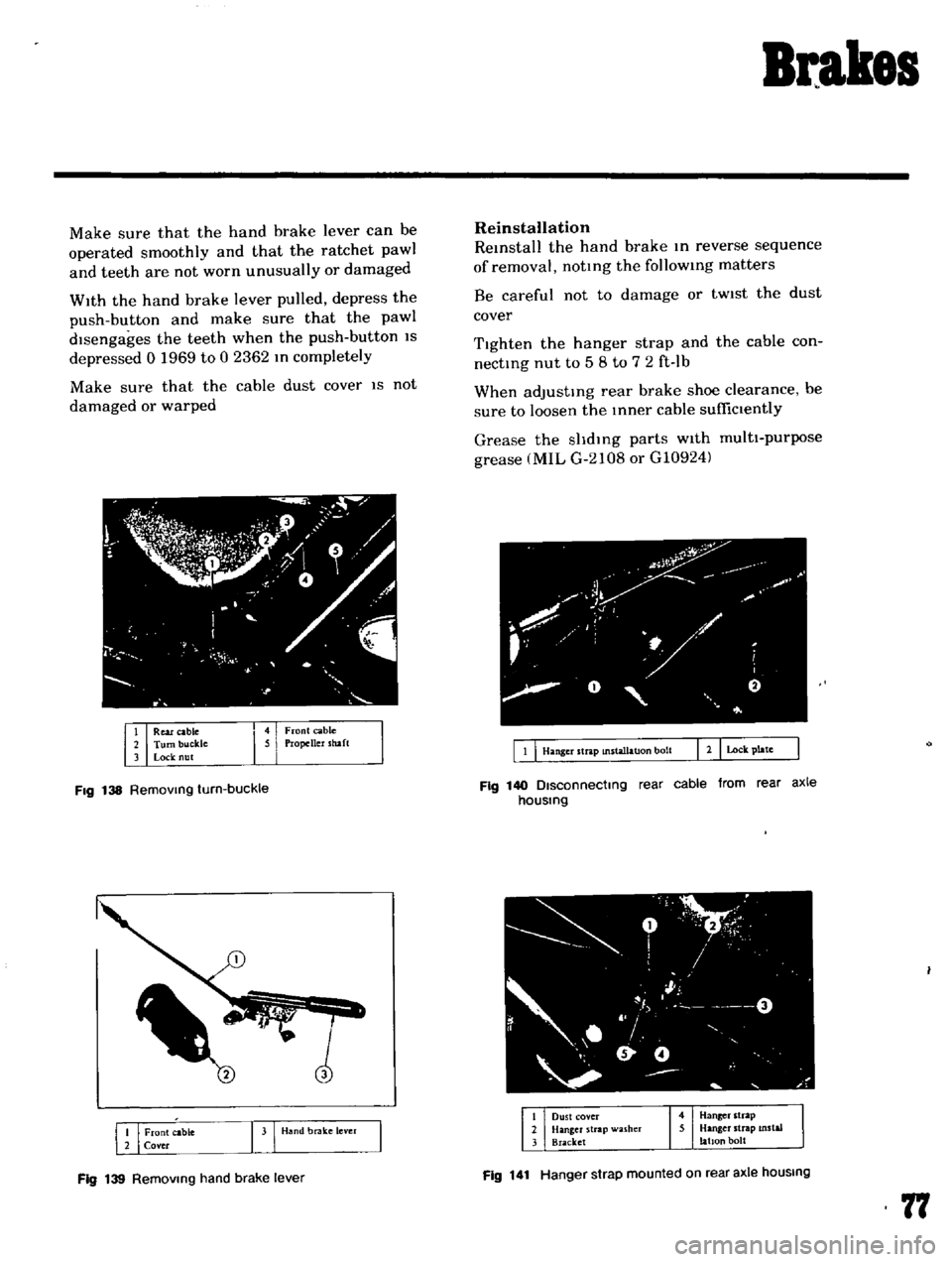
FIg
138
Removing
turn
buckle
I
Front
cabl
2
Cover
CI
H
nd
brok
1
Ye
Fig
139
Removing
hand
brake
lever
Reinstallation
Remstall
the
hand
brake
m
reverse
sequence
of
removal
notmg
the
folloWIng
matters
Be
careful
not
to
damage
or
tW1St
the
dust
cover
TIghten
the
hanger
strap
and
the
cable
con
nectmg
nut
to
5
8
to
7
2
ft
lb
When
adJustmg
rear
brake
shoe
clearance
be
sure
to
loosen
the
mner
cable
sufficIently
Grease
the
shdmg
parts
w1th
multI
purpose
grease
MIL
G
2108
or
G10924l
o
Lock
plate
Fig
140
Disconnecting
rear
cable
from
rear
axle
housing
i
O
j
0
I
J
i
Ii
0
j
0
0
V
I
Dust
cover
Hanger
strap
washer
Bracket
I
Fig
141
Hanger
strap
mounted
on
rear
axle
hOUSing
77
Page 73 of 136
Brakes
ADJUSTMENT
Front
Disc
Brake
Ordinarily
adJu
tment
IS
not
requIred
because
clearance
between
pad
and
rotor
IS
adjusted
automattcally
by
elasttclty
of
the
pIston
seal
I
iJ
1
el
i
C
1
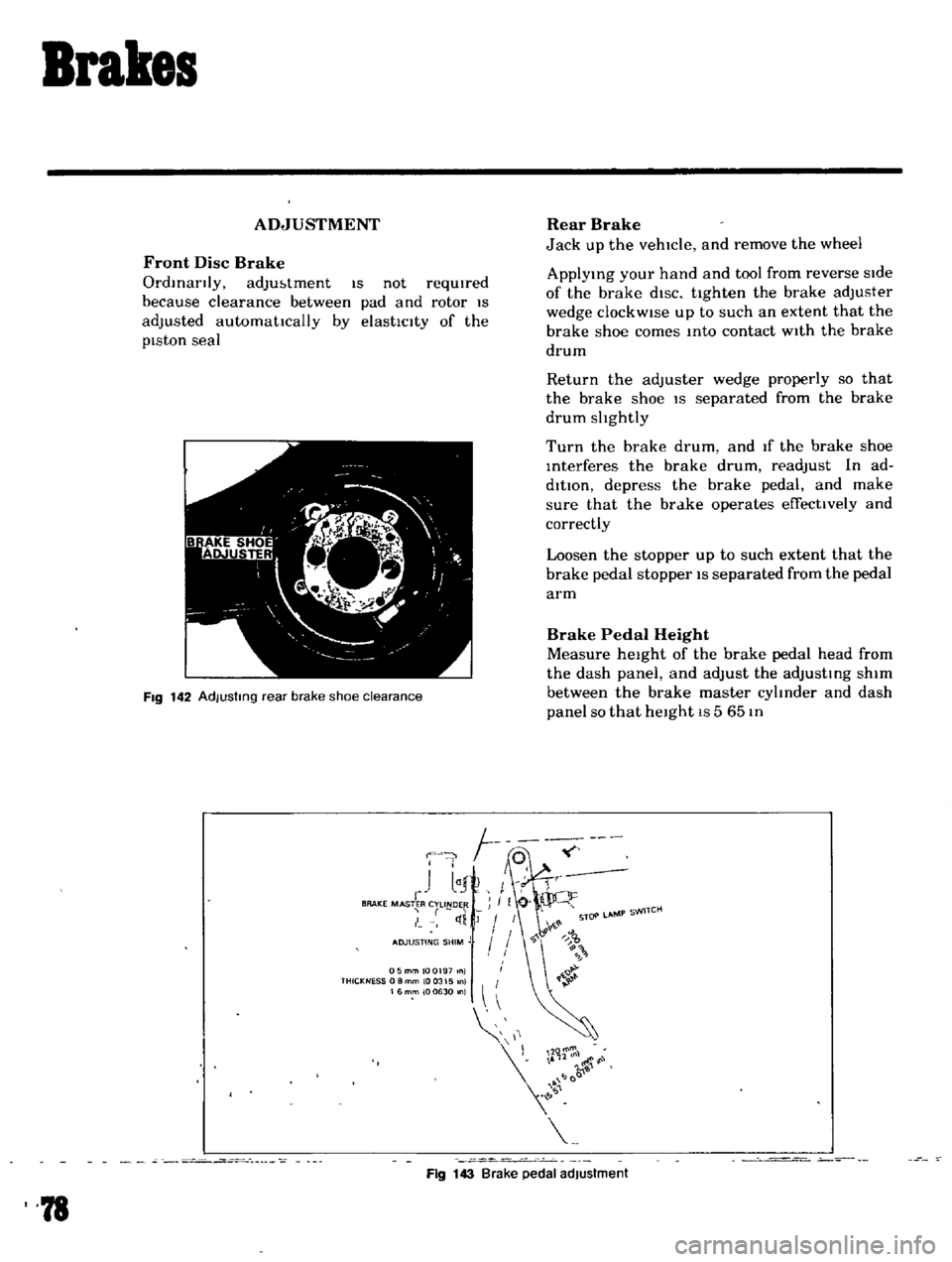
FIg
142
AdJustmg
rear
brake
shoe
clearance
F
J
I
1
I
r
BRAKE
MASTER
CYLINDER
I
tI
Rear
Brake
Jack
up
the
vehicle
and
remove
the
wheel
ApplYing
your
hand
and
tool
from
reverse
side
of
the
brake
diSC
ttghten
the
brake
adjuster
wedge
clockWise
up
to
such
an
extent
that
the
brake
shoe
comes
Into
contact
With
the
brake
drum
Return
the
adjuster
wedge
properly
so
that
the
brake
shoe
IS
separated
from
the
brake
drum
slIghtly
Turn
the
brake
drum
and
If
the
brake
shoe
Interferes
the
brake
drum
readjust
In
ad
dition
depress
the
brake
pedal
and
make
sure
that
the
brake
operates
effecttvely
and
correctly
Loosen
the
stopper
up
to
such
extent
that
the
brake
pedal
stopper
IS
separated
from
the
pedal
arm
Brake
Pedal
Height
Measure
height
of
the
brake
pedal
head
from
the
dash
panel
and
adjust
the
adjusting
shim
between
the
brake
master
cylInder
and
dash
panel
so
that
height
IS
5
65
In
05mmlOQ197
nl
THICKNESS
0
8
mm
10
0315
0
16mm
100630
n
11
r
l00
Fig
143
Brake
pedal
adjustment
78
Page 74 of 136
Brakes
Adjusting
shIm
thickness
for
selectIOn
o
0197
In
00315
In
o
0630
In
Note
When
adjusting
be
sure
to
use
ad
Jusbng
sh1ms
having
same
th1ckness
for
upper
and
lower
brake
master
cylinder
IOstallahon
bolts
Upon
completIOn
of
adjusting
shIm
adjust
ment
tighten
the
stopper
down
to
such
an
ex
tent
that
heIght
of
the
pedal
head
IS
5
57
pO
0787
In
and
tighten
the
lock
nut
becurely
Free
travel
of
the
brake
pedal
IS
0
197
to
0591
tn
and
the
stroke
IS
4
72
In
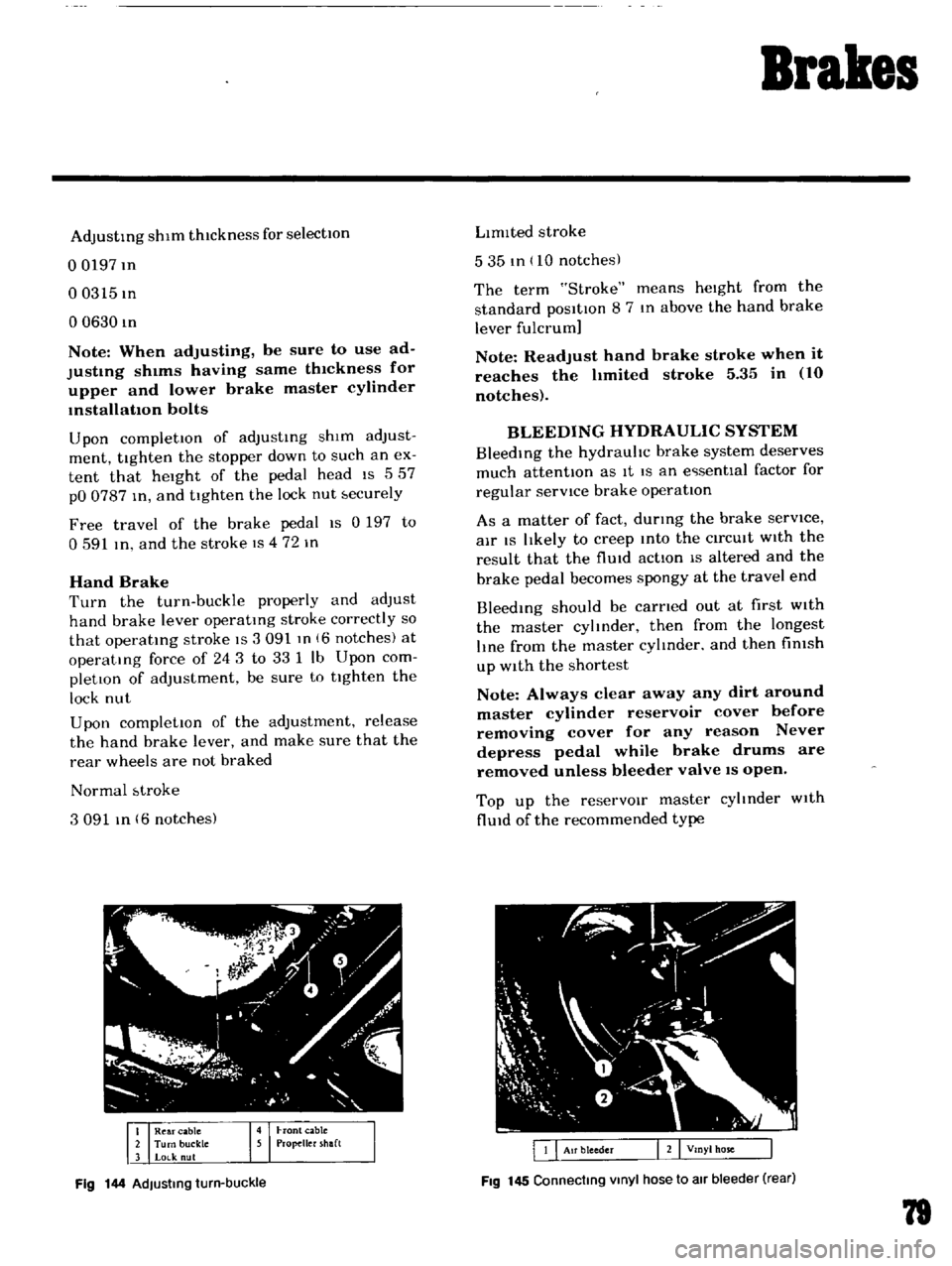
Hand
Brake
Turn
the
turn
buckle
properly
and
adjust
hand
brake
lever
operatmg
stroke
correctly
so
that
operatmg
stroke
IS
3
091
m
16
notches
at
operatIng
force
of
243
to
331
Ib
Upon
com
pletIOn
of
adjustment
be
sure
to
tIghten
the
lock
nut
Upon
completIOn
of
the
adjustment
release
the
hand
brake
lever
and
make
sure
that
the
rear
wheels
are
not
braked
Normal
btroke
3091
In
6
notches
Fig
144
AdJusting
turn
buckle
LImIted
stroke
535
tn
10
notches
The
term
Stroke
means
heIght
from
the
standard
posItIon
8
7
In
above
the
hand
brake
lever
fulcrum
Note
Readjust
hand
brake
stroke
when
it
reaches
the
hmited
stroke
5
35
in
10
notches
BLEEDING
HYDRAULIC
SYSTEM
BleedIng
the
hydrauhc
brake
system
deserves
much
attentIOn
as
It
IS
an
e
senttal
factor
for
regular
servICe
brake
operatIon
As
a
matter
of
fact
durmg
the
brake
serVice
air
IS
lIkely
to
creep
Into
the
CirCUIt
WIth
the
result
that
the
flUId
actIon
IS
altered
and
the
brake
pedal
becomes
spongy
at
the
travel
end
Bleedmg
should
be
carned
out
at
first
WIth
the
master
cylmder
then
from
the
longest
lIne
from
the
master
cylmder
and
then
fimsh
up
With
the
shortest
Note
Always
clear
away
any
dirt
around
master
cylinder
reservoir
cover
before
removing
cover
for
any
reason
Never
depress
pedal
while
brake
drums
are
removed
unless
bleeder
valve
IS
open
Top
up
the
reservOIr
master
cyltnder
With
flUId
of
the
recommended
type
Fig
145
Connecting
Vinyl
hose
to
air
bleeder
rear
79
Page 85 of 136
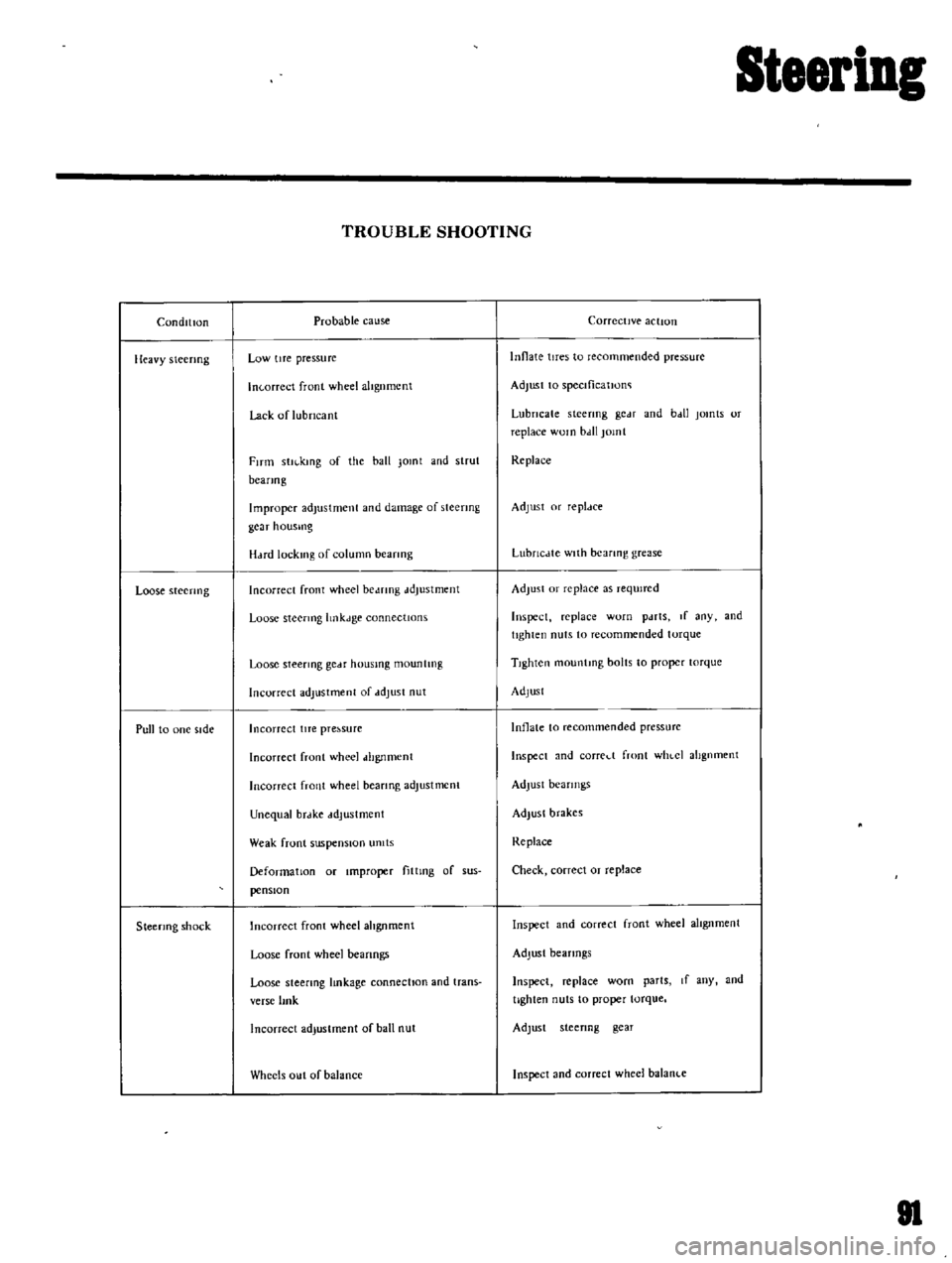
SteeriDg
ConditIon
lIeavy
steering
Loose
steenng
Pull
to
one
side
Steermg
shock
TROUBLE
SHOOTING
Probable
cause
Low
tIre
pressure
In
orreet
front
wheel
altgnmcnt
Lack
of
lubricant
FITm
stll
kmg
of
the
ball
Jomt
and
strut
beanog
Improper
adjustment
and
damage
of
steering
gcar
housmg
H
Hd
lock1l1g
of
column
beanng
Incorrect
front
wheel
be
mng
ddJustment
Loose
steermg
hnkJge
connectIOns
Loose
steermg
gCdf
housmg
mountIng
Incorrect
adjustment
of
ddJust
nut
Incorrect
lITe
pre
sure
Incorrect
front
wheel
dhgnment
Incorrect
front
wheel
beanng
adjustment
Unequal
brdke
ddJustment
Weak
front
suspensIOn
umts
Deformation
or
Improper
fittmg
of
sus
pensIOn
Incorrect
front
wheel
ahgnment
Loose
front
wheel
beanngs
Loose
steering
lmkage
connectIOn
and
trans
verse
lmk
Incorrect
adjustment
of
ball
nut
Wheels
out
of
balance
Corrective
action
Innate
tires
to
recommended
pressure
Adjust
to
speclficatJono
Lubricate
steering
gc
H
and
b
dl
jomts
or
replace
WOln
bdll
jomt
Replace
Adjust
or
repldce
LubrlcJte
with
bearing
grease
Adjust
or
replace
as
reqUired
Inspect
replace
worn
pdrts
If
any
and
tighten
nuts
to
recommended
torque
TIghten
mountmg
bolts
to
proper
torque
Adjust
Inflate
to
recommended
pressurc
Inspect
and
corred
front
WhlCI
alignment
Adjust
bearings
Adjust
brakes
Replace
Check
correct
or
replace
Inspect
and
correct
front
wheel
alIgnment
Adjust
bearings
Inspect
replace
worn
parts
If
any
and
tighten
nuts
to
proper
torque
Adjust
steenng
gear
Inspect
and
correct
wheel
balanl
e
81
Page 91 of 136
Clutch
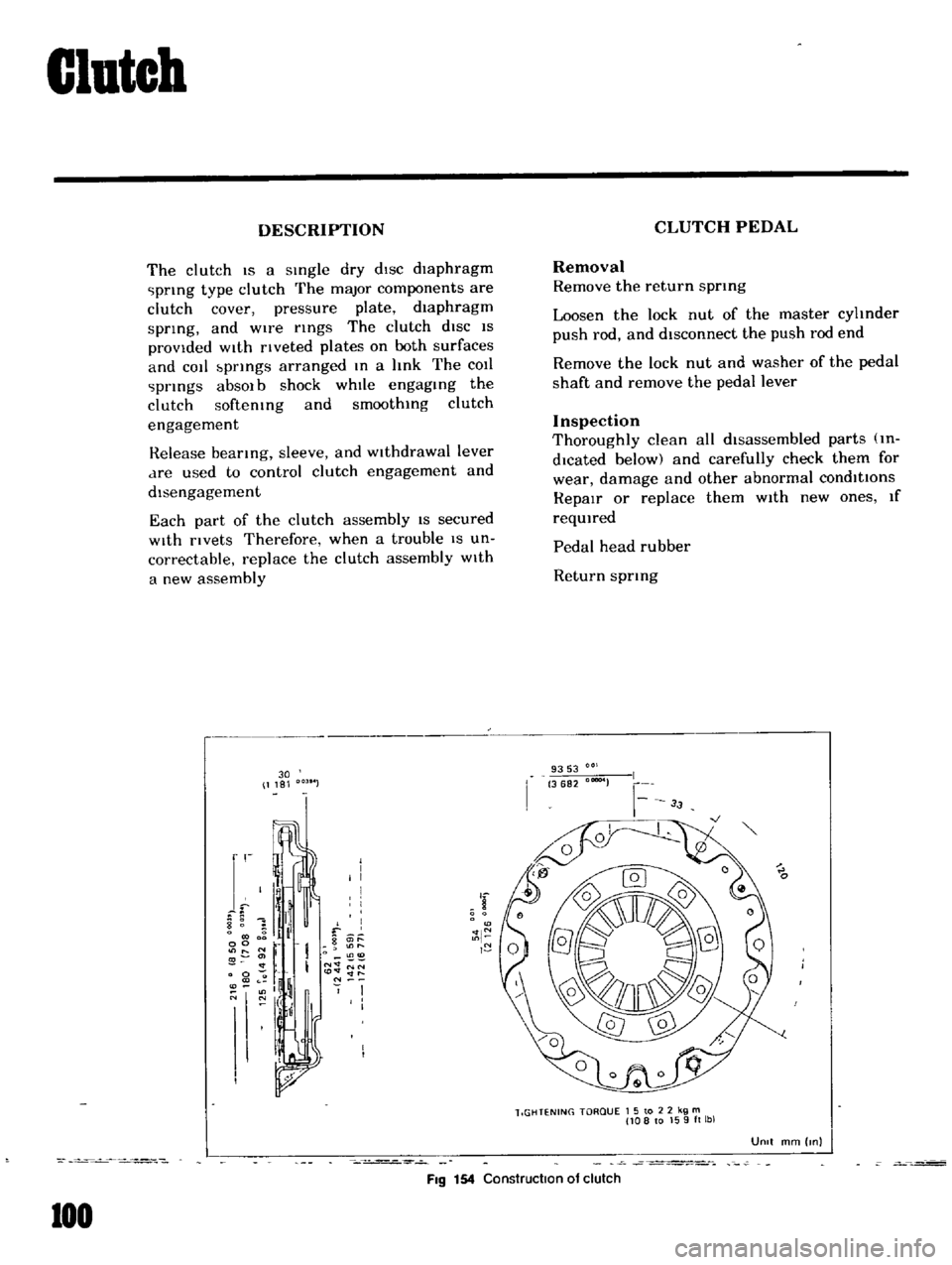
DESCRIPTION
The
clutch
IS
a
sIngle
dry
dIsc
diaphragm
prIng
type
clutch
The
major
components
are
clutch
cover
pressure
plate
diaphragm
sprIng
and
wire
rIngs
The
clutch
diSC
IS
provided
WIth
rIveted
plates
on
both
surfaces
and
cot
bprIngs
arranged
In
a
hnk
The
COIl
prIngs
absOl
b
shock
whIle
engagIng
the
clutch
softemng
and
smoothIng
clutch
engagement
Release
bearIng
sleeve
and
WIthdrawal
lever
dre
used
to
control
clutch
engagement
and
disengagement
Each
part
of
the
clutch
assembly
IS
secured
With
rivets
Therefore
when
a
trouble
IS
un
correctable
replace
the
clutch
assembly
With
a
new
assembly
30
1181
r
I
I
I
I
I
8
1
il
f
0
g
it
l
00
r
O
11
I
N
NN
0
to
lt
lt
ll
l
If
N
O
N
I
I
I
I
FIg
154
Construction
of
clutch
100
CLUTCH
PEDAL
Removal
Remove
the
return
sprmg
Loosen
the
lock
nut
of
the
master
cyhnder
push
rod
and
disconnect
the
push
rod
end
Remove
the
lock
nut
and
washer
of
the
pedal
shaft
and
remove
the
pedal
lever
Inspection
Thoroughly
clean
all
disassembled
parts
m
dlcated
below
and
carefully
check
them
for
wear
damage
and
other
abnormal
conditions
RepaIr
or
replace
them
With
new
ones
If
reqUIred
Pedal
head
rubber
Return
sprIng
9353
3682
00004
lIGHTENING
TORQUE
1
5
to
2
2
kg
m
108
to
159ft
lbl
UOIt
mm
Inl
Page 93 of 136
Clutch
Pedal
lever
bush
Fulcrum
pedal
pIn
etc
Remstallation
Reinstall
the
clutch
pedal
In
reverse
sequence
of
removal
Adjustment
Adjust
pedal
pad
heIght
to
565
In
Without
stopper
The
adjustment
IS
made
by
selectmg
and
applYIng
shlm
s
haVing
adequate
thIckness
Be
Ule
to
use
shIms
haVIng
same
thIckness
for
both
upper
and
lower
Next
adjust
the
pedal
stopper
properly
so
that
the
pedal
pad
height
IS
557
In
and
secure
the
pOSitIOn
WIth
lock
nut
Note
Make
sure
that
chaSSIS
grease
has
been
applied
to
the
CG
marked
portions
two
places
Grease
if
reqUired
CLUTCH
MASTER
CYLINDER
Removal
DIsconnect
the
push
rod
from
the
cleVIS
DIsconnect
the
clutch
lIne
from
the
master
cylinder
and
draIn
flUid
Remove
the
ecunng
bolts
and
remove
the
master
cyhnder
assembly
from
the
vehIcle
DIsassembly
Remove
the
filler
cap
and
draIn
flUId
Pull
back
the
dust
cover
and
remove
the
snap
rIng
The
stopper
push
rod
pIston
assembly
pnmary
cup
and
return
sptlng
assembly
can
be
removed
Inspection
Thoroughly
clean
all
parts
With
brake
flUId
before
InspectIOn
Check
the
cyhnder
and
piston
for
uneven
wear
or
damage
Replace
If
required
When
clearance
between
the
cylinder
and
pIston
IS
more
than
O
0059
In
replace
the
cyhnder
102
Replace
the
pIston
cup
pnmanly
whenever
the
master
cyhnder
IS
dIsassembled
It
must
also
be
replaced
when
wear
or
deformatIOn
due
to
fatIgue
or
damage
IS
found
Check
the
dust
cover
OIl
reservOIr
filler
cap
and
clutch
lIne
for
damage
or
deformatIOn
If
abnormal
condItIOn
IS
found
replace
With
new
one
Reassembly
Reassemble
the
master
cylInder
assembly
In
reverse
sequence
of
dIsassembly
notIng
the
follOWIng
matters
The
pIston
cup
should
be
soaked
In
brake
flUId
before
reassembly
Install
the
pIston
cup
carefully
so
that
It
IS
correctly
faced
Apply
brake
flUId
suffiCIently
to
the
cyhnder
and
pIston
and
assemble
them
Reinstallation
ReInstall
the
master
cyhnder
assembly
In
reverse
sequence
of
removal
and
adjust
as
follows
Adjust
the
pedal
heIght
by
changmg
the
push
rod
length
Bleed
air
out
of
the
hydrauhc
system
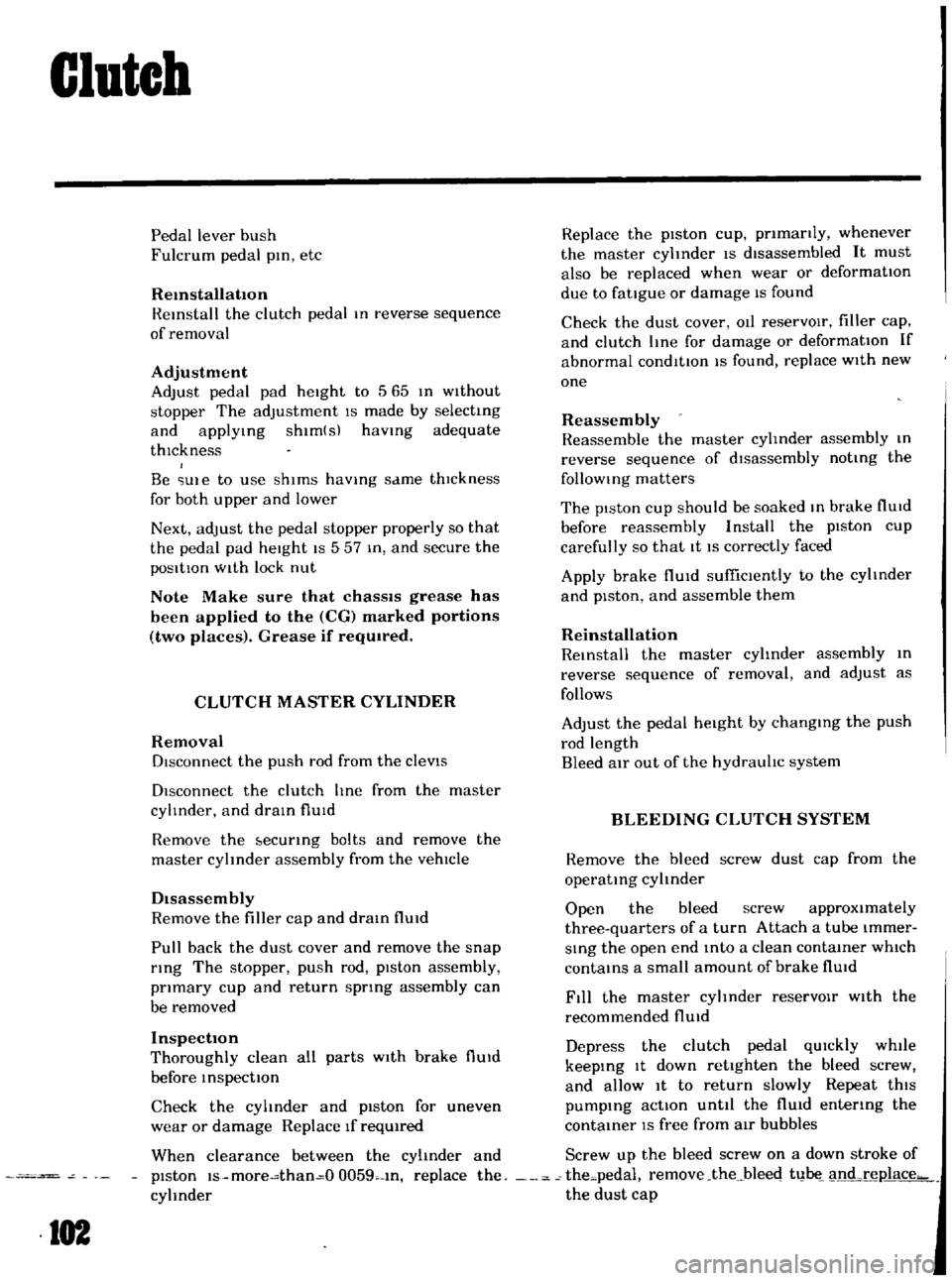
BLEEDING
CLUTCH
SYSTEM
Remove
the
bleed
screw
dust
cap
from
the
operatIng
cyhnder
Open
the
bleed
screw
approximately
three
quarters
of
a
turn
Attach
a
tube
Immer
SIng
the
open
end
mto
a
clean
contaIner
which
contaInS
a
small
amount
of
brake
flUId
Fill
the
master
cyhnder
reservOIr
With
the
recommended
flUId
Depress
the
clutch
pedal
qUIckly
while
keepIng
It
down
retighten
the
bleed
screw
and
allow
It
to
return
slowly
Repeat
thiS
pumpIng
actIOn
unttl
the
flUId
entenng
the
contaIner
IS
free
from
air
bubbles
Screw
up
the
bleed
screw
on
a
down
stroke
of
the
pedal
remove
the
bleec
t1
1
nd
rel1lace
the
dust
cap
Page 97 of 136
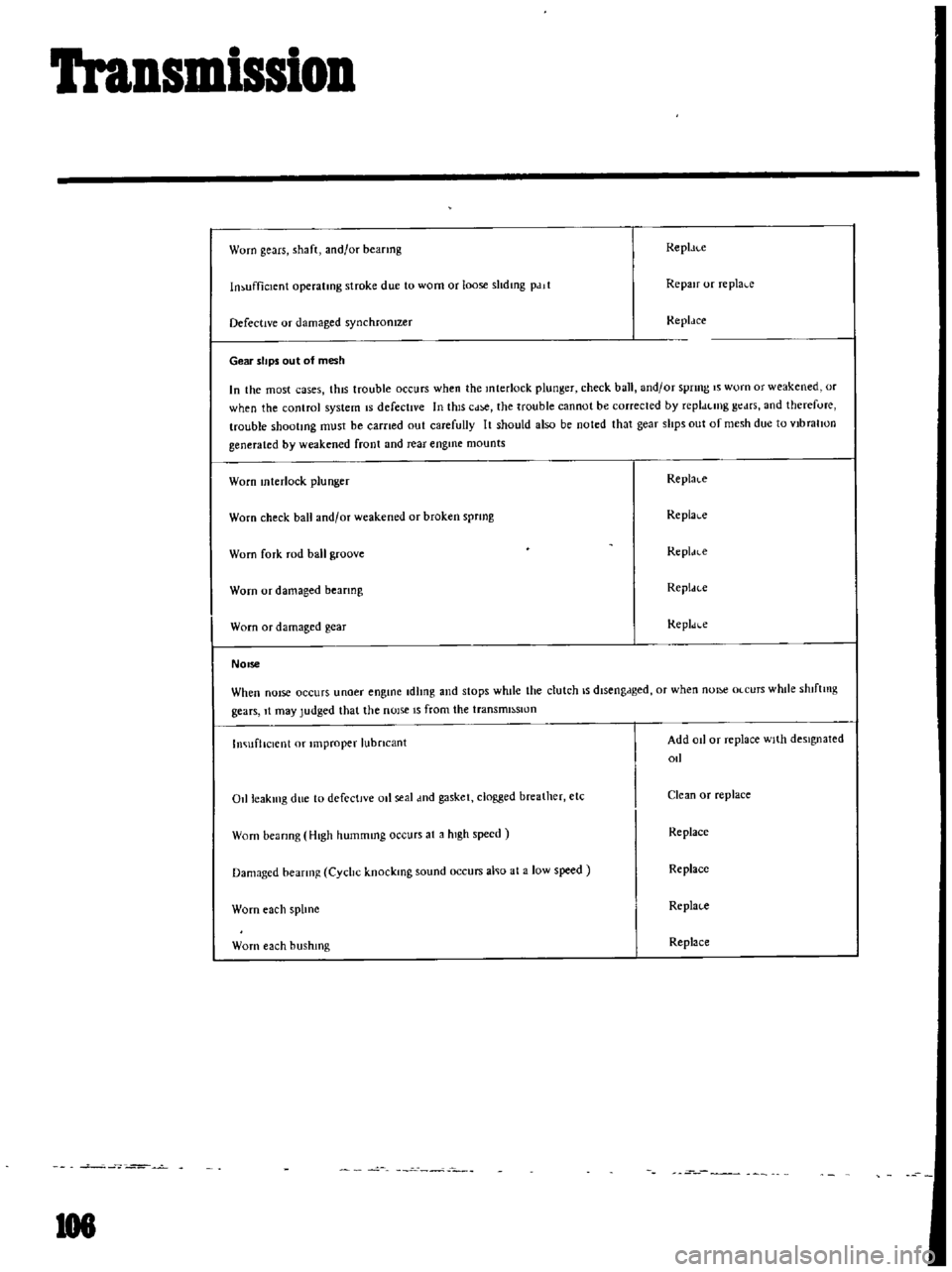
Transmission
Worn
gears
shaft
and
or
heanng
Repl
ll
c
In
ufficlcnt
operatmg
stroke
due
to
worn
or
loose
shdmg
pdll
Repair
or
replal
c
Defective
or
damaged
synchronIzer
Replace
Gear
slips
out
of
mesh
In
the
most
cases
thiS
trouble
occurs
when
the
Interlock
plunger
check
ball
and
or
spnng
IS
worn
or
weakened
or
when
the
control
system
IS
defectIve
In
thiS
Cd
the
trouble
cannot
be
corrected
by
repldtlllg
gt
drs
and
therefore
trouble
shootmg
must
be
earned
out
carefully
It
should
also
be
noted
that
gear
slips
out
of
mesh
due
to
vlbralIon
generated
by
weakened
front
and
rear
engme
mounts
Worn
mterlock
plunger
Replal
c
Worn
check
hall
and
or
weakened
or
broken
sprmg
Replal
c
Worn
fork
rod
ball
groove
RepI
H
e
Worn
or
damaged
beanng
Repldce
Worn
or
damaged
gear
Repldl
c
NOise
When
nOIse
occurs
unoer
engine
Idling
and
stops
whde
the
clutch
IS
dlseng
lged
or
when
nOI
Olcurs
while
shlftmg
gears
It
may
Judged
that
the
nOIse
IS
from
the
tranSmll
lSIUn
Ino
ufllclenl
or
1mproper
lubncant
Add
od
or
replace
With
deSignated
oIl
Ollleaklllg
due
to
defectIve
011
seal
md
gasket
clogged
breather
etc
Clean
or
replace
Worn
beanng
High
hummmg
occurs
at
a
high
speed
Replace
Damaged
beanng
Cychc
knockmg
sound
occurs
alllo
at
a
low
speed
Replace
Worn
each
sphne
Replace
Worn
each
hushmg
Replace
108
Page 99 of 136
Transmission
AUTOMATIC
TRANSMISSION
The
model
3N71B
automatic
transmiSSIOn
IS
a
fully
automatic
Unit
consisting
pnmanly
of
3
element
hydrauhc
torque
converter
and
two
planetary
gear
sets
Two
multiple
disc
clut
ches
a
multiple
disc
brake
a
band
brake
and
a
one
way
sprag
clutch
provide
the
fnctlon
elements
reqUired
to
obtain
the
deSired
fun
tlon
of
the
two
planetary
gear
sets
The
two
planetary
gear
sets
give
three
for
ward
ratIOs
and
one
reverse
Changing
of
the
gear
ratIOs
IS
fully
automatic
In
relation
to
vehicle
speed
and
engine
torque
Input
Vehicle
speed
and
engine
mamfold
vacuum
Signals
are
constantly
fed
to
the
transmiSSIOn
to
prOVide
the
proper
gear
ratIO
for
maximum
effiCiency
and
performance
at
all
throttle
openmgs
The
Model
3N71B
has
SIX
selector
poSitIOns
P
R
N
D
2
1
p
Park
pOSitIOn
posItively
locks
the
out
put
shaft
to
the
transmiSSIOn
case
by
means
of
a
lockmg
pawl
to
prevent
the
vehicle
from
rollmg
either
directIOn
ThiS
pOSitIOn
should
be
selected
whenever
the
dnver
leaves
the
vehicle
The
engme
may
be
started
m
Park
pOSition
R
Reverse
range
enables
the
vehicle
to
be
operated
m
a
reverse
direction
N
Neutral
pOSitIOn
enables
the
engine
to
be
started
and
run
Without
dnvIngthe
vehicle
0
Drive
range
IS
used
for
all
normal
driVing
conditions
Dnve
range
has
three
gear
ratios
from
the
startmg
ratIO
to
direct
dnve
2
2
range
prOVides
performance
for
dnvIng
onshppery
surfaces
2
range
can
also
be
used
for
engine
brakmg
2
range
can
be
selected
at
any
vehicle
speed
and
prevents
the
transmlsslOn
from
shifting
out
of
second
gear
108
Rg
162
Idenllflcatlon
number
I
1
range
can
be
selected
at
any
vehicle
speed
and
the
transmiSSIOn
will
shift
to
second
gear
and
remain
m
second
until
vehicle
speed
IS
reduced
to
approximately
25
to
31
MPH
1
range
posItion
prevents
the
transmiSSIOn
from
shlftmg
out
of
low
gear
ThiS
IS
par
tlcularly
benefiCial
for
mamtamIng
maximum
engine
brakmg
when
continUOUS
low
gear
operation
IS
deSirable
The
torque
converter
assembly
IS
of
welded
constructIOn
and
can
not
be
dlssassembled
for
service
FlUld
Recommendatwn
Use
automatic
transmiSSIOn
flUid
haVing
DEXRON
IdentificatIOns
only
m
the
3N71B
automatic
transmiSSIOn
denttficatwn
Number
Stamped
posttwn
The
plate
attached
to
the
rIght
hand
Side
of
transmission
case
as
shown
m
Figure
161
denttficatwn
of
number
arrangements
See
Page
109
RECOMMENDATIONS
Due
to
the
compleXity
of
setting
up
a
disassembled
transmissIOn
as
well
as
the
special
tools
necessary
It
IS
recommended
thaL
nternal
epalrs
be
left
to
a
fully
eqUip
ped
shop
Page 102 of 136
Bod
Work
HOOD
Removal
DI
connect
the
WInd
hwld
washer
hose
at
the
nozzle
In
order
to
protect
the
hood
from
damaging
place
rag
In
hoth
Ide
of
the
hood
rear
end
loosen
the
hood
hinge
installatIOn
bolts
and
remove
the
hood
UPPOl
tIng
It
from
both
SIdes
as
shown
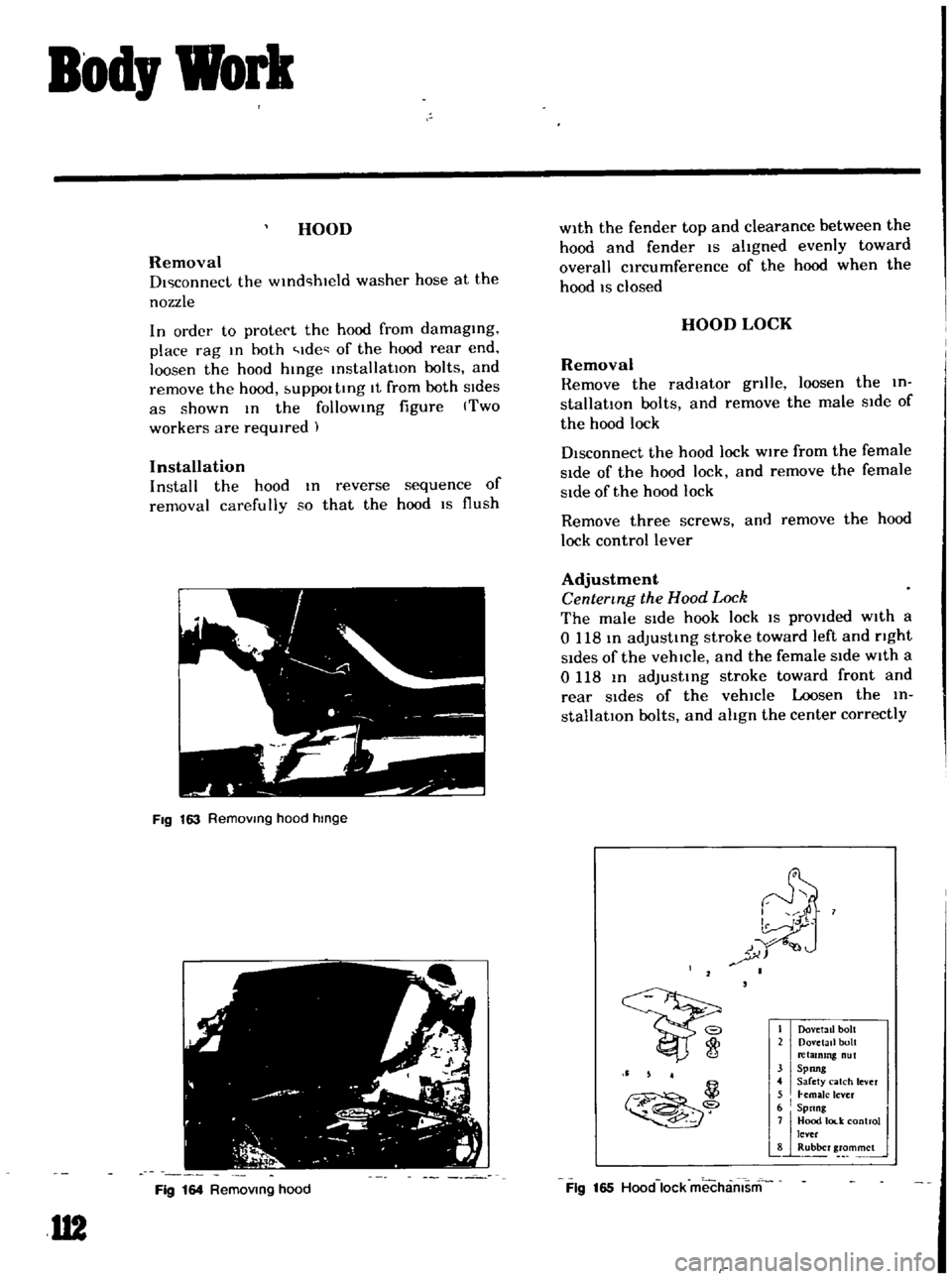
In
the
follOWing
figure
Two
workers
are
required
Installation
Install
the
hood
In
reverse
sequence
of
removal
carefully
so
that
the
hood
IS
flush
FIg
163
Removmg
hood
hmge
Fig
164
Removmg
hood
U2
with
the
fender
top
and
clearance
between
the
hood
and
fender
IS
aligned
evenly
toward
overall
circumference
of
the
hood
when
the
hood
IS
closed
HOOD
LOCK
Removal
Remove
the
radiator
gnlle
loosen
the
in
stallation
bolts
and
remove
the
male
Side
of
the
hood
lock
Disconnect
the
hood
lock
wire
from
the
female
Side
of
the
hood
lock
and
remove
the
female
Side
of
the
hood
lock
Remove
three
screws
and
remove
the
hood
lock
control
lever
Adjustment
Centermg
the
Hood
Lock
The
male
Side
hook
lock
IS
prOVided
with
a
o
118
In
adjusting
stroke
toward
left
and
nght
Sides
of
the
vehicle
and
the
female
SIde
with
a
0118
In
adjustIng
stroke
toward
front
and
rear
Sides
of
the
vehicle
Loosen
the
in
stallatIOn
bolts
and
align
the
center
correctly
I
Dov
tall
bolt
2
Dovetail
bolt
retammg
nut
31
Spong
4
Sarety
catch
lever
5
I
hmaJc
lever
6
Spnng
j
7JjHood
lod
control
lever
8
Rubber
grommet
Ii
5
4
il
Fig
165
Hood
lock
mechamsm