lock DATSUN B110 1969 Service User Guide
[x] Cancel search | Manufacturer: DATSUN, Model Year: 1969, Model line: B110, Model: DATSUN B110 1969Pages: 136, PDF Size: 5.64 MB
Page 26 of 136
BDgiDe
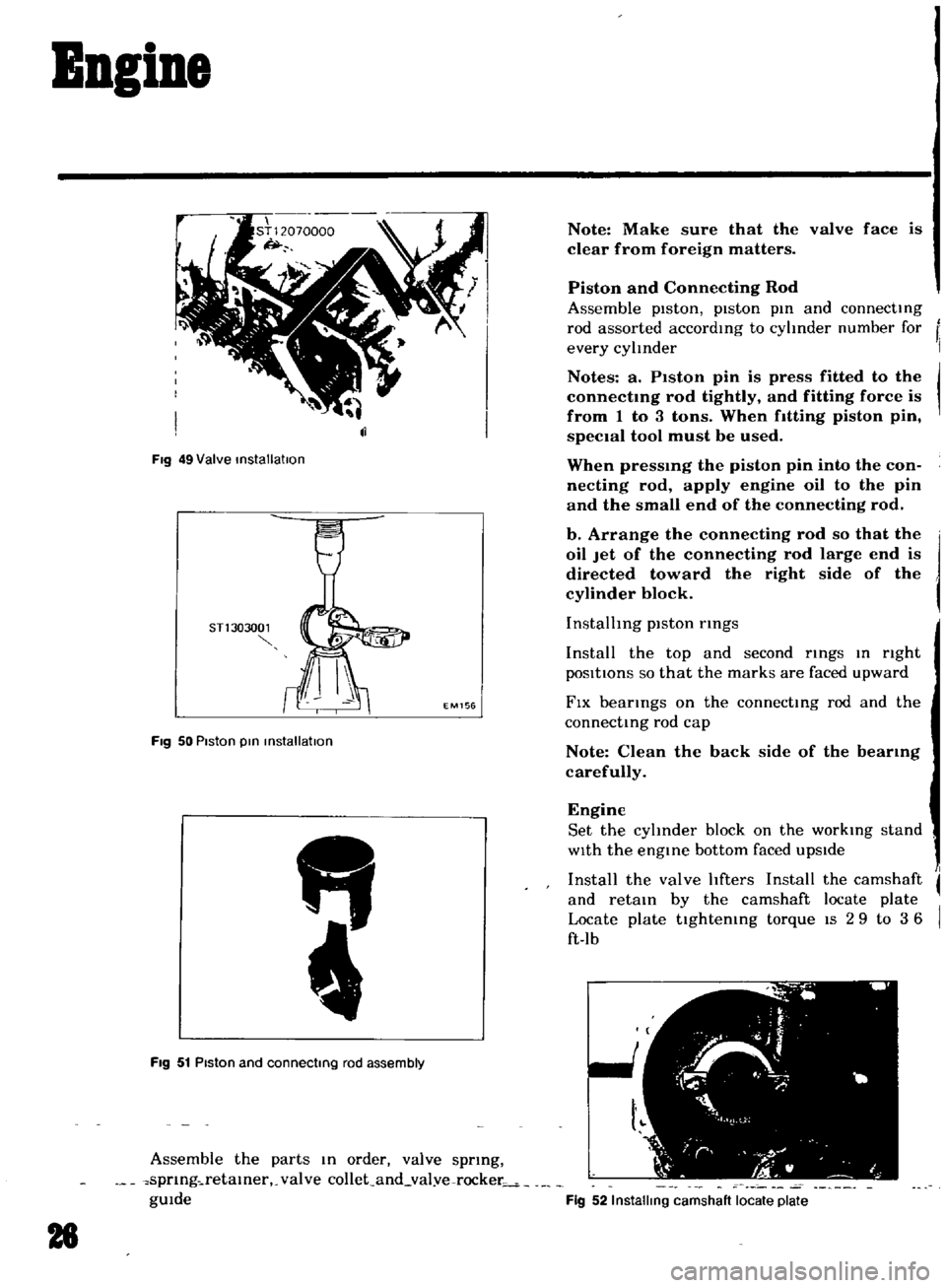
Fig
49
Valve
installatIon
STl
303001
EM156
Fig
50
Piston
pin
installation
FIg
51
Piston
and
connecting
rod
assembly
Assemble
the
parts
In
order
valve
sprmg
spnng
retamer
valve
collet
and
val
ve
rocker
gUIde
28
Note
Make
sure
that
the
valve
face
is
clear
from
foreign
matters
Piston
and
Connecting
Rod
Assemble
pIston
piston
pm
and
connecting
rod
assorted
accordmg
to
cyhnder
number
for
every
cylInder
Notes
a
P1ston
pin
is
press
fitted
to
the
connectmg
rod
tightly
and
fitting
force
is
from
1
to
3
tons
When
fitting
piston
pin
speCIal
tool
must
be
used
When
pressmg
the
piston
pin
into
the
con
necting
rod
apply
engine
oil
to
the
pin
and
the
small
end
of
the
connecting
rod
b
Arrange
the
connecting
rod
so
that
the
oil
Jet
of
the
connecting
rod
large
end
is
directed
toward
the
right
side
of
the
cylinder
block
InstallIng
piston
rmgs
Install
the
top
and
second
rings
In
nght
pOSItIOns
so
that
the
marks
are
faced
upward
FIX
bearings
on
the
connecting
rod
and
the
connecting
rod
cap
Note
Clean
the
back
side
of
the
bearmg
carefully
Engine
Set
the
cyhnder
block
on
the
workmg
stand
WIth
the
engine
bottom
faced
upSIde
Install
the
valve
hfters
Install
the
camshaft
and
retain
by
the
camshaft
locate
plate
Locate
plate
tightemng
torque
IS
2
9
to
3
6
ft
lb
Fig
52
Installing
camshaft
locate
plate
Page 27 of 136
Bogine
Note
Set
the
locate
plate
so
as
the
LOWER
mark
comes
to
the
engine
bot
tom
side
Set
the
maIn
bearIngR
on
theIr
posItIOns
on
the
cylinder
block
Notes
a
The
center
bearmg
No
3
bearmg
is
a
flanged
type
for
thrust
force
b
Two
lOner
bearmgs
No
2
and
No
4
are
of
the
same
type
c
The
front
bearmg
No
1
IS
the
same
type
as
the
rear
bearmg
No
5
d
All
bearings
except
for
No
I
bearing
are
interchangeable
between
upper
and
lower
bearings
Apply
engIne
OIl
to
the
mam
bearIng
surfaces
on
both
sIdes
of
the
cyltnder
block
and
cap
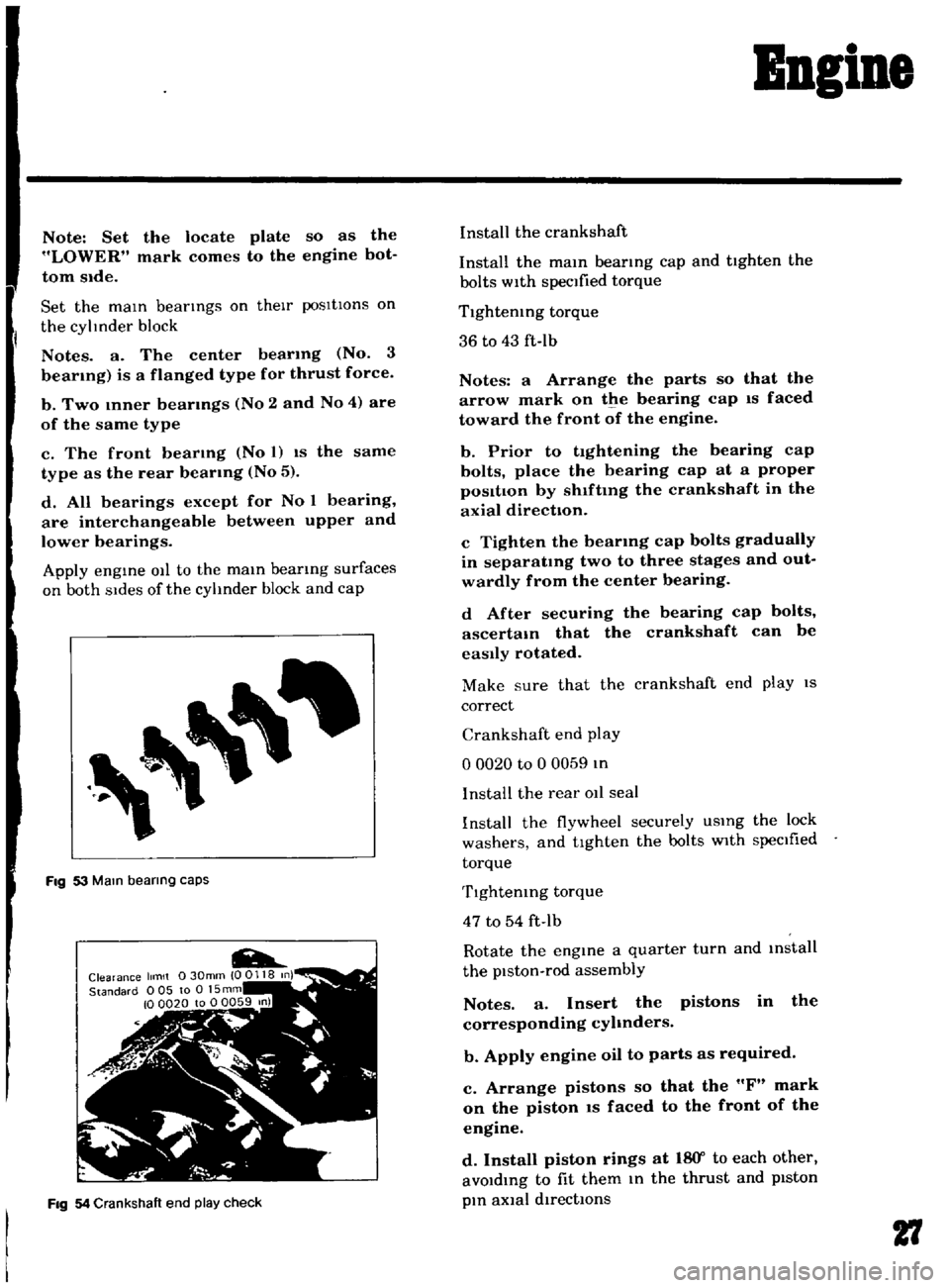
Fig
53
Mam
bearing
caps
Fig
54
Crankshaft
end
play
check
Install
the
crankshaft
Install
the
mam
bearmg
cap
and
tighten
the
bolts
with
specified
torque
Tlghtemng
torque
36
to
43
ft
Ib
Notes
a
Arrange
the
parts
so
that
the
arrow
mark
on
the
bearing
cap
IS
faced
toward
the
front
of
the
engine
b
Prior
to
tightening
the
bearing
cap
bolts
place
the
bearing
cap
at
a
proper
posItIon
by
shlftmg
the
crankshaft
in
the
axial
direction
c
Tighten
the
bearmg
cap
bolts
gradually
in
separatmg
two
to
three
stages
and
out
wardly
from
the
center
bearing
d
After
securing
the
bearing
cap
bolts
ascertam
that
the
crankshaft
can
be
easily
rotated
Make
sure
that
the
crankshaft
end
play
IS
correct
Crankshaft
end
play
o
0020
to
0
0059
In
I
nstalI
the
rear
011
seal
Install
the
flywheel
securely
USIng
the
lock
washers
and
tighten
the
bolts
with
specIfied
torque
Tlghtemng
torque
47
to
54
ft
Ib
Rotate
the
engine
a
quarter
turn
and
mstall
the
piston
rod
assembly
Notes
a
Insert
the
pistons
in
the
corresponding
cyhnders
b
Apply
engine
oil
to
parts
as
required
c
Arrange
pistons
so
that
the
F
mark
on
the
piston
IS
faced
to
the
front
of
the
engine
d
Install
piston
rings
at
18
Y
to
each
other
avoIdIng
to
fit
them
In
the
thrust
and
pIston
pIn
aXial
directIOns
27
Page 30 of 136
BDgiDe
Install
the
new
011
seal
to
the
front
cover
The
front
cover
011
seal
should
be
replaced
when
the
front
cover
IS
disassembled
Install
the
front
cover
applYing
the
seahng
agent
to
both
surfaces
of
the
gasket
Tlghtemng
torque
36
to
5
1
ft
lb
Install
the
ot
strainer
and
the
011
pan
uSing
the
gasket
Apply
seahng
agent
on
both
surfaces
of
the
gasket
especIally
on
the
front
and
rear
por
tlOns
of
the
011
pan
011
pan
tlghtemng
torque
2
9
to
4
3
ft
lb
Invert
the
engine
and
Install
the
cyhnder
head
assembly
and
gasket
Note
Apply
sealing
agent
overall
the
cylinder
block
surface
Place
the
gasket
on
It
and
apply
sealing
agent
to
the
gasket
top
Tighten
the
cylinder
head
bolts
to
the
peclfied
torque
Cylmder
bloLk
Side
Stecl
heet
Sealmg
agent
not
required
Cylinder
head
Side
Jomt
sheet
Remarks
Install
WIthout
applymg
sealing
agent
Be
careful
not
to
damage
the
push
rod
Side
because
thIS
SIde
has
prevIOusly
been
provIded
WIth
sealing
agent
J
30
v
o
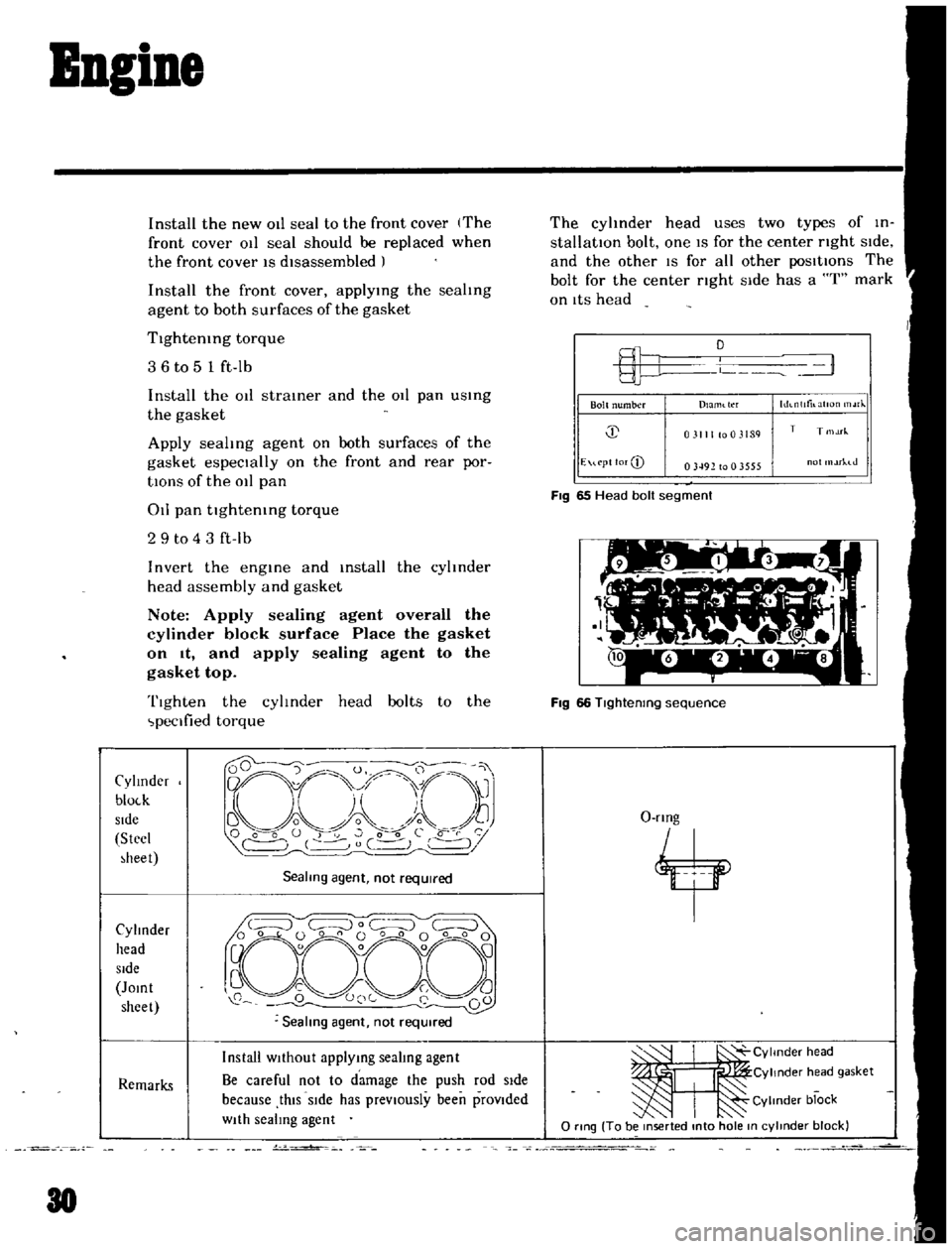
The
cyhnder
head
uses
two
types
of
in
stallatIOn
bolt
one
IS
for
the
center
nght
SIde
and
the
other
IS
for
all
other
posItIOns
The
bolt
for
the
center
nght
Side
has
a
I
mark
on
ItS
head
L
1
Bolt
number
hh
nlltilatlOn
rJ
Dlaml
tl
f
j
031111003189
T
T
1M
E
u
pt
lor
CD
03492
to
0
3555
ot
rhJ
FIg
65
Head
bolt
segment
Fig
66
Tlghtenmg
sequence
O
rmg
4
ItI
CYlmder
head
Cylinder
h
ad
gasket
Cylinder
block
o
rtng
To
be
mserted
mto
hole
m
cylmder
block
Page 38 of 136
llectrical
Spt
When
Harting
lWltch
I
IgllltlUn
iwltch
FJuhy
rctuflung
Repldce
set
10
OFf
the
slJrl
motor
do
nut
MJgnclK
Wltdl
Seiad
contJr
l
Repldcc
IIlg
I
op
Shorted
1
011
Replace
Faulty
plunger
slidmg
Replace
StJflillg
motOr
Pillion
does
not
dlsengJge
from
the
Repair
or
replace
nng
gedr
smoothly
Pinion
sphne
dot
110t
disengage
Repan
or
replJce
moothly
SCl7Cd
pinIOn
metal
Replace
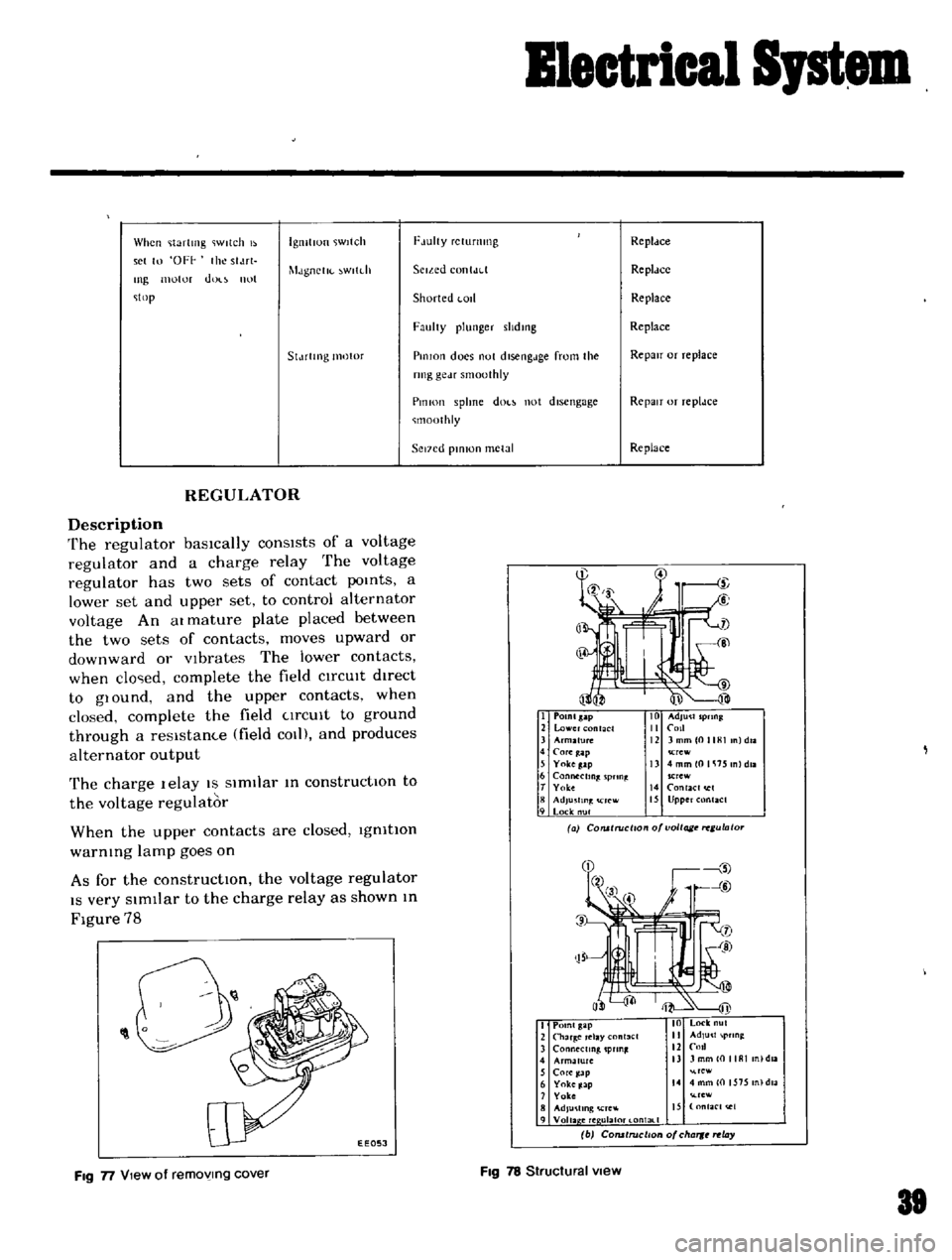
REGULATOR
Description
The
regulator
basically
consists
of
a
voltage
regulator
and
a
charge
relay
The
voltage
regulator
has
two
sets
of
contact
poInts
a
lower
set
and
upper
set
to
control
alternator
voltage
An
at
mature
plate
placed
between
the
two
sets
of
contacts
moves
upward
or
downward
or
Vibrates
The
lower
contacts
when
clo
ed
complete
the
field
CIrCUIt
dIrect
to
glOund
and
the
upper
contacts
when
closed
complete
the
field
CIrCUIt
to
ground
through
a
resIstam
e
field
COl
and
produces
alternator
output
The
charge
lelay
IS
SimIlar
In
constructIOn
to
the
voltage
regulator
When
the
upper
contacts
are
closed
IgnitIOn
warnIng
lamp
goes
on
As
for
the
constructIOn
the
voltage
regulator
IS
very
SImIlar
to
the
charge
relay
as
shown
In
Figure
78
I
POlnlsap
2
lower
nt
CI
3
Arm2fu1C
4
COfe
ap
5
Yokeg
lp
6
Connecting
pnn
t
T
Yolce
8
AdJu
fln
rcw
9
Lock
nul
Crew
13
4mmlOlli15
nldll
SCrew
14
RlaCI
I
15
Upper
Rlact
a
COlUlruci
o
o
voltage
ulato
O
0
1
EEOSJ
I
Point
gap
2
Char
Clay
nl3el
3
ConMctmg
pun
4
Armature
nl
daa
5
Core
ap
re
6
Yoke
Jap
14
4
mm
0
1575
n
dla
7
Yoke
rew
8
AdJu
llng
Cre
IS
nfaC
t
e1
9
Voila
ere
ulal0t
l
ontal
1
b
COfUtruclton
of
cha
rt
ay
FIg
n
View
of
removing
cover
FIg
78
Structural
view
81
Page 50 of 136
Fuel
Sptem
The
power
valve
mechanIsm
IS
of
a
vacuum
actuated
boost
type
and
Improves
hIgh
speed
drivIng
The
throttle
opener
control
system
Incor
porates
a
servo
diaphragm
The
servo
dIaphragm
helps
open
the
throttle
valve
at
a
decreasIng
speed
so
as
to
reduce
the
emISSIOn
of
hydrocarbons
to
a
minImum
An
antI
dlesehng
olen01d
IS
used
as
a
means
of
preventIng
dlesehng
When
the
IgnItIOn
key
IS
turned
ofT
the
fuel
passage
Involved
In
the
slow
system
IS
closed
and
the
fuel
supply
IS
shut
down
completely
In
the
chok
mechanIsm
an
electric
automatIc
choke
IS
used
to
automatically
con
trol
the
choke
valve
operatIOn
durIng
the
war
m
up
of
the
engIne
The
carburetor
for
automatic
transmiSSIOn
IS
eqUIpped
WIth
so
called
dash
pot
that
IS
It
makes
smooth
deceleratIng
WIthout
engIne
stall
at
any
operatIng
conditIOn
These
carburetors
are
qUIte
SImIlar
In
ap
pearance
as
explaIned
above
except
the
dash
pot
for
the
automatIc
transmISSion
model
Adjustment
Idhng
Adjustment
Idle
mixture
adjustment
requIres
the
use
of
a
CO
meter
When
prepatlng
to
adjust
Idle
mIxture
It
IS
essentIal
to
have
the
meter
thoroughly
warmed
and
cahbrated
Warm
up
the
engIne
suffiCiently
ContInue
engme
operatIOn
for
one
mmute
un
der
ldhng
speed
Adjust
throttle
adjustIng
screw
so
that
engme
speed
IS
800
rpm
m
N
pos1tIon
for
automatic
transmiSSIOn
Check
IgmtlOn
tl
If
necessary
adjust
It
to
the
speCificatIOns
IgnItIOn
tImlo
800
rpm
Adjust
Idle
adJustmg
screw
so
that
CO
percen
tage
IS
1
5
0
50
at
800
ns
a
On
automatIc
transmiSSIOn
eqUipped
model
check
must
be
done
In
the
D
poSItIon
Be
sure
to
apply
parkmg
brake
and
to
lock
both
front
and
rear
wheels
With
wheel
chocks
b
Hold
brake
pedal
while
steppIng
down
on
accelerator
pedal
OtherWise
car
Will
rush
out
dangerously
On
automatIc
transmiSSIOn
eqUIpped
model
make
sure
that
the
adjustment
has
been
made
With
the
selector
lever
In
N
posItIon
And
then
check
the
specificatIOns
With
the
lever
In
D
pOSitIOn
Insure
that
CO
percent
and
Idle
speed
are
as
follows
Idle
rpm
650
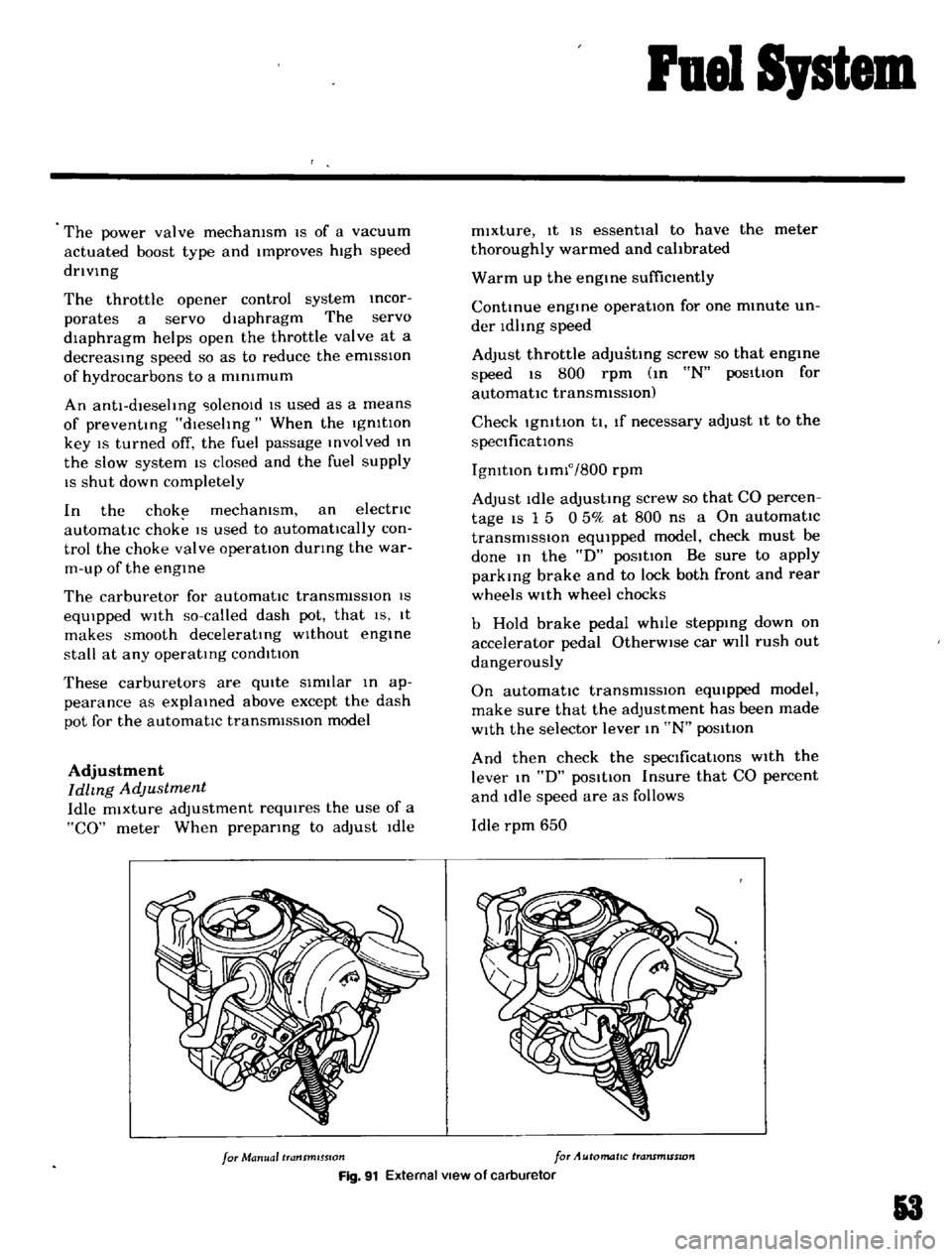
for
Manual
transmISSion
for
Automatic
transmISSion
Fig
91
External
view
of
carburetor
3
Page 54 of 136
Fuel
Sptem
ted
on
the
car
If
the
throttle
valve
fails
to
fully
open
the
unIoader
becomes
inoperative
resulting
in
poor
ac
celleration
after
the
engine
is
started
Note
Use
an
accurate
measuring
in
strument
such
as
a
wheatstone
bridge
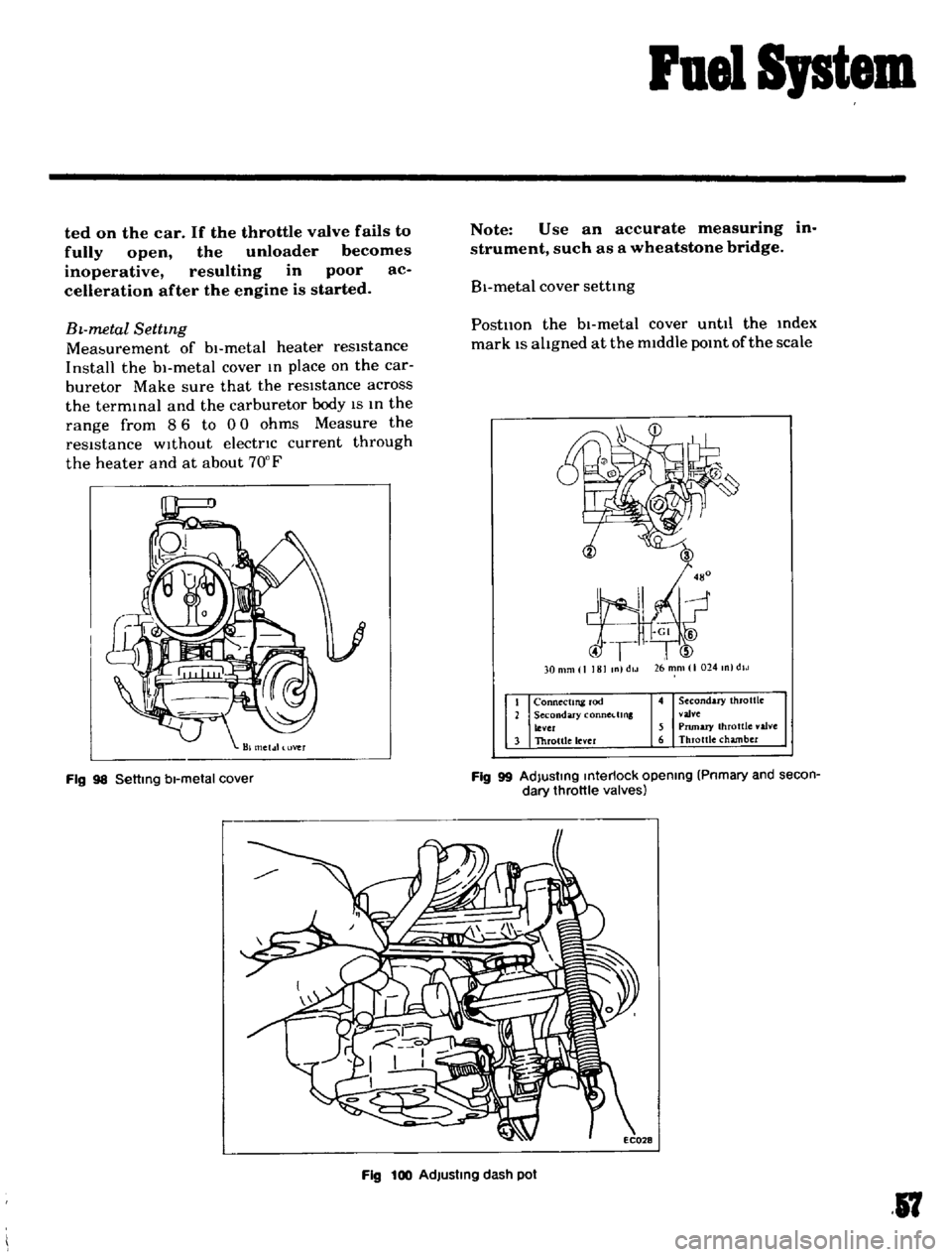
B1
metal
cover
settmg
BL
metal
Settmg
Mea
urement
of
bl
metal
heater
resistance
Install
the
bl
metal
cover
m
place
on
the
car
buretor
Make
sure
that
the
resIstance
across
the
termmal
and
the
carburetor
body
IS
m
the
range
from
8
6
to
0
0
ohms
Measure
the
resIstance
without
electnc
current
through
the
heater
and
at
about
70
F
Postllon
the
bl
metal
cover
until
the
mdex
mark
1S
altgned
at
the
middle
pomt
of
the
scale
26
mm
I
024
m
dlJ
30
m
1
181
In
dlJ
Connectml
rod
Secondary
COnnCl
lms
lever
Throltle
lever
4
Secondary
throttle
vaJve
5
Pnmary
throttle
valve
6
Throttle
chamber
Fig
98
Settmg
bl
metal
cover
Fig
99
AdJustmg
mterlock
opening
Pnmary
and
secon
dary
throttle
valves
Fig
100
AdJustmg
dash
pot
17
Page 55 of 136
ruel
S
stem
Note
When
somewhat
over
choked
set
bl
metal
cover
after
turning
it
clockwise
slightly
Adjustment
oflnterlock
Opelntng
of
Pnmary
and
Secondary
Throttle
Values
Open
the
pnmary
Side
throttle
valve
48
from
the
fully
closed
positIOn
and
measure
clearance
GIn
between
the
throttle
valve
and
throttle
chamber
mSlde
wall
as
shown
m
Figure
99
GIn
0
228
m
WIthout
dlsturbmg
the
above
settmg
bend
connectmg
rod
as
necessary
so
that
secoridary
throttle
valve
IS
about
to
open
Upon
com
pletIOn
of
the
adjustment
make
sure
that
the
hnk
system
operates
smoothly
Dash
Pot
Adjustment
AutomatIC
Trans
mlsszon
car
only
It
IS
necessary
that
the
Idhng
speed
of
engme
and
mIxture
have
been
well
turned
up
and
engme
IS
suffiC1
n
y
warm
1
Turn
throttle
valve
by
hand
and
read
engme
speed
when
the
da
h
pot
Just
touches
the
stop
per
lever
Adjust
the
pOSitIOn
of
the
dash
pot
by
turnmg
the
nut
until
the
engine
speed
IS
In
the
range
from
1
900
to
2
000
rpm
Make
sure
that
the
engine
speed
IS
smoothly
leduced
from
3
000
to
1
000
rpm
within
a
few
econds
Removal
Remove
the
aIr
cleaner
DIsconnect
the
fuel
line
vacuum
line
automatic
choke
harness
and
antl
dlesehng
solenOId
harness
from
carburetor
Remove
the
throttle
lever
Remove
four
nuts
and
washers
retaining
the
carburetor
to
the
mamfold
If
necessary
LIft
the
carburetor
and
remove
from
the
mamfold
Remove
and
dlscard
the
gasketcused
between
the
carburetor
and
mamfold
8
Disassembly
The
main
Jets
and
needle
valves
on
both
primary
and
secondary
Sides
are
accessible
from
outSIde
of
the
carburetor
for
disassem
bly
Remove
throttle
return
sprmg
Remove
pump
level
shaft
take
out
pump
lever
and
pump
connectmg
rod
Remove
rubber
pipe
from
choke
piston
Loosen
off
bolts
secutlng
servo
diaphragm
In
positIOn
take
out
dIaphragm
Back
off
total
of
five
bolts
which
hold
choke
In
posItion
and
remove
rods
of
starter
system
take
out
choke
chamber
In
removmg
chamber
exercise
care
to
aVOId
damaging
float
The
pnmary
and
secondary
emulsIOn
tubes
can
be
disassembled
by
removmg
the
main
air
bleeds
on
the
indiVidual
SIdes
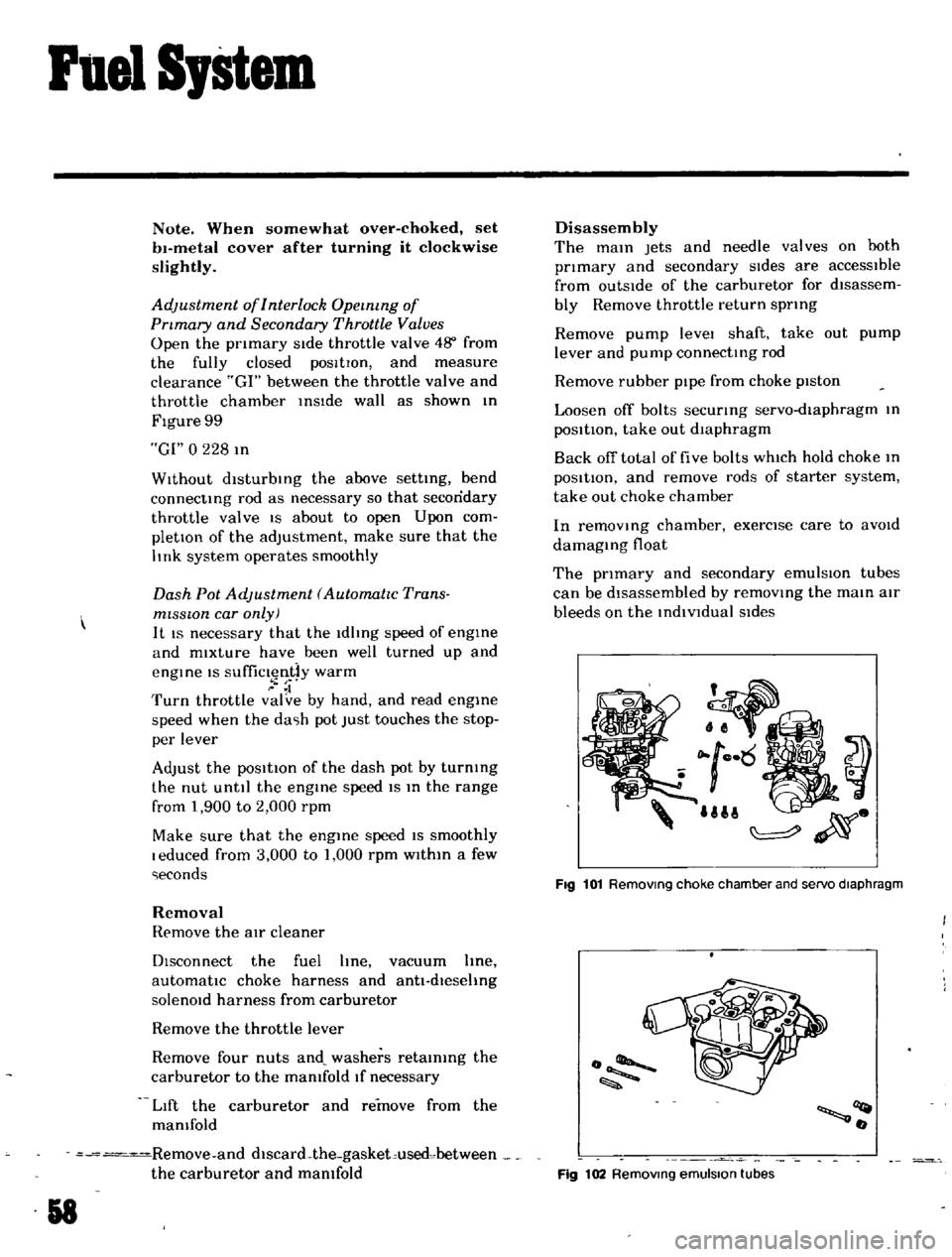
UII
ij
Fig
101
Removmg
choke
chamber
and
servo
diaphragm
o
llQt
o
Fig
102
Removmg
emulsion
tubes
Page 56 of 136
Fuel
Sptem
In
removIng
Injector
weight
piston
return
sptlng
and
ball
care
should
be
exercIsed
to
prevent
them
from
beIng
scattered
and
lost
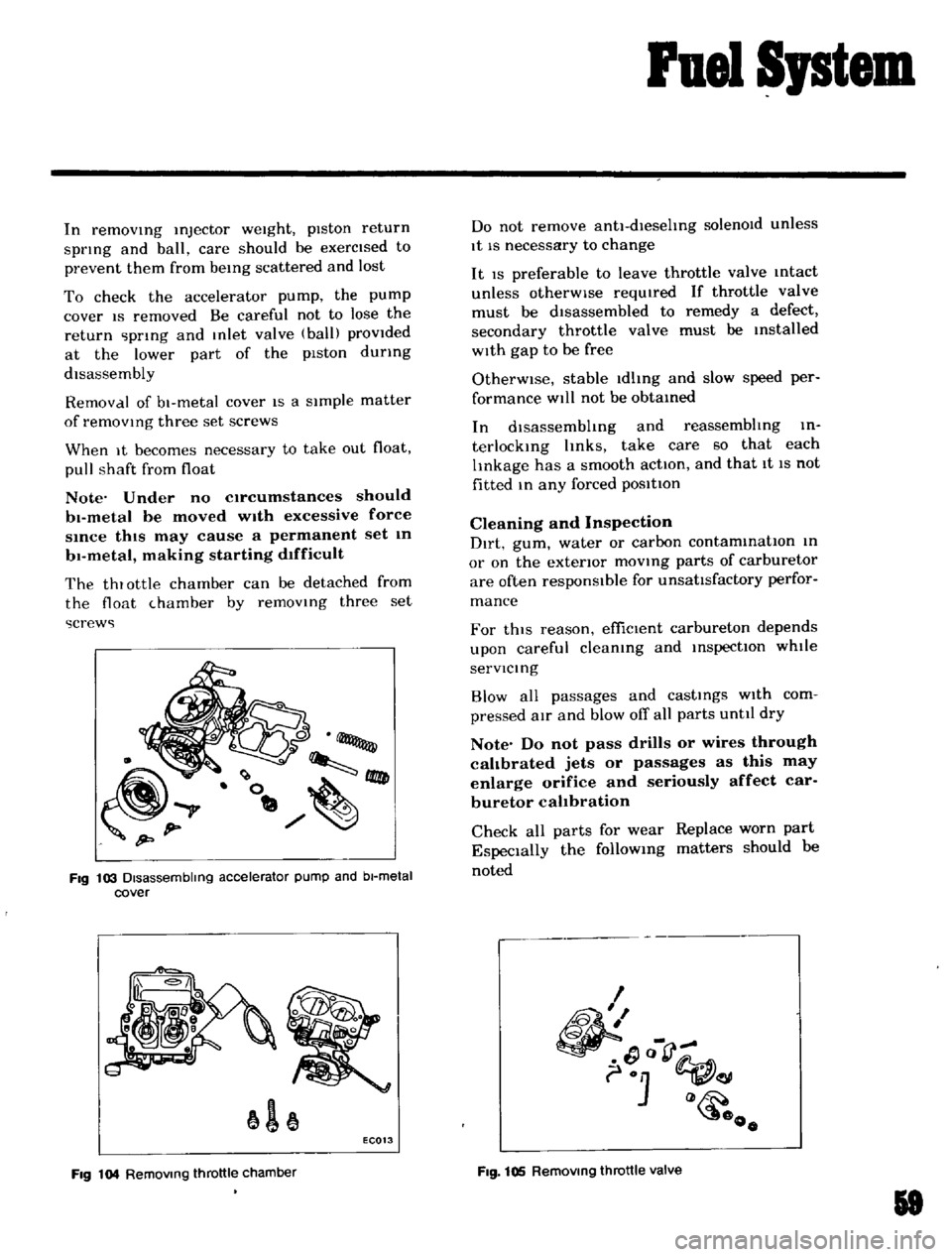
To
check
the
accelerator
pump
the
pump
cover
IS
removed
Be
careful
not
to
lose
the
return
spring
and
mlet
valve
bal
prOVided
at
the
lower
part
of
the
piston
dUring
dIsassembly
Removal
of
bl
metal
cover
IS
a
sImple
matter
of
removmg
three
set
screws
When
It
becomes
necessary
to
take
out
float
pull
shaft
from
float
Note
Under
no
C1rcumstances
should
bl
metaI
be
moved
with
excessive
force
Since
this
may
cause
a
permanent
set
In
b1
metal
making
starting
d1fficuIt
The
thlottle
chamber
can
be
detached
from
the
float
hamber
by
removmg
three
set
screws
Fig
103
Disassembling
accelerator
pump
and
bl
metal
cover
1
EC013
Fig
104
RemOVing
throttle
chamber
Do
not
remove
antl
dlesehng
solenOId
unless
It
IS
necessary
to
change
It
IS
preferable
to
leave
throttle
valve
mtact
unless
otherWise
reqUIred
If
throttle
valve
must
be
dIsassembled
to
remedy
a
defect
secondary
throttle
valve
must
be
Installed
wIth
gap
to
be
free
OtherWise
stable
Idlmg
and
slow
speed
per
formance
Will
not
be
obtamed
In
dlsassembhng
and
reassembhng
in
terlockIng
hnks
take
care
so
that
each
lInkage
has
a
smooth
action
and
that
It
IS
not
fitted
m
any
forced
posltton
Cleaning
and
Inspection
Dirt
gum
water
or
carbon
contammatIon
m
or
on
the
exterior
movmg
parts
of
carburetor
are
often
responsible
for
unsattsfactory
perfor
mance
For
thiS
reason
effiCient
carbureton
depends
upon
careful
cleamng
and
InspectIOn
whtle
servlcmg
Blow
all
passages
and
castmgs
wIth
com
pressed
aIr
and
blow
off
all
parts
unttl
dry
Note
Do
not
pass
drills
or
wires
through
calibrated
jets
or
passages
as
this
may
enlarge
orifice
and
seriously
affect
car
buretor
calibration
Check
all
parts
for
wear
Replace
worn
part
EspeCially
the
followmg
matters
should
he
noted
I
1
Q
o
Fig
105
RemOVing
throttle
valve
18
Page 57 of 136
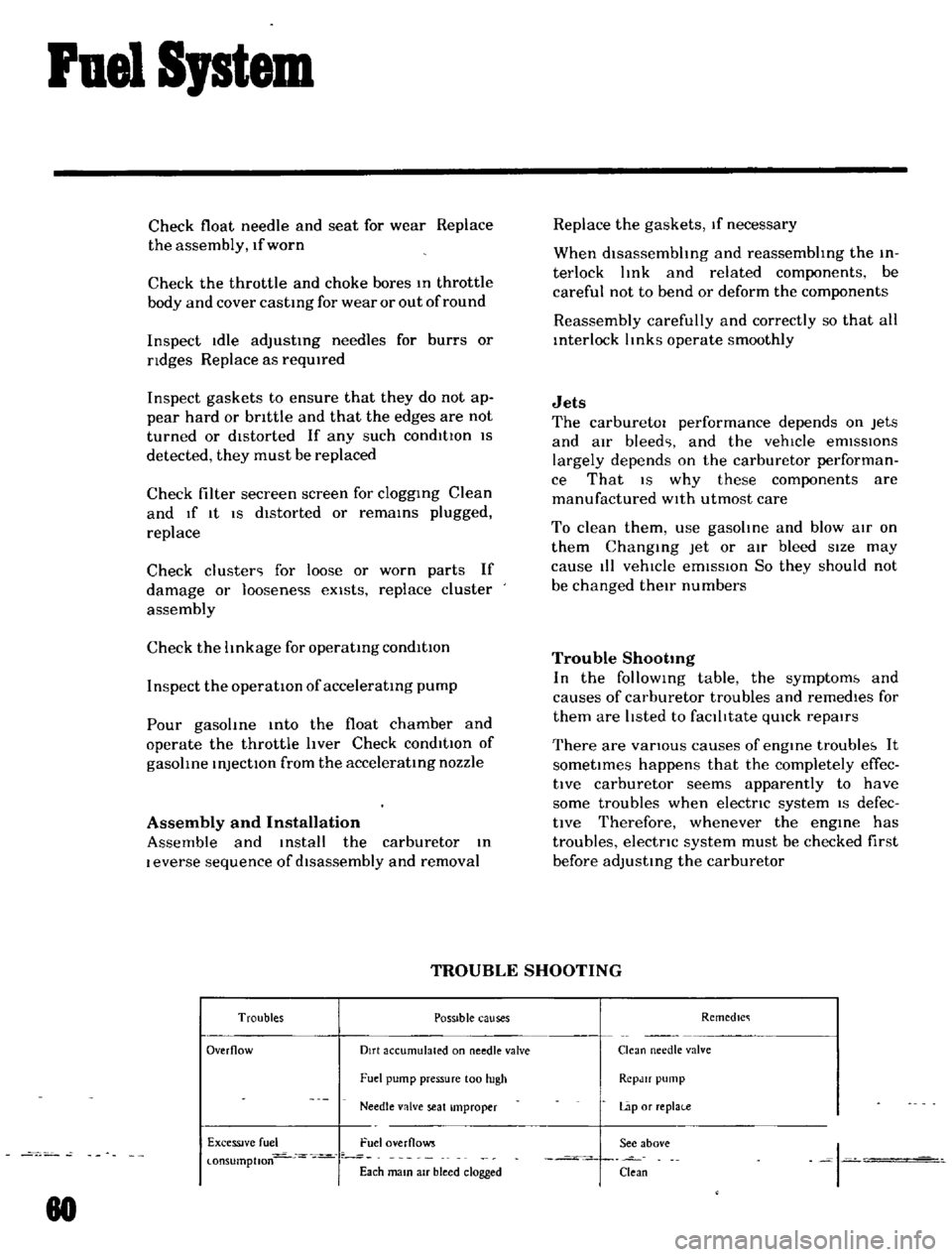
Fuel
SJstem
Check
float
needle
and
seat
for
wear
Replace
the
assembly
If
worn
Check
the
throttle
and
choke
bores
In
throttle
body
and
cover
castIng
for
wear
or
out
of
round
Inspect
Idle
adjustIng
needles
for
burrs
or
ndges
Replace
as
reqUIred
Inspect
gaskets
to
ensure
that
they
do
not
ap
pear
hard
or
bnttle
and
that
the
edges
are
not
turned
or
dIstorted
If
any
such
condItIOn
IS
detected
they
must
be
replaced
Check
filter
secreen
screen
for
cloggIng
Clean
and
If
It
IS
dIstorted
or
remaInS
plugged
replace
Check
cluster
for
loose
or
worn
parts
If
damage
or
Ioosene
s
eXists
replace
cluster
assembly
Check
the
hnkage
for
operatIng
condItion
Inspect
the
operatIOn
of
acceleratIng
pump
Pour
gasohne
Into
the
float
chamber
and
operate
the
throttle
hver
Check
conditIOn
of
gasohne
InjectIOn
from
the
acceleratIng
nozzle
Assembly
and
Installation
Assemble
and
Install
the
carburetor
In
I
everse
sequence
of
dIsassembly
and
removal
Replace
the
gaskets
If
necessary
When
dlsassembhng
and
reassembhng
the
In
terlock
hnk
and
related
components
be
careful
not
to
bend
or
deform
the
components
Reassembly
carefully
and
correctly
so
that
all
Interlock
hnks
operate
smoothly
Jets
The
carburetor
performance
depends
on
Jets
and
aIr
bleed
and
the
vehicle
emISSIOns
largely
depends
on
the
carburetor
performan
ce
That
IS
why
these
components
are
manufactured
WIth
utmost
care
To
clean
them
use
gasohne
and
blow
aIr
on
them
ChangIng
Jet
or
air
bleed
sIze
may
cause
III
vehICle
emIssIon
So
they
should
not
be
changed
theIr
numbers
Trouble
Shootmg
In
the
follOWIng
table
the
symptom
and
causes
of
carburetor
troubles
and
remedIes
for
them
are
hsted
to
faclhtate
qUIck
repaIrs
There
are
vanous
causes
of
engIne
trouble
It
sometImes
happens
that
the
completely
effec
tlve
carburetor
seems
apparently
to
have
some
troubles
when
electnc
systern
IS
defec
tIve
Therefore
whenever
the
engIne
has
troubles
electnc
system
must
be
checked
first
before
adjusting
the
carburetor
TROUBLE
SHOOTING
Troubles
POSSible
causes
Remedlc
Overflow
Dirt
accumulated
on
needle
valve
Clean
needle
valve
Fuel
pump
pressure
100
hIgh
RCpJlf
pump
Needle
valve
seat
Improper
Lap
or
replai
e
ExceSSIve
fuel
Fuel
overflows
See
above
I
l
onsumptlon
Each
mam
aIr
bleed
clogged
Clean
80
Page 60 of 136
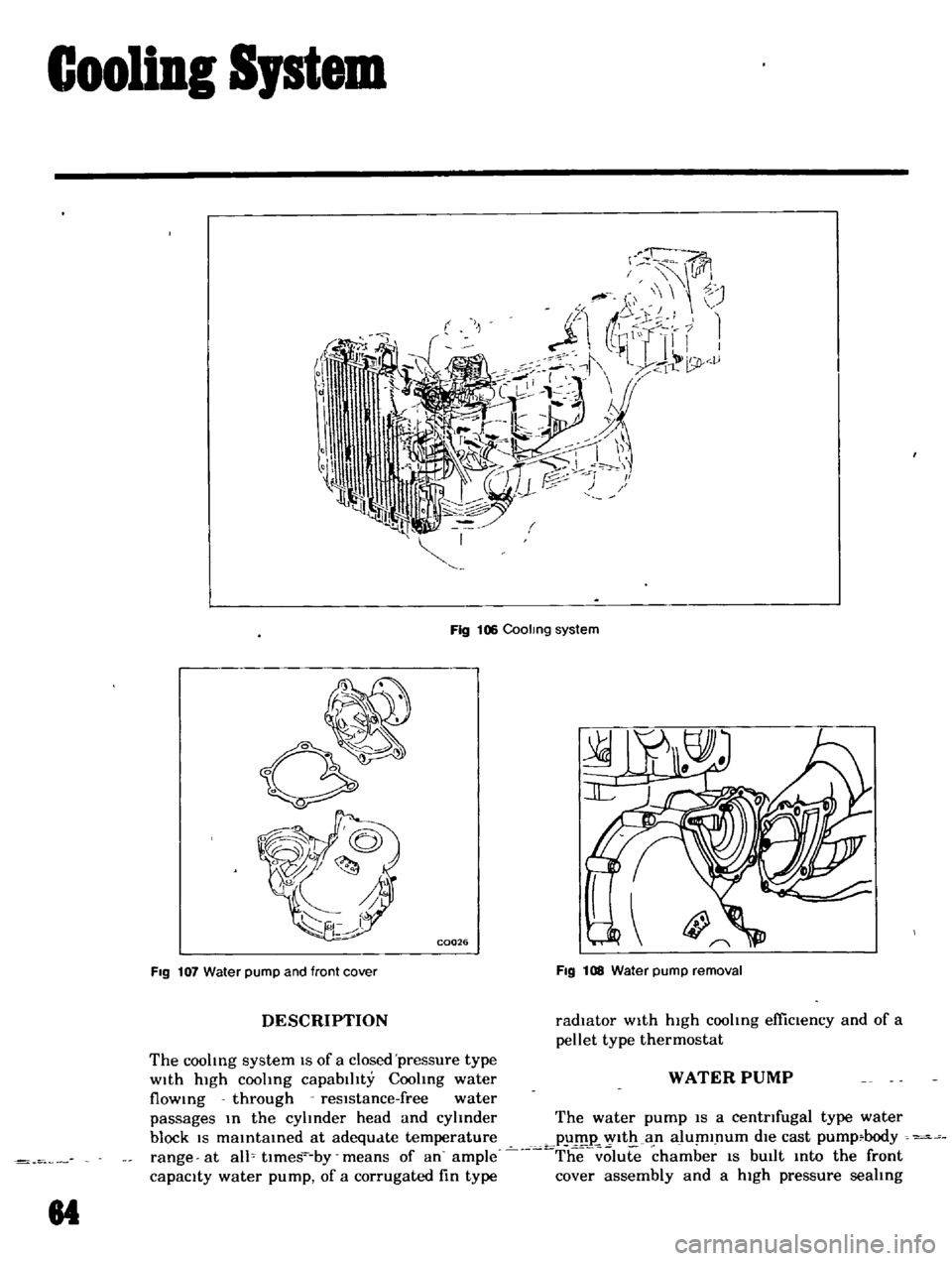
Cooling
Sptem
Fig
106
Coolmg
system
C0026
FIg
107
Water
pump
and
front
cover
FIg
1I1S
Water
pump
removal
DESCRIPTION
radiator
w1th
hIgh
coohng
efficiency
and
of
a
pellet
type
thermostat
The
coohng
system
IS
of
a
closed
pressure
type
With
hIgh
coolmg
capablhty
Coohng
water
WATER
PUMP
flowmg
through
resIstance
free
water
passages
m
the
cyhnder
head
and
cyhnder
The
water
pump
IS
a
centrifugal
type
water
block
IS
mamtamed
at
adequate
temperature
pum
WIth
an
alumlpum
d1e
cast
pump
body
range
at
allo
tlmes
by
means
of
an
ample
T
he
olute
chamber
IS
bUIlt
mto
the
front
capacIty
water
pump
of
a
corrugated
fin
type
cover
assembly
and
a
high
pressure
seahng
84