charging DATSUN B110 1973 Service User Guide
[x] Cancel search | Manufacturer: DATSUN, Model Year: 1973, Model line: B110, Model: DATSUN B110 1973Pages: 513, PDF Size: 28.74 MB
Page 422 of 513
ENGINE
Temperature
Oc
of
Temperature
C
F
x
Temperature
Oc
F
x
0
32
0
0
014
14
572
28
82
4
0
004
0
006
33
8
IS
59
0
19
I
84
2
0
013
2
35
6
16
60
8
0
003
30
86
0
0
007
3
37
4
0
012
17
61
6
0
001
31
87
8
0
008
4
39
2
18
64
4
32
89
6
0
011
0
001
5
41
0
19
66
2
33
91
4
0
009
6
42
8
0
010
20
68
0
0
34
93
2
0
010
7
44
6
0
009
21
69
8
35
95
0
0
001
0
01l
8
46
4
22
71
6
36
96
8
0
008
9
48
2
23
73
4
0
002
37
98
6
0
012
10
50
0
0
007
24
75
2
0
003
38
100
4
0
013
II
51
8
25
77
0
39
t02
2
0
006
0
004
12
53
6
16
78
8
40
104
0
0
Ot4
13
55
4
0
005
27
80
6
0
005
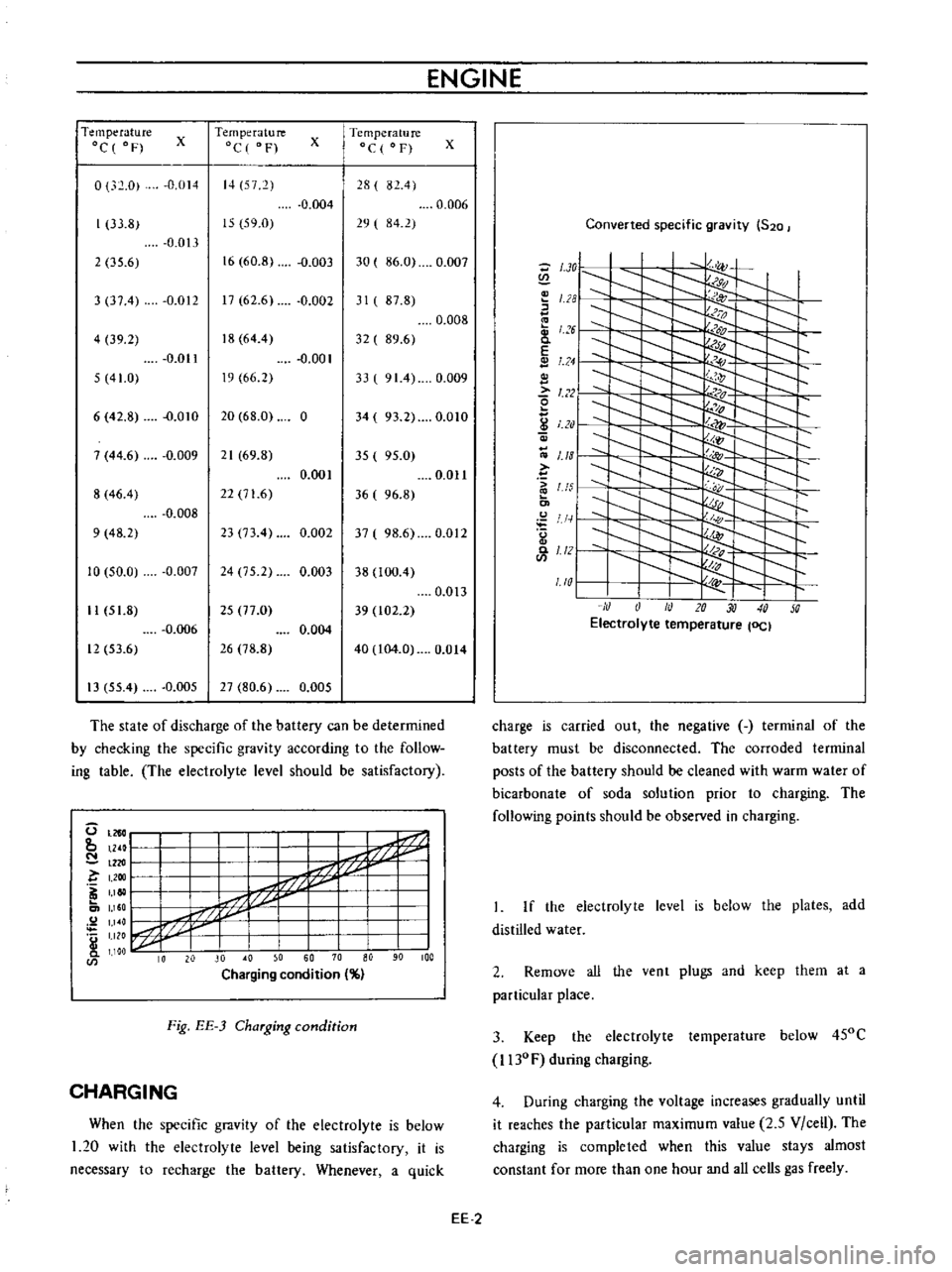
The
state
of
discharge
of
the
battery
can
be
determined
by
checking
the
specific
gravity
according
to
the
follow
ing
table
The
electrolyte
level
should
be
satisfactory
U
tn
l
k
1
I
P
I
IZf
I
r7
42
I
bt
7
J
I
I
11
0
I
M
I
L
J
I
10
20
30
0
50
60
70
aD
90
100
Charging
condition
Fig
EE
3
Charging
condition
CHARGING
When
the
specific
gravity
of
he
electrolyte
is
below
1
20
with
the
electrolyte
level
being
satisfactory
it
is
necessary
to
recharge
the
battery
Whenever
a
quick
x
Converted
specific
gravity
520
V
9d
f
o
1
28
u
1
6
c
E
1
24
l
22
o
0
U5
S
I
1
1
2
1
10
1
NON
M
i
Electrolyte
temperature
lOCI
charge
is
carried
out
the
negative
terminal
of
the
battery
must
be
disconnected
The
corroded
terminal
posts
of
the
battery
should
be
cleaned
with
warm
water
of
bicarbonate
of
soda
solution
prior
to
charging
The
following
points
should
be
observed
in
charging
If
the
electrolyte
level
is
below
the
plates
add
distilled
water
2
Remove
all
the
vent
plugs
and
keep
them
at
a
particular
place
3
Keep
the
electrolyte
temperature
below
450C
l130F
during
charging
4
During
charging
the
voltage
increases
gradually
until
it
reaches
the
particular
maximum
value
2
5
Vice
II
The
charging
is
completed
when
this
value
stays
almost
constant
for
more
than
one
hour
and
all
cells
gas
freely
EE
2
Page 423 of 513
ENGINE
ElECTRICAL
SYSTEM
5
If
the
specific
gravity
is
above
1
260
200C
or
680F
after
charging
adjust
it
by
adding
distilled
water
6
Keep
any
open
flame
away
from
the
place
where
the
battery
is
being
charged
7
Replace
vent
plugs
and
clean
the
upper
face
of
the
battery
after
charging
BATTERY
FREEZING
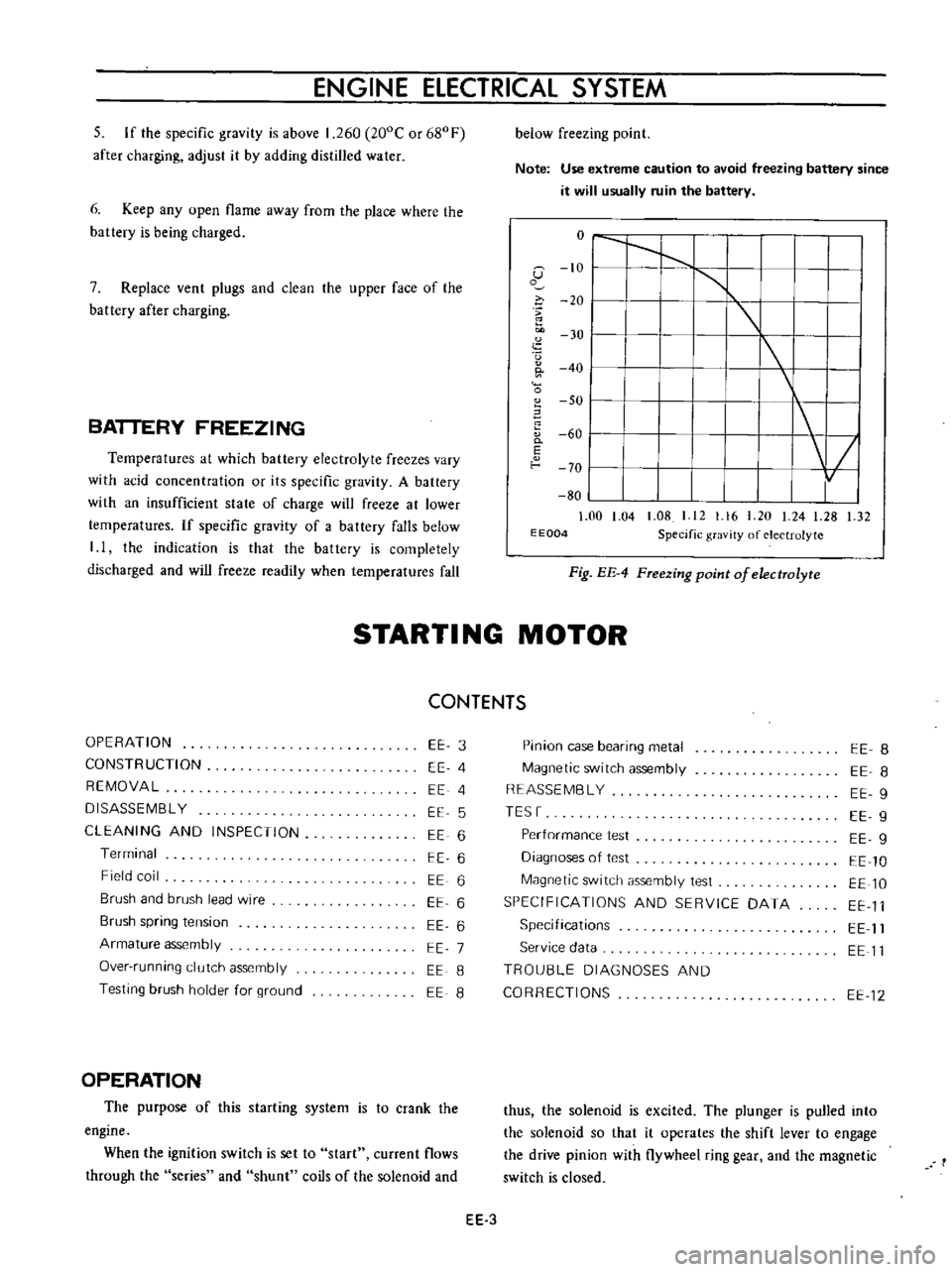
Temperatures
at
which
battery
electrolyte
freezes
vary
with
acid
concentration
or
its
specific
gravity
A
battery
with
an
insufficient
state
of
charge
will
freeze
at
lower
temperatures
If
specific
gravity
of
a
battery
falls
below
I
I
the
indication
is
that
the
battery
is
completely
discharged
and
will
freeze
readily
when
temperatures
fall
below
freezing
point
Note
Use
extreme
caution
to
avoid
freezing
battery
since
it
will
usually
ruin
the
battery
o
I
I
1
G
10
I
1
o
i
20
I
u
30
I
I
0
40
I
0
SO
I
60
0
I
E
f
o
70
I
80
1
00
1
04
1
08
I
12
1
16
20
24
1
28
1
32
E
E004
Specific
gravity
of
electrolyte
Fig
EE
4
FTeezing
point
of
electrolyte
STARTI
NG
MOTOR
CONTENTS
OPERATION
CONSTRUCTION
REMOVAL
DISASSEMBL
Y
CLEANING
AND
INSPECTION
Terminal
Field
coil
Brush
and
brush
lead
wire
Brush
spring
tension
Armature
assembly
Over
running
clutch
assembly
Testing
brush
holder
for
ground
EE
3
EE
4
EE
4
EE
5
EE
6
EE
6
EE
6
EE
6
EE
6
EE
7
EE
8
EE
8
OPERATION
The
purpose
of
this
starting
system
is
to
crank
the
engine
When
the
ignition
switch
is
set
to
start
current
flows
through
the
series
and
shunt
coils
of
the
solenoid
and
Pinion
case
bearing
metal
Magnetic
switch
assembly
REASSEMBL
Y
TESr
Performance
test
Diagnoses
of
test
Magnetic
switch
assembly
test
SPECIFICATIONS
AND
SERVICE
DATA
Specifications
Service
data
TROU8LE
DIAGNOSES
AND
CORRECTIONS
EE
8
EE
8
EE
9
EE
9
EE
g
EE
10
EE
10
EE
11
EE
11
EE
11
EE
12
thus
the
solenoid
is
excited
The
plunger
is
pulled
into
the
solenoid
so
that
it
operates
the
shift
lever
to
engage
the
drive
pinion
with
flywheel
ring
gear
and
the
magnetic
switch
is
closed
EE
3
Page 432 of 513
ENGINE
Arma
ture
shaft
Outer
diameter
Pinion
side
mm
in
12
950
to
12
968
0
5082
to
0
5105
11
450
to
II
468
0
4507
to
0
4515
0
1
0
0039
0
08
0
0031
Rear
end
mm
in
Wear
limit
Bend
limit
mm
in
mm
in
Gap
1
between
the
pinion
front
edge
and
the
pinion
stopper
mm
in
0
3
to
1
5
0
0118
to
0
0591
Magnetic
switch
Coil
resistance
Series
cuil
Q
Shunt
coil
n
Plunger
L
dimension
mm
in
0
3
at
20De
68UF
0
9
at
ooe
680F
317t032
3
l
248
to
1
272
TROUBLE
DIAGNOSES
AND
CORRECTIONS
12
950
to
12
968
0
5082
to
0
5105
11
450
to
II
468
0
4507
to
0
4515
l
0
1
0
0039
0
08
0
0031
0
3
to
1
5
0
0118
to
0
0591
0
3
at
20De
680Fl
0
9
at
200e
680F
317
to
32
3
l
248
to
I
272
Troubles
Trouble
location
Causes
Remedies
Starting
motor
will
not
operate
No
magnetic
switch
Battery
Defective
battery
Replace
battery
operating
sound
Over
discharging
Measure
specific
gravity
of
e
Ie
ctrolyte
and
ch
lrge
or
replace
the
battery
Ignition
switch
Defective
contact
Correct
or
replace
ig
nition
switch
Wiring
Faulty
starting
motor
grounding
Correct
Faulty
battery
grounding
Correct
Broken
or
disconnected
cable
Correct
or
replace
EE
12
Page 433 of 513
Magnetic
switch
operating
sound
is
heard
The
starting
motor
rotates
Pinion
gear
does
not
intermesh
with
ring
gear
ENGINE
ELECTRICAL
SYSTEM
Starter
Magnetic
switch
Battery
Wiring
Starting
motor
Magnetic
switch
Ring
gear
Starting
motor
Broken
armature
or
field
coil
cable
Broken
brush
pig
tail
Defective
mica
Broken
or
shorted
series
coil
Faulty
plunger
sliding
Over
discharging
Faulty
terminal
contact
or
loose
connection
Faulty
B
or
M
terminal
connections
Shorted
armature
or
field
coil
Worn
brush
or
improper
spring
pressure
Contaminated
commutator
or
de
fective
mica
Faulty
brush
connection
Seized
metal
Armature
contacted
with
pole
core
Insufficient
plunger
L
dimension
Faulty
contact
Broken
or
shorted
shunt
coil
wire
Worn
teeth
Weakened
pinion
sleeve
spring
Worn
pinion
teeth
EE
13
Replace
Replace
Correct
or
replace
Replace
Repair
or
replace
Measure
specific
gravity
of
electrolyte
arid
charge
if
necessary
Clean
and
retighten
Retighten
Repair
or
replace
Repair
or
replace
Clean
or
repair
Repair
Replace
Repair
or
replace
Adjust
Replace
Replace
Replace
Replace
Replace
Page 434 of 513
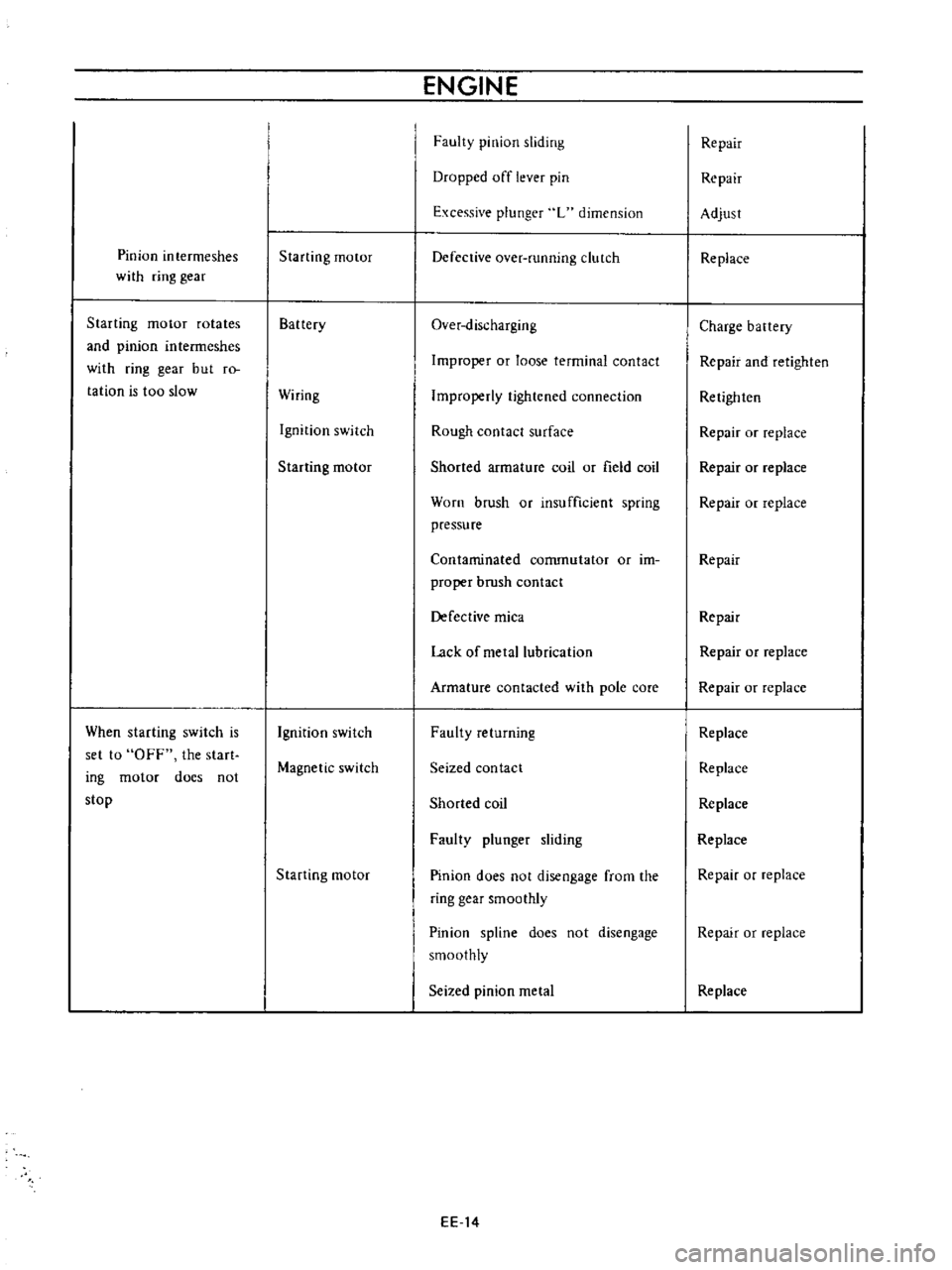
Pinion
intermeshes
with
ring
gear
Starting
motor
rotates
and
pinion
intermeshes
with
ring
gear
but
ro
tation
is
too
slow
When
starting
switch
is
set
to
OFF
the
start
ing
motor
does
not
stop
Starting
motor
Battery
Wiring
Ignition
switch
Starting
motor
Ignition
switch
Magnetic
switch
Starting
motor
ENGINE
Faulty
pinion
sliding
Dropped
off
lever
pin
Excessive
plunger
L
dimension
Defective
over
running
clutch
Over
discharging
Improper
or
loose
terminal
contact
Improperly
tightened
connection
Rough
contact
surface
Shorted
armature
coil
or
field
coil
Worn
brush
or
insufficient
spring
pressure
Contaminated
commutator
or
im
proper
brush
contact
Defective
mica
Lack
of
metal
lubrication
Armature
contacted
with
pole
core
Faulty
returning
Seized
contact
Shorted
coil
Faulty
plunger
sliding
Pinion
does
not
disengage
from
the
ring
gear
smoothly
Pinion
spline
does
not
disengage
smoothly
Seized
pinion
metal
EE
14
Repair
Repair
Adjust
Replace
Charge
battery
Repair
and
retighten
Retighten
Repair
or
replace
Repair
or
replace
Repair
or
replace
Repair
Repair
Repair
or
replace
Repair
or
replace
Replace
Replace
Replace
Replace
Repair
or
replace
Repair
or
replace
Replace
Page 435 of 513
ENGINE
ElECTRICAL
SYSTEM
CHARGING
CIRCUIT
IGNITION
1
i
n
ITCH
r
B
i
i
vel
oU
ARMATURE
lip
J
l
t
lJ
FIEL
Df
e
I
I
3
2
I
u
P
5
0
IL
U
p
P
f
H
i
I
I
L
J
L
J
ALTERNATOR
VOL
TAGE
REGULATOR
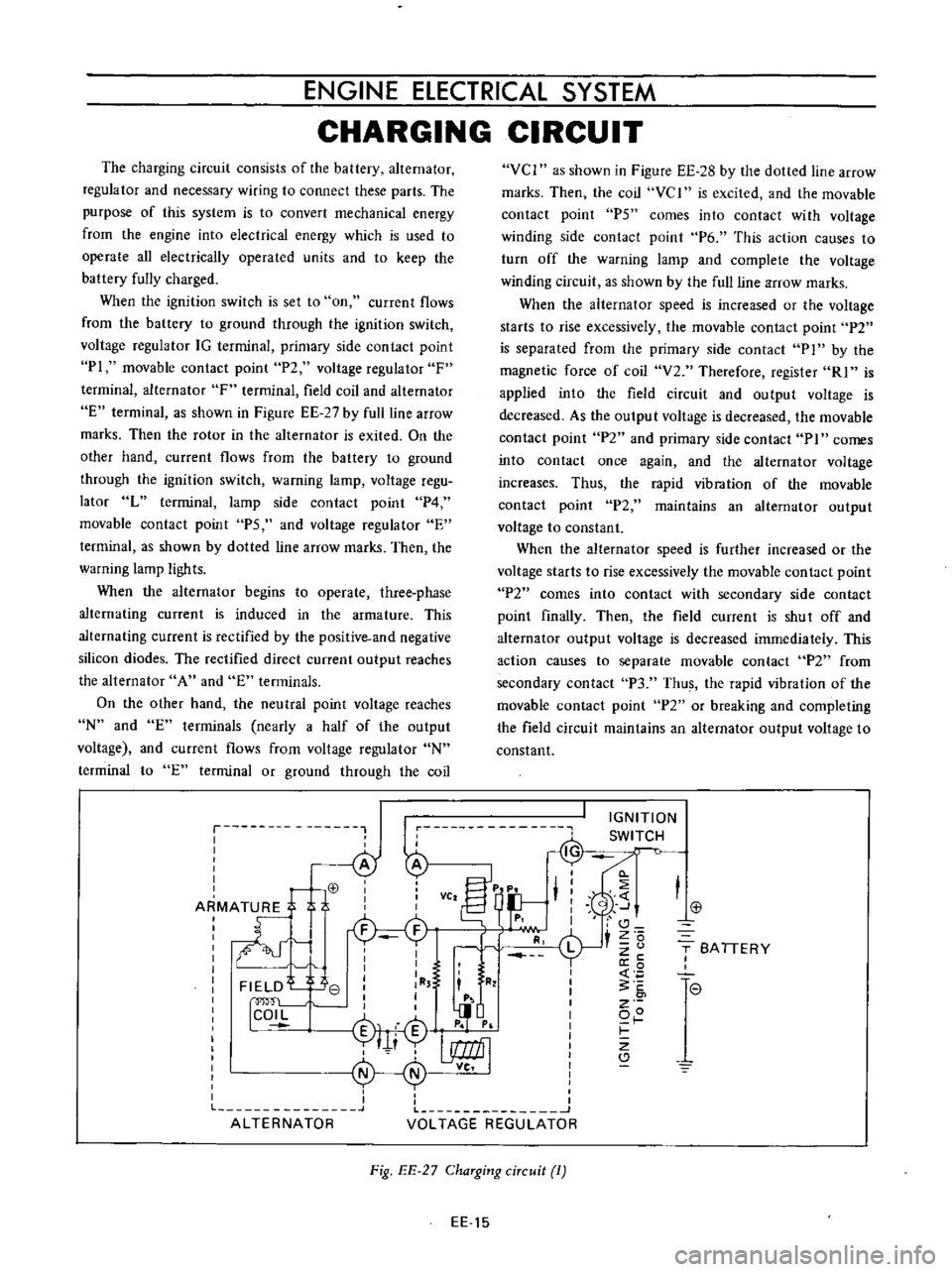
The
charging
circuit
consists
of
the
battery
alternator
regulator
and
necessary
wiring
to
connect
these
parts
The
purpose
of
this
system
is
to
convert
mechanical
energy
from
the
engine
into
electrical
energy
which
is
used
to
operate
all
electrically
operated
units
and
to
keep
the
battery
fully
charged
When
the
ignition
switch
is
set
to
on
current
flows
from
the
battery
to
ground
through
the
ignition
switch
voltage
regulator
IG
terminal
primary
side
contact
point
PI
movable
contact
point
P2
voltage
regulator
F
terminal
alternator
F
terminal
field
coil
and
alternator
E
terminal
as
shown
in
Figure
EE
27
by
full
line
arrow
marks
Then
the
rotor
in
the
alternator
is
exited
On
the
other
hand
current
flows
from
the
battery
to
ground
through
the
ignition
switch
warning
lamp
voltage
regu
lator
L
terminal
lamp
side
contact
point
P4
movable
contact
point
PS
and
voltage
regulator
E
terminal
as
shown
by
dotted
line
arrow
marks
Then
the
warning
lamp
ligh
ts
When
the
alternator
begins
to
operate
three
phase
alternating
current
is
induced
in
the
armature
This
alternating
current
is
rectified
by
the
positive
and
negative
silicon
diodes
The
rectified
direct
current
output
reaches
the
alternator
A
and
E
terminals
On
the
other
hand
the
neutral
point
voltage
reaches
N
and
E
terminals
nearly
a
half
of
the
output
voltage
and
current
flows
from
voltage
regulator
N
terminal
to
E
terminal
or
ground
through
the
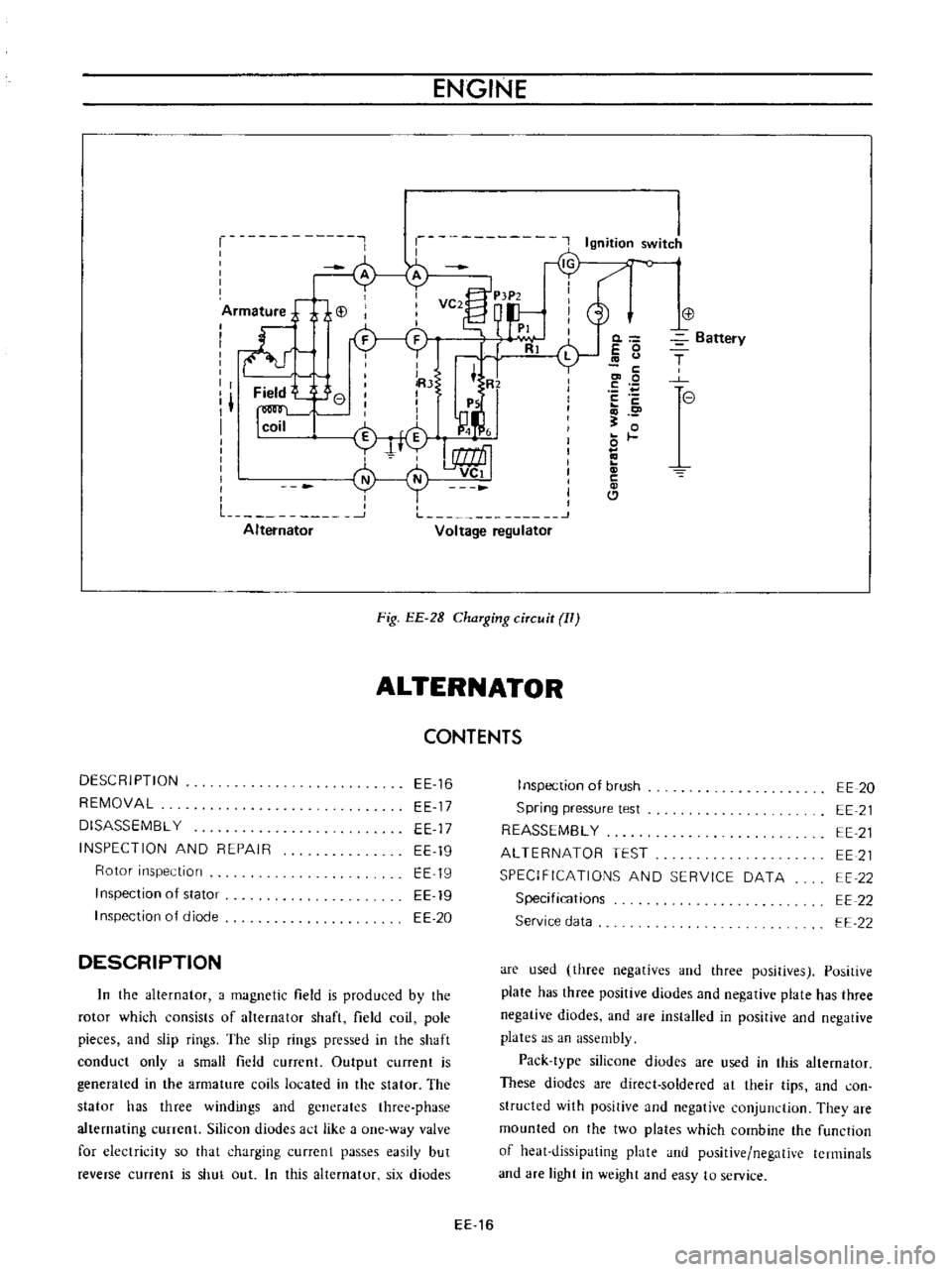
coil
VCI
as
shown
in
Figure
EE
28
by
the
dolled
line
arrow
marks
Then
the
coil
vc
I
is
excited
and
the
movable
contact
point
P5
comes
into
contact
with
voltage
winding
side
contact
point
P6
This
action
causes
to
turn
off
the
warning
lamp
and
complete
the
voltage
winding
circuit
as
shown
by
the
ullline
arrow
marks
When
the
alternator
speed
is
increased
or
the
voltage
starts
to
rise
excessively
the
movable
contact
point
P2
is
separated
from
the
primary
side
contact
P
1
by
the
magnetic
force
of
coil
V2
Therefore
register
RI
is
applied
into
the
field
circuit
and
output
voltage
is
decreased
As
the
outpu
t
voltage
is
decreased
the
movable
contact
point
P2
and
primary
side
contact
PI
comes
into
contact
once
again
and
the
alternator
voltage
increases
Thus
the
rapid
vibration
of
the
movable
contact
point
P2
maintains
an
alternator
output
voltage
to
constant
When
the
alternator
speed
is
further
increased
or
the
voltage
starts
to
rise
excessively
the
movable
contact
point
P2
comes
into
contact
with
secondary
side
contact
point
finally
Then
the
field
current
is
shut
off
and
alternator
output
voltage
is
decreased
immediately
This
action
causes
to
separate
movable
contact
P2
from
secondary
contact
P3
Thus
the
rapid
vibration
of
the
movable
contact
point
P2
or
breaking
and
completing
the
field
circuit
maintains
an
alternator
output
voltage
to
constant
j
T
SA
TIERY
I
l
e
7
Fig
EE
27
ChaTging
ciTcuit
1
EE
15
Page 436 of 513
ENGINE
r
Ignition
switJ
c
o
iArm
ture
j
i
i
VC2
P
tP2
d
I
I
I
PI
I
ll
Rl
L
I
I
lRJ
t
R
I
Field
e
I
I
I
I
Ps
I
1
I
I
n
I
coil
M
4
i
f
I
L
1
J
Alternator
Voltage
regulator
Fig
EE
2B
ChaTging
ciTcuit
II
ALTERNATOR
CONTENTS
DESCRIPTION
REMOVAL
DISASSEMBL
Y
INSPECTION
AND
REPAIR
Rotor
inspection
Inspection
of
stator
I
nspection
of
diode
EE
16
EE
17
EE
17
EE
19
EE
19
EE
19
EE
20
DESCRIPTION
In
the
alternator
a
magnetic
field
is
produced
by
the
rotor
which
consists
of
alternator
shaft
field
coil
pole
pieces
and
slip
rings
The
slip
rings
pressed
in
the
shaft
conduct
only
a
small
field
current
Output
current
is
generated
in
the
armature
coils
located
in
the
stator
The
stator
has
three
windings
and
generates
three
phase
alternating
currenl
Silicon
diudes
act
like
a
one
way
valve
for
electricity
so
that
charging
currcnt
passes
easily
but
reverse
current
is
shut
out
In
this
alternator
six
diodes
0
E
0
c
co
0
E
c
o
0
c
Cl
Battery
T
e
I
nspection
of
brush
Spring
pressure
test
REASSEMBL
Y
ALTERNATOR
TEST
SPECIFICATIONS
AND
SERVICE
DATA
Specifications
Service
data
EE
20
EE
21
EE
21
EE
21
EE
22
EE
22
EE
22
are
used
three
negatives
and
three
positives
Positive
plate
has
three
positive
diodes
and
negative
plate
has
three
negative
diodes
and
are
installed
in
positive
and
negative
plates
as
an
assembly
Pack
type
silicone
diodes
are
used
in
this
alternator
These
diodes
are
direct
soldered
at
their
tips
and
con
structed
with
positive
and
negative
conjunction
They
are
mounted
on
the
two
plates
which
combine
the
function
of
heat
dissipating
plate
and
positive
negative
terminals
and
are
light
in
weight
and
easy
to
service
EE
16
Page 446 of 513
ENGINE
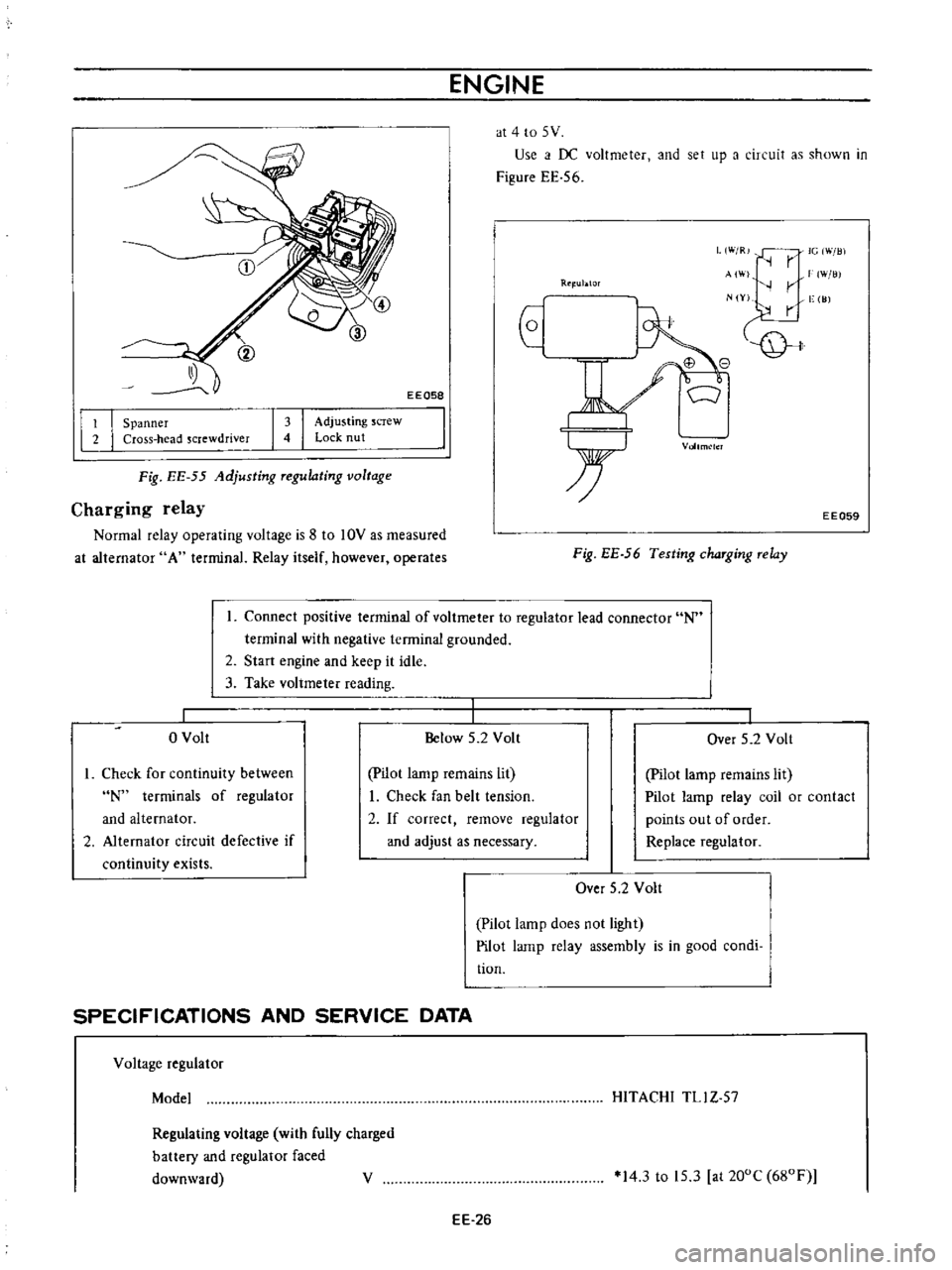
at
4
to
5
V
Use
i
f
DC
voltmeter
and
set
up
a
circuit
as
shown
in
Figure
EE
56
EEQ58
L
W
R
IG
Will
r
AI
W
lli
r
N
Y
vge
I
JJ
Rtl
ublOr
I
I
Spanner
Cross
head
screwdriver
I
I
Adjusting
screw
Lock
nut
Vollm
lcl
Fig
EE
55
Adjusting
Tegulating
voltage
Charging
relay
Normal
relay
operating
voltage
is
8
to
10V
as
measured
at
alternator
A
terminal
Relay
itself
however
operates
EE059
Fig
EE
56
Testing
chaTging
Telay
Connect
positive
terminal
of
voltmeter
to
regulator
lead
connector
N
terminal
with
negative
terminal
grounded
2
Start
engine
and
keep
it
idle
3
Take
voltmeter
reading
o
Volt
Below
5
2
Volt
I
Over
5
2
Volt
I
Check
for
continuity
between
N
terminals
of
regulator
and
alternator
2
Alternator
circuit
defective
if
continuity
exists
pilot
lamp
remains
lit
I
Check
fan
belt
tension
2
If
correct
remove
regulator
and
adjust
as
necessary
Pilot
lamp
remains
lit
Pilot
lamp
relay
coil
or
contact
points
out
of
order
Replace
regulator
Over
5
2
Volt
Pilot
lamp
does
not
light
Pilot
lamp
relay
assembly
is
in
good
condi
tion
SPECIFICATIONS
AND
SERVICE
DATA
Voltage
regulator
Model
HITACHI
TLl
Z
57
Regulating
voltage
with
fully
charged
battery
and
regulator
faced
downward
V
14
3
to
15
3
at
200C
680F
EE
26
Page 448 of 513
Low
output
Excessive
output
Regulator
Wiring
Alternator
Regula
tor
Wiring
Alternator
Regulatur
ENGINE
Faulty
voltage
regulator
point
con
tact
Broken
cable
or
disconnection
of
charging
cireui
t
Sticking
brushes
Low
brush
spring
tension
Dirty
slip
rings
Partially
shorted
ground
or
open
stator
coil
Partially
shorted
or
grounded
rotor
coil
Defective
diode
Loose
or
worn
fan
belt
Improper
voltage
regulator
adjust
ment
Faulty
voltage
regulator
point
con
tact
Defective
operation
Faulty
charging
circuit
lead
wire
connection
Loose
battery
terminal
Short
circuited
or
broken
neutral
wire
Improper
voltage
regulator
adjust
ment
Defective
operation
Improper
charge
relav
adjustment
detective
operation
and
or
faulty
point
contact
EE
28
Repair
or
replace
the
regulatur
Repair
or
replace
Correct
or
replace
brushes
if
neces
sary
Correct
or
replace
brush
Clean
Replace
the
stator
Replace
the
rotor
Replace
the
diode
assembly
Retighten
or
replace
the
belt
Check
the
voltage
regulator
op
eration
and
repair
or
replace
as
required
Repair
or
replace
the
regulator
Repair
or
replace
Retighten
Replace
the
wire
Check
the
voltage
regulator
op
eration
and
repair
or
replace
as
required
Check
the
charge
relay
operation
and
repair
or
replace
as
required