cooling DATSUN B110 1973 Service User Guide
[x] Cancel search | Manufacturer: DATSUN, Model Year: 1973, Model line: B110, Model: DATSUN B110 1973Pages: 513, PDF Size: 28.74 MB
Page 330 of 513
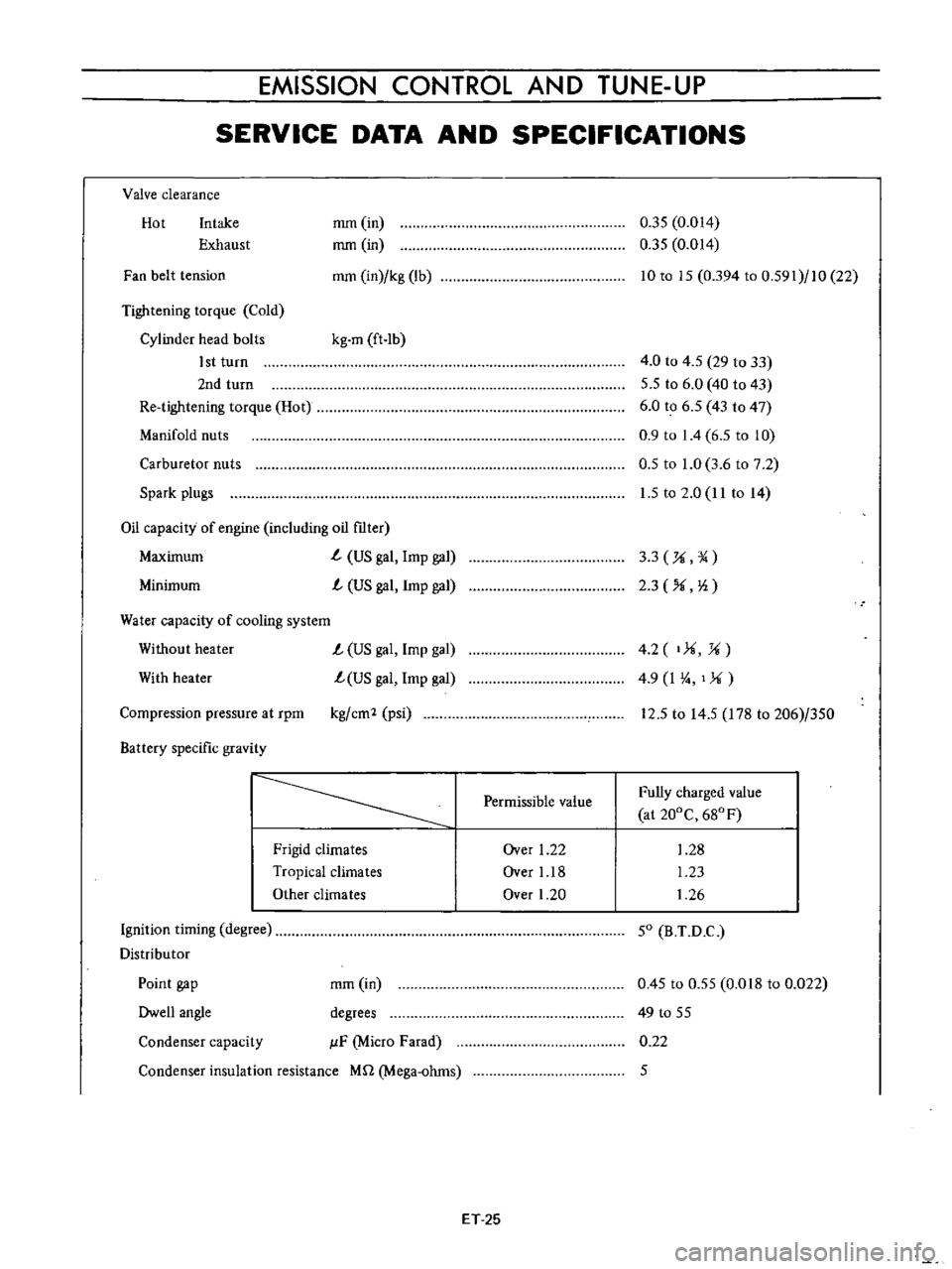
EMISSION
CONTROL
AND
TUNE
UP
SERVICE
DATA
AND
SPECIFICATIONS
Valve
clearance
Hot
Intake
Exhaust
mm
in
rom
in
rom
in
kg
lb
0
35
0
014
0
35
0
014
10
to
15
0
394
to
0
591
10
22
Fan
belt
tension
Tightening
torque
Cold
Cylinder
head
bolts
kg
m
ft
lb
1st
turn
2nd
turn
Re
tightening
torque
Hot
Manifold
nuts
Carburetor
nuts
4
0
to
4
5
29
to
33
5
5
to
6
0
40
to
43
6
0
to
6
5
43
to
47
0
9
to
I
4
6
5
to
10
0
5
to
1
0
3
6
to
7
2
1
5
to
2
0
II
to
14
Spark
plugs
Oil
capacity
of
engine
including
oil
ftIter
Maximum
L
US
gal
Imp
gal
L
US
gal
Imp
gal
3
3
U
14
2
3
Ii
Minimum
Water
capacity
of
cooling
system
Without
heater
L
US
gal
Imp
gal
With
heater
L
US
gal
Imp
gal
4
2
1
U
4
9
I
4
11
12
5
to
14
5
I78
to
206
350
Compression
pressure
at
rpm
kg
em
psi
Battery
specific
gravity
Permissible
value
Fully
charged
value
at
200C
680F
Frigid
climates
Tropical
climates
Other
elima
tes
Over
1
22
Over
1
18
Over
1
20
1
28
1
23
1
26
Ignition
timing
degree
Distributor
50
B
T
D
C
Condenser
capacity
mm
in
degrees
IlF
Micro
Farad
0
45
to
0
55
0
018
to
0
022
49
to
55
0
22
5
Point
gap
Dwell
angle
Condenser
insulation
resistance
Mil
Mega
ohms
ET
25
Page 335 of 513
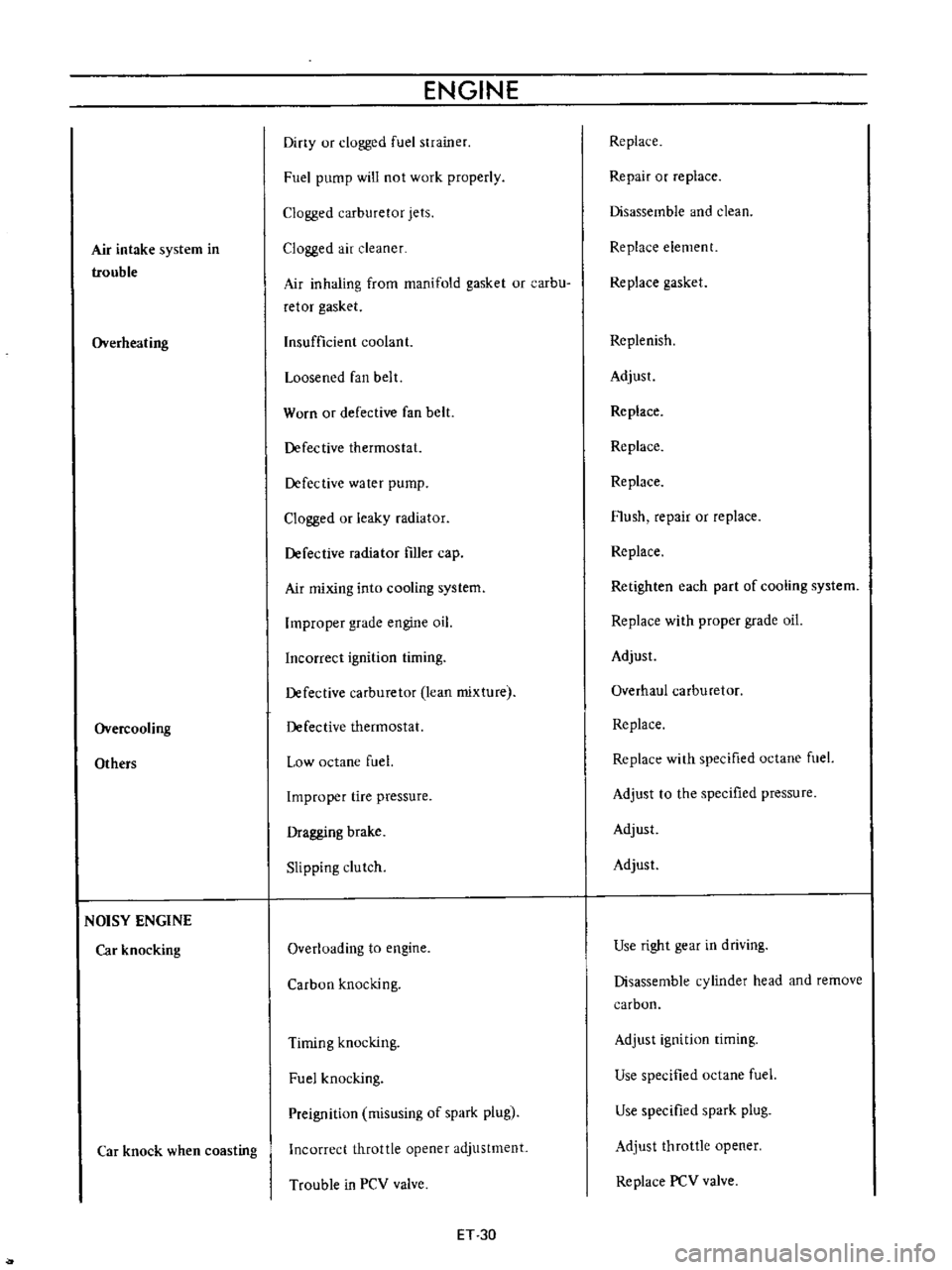
Air
intake
system
in
trouble
Overheating
Overcooling
Others
NOISY
ENGINE
Car
knocking
Car
knock
when
coasting
ENGINE
Diny
ur
clogged
fuel
strainer
Fuel
pump
will
not
work
properly
Clogged
carburetor
jets
Clogged
air
cleaner
Air
inhaling
from
manifold
gasket
or
carbu
retor
gasket
Insufficient
coolant
Loosened
fan
belt
Worn
or
defective
fan
belt
Defective
thermostat
Defective
water
pump
Clogged
or
leaky
radiator
Defective
radiator
filler
cap
Air
mixing
into
cooling
system
Improper
grade
engine
oil
Incorrect
ignition
timing
Defective
carburetor
lean
mixture
Defective
thermostat
Low
octane
fuel
Improper
tire
pressure
Dragging
brake
Slipping
clutch
Overloading
to
engine
Carbon
knocking
Timing
knocking
Fuel
knocking
Preignition
misusing
of
spark
plug
Incorrect
throttle
opener
adjustment
Trouble
in
PCV
valve
ET
30
Replace
Repair
or
replace
Disassemble
and
clean
Replace
element
Replace
gasket
Replenish
Adjust
Replace
Replace
Replace
Flush
repair
or
replace
Replace
Retighten
each
part
of
cooling
system
Replace
with
proper
grade
oil
Adjust
Overhaul
carburetor
Replace
Replace
with
specified
octane
fuel
Adjust
to
the
specified
pressure
Adjust
Adjust
Use
right
gear
in
driving
Disassemble
cylinder
head
and
remove
carbon
Adjust
ignition
timing
Use
specified
octane
fuel
Use
specified
spark
plug
Adjust
throttle
opener
Replace
PCV
valve
Page 342 of 513
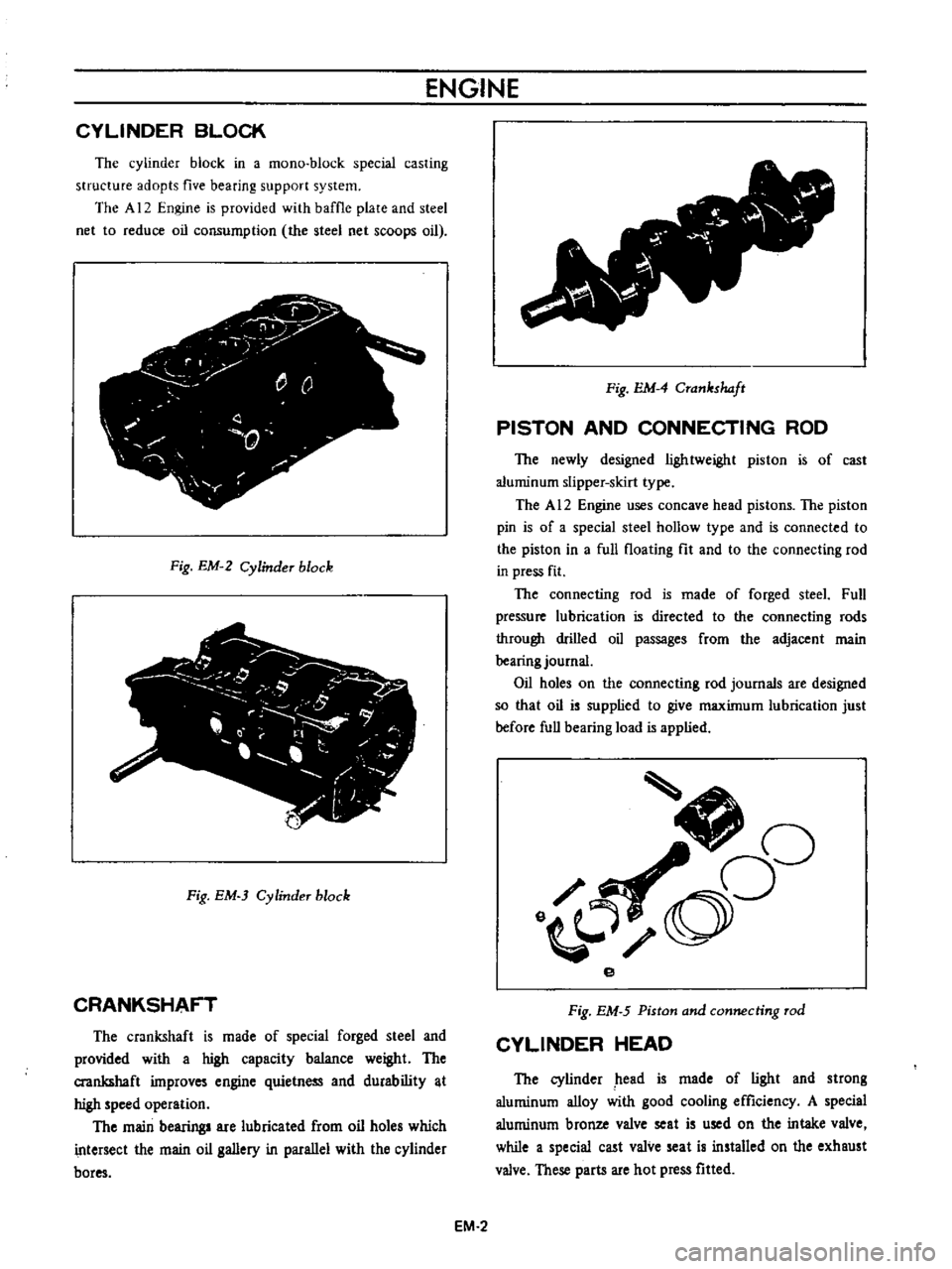
ENGINE
CYLINDER
BLOCK
The
cylinder
block
in
a
mono
block
special
casting
structure
adopts
five
bearing
support
system
The
A
12
Engine
is
provided
with
baffle
plate
and
steel
net
to
reduce
oil
consumption
the
steel
net
scoops
oil
j
y
r
0
Q
0
T
Fig
EM
2
Cylinder
block
Fig
EM
3
Cylinder
block
CRANKSHAFT
The
crankshaft
is
made
of
special
forged
steel
and
provided
with
a
high
capacity
balance
weight
The
crankshaft
improves
engine
quietness
and
durability
t
high
speed
operation
The
main
bearing
are
lubricated
from
oil
holes
which
intersect
the
main
oil
gallery
in
parallel
with
the
cylinder
bores
v
Fig
EM
4
Crankshaft
PISTON
AND
CONNECTING
ROD
The
newly
designed
lightweight
piston
is
of
cast
aluminum
slipper
skirt
type
The
A
12
Engine
uses
concave
head
pistons
The
piston
pin
is
of
a
special
steel
hollow
type
and
is
connected
to
the
piston
in
a
full
floating
fit
and
to
the
connecting
rod
in
press
fit
The
connecting
rod
is
made
of
forged
steeL
Full
pressure
lubrication
is
directed
to
the
connecting
rods
through
drilled
oil
passages
from
the
adjacent
main
bearing
journal
Oil
holes
on
the
connecting
rod
journals
are
designed
so
that
oil
is
supplied
to
give
maximum
lubrication
just
before
full
bearing
load
is
applied
J
oO
o
e
Fig
EM
5
Piston
and
connecting
rod
CYLINDER
HEAD
The
cylinder
head
is
made
of
light
and
strong
aluminum
alloy
with
good
cooling
efficiency
A
special
aluminum
bronze
valve
seat
is
used
on
the
intake
valve
while
a
special
cast
valve
seat
is
installed
on
the
exhaust
valve
These
parts
are
hot
press
fitted
EM
2
Page 386 of 513
r
r
J
j
r
I
1
Bi
l
it
1
J
f
J
f
f
r
c
i
I
i
f
4
Y
fj
r
i
SER
V
E
o
r
irJ
fl
i
rt
r
f
c
V
A
M
I
I
U
I
L
WI
F
or
i
7
v
I
1II
i
r
JIt
l
W
1
pI
r
r
1
r
0
j
j
j
t
r
7
f
of
JI
p
Xjlf
ii
i
t
oI
c
J
SECTION
CO
DATSUN
1200
MODEL
8110
SERIES
COOLING
SYSTEM
LNISSAN
I
NI55AN
MOTOR
CO
LTD
TOKYO
JAPAN
COOLING
SYSTEM
co
1
Page 387 of 513
COOLING
SYSTEM
COOLING
SYSTEM
CONTENTS
DESCRIPTION
WATER
PUMP
Removal
THERMOSTAT
Removal
Inspection
CO
1
CO
2
CO
2
CO
2
CO
2
CO
2
DESCRIPTION
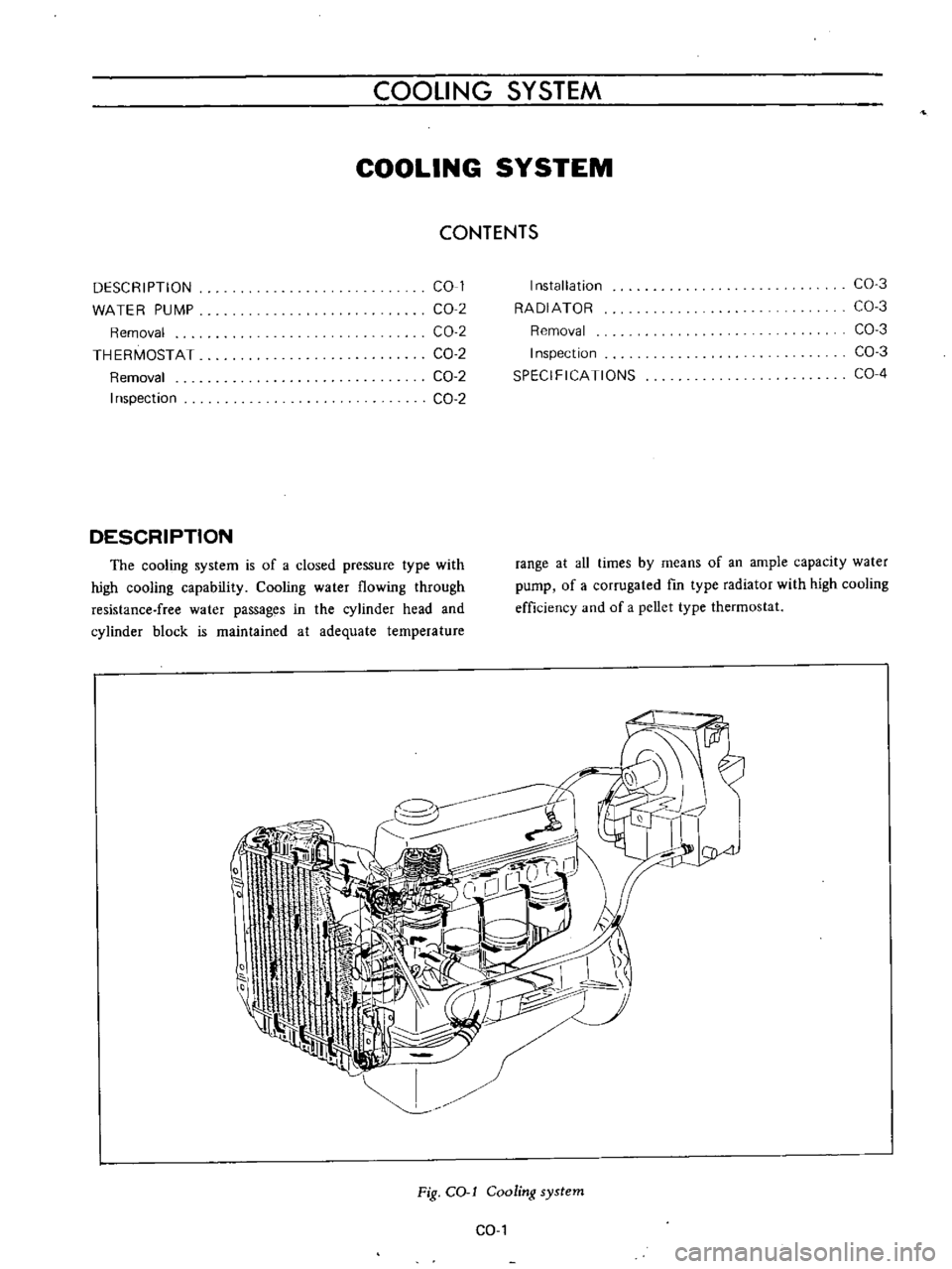
The
cooling
system
is
of
a
closed
pressure
type
with
high
cooling
capability
Cooling
water
flowing
through
resistance
free
water
passages
in
the
cylinder
head
and
cylinder
block
is
maintained
at
adequate
temperature
Installation
RADIATOR
Removal
Inspection
SPECIFICATIONS
CO
3
CO
3
CO
3
CO
3
CO
4
range
at
aU
times
by
means
of
an
ample
capacity
water
pump
of
a
corrugated
fm
type
radiator
with
high
cooling
efficiency
and
of
a
pellet
type
thermostat
I
I
I
0
Jrl
oA
Fig
COol
Cooling
system
CO
I
Page 388 of 513
ENGINE
WATER
PUMP
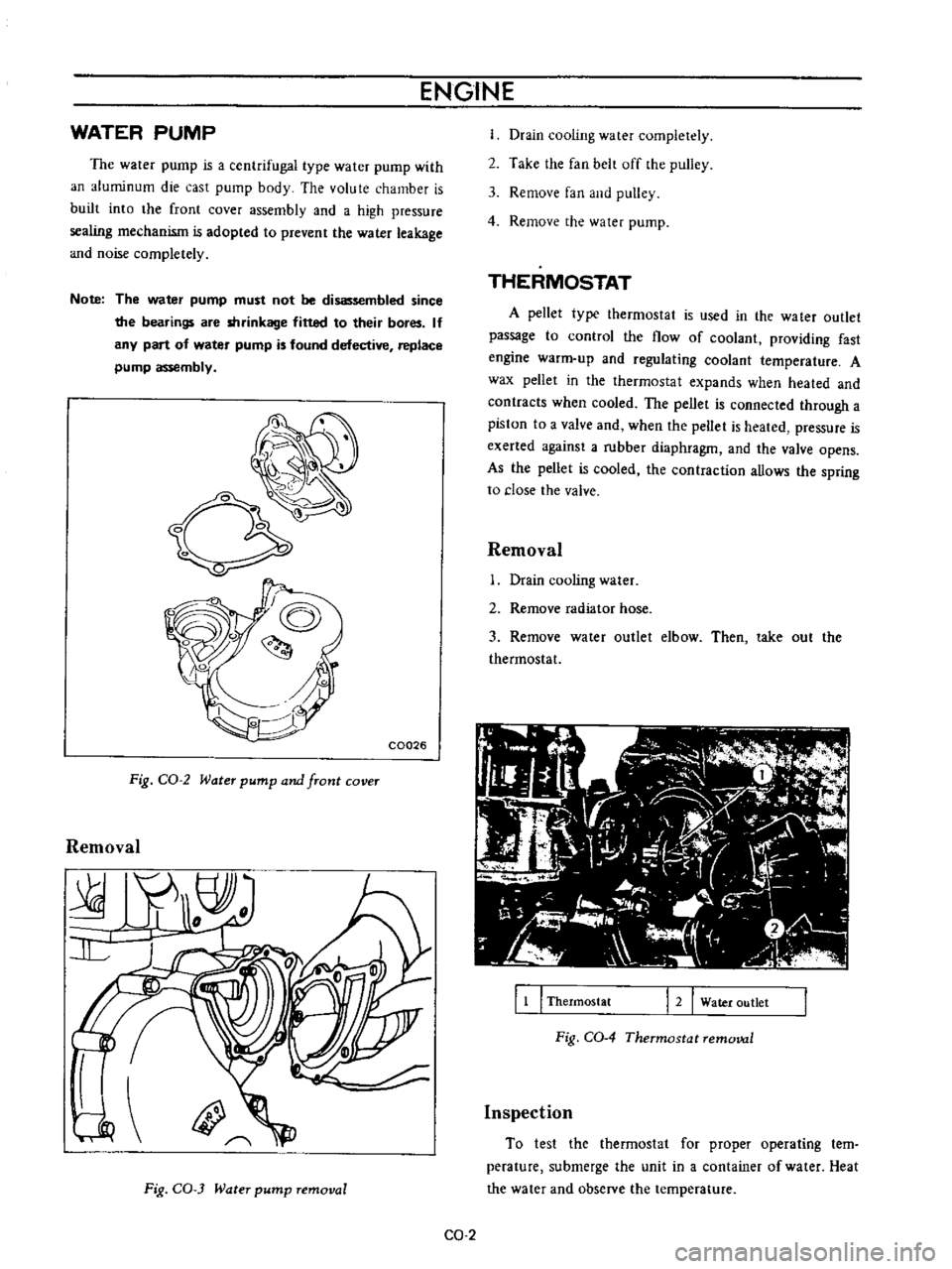
The
water
pump
is
a
centrifugal
type
water
pump
with
an
aluminum
die
cast
pump
body
The
volute
chamber
is
built
into
the
front
cover
assembly
and
a
high
pressure
sealing
mechanism
is
adopted
to
prevent
the
water
leakage
and
noise
completely
Note
The
water
pump
must
not
be
disassembled
since
the
bearings
are
shrinkage
fitted
to
their
bores
If
any
part
of
water
pump
is
found
defective
replace
pump
assembly
o
C0026
Fig
CO
2
Water
pump
and
front
cover
Removal
Fig
CO
3
Water
pump
removal
Drain
cooling
water
completely
2
Take
the
fan
belt
off
the
pulley
3
Remove
fan
and
pulley
4
Remove
the
water
pump
THERMOSTAT
A
pellet
type
thermostat
is
used
in
the
wa
ter
outlet
passage
to
control
the
flow
of
coolant
providing
fast
engine
warm
up
and
regulating
coolant
temperature
A
wax
pellet
in
the
thermostat
expands
when
heated
and
contracts
when
cooled
The
pellet
is
connected
through
a
piston
to
a
valve
and
when
the
peUet
is
heated
pressure
is
exerted
against
a
rubber
diaphragm
and
the
valve
opens
As
the
pellet
is
cooled
the
contraction
allows
the
spring
to
close
the
valve
Removal
Drain
cooling
water
2
Remove
radiator
hose
3
Remove
water
outlet
elbow
Then
take
out
the
thermostat
11
I
Thermostat
12
Water
outlet
Fig
CO
4
Thermostat
removal
Inspection
To
test
the
thermostat
for
proper
operating
tern
perature
submerge
the
unit
in
a
container
of
water
Heat
the
water
and
observe
the
temperature
CO
2
Page 389 of 513
COOLING
SYSTEM
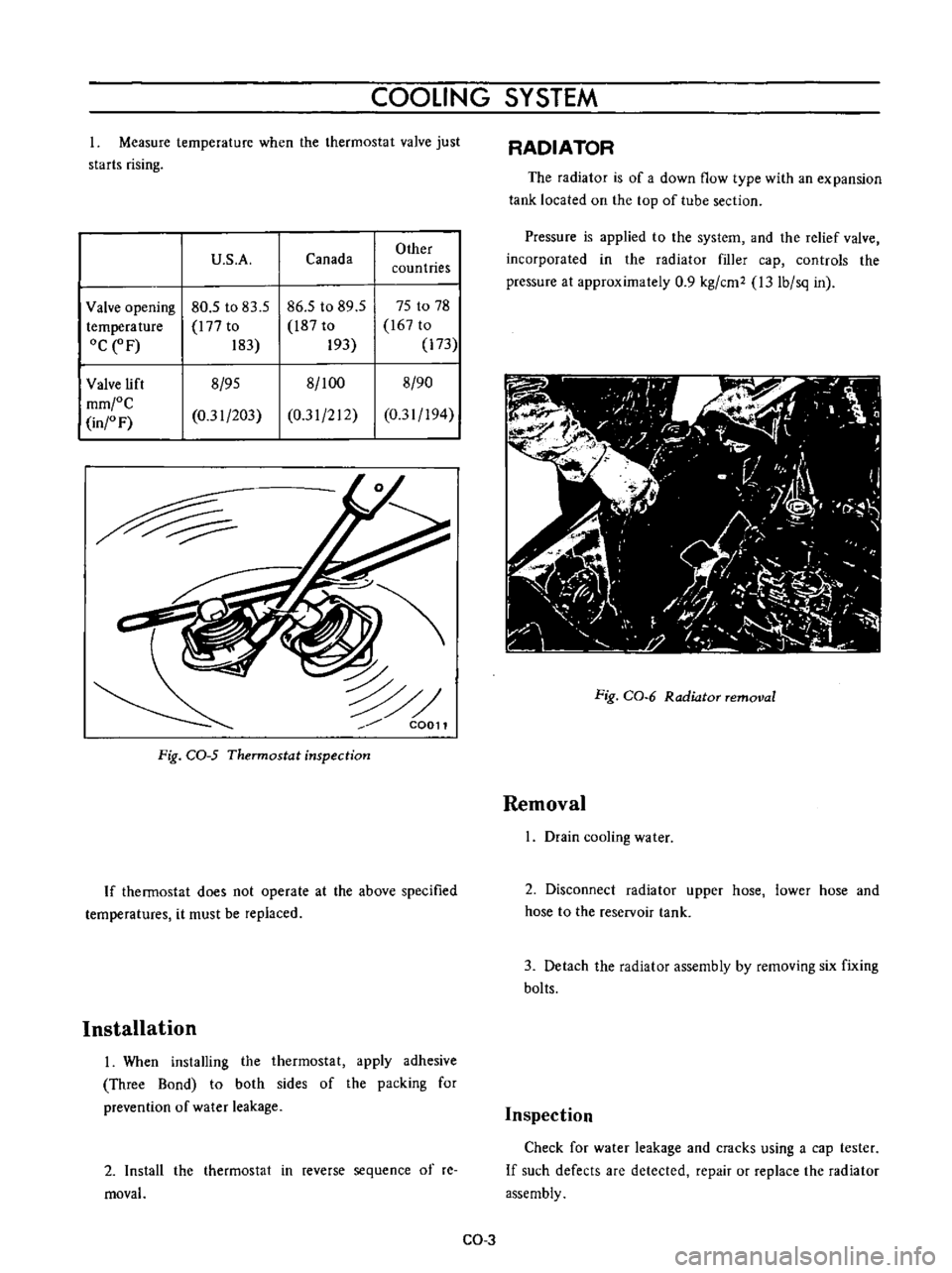
Measure
temperature
when
the
thermostat
valve
just
starts
rising
U
S
A
Canada
Other
countries
Valve
opening
80
5
to
83
5
86
5
to
89
5
75
to
78
temperature
l77
to
l87
to
167
to
OCeF
183
193
173
Valve
lift
8
95
8
100
8
90
mm
C
0
31
203
0
31
212
0
31
194
in
F
C0011
Fig
CQ
5
Thermostat
inspection
If
thermostat
does
not
operate
at
the
above
specified
temperatures
it
must
be
replaced
Installation
I
When
installing
the
thermostat
apply
adhesive
Three
Bond
to
both
sides
of
the
packing
for
prevention
of
water
leakage
2
Install
the
thermostat
in
reverse
sequence
of
re
moval
RADIATOR
The
radiator
is
of
a
down
flow
type
with
an
expansion
tank
located
on
the
top
of
tube
section
Pressure
is
applied
to
the
system
and
the
relief
valve
incorporated
in
the
radiator
filler
cap
controls
the
pressure
at
approximately
0
9
kg
cm2
l3
Ib
sq
in
Fig
CO
6
Radiator
removal
Removal
I
Drain
cooling
water
2
Disconnect
radiator
upper
hose
lower
hose
and
hose
to
the
reservoir
tank
3
Detach
the
radiator
assembly
by
removing
six
fixing
bolts
Inspection
Check
for
water
leakage
and
cracks
using
a
cap
tester
If
such
defects
are
detected
repair
or
replace
the
radiator
assembly
CO
3